Economics Today, 19e (Miller)
Chapter 26 Oligopoly and Strategic Behavior
26.1 Oligopoly
1) Which of the following does NOT help explain why oligopolies exist?
A) economies of scale
B) mergers
C) product homogeneity
D) barriers to entry
2) Which of the following is a characteristic of oligopoly?
A) easy entry and exit
B) many firms
C) strategic dependence
D) horizontal market demand curve
3) A merger between firms that are in the same industry is called a
A) conglomerate merger.
B) horizontal merger.
C) vertical merger.
D) none of the above.
4) A merger between firms in which one firm purchases an input from the other is called a
A) conglomerate merger.
B) horizontal merger.
C) vertical merger.
D) none of the above.
5) The measurement of industry concentration which calculates the percentage of all sales
contributed by a specific number of leading firms is called the
A) Herfindahl-Hirschman Index.
B) concentration ratio.
C) producer price index.
D) payoff matrix.
6) Strategic behavior and game theory are features of which market structure?
A) perfect competition
B) monopoly
C) monopolistic competition
D) oligopoly
7) In oligopoly, any action by one firm to change price, output, or quality causes
A) a reaction by other firms.
B) no reaction from the other firms.
C) a profit gain for the other firms.
D) loss of market share by the acting firm.
8) Which of the following is NOT a characteristic of oligopoly firms?
A) strategic dependence
B) product differentiation
C) non-price competition, such as advertising and promotions
D) perfectly elastic demand curves
9) Which one of the following industries is best classified as an oligopoly?
A) textbook publishers
B) retailing
C) wheat farms in the United States
D) fast food restaurants
10) Which of the following is most likely to be sold in an oligopoly market?
A) pizza
B) wireless service
C) electricity
D) cotton
11) Which of the following is NOT a necessary condition for oligopoly?
A) barriers to entry
B) strategic dependence of firms
C) differentiated products
D) either a small number of firms or market dominance by a small number of firms
12) Managers in oligopoly firms must
A) eliminate any barriers to entry if they hope to make short-run profits.
B) advertise heavily in order to differentiate their product.
C) anticipate the reaction of rival firms.
D) establish many varieties of their products to cover the spectrum of consumer tastes.
13) In an oligopolistic market, each firm
A) has a constant marginal cost.
B) faces a perfectly elastic demand function.
C) must consider the reaction of rival firms when making a pricing or output decision.
D) produces at minimum average cost in the long run.
14) An oligopoly is a market situation in which
A) there are many firms producing differentiated products.
B) there is a single firm producing several varieties of a product.
C) all the sellers act independently of the others.
D) there are very few sellers and they recognize their strategic dependence on one another.
15) Which of the following is NOT a common characteristic of oligopoly?
A) strategic dependence among firms in the industry
B) product differentiation
C) barriers to entry
D) marginal cost pricing.
16) If a firm is an oligopolist, which is NOT true?
A) It must pay attention to other firms’ prices.
B) It is one of a relatively small number of firms dominating its industry.
C) It can sell all the units it wants at the going market price.
D) It is engaged in a strategic game.
17) The most common reason for the existence of oligopolies is
A) ease of entry.
B) economies of scale.
C) product homogeneity
D) advertising.
18) Monopolies and oligopolies both erect barriers to entry through the use of
A) price cutting.
B) patents.
C) franchising.
D) advertising.
19) Oligopolies can result from any of the following EXCEPT
A) economies of scale.
B) vertical mergers.
C) government regulation.
D) diseconomies of scale.
20) When U.S. Steel, a steel producer, bought control of iron ore companies at the beginning of
the 20th century, the company was initiating
A) a horizontal merger.
B) a vertical merger.
C) a cartel.
D) an expropriation.
21) If Verizon Wireless and T-mobile, another wireless service company, were to merge, this
would represent
A) a vertical merger.
B) a horizontal merger.
C) a cartel.
D) an up-and-down merger.
22) Which of the following combinations would constitute a vertical merger?
A) General Motors and Bridgestone Tire Company
B) General Motors and Ford Motor Company
C) Dell and Apple computer companies
D) Yahoo! and Google Internet search engine companies
23) In general, horizontal mergers will
A) increase the number of firms in an industry.
B) decrease the number of firms in an industry.
C) increase competition in an industry.
D) reduce economic profits in an industry.
24) The combining of First Union National Bank and The National Bank of Memphis is an
example of
A) a vertical merger.
B) a horizontal merger.
C) a downstream formation.
D) a conglomerate merger.
25) The joining of firms that are producing or selling a similar product is
A) a conglomerate merger.
B) a horizontal merger.
C) a vertical merger.
D) a cross or diagonal merger.
26) If Apple, a company that produces smartphones, purchases a company that specializes in
developing phone apps, we would have an example of
A) a horizontal merger.
B) a vertical merger.
C) a monopoly.
D) excessive product differentiation.
27) A horizontal merger involves
A) the joining of two firms at different stages of the production process.
B) the separation of management from ownership.
C) the joining of two firms selling similar products.
D) the exchange of debt for stock.
28) How do economies of scale contribute to the development of an oligopoly?
A) Economies of scale make it legally difficult for new firms to enter.
B) Economies of scale make small-scale producers inefficient.
C) Economies of scale are based on control of a key resource, without which other firms cannot
enter an industry.
D) Economies of scale are guaranteed when a patent is granted.
Four-Firm Concentration Ratios
29) The most competitive industry of those presented in the above table is likely to be industry
A) W.
B) X.
C) Y.
D) Z.
30) The most oligopolistic industry of those presented in the above table is likely to be industry
A) W.
B) X.
C) Y.
D) Z.
31) Suppose an industry has total sales of $25 million per year. The two largest firms have sales
of $6 million each, the third largest firm has sales of $2 million, and the fourth largest firm has
sales of $1 million. The four-firm concentration ratio for this industry is
A) 36 percent.
B) 60 percent.
C) 50 percent.
D) 25 percent.
32) Suppose a ten firm industry has total sales of $35 million per year. The largest firm have
sales of $10 million, the third largest firm has sales of $4 million, and the fourth largest firm has
sales of $2 million. If fifth through tenth largest firms combined have annual sales of $12
million, the four-firm concentration ratio for this industry is
A) 45.7 percent.
B) 80 percent.
C) 65.7 percent.
D) none of the above.
33) Suppose a ten firm industry has total sales of $35 million per year. The largest firm have
sales of $10 million, the third largest firm has sales of $4 million, and the fourth largest firm has
sales of $2 million. If the rest of the industry has annual sales of $12 million, the second largest
firm has sales of
A) $8 million.
B) $7 million.
C) $4 million.
D) none of the above.
34) Suppose that an industry consists of 10 firms, and the top 4 firms have annual sales of $2.5
million, $2 million, $1.5 million, and $1 million, respectively. If the entire industry has annual
sales of $10 million, the four-firm concentration ratio is
A) 85 percent.
B) 50 percent.
C) 10 percent.
D) 70 percent.
35) The industry concentration ratio measures the
A) value of the assets owned by the largest corporations in the market.
B) percentage of industry sales accounted for by the top four or eight firms.
C) difference between price and marginal cost for the largest firms in the industry.
D) degree of product differentiation in the market.
12
36) If industry sales are $1,000, and the top four firms have sales of $500, $200, $100, and $50,
respectively, what will be the four-firm concentration ratio?
A) 95 percent
B) 85 percent
C) 70 percent
D) 100 percent
37) As the definition of products narrows (i.e., becomes more specific), the concentration ratio
A) is not valid.
B) tends to decrease.
C) tends to increase.
D) does not change in any predictable manner.
38) A concentration ratio gives
A) the average size of the firms in an industry.
B) the total sales of four or eight of the mid-sized firms in the industry.
C) the percentage of all sales contributed by the four or eight largest firms in the industry.
D) the sales of the four largest firms in the industry divided by the sales of the eight largest firms
in the industry.
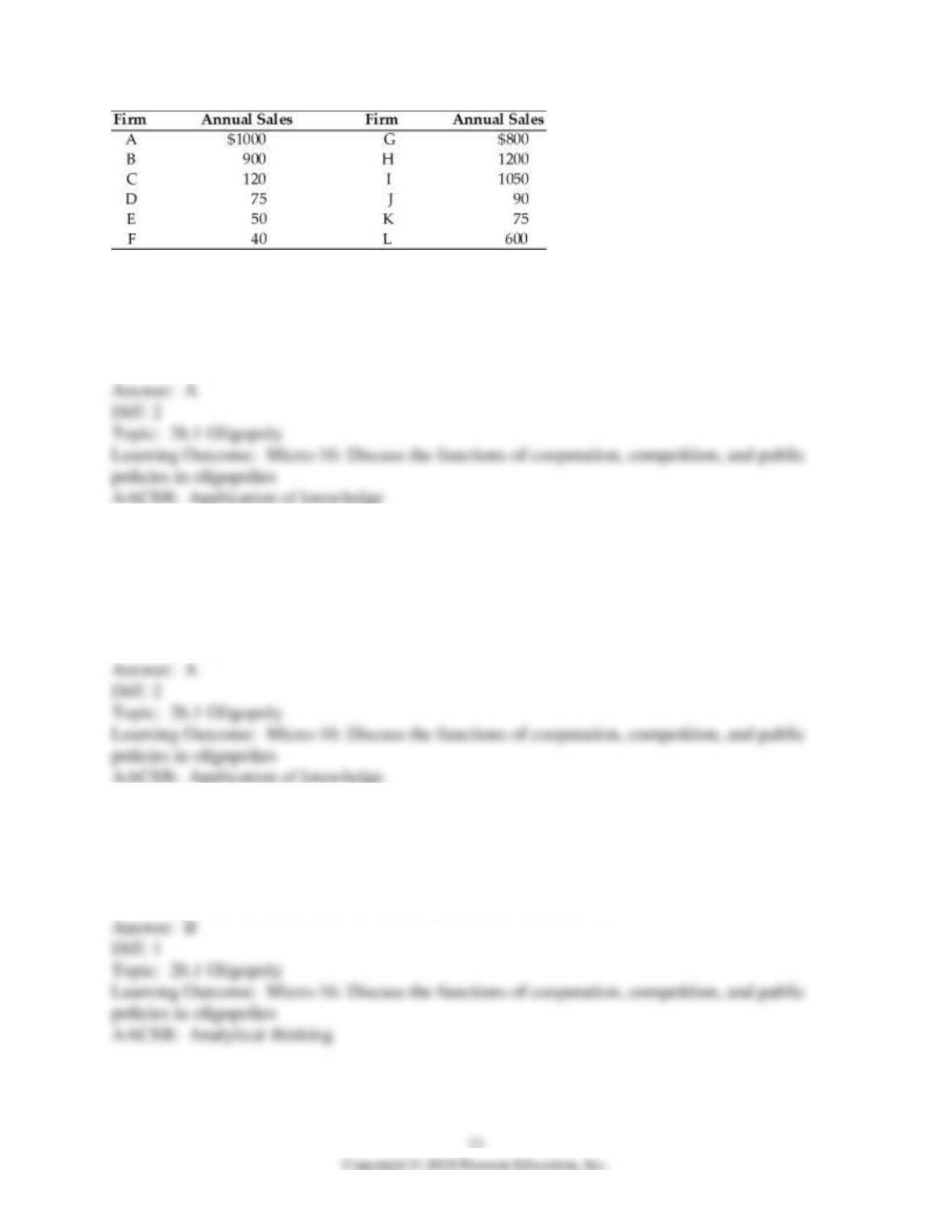
39) According to the above table, the four-firm concentration ratio of this industry is
A) 69.2 percent.
B) 35.1 percent.
C) 66.7 percent.
D) 67.5 percent.
40) According to the above table, if the fourth and fifth largest firms in the industry merge, the
four-firm concentration ratio in the industry will be
A) 82.5 percent.
B) 35.8 percent.
C) 69.0 percent.
D) 84.1 percent.
41) The Herfindahl-Hirschman index is measured by
A) adding the market shares of all firms in an industry.
B) adding the squares of the market shares of all firms in an industry.
C) squaring the sum of the market shares of the all firms in an industry.
D) adding the market shares of the four largest firms in an industry.
42) There are 30 firms in an industry. What happens to that industry’s four-firm concentration
when the third- and fourth-largest firms merge?
A) Nothing, because their shares are already included in the concentration calculation.
B) The industry’s concentration ratio will fall.
C) The industry’s concentration ratio will increase.
D) It is impossible to know without more information.
43) Over the past several decades, U.S. firms have faced more competition from overseas firms.
Does this have any impact on the market power of U.S. oligopoly firms?
A) no, because domestic firms in oligopoly markets are always so dominant that overseas
producers have little or no impact on those markets
B) no, because the United States government has effectively blocked all imports that might
compete with domestic firms in oligopoly industries
C) Yes, competition from overseas firms can substantially limit domestic firms’ market power.
D) There is no way to know.
44) Which of the following is a characteristic of oligopoly?
A) mutual firm independence
B) zero economic profits in the short run
C) marginal cost pricing
D) only a few firms in the industry
45) Oligopoly is a situation when there
A) is one firm in the industry that is large relative to the size of the economy.
B) are a few large firms in the industry.
C) are too many firms in the industry and there is excess capacity.
D) is one large firm and many smaller firms forming a competitive fringe.
46) Which of the following is TRUE of an oligopoly?
A) They engage in nonprice competition.
B) They do not react to actions of their competitors.
C) Each firm produces a small portion of the total output.
D) Firms do not care what their competitors do.
47) Which of the following is NOT true of an oligopoly?
A) They advertise their product.
B) The firms recognize their interdependence.
C) A few firm account for a large portion of the total output.
D) Firms are price takers.
48) When managers in oligopolistic firms make decisions that affect output or price, they must
A) also be sure they erect barriers to entry to prevent new entrants from affecting their plans.
B) anticipate the reactions of their rivals and plan accordingly.
C) register with the Antitrust Division of the Department of Justice.
D) inform the regulators of their industry about their plans.
49) A situation in which one firm’s actions with respect to price, quality, advertising and related
changes may be strategically countered by the reactions of one or more other firms in the
industry is known as
A) strategic dependence.
B) economies of scale.
C) the concentration ratio.
D) barriers to entry.
50) All of the following are reasons for an oligopoly to occur EXCEPT
A) economies to scale.
B) barriers to entry.
C) independence among firms.
D) merger.
51) The existence of economies of scale is one reason oligopolies exist because
A) a firm is able to increase price leading to increased profits.
B) the marginal cost decreases as output increases.
C) of strategic dependence.
D) as output increases average total cost decreases leading to large-scale firms.
52) Which of the following is NOT a reason why some industries are oligopolies?
A) economies of scale
B) barriers to entry
C) independence in pricing behavior
D) mergers
53) Horizontal merger occurs when
A) two firms merge where one had sold its output to the other as an input.
B) the merger moves the combined firm onto the horizontal portion of its long-run average cost
curve.
C) two firms merge where each is about the same size.
D) two firms producing a similar product merge.
54) Vertical merger occurs when
A) two firms merge where one had sold its output to the other as an input.
B) the merger moves the combined firm onto the horizontal portion of its long-run average cost
curve.
C) two firms merge where each is about the same size.
D) two firms producing a similar product merge.
55) James’ pretzel stand merges with a company that supplies the condiments to James. This is
an example of
A) conglomerate merger.
B) concentration ratio.
C) vertical merger.
D) horizontal merger.
56) Straight Cut beauty salon merges with Clean-Cut beauty salon. This is an example of
A) conglomerate merger.
B) concentration ratio.
C) vertical merger.
D) horizontal merger.
57) Which of the following is an example of a vertical merger?
A) Northwestern Idaho University merging with McDonald’s.
B) Northwestern Idaho University merging with a training academy for new professors.
C) Northwestern Idaho University merging with Roosevelt University.
D) Northwestern Idaho University going from a public to a private university.
58) Which of the following is an example of a horizontal merger?
A) Northeastern Illinois University merging with McDonald’s.
B) Northeastern Illinois University merging with a training academy for new professors.
C) Northeastern Illinois University merging with Roosevelt University.
D) Northeastern Illinois University going from a public to a private university.
59) The joining of firms that are producing or selling a similar product is known as
A) a conglomerate merger.
B) a horizontal merger.
C) a vertical merger.
D) economies to scale.
60) The joining of a firm with another to which it sells an output or from which it buys an input
is known as
A) a conglomerate merger.
B) a horizontal merger.
C) a vertical merger.
D) economies to scale.
61) All of the following can create an oligopolistic structure EXCEPT
A) low barriers to entry.
B) economies of scale.
C) government licensing rules.
D) mergers.
62) Suppose a cereal firm, Nabisco, merges with both a wheat firm and milling firm. This is an
example of a
A) vertical merger.
B) horizontal merger.
C) parallel merger.
D) diagonal merger.
63) A market structure characterized by a small number of interdependent sellers is called a(n)
A) monopoly.
B) monopolistic competition.
C) monopsony.
D) oligopoly.