64) If a retail food chain merged with a meat packing company, this would be an example of a
A) horizontal merger.
B) conglomerate merger.
C) vertical merger.
D) diagonal merger.
65) The recent merger of Southwest Bell (SBC) and AT&T companies is an example of a
A) horizontal merger.
B) vertical merger.
C) consolidation merger.
D) cooperative merger.
66) Which of the following is NOT a cause for an oligopoly to exist?
A) economies of scale
B) structural dependence
C) barriers to entry
D) horizontal mergers
67) Which of the following would be the best example of an oligopolistic industry?
A) agriculture
B) large aircraft manufacturing
C) the local water supply
D) retail convenience stores
68) There are fewer than half as many publishers of college textbooks in the United States now
as a generation ago. Three companies alone account for almost two-thirds of the sale of new
textbooks. This market situation characterized by very few sellers is known as
A) an oligopoly.
B) perfect competition.
C) pure monopoly.
D) monopolistic competition.
69) Between World War II and the 1970s, three firms—General Motors, Chrysler, and Ford—
produced and sold nearly all the output of the U.S. auto industry. These three firms had
A) an oligopoly.
B) monopolistic competition.
C) colluded.
D) a pure monopoly.
70) Which does NOT cause an industry that might otherwise be competitive to tend toward
oligopoly?
A) economies of scale
B) barriers to entry
C) mergers
D) strategic independence
71) The joining of firms that are producing or selling a similar product is
A) competition by merger.
B) a vertical merger.
C) a horizontal merger.
D) a hostile takeover.
72) If a company that drilled for and produced oil acquired a firm which refined oil into gasoline,
this would be referred to as a
A) horizontal merger.
B) vertical merger.
C) conglomerate merger.
D) reverse merger.
73) If Target were to merge with Wal-Mart, this would be referred to as a(n)
A) horizontal merger.
B) vertical merger.
C) conglomerate merger.
D) anti-competitive merger.
74) All of the following are characteristics of an oligopoly EXCEPT
A) diseconomies of scale over all ranges of output.
B) small number of firms.
C) high barriers to entry.
D) interdependence.
75) The situation of oligopoly suggests
A) many firms compete in an industry.
B) mergers have not occurred.
C) interdependence among firms.
D) no barriers to entry exist.
76) One of the strongest reasons that oligopolies exist is due to
A) the homogeneity of their products.
B) marginal cost pricing.
C) lowest cost production.
D) economies of scale.
77) Economies of scale means that
A) the average fixed cost curve slopes downward over its entire range.
B) the four-firm concentration ratio is below 80.
C) the long-run average total cost curve slopes downward over it entire range.
D) the long-run total cost curve slopes downward over it entire range.
78) The merger of two pizza restaurant chains would be an example of
A) a horizontal merger.
B) a vertical merger.
C) a conglomerate merger.
D) an independent merger.
79) A market situation in which there are a few large firms is called
A) monopolistic competition.
B) imperfect competition.
C) oligopoly.
D) monopoly.
80) Strategic dependence is found in
A) monopoly markets.
B) oligopolistic markets.
C) monopolistic competitive markets.
D) perfect competitive markets.
81) For Industry A, its 1-firm, 2-firm, 4-firm and 8-firm concentration ratios are the same. Based
on this, we can conclude that Industry A is
A) pure competition.
B) monopolistic competition.
C) oligopoly.
D) pure monopoly.
82) Industry A comprises only very few large firms engaged in stiff competition with each other.
Industry A can best be described as
A) pure competition.
B) monopolistic competition.
C) pure monopoly.
D) oligopoly.
83) Interdependence is the key characteristic of
A) perfect competition.
B) monopolistic competition.
C) oligopoly.
D) monopoly.
84) A market situation in which there are a few firms that recognize their mutual
interdependence is
A) monopolistic competition.
B) oligopoly.
C) monopoly.
D) regulated monopoly.
85) A market situation in which there are very few sellers is
A) oligopoly.
B) perfect competition.
C) monopoly.
D) monopolistic competition.
86) For which market structure do economists have the least precise model of price
determination?
A) perfect competition in the short run
B) perfect competition in the long run
C) oligopoly
D) monopoly
87) Product differentiation exists in
A) oligopolies only.
B) monopolies only.
C) monopolistic competition only.
D) all market structures except perfect competition.
88) What is oligopoly? How does oligopoly differ from the other kinds of market structure?
89) Distinguish between a horizontal merger and a vertical merger.
90) “Oligopoly is the only market structure in which rivalry among firms takes place.” Do you
agree or disagree? Why?
26.2 Measuring Industry Concentration
1) A concentration ratio measures
A) the average size of the firms in the industry.
B) the sales of the three largest firms in the industry minus the costs of these three largest firms
in the industry.
C) the share of industry sales accounted for by the largest firms in the industry.
D) the excess capacity found in a particular oligopolistic industry.
2) The percentage of all sales contributed by the leading firms in an industry is known as
A) the Herfindahl index.
B) the Hirschman index.
C) the zero sum.
D) the concentration ratio.
3) Which of the following statements about concentration ratios is correct?
A) A high concentration ratio indicates that the industry is a monopoly.
B) A high concentration ratio indicates that the industry is monopolistically competitive.
C) A high concentration ratio suggests that the industry is characterized by strategic
independence.
D) A high concentration ratio suggests that the industry is characterized by strategic dependence.
4) A concentration ratio is used to
A) determine whether a market structure is oligopoly.
B) determine the price level relative to firms’ marginal costs.
C) determine the degree of homogeneity in the market.
D) determine the absolute size of a market.
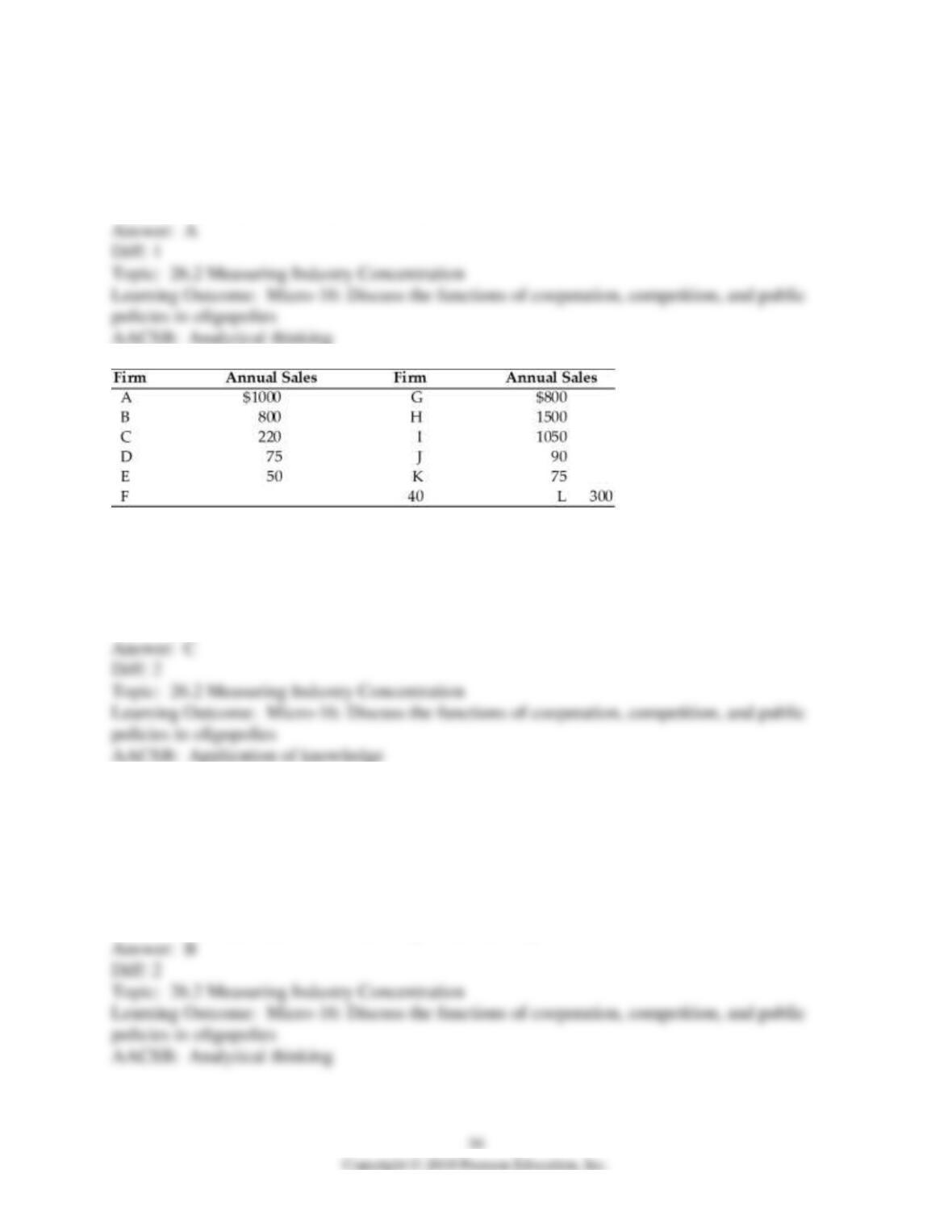
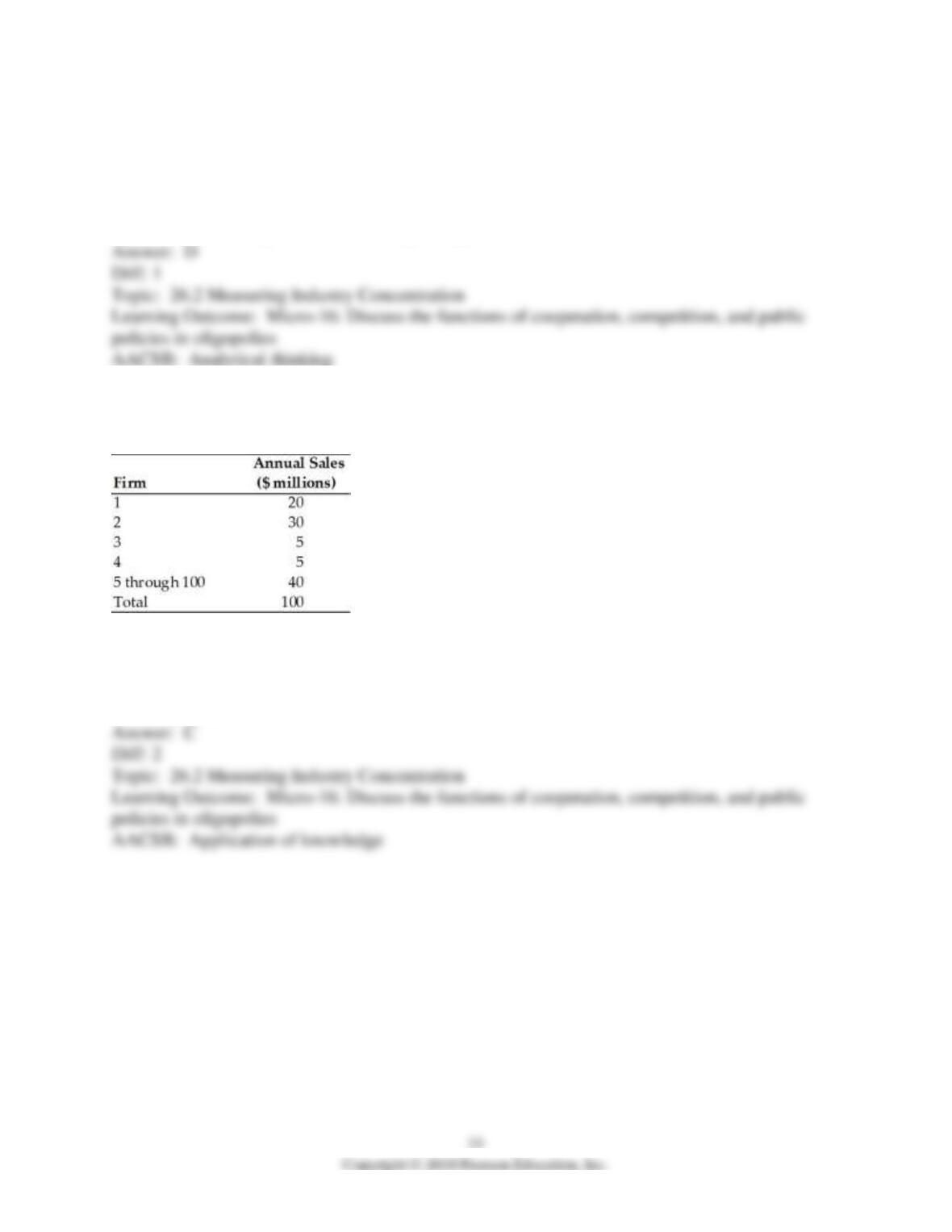
5) Refer to the above table. The four-firm concentration ratio is
A) 85.8 percent.
B) 75 percent.
C) 72.5 percent.
D) 59.2 percent.
6) Suppose that Industry X has two firms with equal market shares, and Industry Y has three
firms with 65 percent, 30 percent, and 5 percent market shares, respectively. Which of the
following is TRUE?
A) The HHI for Industry X is 50 higher than the HHI for Industry Y.
B) The HHI for Industry X is 150 lower than the HHI for Industry Y.
C) The HHI for Industry X is 100 higher than the HHI for Industry Y.
D) The HHI is the same between Industry X and Industry Y.
7) In a 20-firm industry, two of the smallest firms merge. Yet the 4-firm concentration ratio and
the 8-firm concentration ratio did not change. All things considered, we can say that the industry
has
A) moved closer to pure competition because the number of firms decreased.
B) moved farther away from competition because the number of firms decreased.
C) experienced no change in competition even though the number of firms decreased.
D) to be identified first; otherwise there is no way to tell.
8) Refer to the above table. The four-firm concentration ratio is
A) 86.5 percent.
B) 33.3 percent.
C) 13.3 percent.
D) 11.6 percent.
9) The Herfindahl-Hirschman index is a measure of
A) the profit margin of an industry.
B) market size.
C) the degree of collusion among firms in a market.
D) the degree of concentration among firms in a market.
10) Suppose there are four firms in an industry. The market shares of the four firms are 5
percent, 20 percent, 35 percent, and 40 percent. The Herfindahl-Hirschman index for that
industry is
A) 6,650.
B) 3,250.
C) 1,250.
D) 100.
11) Which of the following has the highest Herfindahl-Hirschman index?
A) monopoly
B) monopolistic competition
C) oligopoly
D) any of the above, depending on the size of firm sales
12) Industry A has four firms. The largest firm in Industry A has more than 90 percent of the
market share. Industry B also has four firms, but each of those four firms in Industry B has 25
percent of the market share. The Herfindahl-Hirschman index will be
A) the same for both industries, but the four-firm concentration will be larger for Industry B than
Industry A.
B) the same for both industries, but the four-firm concentration will be larger for Industry A than
Industry B.
C) larger for Industry B than Industry A, but the four-firm concentration will be the same.
D) larger for Industry A than Industry B, but the four-firm concentration will be the same.
13) The market power of a firm refers to its ability to
A) erect entry barriers in the industry.
B) make a profit even when other firms in the industry are making losses.
C) control its own output level while keeping its price the same as the prices charged by other
firms.
D) affect the market price for its industry’s output.
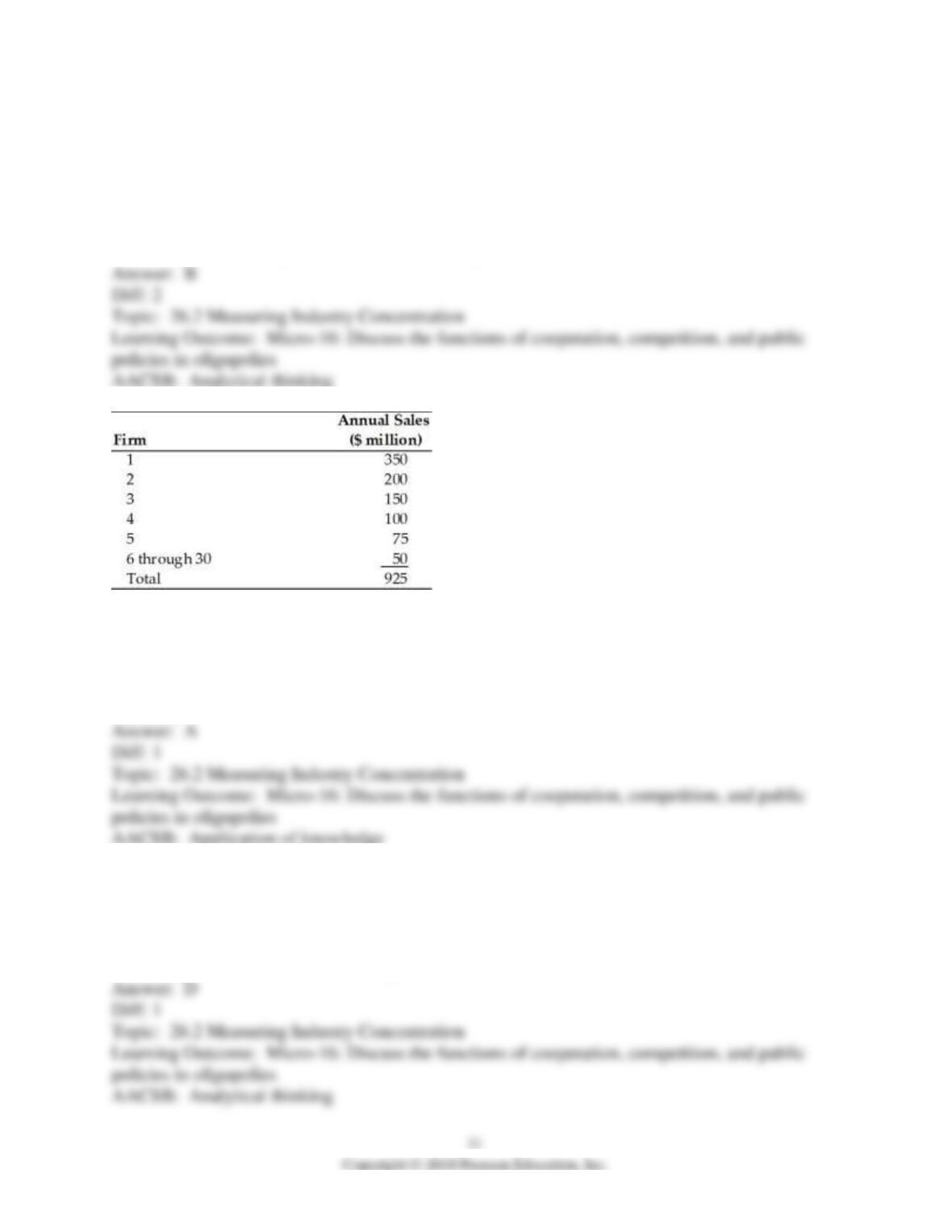
14) Based on the table below, the four-firm concentration ratio equals what percentage of annual
sales?
A) 33 percent
B) 40 percent
C) 60 percent
D) 100 percent
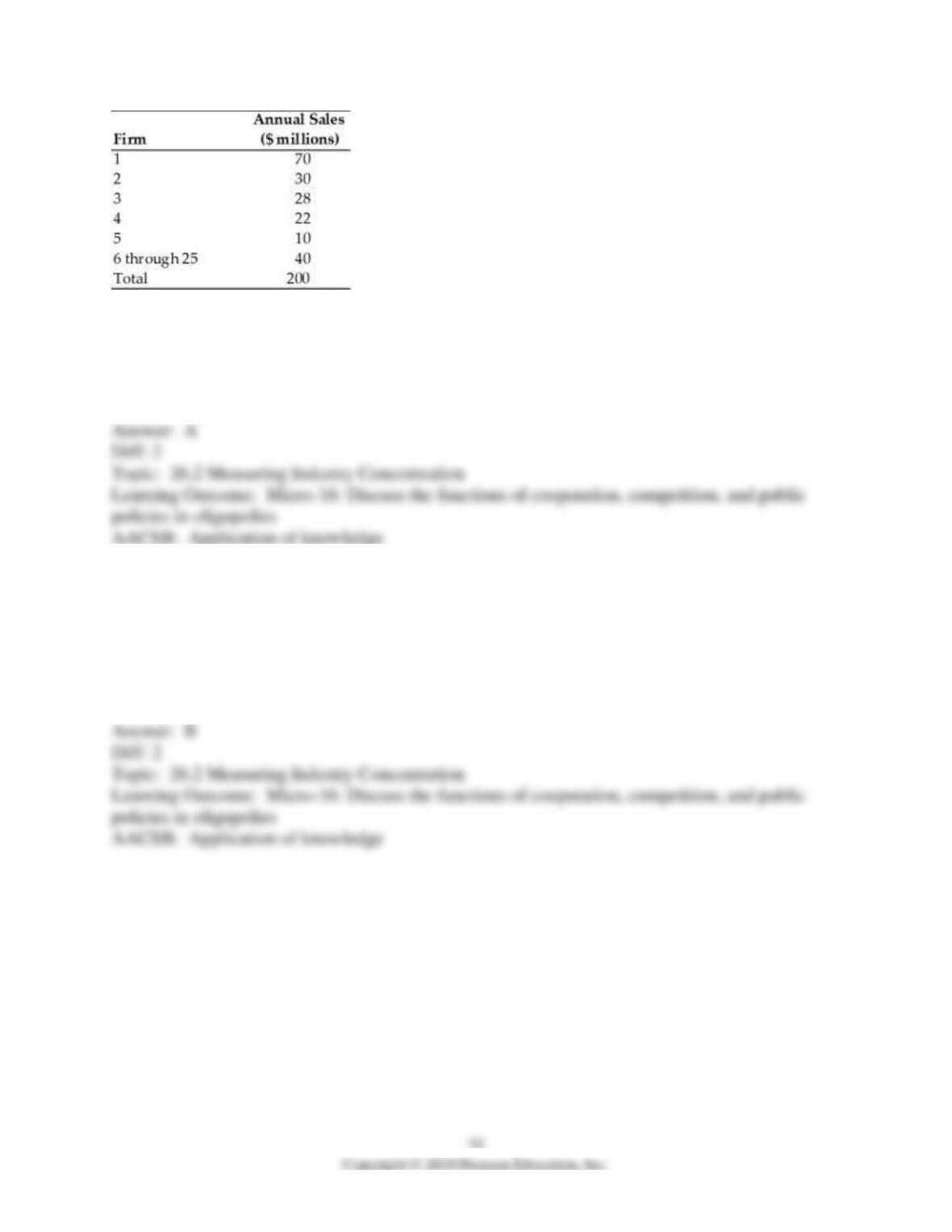
15) Use the above table. If firms 3 and 4 merge, the four-firm concentration ratio will
A) increase from 75 percent to 80 percent.
B) increase from 60 percent to 75 percent.
C) decrease from 75 percent to 60 percent.
D) not change.
16) If an industry has 25 firms that collectively have $150 million in total sales and the top four
firms in this industry account for $90 million in sales, what is the concentration ratio of the top
four firms in this industry?
A) 42 percent
B) 60 percent
C) 70 percent
D) 80 percent
17) If an industry has 25 firms that collectively have $150 million in total sales and the top three
firms in this industry account for $78 million in sales and the fifth through twenty-fifth firms
account for $60 million in sales, what is the amount of sales for the fourth largest firm?
A) $12 million
B) $6 million
C) $18 million
D) none of the above
18) Which of the following is likely among the most concentrated industries in the United
States?
A) printing and publishing
B) soft drinks
C) tobacco products
D) household vacuum cleaners
19) Which of the following is likely among the most concentrated industries in the United
States?
A) printing and publishing
B) breakfast cereals
C) primary aluminum
D) computers
20) The higher the concentration ratio is in an industry, the more likely it is that
A) the industry is perfectly competitive.
B) the market share of the smallest four firms is larger.
C) the market share of the largest four firms is smaller.
D) the industry has an oligopoly.
21) The number of firms in an oligopolistic industry
A) must be less than 10.
B) must be less than 20.
C) must be small enough that firms are interdependent.
D) must be large enough for firms to be independent.
22) The outputs of an oligopolistic industry
A) can be homogeneous or differentiated.
B) must be at high levels so that price exceeds average total cost.
C) always have excise taxes imposed on them.
D) have no substitutes on the market.
23) Oligopolistic industries are characterized by a
A) few large firms and no barriers to entry.
B) large number of firms and no barriers to entry.
C) few large firms and substantial barriers to entry.
D) large number of firms and substantial barriers to entry.
24) Economies of scale
A) do not arise in oligopolistic industries.
B) can exist but are rare in oligopolistic industries.
C) can exist but fail to create barriers to entry in oligopolistic industries.
D) are commonplace and often a barrier to entry in oligopolistic industries.
25) Suppose an industry consists of 20 firms. Each firm’s share of total sales in the industry is 5
percent. If two of the firms merge, then the four-firm concentration ratio in the industry will
A) remain unchanged.
B) decrease as there are fewer firms in the industry.
C) increase.
D) depend on the market condition faced by the industry.
26) Suppose an industry is composed of 10 firms. Each firm’s share of total sales in the industry
is 10 percent. If two of the firms merge, then the four-firm concentration ratio in the industry is
A) 40 percent.
B) 45 percent.
C) 50 percent.
D) unable to determine.
27) If the four-firm concentration ratio for an industry is 84 percent, then
A) each of the firms account for 21 percent of total sales.
B) the four largest firms in the industry account for 16 percent of the total sales.
C) the four largest firms in the industry account for 84 percent of the total sales.
D) the remaining firms in the industry accounts for 84 percent of the total sales.
28) Using the concentration ratio to measure the degree of competition
A) may understate the degree of competition because it ignores imported goods.
B) may overstate the degree of competition because it ignores imported goods.
C) may overstate the degree of competition because inter-industry competition is ignored.
D) may understate the degree of competition because market share changes annually.
29) What is meant by the concentration of an industry? How is concentration measured? What
are likely causes of high concentration?
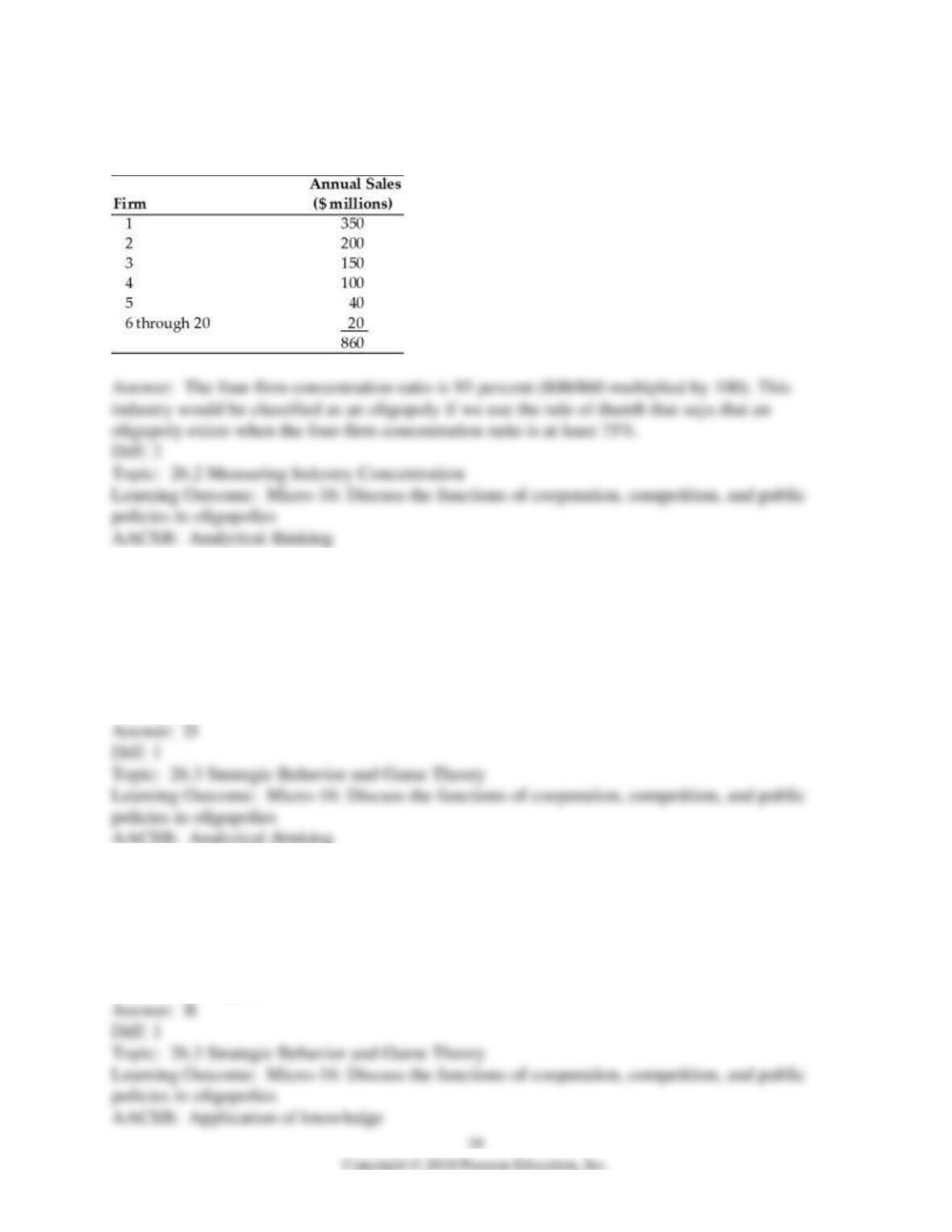
30) Using the information in the table, develop the four-firm concentration ratio. Would you
classify this industry as an oligopoly? Explain your answer.
26.3 Strategic Behavior and Game Theory
1) Game theory is used to explain the pricing behavior of
A) monopolies.
B) perfect competition.
C) monopolistic competition.
D) oligopolies.
2) Within a game theory model, if a change in decision-making raises corporation A’s profits by
$2 million and lowers corporation B’s profits by $2 million, the game is a
A) negative-sum game.
B) zero-sum game.
C) positive-sum game.
D) cooperative game.
3) Within a game theory model, if a change in decision-making raises corporation X’s profits by
$100 and lowers corporation Y’s profits by $50, the game is a
A) negative-sum game.
B) zero-sum game.
C) positive-sum game.
D) cooperative game.
4) Within a game theory model, if a change in decision-making raises corporation A’s profits by
$100 and lowers corporation B’s profits by $200, the game is a
A) negative-sum game.
B) zero-sum game.
C) positive-sum game.
D) cooperative game.
5) Game theory would classify a cartel under the topic of
A) zero-sum games.
B) cooperative games.
C) noncooperative games.
D) dominant-strategy games.