72. Which of the following is a transfer payment?
a.
Work-study students receive wages transferred from the university budget.
b.
A company pays the moving expenses for a transferred employee.
c.
A student transfers to another college and receives a tuition rebate.
d.
A student receives a tuition grant from the federal government.
Moderate
DISC: Aggregate demand and aggre – DISC: Aggregate demand and aggregate supply
United States – BPROG: Analytic
Aggregate demand and aggregate s – Aggregate demand and aggregate supply
The Circular Flow of Spending, Production, and Income
73. When saving leaks out of the circular flow of income and spending,
a.
total income necessarily falls.
b.
it leaks out of the financial system.
c.
it flows to borrowers.
d.
it increases the size of the spending flow.
c
Difficult
DISC: Aggregate demand and aggre – DISC: Aggregate demand and aggregate supply
United States – BPROG: Analytic
Aggregate demand and aggregate s – Aggregate demand and aggregate supply
The Circular Flow of Spending, Production, and Income
74. In the circular flow model, which of the following is an injection?
a.
investment spending
b.
government taxes
c.
total exports
d.
imports
a
Moderate
DISC: Aggregate demand and aggre – DISC: Aggregate demand and aggregate supply
United States – BPROG: Analytic
Aggregate demand and aggregate s – Aggregate demand and aggregate supply
The Circular Flow of Spending, Production, and Income
75. To get a complete measure of the total spending on U.S.-produced final goods and services, one must adjust aggregate
demand by
a.
adding imports and subtracting exports.
b.
adding imports that are purchased by U.S. consumers.
c.
adding exports and subtracting imports.
d.
subtracting exports sold to foreigners.
DISC: Aggregate demand and aggre – DISC: Aggregate demand and aggregate supply
United States – BPROG: Analytic
Aggregate demand and aggregate s – Aggregate demand and aggregate supply
The Circular Flow of Spending, Production, and Income
76. Imports are a leakage in the sense that
a.
the international financial system is unstable.
b.
consumers buy foreign output of goods and services.
c.
foreigners earn less than U.S. workers.
d.
a trade deficit increases aggregate demand.
DISC: Aggregate demand and aggre – DISC: Aggregate demand and aggregate supply
United States – BPROG: Analytic
Aggregate demand and aggregate s – Aggregate demand and aggregate supply
The Circular Flow of Spending, Production, and Income
77. The relationship between consumption and disposable income is such that as
a.
consumption rises, disposable income falls.
b.
disposable income rises, consumption rises.
c.
disposable income rises, consumption falls.
d.
disposable income rises, saving falls.
DISC: Aggregate demand and aggre – DISC: Aggregate demand and aggregate supply
United States – BPROG: Analytic
Aggregate demand and aggregate s – Aggregate demand and aggregate supply
Consumer Spending and Income: The Important Relationship
78. Historical data representing consumption and disposable income reveals that
a.
during the 1930s, U.S. saving was at a high level.
b.
U.S. citizens increased saving during World War II.
c.
there is no systematic relationship between the two.
d.
consumption rises faster than disposable income during recessions.
Moderate
DISC: Aggregate demand and aggre – DISC: Aggregate demand and aggregate supply
United States – BPROG: Analytic
Aggregate demand and aggregate s – Aggregate demand and aggregate supply
Consumer Spending and Income: The Important Relationship
79. If you produce a graph with consumption spending on the vertical axis and disposable income on the horizontal axis,
the relation between consumption and income will
a.
be inverse.
b.
be transcendental.
c.
shift unpredictably.
d.
be direct.
Moderate
DISC: Aggregate demand and aggre – DISC: Aggregate demand and aggregate supply
United States – BPROG: Reflective Thinking – BPROG: Analysis
Aggregate demand and aggregate s – Aggregate demand and aggregate supply
Consumer Spending and Income: The Important Relationship
80. On a graph with consumption on the vertical axis and disposable income on the horizontal axis, the slope of the line is
a.
greater than one.
b.
equal to one.
c.
less than one.
d.
undefined.
c
Difficult
DISC: Aggregate demand and aggre – DISC: Aggregate demand and aggregate supply
United States – BPROG: Reflective Thinking – BPROG: Analysis
Aggregate demand and aggregate s – Aggregate demand and aggregate supply
Consumer Spending and Income: The Important Relationship
81. The difference between disposable income and consumption spending is
a.
transfer payments.
b.
personal taxes.
c.
net exports.
d.
personal investment.
e.
personal saving.
e
Easy
DISC: Aggregate demand and aggre – DISC: Aggregate demand and aggregate supply
United States – BPROG: Analytic
Aggregate demand and aggregate s – Aggregate demand and aggregate supply
Consumer Spending and Income: The Important Relationship
82. Historical data depicted on a scatter diagram show that consumer spending and disposable income
a.
converge as income grows.
b.
generally move together.
c.
diverge as income grows.
d.
show no clear relationship.
DISC: Aggregate demand and aggre – DISC: Aggregate demand and aggregate supply
United States – BPROG: Analytic
Aggregate demand and aggregate s – Aggregate demand and aggregate supply
Consumer Spending and Income: The Important Relationship
83. The federal government’s principal tool in altering consumer spending is changing
a.
corporate income taxes.
b.
federal sales taxes.
c.
unemployment insurance benefits.
d.
personal income tax rates.
DISC: Aggregate demand and aggre – DISC: Aggregate demand and aggregate supply
United States – BPROG: Analytic
Aggregate demand and aggregate s – Aggregate demand and aggregate supply
Consumer Spending and Income: The Important Relationship
84. If real disposable income is $300 billion and real consumer expenditures are $250 billion, it can be assumed that
a.
the government is spending the difference.
b.
the difference is being invested.
c.
households are saving the difference.
d.
transfer payments make up the difference.
DISC: Aggregate demand and aggre – DISC: Aggregate demand and aggregate supply
United States – BPROG: Analytic
Aggregate demand and aggregate s – Aggregate demand and aggregate supply
Consumer Spending and Income: The Important Relationship
85. “Men are disposed, as a rule, and on the average, to increase their consumption as their income increases, but not by as
much as the increase in their incomes.” Which of the following is consistent with this statement by J.M. Keynes?
a.
The slope of the consumption function is positive and less than one.
b.
The slope of the consumption function is greater than that of the 45-degree line.
c.
The slope of the consumption function is negative.
d.
The slope of the consumption function is equal to one.
a
Difficult
DISC: Aggregate demand and aggre – DISC: Aggregate demand and aggregate supply
United States – BPROG: Reflective Thinking – BPROG: Analysis
Aggregate demand and aggregate s – Aggregate demand and aggregate supply
Consumer Spending and Income: The Important Relationship
86. If an economist wants to make a prediction about the effects of a change in disposable income on the change in
consumption spending based on historical data, she must assume that
a.
the future will closely resemble the past.
b.
consumption and disposable income will be negatively related.
c.
the consumption function will have a downward slope.
d.
as disposable income increases, consumer spending will remain constant.
a
Difficult
DISC: Aggregate demand and aggre – DISC: Aggregate demand and aggregate supply
United States – BPROG: Reflective Thinking – BPROG: Analysis
Aggregate demand and aggregate s – Aggregate demand and aggregate supply
Consumer Spending and Income: The Important Relationship
87. The slope of the scatter diagram representing the relationship between consumption and disposable income in the
United States is approximately
a.
1.10.
b.
0.30
c.
0.50
d.
0.90
Easy
DISC: Aggregate demand and aggre – DISC: Aggregate demand and aggregate supply
United States – BPROG: Reflective Thinking – BPROG: Analysis
Consumer Spending and Income: The Important Relationship
88. If personal taxes are increased by $10 billion, we can expect that consumers will reduce
a.
spending by $10 billion.
b.
spending by more than $10 billion.
c.
spending by less than $10 billion.
d.
saving by $10 billion.
e.
saving by more than $10 billion.
c
Moderate
DISC: Aggregate demand and aggre – DISC: Aggregate demand and aggregate supply
United States – BPROG: Reflective Thinking – BPROG: Analysis
Aggregate demand and aggregate s – Aggregate demand and aggregate supply
Consumer Spending and Income: The Important Relationship
89. The relationship between consumer spending and disposable income is called the
a.
conjunction function.
b.
consumption function.
c.
aggregate demand function.
d.
marginal spending function.
Easy
DISC: Aggregate demand and aggre – DISC: Aggregate demand and aggregate supply
United States – BPROG: Reflective Thinking – BPROG: Analysis
Aggregate demand and aggregate s – Aggregate demand and aggregate supply
The Consumption Function and The Marginal Propensity to Consume
90. Economists expect the relationship between consumption and disposable income to be
a.
unpredictable.
b.
transitory.
c.
fixed.
d.
inverse
e.
stable.
e
Moderate
DISC: Aggregate demand and aggre – DISC: Aggregate demand and aggregate supply
United States – BPROG: Analytic
Aggregate demand and aggregate s – Aggregate demand and aggregate supply
The Consumption Function and The Marginal Propensity to Consume
91. The Marginal Propensity to Consume (MPC) is defined as the change in
a.
C over the change in DI.
b.
income over the change in disposable income.
c.
DI over the change in C.
d.
total income over the change in net income.
a
Easy
DISC: Aggregate demand and aggre – DISC: Aggregate demand and aggregate supply
United States – BPROG: Analytic
Aggregate demand and aggregate s – Aggregate demand and aggregate supply
The Consumption Function and The Marginal Propensity to Consume
92. The nation’s disposable income increases by $400 billion and, as a result, consumer spending increases by $320
billion. Therefore, the MPC equals
a.
0.16.
b.
0.20.
c.
0.60.
d.
0.80.
e.
0.96.
Moderate
DISC: Aggregate demand and aggre – DISC: Aggregate demand and aggregate supply
United States – BPROG: Reflective Thinking – BPROG: Analysis
Aggregate demand and aggregate s – Aggregate demand and aggregate supply
The Consumption Function and The Marginal Propensity to Consume
93. If DI falls by $100 billion, and C falls by $90 billion, the slope of the consumption is
a.
−0.45.
b.
0.45.
c.
−0.90.
d.
0.90.
e.
0.50.
Moderate
DISC: Aggregate demand and aggre – DISC: Aggregate demand and aggregate supply
United States – BPROG: Reflective Thinking – BPROG: Analysis
Aggregate demand and aggregate s – Aggregate demand and aggregate supply
The Consumption Function and The Marginal Propensity to Consume
94. The numerical value of the MPC is typically
a.
less than 1.
b.
equal to 1.
c.
greater than 1.
d.
unpredictable.
a
Moderate
DISC: Aggregate demand and aggre – DISC: Aggregate demand and aggregate supply
United States – BPROG: Analytic
Aggregate demand and aggregate s – Aggregate demand and aggregate supply
The Consumption Function and The Marginal Propensity to Consume
95. The marginal propensity to consume (MPC) is calculated by which formula?
a.
MPC = change in DI divided by change in C
b.
MPC = change in GDP divided by change in DI
c.
MPC = change in C divided by change in DI
d.
MPC = change in C divided by change in GDP
c
Moderate
DISC: Aggregate demand and aggre – DISC: Aggregate demand and aggregate supply
United States – BPROG: Analytic
Aggregate demand and aggregate s – Aggregate demand and aggregate supply
The Consumption Function and The Marginal Propensity to Consume
96. If disposable income increases by $400 billion and consumption increases by $300 billion, the MPC equals
a.
0.75
b.
0.60
c.
0.80
d.
0.68
a
Easy
DISC: Aggregate demand and aggre – DISC: Aggregate demand and aggregate supply
United States – BPROG: Analytic
Aggregate demand and aggregate s – Aggregate demand and aggregate supply
The Consumption Function and The Marginal Propensity to Consume
97. The marginal propensity to consume is
a.
disposable income divided by consumption.
b.
the change in consumption divided by the change in disposable income.
c.
consumption divided by disposable income.
d.
the change in disposable income divided by the change in consumption.
1
Easy
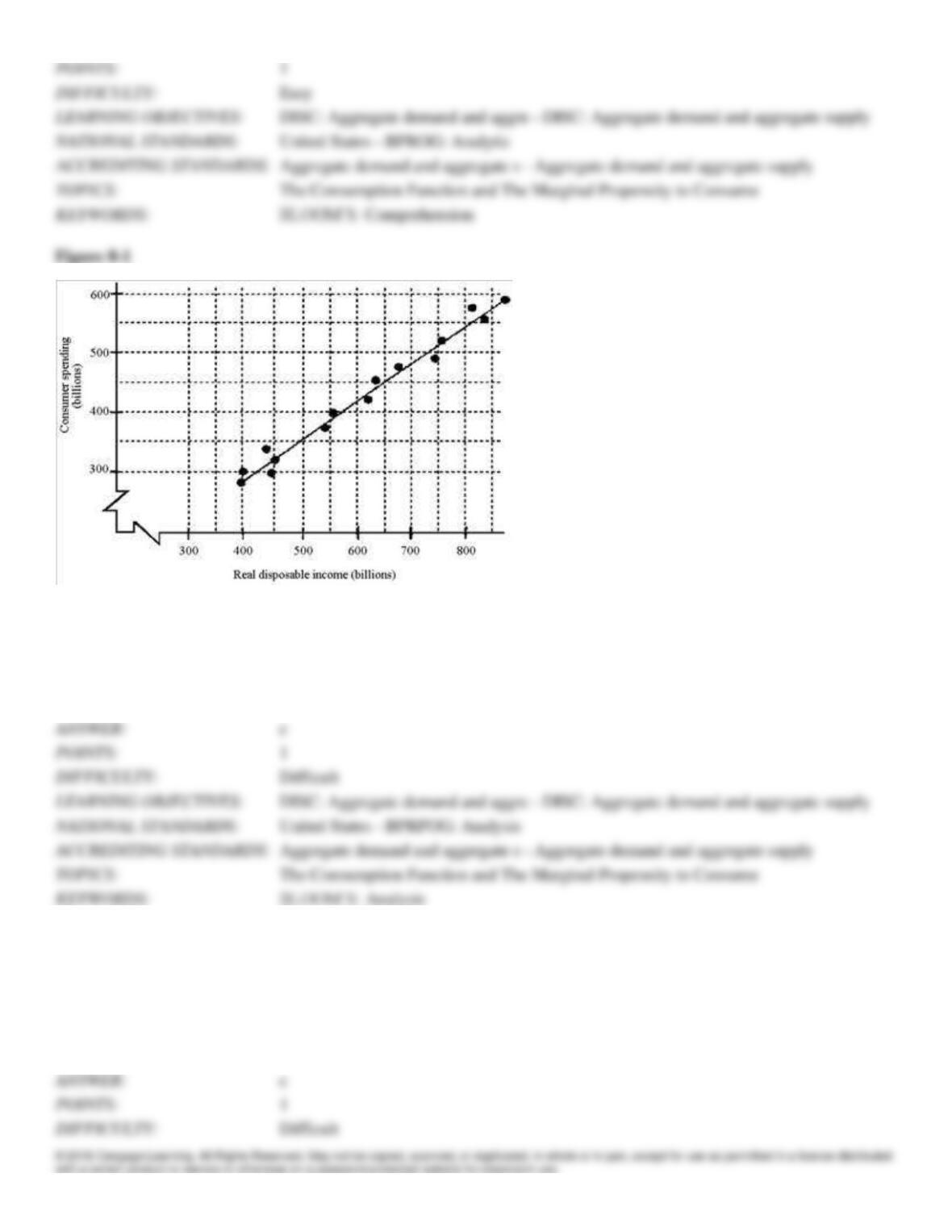
98. Given the scatter diagram in Figure 8-1, what is the MPC (your best estimate)?
a.
1/2
b.
1/3
c.
2/3
d.
1
c
1
Difficult
99. Based on the scatter diagram in Figure 8-1, approximately how much will consumption increase after a permanent tax
cut of $400 billion?
a.
$100 billion
b.
$150 billion
c.
$250 billion
d.
$350 billion
c
1
Difficult
DISC: Aggregate demand and aggre – DISC: Aggregate demand and aggregate supply
United States – BPRPOG: Analysis
Aggregate demand and aggregate s – Aggregate demand and aggregate supply
The Consumption Function and The Marginal Propensity to Consume
100. Given the scatter diagram in Figure 8-1, how much will consumption decrease if the price level rises by 5 percent?
a.
$50 billion
b.
$100 billion
c.
$200 billion
d.
cannot be determined
DISC: Aggregate demand and aggre – DISC: Aggregate demand and aggregate supply
United States – BPROG: Reflective Thinking – BPROG: Analysis
Aggregate demand and aggregate s – Aggregate demand and aggregate supply
The Consumption Function and The Marginal Propensity to Consume
101. Based on the scatter diagram in Figure 8-1, if real disposable income is $800 billion, the consumption spending
would be approximately
a.
$800 billion.
b.
$650 billion.
c.
$540 billion.
d.
$420 billion.
DISC: Aggregate demand and aggre – DISC: Aggregate demand and aggregate supply
United States – BPROG: Reflective Thinking – BPROG: Analysis
Aggregate demand and aggregate s – Aggregate demand and aggregate supply
The Consumption Function and The Marginal Propensity to Consume
102. If you fit a line through a scatter diagram of points that represent coordinates of consumer spending and disposable
income, the slope of this line will equal the
a.
propensity to consume
b.
variable propensity to consume.
c.
marginal propensity to consume.
d.
average propensity to consume.
DISC: Aggregate demand and aggre – DISC: Aggregate demand and aggregate supply
United States – BPROG: Analytic
Aggregate demand and aggregate s – Aggregate demand and aggregate supply
The Consumption Function and The Marginal Propensity to Consume
103. In 1963, government economists assumed that the MPC for the United States was approximately 0.90. If taxes were
cut by $9 billion, then consumer expenditures would initially be expected to
a.
decrease by $9.0 billion.
b.
increase by $9.0 billion.
c.
decrease by $8.1 billion.
d.
increase by $8.1 billion.
DISC: Aggregate demand and aggre – DISC: Aggregate demand and aggregate supply
United States – BPROG: Analytic
Aggregate demand and aggregate s – Aggregate demand and aggregate supply
The Consumption Function and The Marginal Propensity to Consume
104. Assume that consumption in the United States is $9,000 billion in 2009. If the MPC is 0.8 and disposable income
increases by $1,000 billion in 2010, then the level of consumption in 2010 will be
a.
$10,000 billion.
b.
$9,800 billion.
c.
$9,000 billion.
d.
$7,200 billion.
DISC: Aggregate demand and aggre – DISC: Aggregate demand and aggregate supply
United States – BPROG: Reflective Thinking – BPROG: Analysis
Aggregate demand and aggregate s – Aggregate demand and aggregate supply
The Consumption Function and The Marginal Propensity to Consume
105. If the MPC increases in value, what will happen to the slope of the consumption function?
a.
The slope will decrease and the consumption function will become flatter.
b.
The slope will decrease and the consumption function will become steeper.
c.
The slope will increase and the consumption function will become steeper.
d.
The slope will increase and the consumption function will become flatter.
DISC: Aggregate demand and aggre – DISC: Aggregate demand and aggregate supply
United States – BPROG: Reflective Thinking – BPROG: Analysis
Aggregate demand and aggregate s – Aggregate demand and aggregate supply
The Consumption Function and The Marginal Propensity to Consume
106. Do economists know the value of the MPC for most economies?
a.
Yes, with a high level of precision.
b.
Yes, with a certainty level of four decimal places.
c.
No, it is impossible to determine a national MPC.
d.
Yes, but with some level of uncertainty.
DISC: Aggregate demand and aggre – DISC: Aggregate demand and aggregate supply
United States – BPROG: Reflective Thinking – BPROG: Analysis
Aggregate demand and aggregate s – Aggregate demand and aggregate supply
The Consumption Function and The Marginal Propensity to Consume
107. If the MPC is .80, then a change in disposable income of $60 billion will lead to an initial change in consumption of
a.
$30 billion.
b.
$42 billion.
c.
$48 billion.
d.
$60 billion.
e.
$70 billion.
DISC: Aggregate demand and aggre – DISC: Aggregate demand and aggregate supply
United States – BPROG: Reflective Thinking – BPROG: Analysis
Aggregate demand and aggregate s – Aggregate demand and aggregate supply
The Consumption Function and The Marginal Propensity to Consume
108. In Macronesia, the MPC is approximately .80. If disposable income changes from 1,000 billion pukas to 1,500
billion pukas, then consumption will change by a(n)
a.
decrease of 500 billion pukas.
b.
increase of 500 billion pukas.
c.
increase of 400 billion pukas.
d.
increase of 800 billion pukas.
DISC: Aggregate demand and aggre – DISC: Aggregate demand and aggregate supply
United States – BPROG: Reflective Thinking – BPROG: Analysis
Aggregate demand and aggregate s – Aggregate demand and aggregate supply
The Consumption Function and The Marginal Propensity to Consume
109. For each $1 of a tax cut, economists expect consumption to
a.
decrease by $1.
b.
decrease by less than $1.
c.
increase by less than $1.
d.
increase by $1.
c
Moderate
DISC: Aggregate demand and aggre – DISC: Aggregate demand and aggregate supply
United States – BPROG: Reflective Thinking – BPROG: Analysis
Aggregate demand and aggregate s – Aggregate demand and aggregate supply
The Consumption Function and The Marginal Propensity to Consume
110. If income in Austria decreases by 30 million euros and consumption decreases by 24 euros, then the MPC equals
a.
0.90.
b.
0.80.
c.
0.60
d.
−0.60.
Moderate
DISC: Aggregate demand and aggre – DISC: Aggregate demand and aggregate supply
United States – BPROG: Reflective Thinking – BPROG: Analysis
Aggregate demand and aggregate s – Aggregate demand and aggregate supply
The Consumption Function and The Marginal Propensity to Consume
111. To predict the effects of a tax cut on consumption spending, economists must have some estimate of the
a.
income effect.
b.
substitution effect.
c.
relative price effect.
d.
marginal propensity to consume.
Moderate
DISC: Aggregate demand and aggre – DISC: Aggregate demand and aggregate supply
United States – BPROG: Analytic
Aggregate demand and aggregate s – Aggregate demand and aggregate supply
The Consumption Function and The Marginal Propensity to Consume
112. According to the relationship represented by the consumption function, governments can indirectly decrease
consumption spending by
a.
increasing taxes.
b.
decreasing transfers.
c.
decreasing taxes.
d.
decreasing government spending.
DISC: Aggregate demand and aggre – DISC: Aggregate demand and aggregate supply
United States – BPROG: Analytic
Aggregate demand and aggregate s – Aggregate demand and aggregate supply
The Consumption Function and The Marginal Propensity to Consume
113. A decrease in disposable income will
a.
lead to an upward movement along the consumption function.
b.
lead to a downward movement along the consumption function.
c.
shift the consumption function upward.
d.
shift the consumption function downward.
DISC: Aggregate demand and aggre – DISC: Aggregate demand and aggregate supply
United States – BPROG: Analytic
Aggregate demand and aggregate s – Aggregate demand and aggregate supply
Factors that Shift the Consumption Function
114. A movement from one point to an another point on the same consumption function could be caused due to
a.
changes in wealth.
b.
an increase in the general price level.
c.
decrease in the real interest rates.
d.
changes in disposable income.
DISC: Aggregate demand and aggre – DISC: Aggregate demand and aggregate supply
United States – BPROG: Analytic
Aggregate demand and aggregate s – Aggregate demand and aggregate supply
Factors that Shift the Consumption Function
115. A movement upward along the consumption function can be caused only by a(n)
a.
increase in disposable income.
b.
decrease in disposable income.
c.
decrease in the price level.
d.
increase in the price level.
DISC: Aggregate demand and aggre – DISC: Aggregate demand and aggregate supply
United States – BPROG: Analytic
Aggregate demand and aggregate s – Aggregate demand and aggregate supply
Factors that Shift the Consumption Function
116. One of the effects of a change in disposable income could not be a(n)
a.
movement up along the consumption function.
b.
movement down along the consumption function.
c.
change in the amount of consumption expenditures.
d.
upward shift of the consumption function.
DISC: Aggregate demand and aggre – DISC: Aggregate demand and aggregate supply
United States – BPROG: Analytic
Aggregate demand and aggregate s – Aggregate demand and aggregate supply
Factors that Shift the Consumption Function
117. Because of recent corporate downsizing, Chuck loses his job. The most likely effect on his consumption function is
a(n)
a.
movement downward along the function.
b.
shift upward of the function.
c.
shift downward of the function.
d.
increase in consumption expenditures.
DISC: Aggregate demand and aggre – DISC: Aggregate demand and aggregate supply
United States – BPROG: Reflective Thinking – BPROG: Analysis
Aggregate demand and aggregate s – Aggregate demand and aggregate supply
Factors that Shift the Consumption Function
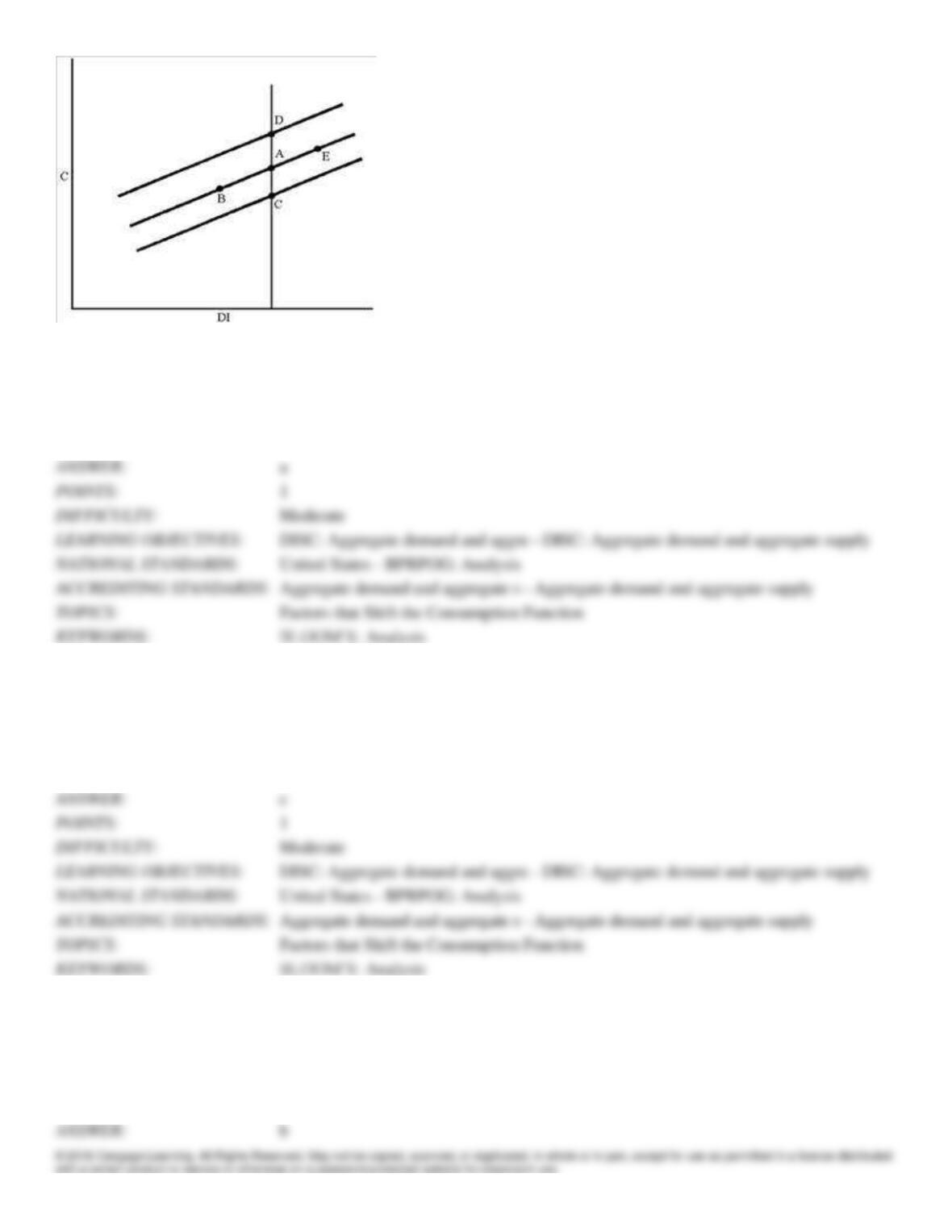
118. In Figure 8-2, which of the following moves can be explained by a decrease in disposable income?
a.
E to B
b.
A to C
c.
A to D
d.
B to E
DISC: Aggregate demand and aggre – DISC: Aggregate demand and aggregate supply
United States – BPRPOG: Analysis
Aggregate demand and aggregate s – Aggregate demand and aggregate supply
Factors that Shift the Consumption Function
119. In Figure 8-2, which of the following moves can be explained by a decrease in the price level?
a.
A to B
b.
A to C
c.
A to D
d.
A to E
DISC: Aggregate demand and aggre – DISC: Aggregate demand and aggregate supply
United States – BPRPOG: Analysis
Aggregate demand and aggregate s – Aggregate demand and aggregate supply
Factors that Shift the Consumption Function
120. In Figure 8-2, which of the following moves can be explained by a decrease in the prices of stock on the NASDAQ?
a.
A to B
b.
A to C
c.
A to D
d.
A to E
DISC: Aggregate demand and aggre – DISC: Aggregate demand and aggregate supply
United States – BPRPOG: Analysis
Aggregate demand and aggregate s – Aggregate demand and aggregate supply
Factors that Shift the Consumption Function
121. In Figure 8-2, which of the following moves can be explained by a tax cut?
a.
A to B
b.
A to C
c.
A to D
d.
A to E
DISC: Aggregate demand and aggre – DISC: Aggregate demand and aggregate supply
United States – BPRPOG: Analysis
Aggregate demand and aggregate s – Aggregate demand and aggregate supply
Factors that Shift the Consumption Function
122. In Figure 8-2, which of the following moves can be explained by an increase in government transfer payments?
a.
A to B
b.
A to C
c.
A to D
d.
A to E
DISC: Aggregate demand and aggre – DISC: Aggregate demand and aggregate supply
United States – BPRPOG: Analysis
Aggregate demand and aggregate s – Aggregate demand and aggregate supply
Factors that Shift the Consumption Function
123. After years of hard work in the field of macroeconomics, you win the Nobel Prize in economics (currently about $1.5
million). What is the most likely effect of this prize on your consumption function?
a.
It will shift downward temporarily.
b.
It will shift upward temporarily.
c.
It will shift downward permanently.
d.
It will shift upward permanently.
e.
none of the above
DISC: Aggregate demand and aggre – DISC: Aggregate demand and aggregate supply
United States – BPROG: Reflective Thinking – BPROG: Analysis
Aggregate demand and aggregate s – Aggregate demand and aggregate supply
Factors that Shift the Consumption Function
124. Which of the following is an example of wealth?
a.
a yearly salary of $40,000
b.
a mutual fund balance of $1,000
c.
rental payments of $3,000 per month
d.
stock dividends of $500 per quarter
Easy
DISC: Aggregate demand and aggre – DISC: Aggregate demand and aggregate supply
United States – BPROG: Reflective Thinking – BPROG: Analysis
Aggregate demand and aggregate s – Aggregate demand and aggregate supply
Factors that Shift the Consumption Function
125. If Kobe, an NBA star athlete, earns $10 million per year but has no money in the bank, he has a
a.
high income and high wealth.
b.
low income and high wealth.
c.
high income and low wealth.
d.
low income and low wealth.
c
Moderate
DISC: Aggregate demand and aggre – DISC: Aggregate demand and aggregate supply
United States – BPROG: Reflective Thinking – BPROG: Analysis
Aggregate demand and aggregate s – Aggregate demand and aggregate supply
Factors that Shift the Consumption Function
126. Households can finance their consumer spending from current
a.
income.
b.
wealth.
c.
debt.
d.
income and current wealth.
Moderate
DISC: Aggregate demand and aggre – DISC: Aggregate demand and aggregate supply
United States – BPROG: Analytic
Aggregate demand and aggregate s – Aggregate demand and aggregate supply
Factors that Shift the Consumption Function
127. Which of the following would be most likely to shift the consumption function downward?
a.
a stock market crash
b.
a price level decrease
c.
increased corporate profits
d.
a stock market boom
a
Moderate
DISC: Aggregate demand and aggre – DISC: Aggregate demand and aggregate supply
United States – BPROG: Reflective Thinking – BPROG: Analysis
Aggregate demand and aggregate s – Aggregate demand and aggregate supply
Factors that Shift the Consumption Function
128. Price level changes have their greatest effect on consumers’
a.
income.
b.
wealth.
c.
debt.
d.
expectations.
Moderate
DISC: Aggregate demand and aggre – DISC: Aggregate demand and aggregate supply
United States – BPROG: Analytic
Aggregate demand and aggregate s – Aggregate demand and aggregate supply
Factors that Shift the Consumption Function
129. If the price level increases, we would expect consumers to
a.
raise their consumption functions.
b.
move downward along their consumption functions.
c.
lower their consumption functions.
d.
move upward along their consumption functions.
c
Moderate
DISC: Aggregate demand and aggre – DISC: Aggregate demand and aggregate supply
United States – BPROG: Analytic
Aggregate demand and aggregate s – Aggregate demand and aggregate supply
Factors that Shift the Consumption Function
130. Consumption functions would shift downward if
a.
disposable incomes fall.
b.
disposable incomes rise.
c.
price levels fall.
d.
price levels rise.
DISC: Aggregate demand and aggre – DISC: Aggregate demand and aggregate supply
United States – BPROG: Analytic
Aggregate demand and aggregate s – Aggregate demand and aggregate supply
Factors that Shift the Consumption Function
131. Pat Robertson, a TV evangelist and former Republican Party candidate for president, once said that “debt is an
affront to God,” so good Christians should not spend beyond their incomes. Indeed, Robertson wants Christians to save
more. If more Americans, Christians as well as others, took his message seriously, how would we represent the result
using a Keynesian macroeconomic model?
a.
a downward movement along the consumption function
b.
an upward movement along the consumption function
c.
a downward shift of the consumption function
d.
an upward shift of the consumption function
DISC: Aggregate demand and aggre – DISC: Aggregate demand and aggregate supply
United States – BPROG: Reflective Thinking – BPROG: Analysis
Aggregate demand and aggregate s – Aggregate demand and aggregate supply
Factors that Shift the Consumption Function
132. Which of the following would cause an upward shift in the consumption function?
a.
a stock market crash
b.
an increase in the price level
c.
a decrease in disposable income
d.
a decrease in the price level
DISC: Aggregate demand and aggre – DISC: Aggregate demand and aggregate supply
United States – BPROG: Analytic
Aggregate demand and aggregate s – Aggregate demand and aggregate supply
Factors that Shift the Consumption Function
133. Which of the following would lead you to predict an upward shift in the consumption function?
a.
a decrease in the value of real wealth
b.
a decrease in disposable income