98) Compared with a firm in a perfectly competitive market, the demand curve faced by a
monopolistically competitive firm is
A) more elastic.
B) more inelastic.
C) perfectly elastic.
D) perfectly inelastic.
99) In the long run, monopolistic competitive firms are considered to be operating inefficiently
because their
A) economic profits are positive.
B) economic profits are zero.
C) average total costs are not at a minimum.
D) marginal costs are rising.
100) Which of the following is FALSE about a comparison between a perfectly competitive firm
and a monopolistically competitive firm?
A) A perfectly competitive firm has a horizontal demand curve, while a monopolistically
competitive firm has a downward sloping demand curve.
B) In the short run, a perfectly competitive firm will earn zero economic profits, while a
monopolistically competitive firm will earn positive economic profits.
C) Both the perfectly competitive and monopolistically competitive firm will earn economic
profits equal to zero in the long-run.
D) In the long run, the perfectly competitive firm will produce at the minimum of the average
total cost curve, while the monopolistically competitive firm will produce to the left of the
minimum of the average total cost curve.
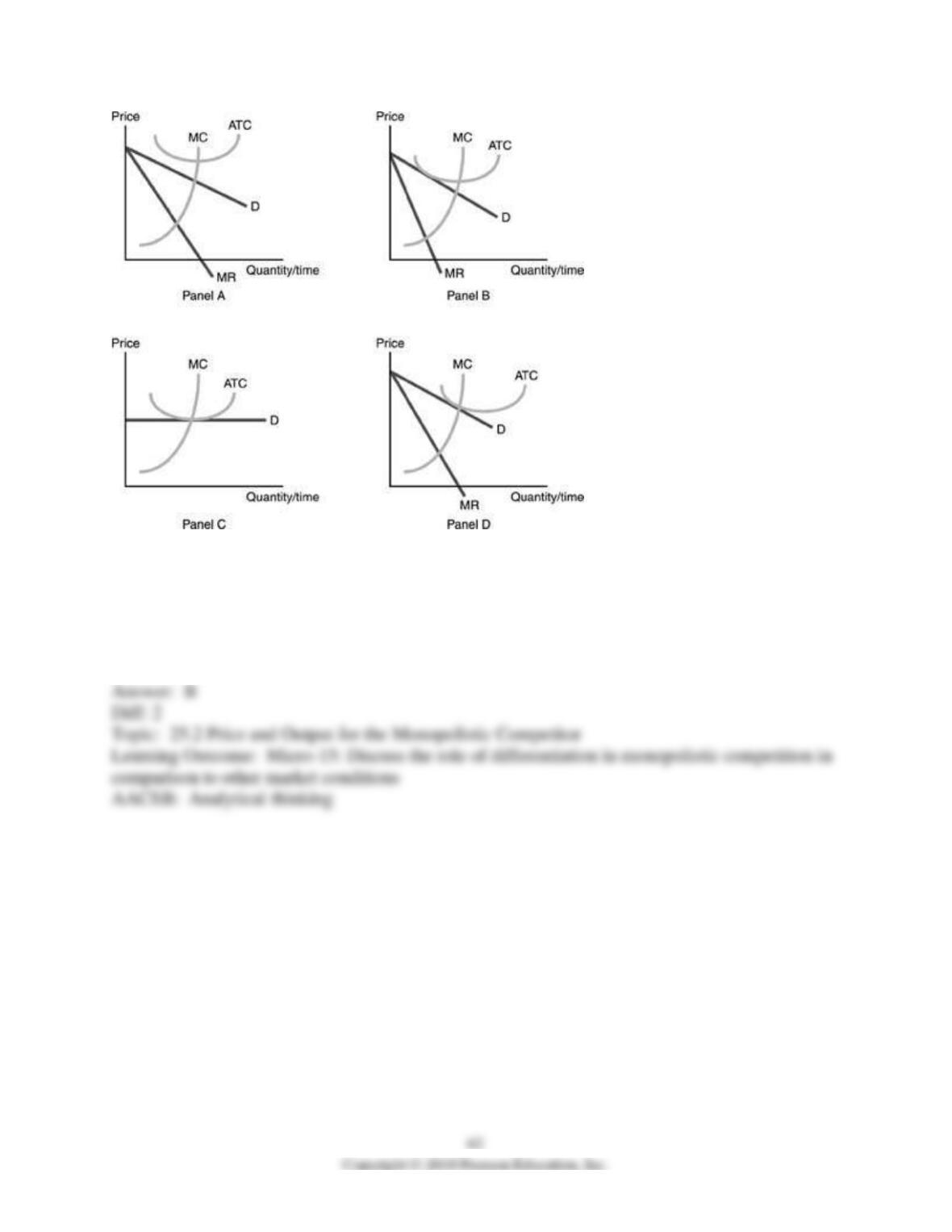
101) Refer to the above figure. Which panels represent long run equilibrium for the perfectly
competitive firm and monopolistic competitive firm, respectively?
A) Panel C and Panel A
B) Panel C and Panel B
C) Panel B and Panel C
D) Panel C and Panel D
102) A monopolistically competitive firm differs from a perfectly competitive firm in the long
run in that
A) the demand curve faced by a monopolistically competitive firm is downward sloping, while
the demand curve faced by a perfectly competitive firm is horizontal.
B) profits are positive for a monopolistically competitive firm and zero for a perfectly
competitive firm.
C) profits are zero for a monopolistically competitive firm and positive for a perfectly
competitive firm.
D) marginal cost equals the market price for a monopolistically competitive firm but not for a
perfectly competitive firm.
103) In long-run equilibrium in a monopolistically competitive industry, a firm will
A) always earn an economic profit.
B) produce an output rate at which P = MC.
C) produce at a point to the left of the minimum point on its average total cost curve.
D) have a perfectly elastic demand curve.
104) Compared with a perfectly competitive firm facing the same costs, long-run equilibrium for
a monopolistically competitive firm will result in
A) a higher price and greater output.
B) a lower price and less output.
C) a higher price and less output.
D) a lower price and greater output.
105) Compared to perfect competition, a monopolistically competitive market will produce
________ output and charge a ________ price.
A) more; higher
B) more; lower
C) less; higher
D) less; lower
106) Compared to a perfectly competitive firm, in a long run the monopolistically competitive
firm will have
A) a lower price.
B) a lower average cost.
C) a horizontal demand function.
D) a lower rate of output.
107) In which market structure will a firm choose not to shut down when price is less than
average variable cost?
A) perfect competition
B) monopoly
C) monopolistic competition
D) All of the above. Any firms will shut down when P < AVC.
108) Monopolistic competition and perfect competition are similar in that each market structure
is characterized by
A) advertising.
B) production at minimum average cost in the long run.
C) a horizontal demand curve.
D) the absence of long-run economic profits.
109) Monopolistic competition and perfect competition are different in that
A) only monopolistically competitive firms advertise.
B) only monopolistically competitive firms can earn economic losses in the short-run.
C) only perfectly competitive firms maximize profits where marginal revenue equals marginal
cost.
D) only perfectly competitive firms are characterized by long-run economic profits of zero.
110) One way to view the cost structure of monopolistic competition is to say that the cost of
product differentiation is equal to
A) the difference between marginal revenue and marginal cost.
B) the difference between the cost of production for a monopolistically competitive firm in an
open market and the minimum average total cost.
C) the sum of price and marginal cost.
D) the sum of marginal cost and minimum average cost.
111) What did Harvard economist Edward Chamberlain say about the observation that a
monopolistically competitive firm’s average cost of production exceeds its minimum average
total cost?
A) Chamberlain argued that these higher costs represent the wastefulness of this market
structure.
B) Chamberlain argued that this belief is incorrect. In his view, monopolistically competitive
firms do not produce at a cost above their minimum average total costs.
C) According to Chamberlain, this cost difference represents the value consumers place on
variety and having more choice.
D) In Chamberlain’s view, this is evidence that monopolistic competition uses society’s resources
inefficiently and in a fashion that merits government intervention.
112) The long-run equilibrium of a monopolistic competitor differs from the long-run
equilibrium of a perfect competitor in that
A) the monopolistic competitor makes economic profits.
B) the monopolistic competitor sets price equal to marginal cost.
C) the monopolistic competitor produces at the minimum point of its average total cost curve.
D) the monopolistic competitor charges a price that exceeds marginal cost.
113) A monopolistic competitor in long-run equilibrium is like a perfect competitor in that
A) price equals marginal cost.
B) price is greater than marginal cost.
C) zero economic profits are made.
D) both produce at the minimum points of their average total cost curves.
114) Long-run equilibrium for a monopolistic competitor is characterized by
A) a price exceeding marginal cost.
B) marginal cost pricing.
C) economic profits.
D) too few firms in the industry.
115) It has been argued that a monopolistically competitive industry involves “waste” because
A) there is too much product differentiation making shelves too crowded.
B) they end up producing to the right of the minimum of the average total cost curve and the
price is below the marginal cost.
C) the firms do not equate marginal cost to marginal revenue to find the profit maximizing price
and output.
D) the firms do not produce at the minimum of the average total cost curve and price is above
marginal cost.
116) According to Chamberlin, the fact that in the long run average total cost exceeds its
minimum value under monopolistic competition is
A) the social cost of monopolistic competition.
B) the most important reason for why monopolistic competition is not efficient.
C) part of the cost of producing different products for consumers.
D) actually beneficial because it makes adjustments easier when demand increases.
117) In the long run, a monopolistic competitor will produce to the point at which
A) average total costs are at the minimum of possible ATC.
B) average total costs are higher than the minimum of possible ATC.
C) resources are used at the lowest possible cost.
D) at the lowest possible price.
118) In the long run, equilibrium positions that arise in both monopolistically competitive and
perfectly competitive markets are
A) MR = MC and P = MC.
B) P = ATC and P = MC.
C) MR = MC and P = ATC.
D) MR = MC = P.
119) In a long-run monopolistically competitive equilibrium
A) P = ATC, and ATC is not at its minimum value.
B) P = ATC, and ATC is at its minimum value.
C) P > ATC, and ATC is at its minimum value.
D) P > ATC, and ATC is not at its minimum value.
120) In the long run, both monopolistically competitive and perfectly competitive firms attain
A) lowest cost production.
B) positive economic profits.
C) zero economic profits.
D) productive efficiency.
121) It has been argued that in the long run monopolistic competition is inefficient because
A) there are too many firms, each with excess capacity, producing too little output.
B) there are few many firms, each with excess capacity, producing too much output.
C) minimum average total costs are achieved but price exceeds marginal cost.
D) minimum average total costs are not achieved and marginal cost exceeds price.
122) In the long run, a perfectly competitive market produces at ________, whereas the
monopolistic competitive firm does not.
A) the output at which the lowest average total cost of production is reached
B) an output level at which positive economic profits exist
C) zero economic profits
D) the point at which MR = MC=ATC
123) The most significant difference between perfect competition and monopolistic competition
is that
A) in a perfectly competitive market products are differentiated, while in a monopolistically
competitive market products are homogeneous.
B) in a perfectly competitive market products are homogeneous, while in a monopolistically
competitive market products are differentiated.
C) in a perfectly competitive market there is a large number of sellers, while in a
monopolistically competitive market there is a small number of sellers.
D) in a perfectly competitive market there is a small number of sellers, while in a
monopolistically competitive market there is a large number of sellers.
124) Why can’t a monopolistic competitor earn economic profits in the long run?
125) Explain what will happen if firms in a monopolistically competitive industry are earning
positive economic profits.
126) Why is it that a monopolistically competitive firm cannot earn positive economic profits in
the long run?
127) How is monopolistic competition like perfect competition? How is it like monopoly?
128) How does the short-run equilibrium of a monopolistic competitor differ from a monopolist?
How does it differ from a perfect competitor?
129) Is monopolistic competition efficient? Explain. What is Edward Chamberlin’s view about
the efficiency of monopolistic competition?
130) According to Edward Chamberlin, is the “differentness” of products a waste of resources?
Explain.
1) When a telemarketer calls you about a product, this is an example of
A) direct marketing.
B) indirect marketing.
C) searching for a good.
D) persuasive marketing.
2) A product with qualities that consumers lack the expertise to assess without assistance is
called a(n)
A) search good.
B) experience good.
C) credence good.
D) inferior good.
3) By promoting its brand name heavily, the monopolistically competitive firm
A) earns more profit in the long run.
B) signals its long-term intention to stay in the industry.
C) signals its intention to leave the industry.
D) guarantees a short run profit.
4) If a firm produces an experience good, its mode of advertising will be
A) persuasive advertising.
B) direct advertising.
C) not to advertise.
D) none of the above.
5) To differentiate its product, a monopolistic competitive firm will engage in all of the
following advertising practices EXCEPT
A) direct marketing.
B) mass marketing.
C) interactive marketing.
D) indirect marketing.
6) Persuasive advertising is used to
A) induce a consumer to try a product and discover a previously unknown taste for it.
B) promote only used goods.
C) sell to an established clientele.
D) cut costs.
7) Mass marketing involves
A) using all types of media, such as television and radio, to reach as many consumers as
possible.
B) Internet ads only.
C) using direct mailings only.
D) lower-cost methods of advertising.
8) The brand name of a firm
A) has nothing to do with the profitability of a firm.
B) has been considered irrelevant by economists since profits for a monopolistic competitive
firm are zero in the long-run.
C) relates to consumers’ perception of product differentiation and to the market value of a firm.
D) is important in the short-run but not in the long-run.
9) A firm’s trademark is protected from misuse if it is registered with the
A) U.S.D.A.
B) U.S. Patent and Trademark Office.
C) U.S. Supreme Court.
D) F.C.C.
10) In order to differentiate their product brands from those of competing firms, monopolistically
competitive firms
A) equate marginal cost to marginal revenue to determine the profit maximizing quantity.
B) spread false rumors about their competitors.
C) take their competitor’s reactions to changes in their policies into account.
D) advertise their product.
11) Personalized advertising that uses postal mailings, phone calls, and e-mail messages is
known as
A) direct marketing.
B) mass marketing.
C) indirect marketing.
D) guerilla marketing.
12) Direct marketing is
A) advertising that permits a consumer to follow up directly by searching for more information
and placing direct product orders.
B) advertising that targets a specific audience and allows the consumer to follow up directly by
placing direct product orders usually through television or radio.
C) advertising targeted at specific consumers.
D) advertising intended to reach as many consumers as possible.
13) When a firm relies on social media ads to reach potential customers, the firm is engaging in
A) direct marketing.
B) mass marketing.
C) false marketing.
D) none of the above.
14) Mass marketing is
A) advertising that permits a consumer to follow up directly by searching for more information
and placing direct product orders.
B) advertising that targets a specific audience and allows the consumer to follow up directly by
placing direct product orders usually through television or radio.
C) advertising targeted at specific consumers.
D) advertising intended to reach as many consumers as possible.
15) Interactive marketing is
A) advertising that permits a consumer to follow up directly by searching for more information
and placing direct product orders.
B) advertising that targets a specific audience and allows the consumer to follow up directly by
placing direct product orders usually through television or radio.
C) advertising targeted at specific consumers.
D) advertising intended to reach as many consumers as possible.
16) Advertisement in which firms aim messages to as many customers as possible via media is
known as
A) direct marketing.
B) mass marketing.
C) indirect marketing.
D) interactive marketing.
17) The advertisement approach that allows a consumer to follow up directly to an advertising
message is known as
A) direct marketing.
B) mass marketing.
C) indirect marketing.
D) interactive marketing.
18) All of the following are advertisement methods EXCEPT
A) direct marketing.
B) mass marketing.
C) indirect marketing.
D) interactive marketing.
19) Jaime has just researched and purchased a book through the Internet as a result of responding
directly to a ad on Facebook. The Facebook ad is an example of
A) mass marketing.
B) direct marketing.
C) indirect marketing.
D) interactive marketing.
20) Judy has just looked through her favorite catalog that came in the mail and has placed an
order. The catalog is an example of
A) mass marketing.
B) direct marketing.
C) indirect marketing.
D) interactive marketing.
21) Stephanie has just placed an order for the latest video after she received a personalized e-
mail. The e-mail is an example of
A) mass marketing.
B) direct marketing.
C) indirect marketing.
D) interactive marketing.
22) Carol has just purchased a cereal she saw advertised on TV because of the health benefits
contained in the ad. The TV ad is an example of
A) mass marketing.
B) direct marketing.
C) indirect marketing.
D) interactive marketing.
23) Bonnie has just purchased a crystal vase she saw advertised when she went on line to find
her local weather forecast. The Internet ad is an example of
A) mass marketing.
B) direct marketing.
C) indirect marketing.
D) interactive marketing.
24) A good that has qualities that are easy for a consumer to assess in advance of a purchase is
called
A) a credence good.
B) a search good.
C) an experience good.
D) a persuasive good.
25) A search good is a product
A) with qualities that consumers lack the expertise to assess without assistance.
B) that emphasizes the features of its product.
C) with characteristics that enable an individual to evaluate the product’s quality in advance of a
purchase.
D) that an individual must consume before the quality can be established.