64) Which is NOT a characteristic of monopolistic competition?
A) small share of market to each firm
B) lack of collusion among firms
C) few firms in the industry
D) independence of each firm’s decisions
65) The two economists associated with the development of the theory of monopolistic
competition were
A) Joan Robinson and Edward Chamberlin.
B) David Hume and Adam Smith.
C) John Neville Keynes and John Maynard Keynes.
D) Carl Menger and Eugen Von Bohm-Bawerk.
66) A monopolistic competitor would face a demand curve with a
A) positive slope.
B) negative slope.
C) constant slope.
D) slope equal to 0.
67) When Crest claims that its toothpaste product whitens teeth more than the products of its
competitors, Crest is practicing
A) product differentiation.
B) false advertising.
C) marginal revenue pricing.
D) marginal cost pricing.
68) Advertising is used by firms in a monopolistic competitive industry to
A) differentiate their product from those of competitors.
B) increase brand loyalty.
C) increase demands for their individual products.
D) all of the above.
69) Because there are low barriers to entry in a monopolistically competitive market
A) there are many firms in the industry.
B) they produce a homogeneous product.
C) the firms are price takers.
D) there is no non-price competition.
70) The demand curve for the product of a monopolistically competitive firm slopes downward
because
A) products are perceived by consumers as different.
B) products are homogeneous.
C) people only care about price when they buy a good.
D) the firm’s goal is to maximize profits.
71) The demand curve for the product of a monopolistic competitor
A) is the same as the market demand curve.
B) is horizontal.
C) is vertical.
D) slopes downward.
72) Compared with a monopolist, the demand curve faced by a monopolistically competitive
firm is
A) more elastic.
B) more inelastic.
C) perfectly elastic.
D) perfectly inelastic.
73) What is the most important characteristic of monopolistic competition? How do firms behave
differently from perfect competitors?
74) What are the implications of there being a large number of firms in a monopolistically
competitive market?
75) Why do firms in a monopolistically competitive industry advertise?
25.2 Price and Output for the Monopolistic Competitor
1) In the short run, a monopolistically competitive firm can earn
A) positive profits only.
B) zero profits only.
C) zero or positive profits only.
D) zero, positive or negative profits.
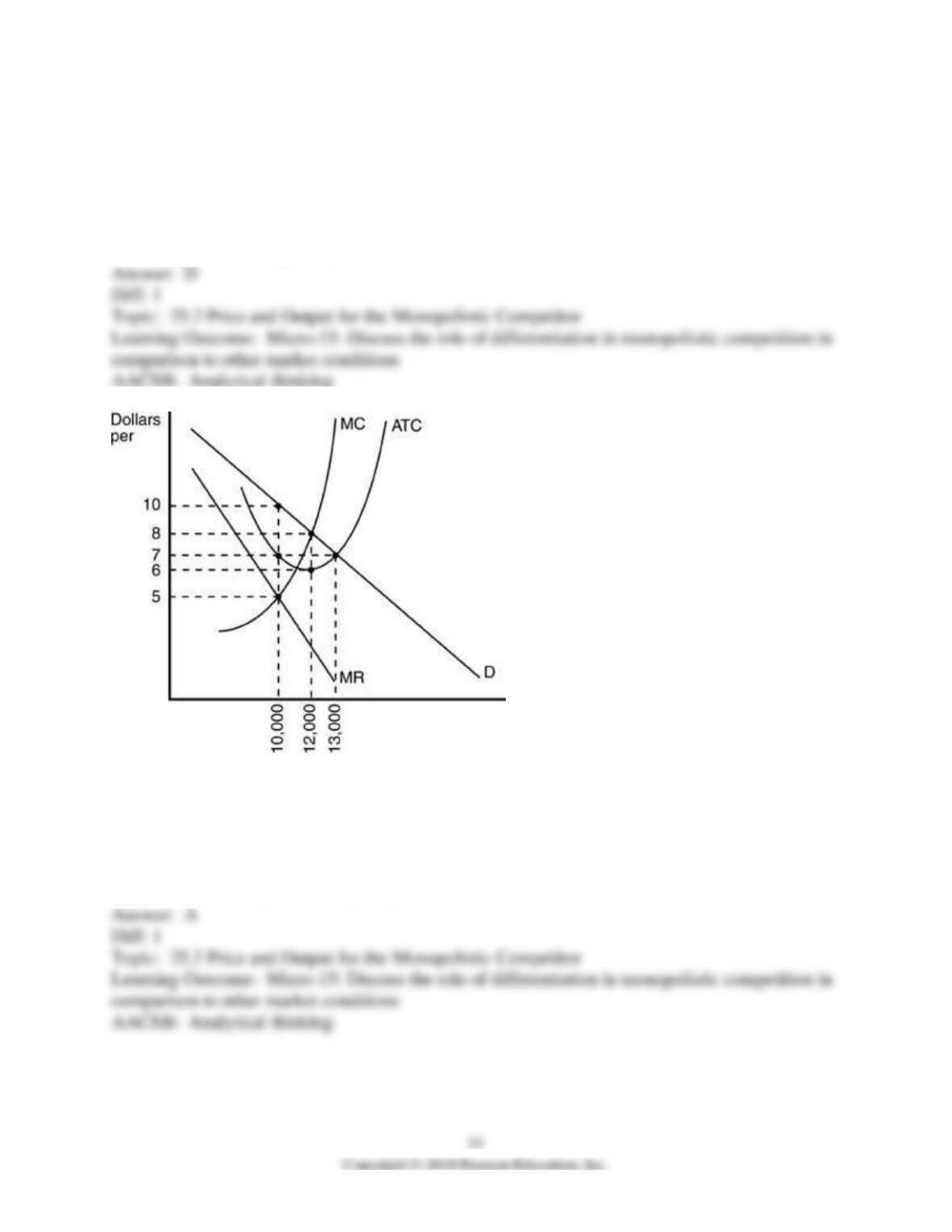
2) In the above figure, the profit-maximizing output and price for this monopolistically
competitive firm are
A) 10,000 units at a price of $10 per unit.
B) 10,000 units at a price of $5 per unit.
C) 13,000 units at a price of $7 per unit.
D) 12,000 units at a price of $8 per unit.
3) In the above figure, total revenue for this profit-maximizing monopolistically competitive firm
is
A) $50,000.
B) $91,000.
C) $96,000.
D) $100,000.
4) In the above figure, total cost for this profit-maximizing monopolistically competitive firm is
A) $91,000.
B) $50,000.
C) $70,000.
D) $72,000.
5) In the above figure, the profit-maximizing monopolistically competitive firm will
A) make a profit of $24,000.
B) make a profit of $30,000.
C) make a profit of $0.
D) incur a loss of $20,000.
6) The above figure shows the situation of a monopolistic competitor in the short run. The
maximum economic profits of the firm equal
A) $50,000.
B) $30,000.
C) 15,000.
D) zero.
7) The above figure shows the situations of a monopolistic competitor in the short run. To
maximize profits, the firm should produce
A) 10,000 units.
B) 12,000 units.
C) 13,000 unit.
D) somewhere between 10,000 and 12,000 units.
8) In the short run, the profit-maximizing monopolistically competitive firm will produce the rate
of output at which
A) P = MC.
B) MR = MC.
C) P = ATC.
D) MR = ATC.
9) The demand curve faced by a monopolistically competitive firm is
A) horizontal.
B) vertical.
C) downward sloping.
D) upward or downward sloping depending on market competition.
10) For a monopolistic competitive firm, which of the following is TRUE in the long run?
A) ATC is minimized.
B) P = ATC.
C) P = MC.
D) all of the above
11) Which of the following is TRUE for a monopolistically competitive firm?
A) MR = P
B) MR > P
C) MR < P
D) MR = AFC
12) Which of the following statements about a monopolistically competitive firm is FALSE?
A) It tries to differentiate its product from that of competitors.
B) It may earn short-run economic profits.
C) It produces the quantity at which MC=MR.
D) It sets price like a perfectly competitive firm.
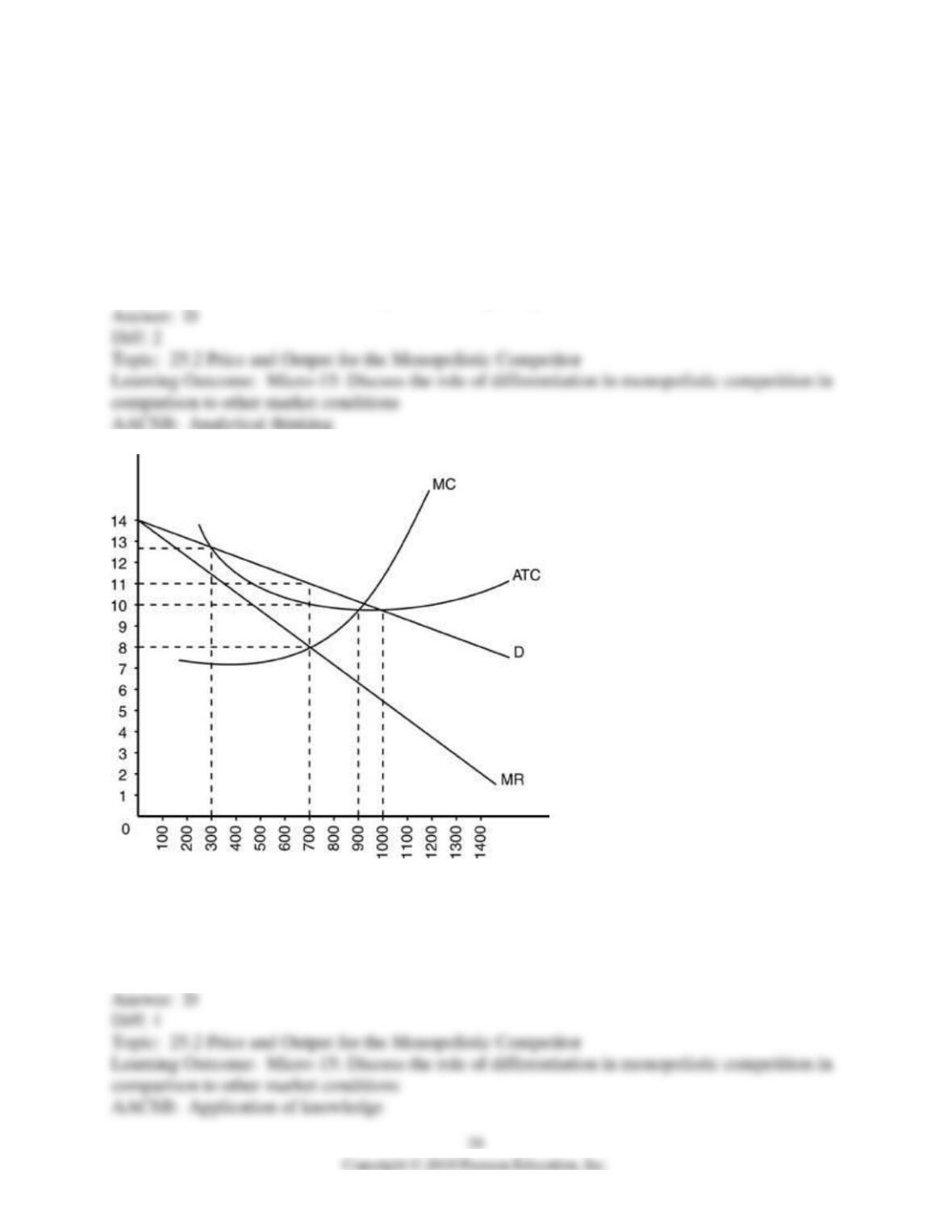
13) Graphically, how does a monopolistically competitive firm determine its profit-maximizing
price?
A) It accepts the price set by the industry-wide forces of supply and demand.
B) Graphically, it finds the place where MR = MC and charges the price directly to the left of
that point.
C) The firm’s pricing structure is set by government regulators.
D) The firm determines its profit-maximizing output and then charges the price associated with
the point on its demand curve directly above that quantity.
14) In the above figure, the monopolistically competitive firm’s profit-maximizing output is
A) 1,000 units.
B) 300 units.
C) 900 units.
D) 700 units.
15) In the above figure, when this monopolistically competitive firm produces its profit-
maximizing output, it sets a per-unit price of
A) $13.
B) $11.
C) $10.
D) $8.
16) At its profit-maximizing output, the firm in the above figure incurs a total cost of production
of
A) $7,000.
B) $9,000.
C) $6,300.
D) $3,900.
17) In the above figure, this profit-maximizing monopolistic competitive firm will realize an
economic profit of
A) -$1,400.
B) $2,100.
C) $1,400.
D) $700.
18) Since the firm in the above figure is operating in a monopolistically competitive industry, in
the long run we can expect to see
A) the typical firm’s economic profits expand as production becomes more efficient.
B) more firms entering the industry until economic profits are zero.
C) the typical firm producing at the minimum point on its ATC curve.
D) each firm expand its share of the total market.
19) The demand curve for a monopolistically competitive firm is
A) the same as the industry demand curve.
B) more elastic than the demand curve of the perfectly competitive firm.
C) less elastic than the demand curve of the perfectly competitive firm.
D) horizontal.
20) For the monopolistically competitive firm, in both the short run and the long run
A) the demand curve is inelastic.
B) price will exceed marginal cost.
C) there will be no economic profit.
D) production will be at minimum average cost.
21) The demand curve faced by a monopolistically competitive firms is
A) horizontal.
B) vertical.
C) downward sloping.
D) unitary elastic.
22) The monopolistic competitive firm in short-run equilibrium may experience economic profits
that are
A) always zero.
B) greater than, equal to, or less than zero.
C) always positive.
D) always negative.
23) In both a monopolistically competitive market and a pure monopoly market, firms
A) can make long-run profits.
B) set price greater than marginal cost.
C) are protected by entry barriers.
D) advertise extensively.
24) The monopolistically competitive firm maximizes profit by producing to the point at which
A) ATC = AVC.
B) MC = MR.
C) MR = AR.
D) MC = P.
25) In the short run, a firm operating as a monopolistic competitor will produce to the point at
which
A) MR = ATC.
B) MC = ATC.
C) P = MC.
D) MR = MC.
26) Which will be TRUE for a monopolistic competitor experiencing short-run losses?
A) P > ATC
B) P = ATC
C) P < ATC
D) P < MC
27) A monopolistically competitive firm finds its profit-maximizing rate of output by equating
A) the marginal revenue of advertising with the marginal cost of advertising.
B) average revenue and average total cost.
C) price and marginal cost.
D) marginal revenue and marginal cost.
28) In the short run, a monopolistically competitive firm
A) always earns positive economic profits.
B) never earns positive economic profits.
C) can earn positive, negative, or zero economic profits.
D) always earns positive accounting profits.
29) In the long run, in a monopolistically competitive market, price will be
A) equal to MR.
B) equal to MC.
C) greater ATC.
D) equal to ATC.
30) In the long run in a monopolistically competitive market, a firm will, in theory,
A) earn economic profits.
B) suffer losses.
C) break even.
D) earn zero accounting profits.
31) In the long run, the monopolistically competitive firm’s demand curve will
A) intersect the ATC at its minimum point.
B) intersect the ATC curve somewhere past the minimum point.
C) become tangent to the ATC curve at its minimum point.
D) become tangent to the ATC curve somewhere to the left of its minimum point.
32) The monopolistically competitive firm’s economic profits tend toward zero in the long run.
Why is this so?
A) Monopolistically competitive firm’s are rarely able to maintain the corporate discipline
necessary to sustain profits in the long run.
B) If a monopolistically competitive firm is profitable for more than 2 years, the Justice
Department orders a corporate restructuring to pull the company back to a normal rate of return.
C) In the long run, other firms will successfully offer substitutes for the profitable firm’s product,
and competition will eliminate economic profits.
D) Even though the monopolistically competitive firm can successfully maintain barriers to
entry, keeping competition at bay becomes very expensive.
33) The long-run equilibrium of monopolistic competition is characterized by
A) P = MC = ATC.
B) P = MC > ATC.
C) P = MR = MC.
D) P = ATC > MC.
34) In the long run, monopolistically competitive firms will not earn economic profits because
A) average total cost will shift up to meet the demand curve.
B) input prices will be bid up.
C) production will not be at minimum average cost.
D) new firms will enter the industry.
35) In the long run, if some monopolistically competitive firms are earning economic losses then
A) firms will leave the industry.
B) raise prices until they earn economic profits.
C) they will increase production until marginal costs fall.
D) new firms will enter the industry.
36) If firms in a monopolistically competitive industry are operating with economic losses, over
time we would see
A) firms alter their advertising rates until they made at least normal profits.
B) some firms exiting the industry, causing the market supply curve to shift to the left, raising
price.
C) some firms exiting the industry, causing the demand curves of the remaining firms to shift to
the right.
D) the firms working together to increase price and everyone’s profitability.
37) If firms in a monopolistically competitive industry are operating with positive economic
profit, over time we would see
A) firms alter their advertising rates until they made at least normal profits.
B) some firms entering the industry, causing the market supply curve to shift to the right,
lowering price.
C) some firms entering the industry, causing the demand curves of the existing firms to shift to
the left.
D) some firms entering the industry, causing the demand curves of the existing firms to shift to
the right.
38) In the long run, firms in a monopolistically competitive market
A) usually earn positive economic profits.
B) always earn monopoly profits.
C) usually earn economic losses.
D) earn zero economic profits.
39) The long-run equilibrium of a monopolistically competitive firm is characterized by
A) a tangency of the average total cost curve with the firm’s demand curve.
B) price equal to marginal cost.
C) production at the minimum point of the firm’s average total cost curve.
D) production at the minimum point of the firm’s average variable cost curve.
40) Long-run equilibrium is characterized by zero profits in
A) monopolistic competition only.
B) perfect competition only.
C) both perfect competition and monopolistic competition.
D) market structures in which there are barriers to entry.
41) A monopolistically competitive firm maximizes profits when it
A) produces the quantity at which marginal cost equals the market price.
B) produces the quantity at which marginal cost equals marginal revenue and uses the demand
curve to determine the market price.
C) produces the quantity at which marginal cost equals marginal revenue and sets the price equal
to the marginal cost.
D) produces the quantity at which marginal cost equals marginal revenue and sets the price equal
to the marginal revenue.
42) Which of the following statements about a monopolistically competitive firm is TRUE?
A) A monopolistically competitive firm does not always equate marginal cost to marginal
revenue because it uses other means to maximize profits.
B) A monopolistically competitive firm maximizes profits by charging a price equal to marginal
cost.
C) A monopolistically competitive firm produces the quantity at the point at which the demand
curve crosses the marginal cost curve.
D) A monopolistically competitive firm maximizes profits when it produces the quantity at
which marginal cost equals marginal revenue.
43) A monopolistic competitor finds its profit-maximizing rate of output by
A) equating the marginal revenue from advertising with the marginal revenue from selling the
good.
B) setting average revenue equal to average total cost.
C) equating marginal revenue and marginal cost.
D) equating price and marginal revenue.
44) In the short run, the monopolistic competitor is just like the perfect competitor in that
A) equilibrium is determined by setting price equal to marginal cost.
B) either type of firm can earn economic profits, experience economic losses, or break even in
the short run.
C) each equates marginal revenue and marginal cost in order to maximize profits, with the result
that price exceeds marginal revenue.
D) new firms enter in the short run when firms are making profits.
45) If firms in a monopolistically competitive industry experience short-run losses
A) some firms would like to exit the industry but find they cannot.
B) firms increase prices further, until they make at least a normal return.
C) firms increase advertising spending to increase demand, until they make at least a normal
return.
D) some firms exit the industry, causing the demand curves for the remaining firms to shift to the
right until they earn a normal profit.
46) If monopolistically competitive firms earn short-run economic profits, we expect to see
A) new firms enter the industry, which shifts the demand curves of the existing firms to the left
until firms earn zero economic profits.
B) new firms trying to enter the industry, but unable to do so because of barriers to entry.
C) existing firms altering their scale of plant to try to capture larger profits. The combined effect
is to cause all firms to earn zero economic profits.
D) existing firms increasing prices to try to capture larger economic profits.
47) A monopolistic competitor is like a competitive firm in the long run, because
A) it earns positive economic profits.
B) it earns zero economic profits
C) both firms will earn positive economic profits.
D) both firms will increase price to increase profits.
48) A monopolistic competitor is like a monopolist in the short run in that when economic profits
are
A) equal to zero, price equals marginal cost.
B) equal to zero, price below marginal cost.
C) greater than zero, changes in output are due to changes to plants by existing firms and there is
no entry.
D) greater than zero, price exceeds marginal cost.