4) The production of information products is characterized by
A) relatively low fixed cost.
B) relatively low marginal cost.
C) diseconomies of operation.
D) an upward sloping marginal cost curve.
5) The ATC curve for a firm that produces an information product
A) slopes downward, because AVC is constant, AFC slopes downward, and ATC = AVC +
AFC.
B) slopes upward, because AFC is constant, AVC slopes upward, and ATC = AFC + AVC.
C) is U-shaped, because AVC is U-shaped, AFC slopes downward, and ATC = AVC + AFC.
D) slopes downward, because MC slopes downward, AVC is constant, and ATC = AVC +MC.
6) Which of the following conditions best explain the short-run economies of operation
associated with production of an information product?
A) AVC slopes downward, and AFC is constant, so that ATC slopes downward.
B) AVC is constant, and AFC slopes downward, so that ATC slopes downward.
C) AFC is constant, and MC slopes downward, so that AVC slopes downward.
D) MC is constant, and MC slopes upward, so that AVC slopes upward.
7) If the producer of an information product engages in marginal cost pricing, it earns
A) a normal profit.
B) an economic loss.
C) zero economic profits.
D) positive economic profits.
8) There is no incentive for additional producers of an information product to enter the industry
when the price charged for these products by each firm already in the industry is equal to
A) marginal cost.
B) average total cost.
C) average fixed cost.
D) average variable cost.
9) In a long-run equilibrium in a monopolistically competitive industry that produces information
products, revenues are equal to the ________ costs of developing, producing, and selling the
product.
A) total
B) fixed
C) variable
D) marginal
10) A good that entails relatively high fixed costs associated with the use of knowledge and other
information-intensive inputs as key factors of production is
A) a logo good.
B) a search good.
C) a persuasive good.
D) an information product.
11) Which of the following statements is generally TRUE about information products?
A) high fixed costs and low marginal costs
B) high fixed costs and high marginal costs
C) low fixed costs and low marginal costs
D) low fixed costs and high marginal costs
12) Marginal cost for an information product would
A) first decrease and then increase as quantity increases.
B) increase constantly as quantity increases.
C) decrease constantly as quantity increases.
D) remain constant as quantity increases.
13) A very high fixed cost and a relatively low marginal cost is associated with
A) every type of good or product.
B) an information product.
C) a persuasive good.
D) an experience good.
14) Average total cost for an information product would
A) first decrease and then increase as quantity increases.
B) increase constantly as quantity increases.
C) decrease constantly as quantity increases.
D) remain constant as quantity increases.
15) Average fixed cost for an information product would
A) first decrease and then increase as quantity increases.
B) increase constantly as quantity increases.
C) decrease constantly as quantity increases.
D) remain constant as quantity increases.
98
16) An information product is a product for which
A) the first item is produced inexpensively but additional units are more costly to produce.
B) the first unit is very costly to make but additional units are less costly to produce.
C) the marginal cost first falls and then rises but the average total cost rises throughout its range.
D) the average fixed cost first falls and then rises, but the average total cost falls throughout its
range.
17) Average variable cost for an information product would
A) first decrease and then increase as quantity increases.
B) increase constantly as quantity increases.
C) decrease constantly as quantity increases.
D) remain constant as quantity increases.
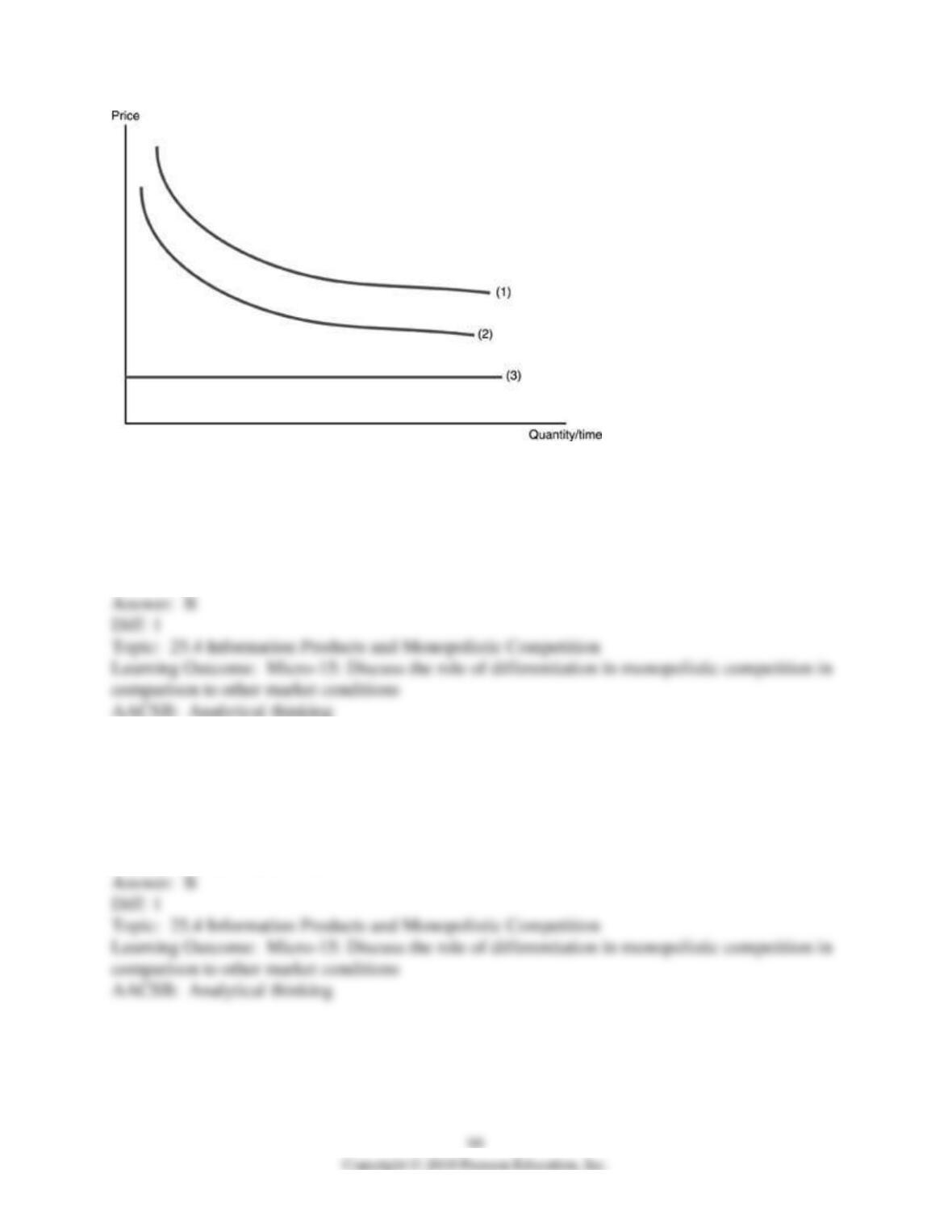
18) Refer to the above figure. The above figure shows the cost structure of a firm producing an
information product. Which curve represents average total cost?
A) Any of the 3 could be ATC.
B) Curve 1
C) Curve 2
D) Curve 3
19) Refer to the above figure. The above figure shows the cost structure of a firm producing an
information product. Which curve represents average fixed cost?
A) Curve 1
B) Curve 2
C) Curve 3
D) Any of the 3 could be AFC.
20) Refer to the above figure. The figure shows the cost structure of a firm producing an
information product. Which curve would represent the marginal cost for an information product?
A) Curve 1
B) Curve 2
C) Curve 3
D) none of the above
21) Refer to the above figure. The above figure shows the cost structure of a firm producing an
information product. Which curve would represent the average variable cost?
A) Curve 1
B) Curve 2
C) Curve 3
D) none of the above
22) Because the short-run average total cost curve slopes downward for an information product,
the firm experiences
A) a downward sloping marginal cost curve.
B) a downward sloping average variable cost curve.
C) short-run economies of operation.
D) long-run diseconomies of scale.
23) Firms that produce an information product experience short-run economies of operation
because
A) the firm will always produce in the decreasing portion of the marginal cost curve.
B) of the U-shaped nature of the average total cost curve.
C) of the U-shaped nature of the average variable cost curve.
D) the average total cost of producing and selling the product declines as output increases.
24) If a firm that produces an information product uses marginal cost pricing, then the firm
A) will earn negative profits.
B) will earn profits equal to zero.
C) will earn positive profits but could earn a higher profit by using a different method.
D) will maximize profits.
25) For a firm that sells an information product, the long-run equilibrium exists at a point at
which economic profits are
A) negative.
B) zero.
C) positive.
D) dependent upon the particular product.
26) The long-run equilibrium for a firm in an information product industry exists at a point at
which
A) marginal cost equals marginal revenue.
B) the demand curve crosses the marginal cost curve.
C) the demand curve is tangent to the average total cost curve.
D) average total cost is minimized.
27) For a firm that sells an information product, the long-run equilibrium exists at a point where
A) price equals average total cost.
B) price equals average variable cost.
C) price equals average fixed cost.
D) price equals marginal cost.
28) Information products (e.g., software)
A) have relatively high fixed costs but low marginal and average variable costs.
B) have relatively low fixed costs but high marginal and average variable costs.
C) have relatively high fixed costs and relatively high marginal and average variable costs.
D) have relatively low fixed costs and relatively low marginal and average variable costs.
29) Which of the following statements is INCORRECT regarding the properties of information
products?
A) Providing an information product entails incurring relatively high fixed costs.
B) The average total cost curve for a firm that sells an information product slopes upward.
C) The firm experiences economies of operation in the short run.
D) In the long run, the producer earns sufficient revenue to cover the opportunity cost of capital.
30) Which of the following statements is INCORRECT regarding the model for information
products?
A) Average total costs slope downward, because average variable cost is constant, average fixed
cost slopes downward.
B) The firm maximizes profit by setting the price of its product equal to marginal cost.
C) Marginal cost equals average variable cost.
D) In the long run, accounting profit is positive.
31) The first unit of an information product is produced at a high fixed cost. Producing additional
units entails relatively
A) high average variable cost.
B) low marginal cost.
C) low external cost.
D) high social cost.
32) A distinguishing characteristic of producers of information products is their
A) high social cost.
B) short-run economies of operation.
C) low average fixed costs.
D) low fixed costs.
33) In the short run, the ATC curve and the AFC curve for information products are
A) downward sloping.
B) horizontal.
C) upward sloping.
D) vertical.
34) A computer game is an example of
A) a free product.
B) an information product.
C) a search product.
D) a credibility product.
35) Firms that sell information products experience relatively high fixed costs but, once they
have produced the first unit, can
A) sell additional units at a loss, or above cost.
B) provide expensive information products to consumers.
C) sell additional units at a relatively low cost per unit.
D) experience short-run diseconomies of scale.
36) An information product typically has
A) high total fixed costs and high marginal costs.
B) low total fixed costs and low marginal costs.
C) low total fixed costs and high marginal costs.
D) high total fixed costs and low marginal costs.
37) Marginal cost pricing for an information product
A) would cause the firm to experience economic losses.
B) would allow the firm to break even.
C) would cause the firm to earn economic profits.
D) would cause the firm to expand output to increase economic profits.
38) Explain how information products are “special.”
39) How does an information product differ from a product such as a desk?
40) For an information product, why is a profit-maximizing firm unable to practice marginal cost
pricing? How is its price determined in the long run?