49) A monopolistic competitor is in long-run equilibrium when
A) economic profits are equal to zero and the average total cost curve is tangent to the demand
curve.
B) economic profits are equal to zero and the marginal cost curve is tangent to the demand curve.
C) economic profits are greater than zero and the average total cost curve is tangent to the
demand curve.
D) economic profits are greater than zero and the marginal cost curve is tangent to the demand
curve.
50) Which of the following statements is TRUE about the economic profits earned by a
monopolistic competitor firm in the long run?
A) Economic profits can be positive since firms have some degree of monopoly power.
B) Economic profits will be positive since the firm has a downward sloping demand curve.
C) Economic profits will tend towards zero since positive profits will attract new firms into the
industry.
D) Economic profits can be negative since there is so much competition in the market.
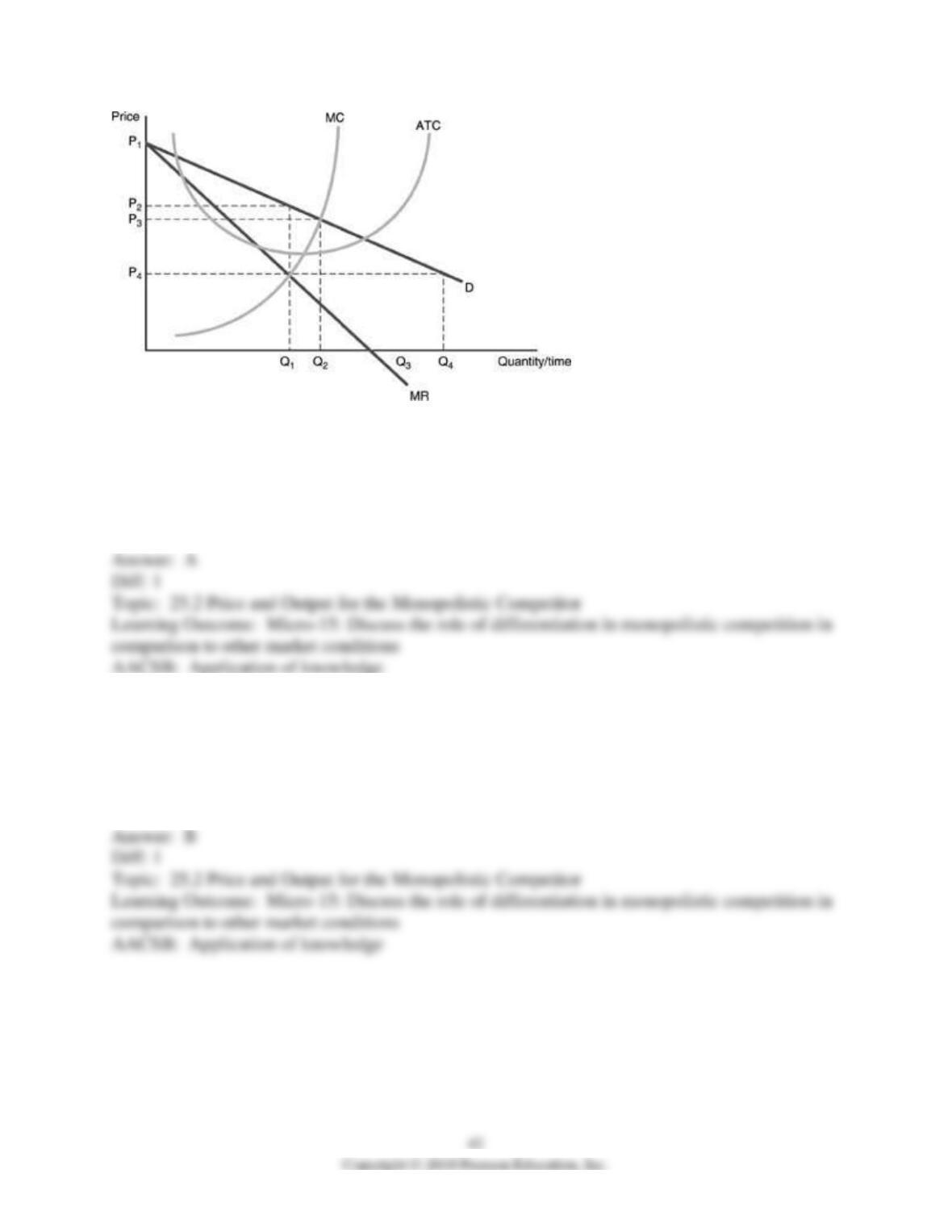
51) Refer to the above figure. The profit maximizing quantity for a monopolistic competitor is
A) Q1.
B) Q2.
C) Q3.
D) Q4.
52) Refer to the above figure. The profit maximizing price for a monopolistic competitor is
A) P1.
B) P2.
C) P3.
D) P4.
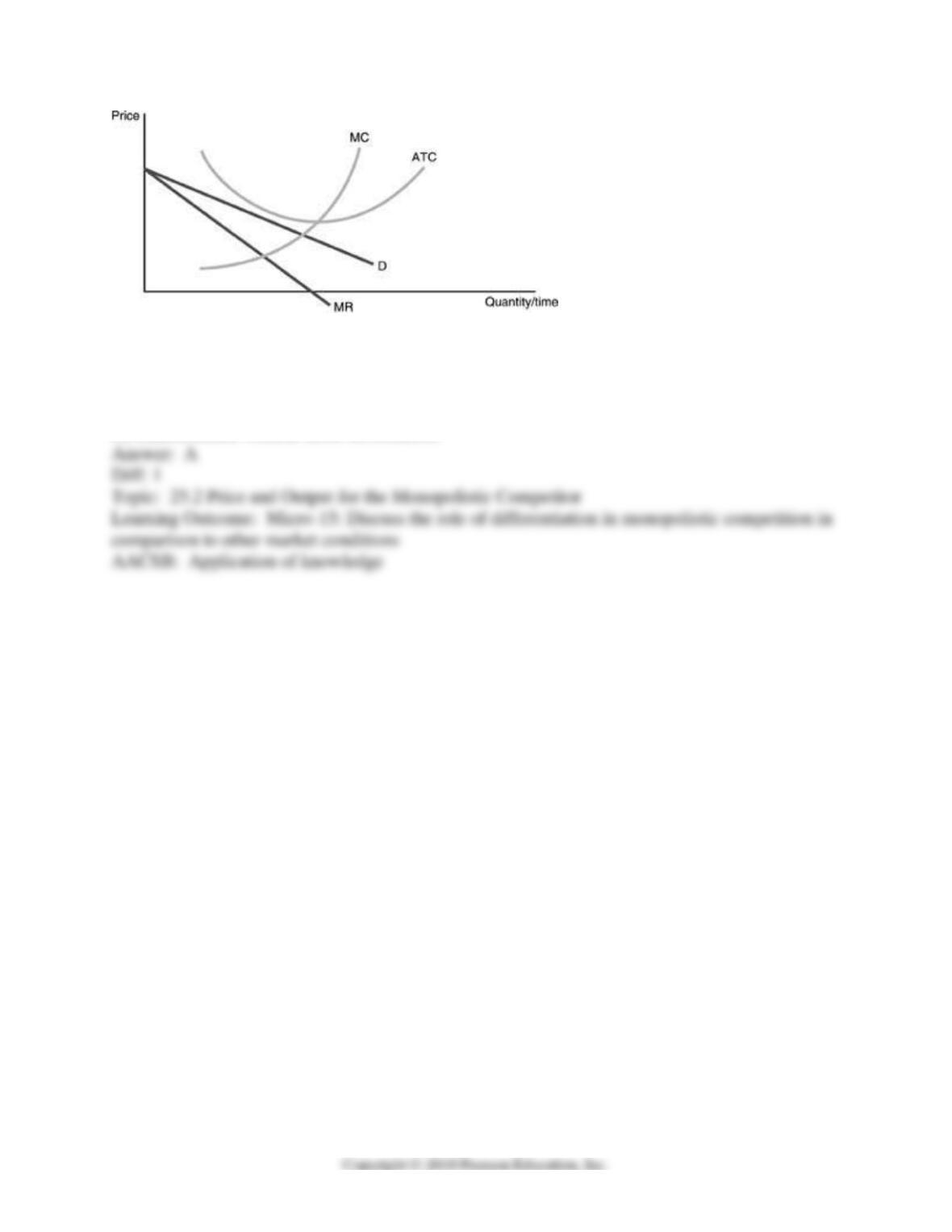
53) Refer to the above figure. As more and more firms are able to and actually do enter the
industry, the demand curve of each firm and its marginal revenue curve
A) will shift inward until the demand curve is tangent to the average total cost curve.
B) will become vertical.
C) will become upward sloping.
D) None of the above will occur.
54) Refer to the above figure. This firm is operating in the
A) long run since economic profits are greater than zero.
B) long run since economic profits are less than zero.
C) short run since economic profits are greater than zero.
D) short run since economic profits are less than zero.
55) Refer to the above figure. Economic profits for this firm are
A) negative.
B) zero.
C) positive.
D) undetermined without more information.
44
56) Refer to the above figure. Economic profits for this firm are
A) negative.
B) zero.
C) positive.
D) undetermined without more information.
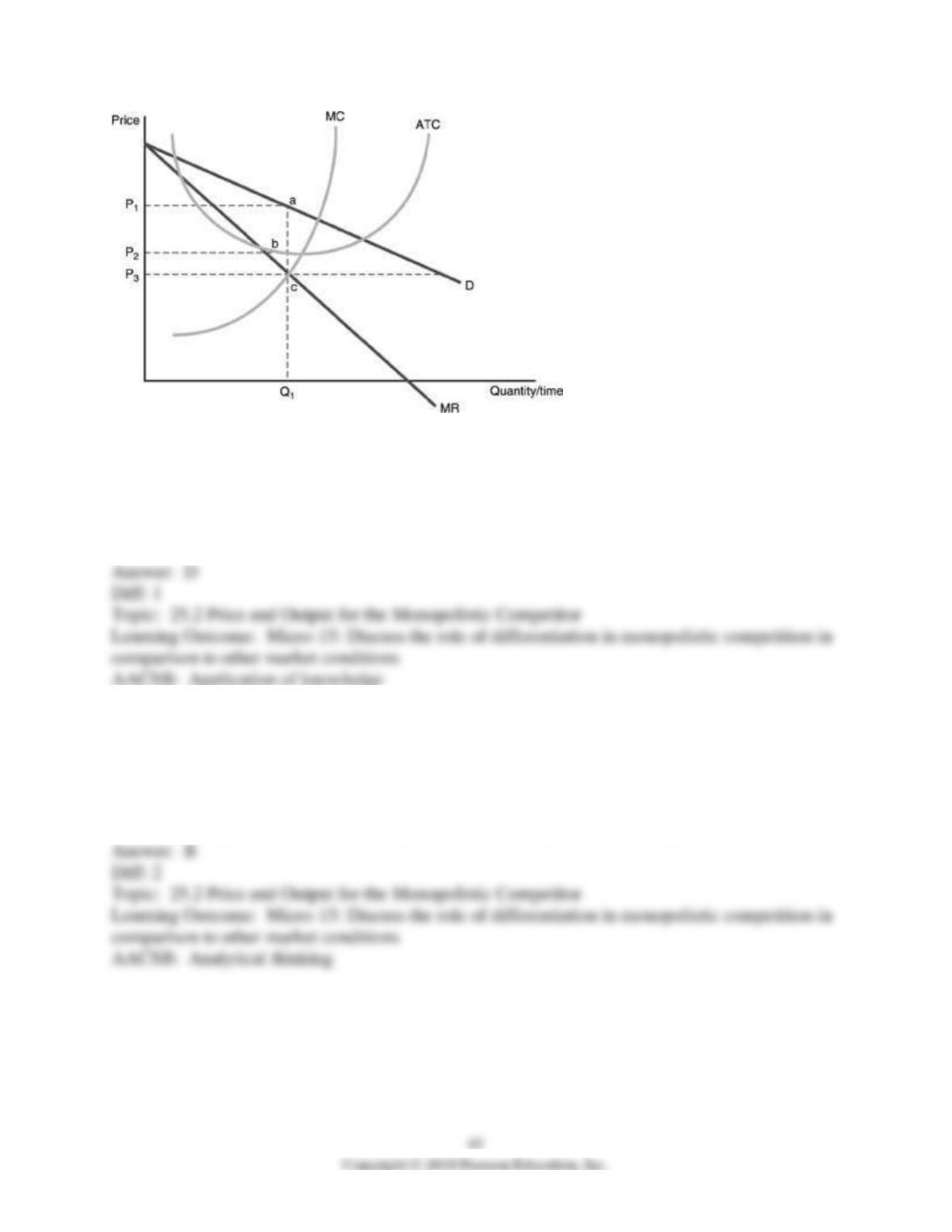
57) Refer to the above figure. Economic profits for this firm are
A) negative and equal to P2bcP3.
B) negative and equal to P1bcP2.
C) positive and equal to P2bcP3.
D) positive and equal to P1abP2.
58) A monopolistic competitor is in long-run equilibrium when
A) it is making zero profits and price equals marginal cost.
B) its average total cost curve is tangent to the demand curve at the profit-maximizing rate of
output.
C) price is greater than marginal cost.
D) it is making positive profits or zero profits and price is greater than marginal cost.
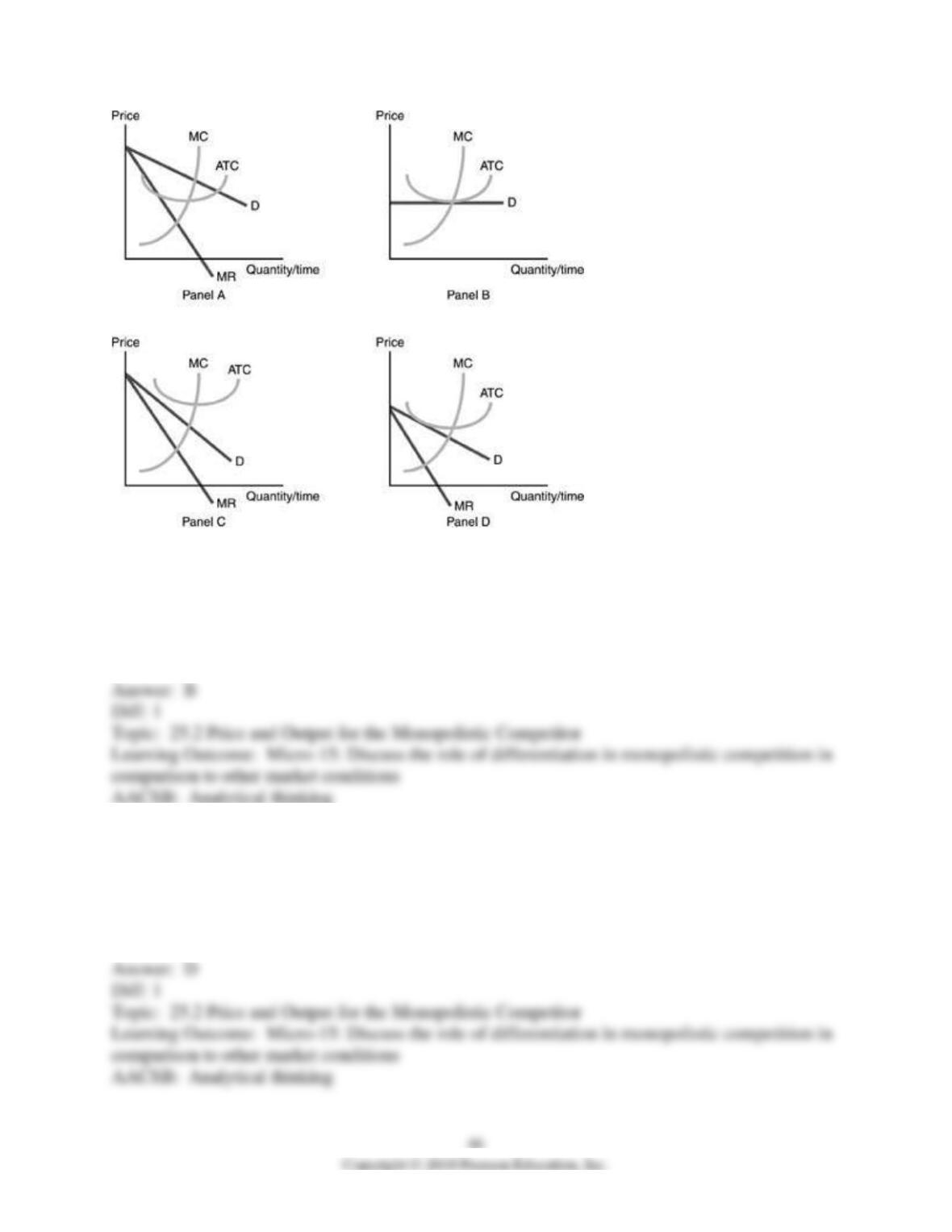
59) Refer to the above figure. Which panel does NOT represent a possible short-run situation for
a monopolistically competitive firm?
A) Panel A
B) Panel B
C) Panel C
D) Panel D
60) Refer to the above figure. Which panel represents the long-run situation for a
monopolistically competitive firm?
A) Panel A
B) Panel B
C) Panel C
D) Panel D
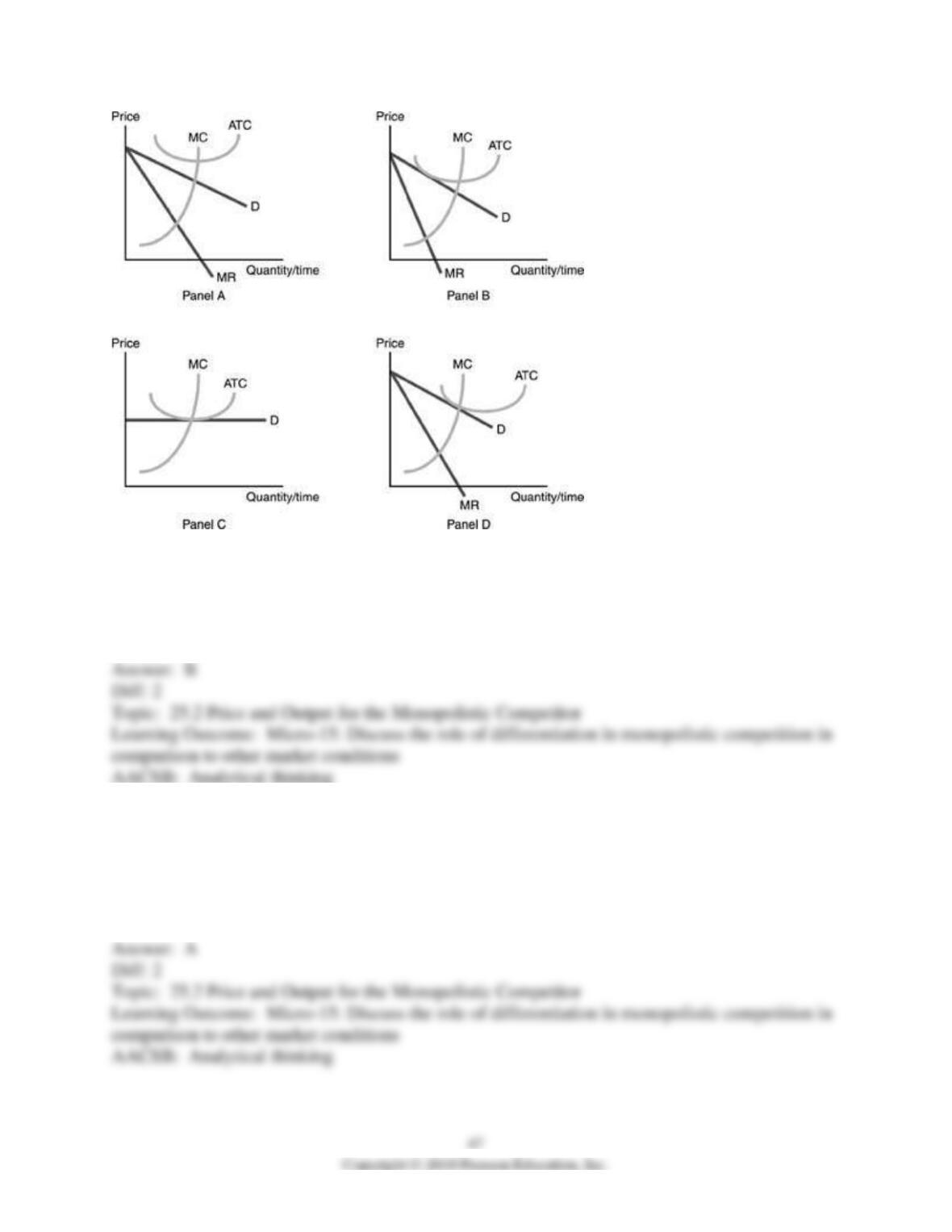
61) Refer to the above figure. A long-run equilibrium in monopolistic competition is pictured by
A) Panel A.
B) Panel B.
C) Panel C.
D) Panel D.
62) Refer to the above figure. Which panel shows a possible short-run equilibrium for
monopolistic competition, but is NOT also a long-run equilibrium?
A) Panel A
B) Panel B
C) Panel C
D) Panel D
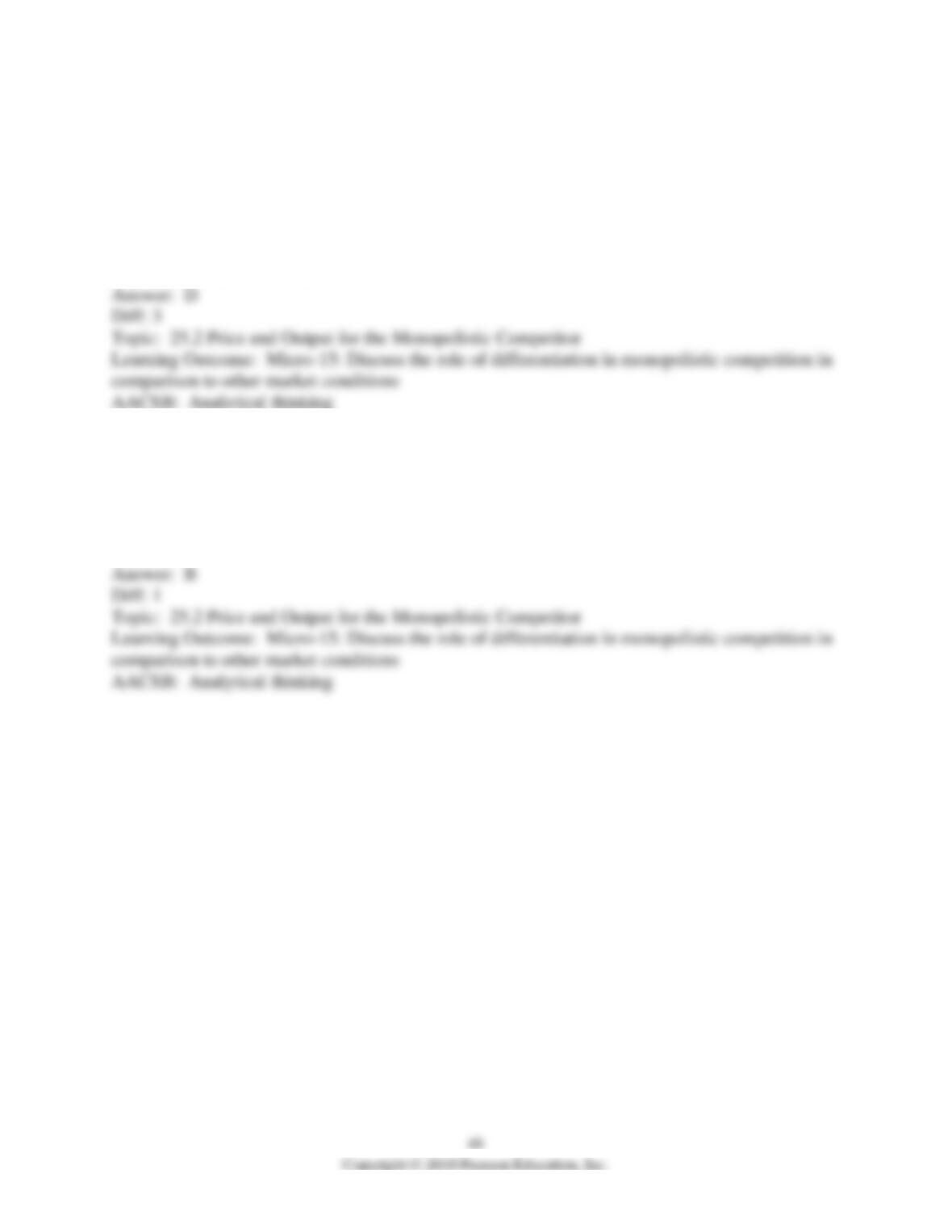
63) Refer to the above figure. Which of the following statements about panel D in the figure is
TRUE?
A) The figure represents a long-run equilibrium for a monopolistic competitor.
B) The figure represents an industry long-run equilibrium for monopolistic competition.
C) The figure is in error since it doesn’t show the monopolistic competitor making profits in the
long run.
D) The figure is in error since it has marginal cost intersecting the ATC curve at a point other
than the minimum of ATC.
64) Refer to the above figure. Which panel represents a monopolistic competitor that is earning
zero economic profits?
A) Panel A
B) Panel B
C) Panel C
D) Panel D
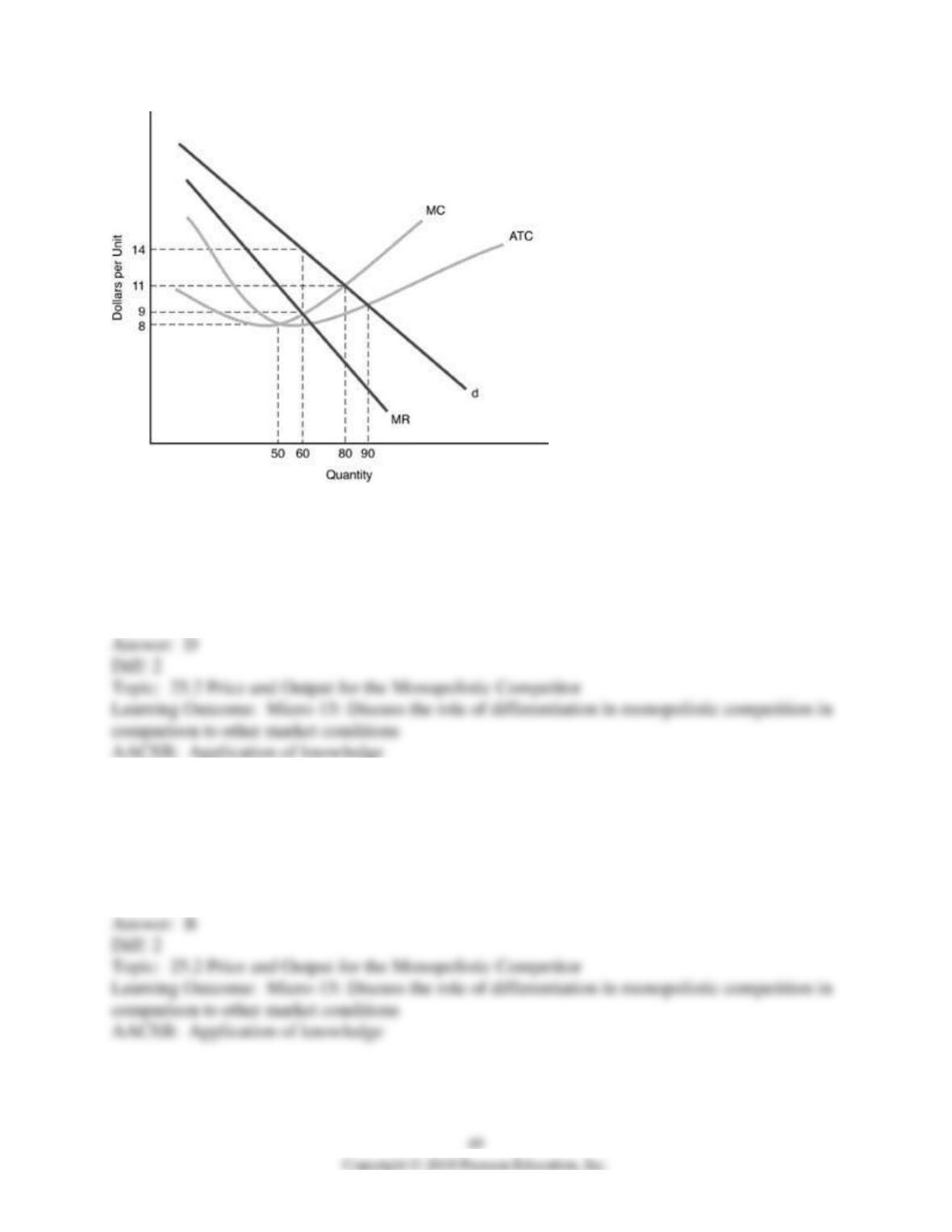
65) In the above figure for a monopolistically competitive firm, the profit-maximizing output and
price are respectively
A) 80 units and $11.
B) 50 units and $8.
C) 60 units and $9.
D) 60 units and $14.
66) In the above figure for a monopolistically competitive firm, the total revenue at the profit-
maximizing point is
A) $540.
B) $840.
C) $400.
D) $880.
67) In the above figure for a monopolistically competitive firm, the total cost at the profit-
maximizing point is
A) $480.
B) $400.
C) $540.
D) $880.
68) In the above figure for a monopolistically competitive firm, the total economic profit at the
profit-maximizing point is
A) $0.
B) $240.
C) $360.
D) $300.
69) In the above figure, what would happen to the monopolistically competitive industry in the
long run?
A) More producers would enter the market, and the share of the market to this firm would fall,
which would cause the demand curve to shift leftward until there is zero economic profit.
B) More producers would exit the market, and the share of the market to this firm would fall,
which would cause the demand curve to shift leftward until there is zero economic profit.
C) More producers would enter the market, and the share of the market to this firm would rise,
which would cause the demand curve to shift rightward until there is zero economic profit.
D) More producers would enter the market, and the share of the market to this firm would fall,
which would cause the demand curve to shift leftward until there is negative economic profit.
70) For the monopolistic competitor, which of the following is INCORRECT?
A) Because the firm is not a perfect competitor, its demand curve slopes downward.
B) The marginal revenue curve is downward sloping and lies below the demand curve.
C) The profit-maximizing rate of output arises at the point at which the marginal cost curve
intersects the marginal revenue curve.
D) If the firm in a monopolistically competitive industry were making economic losses, new
firms will enter the industry.
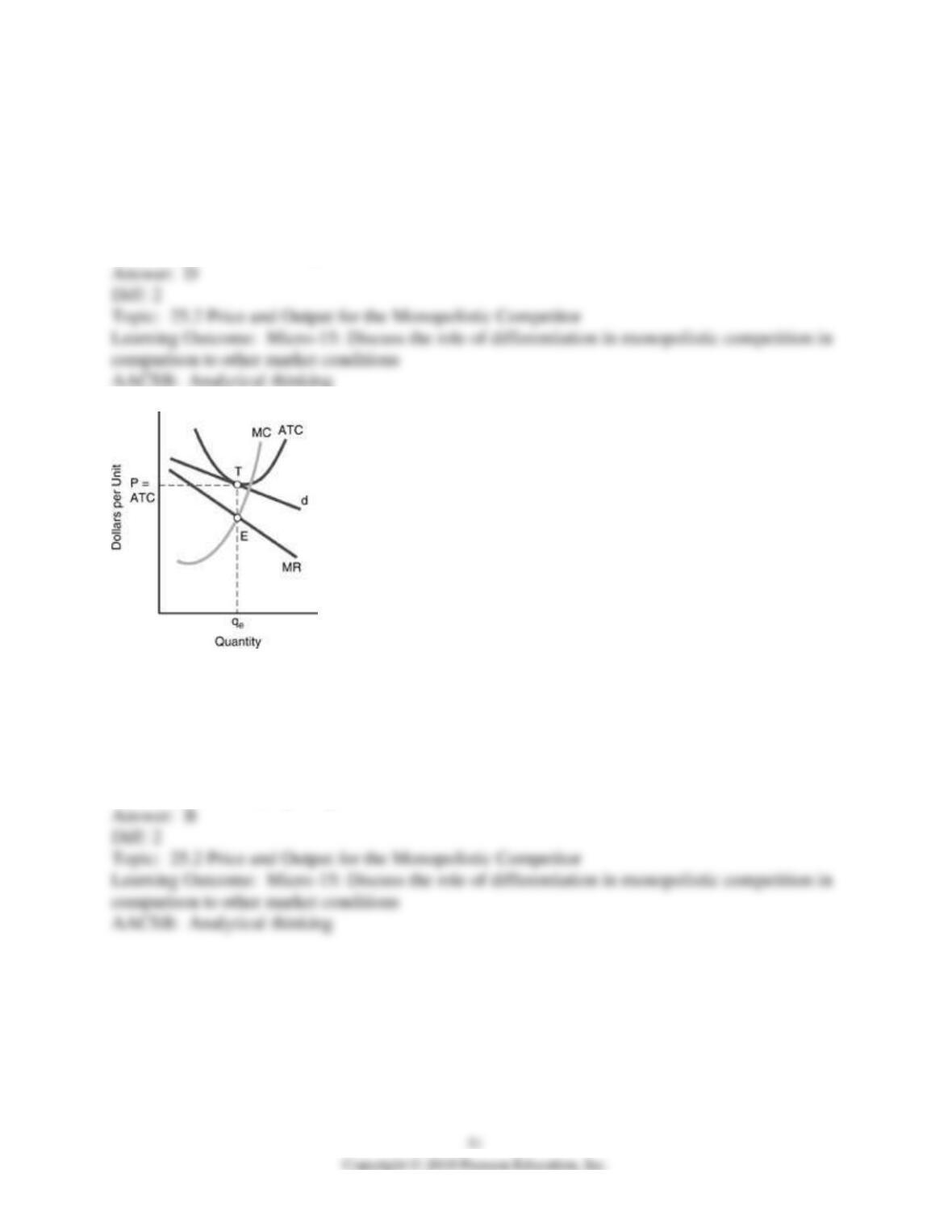
71) Use the above figure. For this monopolistic competitor, which of the following is
INCORRECT?
A) The profit-maximizing rate of output is qe, and the profit-maximizing price is P.
B) The demand curve shows a direct relationship between price and quantity demanded.
C) The profit-maximizing rate of output is at E, where MR intersects MC.
D) A downward sloping marginal revenue curve that is below the demand curve.
72) Use the above figure. The economic profit for this firm is
A) zero.
B) the distance between T and E.
C) the distance between E and x-axis.
D) the distance between T and x-axis.
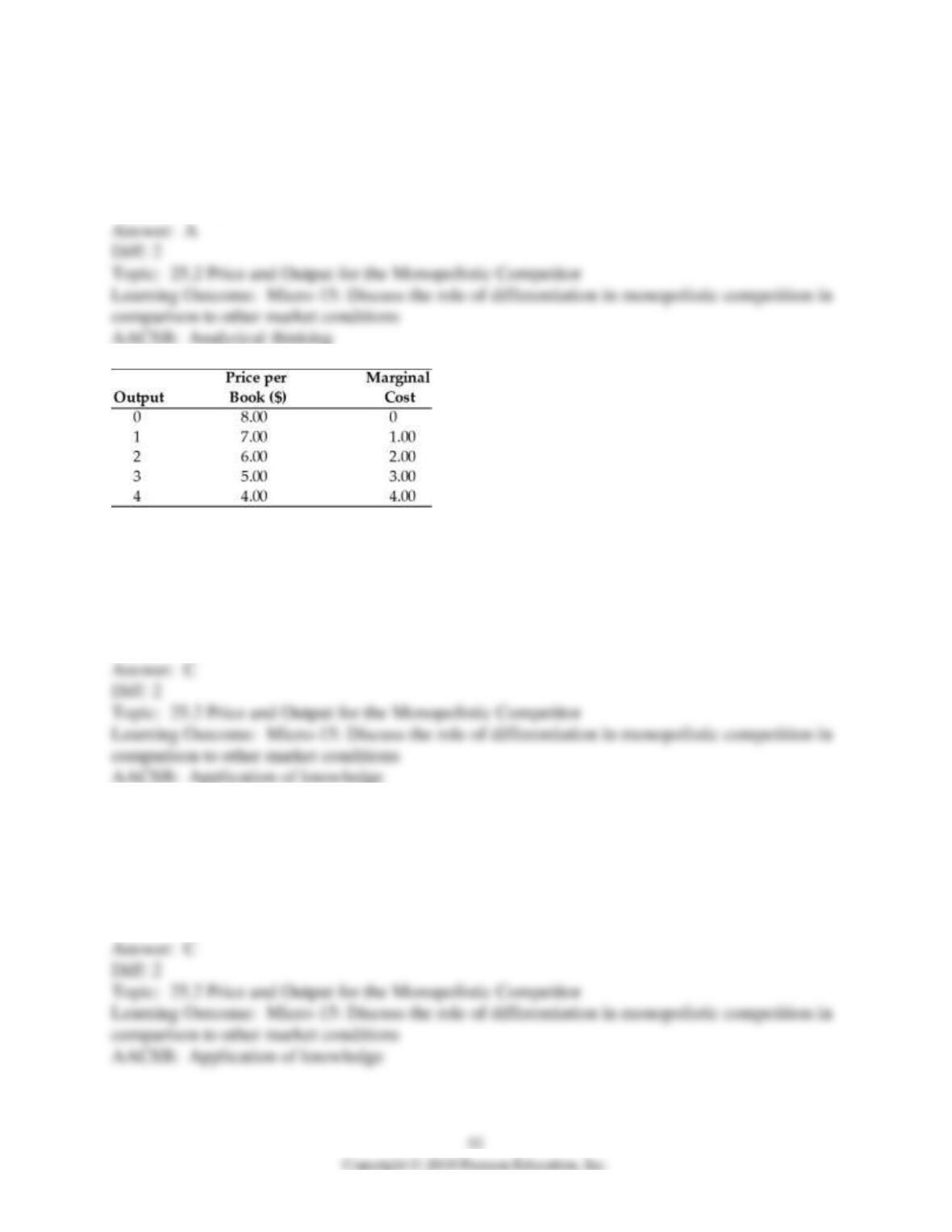
73) The above table depicts prices, quantities, and marginal costs faced by the campus bookstore.
At the profit-maximizing level of output, what is the total revenue earned by the store?
A) $12
B) $5
C) $15
D) $6
74) The above table depicts prices, quantities, and marginal costs faced by the campus bookstore.
Based on marginal analysis, what is the profit-maximizing level of output for the bookstore?
A) 1 book
B) 2 books
C) 3 books
D) 4 books
75) For a monopolistically competitive firm
A) price equals marginal revenue at all levels of output.
B) price is less than marginal revenue at all levels of output.
C) price is greater than marginal revenue at all levels of output except for the first unit.
D) the demand curve is perfectly inelastic and marginal revenue is zero.
76) A firm in a monopolistically competitive market determines the profit-maximizing output at
which
A) MR = P.
B) MR = ATC.
C) MR = AVC.
D) MR = MC.
77) Which of the following is TRUE of the price charged by a monopolistically competitive firm
at the profit-maximizing level of output?
A) P > MC
B) P = MC
C) P = MR
D) P < AVC
78) In the long run, a monopolistically competitive firm
A) earns positive economic profits.
B) earns zero economic profits.
C) earns negative economic profits.
D) can have positive, zero, or negative profits.
79) Which of the following short-run outcomes for monopolistic competition is NOT possible?
A) P = MR = MC.
B) P > MC > ATC.
C) P = ATC.
D) P > ATC.
80) Which of the following is the long-run outcome for monopolistic competition?
A) MR > MC.
B) P > ATC > MC.
C) P = ATC.
D) P > ATC.
81) A monopolistic competitor will maximize its profits at the output level at which
A) TC = TR.
B) MC = MR.
C) the MC curve intersects the demand curve.
D) MR = ATC.
82) In the long run, what level of economic profits can a monopolistic competitor expect to
receive?
A) positive
B) zero
C) negative
D) either negative or positive, depending on the demand for its product and its costs
83) Which of the following is NOT a characteristic of the demand curve faced by a firm in a
monopolistically competitive market?
A) The demand curve is downward sloping.
B) The slope of the demand curve is negative.
C) The firm will produce where the demand curve is inelastic.
D) The firm will produce where the demand curve is elastic.
84) The marginal revenue curve of a monopolistically competitive firm is
A) downward sloping and above the demand curve.
B) downward sloping and below the demand curve.
C) identical to the demand curve as there are many small firms in the market.
D) perfectly elastic.
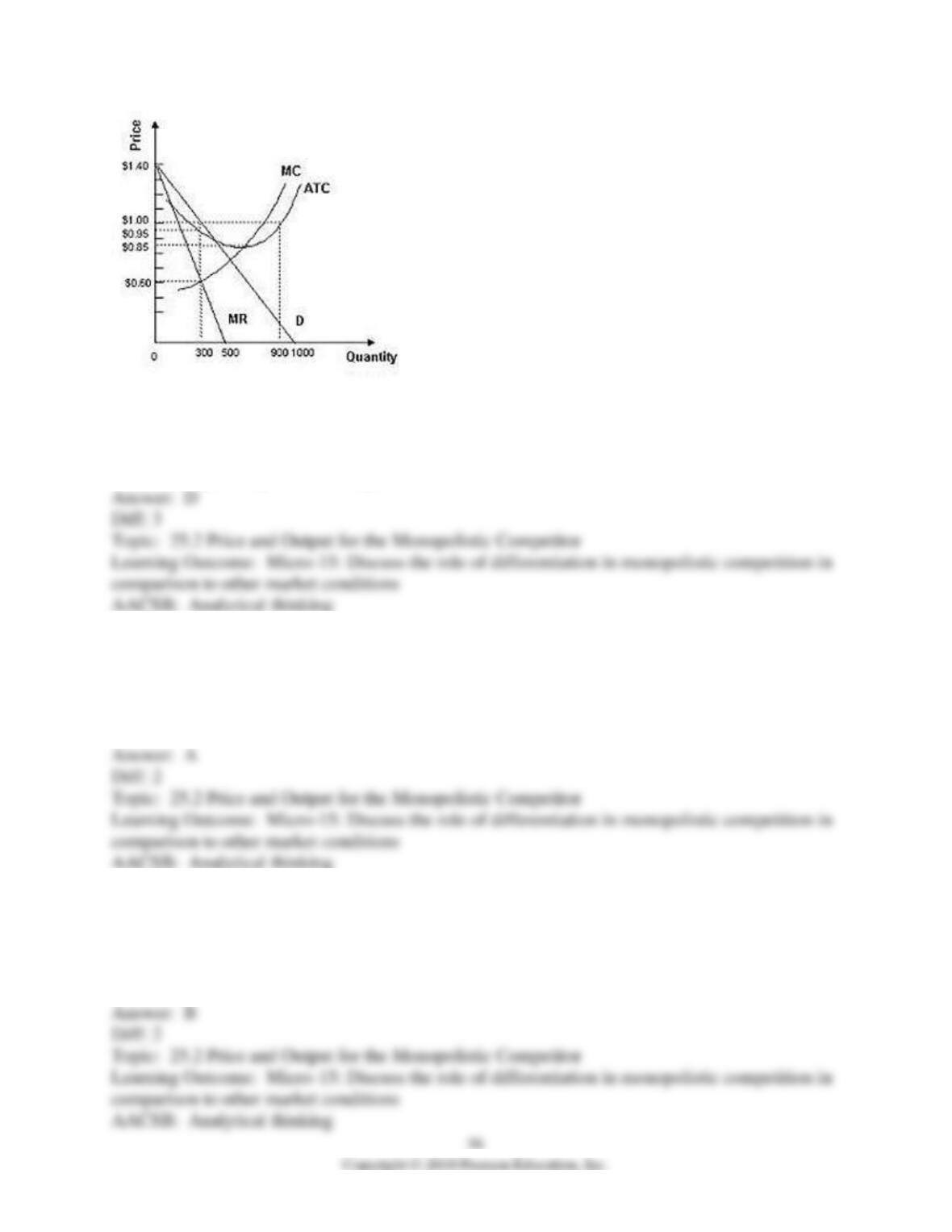
85) Use the above figure. The profit-maximizing monopolistically competitive firm
A) is losing $0.05 per unit of output.
B) is earning $0.40 per unit of output.
C) is earning $0.15 per unit of output.
D) is earning $0.05 per unit of output.
86) Use the above figure. The total revenue earned by the monopolistically competitive firm is
A) $300.
B) $285.
C) $180.
D) $255.
87) Use the above figure. The total profit earned by the monopolistically competitive firm is
A) +$300.
B) +$15.
C) -$15.
D) $0.
88) Use the above figure. The total cost of producing at the optimal level for the
monopolistically competitive firm is
A) $285.
B) $255.
C) $180.
D) $300.
89) The short-run profit-maximizing output level for a monopolistically competitive firm is the
point at which
A) P = ATC.
B) MR = MC.
C) MR > P.
D) MR > ATC.
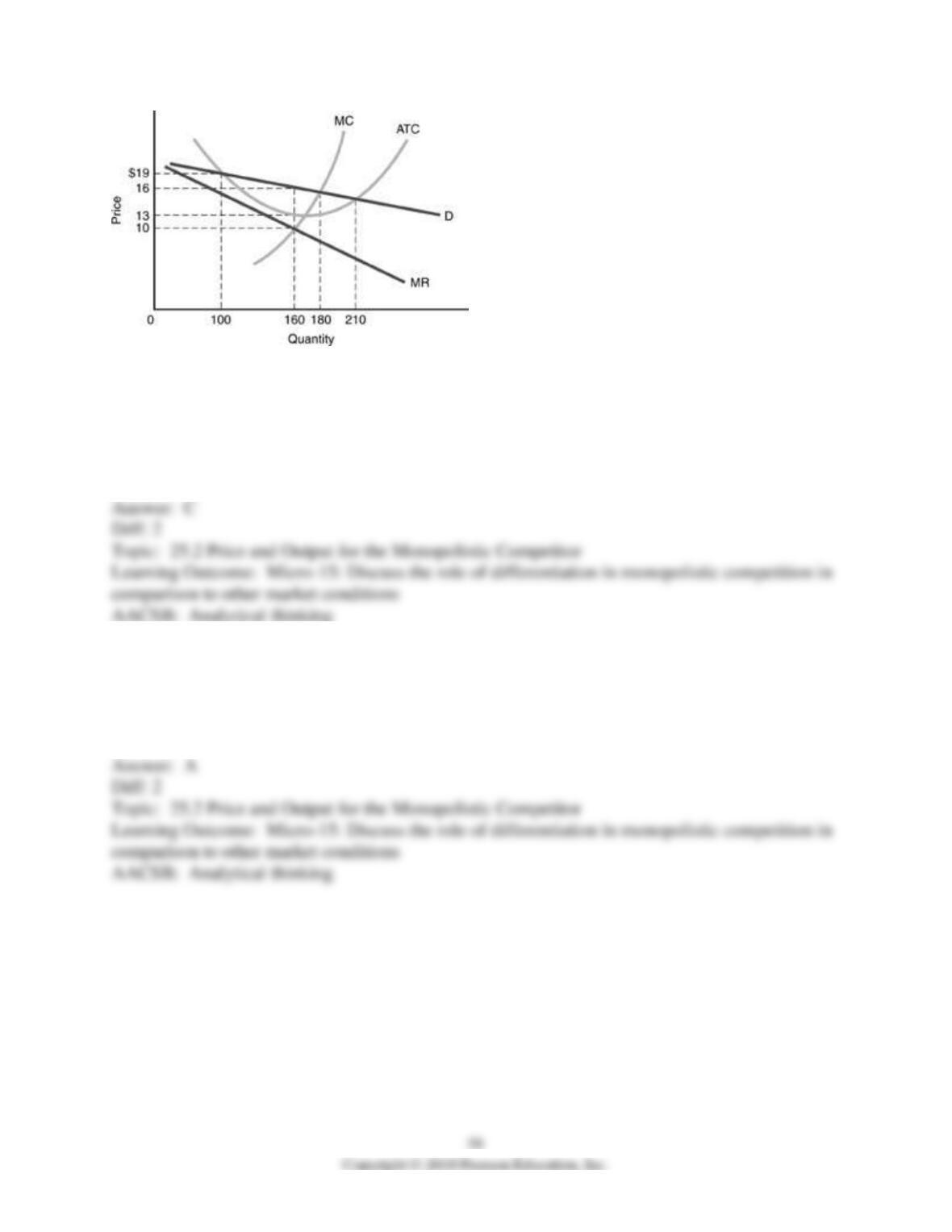
90) Use the above figure. The profit-maximizing output and price for this monopolistically
competitive firm are respectively
A) 100 and $19.
B) 160 and $13.
C) 160 and $16.
D) 210 and $15.
91) Use the above figure. The total revenue earned by this monopolistically competitive firm is
A) $2,560.
B) $1,600.
C) $480.
D) $1,900.
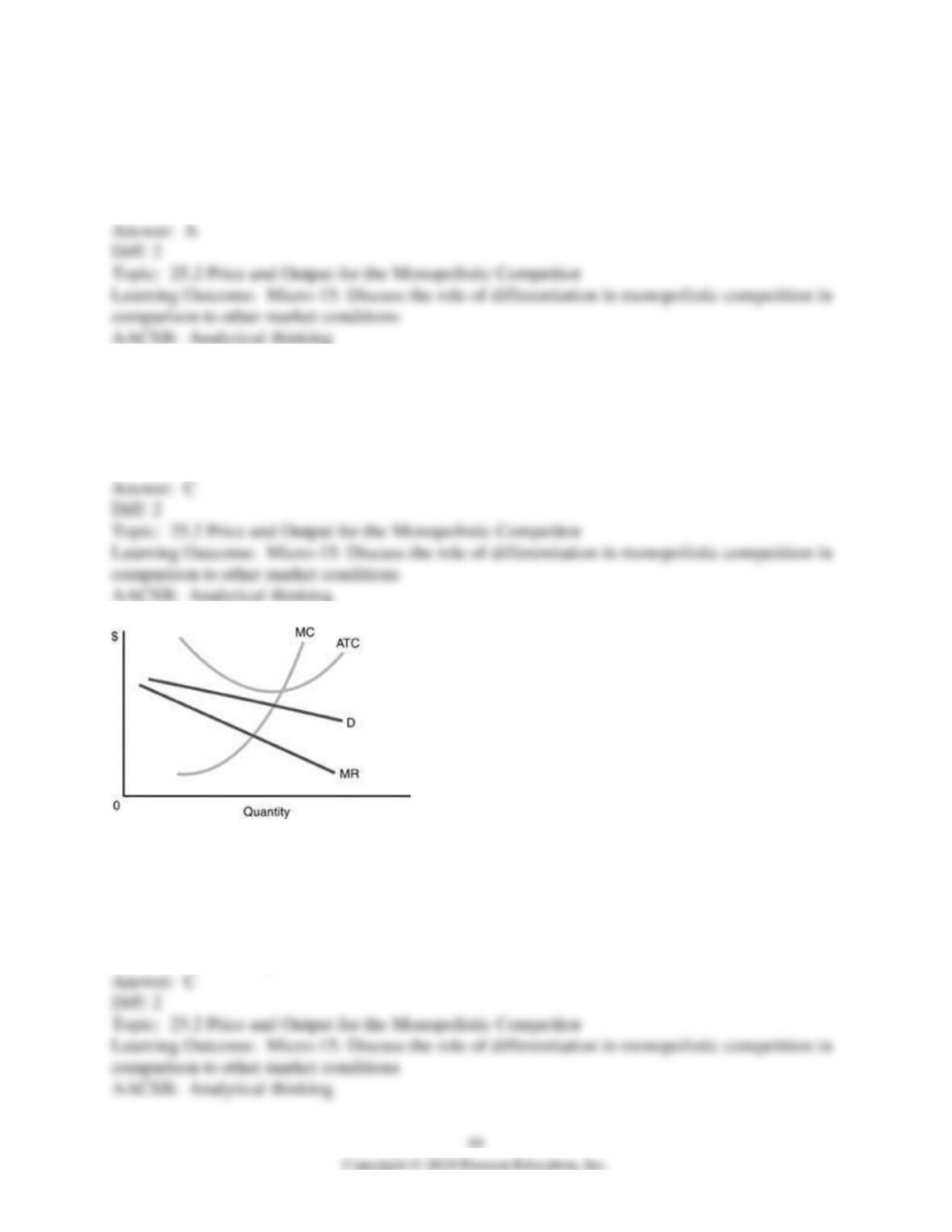
92) Use the above figure. The total cost earned by this monopolistically competitive firm is
A) $2,080.
B) $3,150.
C) $1,600.
D) $1,900.
93) Use the above figure. The total profit earned by this monopolistically competitive firm is
A) $2,560.
B) $1,600.
C) $480.
D) $1,900.
94) Use the above figure. When it maximizes its economic profits, the monopolistically
competitive firm depicted in the figure
A) is earning an economic profit.
B) is earning an accounting profit.
C) is earning an economic loss.
D) must increase output to reduce the ATC.
95) Which of the following statements is TRUE for a monopolistically competitive firm in the
long run?
A) P = ATC > MR
B) MC > P > ATC
C) P > MC > ATC
D) P = MC = MR
96) In the long run, the economic profits of a monopolistically competitive firm
A) will tend to be larger than in the short run.
B) equal zero.
C) will be the average short-run profits earned in the last five years.
D) will be the same as in the short run.
97) Suppose a sushi restaurant is making significant economic profit in the short run. In the long
run
A) more people will open sushi restaurants, reducing the economic profit for each restaurant.
B) high barriers to entry keep people from opening sushi restaurants.
C) the government will require the sushi restaurant to sell part of its interests in the city.
D) more people will open steak restaurants, increasing the economic profit for the sushi
restaurant.