Chapter 25
The Economics of Prescription Drugs
Multiple Choice
1. In 2009 prescription drugs account for approximately ____ of total health care spending
A) 2.5%
B) 10%
C) 25%
D) 50%
2. A patent is a legal device which prevents
A) a company from charging whatever it likes for its product.
B) others from copying an invention.
C) others from copying music and books without author permission.
D) companies from charging unreasonable amounts for their invention.
3. Patents grant the inventor the exclusive rights to sell goods made with the invention
A) for a limited duration.
B) as long as the inventor is alive.
C) forever.
D) as long as the inventor charges what are viewed as reasonable prices.
4. A patent is
A) a right granted to an inventor by the government to be the exclusive seller of a good.
B) often necessary to motivate inventions.
C) never granted for inventions anymore.
D) a right granted to an inventor by the government to be the exclusive seller of a good and
is often necessary to motivate inventions.
5. A patent
A) is a right granted to an inventor by the government to be the exclusive seller of a good.
B) makes inventing the good less appealing.
C) makes a good that has recently been invented more expensive than it would otherwise be.
D) is both a right granted to an inventor by the government to be the exclusive seller of a
good and makes a good that has recently been invented more expensive than it would
otherwise be.
6. A patent
A) is better for a writer of books than it is for an inventor of medicines.
B) is often necessary to motivate inventions.
C) makes a good that has recently been invented more expensive than it could be.
D) is often necessary to motivate inventions and makes a good that has recently been
invented more expensive than it could be.
7. A patent
A) is better for a writer of books than it is for an inventor of medicines.
B) is often necessary to motivate inventions.
C) is never sought for inventions anymore.
D) makes inventing the good less appealing.
8. A patent
A) is better for a writer of books than it is for an inventor of medicines.
B) makes a good that has recently been invented more expensive than it would otherwise be.
C) is never sought for inventions anymore.
D) makes inventing the good less appealing.
9. A patent
A) is better for a writer of books than it is for an inventor of medicines.
B) a right granted to an inventor by the government to be the exclusive seller of a good.
C) is never granted for inventions anymore.
D) makes inventing the good less appealing.
10. The main reason why monopoly governs prescription drugs is
A) a conspiracy to get as much profit as possible.
B) to motivate innovation.
C) to keep prices high so only the people that need them will buy them.
D) to keep prices high so only the people that need them will buy them and to motivate
innovation.
11. An orphan drug is designed to treat
A) an illness that afflicts few people.
B) people without parents.
C) an illness affecting large numbers of people.
D) an illness that causes parents to die.
12. Without orphan drug laws
A) people without parents could not afford drugs.
B) more people would risk losing their parents to disease.
C) people with common diseases would be have little hope of companies seeking a cure for
their ailment.
D) people with uncommon diseases would have little hope of companies seeking a cure for
their ailment.
13. The demand curve for AIDS drugs is likely to be
A) vertical or close to vertical.
B) upward sloping.
C) horizontal or close to horizontal.
D) no different that the demand for aspirin.
14. Relative to a cure for AIDS, the demand for an AIDS vaccine would be
A) more elastic.
B) more inelastic.
C) equal in elasticity.
D) not as elastic.
15. The reason why a cure to a disease such as AIDS would have less elastic demand than a
vaccine at every price is that
A) the vaccine would be more expensive.
B) the cure would be more expensive.
C) for a person with AIDS the only alternative to the cure is death.
D) for a person with AIDS a vaccine would be more effective.
16. The reason why a cure to a disease such as AIDS would have less elastic demand than a
vaccine at every price is that
A) the vaccine would be more expensive.
B) the cure would be more expensive.
C) for a person without AIDS there is a freely available substitute-monogamy with an
unaffected partner.
D) for a person without AIDS there are no substitutes.
17. The “price” of effectively treating AIDS
A) has gone up substantially with the invention of new drugs that cost more than the older
ones.
B) has gone down substantially with the invention of new drugs that cost less than the older
ones.
C) is very difficult to estimate, because prior to the new drugs there was no effective
treatment.
D) has stayed the same.
18. Monopoly power exists in drug inventions because of
A) patents for drugs.
B) inelastic demand for drugs.
C) elastic demand for drugs.
D) elastic supply.
19. Economists estimate that the rate of return to prescription drug companies is
A) much above the average.
B) at or slightly above the average.
C) slightly below average.
D) much below average.
20. Once a drug has been invented, marginal production costs are typically
A) much less than price.
B) about the same as the price.
C) much greater than the price.
21. After a drug has been invented, monopoly (when compared to perfect competition) creates
A) more production.
B) lower profits to firms.
C) higher prices to consumers.
D) more production and higher prices to consumers.
22. After a drug has been invented, monopoly (when compared to perfect competition) creates
A) dead weight loss.
B) lower profits to firms.
C) higher prices to consumers.
D) dead weight loss and higher prices to consumers.
23. After a drug has been invented, monopoly (when compared to perfect competition) creates
A) dead weight loss.
B) greater profits to firms.
C) lower prices to consumers.
D) dead weight loss and lower prices to consumers.
24. Existence of a “deadweight loss” in the prescription drug market indicates that
A) the number of new drugs invented is less than the optimal number.
B) the increased profits to firms is greater than the decreased net value to consumers.
C) the increased profits to firms is less than the decreased net value to consumers.
D) the number of new drugs invented is less than the optimal number and the increased
profits to firms is less than the decreased net value to consumers.
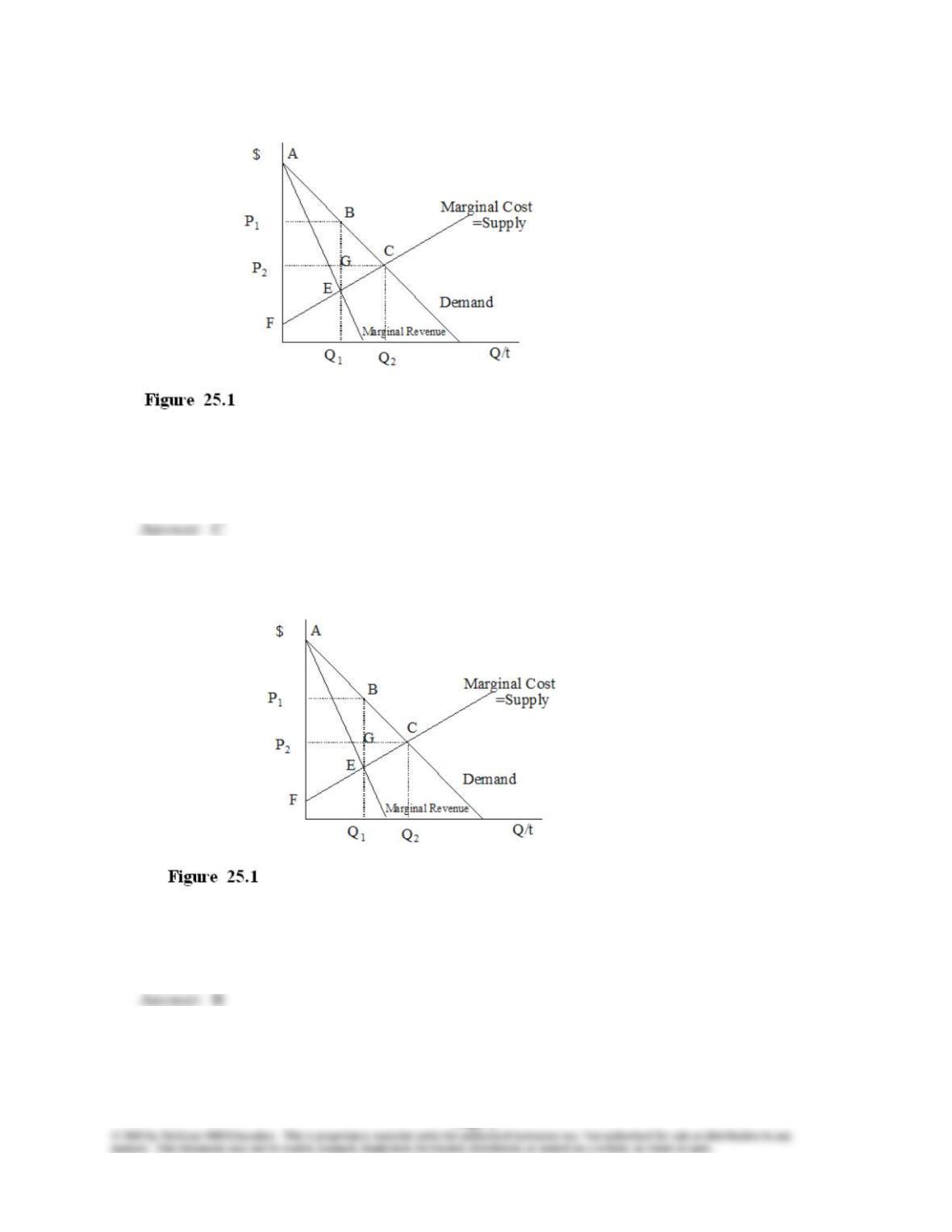
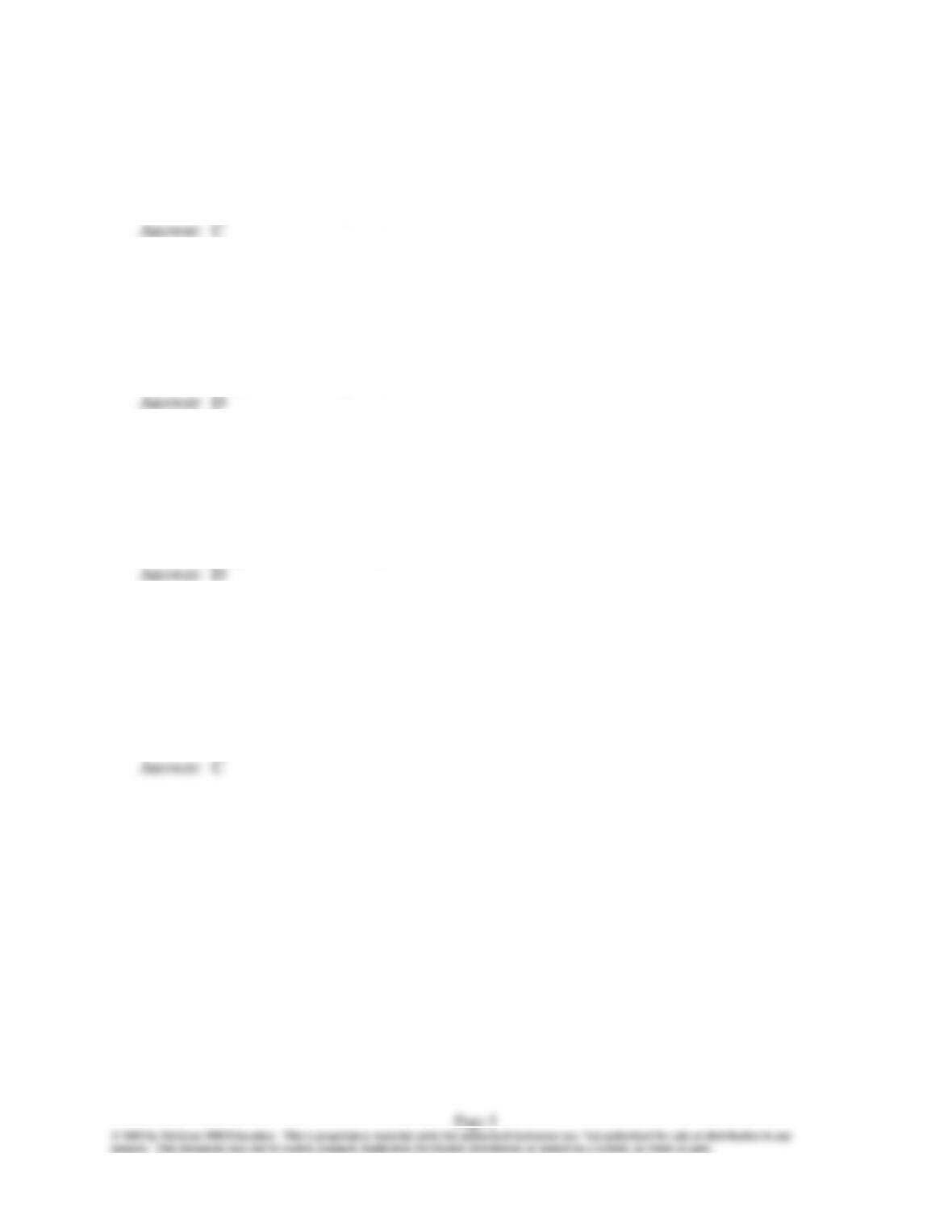
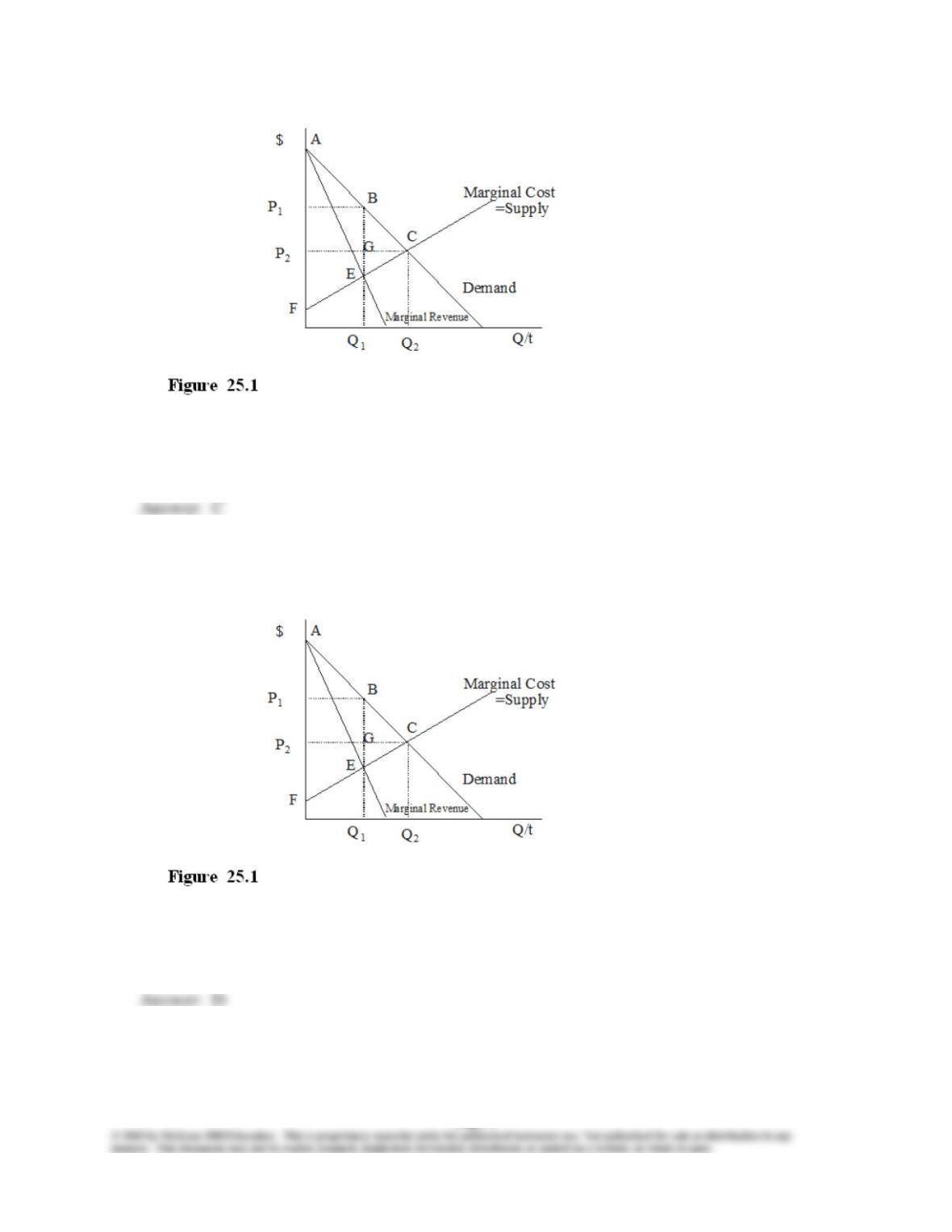
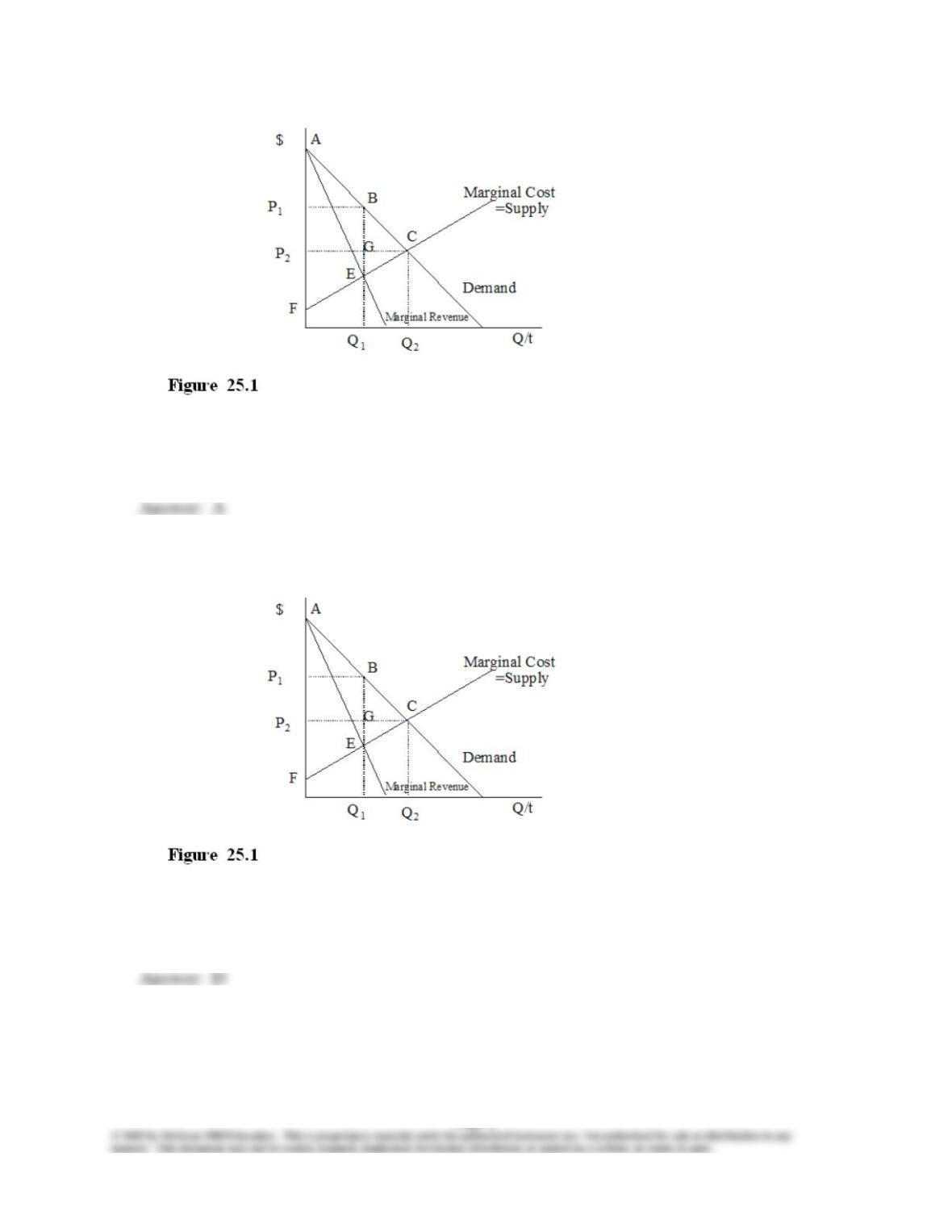
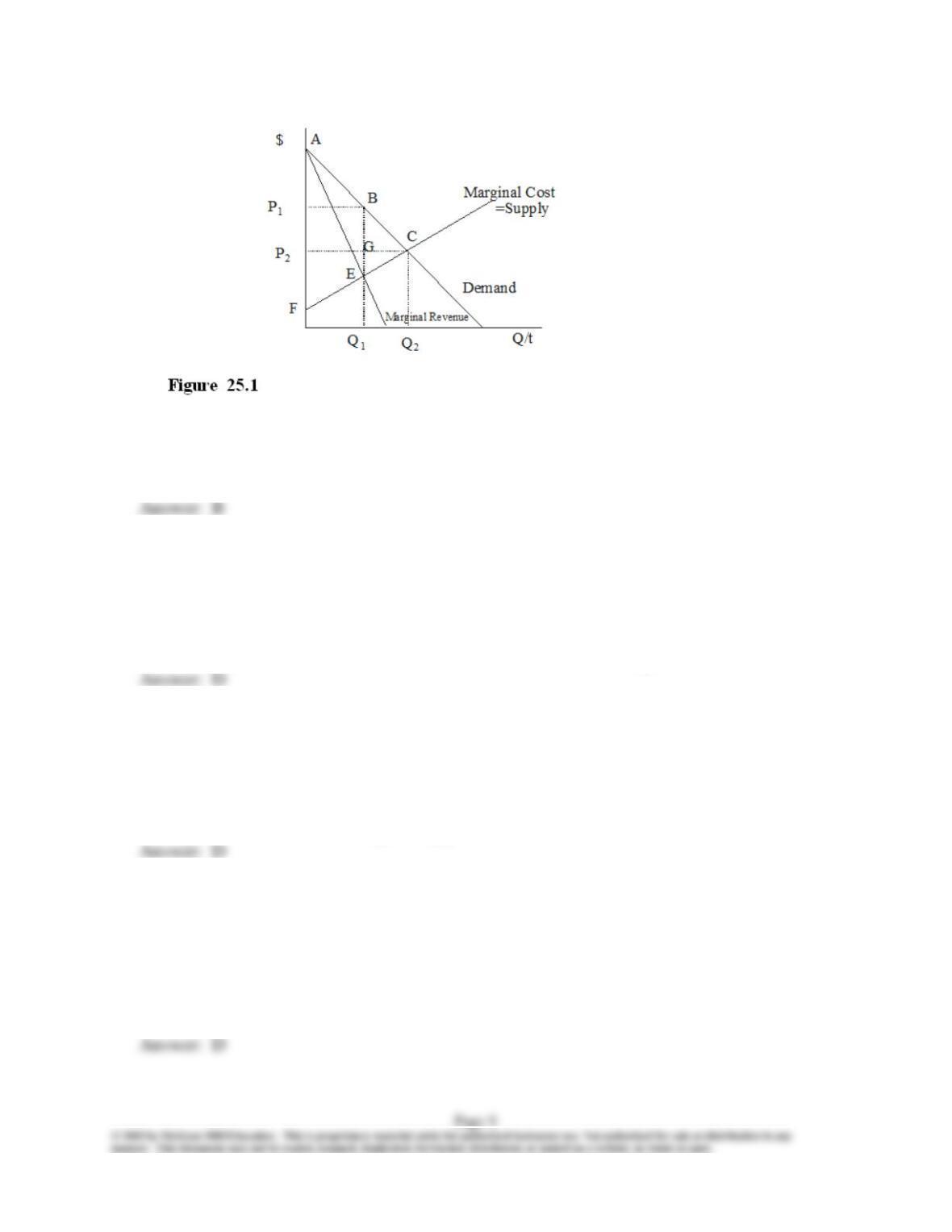
25. In Figure 25.1, the price under perfect competition is
A) A
B) P1
C) P2
D) F
26. In Figure 25.1, the price under monopoly is
A) A
B) P1
C) P2
D) F
27. In Figure 25.1, the dead weight loss that occurs with this monopoly is
A) FAC
B) FABE
C) EBC
D) P2AC
28. In Figure 25.1, consumer surplus under perfect competition is
A) FAC
B) FABE
C) EBC
D) P2AC
29. In Figure 25.1, producer surplus under perfect competition is
A) FP2C
B) FABE
C) EBC
D) P2AC
30. In Figure 25.1, consumer surplus under monopoly is
A) FAC
B) FABE
C) EBC
D) P1AB
31. In Figure 25.1, producer surplus under monopoly is
A) FP2C
B) FP1BE
C) EBC
D) P2AC
32. Between 1986 and 2011 prescription drug prices rose
A) slower than overall inflation.
B) slower than inflation for over-the-counter drugs.
C) at the same rate as over-the-counter drugs.
D) faster than overall inflation and faster than over-the counter drugs.
33. Drug companies tend to attribute higher drug prices on
A) high invention costs.
B) long testing processes.
C) doctors distributing too many free samples.
D) high invention costs and long testing processes.
34. Drug companies tend to attribute higher drug prices on
A) the low percentage of attempts that actually result in revenue producing drugs.
B) long testing processes.
C) doctors distributing too many free samples.
D) the low percentage of attempts that actually result in revenue producing drugs and long
testing processes.
35. Drug companies tend to attribute higher drug prices on
A) the low percentage of attempts that actually result in revenue producing drugs.
B) high invention costs.
C) doctors distributing too many free samples.
D) the low percentage of attempts that actually result in revenue producing drugs and high
invention costs.
36. Drug companies tend to attribute higher drug prices on
A) pharmacies charging too much for drugs.
B) long testing processes.
C) doctors distributing too many free samples.
D) pharmacies charging too much for drugs and long testing processes.
37. Drug companies tend to attribute higher drug prices on
A) the low percentage of attempts that actually result in revenue producing drugs.
B) pharmacies charging too much for drugs.
C) doctors distributing too many free samples.
D) the low percentage of attempts that actually result in revenue producing drugs and
pharmacies that charge too much for drugs.
38. Drug companies tend to attribute higher drug prices on
A) the low percentage of attempts that actually result in revenue producing drugs.
B) high litigation costs on drugs that are ultimately shown to be dangerous.
C) doctors distributing too many free samples.
D) the low percentage of attempts that actually result in revenue producing drugs and high
litigation costs on drugs that are ultimately shown to be dangerous.
39. Drug companies tend to attribute higher drug prices on
A) pharmacies charging too much for drugs.
B) high litigation costs on drugs that are ultimately shown to be dangerous.
C) doctors distributing too many free samples.
D) Pharmacies charging too much for drugs and high litigation costs on drugs that are
ultimately shown to be dangerous.
40. Drug companies tend to attribute higher drug prices on
A) the low percentage of attempts that actually result in revenue producing drugs.
B) high litigation costs on drugs that are ultimately shown to be dangerous.
C) doctors distributing too many free samples.
D) the low percentage of attempts that actually result in revenue producing drugs and high
litigation costs on drugs that are ultimately shown to be dangerous.
41. Most prescriptions are written for
A) live-saving drugs.
B) live-extending drugs.
C) drugs which simply make life more comfortable or enjoyable.
D) over-the-counter drugs.
42. Economists generally agree that price controls in the U.S. would
A) increase prices to consumers.
B) increase the motivation to invent new drugs.
C) diminish profits to drug companies.
D) increase the motivation to invent new drugs and diminish profits to drug companies.
43. Economists generally agree that price controls in the U.S. would
A) increase prices to consumers.
B) diminish the motivation to invent new drugs.
C) diminish profits to drug companies.
D) diminish the motivation to invent new drugs and diminish profits to drug companies.
44. Economists generally agree that price controls in the U.S. would
A) diminish prices to consumers.
B) increase the motivation to invent new drugs.
C) increase profits to drug companies.
D) increase the motivation to invent new drugs and increase profits to drug companies.
45. FDA approval is ______ if the increase in costs to patients ( including the increase in
deaths) is greater than the increase in benefits due to more rapid approval
A) too lax
B) too stringent
C) just right
46. FDA approval is ______ if the increase in costs to patients ( including the increase in
deaths) is equal to the increase in benefits due to more rapid approval
A) too lax
B) too stringent
C) just right
47. FDA approval is ______ if the increase in costs to patients ( including the increase in
deaths) is less than the increase in benefits due to more rapid approval
A) too lax
B) too stringent
C) just right
D)
48. That U.S. drug companies can sell their drugs in Canada and Mexico for much less than they
sell them for in the U.S. suggests that the
A) drugs sell for less than their marginal cost in Canada and Mexico
B) marginal cost of producing the drugs is between the U.S. price and the Canadian price (so
on average the company is making a profit)
C) marginal cost of producing the drugs is less than the Canadian and Mexican price
D) marginal cost of producing the drugs is higher than even the U.S. price.
49. If the U.S. government were to note that because drug companies can sell their drugs in
Canada and make a profit at those regulated prices and impose a similar set of regulations in
the U.S. this would have the effect of
A) lowering the price of drugs in the U.S.
B) increasing the motivation for U.S. drug companies to innovate in the future
C) increasing the motivation for Canadian drug companies to innovate in the future
D) eliminating all profit for drug companies
50. If the U.S. government were to note that because drug companies can sell their drugs in
Canada and make a profit at those regulated prices and impose a similar set of regulations in
the U.S. this would have the effect of
A) raising the price of drugs in the U.S.
B) decreasing the motivation for U.S. drug companies to innovate in the future
C) increasing the motivation for Canadian drug companies to innovate in the future
D) eliminating all profit for drug companies
51. When a drug ceases to require a prescription it is said to have gone
A) off-the-rack
B) off-the-wagon
C) off-label
D) over-the-counter
52. Between 1986 and 2011, while the general price level increased by 110%, prescription drug
prices
A) rose by 55% and nonprescription drug prices rose by 102%.
B) rose by 236% and non-prescription drug prices rose by 294%.
C) rose by 226% and non-prescription drug prices rose by 60%.
D) rose by 552% and non-prescription drug prices rose by 236%.
53. “Restless Leg Syndrome” (RLS) was identified by GlaxoSmithKline in marketing Requip to
A) target a relatively poor segment of the patient population.
B) convince restless people that they might have a curable ailment.
C) shift the demand curve for Requip to the left.
D) all of the options are correct.
54. With the election of President Obama, it is likely that U.S. drug laws will be changed to
A) permit re-importation
B) prohibit re-importation
C) ban television advertising of prescription drugs
D) restrict malpractice lawsuits
55. U.S. drug laws prohibiting re-importation of prescription drugs prevent
A) American pharmaceutical distributors from re-selling to Canadian citizens at higher
prices.
B) the U.S. government from dictating the drug prices to be paid by Canadian citizens.
C) U.S. pharmaceutical companies from earning monopoly profits.
D) Canadian pharmaceutical distributors from re-selling to American citizens at higher
prices.
56. U.S. drug laws prohibiting re-importation of prescription drugs prevent
A) American pharmaceutical distributors from re-selling to Canadian citizens at higher
prices.
B) the Canadian government from dictating the drug prices to be paid by U.S. citizens.
C) U.S. pharmaceutical companies from earning monopoly profits.
D) Canadian pharmaceutical distributors from re-selling to American citizens at lower
prices.
57. Drugs that are labeled “orphan drugs” are
A) made available at no cost to children who have lost their parents.
B) granted very short-lived patents.
C) granted very long-lived patents.
D) denied patent protection entirely.
58. A prescription drug price policy that generates dead weight loss implies that the
A) loss to consumers is greater than the loss to firms.
B) loss of firms is greater than the loss to consumers.
C) loss to consumers is greater than the gain to firms.
D) gain to consumers is less than the loss to firms.
59. Which of the following legal creations is imperative to creating profits for prescription drug
companies?
A) Trademarks
B) Copyrights
C) Patents
D) Corporations
60. Patents on prescription drugs last
A) forever.
B) from the moment they have been received by the patent office until they are approved by
the FDA.
C) from the moment they have been received by the patent office until they hit the market.
D) from the moment they have been received by the patent office and for several more.
years.
61. Which patent would last the longest?
A) One for a drug that has many similar ones in existence.
B) One for a drug that treats a very rare disease.
C) One for a drug that treats a life-threatening disease.
D) One for a drug that treats a very common disease.
62. In debating whether drug companies have high rates of return or moderate rates of return,
economists favoring the drug industry’s point of view are that those opposing it overlook one
key factor that, if you ignore, leads to an overstated rate of return. It is the
A) opportunity cost of the money invested in the invention and testing of the drug.
B) marketing costs.
C) costs of testing.
D) costs of invention.