45) In order to sell more output units, what must a monopoly do?
A) reduce output price
B) reduce input price
C) increase output price
D) increase input price
46) For a monopolist, marginal revenue is always
A) greater than price.
B) equal to price.
C) equal to zero.
D) less than price.
47) Unlike a perfectly competitive firm, a monopolist faces a demand curve that is
A) upward sloping.
B) horizontal.
C) vertical.
D) downward sloping.
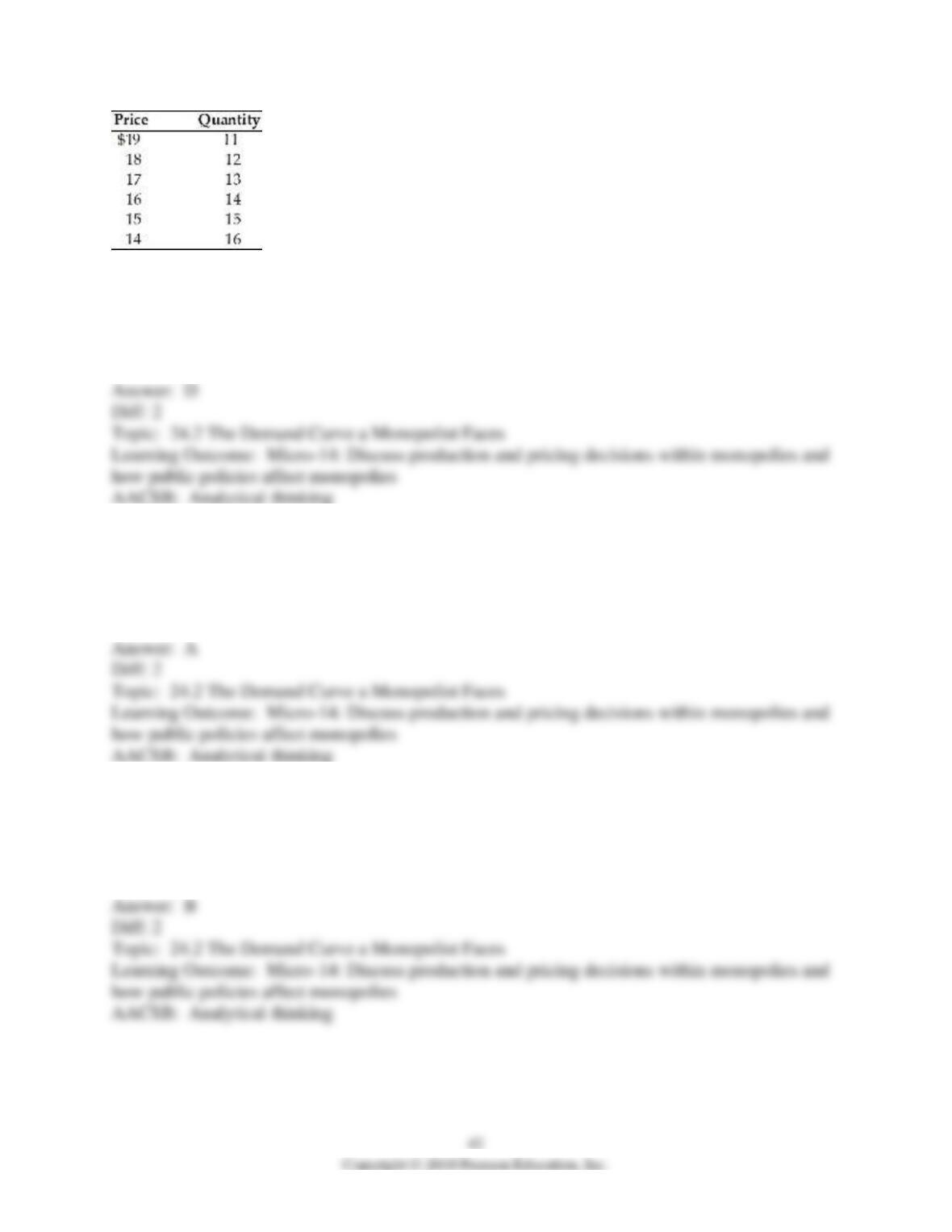
48) Given the data in the above table, what is the marginal revenue when the 15th unit is sold?
A) $7.00
B) $5.00
C) $3.00
D) $1.00
49) Given the data in the above table, what is the marginal revenue when the 12th unit is sold?
A) $7.00
B) $5.00
C) $3.00
D) $1.00
50) Given the data in the above table, what is the marginal revenue when the 13th unit is sold?
A) $7.00
B) $5.00
C) $3.00
D) $1.00
51) Given the data in the above table, what is the marginal revenue when the 14th unit is sold?
A) $7.00
B) $5.00
C) $3.00
D) $1.00
52) Given the data in the above table, the marginal revenue curve
A) lies below the demand curve.
B) lies above the demand curve.
C) intersects the demand curve.
D) is equal to the demand curve.
53) The marginal revenue curve of a monopolist is
A) downward sloping and below the demand curve.
B) downsloping and identical to the demand curve.
C) downsloping and above the demand curve.
D) horizontal and same as the market demand curve.
54) When TR is increasing as a monopolist’s output increases
A) MR is negative.
B) MR is positive.
C) MR = 0.
D) MR may be positive or negative.
55) If a monopolist can sell 20 units at price of $200 per unit and 30 units at a price of $180 per
unit, its marginal revenue at an output of 30 is
A) $-200.
B) $800.
C) $1400.
D) $1800.
56) If a monopolist can sell 9 units at price of $100 per unit and 10 units at a price of $90 per
unit, its marginal revenue at an output of 10 units is
A) $-90.
B) $0.
C) $90.
D) $100.
57) The demand curve facing a monopolist will be more elastic
A) the greater is the number of substitute products.
B) as the consumers’ need for the good increases.
C) the greater is the amount of fixed costs to cover.
D) as the number of consumers increases.
58) The price elasticity of demand for a good produced by a monopolist
A) equals zero as long as the good has no close substitutes.
B) is always inelastic since the demand curve slopes down.
C) does not equal zero because there will always be some substitutes, however imperfect they
may be.
D) does not equal zero because every good has at least one good substitute for it.
59) The profit-maximizing monopolist will never operate in a price range over which
A) the demand curve slopes downward.
B) demand is inelastic.
C) P > MR.
D) P > MC.
60) The profit-maximizing monopolist will operate in a price range over which
A) demand is elastic.
B) demand is inelastic.
C) the price elasticity of demand is less than 1.
D) supply is elastic.
61) The price elasticity of demand for a monopolist’s product depends on
A) the number and similarity of substitutes.
B) the ATC of the item it produces.
C) the AVC of the item it produces.
D) the MC of the item it produces.
62) What is TRUE of the price elasticity of demand faced by a monopoly firm?
A) Demand is inelastic.
B) Demand is more elastic at lower prices and more inelastic at higher prices.
C) Demand is perfectly elastic because the monopolist has no competition.
D) Demand becomes more elastic as the range of imperfect substitutes expands.
63) Which of the following statements about the elasticity of demand for a monopolist is TRUE?
A) Since a monopolist produces a good with no close substitutes, the price elasticity of demand
for the good is zero.
B) A monopolist produces a good with demand that is perfectly inelastic because people can not
do without the good.
C) Since every good has some substitute, even if imperfect, the demand for a good produced by a
monopolist will not have zero price elasticity.
D) Since the demand curve of a monopolist is downward sloping, the demand for the good must
be inelastic.
64) A monopolist
A) can charge whatever price it wants because it is the only firm producing the good.
B) can usually keep price equal to marginal revenue by lowering the price on the last unit sold
only.
C) faces a demand curve that is more elastic than the demand curve for the industry.
D) is constrained in its pricing decisions by the demand curve it faces.
65) The price elasticity of demand for a monopolist
A) is infinite since the monopolist is the only firm in the market.
B) decreases as more competition occurs in the market.
C) increases as similar products enter the market.
D) is undefined due to the lack of competition.
66) The more substitutes there are for a monopolist’s product
A) the less elastic is the demand curve.
B) the more elastic is the demand curve.
C) the steeper is the demand curve.
D) the more positively sloped the demand curve becomes.
67) When the number of substitutes increase, the demand curve for a monopolist will
A) not change.
B) become more elastic.
C) become more inelastic.
D) become steeper.
68) A profit-maximizing monopoly will NEVER produce along a range of output for which
A) the demand curve is elastic.
B) the demand curve is inelastic.
C) the price elasticity of demand is greater than 1.
D) the price elasticity of supply is greater than 1.
69) The monopolist should NEVER produce in the
A) elastic segment of its demand curve because it can increase total revenue and reduce total cost
by lowering price.
B) inelastic segment of its demand curve because further lowering of the price reduces total
revenue.
C) range of output for which the price elasticity of demand is infinity.
D) range of output for which there is a price elasticity exceeding one.
70) If a monopolist were to produce in the inelastic segment of its demand curve
A) total revenue would be at a maximum.
B) total revenue would be at a minimum.
C) the firm would maximize profits.
D) a further drop in the price will change quantity demanded less than proportionately.
71) A monopolist produces in the elastic segment of its demand curve because when it lowers the
price
A) the percentage change increase in quantity demanded is greater than the percentage change
decrease in price and total revenue increases.
B) the percentage change increase in quantity demanded is less than the percentage change
decrease in price and total revenue increases.
C) the percentage change increase in quantity demanded is greater than the percentage change
decrease in price and total revenue decreases.
D) the percentage change decrease in quantity demanded is less than the percentage change
decrease in price and total revenue increases.
72) Discuss and explain the relationships between the monopolist’s demand curve, average
revenue curve, and marginal revenue curve.
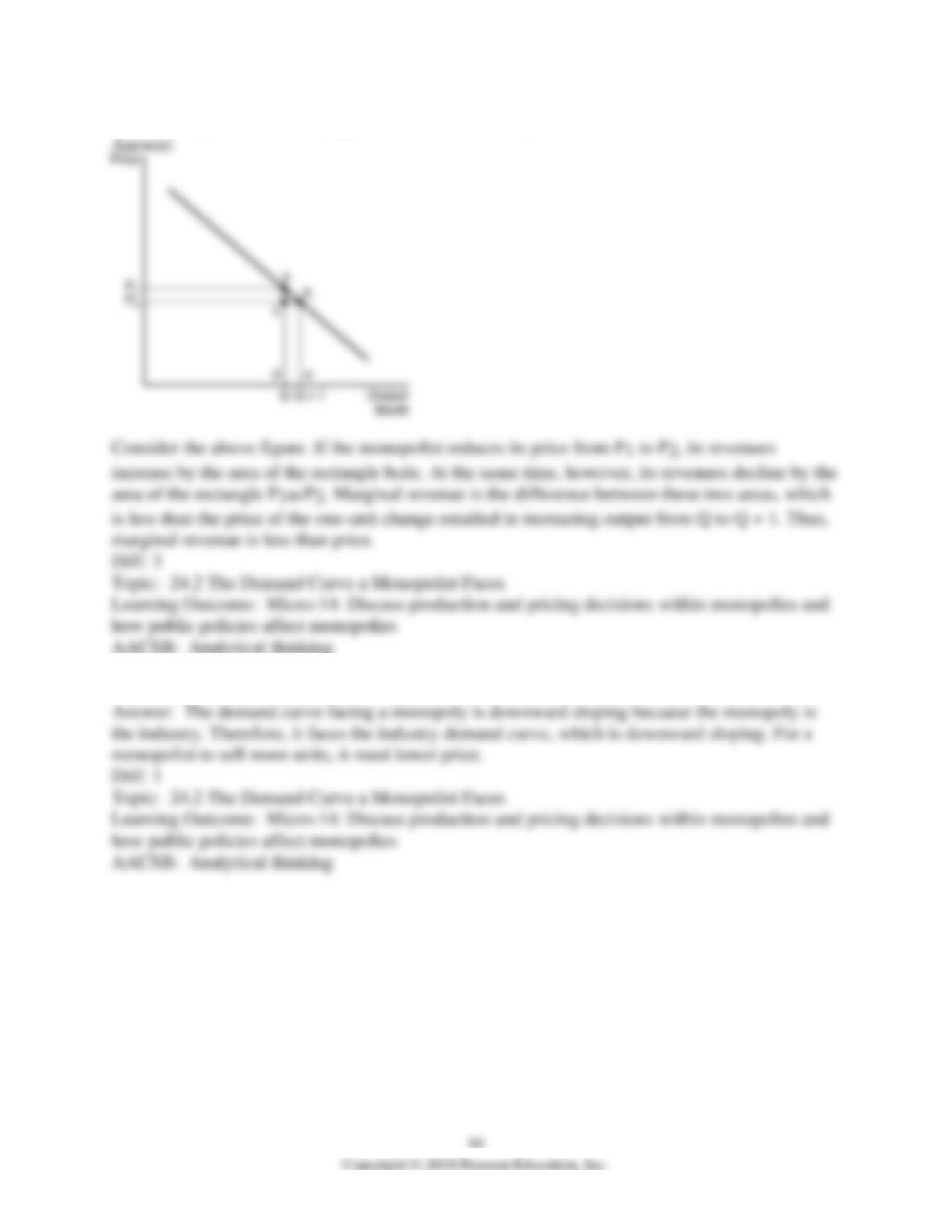
73) Why is price less than marginal revenue for a monopolist?
74) What does the demand curve facing a monopoly look like? Why?
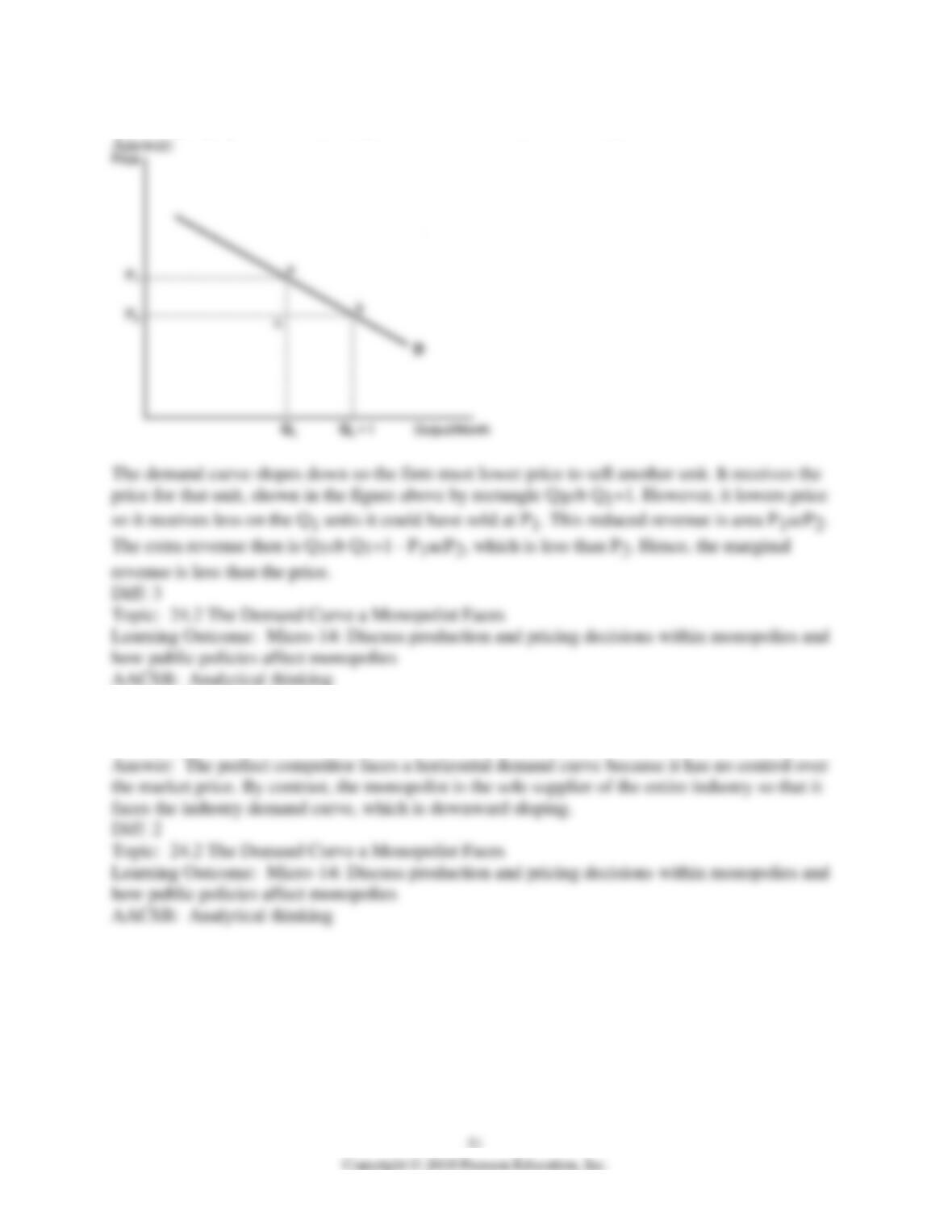
75) Using a graph, show why marginal revenue is always less than price.
76) What is the main difference between the demand curves for the perfect competitor and the
monopolist?
77) What affects the price elasticity of demand for a monopolist’s product?
78) “A monopolist can charge whatever price it wants.” Do you agree or disagree? Why?
24.3 Costs and Monopoly Profit Maximization
1) For a monopolist to maximize profits, its
A) price exceeds marginal cost.
B) price equals marginal revenue.
C) price equals average total cost.
D) marginal revenue exceeds price.
2) A monopoly will maximize profits at the level of output at which
A) MR = MC.
B) MR = AFC.
C) MC = ATC.
D) MC = P.
3) The monopolist will choose the price and output combination at which
A) MC equals AR.
B) MC equals MR.
C) MC equals price.
D) MR equals AR.
4) Suppose a monopolist’s costs and revenues are as follows: ATC = $45.00; MC = $35.00; MR
= $35.00; P = $45.00. The firm should
A) increase output and decrease price.
B) decrease output and increase price.
C) not change output or price.
D) shut down.
5) Suppose a monopolist’s costs and revenues are as follows: ATC = $50; MC = $40; MR = $45;
P = $55. The firm should
A) increase output and decrease price.
B) decrease output and increase price.
C) not change output or price.
D) shut down.
54
6) Suppose a monopolist’s costs and revenues are as follows: ATC = $50; MC = $45; MR = $35;
P = $55. The firm should
A) increase output and decrease price.
B) decrease output and increase price.
C) not change output or price.
D) shut down.
7) The profit maximizing behavior of a monopoly is different from that of a perfectly
competitive firm in that a monopoly can
A) only choose the desired output, while a competitive firm can control only price.
B) only choose the desired price, while a competitive firm can control only output.
C) control the position of its demand schedule, but a competitive firm cannot.
D) control the desired price and output to maximize profits, but a perfectly competitive firm can
only choose the desired output.
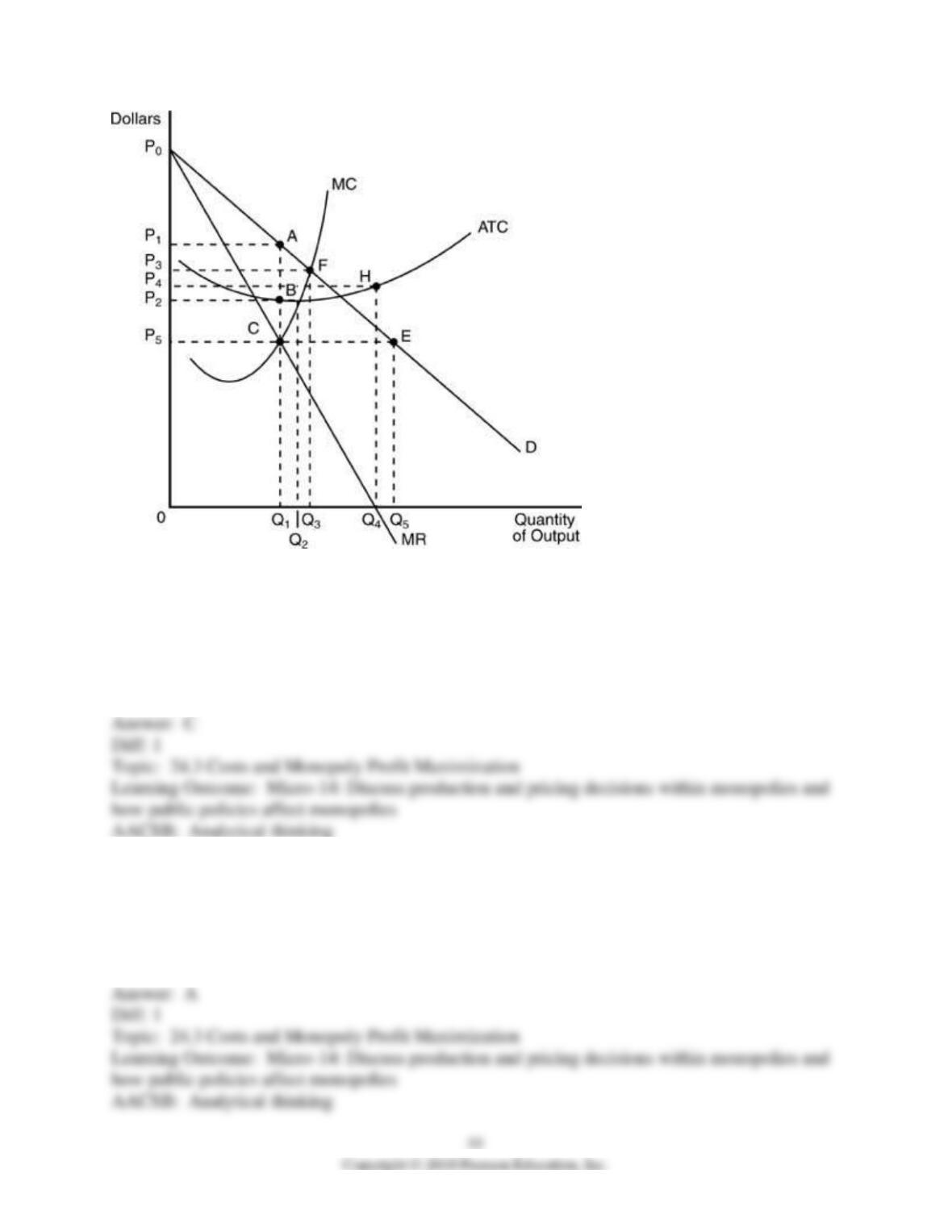
8) The profit-maximizing price and quantity established by the unregulated monopolist in the
above figure are
A) Q1 units of output and a price of P5.
B) Q3 units of output and a price of P3.
C) Q1 units of output and a price of P1.
D) Q4 units of output and a price of P4.
9) In the above figure, at the firm’s profit maximizing output, total revenue is rectangle
A) 0P1AQ1.
B) 0P3FQ3.
C) 0P5EQ5.
D) 0P2BQ1.
10) In the above figure, marginal cost and marginal revenue are equal at output
A) Q5.
B) Q1.
C) Q3.
D) Q2.
11) In the above figure, the total cost of producing the profit maximizing level of output is shown
by rectangle
A) 0P1AQ1.
B) 0P5EQ5.
C) 0P4HQ4.
D) 0P2BQ1.
12) In the above figure, suppose the monopolist is producing at Q3. The firm should
A) increase output and decrease price.
B) decrease output and increase price.
C) not change output or price.
D) shut down.
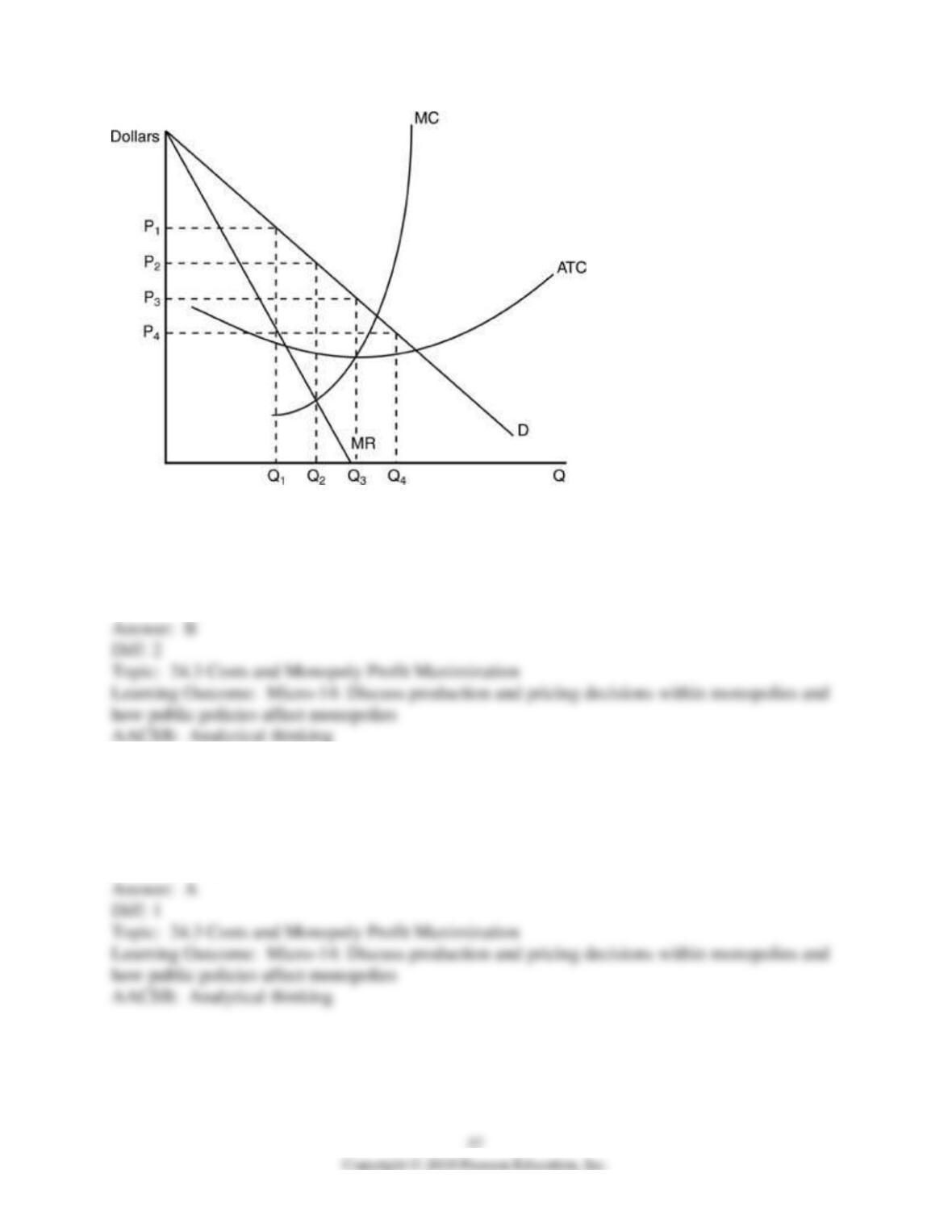
13) In the above figure, if the firm is producing at Q3 and charging a price of P3, it should
A) increase output and decrease price.
B) decrease output and increase price.
C) not change output or price.
D) shut down.
14) In the above figure, if the firm is producing Q1 units at a price P1, the firm should
A) increase output and decrease price.
B) decrease output and increase price.
C) not change output or price.
D) shut down.
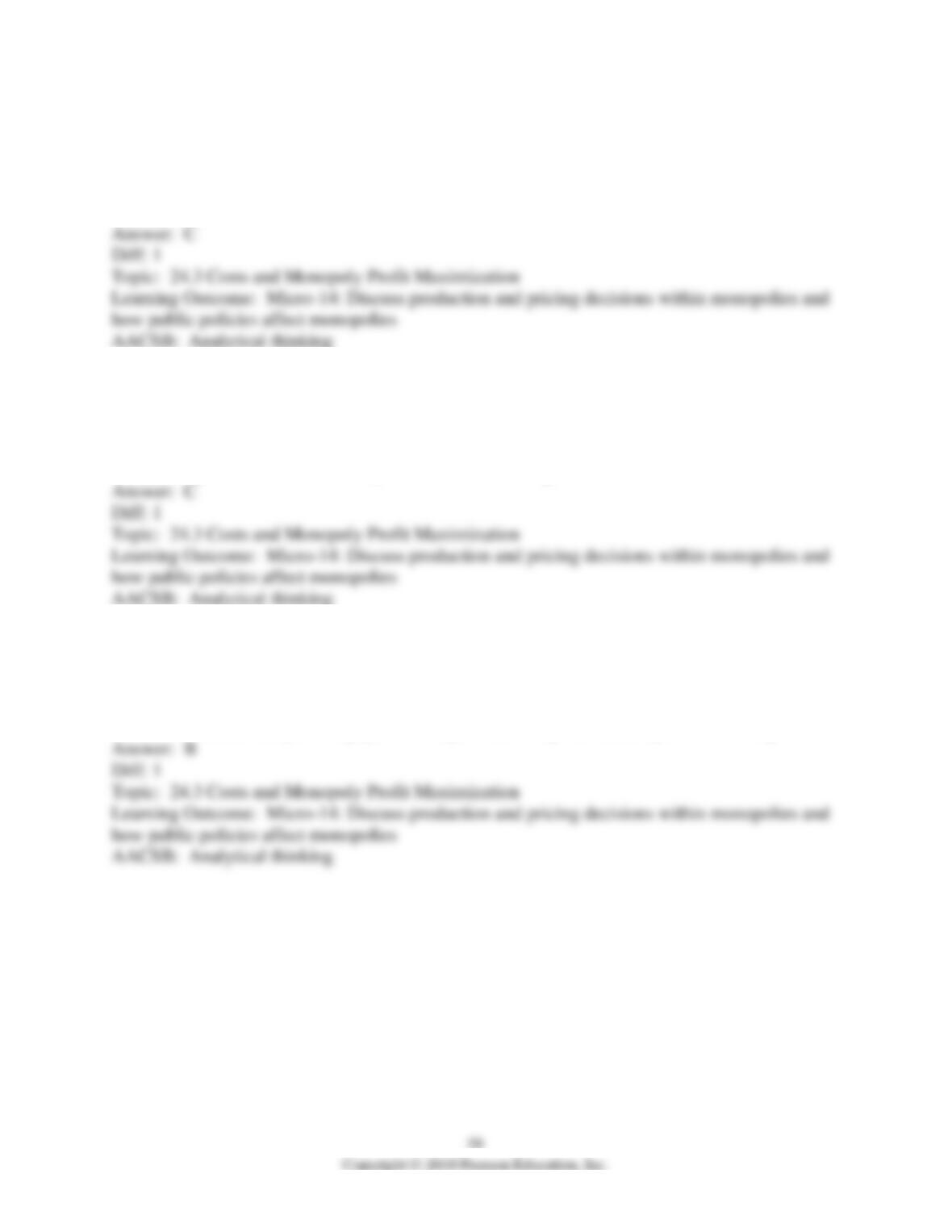
15) In the above figure, if the firm is producing Q2 units at a price P2, it should
A) increase output and decrease price.
B) decrease output and increase price.
C) not change output or price.
D) shut down.
16) Which of the following statements concerning a monopolist is FALSE?
A) A monopolist will produce at which MR = MC.
B) For a monopolist, marginal revenue is less than price.
C) A monopolist will charge the highest price at which any individual will purchase the product.
D) A monopolist will shut down if price is less than average variable cost.
17) As a price searcher, a monopoly firm
A) must only determine the price it charges.
B) must determine its optimal price-output combination.
C) must determine its output level and then accept the market price for its product.
D) must determine the prices it pays for its inputs and accept the market price for its output.
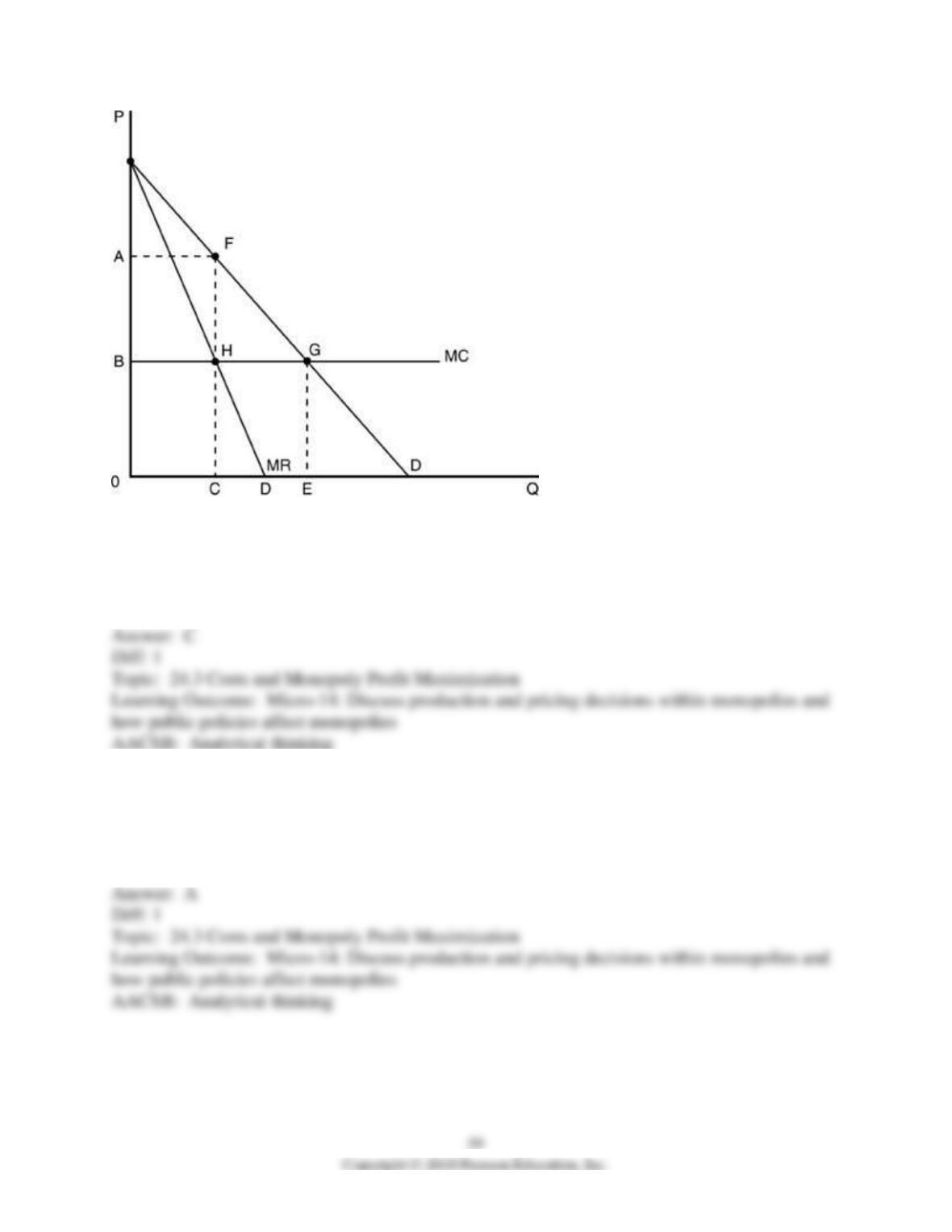
18) In the above figure, the monopolist’s profit-maximizing output level is
A) A.
B) B.
C) C.
D) D.
19) In the above figure, the monopolist’s profit-maximizing price is
A) A.
B) B.
C) C.
D) D.
20) Suppose a monopolist sells 10,000 units of output at $22 per unit. The firm’s total revenue is
A) $2,200.
B) $22,000.
C) $220,000.
D) $2,200,000.
21) The price-output combination that maximizes profits for a monopolist occurs at the point
where
A) total revenues and total costs are equal.
B) the difference between total revenues and total costs is the greatest.
C) total revenues are the greatest.
D) the elasticity of demand equals one.
22) A monopolist finds the price-output combination that maximizes its profits by
A) equating total revenue and total cost.
B) equating marginal revenue and marginal cost.
C) finding the combination for which the difference between marginal revenue and marginal cost
is the greatest.
D) equating price and marginal cost.