62) Which of the following is a characteristic of a monopoly firm?
A) horizontal individual demand curve
B) barriers to entry
C) easy entry and exit
D) many buyers and sellers
63) A monopoly which arises from significant economies of scale is referred to as a
A) monopolistic competitor.
B) strategic resource monopoly.
C) natural monopoly.
D) patent monopoly.
64) A patent protects an inventor’s creation from being copied or stolen for a period of
A) 10 years.
B) 20 years.
C) 30 years.
D) 50 years.
65) When a firm experiences declining long-run average total costs as it produces more output,
there are
A) increasing marginal returns to variable inputs.
B) economies of scale.
C) diseconomies of scale.
D) constant returns to scale.
66) When a firm experiences declining long-run average total costs as it produces more output, it
is known as a(n)
A) oligopoly.
B) rent seeker.
C) natural monopoly.
D) monopolistic competitor.
67) A natural monopoly
A) requires government licensing initially.
B) is derived from deposits of natural resources.
C) usually arises when there are large economies of scale.
D) involves multiple firms selling differentiated products.
68) Governments and legislatures can erect barriers to entry. Which of the following would NOT
be one of them?
A) licenses
B) tariffs
C) patents
D) laws that ensure property rights
69) Which of the following would most likely be classified as a natural monopoly?
A) a city water district
B) Microsoft
C) Disneyland
D) Exxon-Mobil
70) All of the following are barriers to entry in an industry EXCEPT
A) a patent.
B) governmental restrictions.
C) low marginal tax rates.
D) economies of scale.
71) Suppose that a drug for treating cancer is cleared by the Food and Drug Administration and
that the company is successful in obtaining a patent for its product. Which of the following is
then TRUE?
A) The patent holder now faces barriers to entry.
B) The method of producing the product would not be considered intellectual property.
C) The patent holder has a monopoly.
D) The drug would have many close substitutes.
72) A barrier to entry
A) makes it illegal for firms to enter the industry.
B) can be thought of as unrelated to monopoly.
C) slows or even prevents entry into a market.
D) usually takes the form of a cartel.
73) Barriers to entry might include all of the following EXCEPT
A) patents and copyrights.
B) ownership of essential resources.
C) government franchise.
D) positive economic profits.
74) Economies of scale may be a barrier to entry in a situation in which
A) only small-scale production can lower the per-unit cost of production.
B) only small-scale production can meet the constantly changing market demand.
C) only large-scale production can lower the per-unit cost of production.
D) large-scale production is inefficient.
75) Which of the following is most likely to be a monopoly?
A) Ford, an auto manufacturer
B) Verizon, a wireless service provider
C) The Washington Post newspaper
D) a public water utility
76) Legal or governmental restrictions that give monopolistic advantages to a firm include all of
the following EXCEPT
A) economies of scale.
B) tariffs.
C) licenses.
D) franchises.
77) Legal or governmental restrictions that give monopolistic advantages to a firm include all of
the following EXCEPT
A) franchises.
B) environmental protection.
C) exclusive ownership of an unimportant resource.
D) patents.
78) What is a monopolist, and what is required for a monopolist to earn profits in the long run?
79) “A monopolist refers to any firm that is large in size.” Do you agree or disagree? Why?
80) In what ways is government involved with the creation of barriers to entry?
81) Which of the barriers to entry can last indefinitely and which are more likely to eventually
erode such that a new entry can take place?
82) In principle, can a monopolist hold its monopoly power in the long run? Explain.
24.2 The Demand Curve a Monopolist Faces
1) If a monopolist wishes to increase its output and quantity sold
A) it must reduce its price, so its marginal revenue is greater than its price.
B) it must reduce its price, so its marginal revenue is less than its price.
C) it must raise its price, so its marginal revenue is greater than its price.
D) it must raise its price, so its marginal revenue is less than its price.
2) The demand curve faced by the monopolist
A) is perfectly elastic.
B) is perfectly inelastic.
C) slopes downward.
D) slopes upward.
3) Compared to perfectly competitive firms, the demand curve for a monopolist will be
A) as elastic.
B) more elastic.
C) less elastic.
D) perfectly elastic.
4) Compared to a monopolist, the demand curve for a perfectly competitive firm will be
A) as elastic.
B) more elastic.
C) less elastic.
D) perfectly elastic.
5) The demand curve a monopoly faces is
A) horizontal.
B) vertical.
C) upward sloping.
D) downward sloping.
6) Which of the following conditions is TRUE for a monopolist?
A) MR < P
B) MR = P
C) MR = AFC
D) MR < AVC
7) A monopolist’s demand curve is
A) perfectly elastic.
B) perfectly inelastic.
C) of unit elasticity throughout.
D) the industry demand curve.
8) To sell one more unit of a good, a monopolist must
A) lower the price on the last unit only.
B) lower the price on all units.
C) raise the price only on the last unit sold.
D) raise the prices on all goods.
9) The demand curve faced by a pure monopolist
A) is the same as its marginal revenue curve.
B) is perfectly inelastic.
C) lies below the marginal revenue curve.
D) is the market demand curve.
10) A major difference between a monopolist and a perfectly competitive firm is that
A) the monopolist is certain to earn economic profits.
B) the monopolist’s marginal revenue curve lies below its demand curve.
C) the monopolist engages in marginal cost pricing.
D) the monopolist charges the highest possible price that he can.
11) A monopolist faces a demand curve that
A) is perfectly horizontal at the market price.
B) is below the marginal revenue curve.
C) is downward sloping.
D) coincides with the industry supply.
12) The demand curve a monopolist faces is
A) horizontal.
B) the industry demand curve.
C) vertical.
D) inelastic at all points.
13) An important difference between a perfectly competitive firm and a monopolist is
A) the size of the firms.
B) the shape of the demand curve each faces.
C) the goals of the owners of the firms.
D) a monopolist normally produces a service, while a perfect competitor normally produces a
good.
14) An important difference between a perfectly competitive firm and a monopolist is
A) the size of the industry.
B) the primary objective of the firms.
C) a monopolist only produces in the long run, while a perfect competitor only produces in the
short run.
D) the price it charges to sell additional units of a good.
15) To sell more units, a monopolist must
A) merely produce more units.
B) advertise more.
C) raise product quality.
D) lower price.
16) To sell more units, a monopolist
A) simply moves across its horizontal demand curve to a larger quantity.
B) moves down its demand curve to a lower price that will increase quantity demand.
C) can continue to receive the same price it always has as long as it has its customers’ goodwill.
D) must be willing to lower the barriers to entry that have protected it.
17) A monopolist’s marginal revenue curve is
A) the same as a perfectly competitive firm’s marginal revenue curve.
B) higher than the monopolist’s demand curve.
C) below the firm’s demand curve.
D) a horizontal line at the market price.
18) For a monopolist, the marginal revenue gained when one more unit of output is sold is
A) the price at which the extra unit is sold minus the loss in revenue that results from cutting the
price on units sold previously.
B) equal to the price of the product.
C) negative if price is above the midpoint of the demand curve.
D) the average revenue created by the increased sales.
19) If a firm sells 10 units of output at $100 per unit and 11 units of output when price is reduced
to $99, its marginal revenue for the last unit sold is
A) $1.
B) $10.
C) $109.
D) $89.
20) If a firm sells 50 units of output at $9 per unit and 60 units of output when price is reduced to
$8, its marginal revenue from selling the sixth unit is
A) $10.
B) $480.
C) $450.
D) $30.
21) If a firm sells 200 units of output at $15 per unit and 210 units of output when price is
reduced to $14, its marginal revenue from selling the last unit is
A) $60.
B) $210.
C) $294.
D) -$60.
22) For a firm facing a downward sloping demand curve, marginal revenue
A) is at a minimum at the midpoint of the demand curve.
B) is greater at higher prices than at lower prices.
C) increases each time prices are lowered.
D) falls each time prices are raised.
23) For the monopolist, marginal revenue is
A) equal to price.
B) less than average revenue since price must be lowered to sell additional units.
C) greater than price.
D) not a consideration in the firm’s pricing.
24) The monopolist’s marginal revenue is less than price since
A) additional units can only be sold if the price is lowered on all units sold.
B) the demand function is horizontal.
C) average revenue is also less than price.
D) average total cost is declining.
25) A monopolist faces
A) a perfectly elastic demand curve.
B) a perfectly inelastic demand curve.
C) the market demand curve.
D) a two-tiered demand curve.
26) The demand curve facing a monopolist is
A) downward sloping.
B) upward sloping.
C) horizontal.
D) vertical.
27) Which of the following is NOT true about the demand curve faced by a monopolist?
A) The demand curve is downward sloping.
B) The firm’s demand curve is the same as the market demand curve.
C) The marginal revenue curve is below the market demand curve.
D) The demand curve is perfectly elastic.
28) An important difference between perfect competition and monopoly is
A) a monopoly is profitable and a perfect competitor is not.
B) the monopoly faces a downward sloping demand curve and the perfect competitor faces a
horizontal demand curve.
C) the monopoly faces an inelastic demand curve and the perfect competitor faces an elastic
demand curve.
D) a monopoly is not regulated by the market, while a perfect competitor is regulated by the
market.
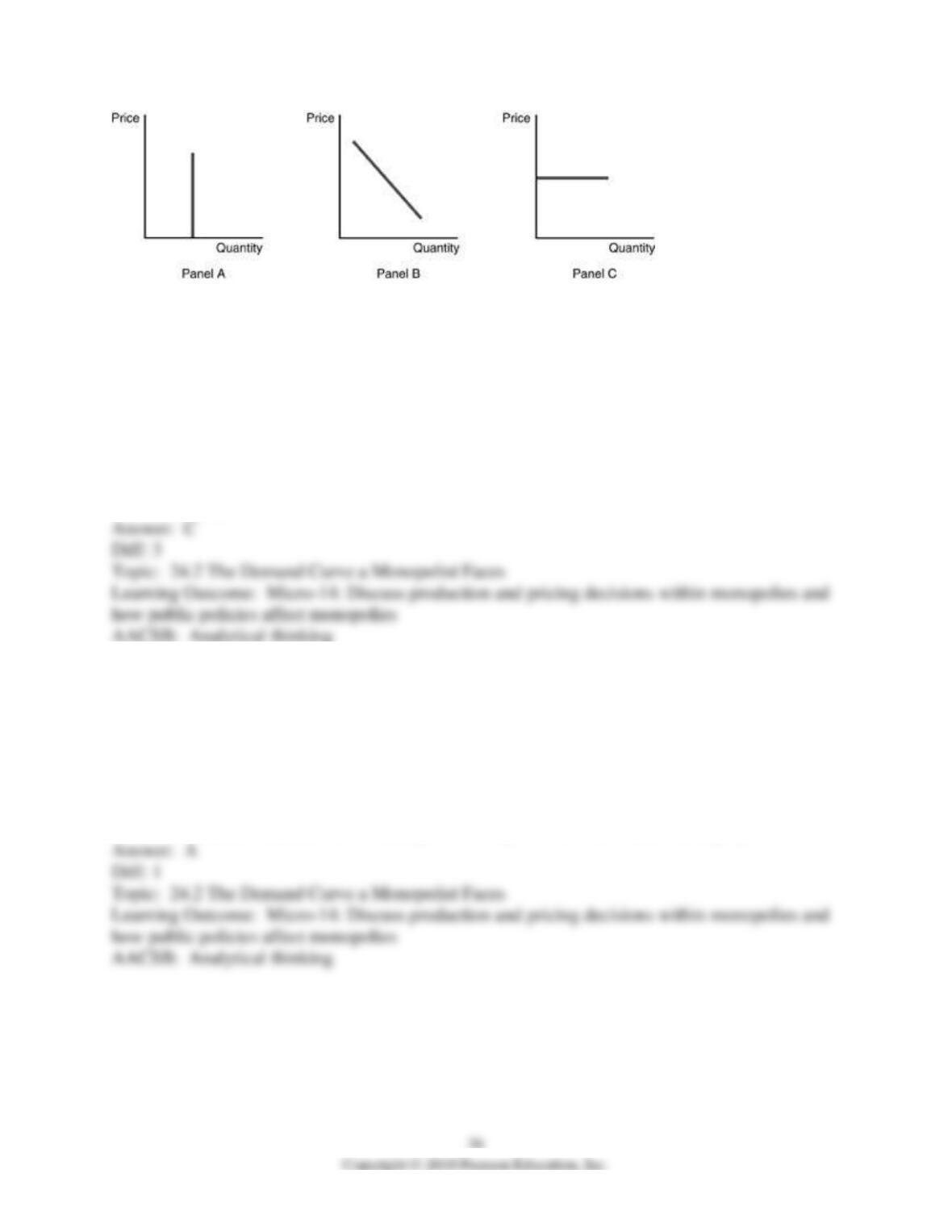
29) Refer to the above figure. Which of the following statements is TRUE about the demand
curves for an individual firm in a perfectly competitive industry and a monopoly?
A) Panel A is the demand curve for a perfectly competitive firm and panel B is the demand curve
for a monopoly.
B) Panel C is the demand curve for a perfectly competitive firm and panel A is the demand curve
for a monopoly.
C) Panel C is the demand curve for a perfectly competitive firm and panel B is the demand curve
for a monopoly.
D) Panel B is the demand curve for a perfectly competitive firm and panel A is the demand curve
for a monopoly.
30) Which of the following statements is TRUE about the relationship between a firm’s demand
curve under perfect competition and monopoly?
A) Under perfect competition, the demand curve is perfectly elastic; under monopoly, the
demand curve has elastic, unit-elastic and inelastic portions.
B) Under monopoly, the demand curve is perfectly elastic; under perfect competition, the
demand curve has elastic, unit-elastic and inelastic portions.
C) The demand curves for a monopoly and perfect competition are always inelastic.
D) We can define a demand curve under perfect competition but not under monopoly.
31) If a monopolist raises its price
A) it raises the barriers to entry.
B) the quantity demanded increases.
C) the quantity demanded remains the same.
D) the quantity demanded decreases.
32) If a monopolist lowers its price
A) the quantity demanded becomes zero.
B) the quantity demanded increases.
C) the quantity demanded remains the same.
D) the quantity demanded decreases.
33) If a monopolist wants to increase the amount it sells, it
A) will keep the price the same.
B) must lower the price on all units.
C) must accept lower profits.
D) must lower the cost of production.
34) To induce an increase in the quantity demanded of its product, a monopolist must reduce the
A) quality of its product and thereby generate a downward shift its ATC curve.
B) price of its product and thereby generate a rightward shift in its demand curve.
C) price of its product and thereby generate a rightward movement along its demand curve.
D) quality of its product and thereby generate a downward movement along its ATC curve.
35) Successive downward movements along the demand curve for the product of a monopolist
always generate successive
A) increases in the monopolist’s marginal revenue.
B) increases in the monopolist’s average total costs.
C) decreases in the additional per-unit costs incurred by the monopolist.
D) decreases in the additional per-unit revenues earned by the monopolist.
36) A monopolist wishing to increase its profit has just discovered that lowering its price and
selling more output yielded the desired result. Profit increased. Based on this, we can conclude
that the cost of the additional production is
A) greater than the revenue from the additional production.
B) precisely equal to the revenue from the additional production.
C) less than the revenue from the additional production.
D) there is no way to answer this because you have not given us the marginal revenue and
marginal cost data.
37) For a monopolist
A) marginal revenue is less than price.
B) marginal revenue equals price.
C) marginal revenue is greater than price.
D) marginal revenue equals average revenue.
38) For a monopolist, the reason that marginal revenue is less than price is
A) because of the perfectly elastic demand curve that the monopolist faces.
B) because the monopolist must lower the price of the good in order to sell an additional unit.
C) because of the U-shaped average revenue curve.
D) because of the lack of competition in the market.
39) Which of the following would best describe the demand curve faced by a monopoly firm?
A) horizontal line at the market price
B) vertical line at the output level
C) same as the market demand curve
D) same as the perfect competitor’s demand curve
40) The demand curve faced by the monopolist
A) has a constant price elasticity.
B) is the industry demand curve.
C) is identical to the firm’s MR curve.
D) is identical to the firm’s TR curve.
41) The demand curve for a monopolist is
A) the industry demand curve.
B) the same as the demand curve for a perfectly competitive firm.
C) a perfectly inelastic demand curve.
D) a unitary elastic demand curve.
42) Which of the following statements about a monopolist is FALSE?
A) A pure monopolist is the sole supplier of one product, good, or service.
B) The monopolist faces a demand curve for the entire market for that good.
C) A pure monopolist is not the same as a perfect competitor.
D) The monopolist faces the industry demand curve, which is upward sloping.
43) When considering marginal revenue for the monopolist, which of the following is FALSE?
A) To sell more of a particular product, given the industry demand curve, the monopoly firm
must lower the price.
B) An essential point for the monopolist, marginal revenue is always less than price.
C) Marginal revenue is always less than price because price must be reduced on all units to sell
more.
D) The more the monopolist wants to sell, the higher the price it has to charge in order to make
more profits.
44) For a monopolist
A) marginal revenue is equal to price for all units being sold.
B) marginal revenue is less than price for all units being sold except the first unit.
C) marginal revenue is greater than price for all units being sold except for the first unit.
D) there is no relationship between marginal revenue and price.