5) The profit-maximizing quantity of the monopolist compared to the perfectly competitive
industry in the above figure are, respectively
A) Q1 and Q2.
B) Q1 and Q3.
C) Q1 and Q5.
D) Q2 and Q3.
6) The profit-maximizing price and quantity of the monopolist compared to the perfectly
competitive industry in the above figure are, respectively
A) A and B.
B) A and C.
C) A and F.
D) C and F.
7) Monopolies are discouraged in the United States because
A) they are more efficient than other industries.
B) they can produce at lower cost in the short run.
C) they restrict output and raise prices.
D) they hire too few workers for their production volumes.
8) Compared to perfect competition, a monopoly will produce ________ output, and charge a
________ price.
A) more; higher
B) more; lower
C) less; higher
D) less; lower
9) Which of the following statements is TRUE?
A) At the monopolist’s equilibrium, resources are being efficiently allocated.
B) With a monopoly, the value to society of the last unit produced is less than it’s production
cost.
C) Monopolists raise the price and restrict production, compared to a competitive situation.
D) A monopolist always produces a higher level of output than would be produced if the market
were competitive.
10) Which of the following statements is FALSE?
A) Other things being equal, society’s overall well-being is reduced when a perfectly competitive
industry is monopolized.
B) When both a perfectly competitive industry and a monopolist face the same production costs
and the same market demand curve,the monopolist offers a lower level of output for sale.
C) The profit-maximizing monopolist will always produce only along the inelastic portion of the
demand curve, whereas equilibrium in a perfectly competitive industry always occurs along the
elastic portion of the demand curve.
D) When both a perfectly competitive industry and a monopolist face the same production costs
and the same market demand curve, the monopolist charges a higher price for its product than
what would be charged in a perfectly competitive situation.
11) Under a monopoly, resources are misallocated such that
A) too few resources are used in other industries, and too many are used by the monopoly.
B) too few resources are used by the monopoly, and too many are used elsewhere.
C) resources are being used as efficiently as possible only by the monopoly.
D) consumers are being forced to pay a price below the MC of the monopolist.
12) Conclusions about the misallocation of resources under conditions of monopoly depend, in
part, on the crucial assumption that
A) monopolies are interested in economic profits and competitive firms are not.
B) the monopolization of a perfectly competitive industry does not change the cost structure of
the industry.
C) the economies of scale exist only in perfectly competitive industries.
D) the marginal cost curve of a monopolist is different from that of a perfectly competitive firm.
13) Compared to an efficient perfectly competitive industry, the monopolist will
A) produce less output at a higher total cost.
B) produce less output and charge a higher price.
C) produce more output at a higher price and higher profit.
D) produce more output at a lower price.
14) The social cost attached to monopolies is reflected by the fact that
A) monopolies produce more output than consumers desire to buy.
B) consumers pay prices that exceed the marginal cost of production.
C) the demand for a monopolist’s product is always lower than the demand for the products of
perfectly competitive firms.
D) consumers are always willing to pay lower prices for a monopolist’s product than for the
products of perfectly competitive firms.
15) Economists criticize monopolies because monopolies
A) always price discriminate.
B) receive accounting profits.
C) restrict output and raise prices compared to a competitive situation.
D) make consumers pay more for their product than the customers value the product.
16) The conclusion that a monopoly results in lower output and higher prices than perfect
competition relies on the assumption that
A) the demand curve for a monopoly is horizontal.
B) consumers are ignorant of the effects of monopoly.
C) the costs of production are the same whether the industry is perfectly competitive or a
monopoly.
D) elasticity of demand varies along the market demand curve.
17) Which of the following is a TRUE statement about monopoly and perfect competition?
A) Price is always higher and output higher under monopoly than under perfect competition.
B) Because costs do not depend on market structure, price is usually higher and output is always
lower under monopoly than perfect competition.
C) If there are substantial economies of scale, price may be lower and output greater under
monopoly than under perfect competition.
D) If there are substantial economies of scale, price may be lower and output greater under
monopoly than under perfect competition, and price may be below marginal cost instead of equal
to marginal cost.
18) Refer to the above figure. What price-output combination would apply under perfect
competition?
A) P4 and Q1
B) P3 and Q2
C) P2 and Q3
D) P1 and Q1
19) Refer to the above figure. Suppose this industry was perfectly competitive and then merged
into one monopolistic firm. The monopoly would
A) raise price from P1 to P2.
B) reduce output from Q3 to Q1.
C) reduce output from Q2 to Q1 and raise price from P3 to P4.
D) raise price from P1 to P4.
20) Refer to the above figure. What is the socially optimal point of production?
A) P1 and Q1.
B) P4 and Q1.
C) P1 and Q4.
D) P3 and Q2.
21) Refer to the above figure. Which of the following statements is TRUE?
A) Under perfect competition, the efficient price is charged, which is the lowest price possible
(P1) while under monopoly output is too large (Q4) and price is too high (P4).
B) Under perfect competition price equals marginal cost (P3) while under monopoly price (P4) is
greater than marginal cost (P1).
C) The rate of output is the same under both monopoly and perfect competition (Q1), but price is
higher under monopoly (P4 rather than P1).
D) Price equals marginal cost under both monopoly and perfect competition, but output is too
low under monopoly (Q1 instead of Q2).
22) Which of the following statements is TRUE about the price that a monopolist charges?
A) The price is the same as the price that would be charged if there was perfect competition.
B) The difference between the price charged by a monopolist and a perfect competitor is due to
differences in costs.
C) The value that society places on the last unit produced in a monopoly is greater than its cost.
D) Too much of the good is being produced in a competitive market and not enough is being
produced in a monopoly. Due to the way that prices are set.
23) Monopolies are inefficient because
A) they price discriminate.
B) they maximize profits.
C) they always make above-normal profits.
D) they charge a price above marginal cost.
24) Monopolies misallocate resources because
A) price does not equal marginal cost.
B) price does not equal average variable cost.
C) marginal cost does not equal average total cost.
D) profits are usually positive.
25) A monopoly misallocates resources when it
A) restricts output so that the marginal benefit of the last unit sold exceeds the marginal social
cost of producing the good.
B) makes an above-normal profit.
C) sells the same product to different groups of customers at different prices.
D) exploits scale economies.
26) One problem associated with a monopoly firm is that it
A) produces too little output but also charges a low price.
B) produces too much output and charges too low a price.
C) restricts output and charges a relatively higher price than a purely competitive firm.
D) is just as good as a purely competitive firm in terms of output and price.
27) When comparing perfect competition and monopoly, a major assumption made is that
A) the monopolist faces a downward sloping demand curve.
B) consumers only care about the price of the good and not whether the seller is a monopoly or
not.
C) the costs of production are the same under monopoly as under perfect competition.
D) the monopolist can make an above normal rate of return.
127
28) A simple way of describing the social cost of monopoly is to say that it
A) produces too much.
B) makes too much money.
C) has too much political power.
D) restricts output and charges a higher price than a perfectly competitive firm.
29) A monopolist charges a price that is ________ and produces ________ than a perfect
competitor.
A) lower; less
B) higher; less
C) higher; more
D) lower; more
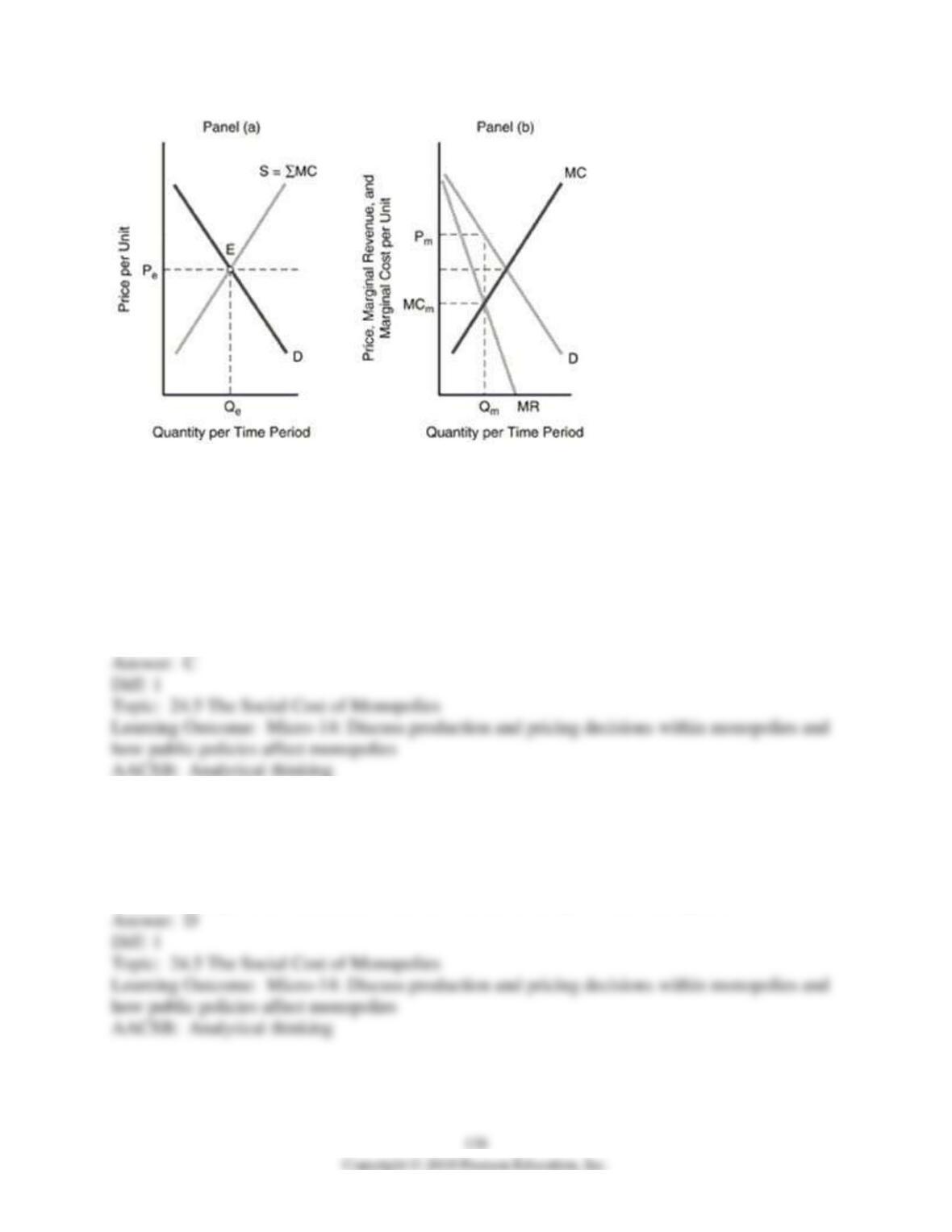
30) Referring to the above graphic, which of the following statements is FALSE?
A) In panel (a), a competitive situation is shown in which equilibrium is established at the
intersection of D and S at point E.
B) In panel (a), the equilibrium price is Pe and the equilibrium quantity Qe.
C) The price the monopolist charges in panel (b) at Pm is lower than the price that the
competitive producer charges.
D) The monopolist produces at Qm, and charges a price ofPm, while maximizing profits at the
intersection of MC and MR.
31) Which of the following statements with respect to the monopolist is FALSE?
A) A monopolist can make higher profits if it can price discriminate.
B) A monopoly tends to result in a lower quantity being sold than perfect competition does.
C) Monopoly is a situation in which a single firm dominates.
D) A monopoly arises in a situation with few barriers to entry into the marketplace.
32) Economic inefficiency of a monopoly occurs because
A) P = ATCmin.
B) P > MR.
C) P > MC.
D) MR = MC.
33) Economic inefficiency exists when
A) P = MR.
B) P = MC.
C) MR = MC.
D) P > MC.
34) Why is a monopoly inefficient?
35) “The social cost of a monopoly comes from the fact that it charges a price higher than what
consumers are willing to pay.” Do you agree or disagree? Why?
36) What is the social cost of a monopoly? Explain.
24.6 Appendix G: Consumer Surplus in a Perfectly Competitive Market
1) In a perfectly competitive market, if all firms face identical, constant marginal cost curves,
then consumer surplus is
A) the area beneath the market demand curve and above the market clearing price.
B) the area above the market demand curve and above the market clearing price.
C) the total area beneath the market demand curve.
D) definitely zero.
2) For a perfectly competitive market in which firms face an identical constant marginal costs,
the amount of consumer surplus increases if
A) market demand decreases.
B) market demand increases.
C) marginal cost increases.
D) none of the above: insufficient information to answer.
3) In a perfectly competitive market, consumer surplus typically is
A) positive.
B) negative.
C) zero.
D) undefined.
4) In a perfectly competitive market in which identical firms face the same horizontal marginal
cost curve, if demand increases, then the amount of consumer surplus will
A) increase.
B) decrease.
C) become negative.
D) not change.
5) If the marginal cost curve of all identical firms in a perfectly competitive industry are
horizontal at the same per-unit cost, then the market’s consumer surplus equals the area
A) beneath the demand curve and above the marginal cost curve.
B) above the demand curve and beneath the marginal cost curve.
C) below the marginal cost curve.
D) above the demand curve.
6) “Unlike a monopoly, consumer surplus in a perfectly competitive market is zero.” Do you
agree or disagree? Why?
24.7 Appendix G: How Society Loses from Monopoly
1) The portion of consumer surplus that no one in society is able to obtain in a situation of
monopoly is known as
A) a market failure.
B) a deadweight loss.
C) an unrealized loss.
D) a market externality.
2) A deadweight loss occurs in a
A) monopoly.
B) perfectly competitive market.
C) market in which the market clearing price of a good equals the marginal cost of producing it.
D) market in which the market clearing price of a good is below the marginal cost of producing
it.
3) If marginal cost is constant, what happens to a market if it alters from perfect competition to
monopoly without any change in the position of the market demand curve or any variation in
costs?
A) Consumer surplus increases, and the previously existing deadweight loss decreases.
B) Consumer surplus increases, and the previously existing deadweight loss increases.
C) Consumer surplus is eliminated, and an equal-sized deadweight loss is created.
D) Consumer surplus decreases in size, and a deadweight loss is created.
4) If marginal cost is constant, what happens to a market if it alters from perfect competition to
monopoly without any change in the position of the market demand curve or any variation in
costs?
A) Consumer surplus decreases, producer surplus increases and a deadweight loss is created.
B) Consumer surplus decreases, producer surplus decreases and a deadweight loss is created.
C) Consumer surplus increases, producer surplus decreases and a deadweight loss is created.
D) Consumer surplus increases, producer surplus increases and a deadweight loss is created.
5) Deadweight loss is
A) the amount of taxes that consumers and monopolists pay.
B) the loss of output when a perfectly competitive firm becomes a monopolist.
C) a loss of benefit to consumers in a monopoly that no one else in society can obtain.
D) the price that consumers pay for a product in excess of the average cost of producing it.
6) The portion of consumer surplus that would have existed in a perfectly competitive market but
is unobtainable by anyone in society under a monopoly is known as
A) monopoly profits.
B) an unattainable surplus.
C) a deadweight loss.
D) an external cost.
7) If a monopoly situation arises from a perfectly competitive market, the portion of producer
surplus that increases in a monopoly is transferred from the perfectly competitive market’s
A) fixed cost.
B) long-run positive economic profit.
C) deadweight loss.
D) consumer surplus.
8) Suppose that a perfect-maximizing monopolist operates with a horizontal marginal cost curve
and no fixed costs. Which of the following would NOT be represented as part of the area
between its demand curve and marginal cost curve?
A) total costs
B) economic profits
C) consumer surplus
D) deadweight loss
9) The loss of economic benefits in society as a result of monopoly arises from
A) the loss in consumer surplus.
B) the gain in consumer surplus.
C) the loss in producer surplus.
D) the gain in producer surplus.
10) What is deadweight loss? Whose loss is it? Explain.
11) “The deadweight loss of a monopoly equals the monopoly firm’s profits.” Do you agree or
disagree? Why?