7) Price discrimination is the
A) refusal by a firm to sell to all customers.
B) selling of a given product at more than one price when the price differences reflect cost
differences.
C) pricing of a product so that not everyone can afford it.
D) selling of a given product at more than one price when the price difference is unrelated to cost
differences.
8) A monopoly will look for opportunities to price discriminate because the practice
A) leads to selling more units.
B) leads to greater profits.
C) allows it to charge higher prices.
D) is desired by customers.
9) Which of the following conditions is NOT necessary for a firm to be able to engage in price
discrimination?
I. The firm must be able to produce to the point at which price equals marginal revenue.
II. The firm must easily be able to identify consumers with different demand elasticities.
III. The firm must be able to prevent resale of the item it produces and sells.
A) I only
B) III only
C) Both I and II only
D) Both II and III only
10) A monopolist sells a homogeneous good in several distinct submarkets, and the elasticities of
demand differ in these submarkets. If the monopolist selects the rate of output to sell in each
submarket by equating marginal revenue and marginal cost, then
A) all customers in all markets end up paying the same price.
B) it is not price discriminating, but merely price differentiating.
C) customers in markets with more elastic demand will pay higher prices than customers in
markets with less elastic demand.
D) customers in markets with more elastic demand will pay lower prices than customers in
markets with less elastic demand.
11) If a firm is price differentiating, then it is
A) producing a homogeneous product.
B) charging different prices to different consumers based on differences in marginal costs.
C) charging different prices based on quality.
D) charging different prices based on advertising costs.
12) Other things being equal, a price-discriminating firm will charge more to the customers who
A) have the highest incomes.
B) have the least elastic demand for its product.
C) have the most elastic demand for the product.
D) are the least rational in making their decisions.
13) Other things being equal, a price-discriminating firm will charge less to the customers who
A) have the lowest incomes.
B) have the least elastic demand for its product.
C) have the most elastic demand for the product.
D) are the most rational in making their decisions.
14) In order to price discriminate, a firm must
A) produce a product that is a close substitute for products of other firms.
B) have different marginal costs for serving different customers.
C) sell to customers with identical price elasticities of demand.
D) be able to prevent resale of its product.
15) If different markets for a product produced by a monopolist can be separated and if the
elasticity of demand differs between the two markets, then the monopolist will
A) be able to make higher profits by using price discrimination.
B) charge a single price in all markets.
C) go out of business.
D) sell the product in only one of the markets with inelastic demand curves.
16) A price discriminating monopolist will
A) charge a lower price to those consumers who have more elastic demand.
B) charge a higher price for a good with more market demand.
C) charge more to those consumers who have more substitute goods.
D) charge the same price to all consumers.
17) If the price elasticity of demand for U.S. automobiles is higher in Europe than it is in China,
and transport costs are zero, a price-discriminating monopolist would charge
A) the same price for autos in China as in Europe.
B) a lower price for autos in China than in Europe.
C) a higher price for autos in China than in Europe.
D) a less profitable price for autos in China than in Europe.
18) If the price elasticity of demand for airline tickets is 1.4 for a leisure traveler and 0.7 for a
business traveler, then a price-discriminating monopolist would charge
A) a higher price for the business traveler than the leisure traveler.
B) the same price for both travelers.
C) a lower price for the business traveler than the leisure traveler.
D) a less profitable price for the business traveler than the leisure traveler.
19) Which of the following is NOT necessary in order for a monopolist to practice effective price
discrimination?
A) The marginal cost of providing the same good to different groups of buyers must be different.
B) The monopolist must be able to segregate its market into different submarkets.
C) The buyers in various markets must face different price elasticities of demand.
D) The monopolist must have a downward sloping demand curve.
20) Establishing different prices for similar products to reflect differences in marginal cost in
providing those goods to different groups of buyers is
A) price discrimination.
B) cost-plus pricing.
C) price differentiation.
D) product differentiation.
21) Which of the following is TRUE?
A) Monopoly results in a higher quantity of output being sold compared with perfect
competition.
B) Price discrimination occurs when there are differences in prices that reflect differences in
marginal cost.
C) Charging all customers the same price when costs vary can actually be a case of price
discrimination.
D) Price discrimination guarantees that the monopolist will make a profit.
22) Which of the following is NOT a necessary condition for a firm to price discriminate?
A) The firm must be able to separate markets.
B) Buyers in different markets must have different elasticities of demand.
C) Resale of the product must be preventable.
D) The firm must be a price-taker.
23) If Samsung sells TVs at a higher price in the United States than in Korea, and if there is no
cost difference in producing or transporting the TV sets, Samsung would be practicing
A) cartel pricing.
B) price discrimination.
C) simple monopoly behavior.
D) price differentiation.
24) Which of the following will make price discrimination difficult for a monopolist?
A) the possibility of resale of the product
B) a constant marginal cost curve
C) an increasing marginal cost
D) a downward sloping demand curve
25) Price discrimination is
A) refusing to sell a given product to some group of customers.
B) selling a given product at more than one price.
C) selling a given product at more than one price, with the price differences reflecting
differences in marginal cost in providing the product to different groups of customers.
D) selling a given product at more than one price, with the price differences being unrelated to
differences in cost.
26) When a monopolist sells the same product at different prices and the prices are NOT related
to cost differences, we have
A) monopoly pricing.
B) marginal cost pricing.
C) price discrimination.
D) price differentiation.
27) When a monopolist sells the same product at different prices and the prices are related to cost
differences, we have
A) monopoly pricing.
B) marginal cost pricing.
C) price discrimination.
D) price differentiation.
28) Price differentiation is a situation in which
A) there are different prices for similar products reflecting differences in the marginal cost of
providing the commodities to different groups of buyers.
B) there are different prices for the same product that are not due to differences in the marginal
cost of providing the commodity to different groups of buyers.
C) consumers’ comparison-shop.
D) the demand curve is vertical.
29) Monopolies that price discriminate do so because
A) they are able to do so and no one else can.
B) they can increase their profits.
C) it keeps them out of trouble with the government.
D) it is more efficient.
30) For price discrimination to exist, all of the following are necessary EXCEPT
A) a downward sloping demand curve.
B) an identifiable group of buyers with different elasticities of demand.
C) an upward sloping marginal cost curve.
D) there can be no resale of the product.
31) For a firm to be able to engage in price discrimination, it must
A) face a downward sloping demand curve.
B) produce more than one product.
C) have customers of different levels of wealth and age.
D) have economies of scale.
32) A monopolist has four distinct groups of customers. Group A has an elasticity of demand of
0.2, B has an elasticity of demand of 0.8, C has an elasticity of demand of 1.0, and D has an
elasticity of demand of 2.0. The group paying the highest price for the product will be
A) A.
B) B.
C) C.
D) D.
33) Price discrimination is more likely in the case of services than in the case of goods because
A) producers of goods usually do not face downward sloping demand curves.
B) it is easier to distinguish customers with different elasticities of demand with respect to
services than with goods.
C) elasticities of demand vary more with services than with goods.
D) it is more difficult to resell services.
34) Which of the following is NOT an example of price discrimination?
A) Gasoline stations charge more for gasoline with higher octane and additional additives.
B) Colleges give some students more financial aid than they do other students.
C) Airlines charge more for people who don’t stay over a Saturday night.
D) College bookstore gives a price discount to faculty.
35) Which of the following is NOT an example of price discrimination?
A) student discount at a local movie theater
B) breakfast cereal makers sending coupons to select buyers
C) Pharmaceutical companies charge customers living in wealthier countries higher prices than
for identical drugs in poorer nations.
D) a hard cover book selling for more than the same book in electronic form
36) Selling a product at different prices when the price difference is unrelated to costs is a
practice known as
A) price fixing.
B) price monopolization.
C) price discrimination.
D) price differentiation.
37) Price discrimination exists when
A) a firm charges different buyers different prices for its product but the costs are the same.
B) each buyer is treated equally.
C) sales are made below cost.
D) a firm charges each buyer a price of the product in proportion to its costs.
38) Which is NOT a necessary condition for price discrimination to exist?
A) The firm must face a downward sloping demand curve.
B) The firm must identify buyers with different elasticities of demand.
C) The firm must be able to prevent resale of the product or service.
D) The firm must establish different prices to reflect marginal cost.
39) When a firm sells a given product at more than one price and the price difference is NOT
caused by differences in cost then there is
A) price discrimination.
B) price differentiation.
C) price demarcation.
D) price delineation.
40) Which of the following is NOT necessary for price discrimination to occur?
A) The firm must be able to separate the market into identifiable groups.
B) The firm must be selling a durable good.
C) The firm must have a downward sloping demand curve.
D) The firm has to be able to prevent resale of the product or service.
41) A firm will practice price discrimination when it believes that by doing so it will be able to
increase total
A) sales.
B) revenue.
C) profits.
D) production.
42) When a firm practices price discrimination, for each separate set of consumers it will
determine the rate of output at which
A) MR > MC.
B) MR = P.
C) MR = AVC.
D) MR = MC.
43) Which of the following is NOT a condition for price discrimination to exist?
A) downward sloping demand curve faced by the firm
B) identification of buyers with differing elasticities
C) unpatented product or the service
D) ability to prevent the resale of the product or service
44) Price discrimination occurs when a firm sells
A) a given product at different prices at different points in time.
B) a given product at different prices to different ethnic groups.
C) a given product at different prices unrelated to differences in cost.
D) a given product at different prices when it is produced in different colors.
45) A monopoly’s goal using price discrimination is to increase
A) total revenue.
B) marginal revenue.
C) total profit.
D) the per unit profit.
46) A monopolist will maximize its profits by charging a higher price for customers with a price
elasticity of
A) 0.7.
B) 1.
C) 1.5.
D) 10.
47) Which of the following is NOT a precondition for price discrimination?
A) The product cannot be resold to another customer.
B) The price elasticities of demand are different for each group of consumers.
C) The product is a durable good.
D) The seller must have some market power.
48) Senior citizens can buy movie tickets at a lower price than the general public. This is an
example of
A) age discrimination.
B) demand discrimination.
C) price discrimination.
D) price differentiation.
49) Which of the following is LEAST likely to be able to regularly engage in price
discrimination?
A) a farmer
B) an airline
C) a university
D) a producer of copyrighted computer software
50) An upscale fusion bistro in a small town charges higher prices for the same menu items at
dinner time than at lunch time. Does the bistro necessarily practice price discrimination? Explain
your answer.
51) Explain how a monopolist can increase profits by price discriminating. What are the
conditions necessary for price discrimination?
116
52) “Price discrimination is the same as price differentiation.” Do you agree or disagree? Why?
24.5 The Social Cost of Monopolies
1) Which of the following statements about a monopolist is TRUE?
A) Monopolies tend to misallocate resources.
B) All monopolies are unlawful in the United States.
C) Monopolies tend to supply goods at lower prices than those charged by firms in perfect
competition.
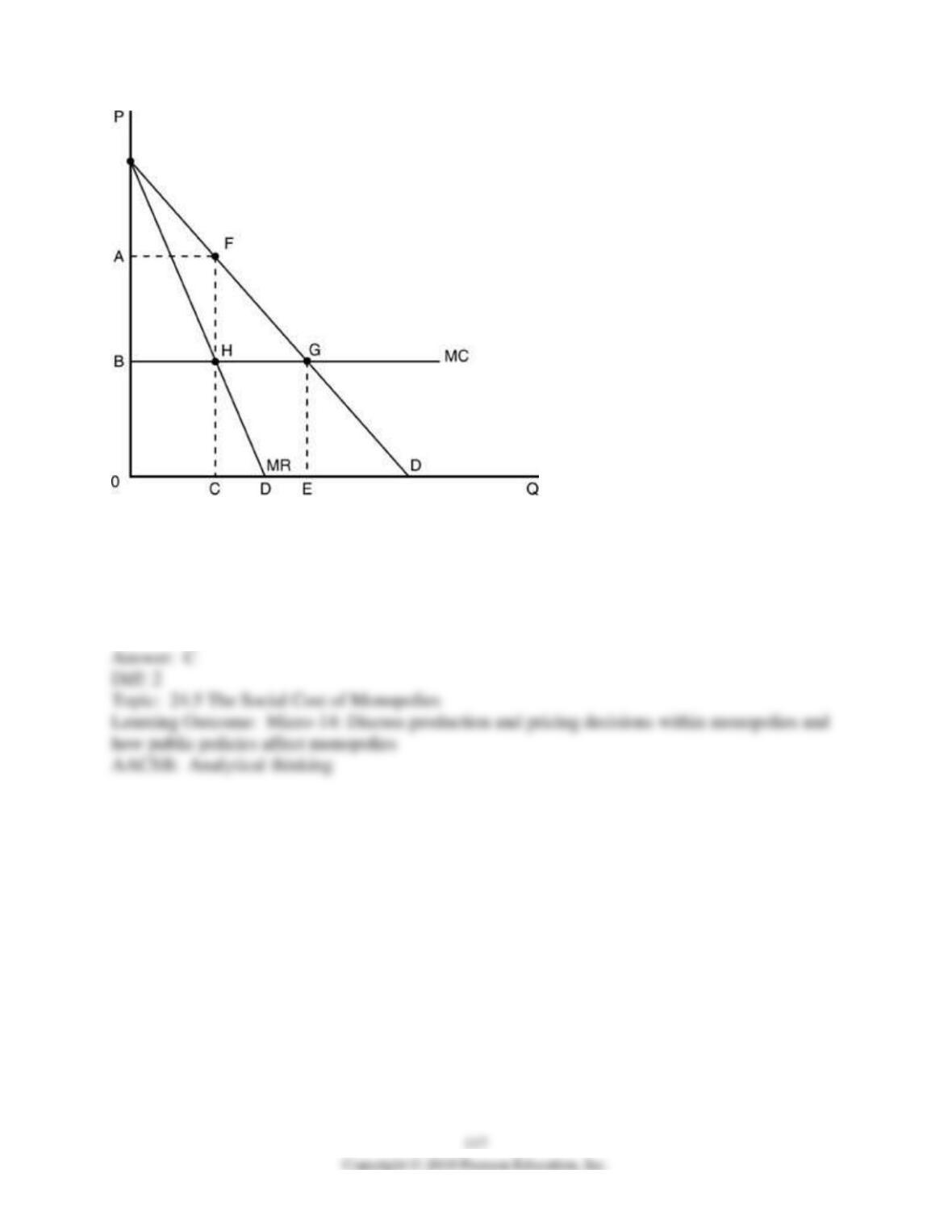
2) In the above figure, the difference between the competitive industry price and that of the
monopolist is
A) 0B.
B) 0A.
C) AB.
D) CE.
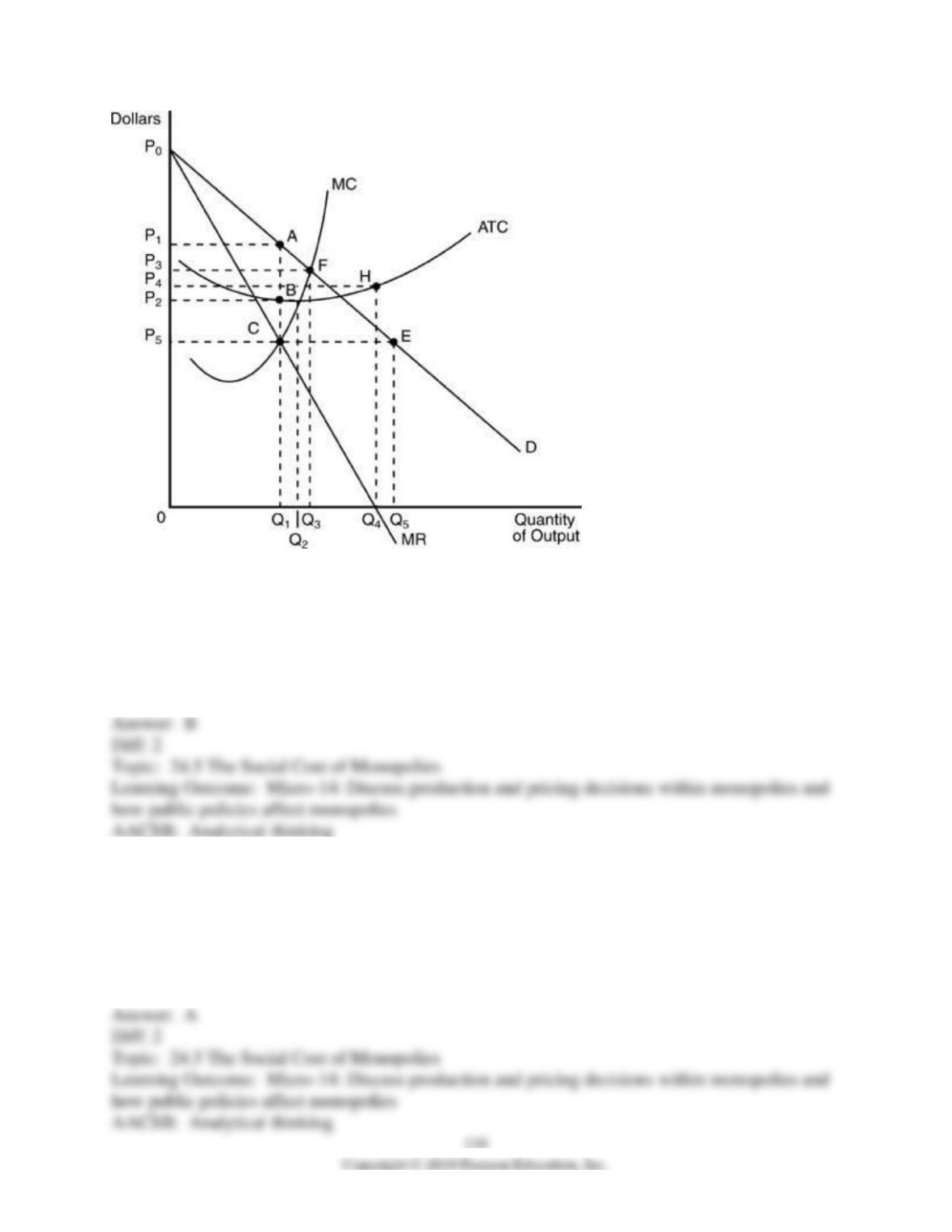
3) The profit-maximizing price and quantity established by a perfectly competitive firm in the
above figure are
A) Q1 units of output and a price of P5.
B) Q3 units of output and a price of P3.
C) Q1 units of output and a price of P1.
D) Q4 units of output and a price of P4.
4) The profit-maximizing price of the monopolist compared to the perfectly competitive industry
in the above figure are, respectively
A) P1 and P3.
B) P1 and P5.
C) P1 and P2.
D) P2 and P5.