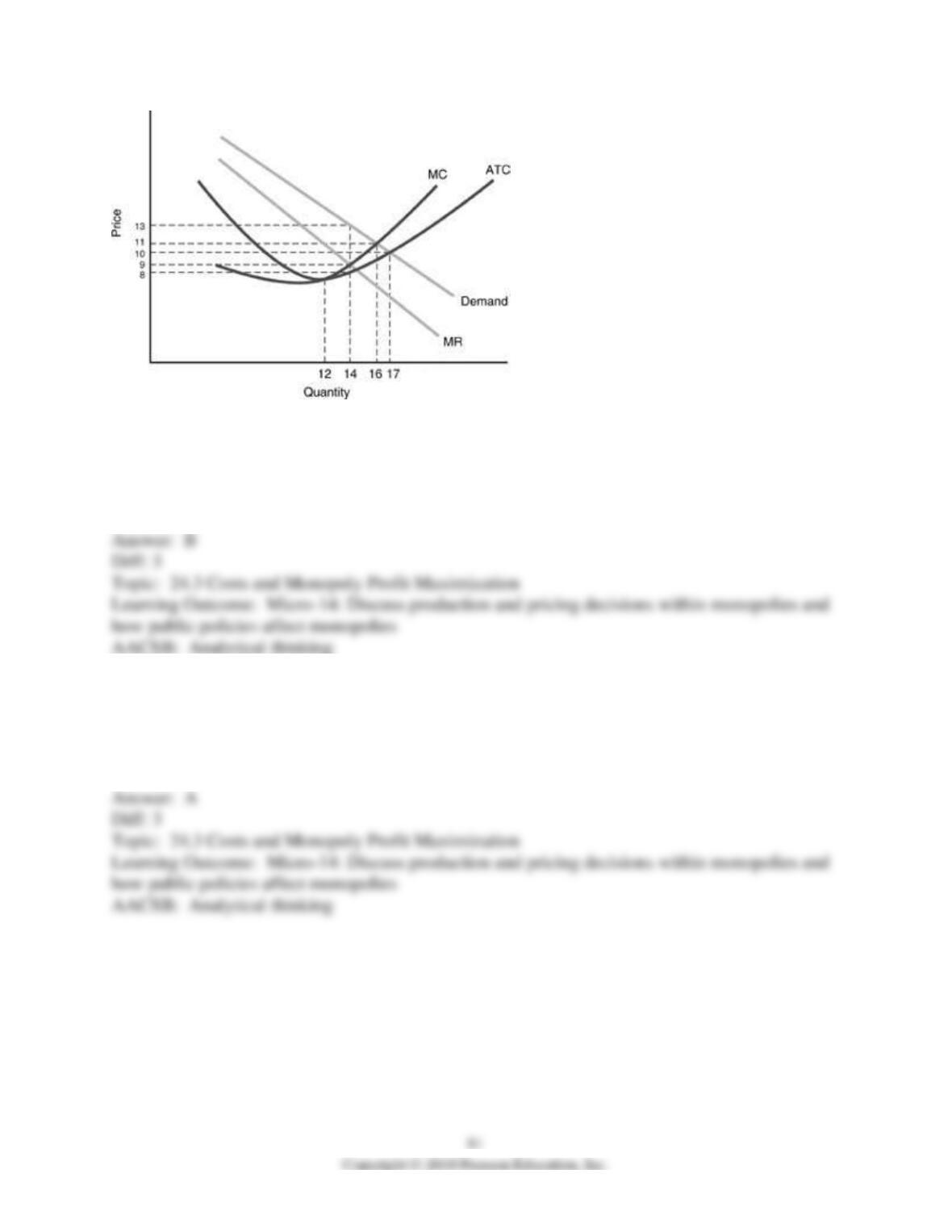
77) In the above figure, what is the profit-maximizing price and output?
A) $9, 14
B) $13, 14
C) $11, 16
D) $10, 17
78) In the above figure, what is total revenue at the profit-maximizing point?
A) $182
B) $126
C) $170
D) $176
79) In the above figure, what is total cost at the profit-maximizing point?
A) $182
B) $126
C) $112
D) $170
80) In the above figure, what is total profit at the profit-maximizing point?
A) $14
B) $56
C) $42
D) $70
81) In the above figure, the break-even output and price is
A) $9 and 14.
B) $13 and 14.
C) $11 and 16.
D) $10 and 17.
82) To maximize profits, the monopolist should produce at which
A) MR = MC.
B) MC intersects the demand curve.
C) total revenue is maximized.
D) total costs are minimized.
83) A monopolist is maximizing profit at an output rate of 100 units per week. At this output
rate, the price that its customers are willing and able to pay is $8 per unit, average total cost is $5
per unit, and marginal cost is $6 per unit. It may be concluded that at this monthly output rate,
marginal revenue is
A) $5 per unit, and the monopolist earns zero economic profits.
B) $6 per unit, and the monopolist earns economic profits of $200 per week.
C) $6 per unit, and the monopolist earns economic losses of $100 per week.
D) $6 per unit, and the monopolist earns economic profits of $300 per week.
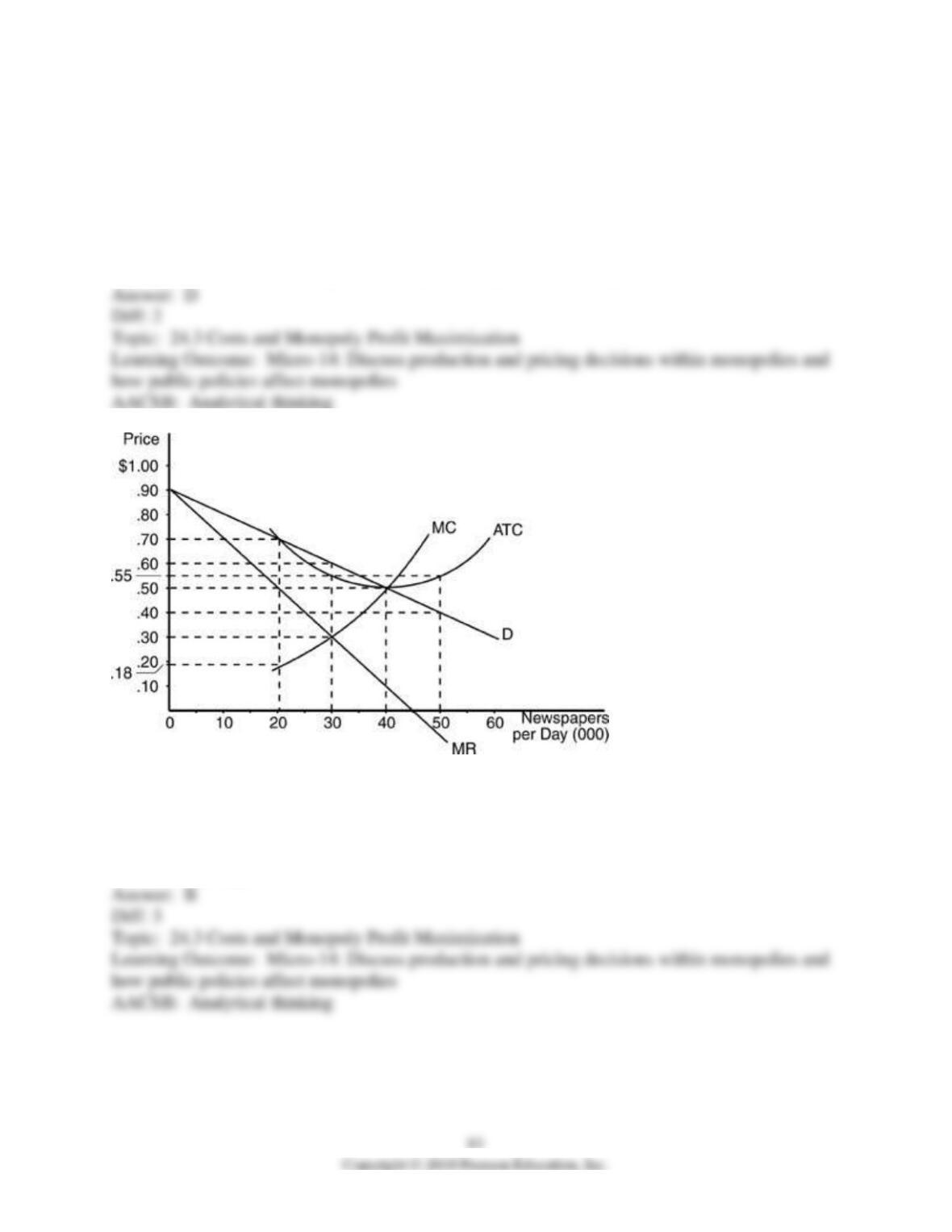
84) According to the above figure, the maximum profit the monopolist can receive is
A) 0.
B) $1,500 per day.
C) $9,000 per day.
D) $7,500 per day.
85) According to the above figure, what are the profits of the firm if it produces 50,000 units?
A) -$5,000 per day
B) -$10,000 per day
C) -$7,500 per day
D) -$17,500 per day
86) A monopolist will not earn any economic profits when
A) AVC is a minimum.
B) AFC is very high.
C) ATC lies above the demand curve.
D) ATC lies below the demand curve.
87) A monopolist will earn economic profits when
A) AVC is a minimum.
B) ATC equals MC.
C) ATC lies above the demand curve.
D) ATC lies below the demand curve.
88) Suppose that the profit maximizing level of output for the monopolist is 10 units, and price =
$50, ATC = $35, and AVC = $25. What is the monopoly’s profit?
A) $50
B) $150
C) $250
D) $500
89) Suppose that the profit maximizing level of output for the monopolist is 100 units, and ATC
= $45.00; MC = $35.00; MR = $35.00; P = $45.00. What is the monopoly’s profit?
A) -$1000
B) $4500
C) $0
D) $3500
90) Suppose that the profit maximizing level of output for the monopolist is 100 units, and ATC
= $45.00; MC = $35.00; MR = $35.00; P = $60.00. What is the monopoly’s profit?
A) -$1000
B) $4500
C) $5000
D) $1500
91) When the marginal cost curve of the monopolist shifts upward, there will be
A) an increase in both price and quantity.
B) an increase in price but a decrease in quantity.
C) a decrease in price and in marginal revenue.
D) a decrease in quantity and a decrease in marginal revenue.
92) A profit-maximizing monopolist earns an economic loss whenever
A) it pays taxes to the government on each unit of output it produces.
B) the price it charges for its product exceeds average total cost.
C) the demand curve lies completely below the ATC curve.
D) it produces along the elastic portion of a demand curve.
93) A monopolist will not be able to receive a positive economic profit at any price-output
combination at which
A) marginal cost is less than average total cost when the monopolist has equated marginal
revenue and marginal cost.
B) the average total cost curve is everywhere above the demand curve.
C) marginal cost is less than average variable cost when the monopolist has equated marginal
revenue and marginal cost.
D) marginal revenue falls at a faster rate than marginal cost increases.
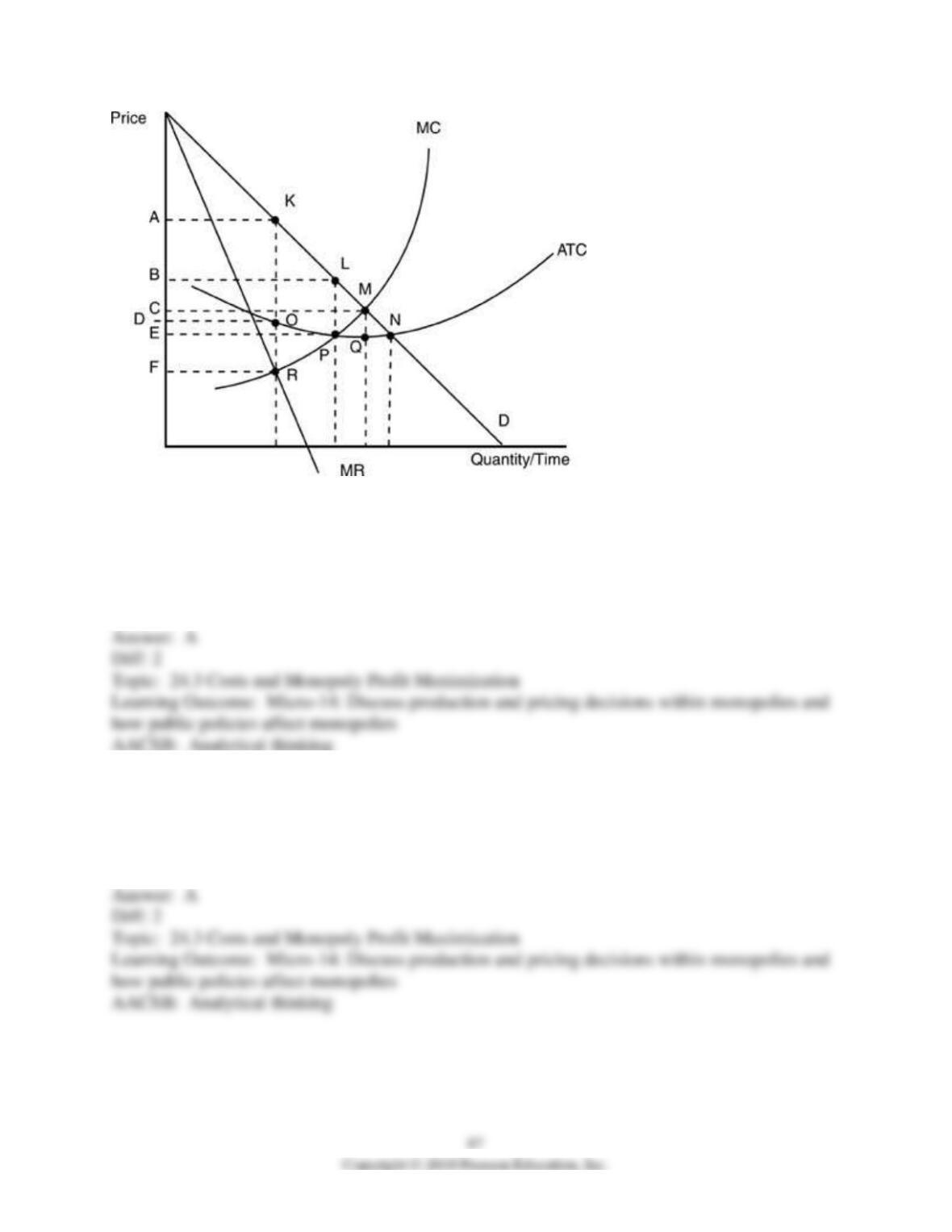
94) According to the above figure, the profit-maximizing output for this monopolist is found
directly below the letter
A) R.
B) M.
C) P.
D) N.
95) According to the above figure, the profit-maximizing price for the monopolist is
A) A.
B) B.
C) C.
D) D.
96) According to the above figure, when the monopolist maximizes profits, its profits are equal
to the area given by
A) AKMC.
B) AKOD.
C) BLPE.
D) EPRF.
97) A profit-maximizing monopolist will receive zero profits when
A) the average total cost curve lies above the demand curve for all possible rates of output.
B) the average total cost curve is tangent to the demand curve at the profit maximizing price.
C) marginal revenue, marginal cost, and average total cost are all equal.
D) a second firm enters the industry.
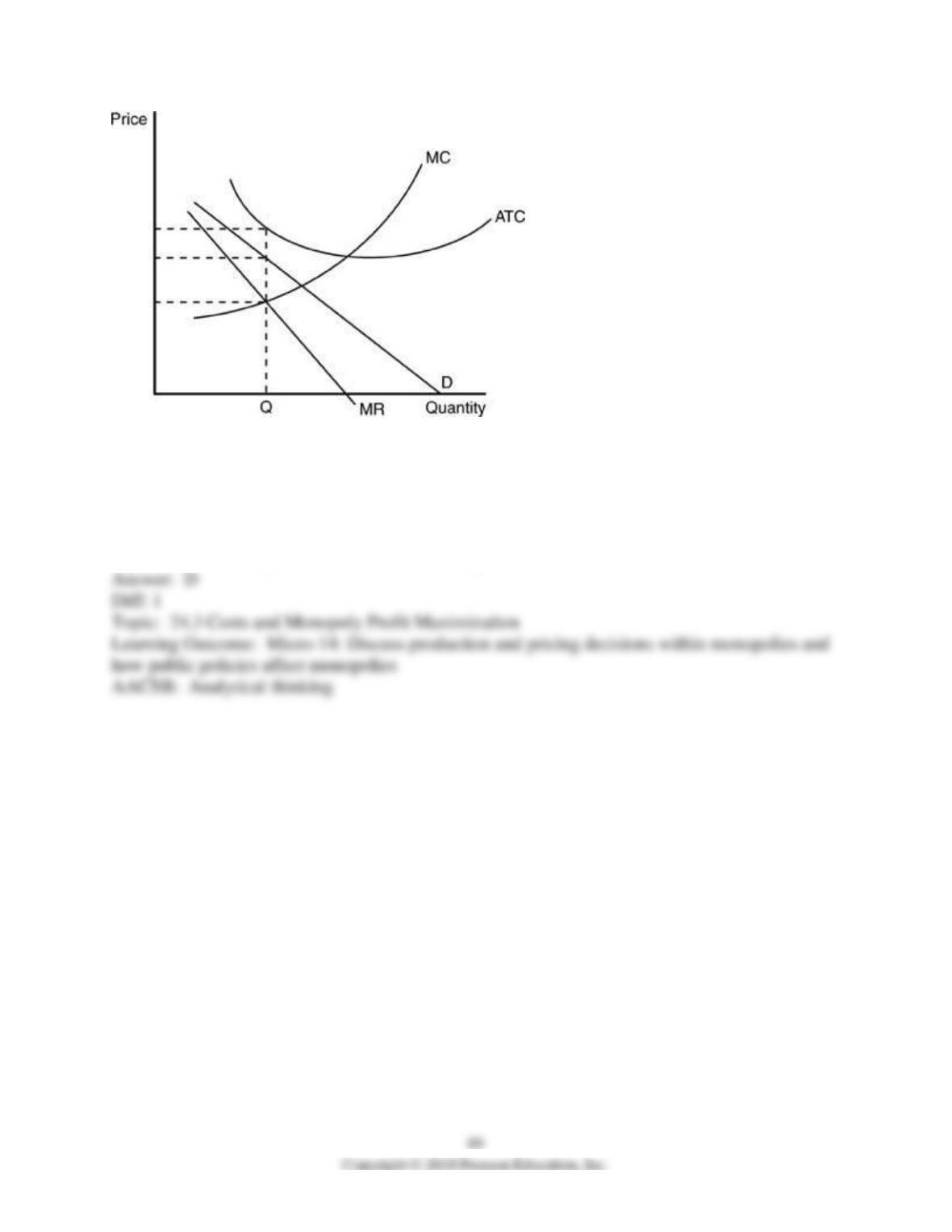
98) If the above figure accurately portrays the market conditions for a given monopolist, we can
be assured that the monopolist
A) is making a normal profit.
B) is producing at the level that will maximize benefit to society.
C) is making excessive profits.
D) will be forced to go out of business in the long run.
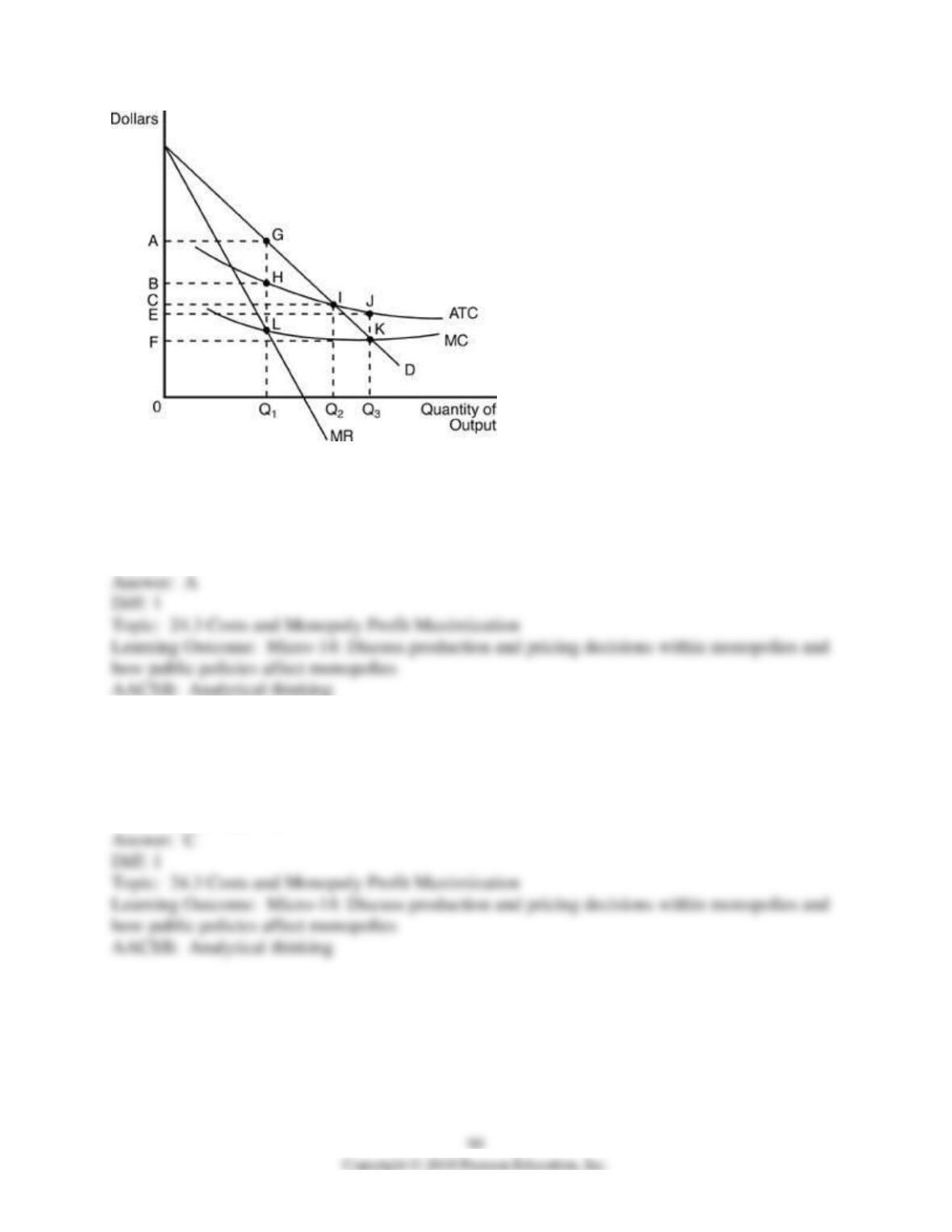
99) In the above figure, the area of rectangle ABHG represents the monopolist’s
A) maximized economic profits.
B) maximized total revenue.
C) average total profits.
D) total costs.
100) In the above figure, the distance between A and B represents this monopoly firm’s
A) total profit.
B) total revenue.
C) average profit per unit.
D) average cost per unit.
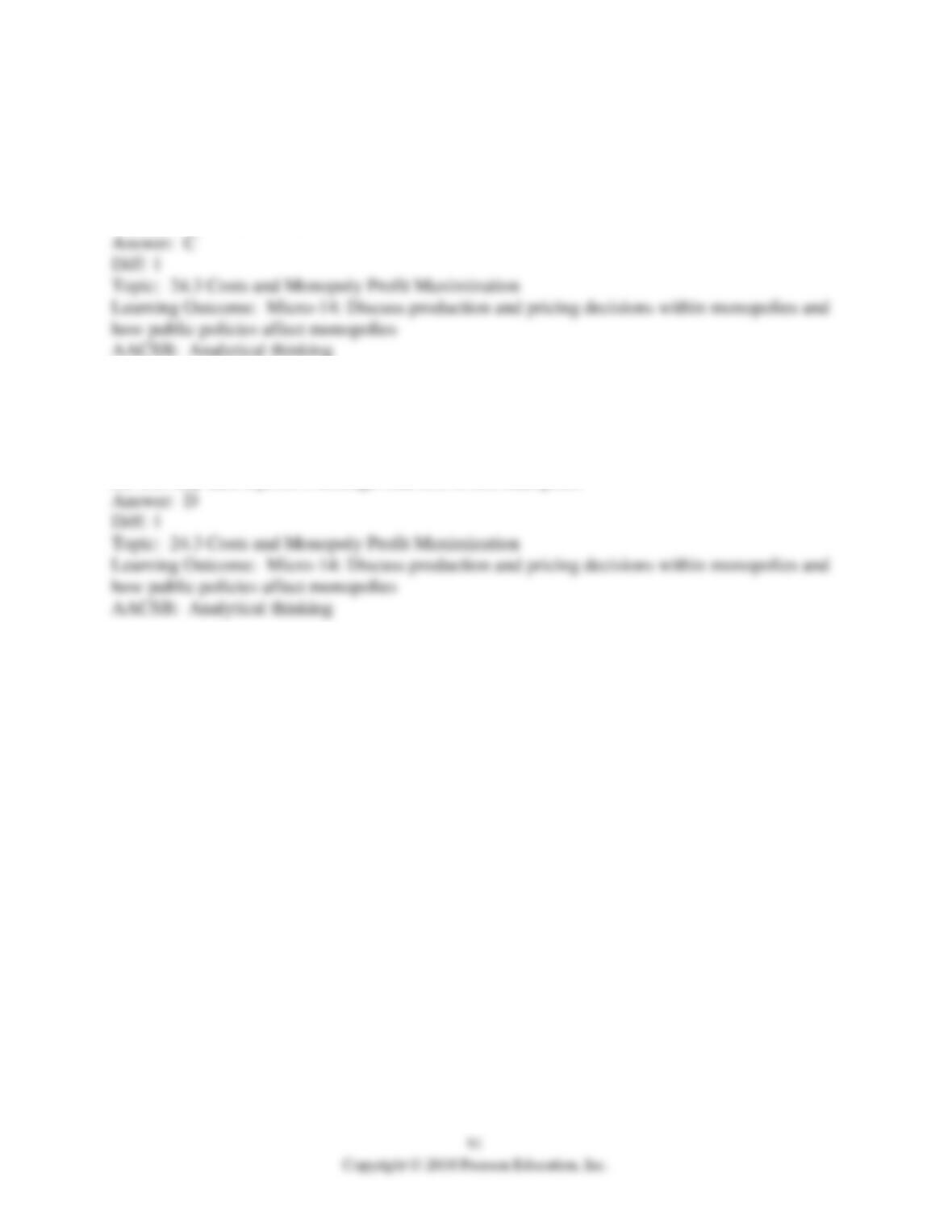
101) In the above figure, a monopolist will set its level of output and price at
A) Q2 and C, respectively.
B) Q3 and F, respectively.
C) Q1 and A, respectively.
D) Q1 and B, respectively.
102) The owner of a patented invention
A) may or may not have a legal monopoly.
B) is guaranteed a profit since her idea cannot be copied.
C) will always have demand high enough and costs low enough to ensure a profit.
D) will only earn a profit if average total cost is less than price.
92
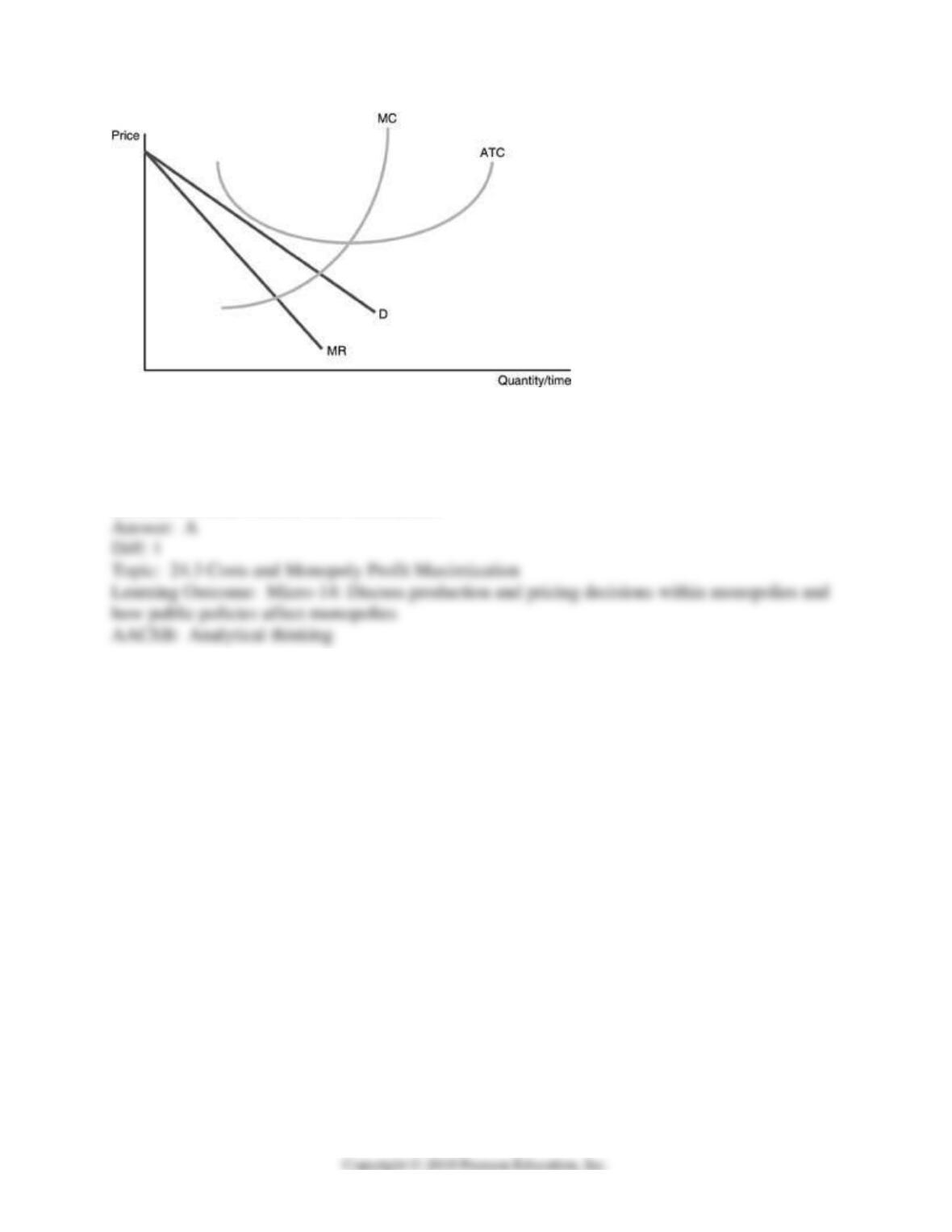
103) Refer to the above figure. Profits for this firm are
A) negative.
B) zero.
C) positive.
D) undetermined without more information.
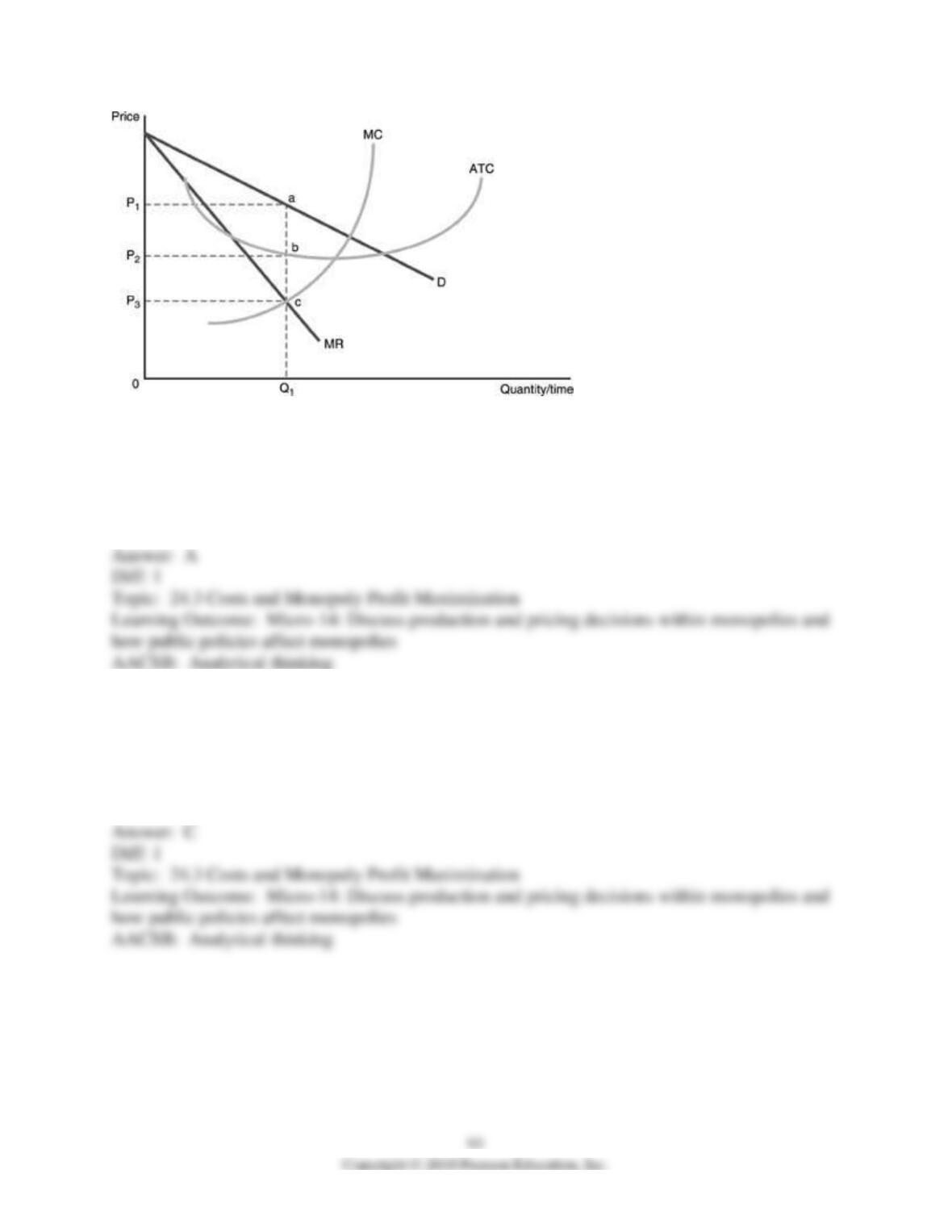
104) Refer to the above figure. Profits for this firm are
A) positive and equal to P2P1ab.
B) positive and equal to P3P1ac..
C) negative and equal to P3P2bc.
D) negative and equal to 0P3cQ1.
105) Refer to the above figure. Total cost for this firm equals
A) P2.
B) P3.
C) 0P2bQ1.
D) 0P3cQ1.
106) A monopolist would not be able to make a positive profit at any price output combination
when
A) marginal cost is less than average total cost for one more unit of output.
B) the average variable cost curve is everywhere above the marginal revenue curve.
C) the minimum point of the average total cost curve lies to the right of the minimum of the
average variable cost curve.
D) the average total cost curve is everywhere above the demand curve.
107) Which of the following is a TRUE statement about a monopoly?
A) A monopoly does not necessarily earn positive economic profits.
B) A monopoly must earn an above-normal profit to stay in business.
C) As long as there are barriers to entry, a monopoly can always find some price-output
combination that generates positive economic profits.
D) As long as the demand curve slopes down, a monopoly can always find some price-output
combination that generates positive economic profits.
108) A monopolistic firm will shut down if
A) P < ATC for every level of output.
B) P > ATC for every level of output.
C) P > AVC for every level of output.
D) P < AVC for every level of output.
109) Which of the following is INCORRECT regarding monopoly and profits?
A) The mere existence of a monopoly does not guarantee high profits.
B) Numerous monopolies have gone bankrupt.
C) A monopolist will never experience economic losses.
D) The monopolist reaches profit-maximizing output by trial and error.
110) For the monopoly in the above figure, if the firm is currently producing 700 units, which of
the following is correct?
A) It could earn higher profits if it produced more units each day.
B) It could earn higher profits if it produced fewer units each day.
C) It is maximizing its profits.
D) It is incurring a loss.
111) Use the above figure. The profit-maximizing output and price is
A) 600 and $16, respectively.
B) 600 and $10, respectively.
C) 600 and $8, respectively.
D) 800 and $10, respectively.
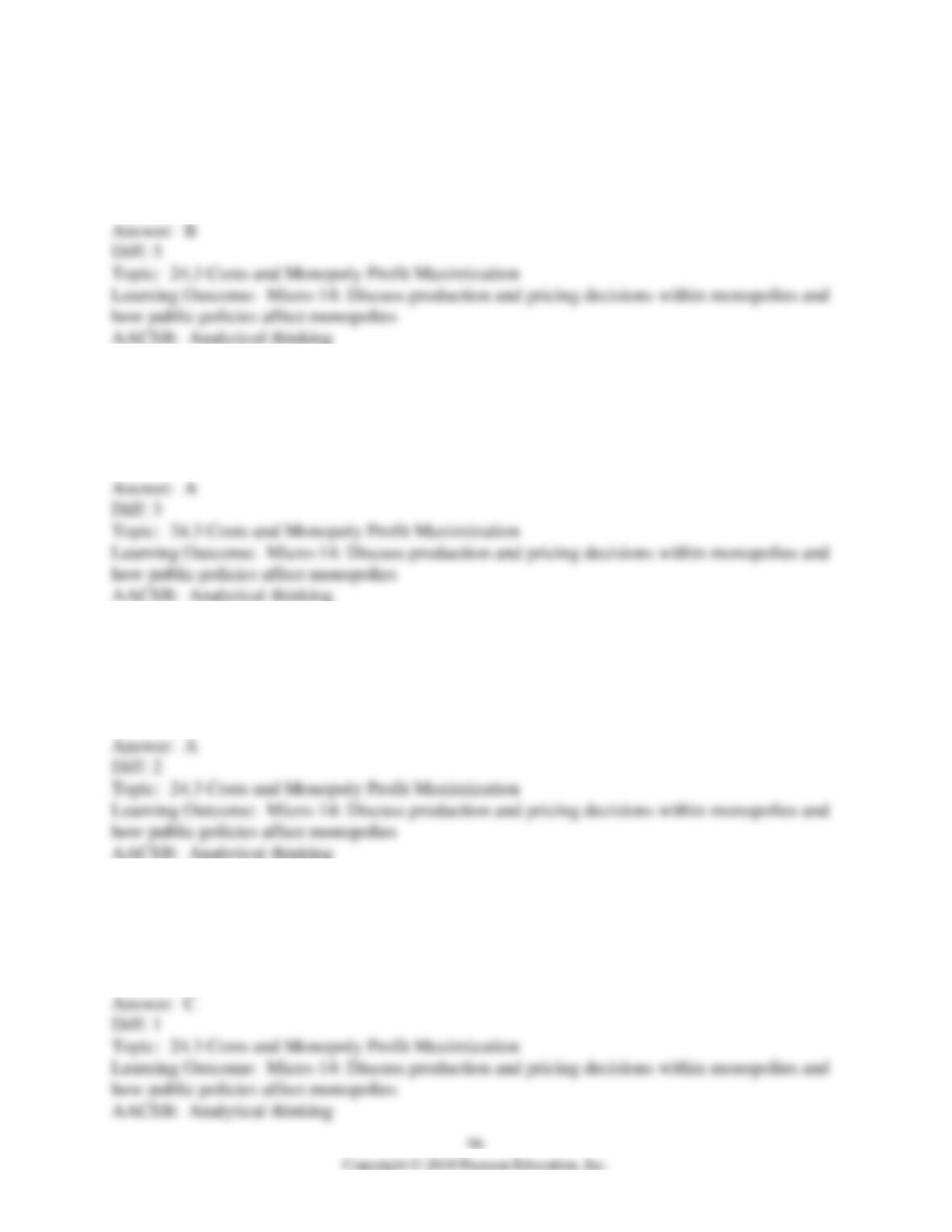
112) Use the above figure. Total revenue at the profit-maximizing output is
A) $4,800.
B) $9,600.
C) $5,600.
D) $8,000.
113) Use the above figure. Total cost at the profit-maximizing output is closet to
A) $6,600.
B) $9,600.
C) $4,800.
D) $8,000.
114) Use the above figure. The profit this monopolist earns is closest to
A) $3,000.
B) $4,800.
C) $1,600.
D) $1,000.
115) A firm that faces a downward sloping demand curve is
A) a price taker.
B) a price provider.
C) a price searcher.
D) a price creator.
116) A firm that faces a downward sloping demand curve is known as a
A) price taker.
B) utility maximizer.
C) price searcher.
D) perfect competitor.
117) How does a monopoly maximize profits? What price does it charge?
118) “Unlike a perfect competitor, a profit-maximizing monopolist produces at an output rate at
which marginal revenue exceeds marginal cost.” Do you agree or disagree? Why
119) “All monopolies operate with positive economic profits.” Do you agree or disagree? Why?
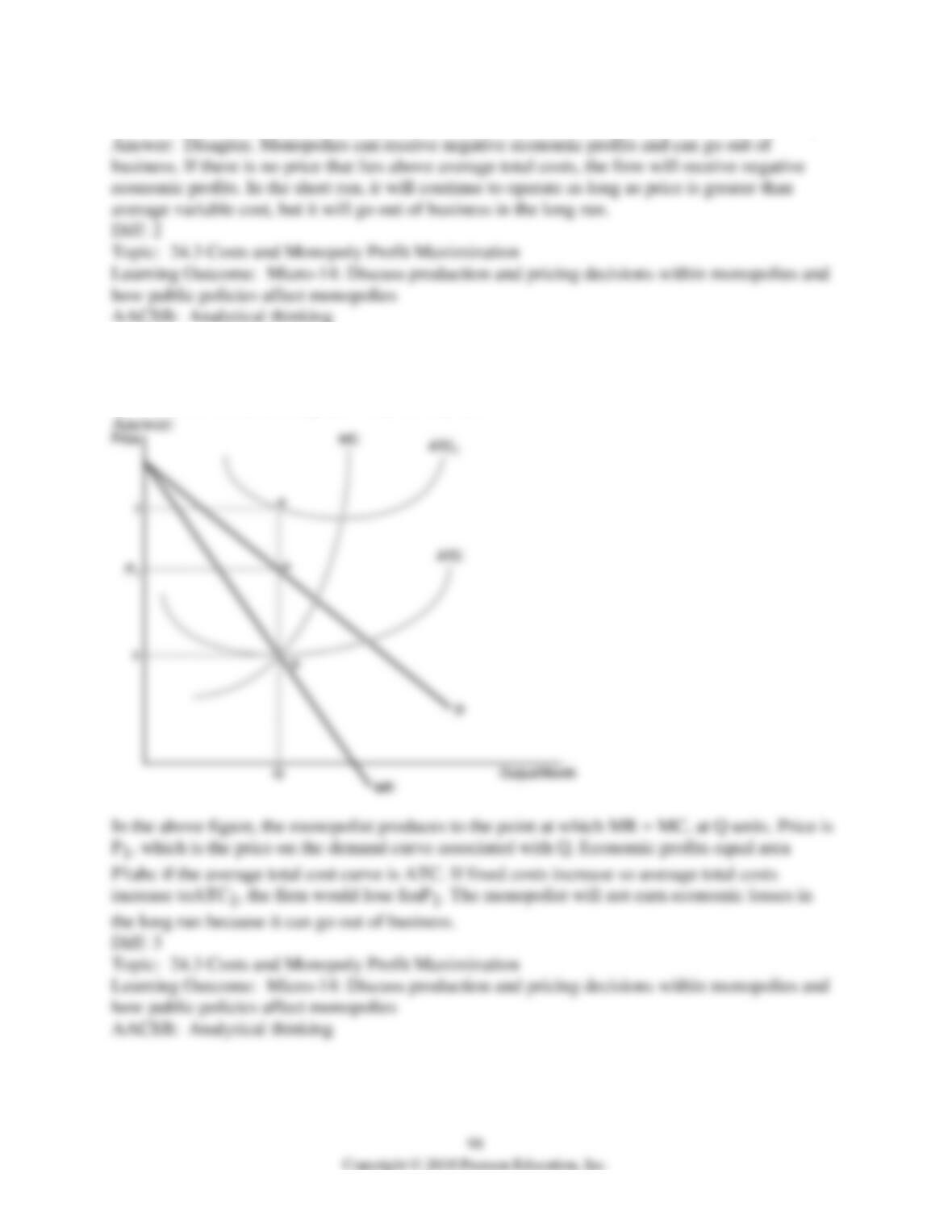
120) Using a graph, show the profits of a monopoly. Suppose fixed costs increased enough to
make the firm earn an economic loss. Show such a situation. Would the monopolist earn
economic losses in the long run? Why or why not?
24.4 On Making Higher Profits: Price Discrimination
1) Price discrimination refers to
A) selling a product at different prices according to the differences in marginal cost of providing
it to different consumers.
B) selling a product at different prices, with the price difference being unrelated to differences in
marginal cost.
C) charging the same prices to all consumers but selling them different quantities.
D) a deliberate effort on the part of a monopoly producer to confuse consumers.
2) A price-discriminating monopolist with two markets will equate
A) the prices of two markets.
B) price and marginal revenue in each of the two markets.
C) marginal revenue and marginal cost in each of the two markets.
D) average revenue and marginal revenue between the two markets.
3) A monopolist engages in price discrimination
A) by charging a higher price to consumers whose demand is more elastic.
B) by charging a higher price when marginal cost is lower.
C) by charging a lower price to consumers whose demand is more elastic.
D) by charging the same price to all consumers.
100
4) A monopolist engages in price discrimination
A) by charging a higher price to consumers whose demand is more inelastic.
B) by charging a lower price when marginal cost is higher.
C) by charging a lower price to consumers whose demand is more inelastic.
D) by charging the same price to all consumers.
5) When grocery stores issue special discount membership cards for shoppers effectively
offering different prices based on quantities consumed, this is an example of
A) price discrimination.
B) price differentiation.
C) product differentiation.
D) patent protection.
6) Which of the following is NOT a necessary condition for price discrimination?
A) preventing resale of the product
B) downward sloping demand curve
C) separating markets for the good
D) having a constant marginal cost