23) In equilibrium, which of the following conditions is common to both unregulated monopoly
and pure competition?
A) P = MR
B) AR = ATC
C) MR = MC
D) MC = P
24) Profits can be maximized by equating MR = MC = Price
A) only in perfectly competitive markets.
B) only in monopoly markets.
C) only in discriminating monopoly markets.
D) only with government price controls.
25) In maximizing economic profit, the monopolist will
A) choose the highest price that still permits some output sales.
B) equate marginal cost to minimum average total cost.
C) equate price to marginal cost.
D) equate marginal revenue to marginal cost.
26) The monopolist faces a downward sloping demand curve, and maximizing profits requires
the monopolist to
A) accept the market price for its product.
B) will produce where the demand curve is inelastic.
C) search for the price consistent with producing to the point at which marginal revenue equals
marginal cost.
D) search for the highest possible price consistent with maximizing its revenues, irrespective of
its explicit and implicit opportunity costs.
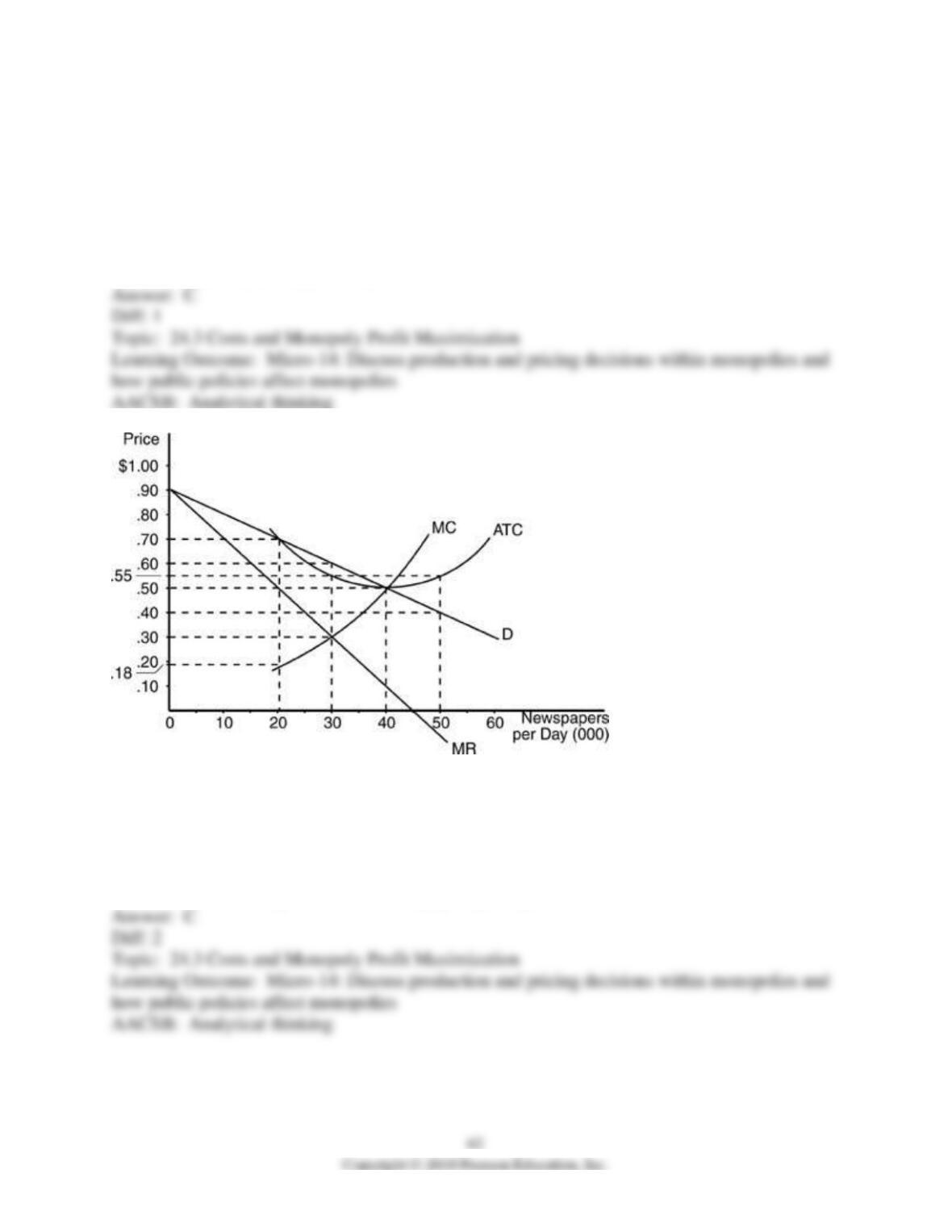
27) According to the above figure, the profit maximizing price-output combination for the
monopolist is a price of
A) 50 cents and an output of 40,000 newspapers per day.
B) 30 cents and an output of 30,000 newspapers per day.
C) 60 cents and an output of 30,000 newspapers per day.
D) 45 cents and an output of 45,000 newspapers per day.
28) The monopolist is a
A) price taker who tries to find the profit-maximizing rate of output.
B) price taker who tries to find the profit-maximizing price.
C) price searcher who tries to find the profit-maximizing price-output combination.
D) price searcher who tries to find the rate of output that maximizes price.
29) A firm that must determine the price-output combination that maximizes profit because it
faces a downward-sloped demand curve
A) has a perfectly elastic demand curve.
B) has a perfectly inelastic demand curve.
C) is a price-taker.
D) is a price searcher.
30) A monopolist maximizes profits by finding
A) the rate of output where marginal revenue equals marginal cost.
B) the rate of output where price equals marginal cost.
C) the price where price exceeds marginal revenue by that largest amount.
D) the price where average revenue and marginal cost are equal.
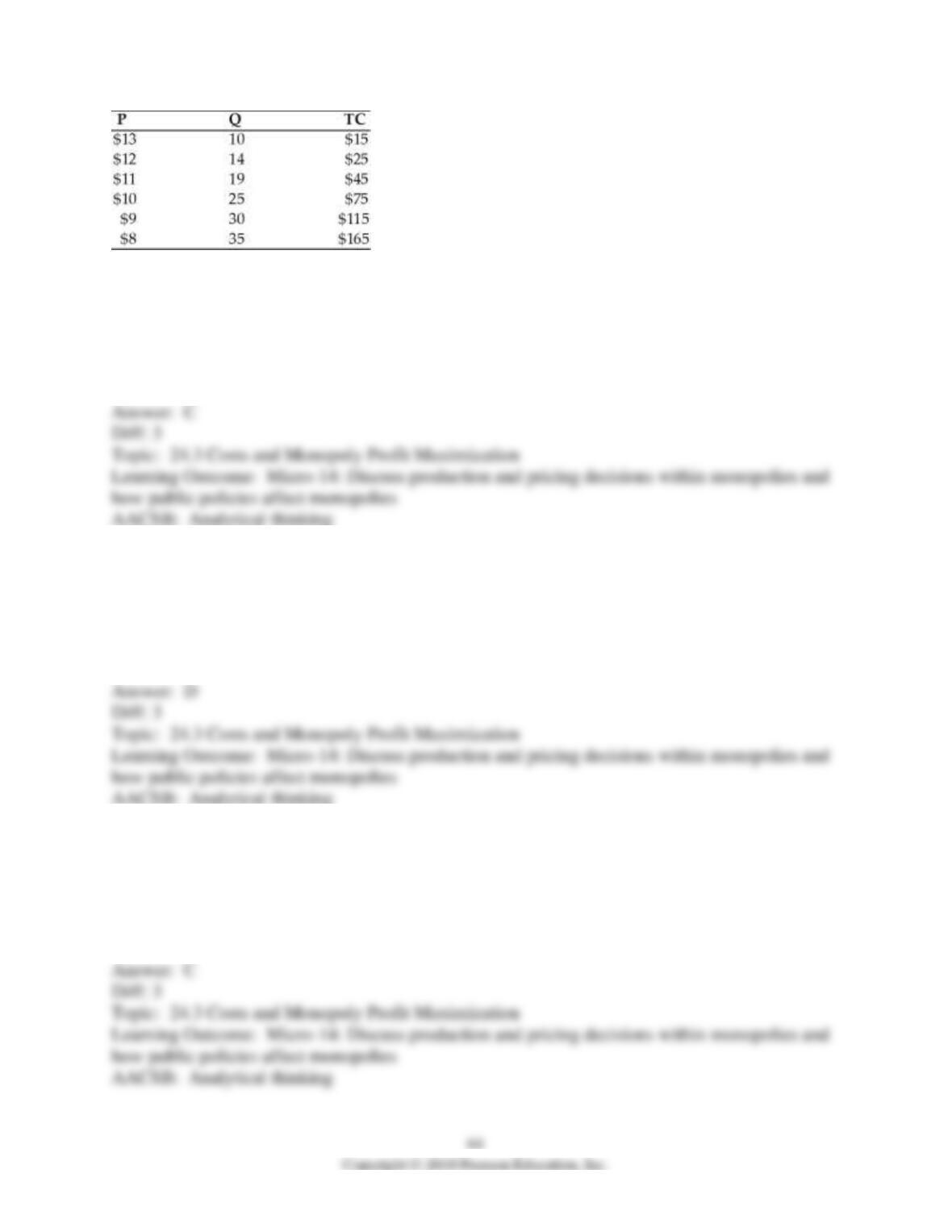
31) Refer to the above table. Given the demand and cost schedules, what is the profit maximizing
quantity for this monopolist?
A) 14
B) 19
C) 25
D) 30
32) Refer to the above table. Given the demand and cost schedules, what is the profit-
maximizing price for this monopolist?
A) $9
B) $12
C) $11
D) $10
33) Refer to the above table. Given the demand and cost schedules, what are the maximum
economic profits for this monopolist?
A) $155
B) $143
C) $175
D) $164
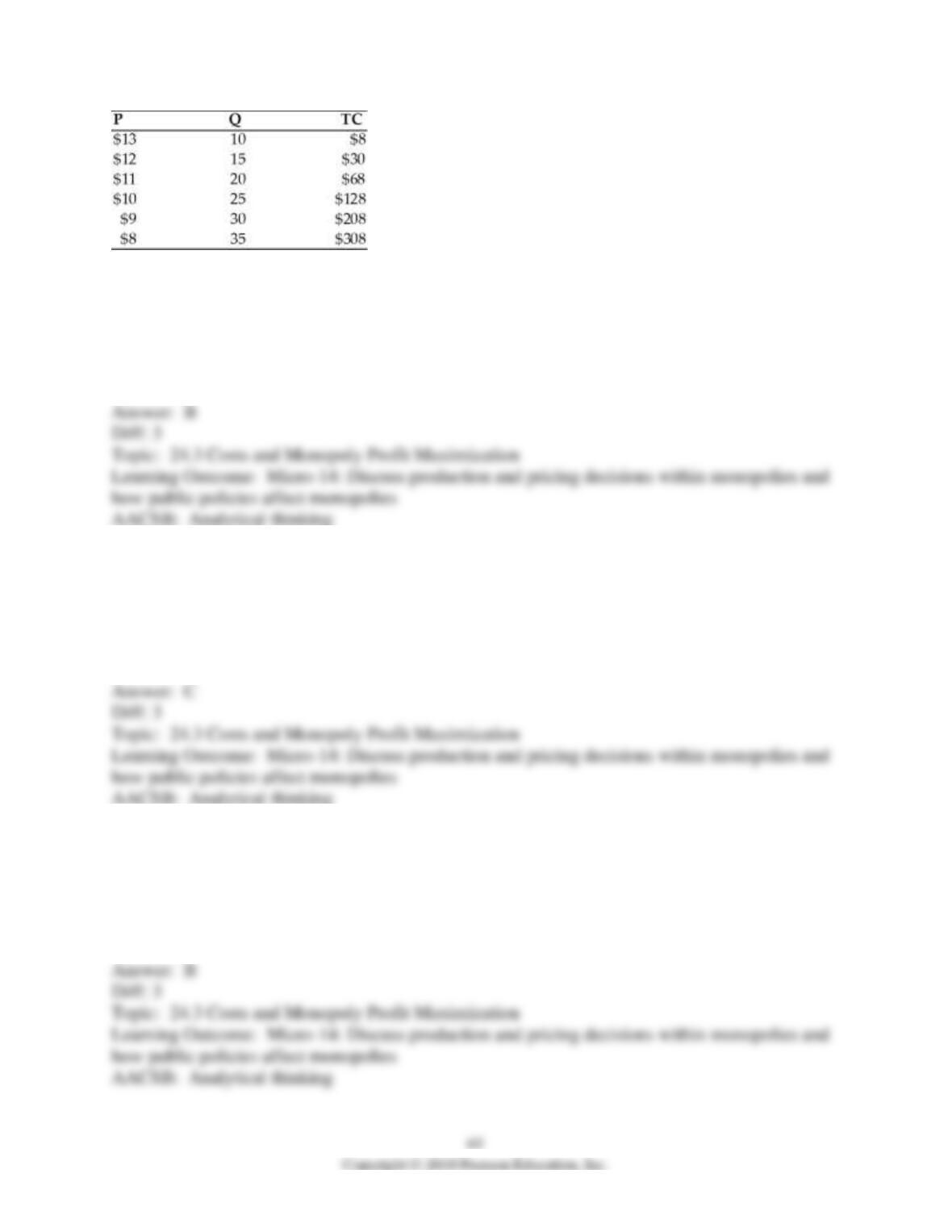
34) Refer to the above table. Given the demand and cost schedules, what is the profit maximizing
quantity for this monopolist?
A) 15
B) 20
C) 25
D) 30
35) Refer to the above table. Given the demand and cost schedules, what is the profit-
maximizing price for this monopolist?
A) $13
B) $12
C) $11
D) $10
36) Refer to the above table. Given the demand and cost schedules, what are the maximized
economic profits for this monopolist?
A) $122
B) $152
C) $220
D) $150
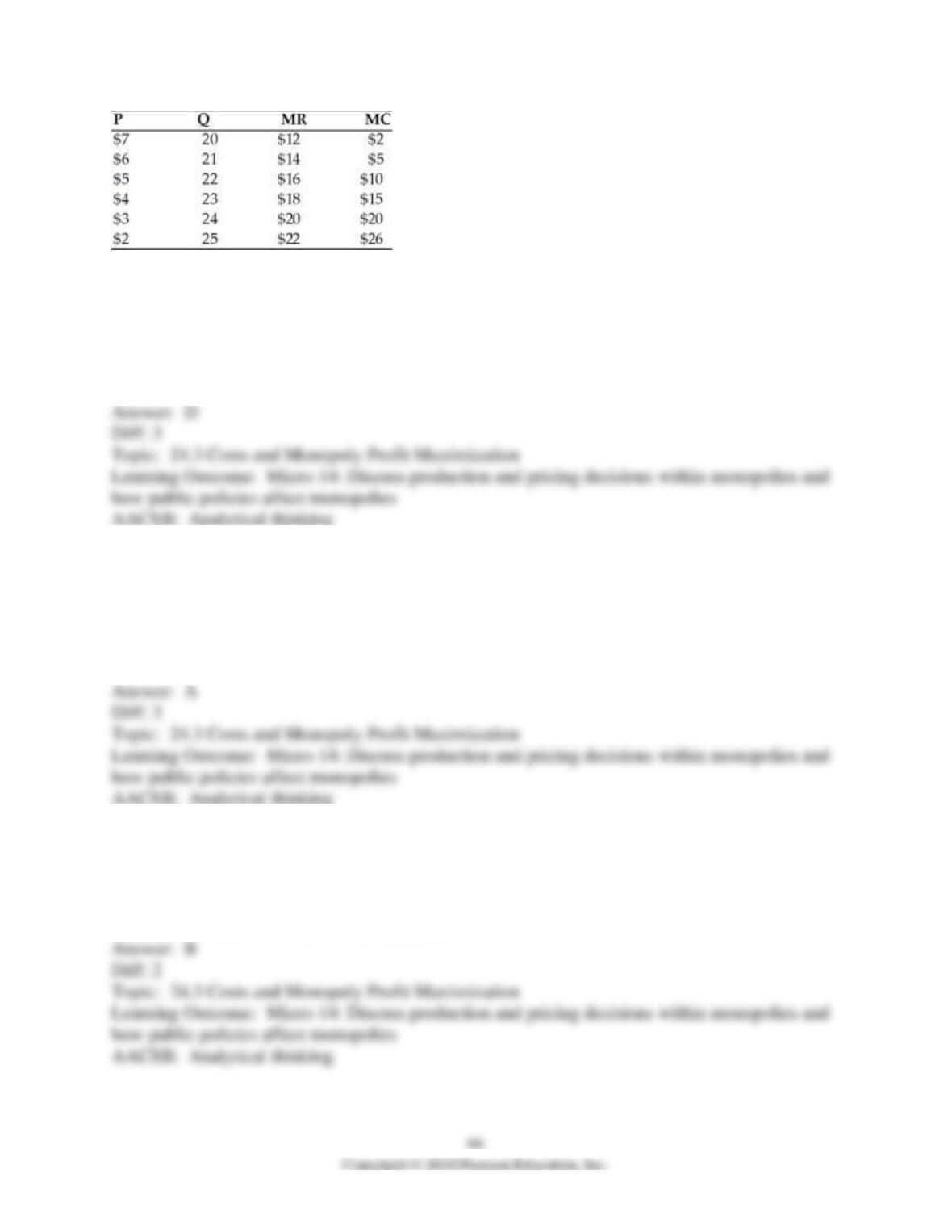
37) Refer to the above table. Given the demand and cost schedules, what is the profit maximizing
quantity for this monopolist?
A) 23
B) 21
C) 20
D) 24
38) Refer to the above table. Given the demand and cost schedules, what is the profit-
maximizing price for this monopolist?
A) $3
B) $4
C) $6
D) $7
39) If a monopolist is producing the quantity at which price equals marginal cost, it should
A) continue to produce this amount if it wants to maximize profits.
B) reduce output if it wants to maximize profits.
C) reduce price and keep output unchanged if it wants to maximize profits.
D) increase output if it wants to maximize profits.
40) If a monopolist is producing the quantity at which marginal revenue equals marginal cost, it
should
A) continue to produce this amount if it wants to maximize profits.
B) reduce output if it wants to maximize profits.
C) increase price and keep output unchanged if it wants to maximize profits.
D) increase output if it wants to maximize profits.
41) If a monopolist is producing the quantity at which marginal revenue exceeds marginal cost, it
should
A) continue to produce this amount if it wants to maximize profits.
B) reduce output if it wants to maximize profits.
C) reduce price and keep output unchanged if it wants to maximize profits.
D) increase output if it wants to maximize profits.
42) A monopolist finds the output (Q*) rate that maximizes profit. It finds the price by
A) taking the height of the marginal revenue curve at output rate Q*.
B) taking the height of the marginal cost curve at output rate Q*.
C) taking the height of the demand curve at output rate Q*.
D) setting price equal to marginal cost.
43) A monopolist who is maximizing profits produces to the point at which
A) marginal cost and average total cost are equal.
B) price, marginal cost and average variable cost are equal.
C) price is greater than marginal cost.
D) price is greater than average total cost.
44) The monopolist determines the price and quantity combination that maximizes short-run
profits by
A) finding the quantity at which marginal cost and marginal revenue are equal and then using the
demand curve to find price.
B) determining the price by finding the highest price at which sales can be made and then using
the demand curve to find the appropriate quantity.
C) finding the point at which marginal revenue and demand intersect. This gives the price and
quantity that maximizes profits.
D) finding the quantity at which average revenue and average total cost are furthest apart.
45) If a monopolist produces to a point at which marginal revenue is less than marginal cost then
A) profits are being maximized.
B) profits will always be negative.
C) the incremental cost of producing the last unit exceeds the incremental revenue.
D) the incremental cost of producing the last unit is less than the incremental revenue.
46) If a monopolist produces to a point at which marginal revenue is greater than marginal cost
then
A) profits are being maximized.
B) profits will always be negative.
C) the incremental cost of producing the last unit exceeds the incremental revenue.
D) the incremental cost of producing the last unit is less than the incremental revenue.
47) If a monopolist produces to a point at which marginal revenue is less than marginal cost then
A) the firm should increase output.
B) the firm should reduce output.
C) the firm is maximizing profits.
D) we do not know if the firm should increase or reduce without more information.
48) If a monopolist produces to a point at which marginal revenue is more than marginal cost
then
A) the firm should increase output.
B) the firm should reduce output.
C) the firm is maximizing profits.
D) we do not know if the firm should increase or reduce without more information.
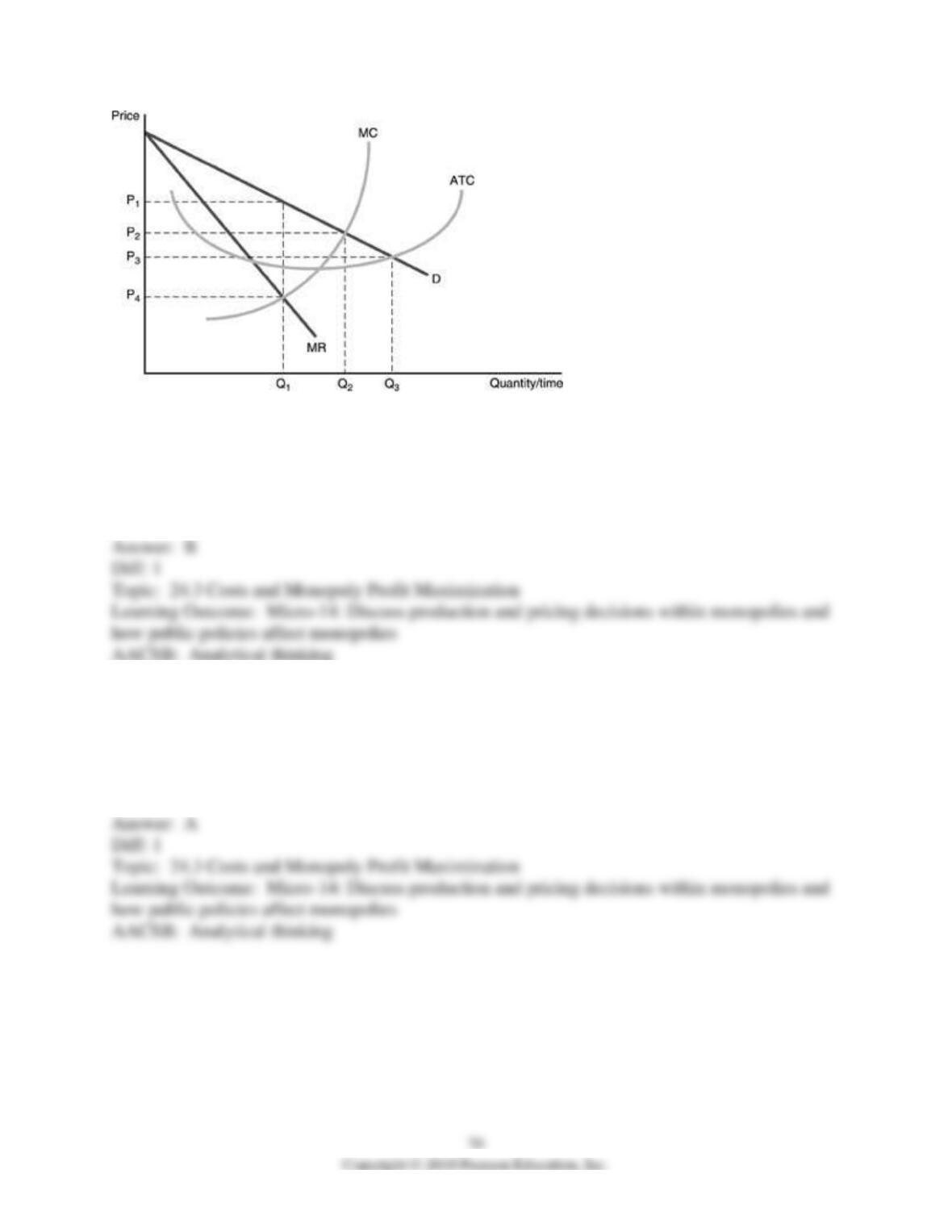
49) Refer to the above figure. The profit maximizing quantity for this firm is
A) zero.
B) Q1.
C) Q2.
D) Q3.
50) Refer to the above figure. The profit-maximizing price for this firm is
A) P1.
B) P2.
C) P3.
D) P4.
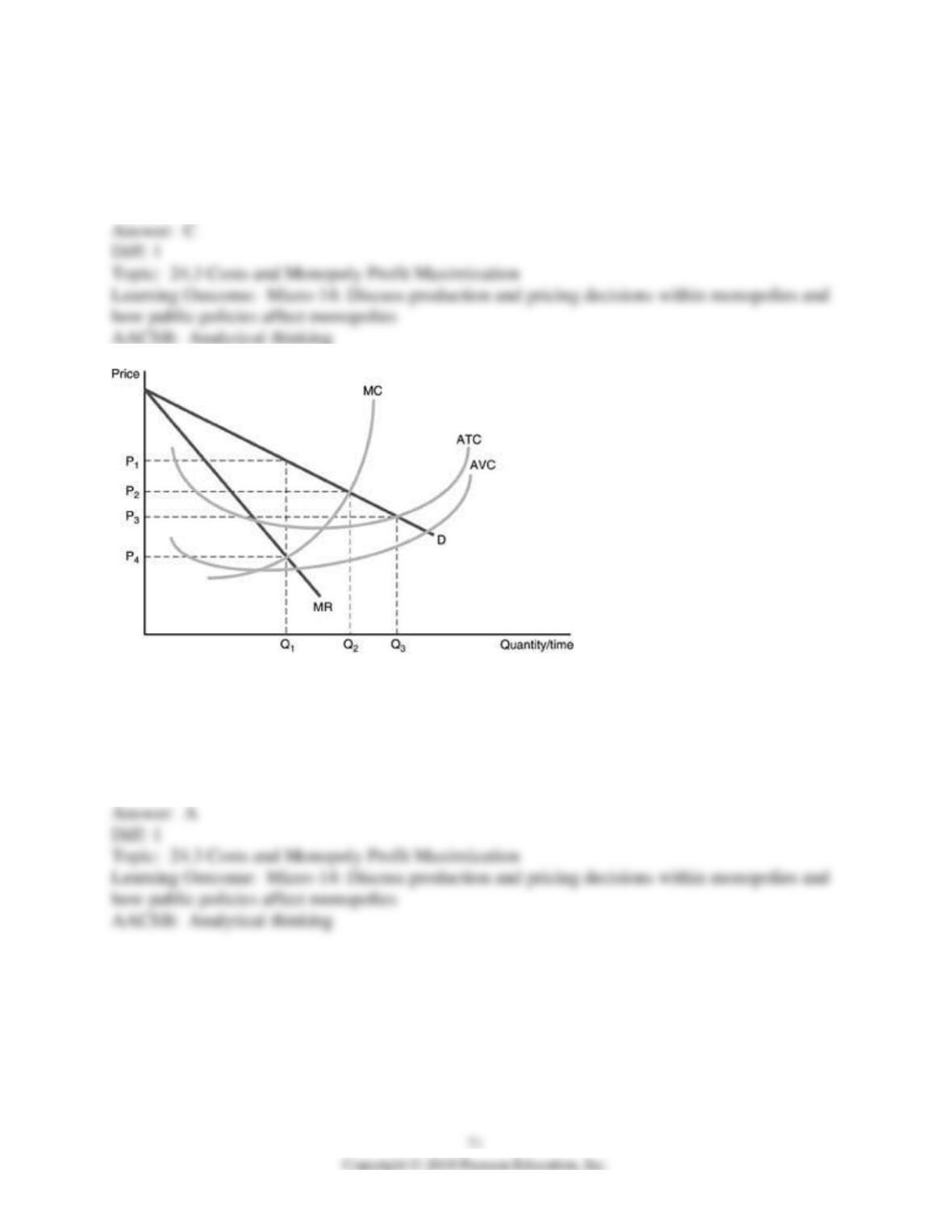
51) Refer to the above figure. Profits for this firm are
A) zero.
B) negative.
C) positive.
D) undetermined without more information.
52) Refer to the above figure. The profit-maximizing price and output for this monopolist are
A) a price of P1 and output of Q1.
B) a price of P4 and output of Q1.
C) a price of P2 and output of Q2.
D) a price of P3 and output of Q3.
53) Refer to the above figure. Profits for this firm are
A) negative.
B) zero.
C) positive.
D) undetermined without more information.
54) Refer to the above figure. The firm is currently producing at Q2. The firm should
A) reduce production.
B) leave production as it is.
C) increase production.
D) shut down.
55) Refer to the above figure. The firm is currently producing at Q1. The firm should
A) reduce production.
B) leave production as it is.
C) increase production.
D) shut down.
56) A monopolist
A) is a price searcher.
B) is a price taker.
C) faces an upward sloping demand curve.
D) faces a vertical demand curve.
57) A firm that can determine the price-output combination in order to maximize profit is known
as a
A) price searcher.
B) price taker.
C) demand searcher.
D) cost taker.
58) The point of profit maximization for a monopolist is exemplified by
A) TR = TC.
B) MR = MC.
C) ATCmin.
D) MR > MC.
59) A monopolist determines the profit-maximizing output
A) at the point at which TR = TC.
B) at the point at which MR = MC.
C) at any point it wants because it is the only producer of the product.
D) at the point at which TR is maximum.
60) Which of the following conditions is TRUE for both the perfectly competitive firm and the
monopoly at the profit-maximizing output level?
A) MR = P
B) MC = ATC
C) MC = P
D) MR = MC
61) A pure monopolist is selling 10 units at a price of $12. If the marginal revenue of the 11th
unit is $1, then the price of the 11th unit is
A) $10.
B) $11.
C) greater than $12.
D) $12.
62) A monopoly sells 10 units of output at $10. If the MR of the 11th unit is $4.50, then the price
of the 11th unit is
A) also $10.
B) $9.50.
C) greater than $10.
D) $7.25.
63) A monopoly sells 5 units of output at $20. If the MR of the 6th unit is $14, then the price of
the 6th unit is
A) also $14.
B) $17.
C) greater than $20.
D) $19.
64) A monopolist is producing at an output level at which MR = $6 and MC = $9. It could
increase profits
A) by increasing both output and price.
B) by reducing output and by increasing price.
C) by reducing both output and price.
D) by increasing output and by reducing price.
65) A monopolist is producing at an output level at which MR = $9 and MC = $8. It could
increase profits
A) by increasing both output and price.
B) by reducing output and by increasing price.
C) by reducing both output and price.
D) by increasing output and by reducing price.
66) A monopolist is producing at an output level at which ATC = $5, P = $6, MC = $3, and MR
= $4. We can conclude that
A) economic profit could be increased by producing more.
B) economic profit could be increased by producing less.
C) economic profit cannot be increased.
D) the firm is earning $10 in economic profits.
67) A monopolist is producing at an output level at which ATC = $5, P = $6, MC = $4, and MR
= $3. We can conclude that
A) economic profit could be increased by producing more.
B) economic profit could be increased by producing less.
C) economic profit cannot be increased.
D) the firm is earning $10 in economic profits.
68) Assume that a monopoly is producing at a profit-maximizing output level. If the firm’s total
fixed costs decrease, the firm
A) should lower its price.
B) should increase its price.
C) should continue to produce at the same level.
D) increase its output level.
69) For a profit-maximizing monopolist
A) P > MC.
B) P = MC.
C) P = MR.
D) P = ATC.
70) In the long run, all of the following are true for a monopolist EXCEPT
A) P > ATC.
B) P = MC.
C) MR = MC.
D) P > AVC.
71) Which of the following is TRUE of a perfectly competitive firm and a monopoly in the long
run?
A) P = MC
B) P = ATC
C) MR = MC
D) P = MR
72) For a monopoly earning positive economic profits at the profit-maximizing output level, all
of the following are true EXCEPT
A) P > ATC.
B) P > MR.
C) P > MC.
D) P = MR.
73) If a monopolist is producing at an output rate at which P = ATC, then
A) its economic profit will be zero.
B) its economic profit will be positive.
C) it is maximizing its profits.
D) it is minimizing its losses.
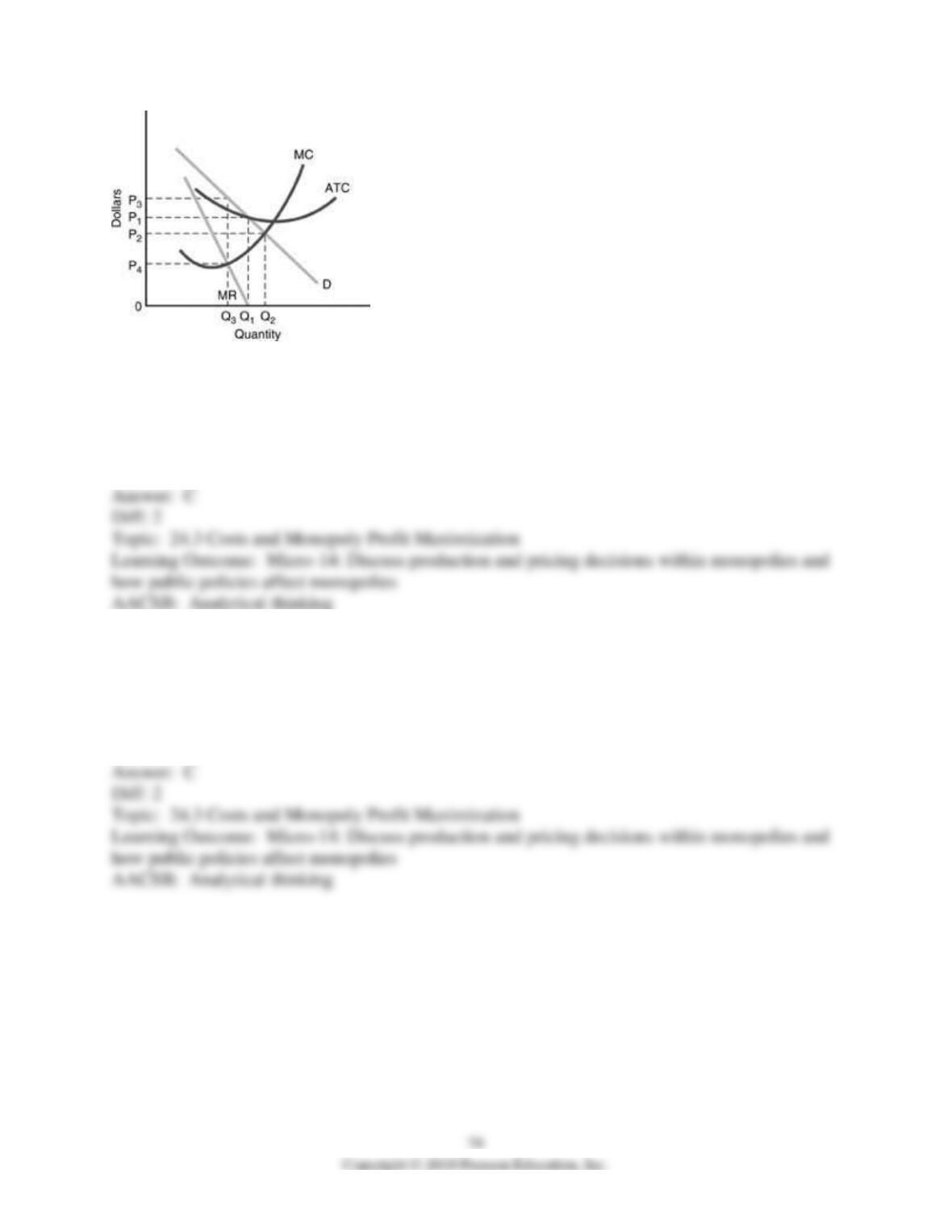
74) Use the above figure. The profit-maximizing output will be
A) Q1.
B) Q2.
C) Q3.
D) None of the above are correct.
75) Use the above figure. The profit-maximizing price will be
A) P1.
B) P2.
C) P3.
D) P4.
80
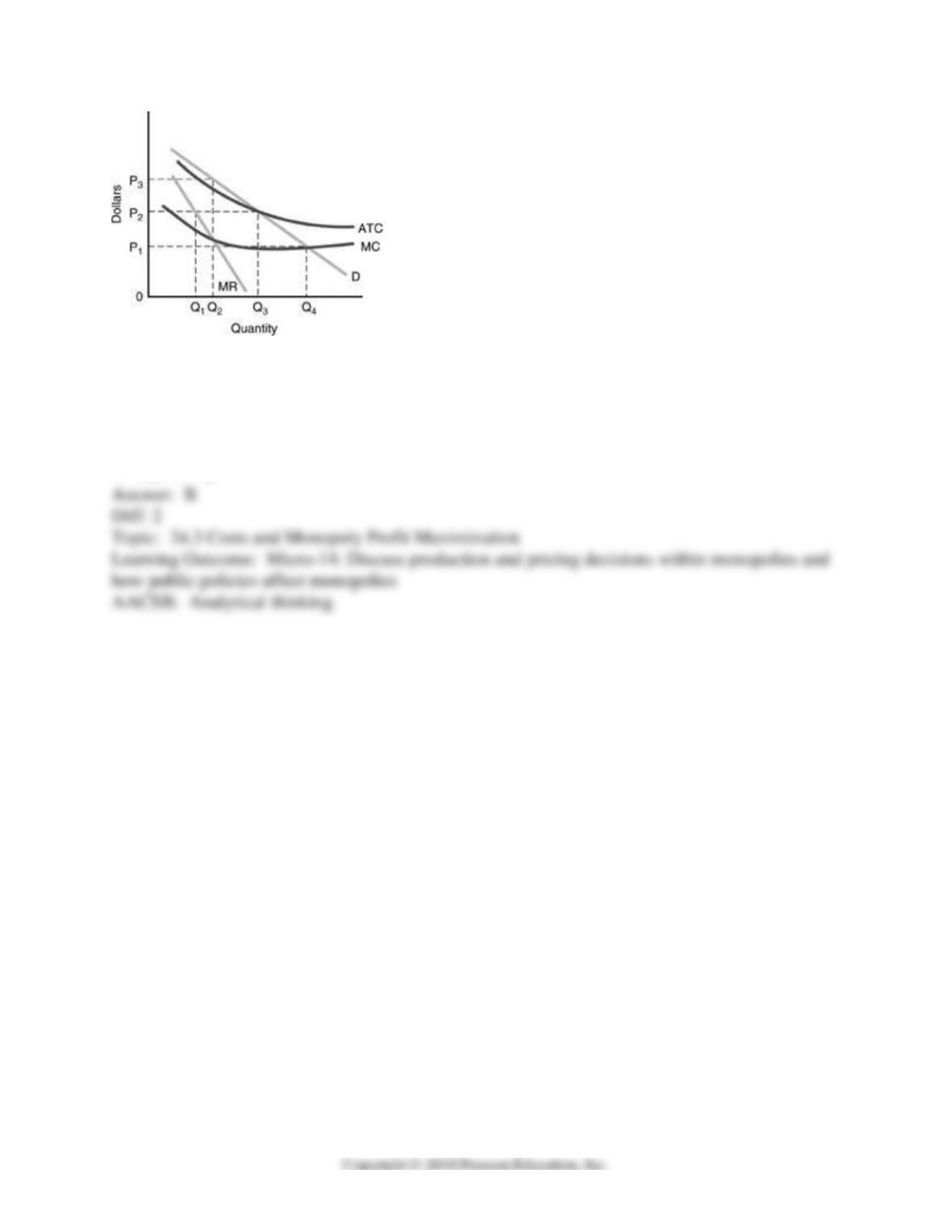
76) Use the above figure. The profit-maximizing or loss minimizing output and price will be
A) Q1 and P2.
B) Q2 and P3.
C) Q3 and P3.
D) Q4 and P1.