Economics Today, 19e (Miller)
Chapter 24 Monopoly
24.1 Defining and Explaining the Existence of Monopoly
1) Monopoly producers face
A) many competitors producing the same product.
B) only a few competitors producing the same product.
C) at least one competitive producer of the same product.
D) no competitive producers of the same product.
2) Which of the following is a characteristic of a monopoly market?
A) many suppliers of similar products
B) one single producer
C) easy entry
D) The firm is a price taker.
3) Which of the following statements is FALSE?
A) An unregulated, profit-maximizing monopolist will not operate in the inelastic portion of the
demand curve.
B) The marginal revenue earned by a monopolist will always be less than the product’s price.
C) Typically there are numerous very close substitutes for the product of a monopolist.
D) For a profit-maximizing monopolist, marginal revenue equals marginal cost.
4) A monopolist is defined as
A) a firm with annual sales over $10 million.
B) a large firm, making substantial profits, that is able to make other firms do what it wants.
C) a single supplier of a good or service for which there is no close substitute.
D) a producer of a good or service that is expensive to produce, requiring large amounts of
capital equipment.
5) A firm can be the sole supplier of a good and is still not a monopolist if
A) the firm is not large.
B) the good produced is not important to the economy.
C) the firm is not making excessive profits.
D) there are very close substitutes for the good.
6) The market structure in which there is a single supplier of a good or service for which there is
no close substitute is
A) a price searcher.
B) a monopoly.
C) a price taker.
D) perfect competition.
7) The market structure in which there is a single supplier of a good or service for which there is
no close substitute is
A) oligopoly.
B) perfect competition.
C) monopoly.
D) monopolistic competition.
8) A monopolist is
A) a firm with the largest annual sales in a country.
B) a single supplier of a good for which there is no close substitute.
C) a large firm that makes all the other firms in the industry do what it wants.
D) a supplier of a good that everyone needs with the result that it makes large profits.
9) In a monopoly
A) the firm is large in an absolute sense.
B) the market is small in an absolute sense.
C) the firm and the industry are the same thing.
D) the monopolist determines how much each firm will produce.
10) A firm can be the only firm in an industry and still not be a monopoly if
A) the firm is not large.
B) the firm is not making economic profits.
C) the firm produces a good similar to a good in another industry.
D) the firm produces a good that is not considered a necessity.
11) In a monopoly market structure, the firm (the monopolist) always
A) is the whole industry.
B) produces too much.
C) sells faulty products.
D) earns economic profit.
12) Which of the following regarding a monopolist is INCORRECT?
A) The monopolist is a single supplier of a good or service.
B) The monopolist constitutes the entire industry.
C) The monopolist produces only goods of highest quality.
D) There are barriers to entry that allow monopoly.
13) A single supplier of a good or service for which there is no close substitute is referred to as
a(n)
A) strategic competitor.
B) monopoly.
C) oligopoly.
D) monopolistic competitor.
14) A firm that is the only seller of a good with no close substitutes is a(n)
A) perfect competitor.
B) monopolistic competitor.
C) oligopolist.
D) monopolist.
15) All of the following are true about a monopolist EXCEPT
A) the demand curve for its product is perfectly elastic.
B) it produces a product with no close substitutes.
C) its demand curve is the same as the market demand for the industry.
D) it is a single seller of a good or service.
16) In order for a firm to receive monopoly profits, there must be
A) homogeneous products.
B) barriers to market entry.
C) mutual interdependence among firms.
D) free entry and exit to the market.
17) Which of the following are barriers to entry?
A) economies of scale
B) patents and copyrights
C) control of resources
18) Which of the following is NOT a barrier to entry?
A) patents
B) licenses
C) economies of scale
D) U.S. antitrust legislation
19) To be able to engage in profit-maximizing price searching, a monopoly firm must be able to
A) prevent the entry of other firms into the market for its product.
B) induce the entry of other firms into the market for its product.
C) avoid earning negative economic profits in the short run.
D) always earn zero economic profits.
20) Which of the following is NOT a barrier to entry that would allow a monopolist to keep
potential competitors out of its market?
A) Significant economies of scale exist.
B) The market price of the product is too high.
C) The firm has a patent on the good or control over some resource required for the production
of the good.
D) The firm has government authorization to be a monopoly.
21) Which of the following would NOT be a barrier to entry for a particular market?
A) ownership of a patent
B) low cost of obtaining initial capital
C) the presence of economies of scale
D) government regulation
22) If government regulations significantly increase the cost of operating within a particular
market, one result is that
A) new firms are discouraged from entering the market.
B) barriers to entry are nullified.
C) a perfectly competitive market environment is encouraged.
D) new firms are encouraged to enter the market.
23) If there are no barriers to entry into an industry
A) short-run economic profits must be zero.
B) long-run economic profits must be zero.
C) both short-run and long-run economic profits must be zero.
D) short-run and long-run profits must still be positive.
24) A firm typically achieves its position as a monopolist as a result of
A) a small market and a constant average cost.
B) a downward sloping demand for the product.
C) barriers to entry.
D) the absence of long-run profits in an industry.
25) A monopolist can earn economic profits in the long run because
A) a monopoly is by definition large, and this gives it the ability to make large profits.
B) a monopoly makes the good or service better than anyone else.
C) barriers to entry prevent new firms from entering the industry.
D) monopolies can legally force people to buy their products and to pay more for them than they
are worth.
26) Which of the following can be a barrier to entry, closing a market to new firms?
A) an elastic industry demand curve
B) control of a vital resource by one producer
C) diseconomies of scale
D) ease of obtaining capital financing
27) Economies of scale can
A) result in an increasing cost industry.
B) cause firm exits out of the industry.
C) prevent the entry of new firms into a market.
D) reduce the rate of return which the firm may earn.
28) A natural monopoly usually arises when
A) there are diseconomies of scale in an industry.
B) the government allows unrestricted access to a market.
C) there are large economies of scale relative to the industry’s demand.
D) companies band together to form a larger company.
29) According to the text, government licensing frequently enables monopoly in
A) agriculture.
B) electricity production.
C) mining.
D) retail sales.
30) Smartphone companies protect their monopolies over new products they develop by utilizing
A) patent protection.
B) low cost production.
C) diseconomies of scale.
D) zero economic profits in the long run.
31) A patent on a product gives a firm
A) protection from having the invention copied or stolen for a period of 20 years.
B) economies of scale in producing the product.
C) excessive profits in the long run.
D) the power to impose a tariff on a competing product.
32) If a “certificate of convenience and public necessity” protects a monopolist’s position, the
barrier to entry this firm relies on is called
A) a tariff.
B) a government license.
C) a patent.
D) economies of scale.
33) A patent provides legal protection for an invention for
A) 7 years.
B) 11 years.
C) 20 years.
D) as long as the invention is valuable.
34) From the date a U.S. patent is granted to a firm, it ceases to be a potential source of
monopoly profits after
A) 20 years.
B) 14 years.
C) 10 years.
D) 7 years.
35) The use of a tariff provides monopoly protection since
A) it allows more imports into the country.
B) it reduces competition from imports by raising the import price.
C) it reduces exporters’ profits.
D) it expands tax credits.
36) If a government imposes high enough tariffs, one result will be that
A) foreign producers will be able to sell more goods.
B) domestic producers will face no foreign competition.
C) consumers will benefit from lower prices.
D) markets will become more globalized.
37) A barrier to entry is
A) a term used to explain why monopolies always make economic profits.
B) a restriction on the profits that a monopoly can make.
C) the situation when the government produces a good instead of relying on private firms to
produce the good.
D) a restriction on starting a business.
38) For a firm to become a monopoly in an industry
A) barriers to entry must exist.
B) the firm must charge higher prices than its competitors.
C) the firm must produce a product with the best quality.
D) the firm will engage in unfair practices to drive all competitors out of the market.
39) All of the following are considered a barrier to entry into a market EXCEPT
A) ownership of resources without close substitutes.
B) when firms can only earn a normal rate of return in a market.
C) economies of scale.
D) governmental restrictions on a firm’s ability enter a market.
40) All of the following are considered a barrier to entry into a market EXCEPT
A) government licenses.
B) persistent declining long-run average costs as output increases.
C) lowering tariffs.
D) governmental regulations of business conduct relating to workplace conditions.
41) Shortly after the turn of the century, U.S. Steel owned most of the iron ore reserves in the
country. This is an example of
A) monopoly due to government restrictions.
B) a barrier to entry from owning an important resource.
C) a barrier to entry from scale economies.
D) monopoly due to governmental entry restrictions.
42) Entry barriers are most significant in
A) pure competition.
B) monopolistic competition.
C) oligopoly.
D) pure monopoly.
43) Considering the spectrum of market structures and moving from pure competition to pure
monopoly we can say that
A) entry barriers get lower but exit gets more difficult.
B) entry becomes harder but exit becomes easier.
C) entry gets harder and the number of firms dwindles.
D) none of the above.
44) When it takes one firm in an industry to produce the quantity necessary to realize low unit
costs, the industry
A) experiences economies of scale.
B) has barriers to entry due to ownership of resources.
C) has no barrier to entry.
D) has a license granted by the government.
45) Which of the following is NOT true when there are large economies of scale such that one
firm can produce at a lower average cost than can be achieved by multiple firms?
A) This situation produces a natural monopoly.
B) Proportional increases in output yield proportionally small increases in total cost.
C) The long-run average cost curve of the firm will increase at a low level of output.
D) There will only be one firm in this industry.
46) If it is NOT profitable for more than one firm to be in an industry, we have an example of
A) monopoly due to ownership of key resources.
B) monopoly due to governmental entry restrictions.
C) monopoly due to economies of scale.
D) pure competition.
47) If it is NOT possible for a pharmaceutical drug maker to sell its generic cholesterol reducing
drug along with some name brand cholesterol reducing drugs, we have an example of monopoly
due to
A) ownership of key resources.
B) governmental entry restrictions.
C) economies of scale.
D) pure competition.
48) A natural monopoly exists when
A) the firm holds a patent.
B) there are governmental entry restrictions.
C) the firm owns all of the raw materials needed to produce the product.
D) economies of scale occur.
49) Economies of scale will lead to only one firm in the industry because
A) by increasing output a firm is able to lower the cost per unit and charge lower prices driving
smaller firms out of business.
B) one firm has an average cost curve, which has shifted below the average cost curves of its
competitors.
C) there are governmental entry restrictions.
D) of government licensing.
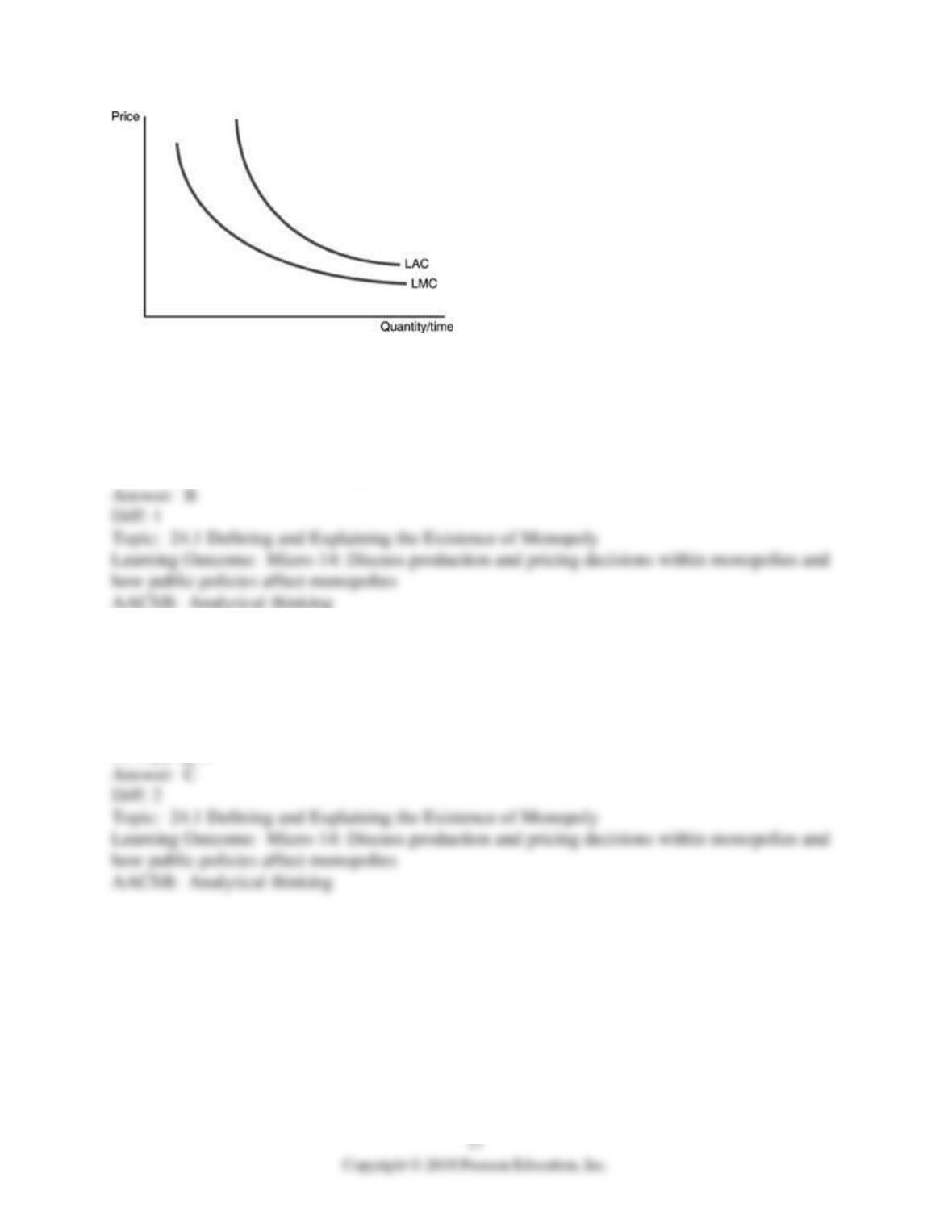
50) Refer to the above figure. The long-run average cost curve and the long-run marginal cost
curves represent
A) the cost curves for a competitive firm.
B) the cost curves for a natural monopoly.
C) a situation where a firm has control over the raw materials.
D) a situation where a firm has a patent.
51) Which of the following is NOT a restriction the government imposes to keep potential
entrants out of a market?
A) patents
B) tariffs
C) assistance with opening new firms
D) copyrights
52) Which of the following is NOT a restriction the government imposes to keep potential
entrants out of a market?
A) subsidizing imported goods
B) licensing of exclusive ownership of such a vital resources
C) certificate of convenience
D) compliance with government safety regulations
53) Some electrical utilities are monopolies because of
A) government restrictions that prevent new firms from entering the market.
B) ownership of resources without close substitutes.
C) diseconomies of scale.
D) their inability to earn profits.
54) Which of the following is NOT true about a certificate of convenience and public necessity?
A) It is a barrier to entry.
B) It is a patent.
C) It is issued by a government agency.
D) It limits competition.
55) A patent provides legal protection for an invention for
A) 20 years.
B) 9 years.
C) 5 years.
D) 3 years.
56) Which of the following is issued to an investor to provide protection from having the
57) Barriers to entry enable many monopolists to
A) charge as high a price as they want.
B) make people buy more of a good than they really want.
C) earn economic profits in the long run.
D) manipulate the government into providing special favors for themselves.
58) A tax that is imposed on an imported good is called a
A) tariff.
B) quota.
C) government license.
D) patent.
59) Which of the following is NOT true about a tariff?
A) It is a barrier to entry in a market.
B) It leads to a natural monopoly.
C) It is a tax.
D) It affects imported goods.
60) The effect of a tariff
A) is negligible since it applies to firms outside the nation.
B) can lead to economies of scale for firms inside the nation.
C) can lead to a monopoly when domestic firms become the sole suppliers inside the nation.
D) will be more beneficial to large firms than to small firms.
61) A monopolist would probably earn fewer profits if
A) the importance of specialized capital equipment in its production techniques increased.
B) the time length of patents increased.
C) environmental regulations increased that required the purchase of special capital equipment.
D) tariffs on competing products were lowered.