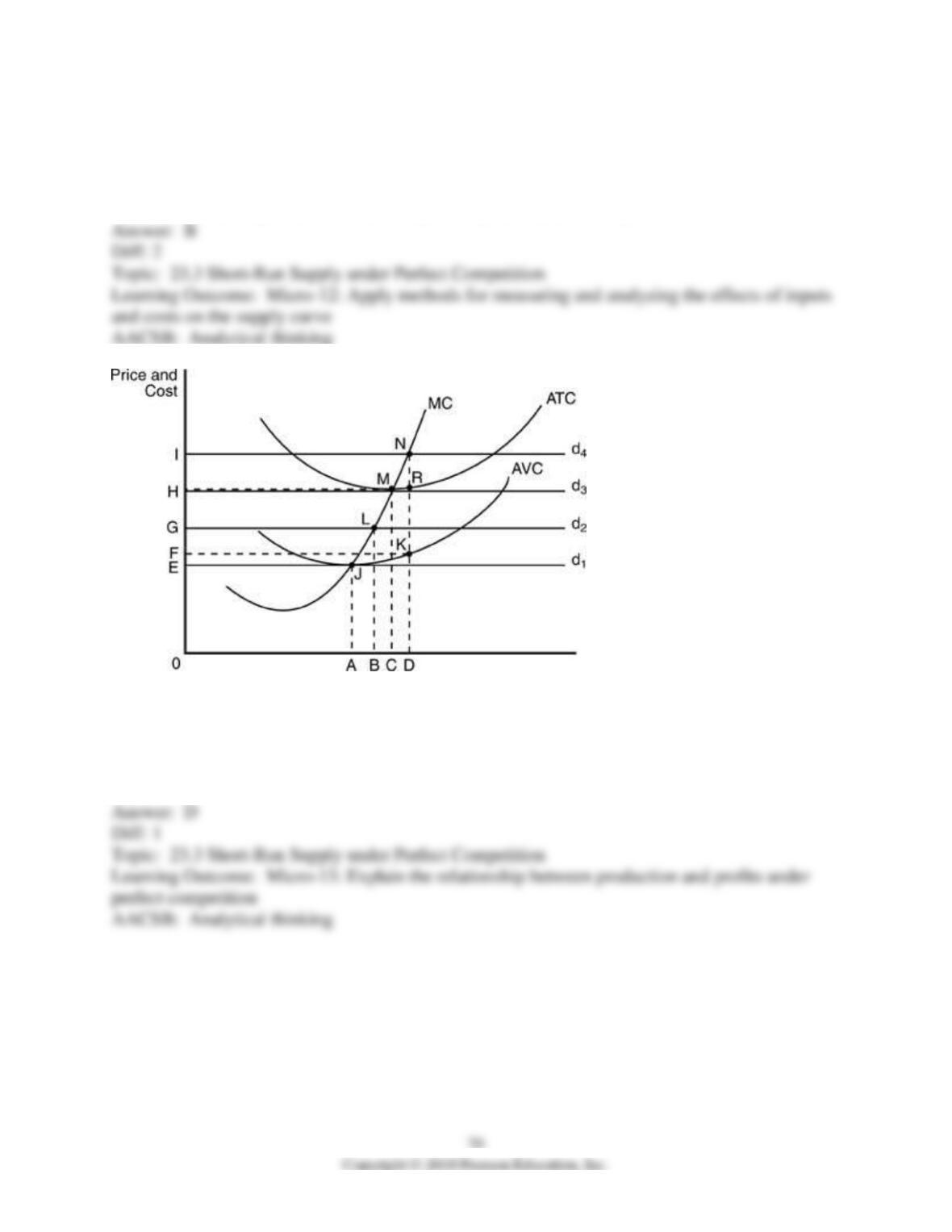
12) If the firm in the above figure produces output level D, it incurs an average fixed cost of
production equal to the distance
A) DK.
B) RN.
C) JL.
D) KR.
13) What is always TRUE about the short-run equilibrium position for a firm in perfect
competition?
A) MR = MC = P = ATC = AR
B) TR = TC
C) MR = MC = P = AR
D) MC = ATC
14) Profit per unit is the difference between
A) average revenue and average total cost.
B) marginal revenue and marginal cost.
C) total revenue and total cost.
D) average revenue and marginal cost.
15) A perfectly competitive firm is maximizing profits in the short run. This implies that the firm
is earning the most economic profits possible, which
A) must be positive.
B) must be either zero or positive.
C) can be positive, negative, or zero.
D) exist at the point at which price equals total cost.
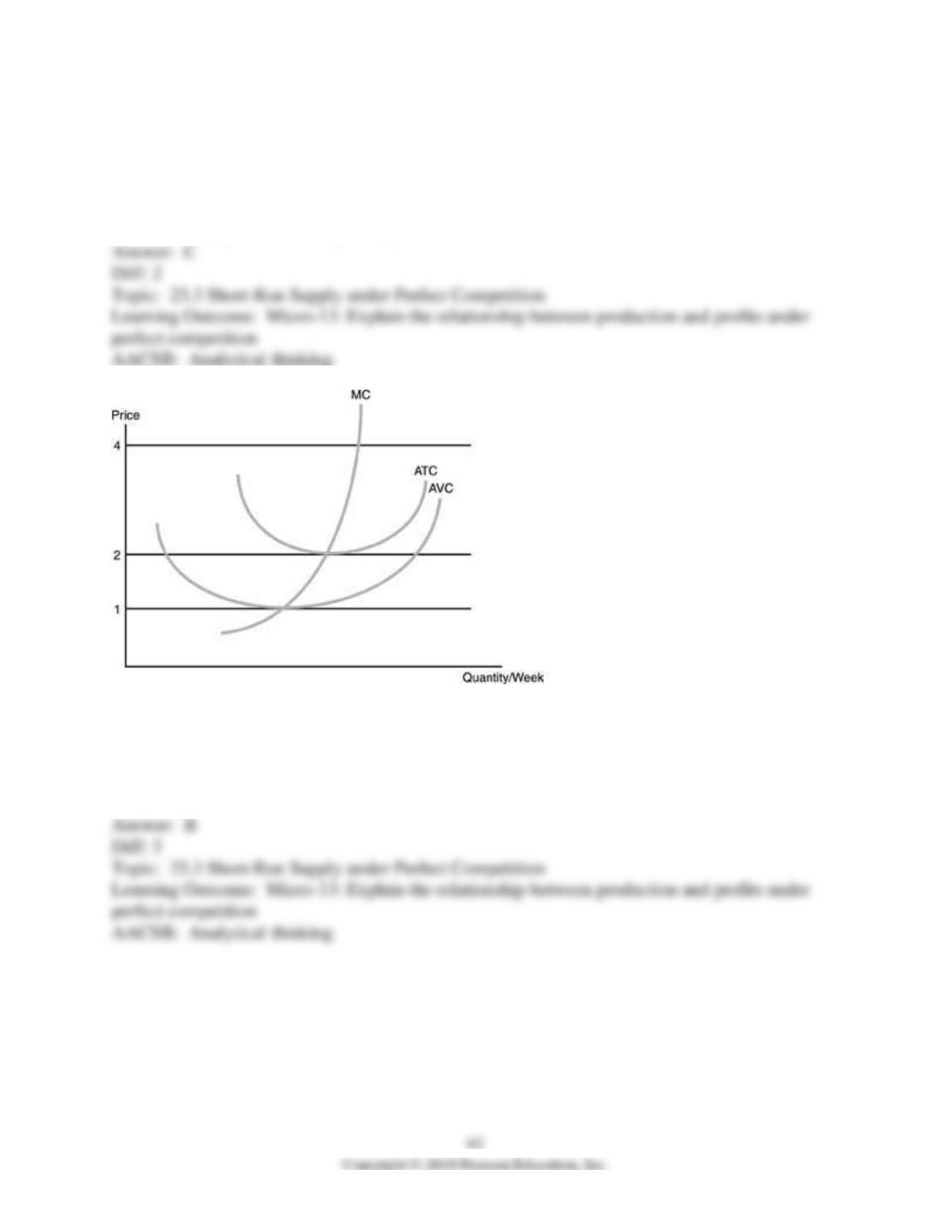
16) Refer to the above figure. Profits will equal zero
A) when the price equals $1.
B) when the price equals $2.
C) when the price equals $4.
D) at prices between $1 and $2.
17) Refer to the above figure. Profits will be positive
A) when the price equals $1.
B) when the price equals $2.
C) at prices between $1 and $2.
D) when the price is above $2.
18) Refer to the above figure. The firm will just be covering all of its variable cost but none of its
fixed cost
A) when the price equals $1.
B) when the price equals $2.
C) when the price equals $4.
D) at prices between $1 and $2.
19) Refer to the above figure. Profits will be negative
A) when the price equals $2.
B) when the price is above $2.
C) when the price is below $2.
D) only when the price equals $1.
20) Refer to the above figure. The firm’s short-run shutdown price is
A) at $1.
B) at $2.
C) at $4.
D) above $4.
21) The difference between price and average total cost is
A) total costs.
B) marginal costs.
C) average profit.
D) an irrelevant quantity.
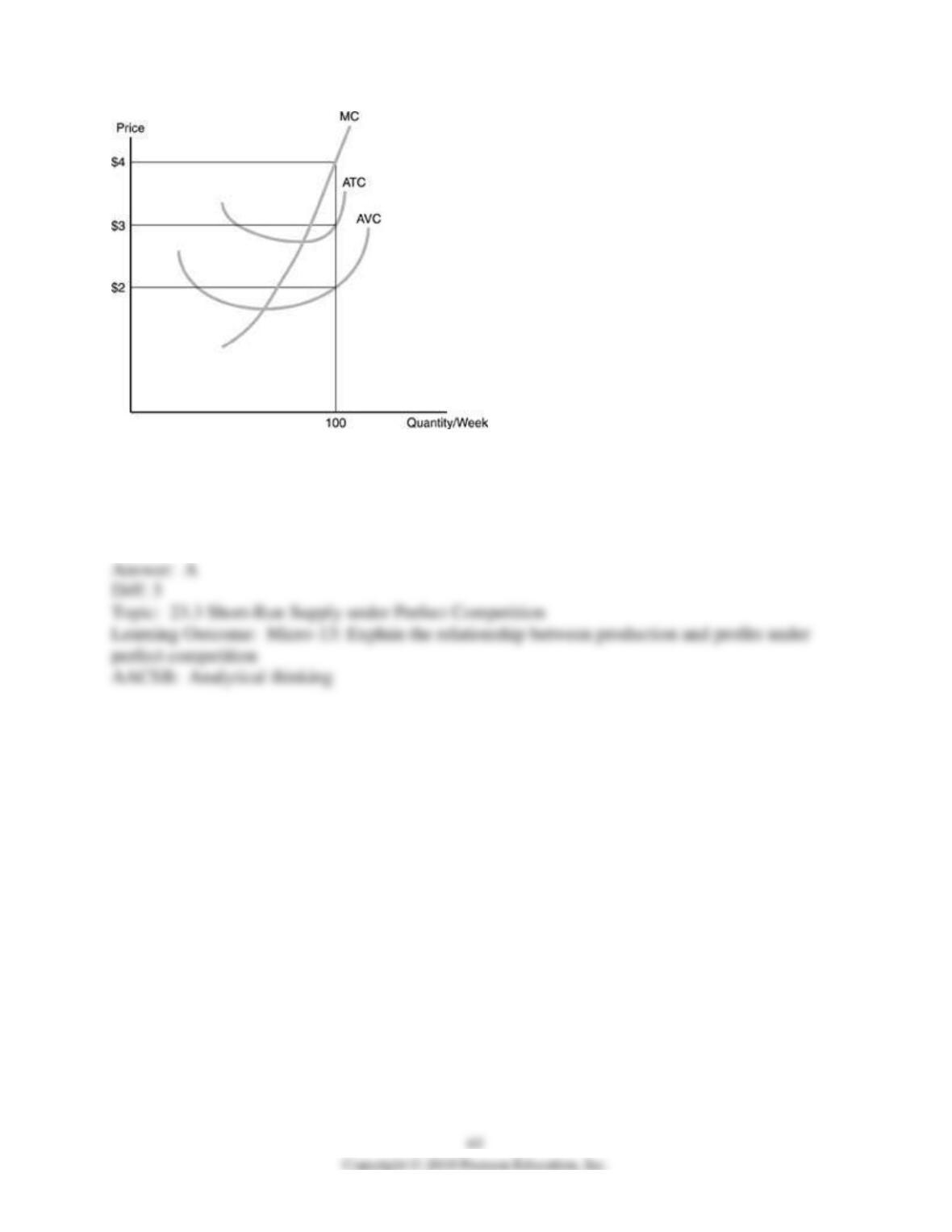
22) Refer to the above figure. When the price in the market is $4, economic profits will equal
A) $100.
B) $200.
C) $300.
D) $400.
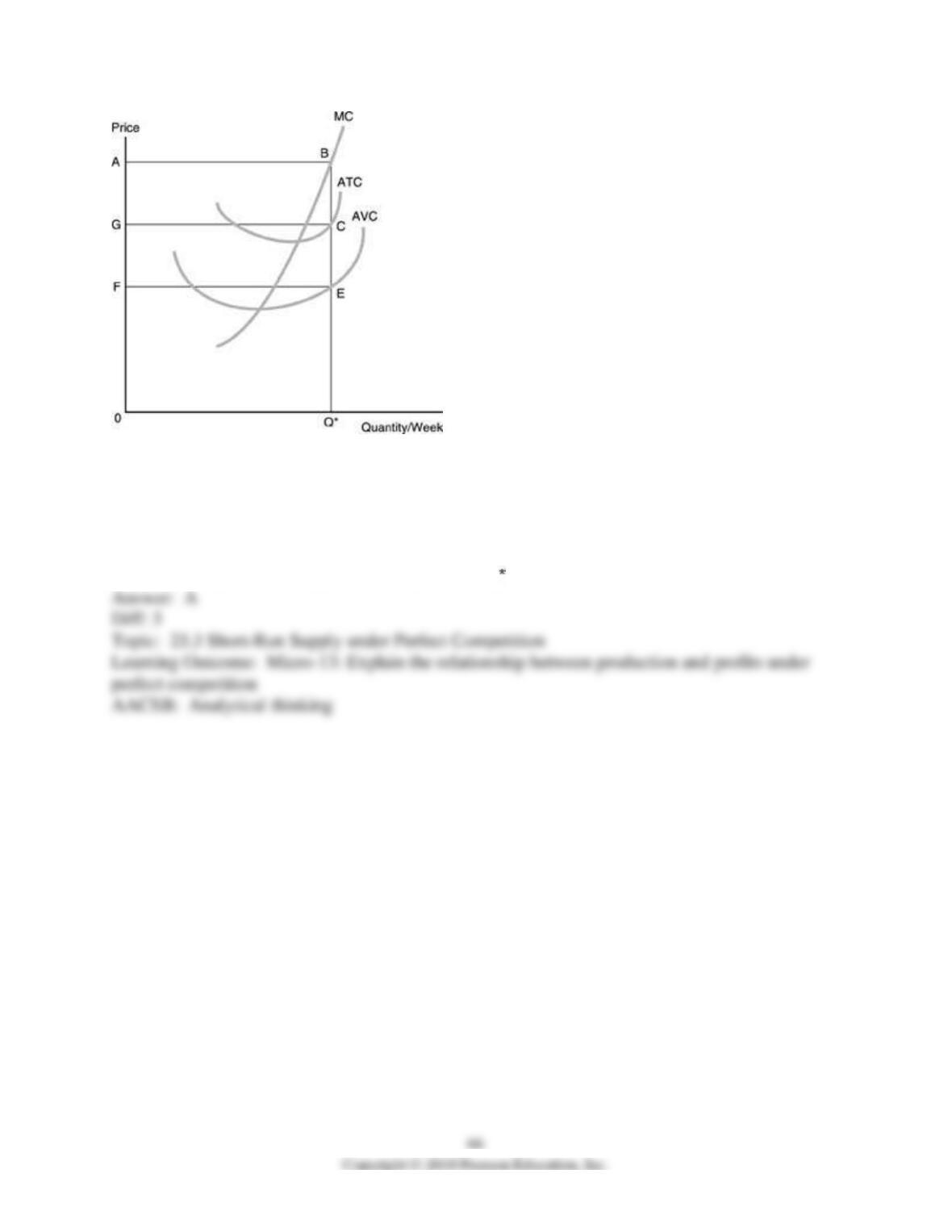
23) Refer to the above figure. If the market price is equal to A, which statement can be made
about economic profits?
A) Economic profits are positive and equal to ABCG.
B) Economic profits are positive and equal to ABEF.
C) Economic profits are negative and equal to GCEF.
D) Economic profits are negative and equal to ABQ 0.
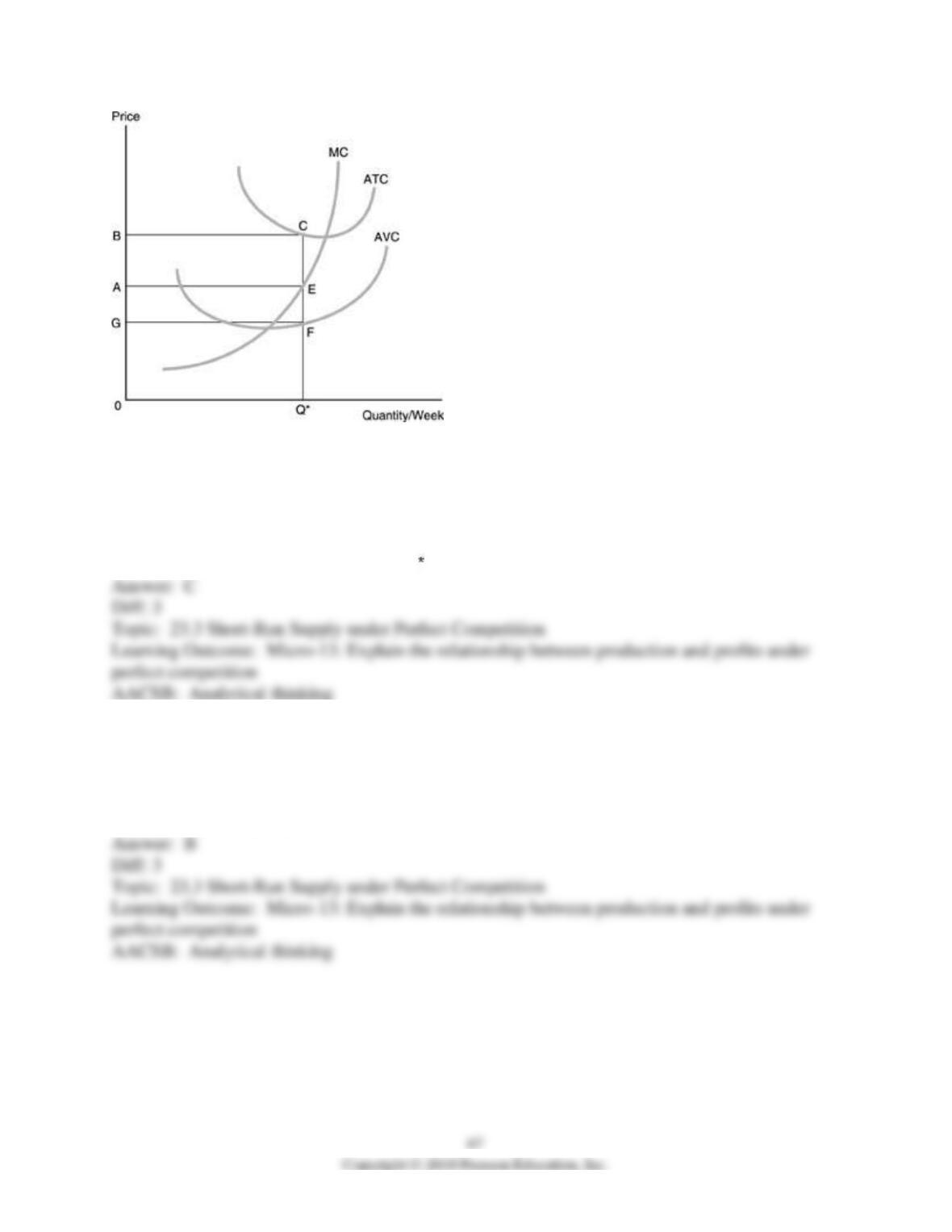
24) Refer to the above figure. If the market price is equal to A, which statement can be made
about profits?
A) Profits are positive and equal to BCEA.
B) Profits are positive and equal to BCFG.
C) Profits are negative and equal to BCEA.
D) Profits are negative and equal to GFQ 0.
25) Refer to the above figure. In order to stay open in the short run, this firm must
A) earn a positive profit.
B) receive a price equal to or greater than the minimum of its average variable cost.
C) receive a price exactly equal to its average total cost.
D) recover its fixed cost.
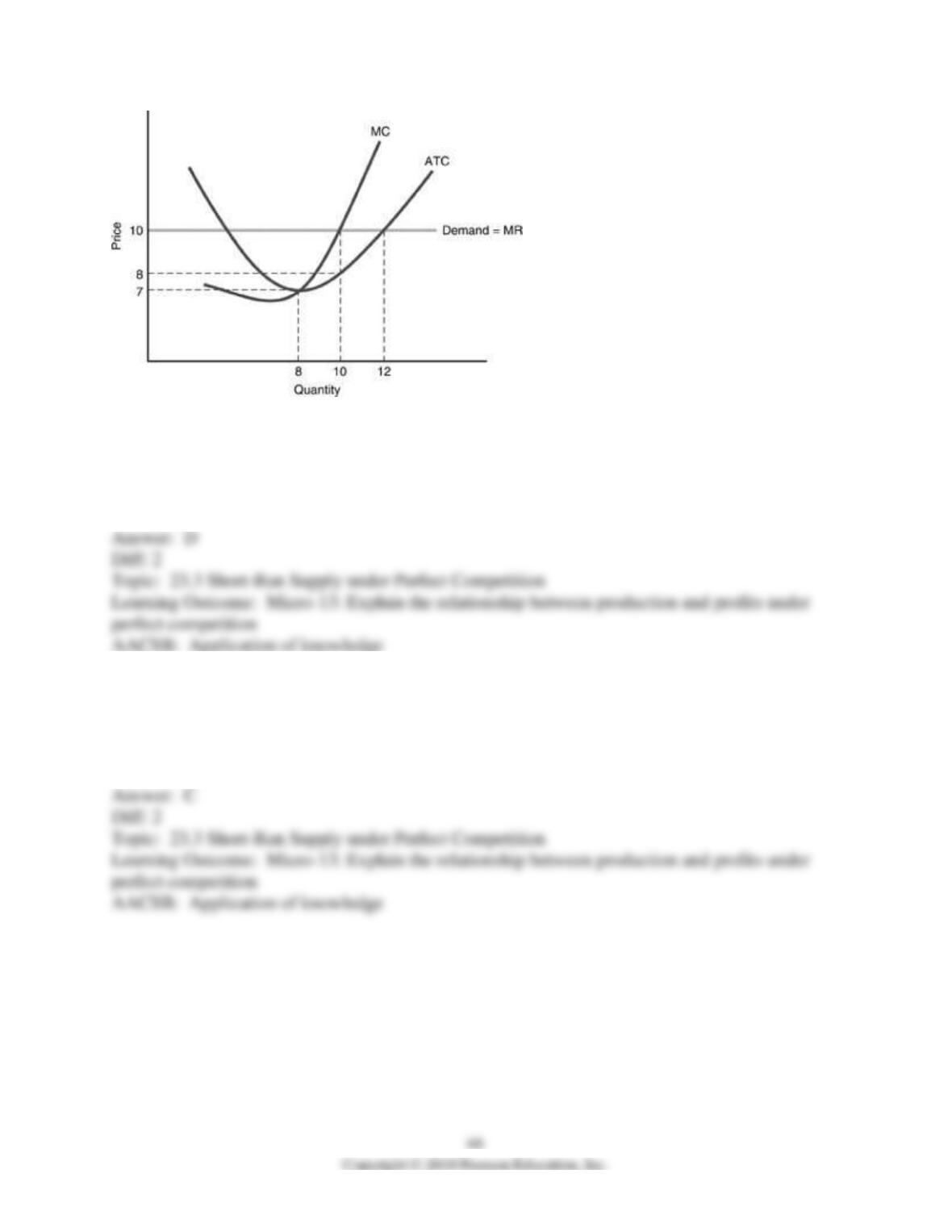
26) In the above figure, what is the profit-maximizing output and price?
A) 8, $7
B) 10, $8
C) 12, $10
D) 10, $10
27) In the above figure, what is the profit at the profit-maximizing output level?
A) $70
B) $2
C) $20
D) $10
28) In the above figure, what is the price the firm receives if the output is 8?
A) $10
B) $2
C) $7
D) $8
29) Suppose a perfectly competitive cotton farmer can produce 10 containers of cotton at an
output at which marginal cost equals marginal revenue. The price per container of cotton is $100
and the average total cost is $75. What is the profit or loss that this cotton farmer is earning?
A) $750
B) $150
C) $250
D) -$25
30) Suppose a perfectly competitive ukulele factory can produce 35 ukuleles at an output at
which marginal cost equals marginal revenue. The price per ukulele is $1300 and the average
total cost is $1500. What is the profit or loss that this furniture factory is earning?
A) $700.00
B) -$7,000.00
C) -$1,050.00
D) -$450.00
31) The short-run break-even price
A) is the price at which the firm’s current liabilities are paid off.
B) is the price at which a firm’s total revenues equal total costs.
C) occurs at the output at which the firm yields a below normal rate of return.
D) occurs at the output at which the firm yields a positive economic profit.
32) In the above figure, the firm will shut down if price falls below
A) F.
B) I.
C) H.
D) E.
33) In the above figure, the firm will shut down if quantity falls below
A) A.
B) B.
C) C.
D) D.
34) The firm in the above figure breaks even when market price is
A) H.
B) E.
C) I.
D) G.
35) The firm in the above figure breaks even when quantity is
A) A.
B) B.
C) C.
D) D.
36) In the short run, the perfectly competitive firm will always earn an economic profit when
A) P = ATC.
B) P > AVC.
C) P = MC.
D) P > ATC.
37) A company finds that at the output level at which marginal cost equals marginal revenue, TC
= $500, TVC = $400, and TR = $450. Your advice to the firm is
A) shut down, as TC > TR.
B) reduce output to reduce the cost of production.
C) increase output to reduce the per unit cost of production.
D) continue to produce because loss is less than TFC.
38) A company finds that at its present level of production, MC = AVC at $15, MC = ATC at
$20, and MC = MR at $17. Your advice to the firm regarding its short-run operations is
A) to continue production, as it is earning an economic profit of $2 per unit.
B) to continue production, as it is earning an economic profit of $3 per unit.
C) to shut down.
D) to continue production at a loss.
39) A company finds that at its present level of production, MR = MC at $14, MC = AVC at $15,
and MC = ATC at $20. Your advice to the firm regarding its short-run operations is
A) to continue production, as it is earning an economic profit of $1 per unit.
B) to continue production, as it is earning an economic profit of $6 per unit.
C) to shut down.
D) to continue production at a loss.
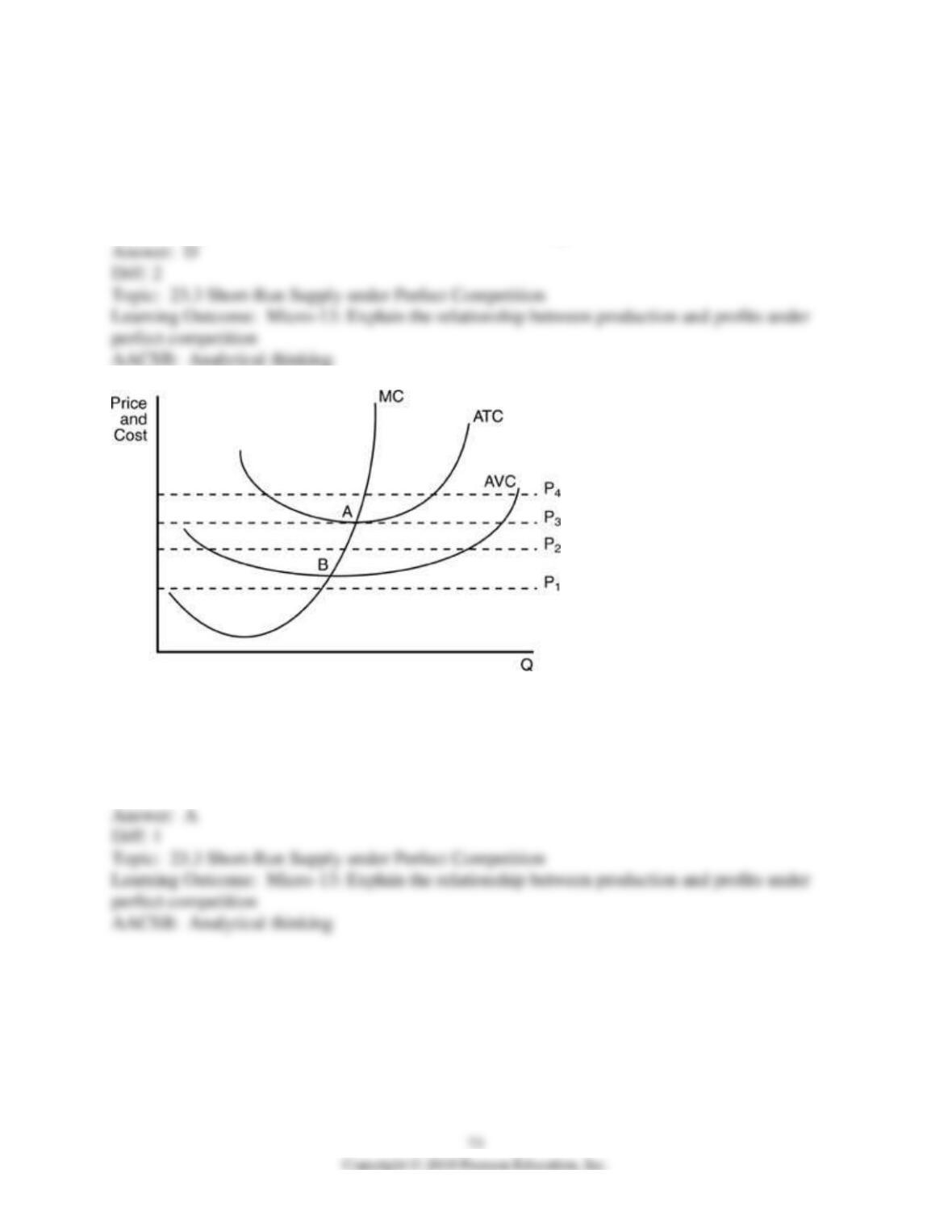
40) Suppose that in a perfectly competitive market, the market price is $10. A firm in that market
has marginal cost of $10, average total cost of $12, and it is producing 100 units. The firm is
A) earning $1,000 in total economic profits and is maximizing economic profits.
B) earning $200 in total economic profits and is maximizing economic profits.
C) earning zero total economic profits and is not maximizing economic profits.
D) incurring $200 in total economic losses and is minimizing economic losses.
41) In the above figure, if price is equal to P4, the firm will
A) earn positive economic profits.
B) incur an economic loss.
C) earn zero economic profits.
D) shut down.
42) If price is $5, marginal cost is $5, average total cost is $3, and the quantity produced is 150
units, then the perfectly competitive firm is
A) not maximizing economic profit.
B) earning $2 in economic profits and is maximizing economic profits.
C) earning $150 in economic profits and is not maximizing economic profits.
D) earning $300 in economic profits and is maximizing economic profits.
43) Suppose the market price is $5, marginal cost is $4, and average total cost is $2. The
perfectly competitive firm in that market is
A) earning $3 in economic profits per unit of output and is not maximizing profits.
B) earning $2 in economic profits per unit of output and is maximizing profits.
C) earning $1 in economic profits per unit of output and is not maximizing profits.
D) none of the above: Insufficient information is given.
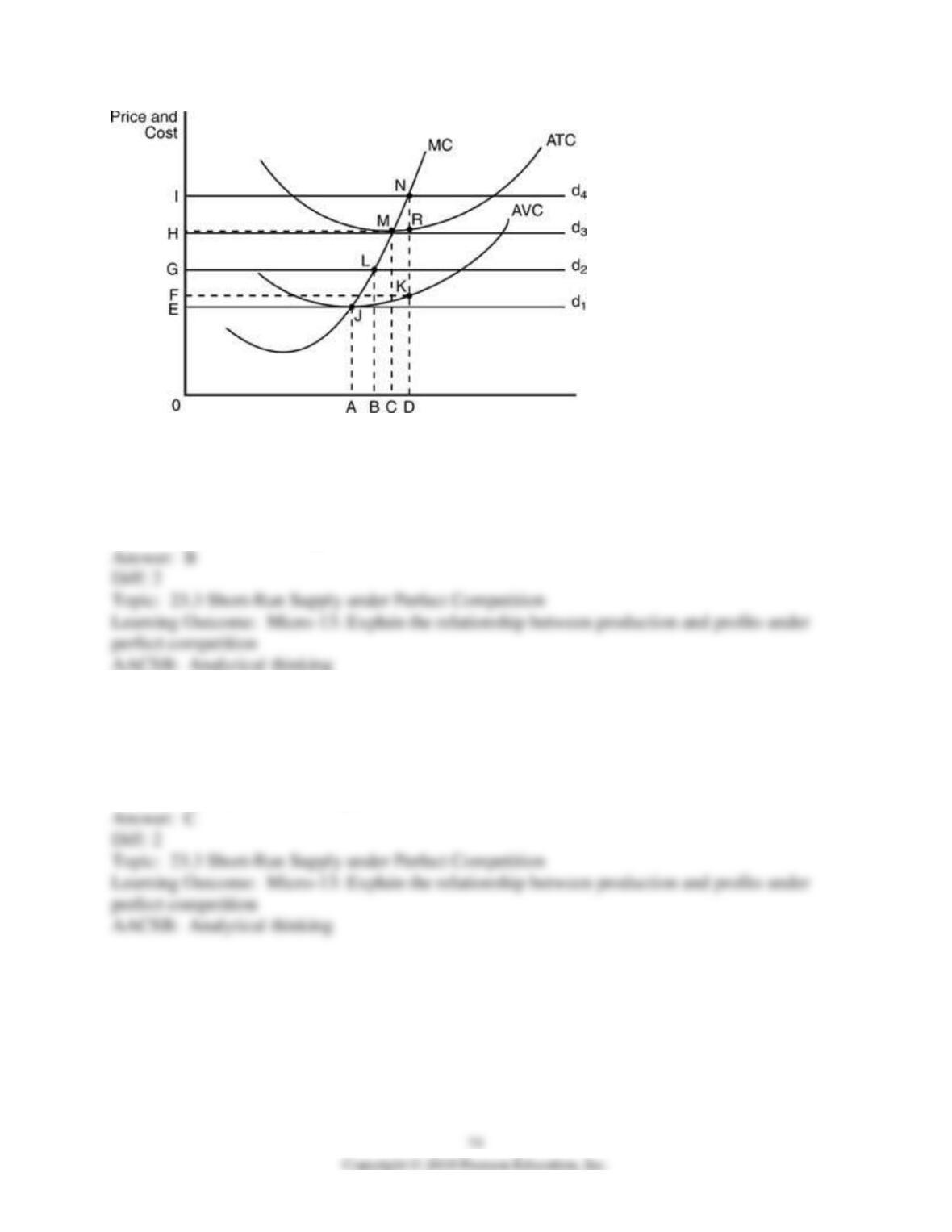
44) In the above figure, assume d1 is the demand curve faced by this firm. Which is TRUE?
A) This firm is earning an economic profit.
B) This firm is experiencing an economic loss.
C) This firm is breaking even.
D) This firm’s total costs equal EJA0.
45) In the above figure, assume d3 is the demand curve faced by this firm. Which is TRUE?
A) This firm is earning an economic profit.
B) This firm is experiencing an economic loss.
C) This firm is breaking even.
D) This firm’s total revenues equal HRD0.
46) In the above figure, when price is below E, this firm should
A) lower prices.
B) continue to operate as-is.
C) attempt to lower ATC and to raise AVC.
D) shut down.
47) For a perfectly competitive firm, the short-run break-even point occurs at the level of output
where
A) P > MR = MC.
B) MR = P > MC.
C) MR < P = MC.
D) P = MC = ATC.
48) At the short-run break-even point, the perfectly competitive firm is
A) earning positive economic profits.
B) earning zero economic profits.
C) earning negative economic profits.
D) just covering its total variable costs.
49) When a firm is earning zero economic profits
A) accounting profit is zero.
B) total revenue is greater than total cost.
C) P = ATC.
D) P is greater than ATC.
50) At the short-run break-even point, the firm is
A) earning zero accounting profit.
B) losing money.
C) earning zero economic profit.
D) ready to shutdown.
51) A perfectly competitive firm’s short-run break-even output occurs
A) at the minimum point of its average variable cost curve.
B) at the minimum point of its average total cost curve.
C) at the minimum point of its marginal cost curve.
D) at the intersection of its total cost curve and its marginal revenue curve.
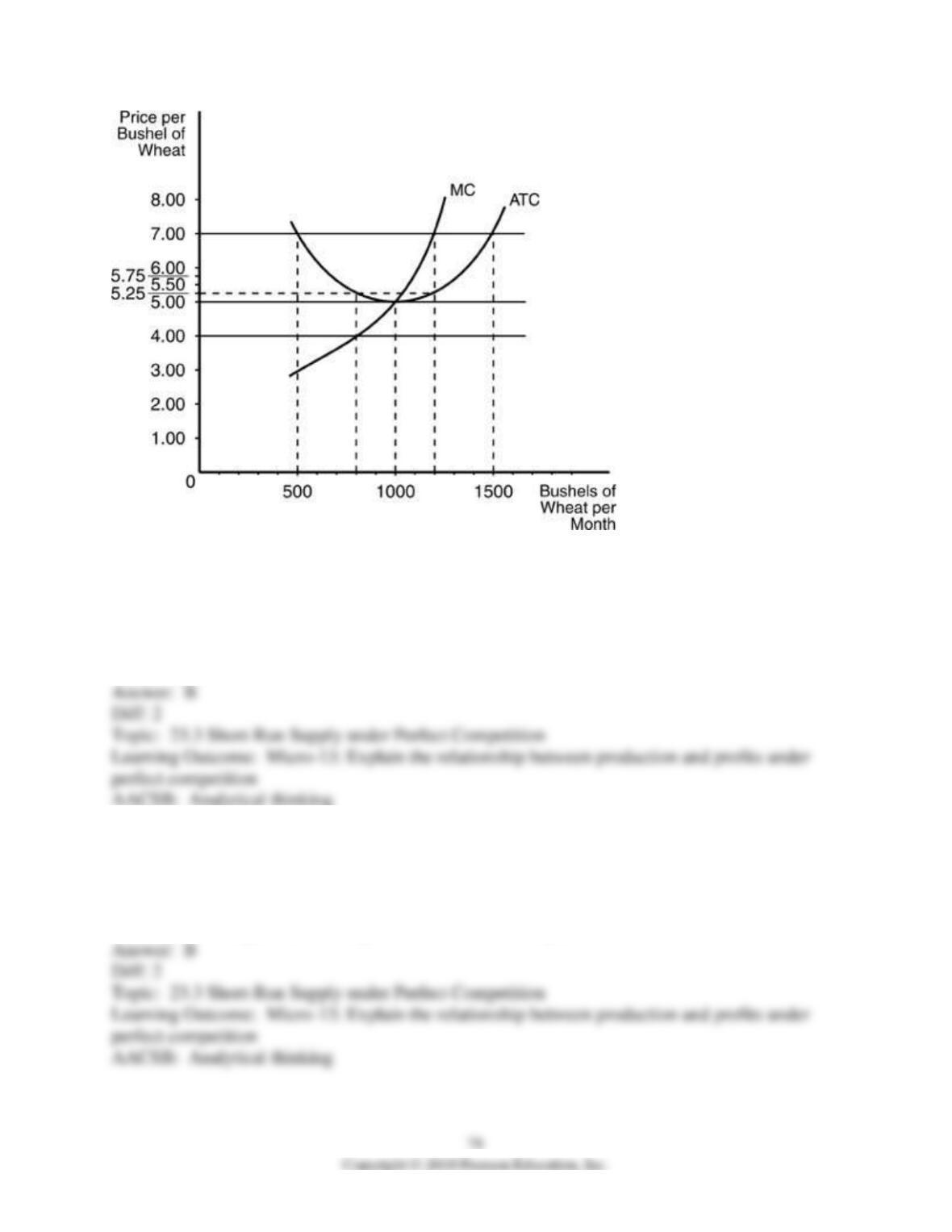
52) According to the above figure, if the firm is earning zero economic profits, what quantity is
the firm selling and at what price?
A) Q = 200; P = $4
B) Q = 1,000; P = $5
C) Q = 800; P = $4
D) Q = 1,200; P = $7
53) The short-run break-even price is the point at which
A) price is less than marginal cost.
B) marginal cost, average total cost and marginal revenue are all equal.
C) average variable cost is at a minimum.
D) marginal cost, price and average variable cost are all equal.
54) Economic profits at the short-run break-even point are
A) positive.
B) negative.
C) equal to zero.
D) indeterminate since they also depend on the size of the fixed costs.
55) Accounting profits at a firm’s break-even point are
A) positive.
B) negative.
C) zero.
D) indeterminate since we need to know what demand is.
56) At a perfectly competitive firm’s short-run break-even price
A) P = ATC.
B) TR is more than TC.
C) the average cost is below the total revenue line.
D) P > AVC, but P < AFC.
57) Suppose a perfectly competitive firm faces the following short-run cost and revenue
conditions: ATC = $6.00; AVC = $4.00; MC = $3.50; MR = $3.50. The firm should
A) increase output.
B) increase price.
C) remain at the same position.
D) shut down.
58) For a perfectly competitive firm, any price below its minimum AVC is a
A) market price.
B) shutdown price.
C) profit maximizing price.
D) negative price.
59) The firm will shut down in the short run if
A) the price falls below its minimum AVC.
B) the market price rises unexpectedly.
C) P = MC.
D) P = ATC at its minimum.