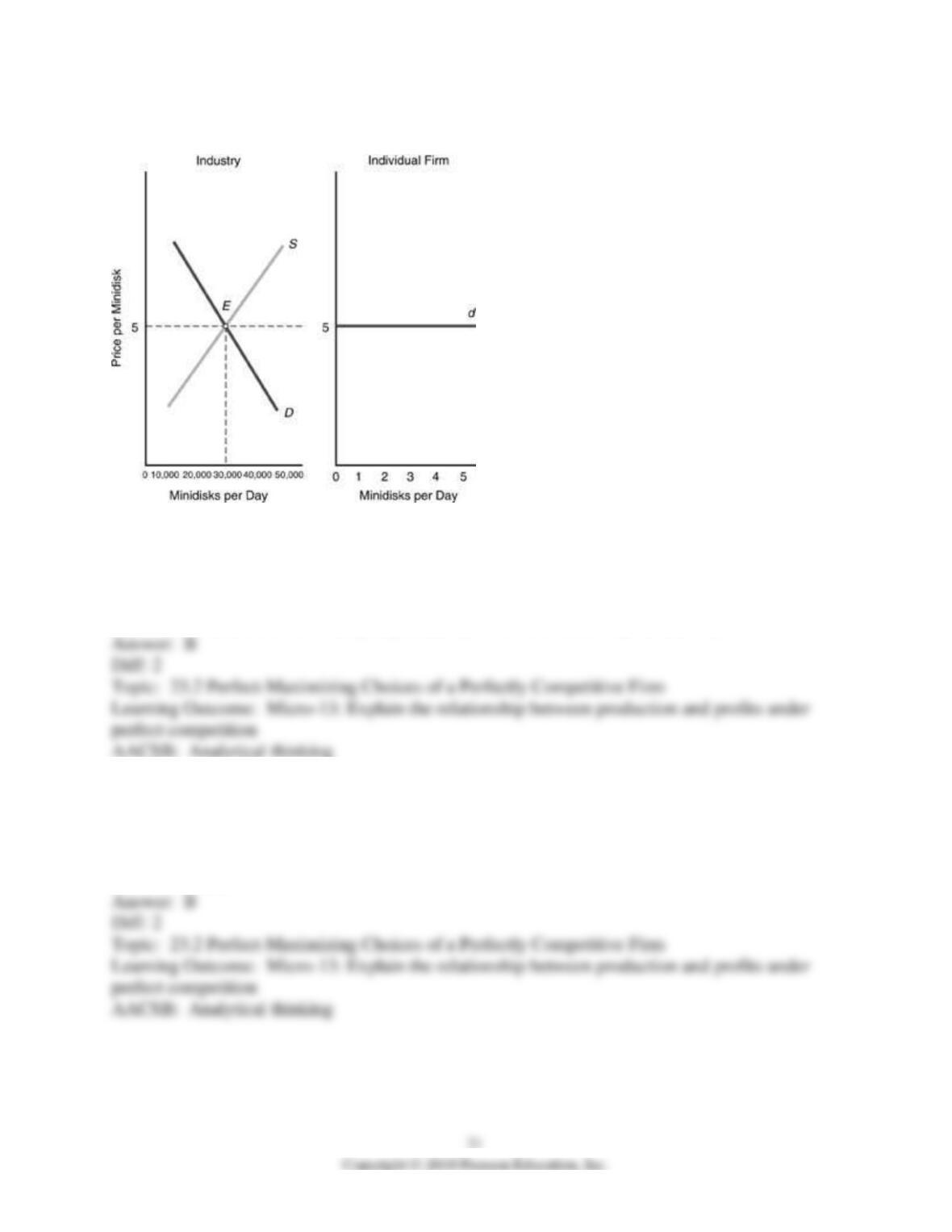
21) Referring to the diagram, which of the following statements is INCORRECT?
A) The equilibrium market price is $5, at which the industry demand and supply curves intersect.
B) If the individual firm raises its price, it will capture all sales in the market.
C) The individual firm takes as given the market price along the perfectly elastic demand curve
“d.”
D) The individual firm faces the going market price as determined by the industry.
22) The demand curve faced by a perfectly competitive industry
A) slopes upward.
B) slopes downward.
C) has no slope.
D) is horizontal.
23) The demand curve for a perfectly competitive industry is
A) perfectly inelastic.
B) downward sloping.
C) perfectly elastic.
D) unit elastic.
24) The demand curve for the product of a perfectly competitive firm is
A) downward sloping.
B) upward sloping.
C) perfectly inelastic.
D) perfectly elastic.
25) If a firm in a perfectly competitive market raises its price
A) it will sell more products.
B) it will sell fewer products.
C) its sales will remain unchanged.
D) it will sell nothing.
26) A perfectly competitive firm faces a horizontal demand curve because it is
A) a price taker.
B) a price maker.
C) a large firm in a small industry.
D) one of few firms in the market.
27) The perfectly competitive firm’s demand curve has
A) a negative slope.
B) a positive slope.
C) a slope of infinity.
D) a slope of 0.
28) For a firm in a perfectly competitive market, average revenue equals
A) average cost.
B) the change in total revenue.
C) the market price.
D) price divided by quantity.
29) The total revenue of a perfectly competitive firm is calculated by
A) multiplying average revenue by price.
B) dividing price by quantity.
C) multiplying price by quantity.
D) multiplying quantity by average total cost.
30) Economists generally assume that firms attempt to maximize
A) total revenue.
B) sales.
C) marginal revenue.
D) total economic profits.
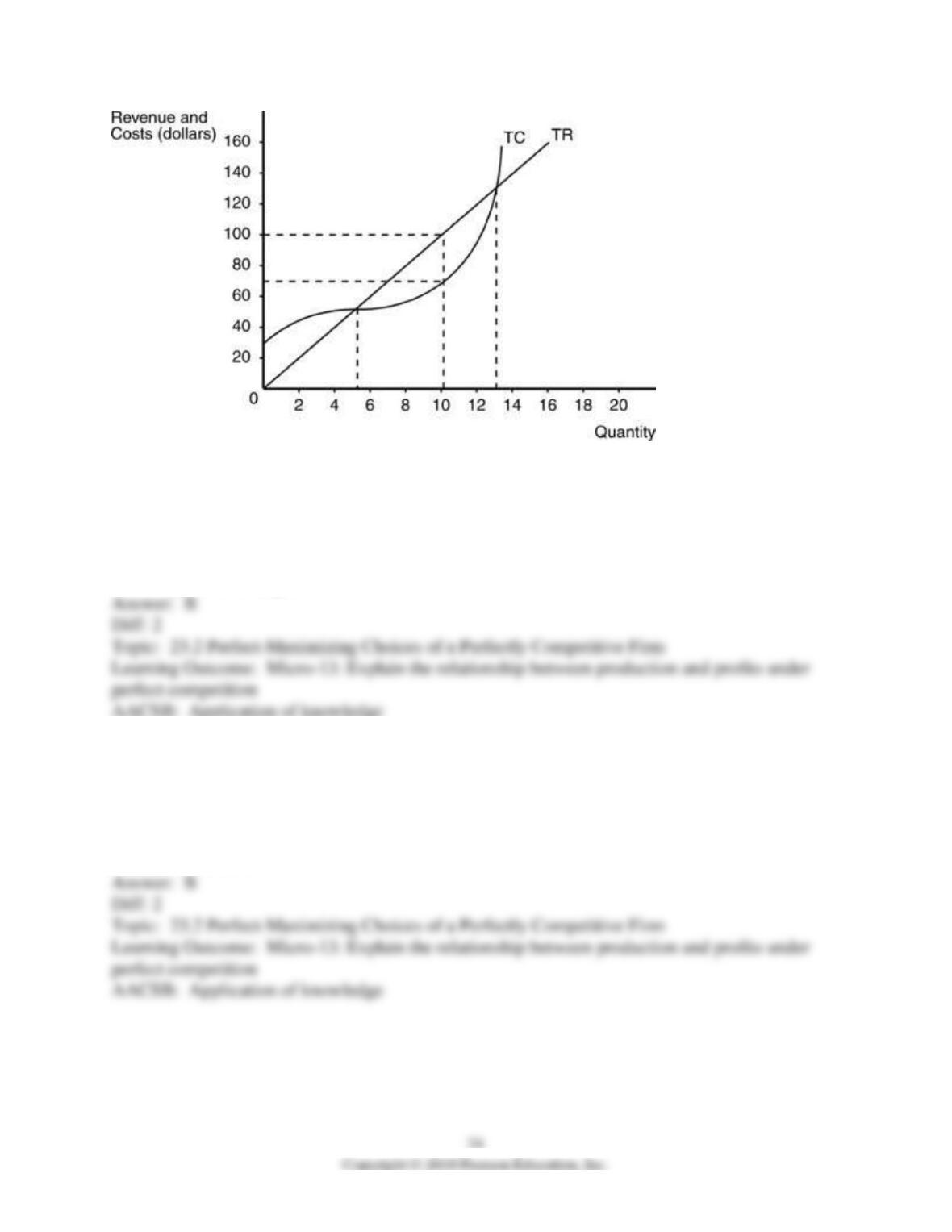
31) In the above figure, the market price charged by this profit-maximizing, perfectly
competitive firm is
A) $5 per unit of output.
B) $10 per unit of output.
C) $8 per unit of output.
D) $14 per unit of output.
32) In the above figure, the profit-maximizing rate of production for the perfectly competitive
firm is
A) 5.
B) 10.
C) 13.
D) none of the above.
33) In the above figure, at the profit-maximizing rate of production for the perfectly competitive
firm total revenue is
A) $100.
B) $70.
C) $30.
D) $130.
34) In the above figure, at the profit-maximizing rate of production for the perfectly competitive
firm total cost is
A) $100.
B) $70.
C) $30.
D) $130.
35) In the above figure, at the profit-maximizing rate of production for the perfectly competitive
firm average total cost is
A) $10.
B) $3.
C) $7.
D) $70.
36) In the above figure, at the profit-maximizing rate of production for the perfectly competitive
firm profit is
A) $100.
B) $70.
C) $30.
D) $130.
37) In the above figure, at output levels between 5 units and 13 units
A) the firm’s accounting profits are negative.
B) total revenue equals total costs.
C) the firm’s economic profits are positive.
D) the firm is breaking even.
38) In the above figure, at which output level is this firm earning negative economic profits?
A) 2
B) 5
C) 10
D) 12
39) A firm in a perfectly competitive market maximizes profits when it finds
A) the price at which total revenue minus total cost is the greatest.
B) the quantity at which total revenue minus total cost is the greatest.
C) the quantity at which total revenue equals total cost.
D) the quantity at which total revenue is maximized.
40) When a firm is operating at an output rate at which total revenue equal total costs, this is
called
A) its shutdown point.
B) its breakeven point.
C) a short-run profit.
D) a loss.
41) Refer to the above table. This firm operates in a perfectly competitive market in which the
market price is $10 per unit. What is its profit-maximizing rate of production?
A) 104 units
B) 106 units
C) 108 units
D) 110 units
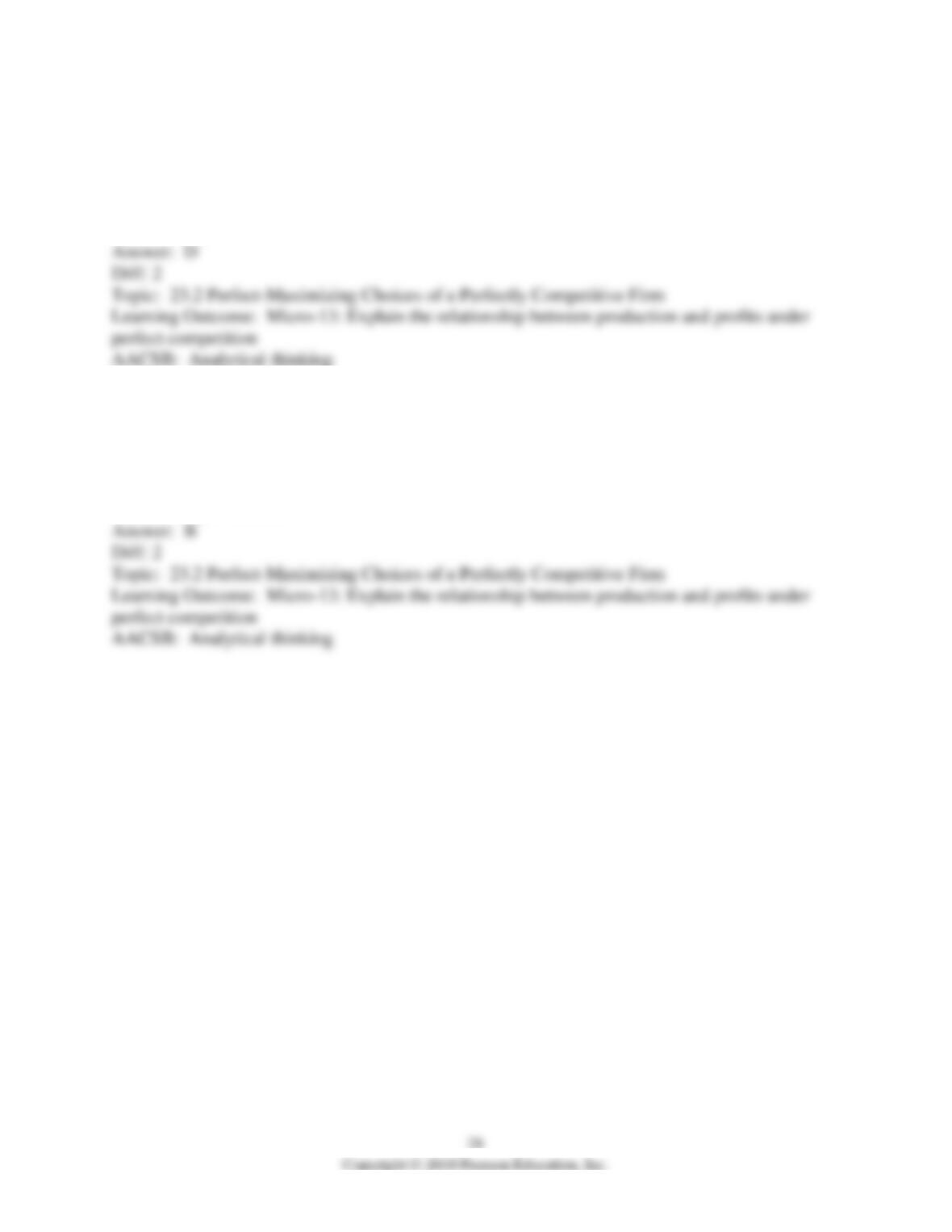
42) Refer to the above table. This firm operates in a perfectly competitive market in which the
market price is $10/unit. What is TRUE when the firm produces 103 units?
A) Total revenue equals $5,060.
B) Total costs exceed total revenue by $403.
C) Marginal revenue is less than marginal cost.
D) Its total profit is $524.
43) Refer to the above table. This firm operates in a perfectly competitive market in which the
market price is $5/unit. What is TRUE when the firm produces 110 units?
A) Total revenue equals $3,075.
B) Total costs exceed total revenue by $65.
C) Marginal revenue is more than marginal cost.
D) Its total profit is $65.
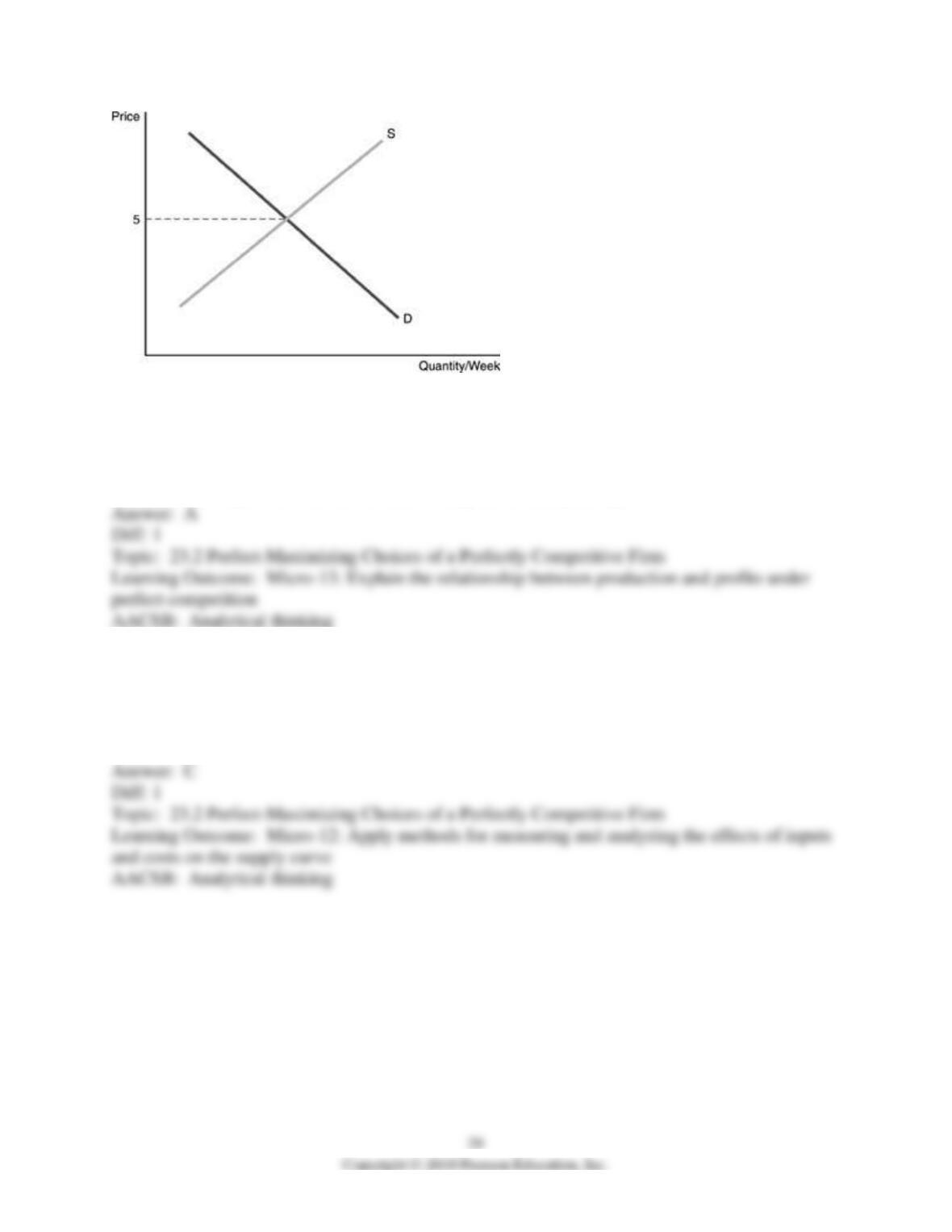
44) Refer to the above figure. If an individual firm wants to maximize economic profits, it should
A) charge $5 for its product.
B) charge more than $5 for its product since increasing the price will increase revenues.
C) charge less than $5 for its product since a lower price will attract more customers.
D) withdraw its product from the market forcing the market price up.
45) The total amount received from the sale of output is
A) average revenue.
B) marginal revenue.
C) total revenue.
D) price revenue.
46) The price per unit times the total quantity sold is
A) average revenue.
B) marginal revenue.
C) total revenue.
D) price revenue.
47) Total revenue divided by quantity is
A) average revenue.
B) marginal revenue.
C) quantity revenue.
D) price revenue.
48) Refer to the above table. The table represents information on the costs for Ajax Corporation.
Ajax operates in a perfectly competitive market and the price of the product is $10. What does
total revenue equal when quantity equals 4?
A) $4
B) $6
C) $36
D) $40
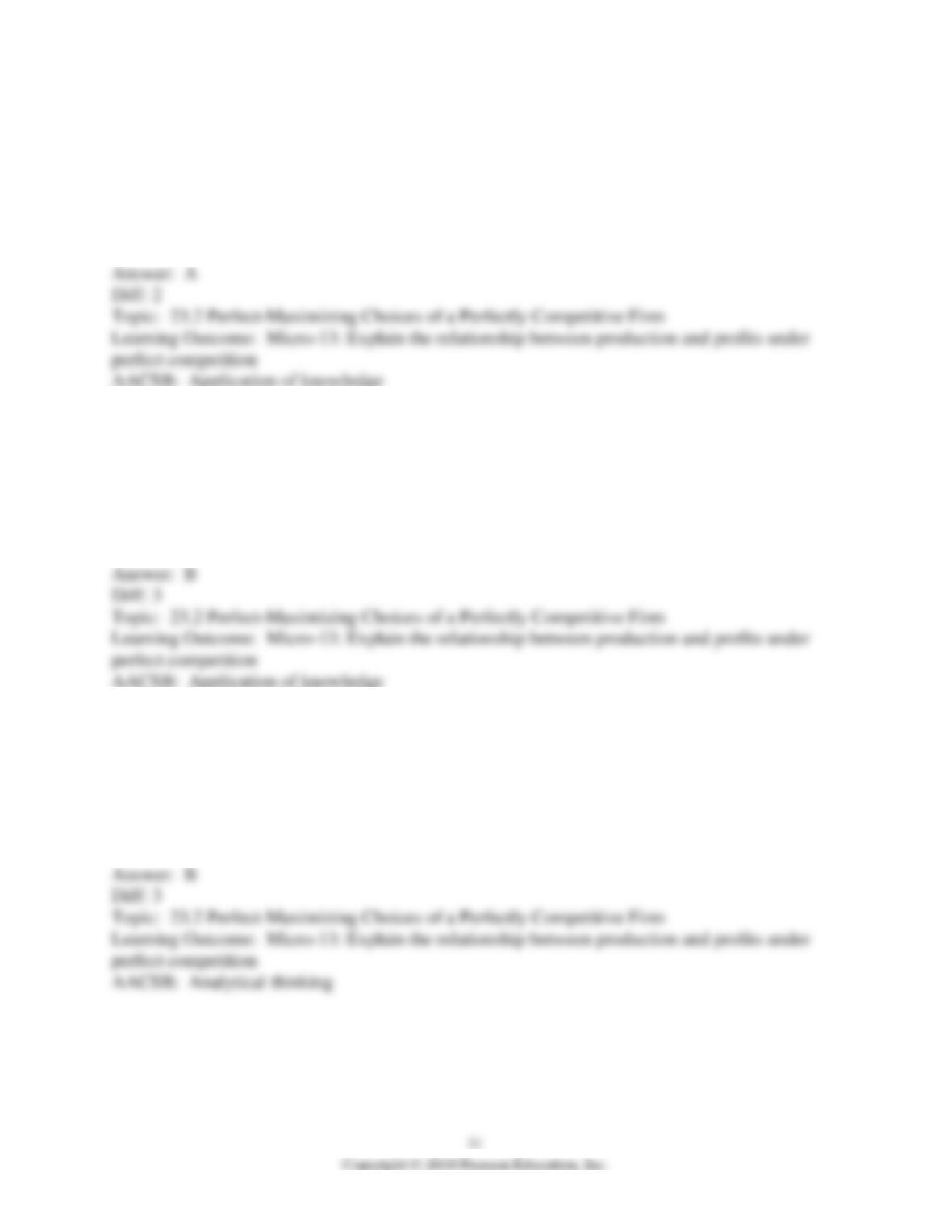
49) Refer to the above table. The table represents information on the costs for Ajax Corporation.
Ajax operates in a perfectly competitive market and the price of the product is $8. What will be
the value of total revenue when quantity sold equals 3?
A) $24
B) $27
C) $3
D) $9
50) Refer to the above table. The table represents information on the costs for Ajax Corporation.
Ajax operates in a perfectly competitive market and the price of the product is $7. What will be
the value of total revenue when quantity sold equals 2?
A) $7
B) $14
C) $21
D) $16
51) Refer to the above table. The table represents information on the costs for Ajax Corporation.
Ajax operates in a perfectly competitive market and the price of the product is $10. What does
profit equal when quantity equals 4?
A) $4
B) $10
C) $8
D) $40
52) Refer to the above table. The table represents information on the costs for Ajax Corporation.
Ajax operates in a perfectly competitive market and the price of the product is $9. What does
profit equal when quantity equals 3?
A) $13
B) $10
C) $6
D) $2
53) Refer to the above table. The table represents information on the costs for Ajax Corporation.
Ajax operates in a perfectly competitive market and the price of the product is $7. What does
profit equal when quantity equals 2?
A) $14
B) -$2
C) $16
D) $2
54) We assume that firms, when they are deciding the best rate of output at which to produce
A) try to get the highest price possible.
B) want to maximize sales.
C) want to minimize costs.
D) want to maximize profits.
55) The equation TR/Q is used to compute
A) total cost.
B) average revenue.
C) demand.
D) marginal revenue.
56) For a perfect competitor, price equals
A) marginal revenue only.
B) average revenue only.
C) both average revenue and marginal revenue.
D) neither marginal revenue nor average revenue.
57) In a perfectly competitive market, the average revenue curve of a firm is
A) the same as its total revenue curve.
B) the same as its demand curve.
C) the same its economic profits.
D) the difference between its total revenue curve and its marginal revenue curve.
58) Under perfect competition, the firm must decide
A) the best price to charge for its product.
B) the best rate of output it should produce.
C) the optimal level of advertising to engage in.
D) the optimal level of quality and the packaging that will maximize profits.
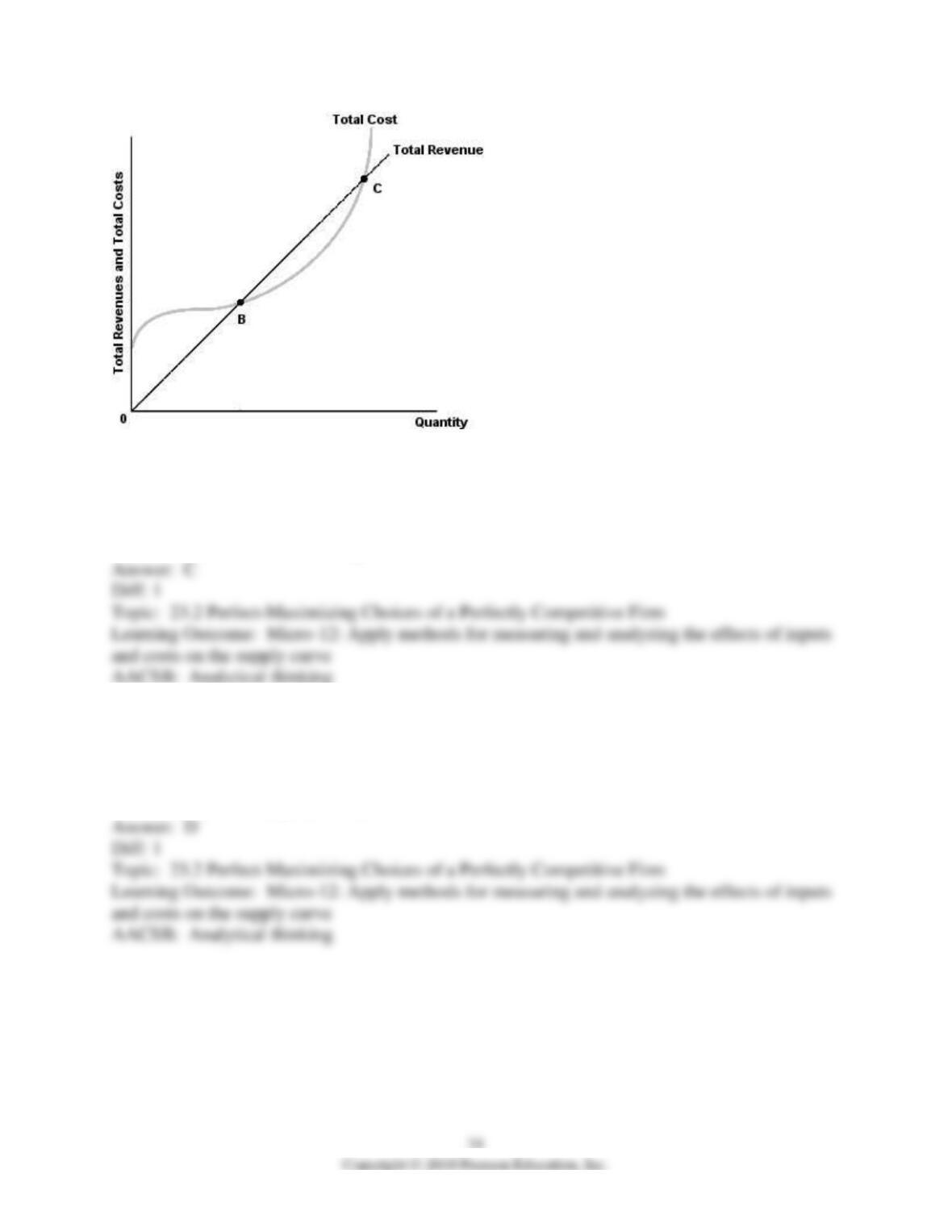
59) Refer to the above figure. Profits for this firm are positive
A) only for all points less than B.
B) only at points B and C.
C) for points between B and C.
D) for all points less than B and greater than C.
60) Refer to the above figure. Profits for this firm will be maximized at
A) point B.
B) point C.
C) a quantity greater than point C.
D) a quantity between points B and C.
61) Refer to the above figure. Profits for this firm are equal to zero
A) only for all points less than B.
B) only at points B and C.
C) for points between B and C.
D) for all points less than B and greater than C.
62) Refer to the above figure. Profits for this firm are negative
A) only for all points less than B.
B) only at points B and C.
C) for points between B and C.
D) for all points less than B and greater than C.
63) Which of the following equals the ratio of the change in total revenues over the change in
output?
A) total cost
B) average revenue
C) demand
D) marginal revenue
64) For the perfectly competitive firm, price
A) equals average revenue and marginal revenue.
B) equals average total cost.
C) changes as output changes.
D) depends on the fixed cost for the firm.
65) Total revenues
A) are defined as the quantity sold divided by price.
B) are not the same as total receipts from the sale of output.
C) equal gross revenues minus all expenses of the firm.
D) equal the price per unit times the total quantity sold.
66) The perfectly competitive firm’s total revenue curve
A) is linear and upward sloping.
B) has a constant slope.
C) has a positive slope.
D) all of the above.
67) The goal of the perfectly competitive firm is to
A) maximize total revenue.
B) maximize total profits.
C) minimize AFC.
D) minimize ATC.
68) The vertical distance between the horizontal axis and any point on a perfect competitor’s
demand curve measures
A) total cost.
B) total revenues.
C) product price, marginal revenue, and average revenue.
D) supply curve for the product.
69) The rate of production that maximizes the positive difference between total revenues and
total costs is the
A) profit-maximizing rate of production.
B) rate of production at which marginal revenue equals marginal product.
C) rate of production at which marginal revenue equals average revenue.
D) rate of production at which average revenue equals average total cost.
70) Which is always TRUE at a firm’s profit-maximizing rate of production?
A) Total Revenue = Total Costs
B) The total revenue curve lies below the total cost curve.
C) Marginal Revenue > Marginal Cost
D) Marginal Revenue = Marginal Cost
71) The perfectly competitive, profit-maximizing rate of production
A) occurs at the point at which marginal revenue is equal to marginal cost.
B) occurs at the point at which the difference between marginal revenue and marginal cost is
maximized.
C) is not measurable for a perfectly competitive firm.
D) ignores the relation of total revenues and total costs.
72) Which of the following is TRUE for the perfectly competitive firm?
A) Price and MR are always equal.
B) AR is less than price.
C) AR is more than price.
D) Price elasticity of demand is equal to 1.
73) The profit-maximizing output for the perfectly competitive firm occurs at the point at which
A) TR – MR is at a maximum.
B) TR – TC is at a minimum.
C) MR = MC.
D) TR – ATC is at a maximum.
74) When MR < MC for a firm, the firm should
A) reduce its level of output.
B) stay at the same level of output.
C) stop producing.
D) increase output, unless P < AVC.
75) A firm seeking to maximize economic profits should produce at the output at which
A) total revenue equals total cost.
B) marginal revenue equals marginal cost.
C) average revenue equals average cost.
D) marginal revenue equals average revenue.
76) A perfectly competitive firm will maximize profits when
A) average cost is greater than marginal revenue.
B) marginal cost is greater than marginal revenue.
C) marginal cost is equal to marginal revenue.
D) average cost is equal to average revenue.
77) For a perfectly competitive firm, profit maximization occurs when
A) marginal revenue equals average total cost.
B) marginal revenue equals marginal cost.
C) marginal cost is equal to average total cost.
D) average total cost is at its minimum.
78) When price and marginal cost are equal for a perfectly competitive firm, the firm is
A) minimizing average total cost.
B) maximizing total revenue.
C) maximizing economic profit.
D) earning negative economic profit.
79) When price is greater than both marginal cost and average variable cost, the perfectly
competitive firm
A) is maximizing economic profit.
B) should increase its level of output.
C) should reduce its level of output.
D) should stop production.
80) If a firm is producing an output rate at which marginal cost is greater than price, the firm
A) is sustaining economic loss.
B) should increase its output level.
C) should reduce its output level.
D) will not be covering its fixed cost.