81) If a firm is producing an output rate at which marginal cost is equal price, the firm
A) is maximizing profits.
B) should increase its output level.
C) should reduce its output level.
D) will not be covering its fixed cost.
82) For a firm in a perfectly competitive industry, which of the following is TRUE?
A) MR = P
B) MR < P
C) AVC = ATC
D) MR > P
83) When demand is perfectly elastic, marginal revenue is
A) zero.
B) equal to price.
C) declining.
D) increasing.
84) Which of the following conditions is TRUE for a profit-maximizing firm in a perfectly
competitive industry?
A) MR = TC
B) ATC = AFC
C) MR = MC
D) MC = AVC
85) Suppose that at the current level of output, price = $12, MC = $4, AVC = $7, and ATC =
$11. Which of the following is TRUE?
A) The firm should decrease output.
B) The firm should shut down.
C) The firm should increase output.
D) The firm should maintain the current level of output.
86) Suppose that at the current level of output, price = $12, MC = $14, AVC = $7, and ATC =
$9. Which of the following is TRUE?
A) The firm should decrease output.
B) The firm should shut down.
C) The firm should increase output.
D) The firm should maintain the current level of output.
87) Suppose that at the current level of output, price = $100, MC = $100, AVC = $80, and ATC
= $90. Which of the following is TRUE?
A) The firm should decrease output.
B) The firm should shut down.
C) The firm should increase output.
D) The firm should maintain the current level of output.
88) For a firm in a perfectly competitive industry
A) the demand curve is unitary elastic throughout.
B) marginal revenue and product price are equal at every level of output.
C) the price elasticity of demand is zero.
D) more output can be sold only if the firm unilaterally lowers its product price.
89) The marginal revenue curve of a perfectly competitive firm
A) has a vertical intercept equal to exactly one-half of the vertical intercept for the demand
curve.
B) lies below the demand curve and above the average revenue curve.
C) intersects the average revenue curve from above at the maximum point of the average revenue
curve.
D) is also the demand curve faced by the firm.
90) In a perfectly competitive industry, the firm’s marginal revenue curve is
A) downward sloping.
B) upward sloping.
C) vertical.
D) horizontal.
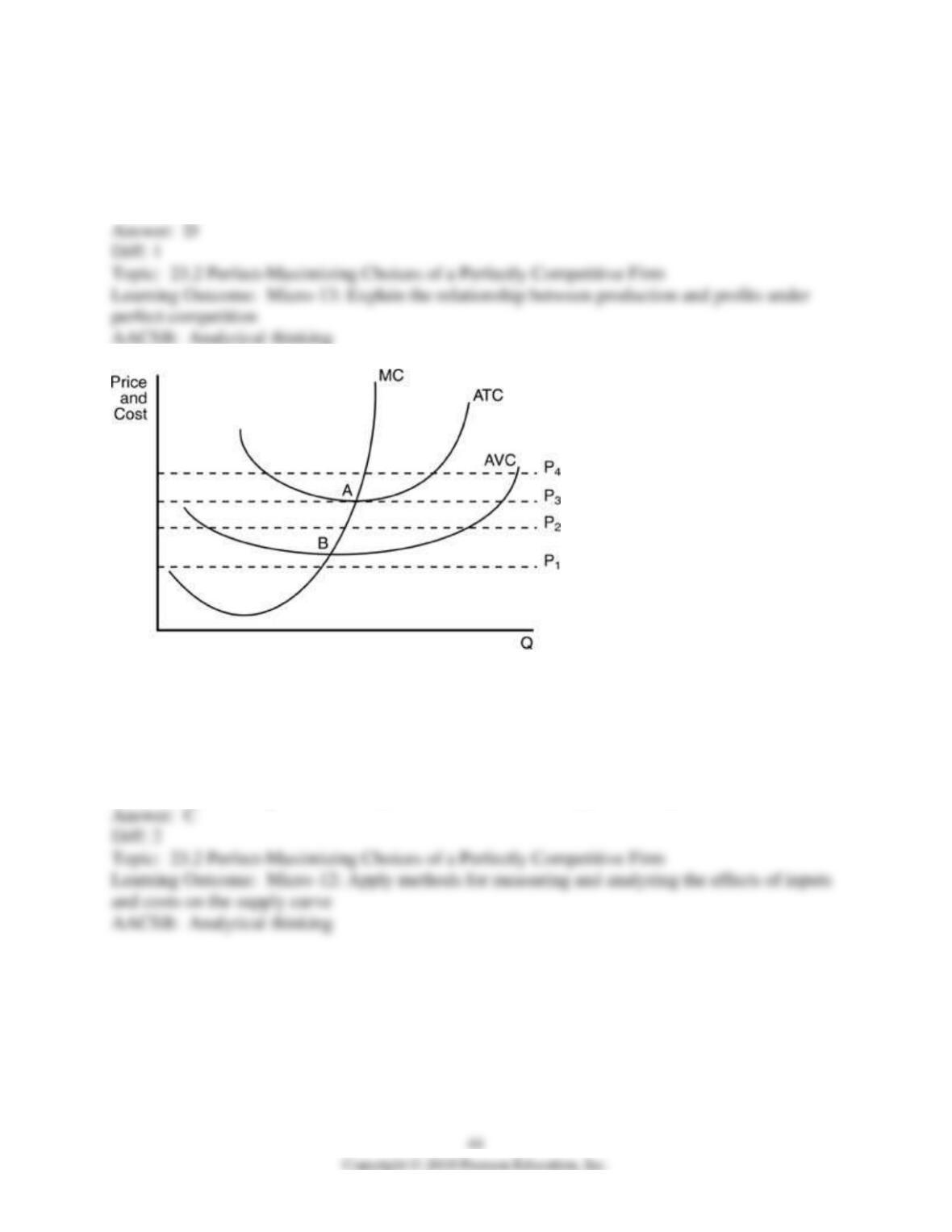
91) In the above figure, what happens to the firm’s optimal level of output if the price it receives
for its product increases from P2 to P3?
A) Output stays the same.
B) Output decreases.
C) Output increases.
D) There is not enough information provided to know what happens to output.
92) In the above figure, what happens to the firm’s optimal level of output if the price it receives
for its product decreases from P4 to P3?
A) Output stays the same.
B) Output decreases.
C) Output increases.
D) There is not enough information provided to know what happens to output.
93) Marginal revenue equals
A) total revenue divided by output.
B) price times quantity, divided by average revenue.
C) total revenue divided by average revenue.
D) the change in total revenue from selling one more unit.
94) The change in total revenues resulting from a change in output of one unit is
A) average revenue.
B) marginal revenue.
C) economic revenue.
D) diminishing revenue.
95) For a perfect competitor, marginal revenue equals
A) the slope of the demand curve.
B) average revenue divided by price.
C) price divided by average revenue.
D) the market price.
96) Which of the following is NOT true for a perfectly competitive firm?
A) P = MR
B) AR = MR
C) MR = TR
D) P = AR
97) For a perfect competitor, the marginal revenue curve will be
A) horizontal.
B) vertical.
C) positively sloped.
D) negatively sloped.
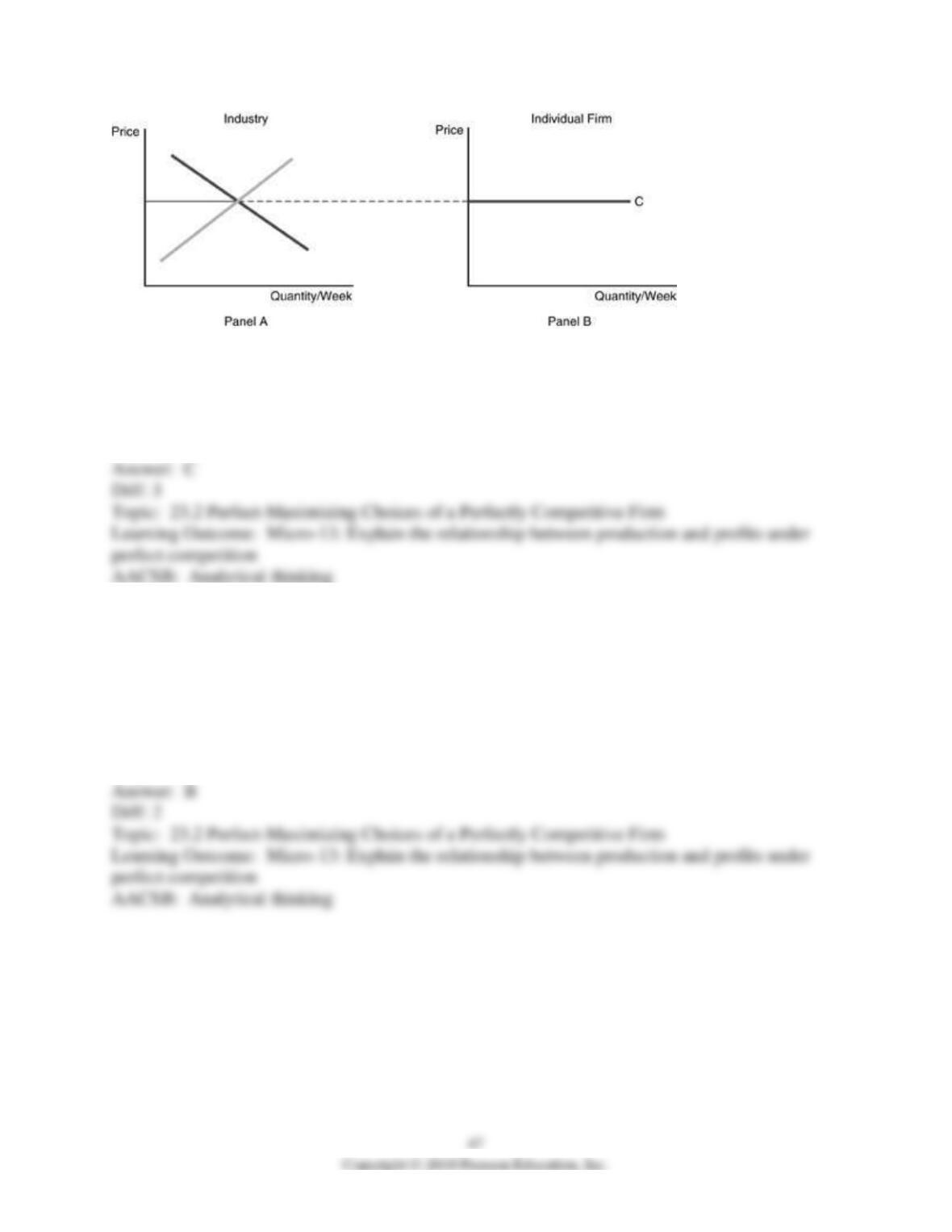
98) Refer to the above figure. Line C in Panel B does NOT represent
A) the equilibrium price.
B) average revenue.
C) total revenue.
D) marginal revenue.
99) The perfectly competitive firm maximizes profits when
A) it produces and sells the quantity at which the difference between marginal revenue and
marginal cost is the greatest.
B) it produces and sells the quantity at which marginal revenue and marginal cost are equal.
C) it produces and sells the quantity at which the difference between average revenue and
average cost is the greatest.
D) it produces and sells the quantity at which the difference between price and average cost is
the greatest.
100) The rate of production at which marginal revenue equals marginal cost is
A) a point of negative profits for the firm.
B) what determines the equilibrium price in the market.
C) the firm’s shutdown point.
D) the point where profits are maximized.
101) If marginal revenue is less than marginal cost, the firm should
A) raise price.
B) raise marginal revenue.
C) increase its rate of output.
D) decrease its rate of output.
102) If marginal revenue is greater than marginal cost, the firm should
A) raise price.
B) raise marginal revenue.
C) increase its rate of output.
D) decrease its rate of output.
103) Which of the following is always TRUE for a perfectly competitive firm?
A) P = d = MR
B) P = d = AVC
C) MC = MR = AVC
D) AVC = ATC = P
104) Which of the following is always TRUE in the short run for a perfectly competitive firm
that is maximizing economic profits?
A) P = d = MR = MC = AVC
B) P = d = MR = MC
C) P = d = MR = Q
D) MR = MC = Q
105) Marginal revenue is
A) change in total revenue/change in output.
B) total revenue/output.
C) change in total revenue/output.
D) total revenue/change in output.
106) For a perfectly competitive firm
A) price is greater than marginal revenue.
B) price equals marginal revenue.
C) price is less than marginal revenue.
D) there is no relationship between price and marginal revenue.
107) The profit-maximizing level of output for a firm occurs at the point at which
A) P = ATC.
B) P = AVC.
C) MR = MC.
D) MR = ATC.
108) Marginal revenue
A) cannot be used to determine the profit-maximizing rate of production.
B) is the change in total revenues resulting from a change in output.
C) is a change in revenue that is immeasurable and non-quantifiable.
D) cannot be effectively utilized when analyzing the perfect competitor.
109) Under what condition are profits maximized?
A) at the rate of output at which marginal revenue equals marginal cost
B) at the output rate where marginal cost is greater than marginal revenue
C) at the point at which the difference between total revenues and total costs is negative
D) at the point at which the difference between price and quantity demanded is greatest
110) The loss-minimizing output for the perfectly competitive firm occurs at the point at which
A) TR – MR = minimum.
B) TR – TC = maximum.
C) MR = MC.
D) TC – ATC = maximum.
111) A perfectly competitive firm is selling 300 units of output at $4 each. At this output level,
total fixed cost is $100 and total variable cost is $500. The firm
A) is maximizing its profit.
B) is earning a profit, but not necessarily the maximum profit.
C) is experiencing an economic loss.
D) should shut down.
112) Economic profits are maximized at the point at which
A) marginal revenues equal marginal costs.
B) accounting profit exceeds economic profit.
C) total revenues are greater than total costs.
D) accounting profits are equal to zero.
113) For a perfectly competitive firm, when MC is less than MR
A) the producer has an incentive to expand output.
B) the producer has an incentive to decrease output.
C) the producer has no incentive to change production.
D) economic profits must be positive.
114) If a perfectly competitive firm is producing at an output at which marginal cost exceeds
marginal revenue
A) price will be at the profit maximizing level.
B) sales will be at the profit maximizing level.
C) the firm should expand production.
D) the firm should reduce production.
115) A firm in a competitive industry faces the following short-run cost and revenue conditions:
ATC = $16; AVC = $8; and MR = MC = $12. This firm should
A) expand production and keep price constant.
B) decrease production and raise its price.
C) shut down.
D) continue to operate at the same price and output level in the short run.
116) Suppose a perfectly competitive firm faces the following short-run cost and revenue
conditions: ATC = $12; AVC = $10; MC = $15; MR = $16. The firm should
A) increase output.
B) decrease output.
C) increase price.
D) change nothing.
117) Suppose a perfectly competitive firm faces the following short-run cost and revenue
conditions: ATC = $700; AVC = $500; MC = $600; MR = $600. The firm should
A) increase output.
B) decrease output.
C) continue to produce its current output.
D) shut down.
118) Suppose a perfectly competitive firm faces the following cost and revenue conditions: ATC
= $25.50; AVC = $20.50; MC = $25.50; MR = $28.50. The firm should
A) decrease output.
B) increase output.
C) shut down.
D) continue to produce its current output.
119) Suppose a perfectly competitive firm faces the following short-run cost and revenue
conditions: ATC = $8.00; AVC = $5.00; MC = $8.00; MR = $7.00. The firm should
A) increase output.
B) decrease output.
C) increase price.
D) continue to produce its current output.
120) A firm should continue producing until
A) the cost of producing the output equals the revenues obtainable from selling the output.
B) the cost of increasing output by one more unit equals the revenues obtainable from selling the
extra unit.
C) average costs are at a minimum.
D) the average cost when another unit is produced equals the average revenue obtainable from
selling the extra unit.
121) For a perfectly competitive firm, which of the following is NOT true?
A) The average revenue curve, the demand and the marginal revenue curves are identical.
B) The total revenue curve begins at the origin and slopes upward as output increases.
C) The slope of the total revenue curve is equal to the product price.
D) The total revenue curve is horizontal.
122) “Demand curves slope down, so the demand curve faced by a perfectly competitive firm
must also be downward sloping.” Do you agree or disagree? Why?
123) Describe and explain how a perfectly competitive firm’s demand curve is found.
124) Why is the demand curve horizontal for a perfectly competitive firm?
125) “A perfect competitor should maximize total revenues.” Do you agree or disagree? Explain.
126) What does a perfectly competitive firm do to maximize profits?
127) Why should a perfect competitor produce at which price equals marginal cost?
128) Why should a firm not produce more than the rate of output at which marginal revenue
equals marginal cost?
129) How do we determine whether a firm has maximized profits?
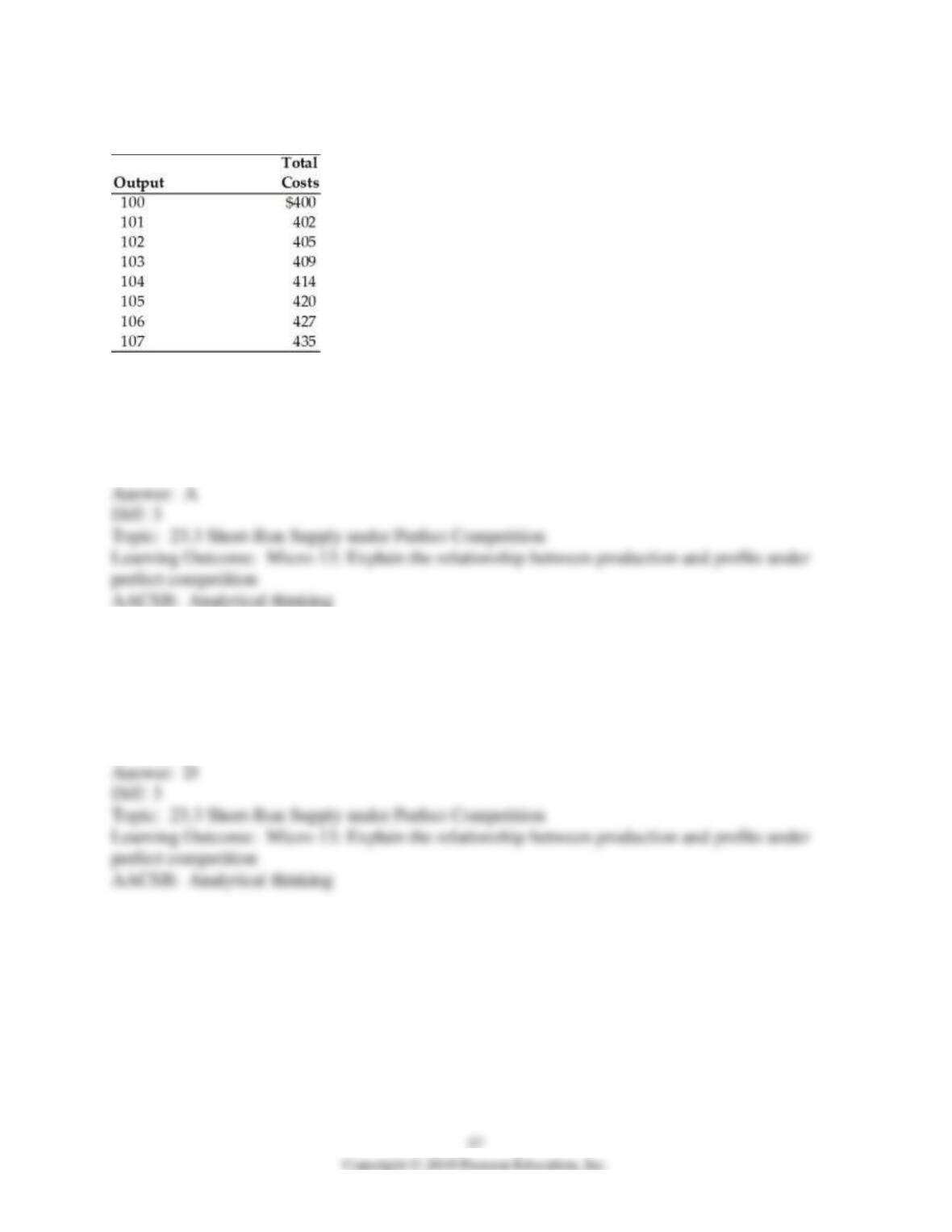
23.3 Short-Run Supply under Perfect Competition
1) Refer to the above table. If the price is $5, the perfectly competitive firm should produce
A) 104 units.
B) 105 units.
C) 106 units.
D) 107 units.
2) Refer to the above table. If the price is $5, the maximum economic profits this firm could earn
is
A) $520.
B) $420.
C) $414.
D) $106.
3) Refer to the above table. If the price is $6, the perfectly competitive firm should produce
A) 104 units.
B) 105 units.
C) 106 units.
D) 107 units.
4) Refer to the above table. If the price is $6 the maximum profit this firm could earn is
A) $210.
B) $414.
C) $420.
D) $630.
5) Refer to the above table. If the price is $3, the perfectly competitive firm should produce
A) 102 units.
B) 105 units.
C) 103 units.
D) 104 units.
6) Refer to the above table. If the price is $3 the maximum profit this firm could earn is
A) $99.
B) $306.
C) -$100.
D) -$99.
7) A firm in a perfectly competitive industry faces the following cost and revenue conditions:
ATC = $6; AVC = $3; MR = MC = $5. The firm is
A) earning economic profits.
B) experiencing economic losses.
C) experiencing zero profits.
D) in a position in which it should shut down.
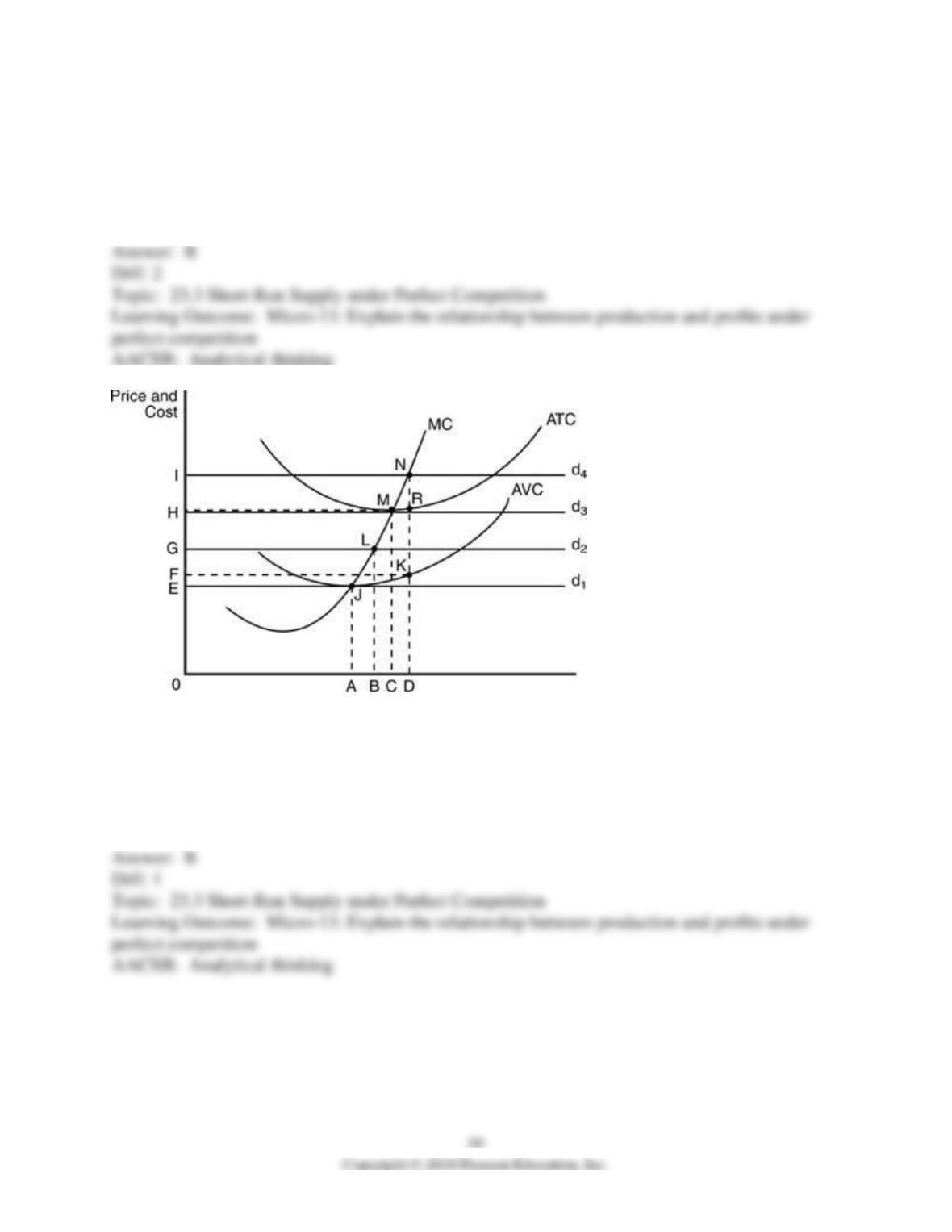
8) In the above figure, if the firm is facing demand curve d2, then to maximize profits it will
produce at output level
A) A.
B) B.
C) C.
D) D.
9) In the above figure, if d3 is the relevant demand curve for this firm, then which level of output
will maximize this firm’s profits or minimize its losses?
A) A
B) B
C) C
D) D
10) In the above figure, if d4 is the relevant demand curve for this firm, then which level of
output will maximize this firm’s profits or minimize its losses?
A) A
B) B
C) C
D) D
11) In the above figure, if d1 is the relevant demand curve for this firm, then which level of
output will maximize this firm’s profits or minimize its losses?
A) A
B) B
C) C
D) D