
119) Factors that cause the short-run supply curve to change are factors that affect
A) demand.
B) fixed costs.
C) variable costs.
D) the market but not the individual firm.
120) An increase in the productivity of labor causes
A) quantity supplied by each firm in a competitive industry to decrease.
B) supply in a competitive industry to increase.
C) the market price to increase in a competitive industry.
D) the firm’s supply curve to shift but has no effect on the industry supply curve.
121) If the wage rate increases and firms in a perfectly competitive industry are hiring labor, then
A) the firms will quit using labor.
B) profits will increase.
C) market supply will decrease.
D) market price will decrease.
122) The short-run supply curve for a perfectly competitive firm is the portion of its
A) ATC curve above the MC curve.
B) MC curve above the ATC curve.
C) ATC curve below the MC curve.
D) MC curve above its AVC curve.
123) The short-run supply curve for the perfectly competitive firm is the portion of its
A) MC curve above the AVC curve.
B) MC curve above the AFC curve.
C) MC curve above the ATC curve.
D) MC curve above the MR curve.
124) In principle, how do we determine a perfectly competitive firm’s profit-maximizing output
and maximum profits given information about the market clearing price, and about the marginal
cost and average total cost curves of the firm? Explain in words.
125) Can a firm make losses by producing the rate of output at which marginal revenue equals
marginal cost? Why?
126) “By producing at an output rate at which marginal revenue equals marginal cost, a firm is
definitely making positive economic profits.” Do you agree or disagree? Why?
127) What is the short-run break-even price? What are economic profits at this price? Why
would a firm be willing to operate permanently at this price?
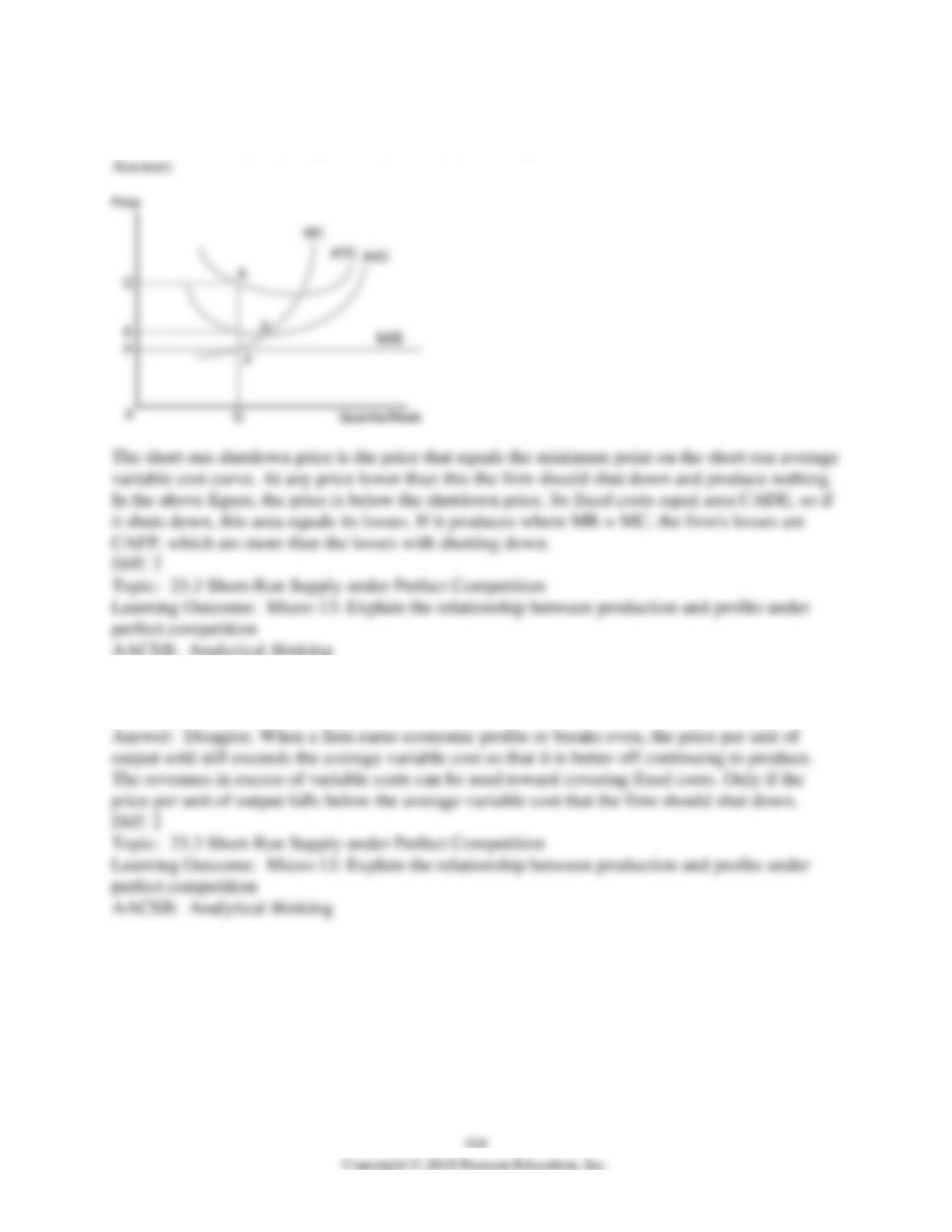
128) What is the short-run shutdown price? Using a graph and a market price of P, show that
losses are less when shutting down than when producing.
129) “A firm should shut down immediately when it earns zero economic profits.” Do you agree
or disagree? Explain your answer.
130) When should a firm shut down? When should a firm go out of business?
131) Why does the industry short-run supply curve slope upward?
132) What determines the perfect competitor’s supply curve? How is the industry supply curve
found?
133) “An industry’s short-run supply curve is constructed by adding horizontally all the average
variable cost curves of firms in that industry.” Do you agree or disagree? Why?
23.4 Price Determination under Perfect Competition
1) A firm is currently producing at the rate of output at which total revenues just cover its total
variable costs. If demand falls, the firm should
A) lower both price and its rate of output.
B) shut down.
C) increase its rate of output to make up for the lower price.
D) not change its rate of output because it is still covering its variable costs.
2) A perfectly competitive industry’s market or “going” price is established by
A) the largest firm in the industry.
B) the largest purchaser of this industry’s output.
C) each individual producing firm and reflects that firm’s costs.
D) the forces of supply and demand.
3) A perfectly competitive industry’s market price is found by
A) finding the point on the market demand curve where the largest number of units will be
purchased.
B) locating the intersection of the market demand and market supply curves.
C) the horizontal summation of all the industry firms’ individual supply curves.
D) identifying the price at which each firm realizes its largest economic profit.
4) Under perfect competition, the demand curve facing the firm is determined by
A) the intersection of the industry demand and supply curves.
B) the tastes and preferences of consumers.
C) utility maximizing behavior on the part of consumers.
D) the willingness of the firm to supply the good.
5) The market demand curve in perfect competition is found by
A) horizontally summing the supply curves of the individual firms in the industry.
B) horizontally summing the demand curves of the individual consumers.
C) utility maximizing behavior of the “representative consumer.”
D) the interaction of supply and demand at the individual firm and consumer levels.
6) In a perfectly competitive market in which all firms are maximizing their economic profits,
the demand and supply curves intersect at a price of $8. From this we know that each
A) firm’s average total cost of producing the good is $8.
B) firm’s average variable cost of producing the good is $8.
C) firm’s marginal cost of producing the good is $8.
D) firm is earning positive economic profits at a price of $8 or more.
7) All of the following are true regarding perfectly competitive price determination EXCEPT
A) the market price is determined by the interactions among all buyers (households) and firms.
B) the individual firm takes the market price as given.
C) the individual firm is known as a market price maker.
D) the individual firm’s marginal revenue curve is horizontal at the market price.
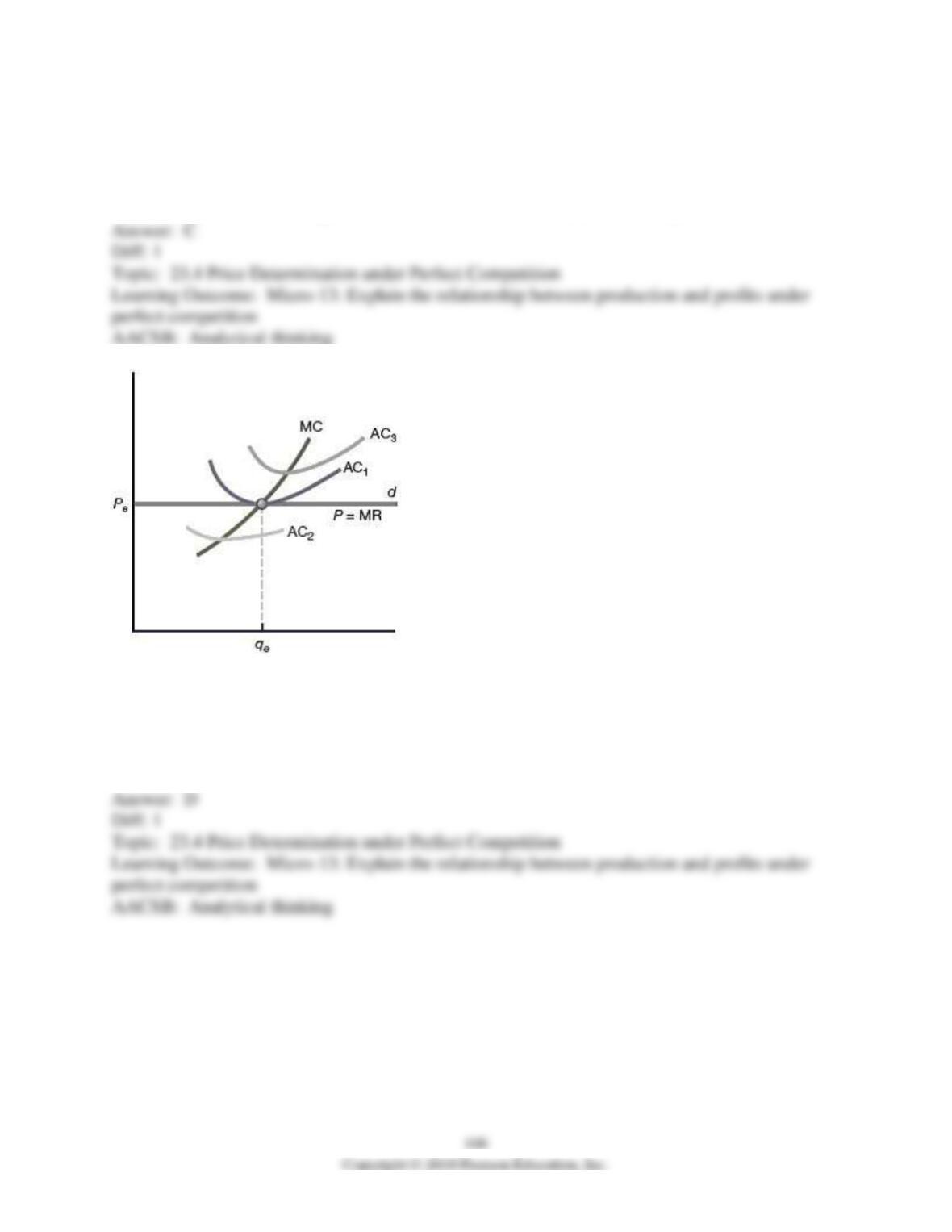
8) Refer to the above figure for the individual firm in a perfectly competitive market. If the firm’s
average costs are given by AC1, then
A) the industry supply curve will shift leftward.
B) the industry supply curve will shift rightward.
C) the industry demand curve will shift rightward.
D) none of the above.
9) Refer to the above figure for the individual firm in a perfectly competitive market. If the firm’s
average costs are given by AC2, then
A) the industry supply curve will shift leftward.
B) the industry supply curve will shift rightward.
C) the industry demand curve will shift rightward.
D) none of the above.
10) Refer to the above figure for the individual firm in a perfectly competitive market. If the
firm’s average costs are given by AC3, then
A) the industry supply curve will shift leftward.
B) the industry supply curve will shift rightward.
C) the industry demand curve will shift rightward.
D) none of the above.
11) How is the market clearing price established in a perfectly competitive industry?
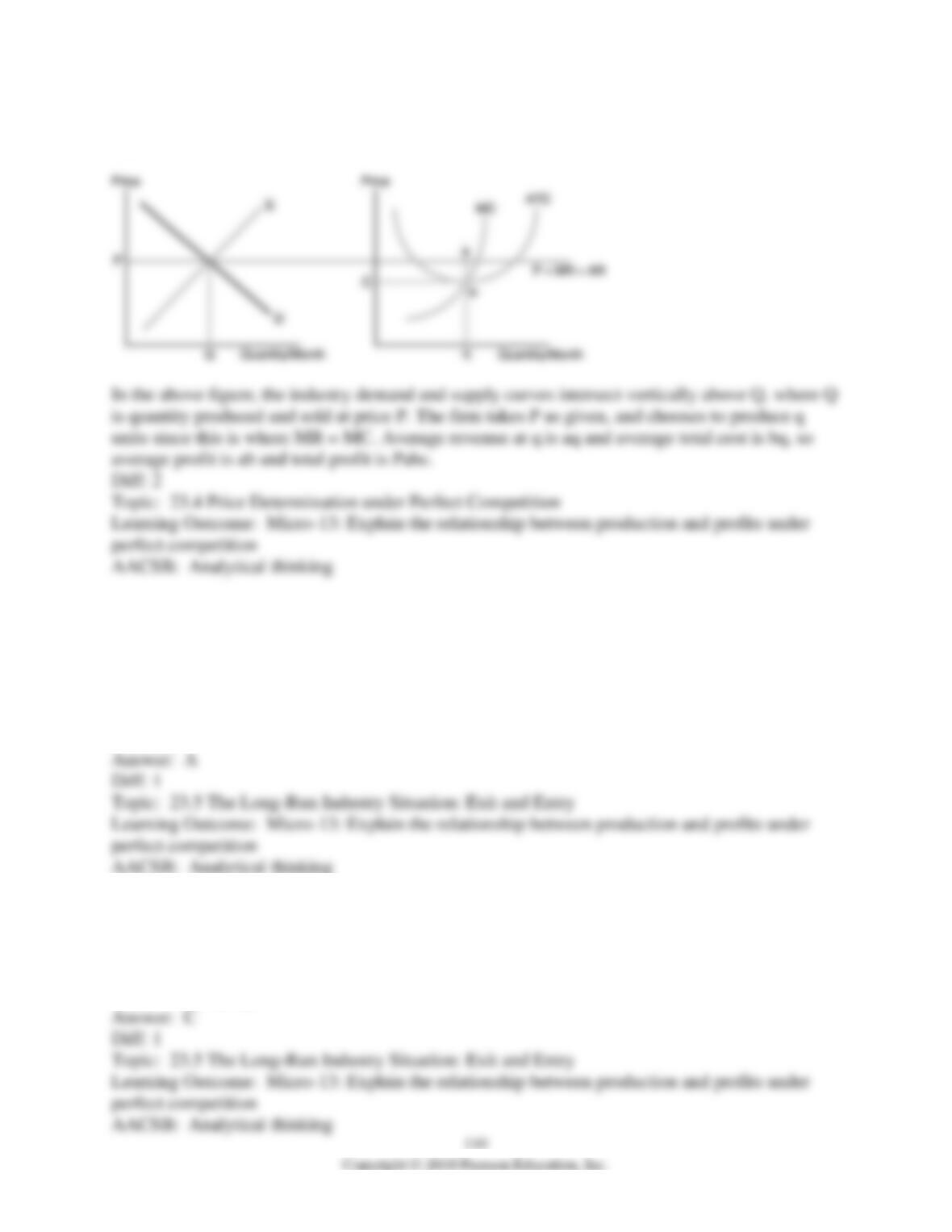
12) Using a graph, show a short-run equilibrium for the industry and the firm. Explain the graph.
Answer:
23.5 The Long-Run Industry Situation: Exit and Entry
1) Market signals
A) are ways of conveying information.
B) are market noise that confuses buyers and sellers.
C) are best ignored by investors.
D) always lead to economic losses.
2) What is the shape of the long-run supply curve in a decreasing-cost industry?
A) horizontal
B) increasing
C) downward sloping
D) upward sloping
3) What is the shape of the long-run supply curve in an increasing-cost industry?
A) horizontal
B) inverted U-shape
C) downward sloping
D) upward sloping
4) What is the shape of the long-run supply curve in a constant-cost industry?
A) horizontal
B) vertical
C) downward sloping
D) upward sloping
5) In the long run when a perfectly competitive firm experiences positive economic profits
A) firms exit the industry, the market supply curve shifts rightward, and the market price falls.
B) firms enter the industry, the market supply curve shifts rightward, and the market price falls.
C) firms exit the industry, the market supply curve shifts leftward, and the market price rises.
D) firms enter the industry, the market supply curve shifts rightward, and the market price rises.

6) In the long run when a perfectly competitive firm experiences negative economic profits
A) firms exit the industry, the market supply curve shifts rightward, and the market price falls.
B) firms enter the industry, the market supply curve shifts rightward, and the market price falls.
C) firms exit the industry, the market supply curve shifts leftward, and the market price rises.
D) firms enter the industry, the market supply curve shifts rightward, and the market price rises.
7) If an industry has constant marginal and average costs, any shift in demand will eventually
A) result in a higher equilibrium price.
B) be met by a smaller change in quantity supplied.
C) be met by an equal change in quantity supplied, and equilibrium price will not change.
D) make economic profits zero in the short run.
8) In a perfectly competitive market, positive economic profits act to
A) attract new entrants into the industry.
B) drive potential competitors away from the industry.
C) prevent reinvestment on the part of firms within the industry.
D) signal resource owners elsewhere not to invest their capital in this industry.
9) In a perfectly competitive market, if P > ATC in the short run, there is apt to be
A) entry of new firms into the market.
B) an accounting loss for existing firms.
C) an inward shift in the industry supply curve.
D) an upward pressure on price.
10) If a perfect competitor faces P = ATC in the long run, the firm will
A) earn economic profits.
B) earn economic losses.
C) leave the industry.
D) remain in the industry.
11) The exiting of firms from a perfectly competitive industry occurs when
A) opportunity costs cannot be covered.
B) P = ATC.
C) accounting profit is less than economic profit.
D) MR equals MC.
12) In a perfectly competitive industry, which of the following is a market signal to resource
owners?
A) economic profits
B) quality of goods
C) the level of exports in the country
D) the level of subsidies the industry receives
13) Economic profits and losses are TRUE market signals because they
A) convey information in an asymmetrical fashion.
B) convey information about rewards people should anticipate experiencing by shifting resources
from one activity to another.
C) convey information to public officials about where to encourage people to invest and what
skills people should develop.
D) cause people to move into careers in both undesirable and desirable industries with equal
ease.
14) A law that restricts plant closings will
A) make the economy more efficient by slowing down the movement of resources to a more
optimal rate.
B) make the economy more efficient by reducing poor decisions on the part of entrepreneurs.
C) prevent resources from flowing to their highest-valued uses.
D) provide useful market signals to all parties in the industry.
15) In a decreasing-cost industry, an increase in output will lead to
A) an upward shift in the ATC curve.
B) an upward shift in the MC curve.
C) a reduction in long-run per-unit costs.
D) an increase in long-run per-unit costs.
16) In an increasing-cost industry, an increase in output will lead to
A) an downward shift in the ATC curve.
B) an downward shift in the MC curve.
C) a reduction in long-run per-unit costs.
D) an increase in long-run per-unit costs.
17) If an industry’s long-run per-unit costs increase as its output increases then
A) the firm’s long-run economic profits must be greater than zero.
B) the firm is most likely a decreasing-cost industry.
C) the firm is most likely an increasing-cost industry.
D) the firm is most likely a constant-cost industry.
18) If an industry’s long-run per-unit costs decrease as its output increases then
A) the firm’s long-run economic profits must be less than zero.
B) the firm is most likely a decreasing-cost industry.
C) the firm is most likely an increasing-cost industry.
D) the firm is most likely a constant-cost industry.
19) If an industry’s long-run per-unit costs are constant as its output increases then
A) the firm’s long-run economic profits must be greater than zero.
B) the firm is most likely a decreasing-cost industry.
C) the firm is most likely an increasing-cost industry.
D) the firm is most likely a constant-cost industry.

20) If a constant-cost, perfectly competitive industry experiences an increase in the demand for
its product, we would expect
A) only the market price of the good to increase.
B) both the market price and quantity supplied to increase.
C) decreases in the market price, but increases in quantity supplied.
D) only the quantity supplied of the product to increase.
21) A constant-cost industry is one in which
A) output increases lead to productivity gains.
B) the marginal product of labor is constant.
C) there is no change in long-run per-unit costs, even as output varies.
D) each firm has a horizontal long-run average cost curve.
22) In an increasing-cost industry, an increase in industry output will
A) lead to a higher market price.
B) lead to a lower market price.
C) shift each firm’s average fixed cost curve down.
D) shift each firm’s short run supply curve down.
23) In a decreasing-cost industry, an increase in industry output will
A) lead to a higher market price.
B) lead to a lower market price.
C) shift each firm’s average fixed cost curve up.
D) shift each firm’s short run supply curve up.
24) A constant-cost industry
A) is one in which an increase in demand is matched by a proportional increases in long-run
supply.
B) generates increasing profits whenever demand increases because the new long-run
equilibrium price is above the old price even though average costs have not changed.
C) has a horizontal long-run supply curve.
D) has a downward sloping long-run supply curve.
25) When economic profits in a perfectly competitive industry are positive
A) new firms will be attracted to the industry, and economic profits will decline to zero.
B) the industry is in equilibrium.
C) firms will increase output to earn even higher profits.
D) firms will increase prices while they have the opportunity.
26) In a perfectly competitive industry, any restrictions that prevent new firms from entering
A) lead to negative profits.
B) guarantee that all existing firms will earn exactly a zero profit.
C) hinder economic efficiency.
D) reduce the average cost of production.
27) Signals are
A) used by economic decision-makers to inform others about their plans.
B) the method by which government planners inform economic decision-makers about the types
of decisions they should make.
C) the method by which firms determine their profit maximizing quantity.
D) compact ways of conveying to economic decision makers information needed to identify
industries where more resources are needed.
28) A TRUE signal must
A) convey information only.
B) convey information and direct the resource owners to act appropriately.
C) convey information about the long-run future.
D) explain in detail why something should be done.
29) Profits and losses are TRUE signals because they
A) convey information about true long-run profits.
B) cannot be misinterpreted by entrepreneurs.
C) convey information about where to place resources and reward people who act on the
information.
D) reward people who make profits with even more profits and punish those who make losses
with even more losses.
30) Firms in a perfectly competitive industry are earning economic losses. This is
A) a signal to entrepreneurs that some of the firms in the industry should exit and the resources
of these firms should move into production of other goods.
B) a signal to entrepreneurs that additional resources should be brought into this industry in order
to make it profitable.
C) a signal that the entrepreneurs are doing a poor job and should become workers for someone
else.
D) a signal to government officials that a subsidy is needed for the firms in the industry.
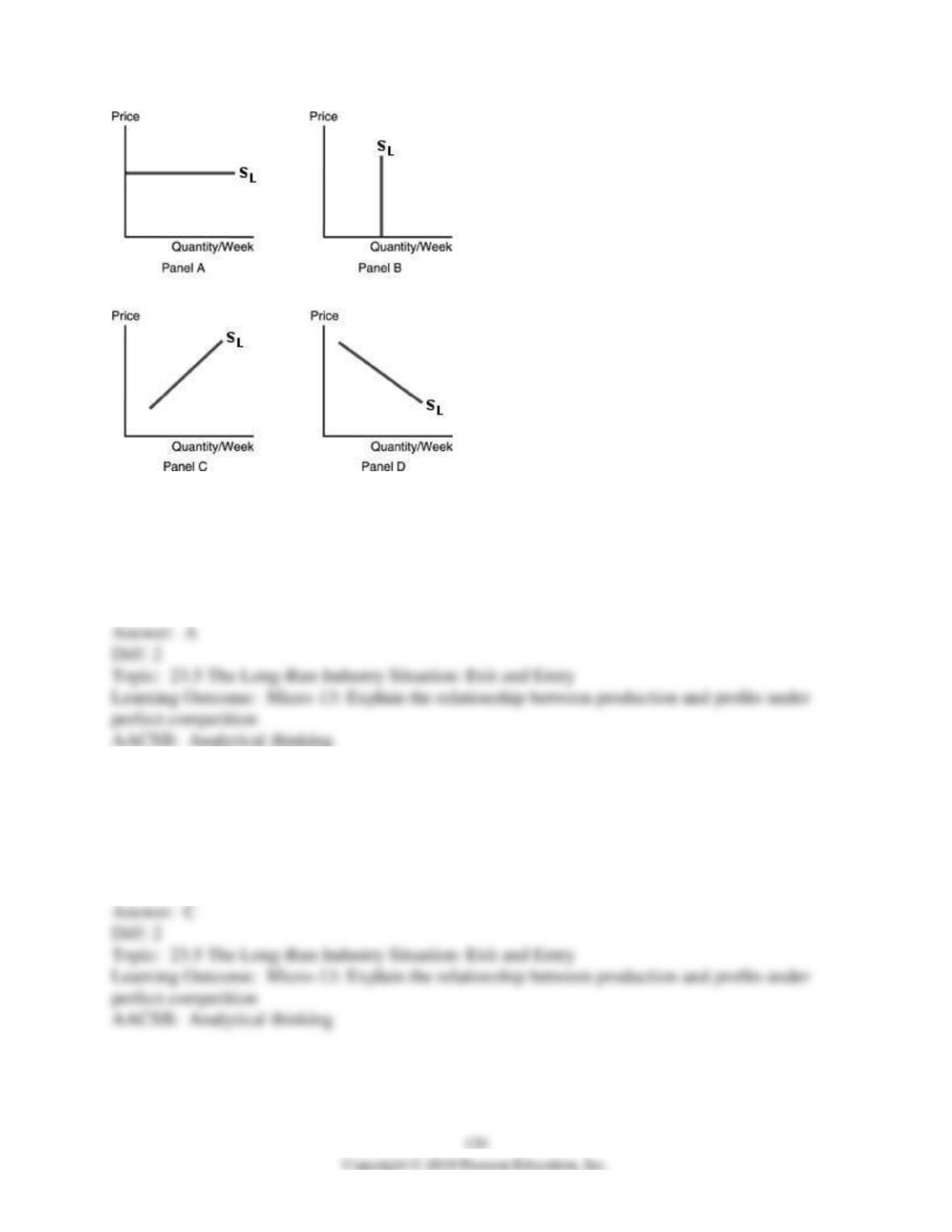
31) Refer to the above figure. Which panel represents the long-run supply curve for a constant
cost industry?
A) Panel A
B) Panel B
C) Panel C
D) Panel D
32) Refer to the above figure. Which panel represents the long-run supply curve for an
increasing-cost industry?
A) Panel A
B) Panel B
C) Panel C
D) Panel D