78) For a perfectly competitive firm at its long-run equilibrium
A) P = MR = MC = AC.
B) P = MR > MC.
C) accounting profit must be zero.
D) there are no opportunity costs to be concerned with.
79) If a perfectly competitive industry is in long-run equilibrium, then
A) price equals average cost.
B) price is greater than average cost and equal to marginal cost.
C) all firms earn the same accounting profits.
D) marginal cost is less than average cost.
80) When a perfectly competitive firm is in long-run equilibrium, economic profits
A) are positive.
B) are zero.
C) are negative.
D) may be positive, zero or negative depending upon costs.
81) In a perfectly competitive market, a firm in long-run equilibrium will be operating
A) to the right of the minimum of the long-run average cost curve.
B) to the left of the minimum of the long-run average cost curve.
C) at the minimum of the long-run average cost curve.
D) at the minimum of the marginal cost curve.
137
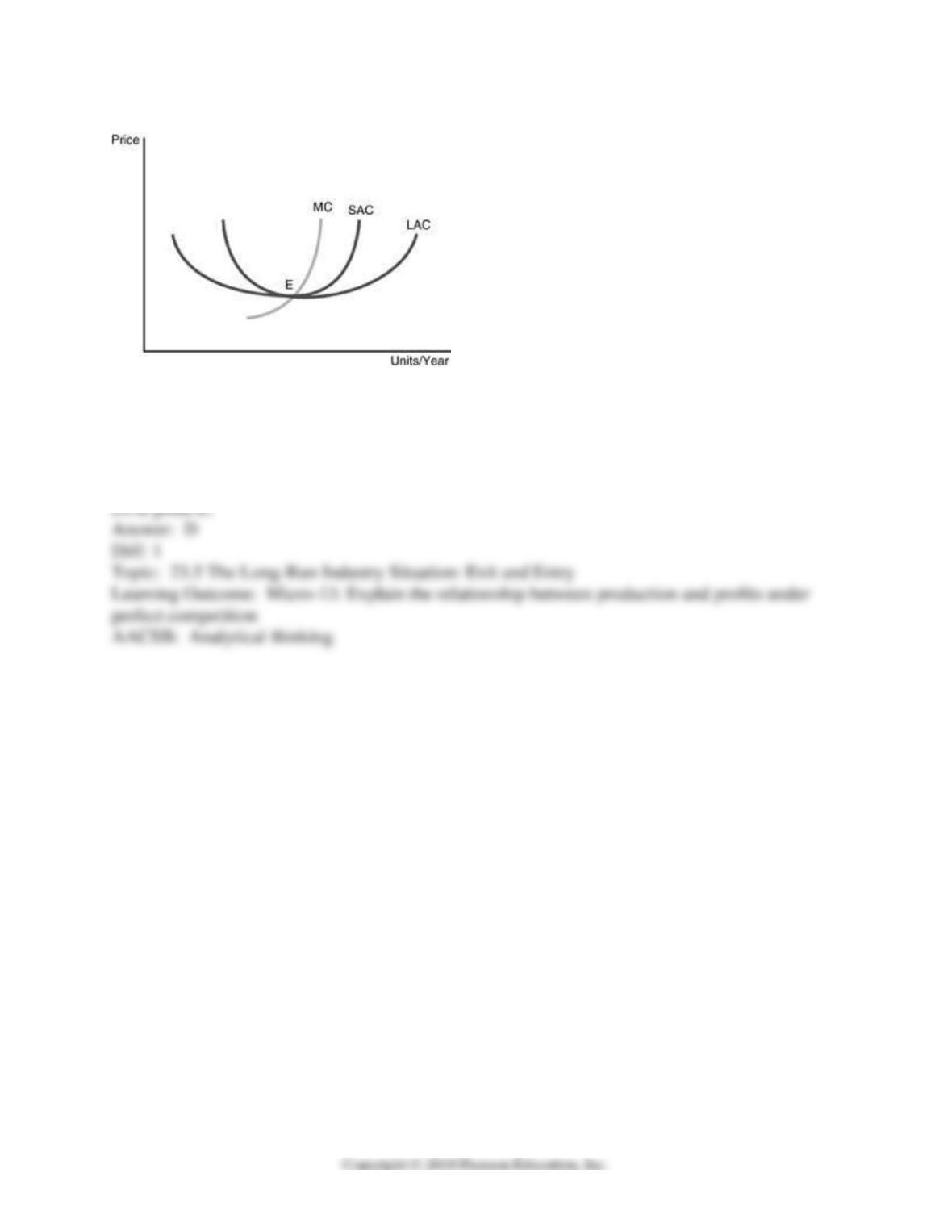
82) Refer to the above figure. A perfectly competitive firm that is in long-run equilibrium will be
operating
A) with positive economic profits.
B) at a quantity greater than point E.
C) at a quantity less than point E.
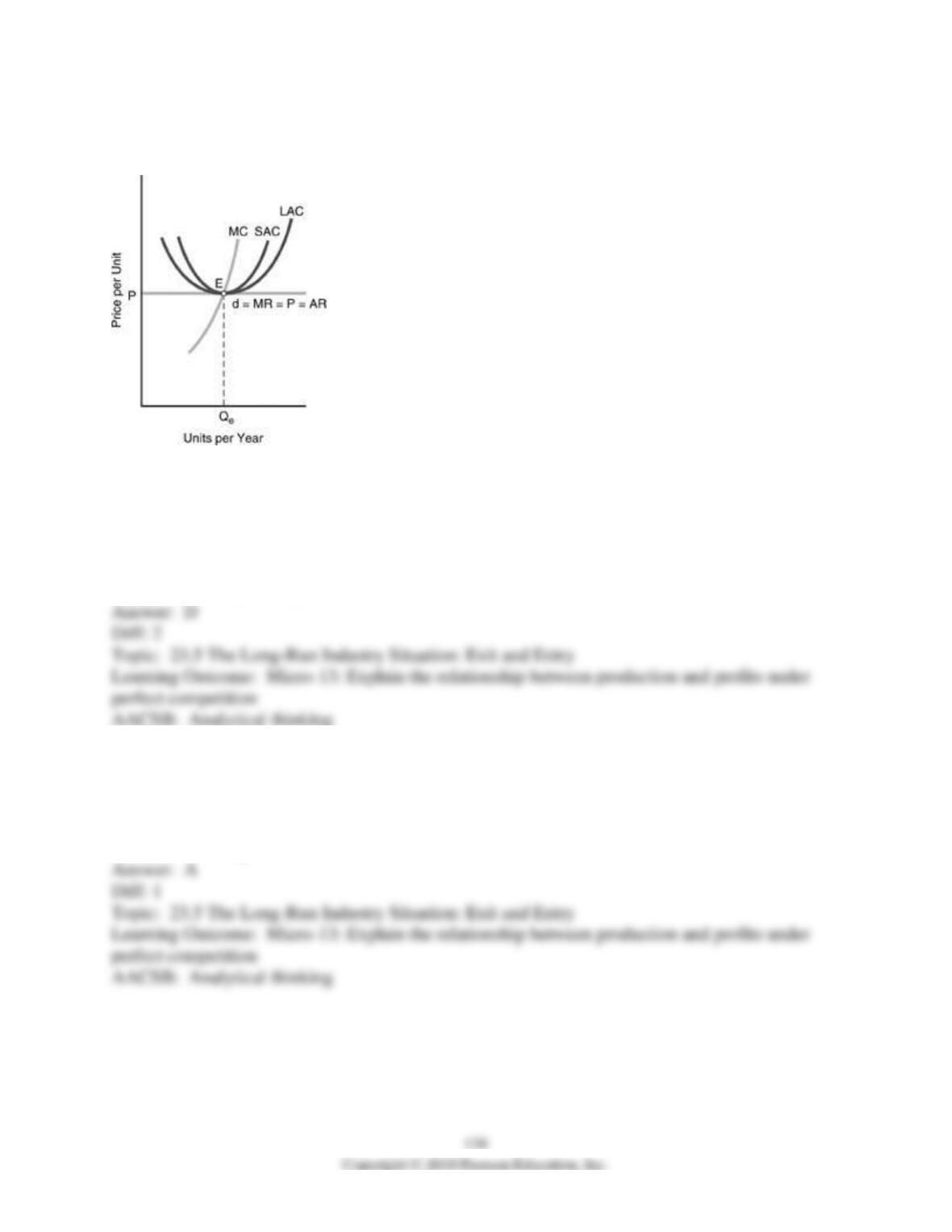
83) In reference to the long-run firm competitive equilibrium diagram, which of the following
statements is INCORRECT?
A) In the long run, the firm has no incentive to alter its scale of operations.
B) Because profits must be zero in the long run, the firm’s short-run average costs (SAC) must
equal P at Qe, which occurs at minimum SAC.
C) In the long run, the firm operates where price, marginal revenue, marginal cost, short-run
minimum average cost, and long-run minimum average cost all are equal.
D) In the long run, this firm must be part of a constant-cost industry, because its marginal
revenue curve is perfectly elastic.
84) In a long-run equilibrium, a perfectly competitive firm’s average total cost is
A) minimized.
B) higher than the market price.
C) zero.
D) equal to average fixed cost.
85) In the long run, all firms in a perfectly competitive industry
A) earn economic profits.
B) break even.
C) suffer economic losses.
D) sell differentiated products to earn economic profits.
86) For a perfectly competitive firm at its long-run competitive equilibrium point
A) P = AR = MR = LATC = ATC = MC.
B) P = AR = MR = LATC > ATC = MC.
C) P = AR = MR = MC = LATC = AVC.
D) P > MR > AR > MC > LATC > ATC.
87) In a long-run perfectly competitive equilibrium
A) P = MR = MC > ATC.
B) P = MR > MC = ATC.
C) P = MR = MC = ATC.
D) P > MR > MC = ATC.
88) Economic efficiency means
A) the same as technical efficiency.
B) that all firms within a single competitive industry are producing at the same level of output.
C) that it is impossible to increase the output of any good without lowering the total value of the
output of the economy.
D) that high-tech methods of production are the most efficient.
89) With marginal cost pricing
A) marginal benefits are usually less than marginal cost.
B) all opportunity costs will be covered in the short run.
C) the price charged is equal to the opportunity cost to society of producing one more unit of the
good.
D) there cannot be any short-run economic profit.
90) When marginal cost pricing occurs
A) price equals the additional cost society incurs in producing the next unit of an item.
B) the firm can only break even if it does not set price to marginal cost.
C) price equals average variable cost but exceeds average total cost.
D) the firm is at the shutdown point.
91) Competitive pricing is efficient because
A) the price that consumers pay reflects the opportunity cost to society of producing the good.
B) firms make positive economic profits in long-run equilibrium.
C) average revenue equals average cost.
D) firms produce above the minimum efficient scale.
92) A market failure is a situation in which
A) resources are being efficiently allocated, but some companies are forced to shut down.
B) the market equilibrium leads to either too many or too few resources going towards producing
the good or service.
C) the government must take actions to correct the failures of the market in a particular industry.
D) there is no free entry or exit into an industry.
93) The opportunity cost to society of producing one more unit of the good is
A) average cost.
B) marginal cost.
C) efficiency costing.
D) the optimal cost.
94) When price equals marginal cost
A) firms make zero profits.
B) firms make positive profits.
C) the industry is in long-run equilibrium.
D) the marginal benefits of consuming an extra unit of the good exactly equals the marginal cost
to society of producing the good.
95) The value of total output decreases when labor leaves one industry and goes to another and
capital leaves the second industry and goes to the first. This indicates that
A) the first situation was not efficient.
B) the second situation is efficient.
C) price is greater than marginal cost.
D) it would be efficient to return to the first situation.
96) If markets are perfectly competitive, then the production of goods
A) will use the least costly combination of resources.
B) will occur at an average total cost value that is above the minimum.
C) will require government intervention.
D) will always lead to business failures.
97) Perfectly competitive markets are efficient because
A) they always reach equilibrium.
B) firms in the market are price takers.
C) the cost to society for producing the goods is exactly equal to the value that society places on
the good.
D) the long run equilibrium assures that the prices of resources will not increase.
98) Suppose the perfectly competitive equilibrium occurs such that too many units of the good
are produced. This is an example of
A) marginal cost pricing.
B) market failure.
C) firms have not yet exited the industry.
D) greedy business people behaving in an inappropriate manner.
99) Economic efficiency is indicated by
A) P = AVC.
B) MR = MC.
C) P = MR.
D) P = MC.
100) A situation in which the price charged is equal to society’s opportunity cost is known as
A) market failure.
B) marginal monopoly pricing.
C) marginal profits.
D) marginal cost pricing.
101) A situation in which the price charged is greater than society’s opportunity cost would lead
to
A) market failure.
B) marginal monopoly pricing.
C) marginal profits.
D) marginal cost pricing.
102) A situation in which the price charged is greater than society’s opportunity cost would lead
to
A) too little being produced.
B) too much being produced.
C) an efficient amount being produced.
D) marginal cost pricing.
103) A situation in which the price charged is less than society’s opportunity cost would lead to
A) too little being produced.
B) too much being produced.
C) an efficient amount being produced.
D) marginal cost pricing.
104) Which of the following best describes a situation of economic efficiency?
A) A firm produces to the point at which P = AVC, with MR < MC.
B) A firm produces to the point at which P = ATC, with MC < MR.
C) A firm produces to the point at which MR = AFC, with P = AVC.
D) A firm produces to the point at which MR = MC, with P = MC.
105) A firm’s long-run position under perfect competition is often said to be efficient because
A) P = AR > MC = AVC.
B) P = AR > MR = MC.
C) P = MR = AVC = AFC.
D) P = MR = MC = ATC.
106) In a perfectly competitive market, if P > MC, then
A) too little output is being produced.
B) too much output is being produced.
C) production is efficient, as the firm is earning profits.
D) the firm is paying a price for resources that is too high.
107) In a perfectly competitive market, if P < MC, then
A) too little output is being produced.
B) too much output is being produced.
C) production is efficient, as the firm is earning profits.
D) the firm is paying a price for resources that is too high.
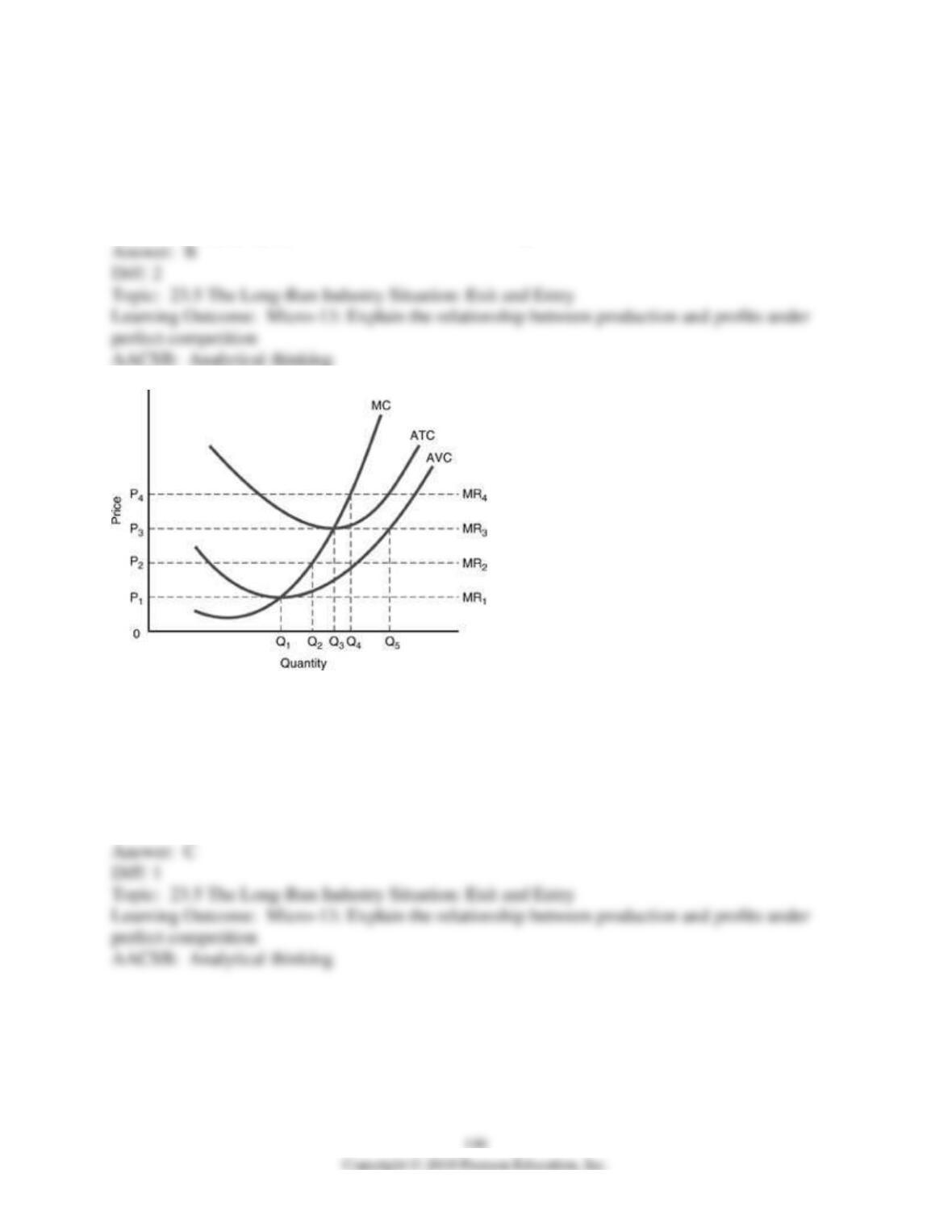
108) Using the above figure, the price facing the perfectly competitive firm in the long run will
be
A) P1.
B) P2.
C) P3.
D) P4.
109) “Because a firm’s supply curve slopes upward, the long-run supply curve of an industry
must also slope upward.” Do you agree or disagree? Explain.
110) What are signals? How do profits function as signals?
111) What determines whether the industry long-run supply curve is upward sloping or
horizontal?
112) Explain what happens to the long-run supply curve of an industry when firm entry raises the
price of inputs used in the industry.
113) If firms in a perfectly competitive industry are earning positive economic profits, then what
will happen in the long run?
114) “In the long run, a perfectly competitive firm’s average total cost is always below the
market clearing price.” Agree or disagree? Why?
115) What is marginal cost pricing? Why is marginal cost pricing important?
116) Why would it be economically inefficient for a firm to charge the price of a good greater
than its marginal cost?
117) Why is the pricing outcome of a perfectly competitive firm efficient in economic sense?