33) Refer to the above figure. Which panel represents the long-run supply curve for a decreasing-
cost industry?
A) Panel A
B) Panel B
C) Panel C
D) Panel D
34) Which of the following would tell us that resources are NOT flowing to their highest valued
uses?
A) short-run economic profits
B) short-run economic losses
C) long-run economic profits
D) Some firms are just breaking even.
35) Along a perfectly competitive industry’s long-run supply curve
A) economic profits are positive.
B) economic profits are zero.
C) the market price is higher than the marginal costs of firms
D) the number of firms is constant.
36) If the long-run supply curve is upward sloping, we know that
A) entrepreneurs are earning higher profits as output expands.
B) some input prices are increasing as the industry expands.
C) firms are getting larger as the industry contracts.
D) the law of diminishing marginal returns has set in.
37) An industry whose total output can be increased without a change in long-run per-unit costs
is a(n)
A) increasing-cost industry.
B) constant-cost industry.
C) zero-cost industry.
D) decreasing-cost industry.
38) An industry in which an increase in industry output is accompanied by an increase in long-
run per-unit costs is a(n)
A) increasing-cost industry.
B) constant-cost industry.
C) break-even cost industry.
D) decreasing-cost industry.
39) An industry in which an increase in output leads to a reduction in long-run per-unit costs is
a(n)
A) increasing-cost industry.
B) constant-cost industry.
C) break-even cost industry.
D) decreasing-cost industry.
40) Suppose a perfectly competitive industry is in long-run equilibrium. If a decrease in demand
leads to a lower long-run price, we know that
A) this is a decreasing-cost industry.
B) this is an increasing-cost industry.
C) some firms will be losing money in the long run.
D) after further adjustments, price will rise to its original level.
41) Suppose a perfectly competitive industry is in long-run equilibrium. If a decrease in demand
leads to a higher long-run price, we know that
A) this is a decreasing-cost industry.
B) this is an increasing-cost industry.
C) some firms will be losing money in the long run.
D) after further adjustments, price will fall to its original level.
42) A perfectly elastic long-run supply curve indicates
A) a decreasing-cost industry.
B) a constant-cost industry.
C) an increasing-cost industry.
D) that some input prices change as firms enter and exit the industry.
43) If the long-run supply curve is horizontal, we know that this is
A) a decreasing-cost industry.
B) a constant-cost industry.
C) an increasing-cost industry.
D) a situation in which some input prices change as firms enter and exit the industry.
44) If the long-run supply curve slopes downward, we know that this is
A) a decreasing-cost industry.
B) a constant-cost industry.
C) an increasing-cost industry.
D) a situation in which no input prices change as firms enter and exit the industry.
45) If the long-run supply curve slopes upward, we know that this is
A) a decreasing-cost industry.
B) a constant-cost industry.
C) an increasing-cost industry.
D) a situation in which no input prices change as firms enter and exit the industry.
46) Consider an industry that is in long-run equilibrium. An increase in demand leads to an
increase in the price of the good. We know that this is
A) a decreasing-cost industry.
B) a constant cost industry.
C) an increasing-cost industry.
D) not a competitive industry.
47) Consider an industry that is in long-run equilibrium. An increase in demand leads to a
decrease in the price of the good. We know that this is
A) a decreasing-cost industry.
B) a constant cost industry.
C) an increasing-cost industry.
D) not a competitive industry.
48) Consider an industry that is in long-run equilibrium. An increase in demand leads to no
change in the price of the good. We know that this is
A) a decreasing-cost industry.
B) a constant cost industry.
C) an increasing-cost industry.
D) not a competitive industry.
49) An increasing-cost industry will have
A) a perfectly elastic long-run supply curve.
B) a perfectly inelastic long-run supply curve.
C) an upward sloping supply curve in the long run.
D) an upward sloping demand curve in the long run.
50) A decreasing-cost industry will have
A) a perfectly elastic long-run supply curve.
B) a perfectly inelastic long-run supply curve.
C) an upward sloping demand curve in the long run.
D) a downward sloping supply curve in the long run.
51) If an industry’s long-run supply curve slopes downward, then the industry is
A) a fixed-cost industry.
B) a constant-cost industry.
C) an increasing-cost industry.
D) a decreasing-cost industry.
52) A constant-cost industry will have
A) a perfectly elastic long-run supply curve.
B) a perfectly inelastic long-run supply curve.
C) an upward sloping demand curve in the long run.
D) an upward sloping supply curve in the long run.
53) A perfectly competitive firm cannot earn an economic profit in the long run because
A) it is a “price-maker.”
B) it faces a perfectly inelastic demand curve.
C) there are no barriers to entry into the industry.
D) all firms in the industry earn accounting profits.
54) When a perfectly competitive firm experiences positive economic profits in the short run
A) the high barriers to entry prevent further competition.
B) existing firms exit the industry.
C) new firms enter the industry.
D) firms have no incentive to exit or enter the industry.
55) In the long run when a perfectly competitive firm experiences negative economic profits
A) the high barriers to entry prevent further competition.
B) that firm exit the industry.
C) new firms enter the industry.
D) firms have no incentive to exit or enter the industry.
56) When a perfectly competitive firm experiences zero economic profits
A) the high barriers to entry prevent further competition.
B) existing firms exit the industry.
C) additional firms enter the industry.
D) firms have no incentive to exit or enter the industry.
57) The motive that drives firms to enter or exit an industry is
A) opportunity costs.
B) diseconomies of scale.
C) economic profit.
D) accounting costs.
58) If a firm is earning short-run economic profits shown in the above figure, in the long run
A) firms exit the industry, the market supply curve shifts rightward, and the market price falls.
B) firms enter the industry, the market supply curve shifts rightward, and the market price falls.
C) firms exit the industry, the market supply curve shifts leftward, and the market price falls.
D) firms enter the industry, the market supply curve shifts rightward, and the market price rises.
59) Which of the following is the best example of a decreasing-cost industry?
A) the health care industry
B) the personal computer industry
C) the college-education industry
D) the oil industry
60) If the costs of production do NOT change as output increases in the long run in a perfectly
competitive industry, then this is a
A) constant-return-to-scale industry.
B) constant-competitive industry.
C) constant-cost industry.
D) constant-price industry.
61) The long-run supply curve in a constant-cost, perfectly competitive industry is
A) perfectly inelastic.
B) upward sloping.
C) downward sloping.
D) perfectly elastic.
62) The long-run industry supply curve in a decreasing-cost, perfectly competitive industry is
A) negatively sloped.
B) perfectly elastic.
C) positively sloped.
D) perfectly inelastic.
63) If a perfectly competitive firm has economic profits greater than zero, then we know that
A) the firm’s industry is not in long-run equilibrium.
B) the firm’s industry is in long-run equilibrium.
C) the firm is producing at the bottom of the average total cost curve.
D) the firm will reduce output.
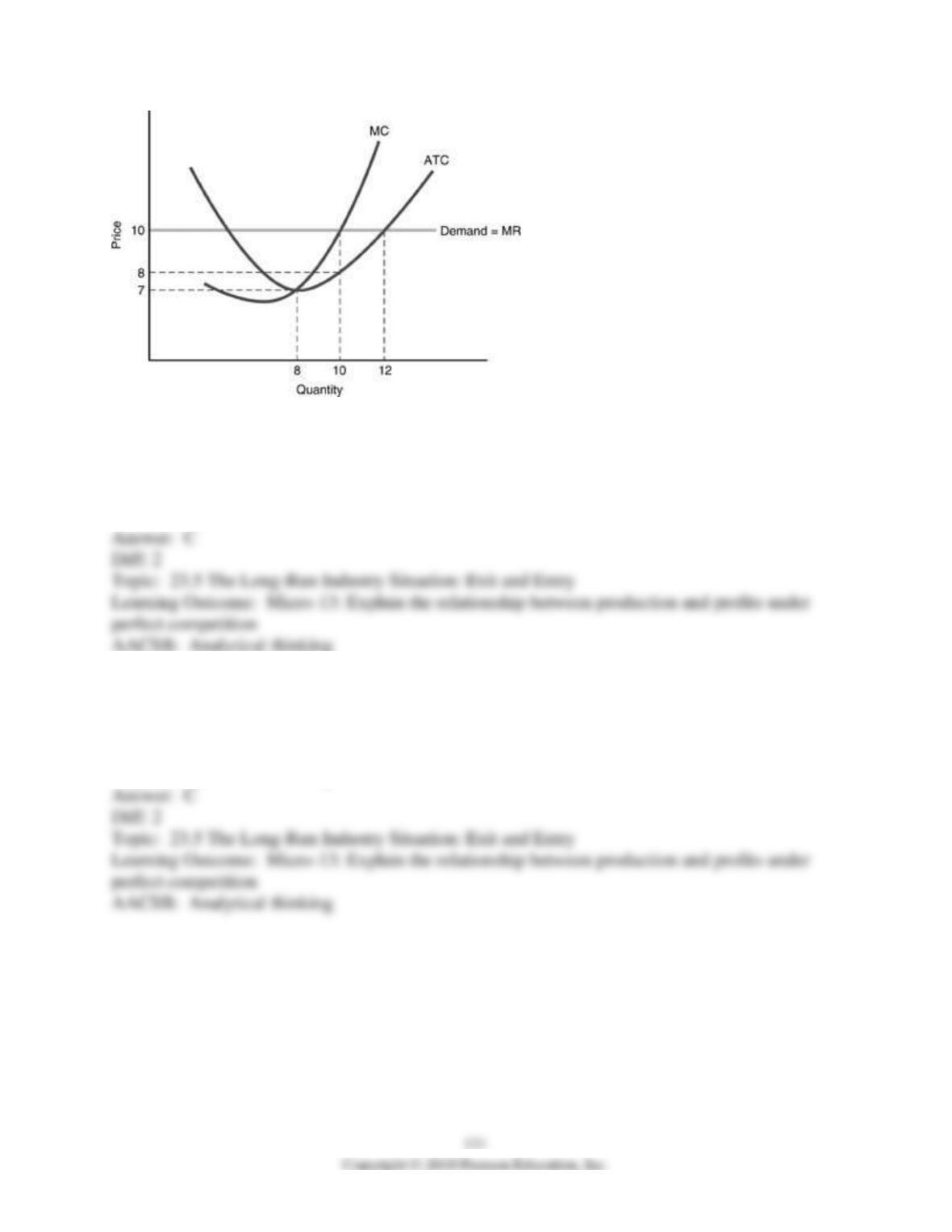
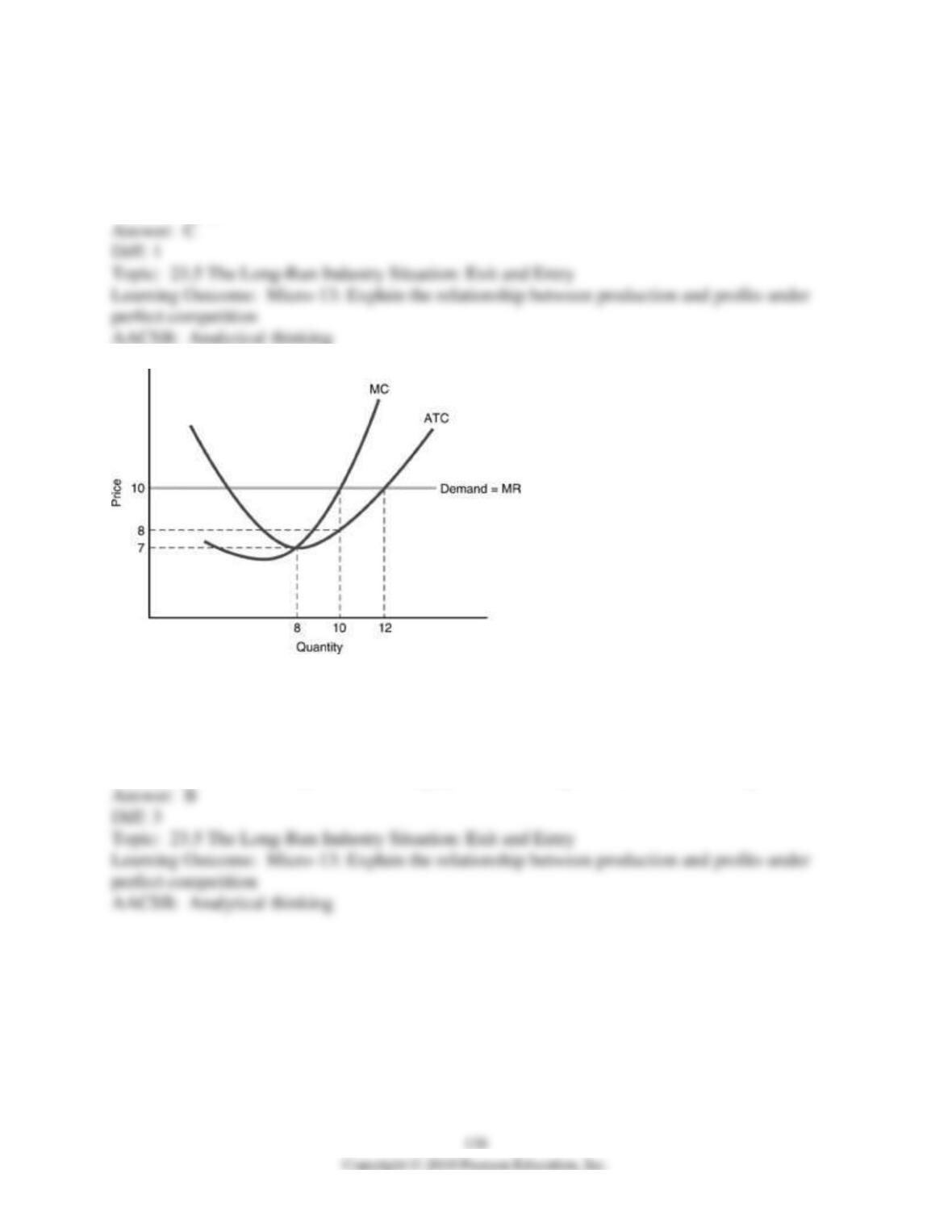
64) In the above figure, the long-run equilibrium price and output are
A) $10 and 10.
B) $10 and 12.
C) $7 and 8.
D) $8 and 10.
65) In the long run, a perfect competitor
A) earns positive profits but will not make losses.
B) earns positive economic profits.
C) earns zero economic profits.
D) produces at its shutdown point.
66) In the long run, the price for a perfectly competitive firm
A) will be determined by the firm’s supply and demand curves.
B) will allow for positive economic profits.
C) will equal marginal cost where marginal cost is at a minimum.
D) will equal the minimum average total cost.
67) Which of the following is NOT correct for a perfectly competitive firm in long-run
equilibrium?
A) SAC = LAC
B) MR = P = AR
C) MC = MR > LAC
D) LAC = P
68) Which of the following is TRUE in perfect competition at long-run equilibrium?
A) P = ATC = MC = MR
B) ATC is minimized.
C) Economic profit is $0.
D) all of the above
69) In the long run in a perfectly competitive industry
A) opportunity costs are negligible.
B) economic profits will be zero.
C) some firms will be experiencing economic losses.
D) only entrepreneurs will earn more than their opportunity costs.
70) Which of the following is NOT true for a perfectly competitive firm in the long run?
A) MR = MC
B) MC > LAC
C) Price = MC
D) SAC = LAC
71) Which of the following is NOT correct concerning perfectly competitive firms in the long
run?
A) Long-run economic profits are zero.
B) Price equals minimum long-run average cost.
C) Entrepreneurs earn the opportunity cost of their investment.
D) The opportunity cost of capital is zero.
72) In the long run, the perfectly competitive firm
A) does not have a shut down price.
B) earns only a normal profit.
C) may produce even if it suffers a loss.
D) earns an economic profit.
73) For a firm in a perfectly competitive industry
A) short-run economic profits must be zero.
B) short-run and long-run economic profits must be zero.
C) short-run economic profits may be positive, but long-run economic profits must be zero.
D) both short-run and long-run economic profits may be negative.
74) Firms in a perfectly competitive industry are producing goods efficiently in the long run if
each is producing at the minimum point of the
A) AVC curve.
B) MC curve.
C) LAC curve.
D) AFC curve.
75) In long-run equilibrium, the perfectly competitive firm will
A) go out of business.
B) produce to the point at which marginal cost is at its minimum.
C) produce to the point at which marginal cost equals average total cost.
D) produce on the upward sloping portion of its ATC curve.
76) Price equals the minimum of long-run average cost
A) in a long-run equilibrium.
B) in a short-run equilibrium as well as in a long-run equilibrium.
C) whenever average revenue equals marginal cost.
D) along a horizontal long-run supply curve, but not along an upward sloping long-run supply
curve.
77) Which of the following is NOT a characteristic of a perfectly competitive long-run
equilibrium?
A) Firms are earning zero profits.
B) Price equals marginal cost.
C) Price equals long-run minimum average cost.
D) Firms are producing on the downward sloping portions of their short-run average cost curves.