60) The short-run shutdown price occurs where price equals
A) MC.
B) AVC at any point.
C) AVC at the minimum point.
D) AFC at the minimum point.
61) When a firm has an accounting profit that is negative, it
A) will never produce output, even in the short run.
B) may still have economic profit.
C) has total revenue that is less than total cost.
D) cannot be producing where price equals marginal cost.
62) In the short run, a firm should shut down when
A) P < AVC.
B) P > MC.
C) MR > MC.
D) MR = ATC.
63) If AVC is $10 when P = MC, a firm
A) will have positive economic profits if price is greater than $10.
B) is producing too little output.
C) should shut down if price is less than $10.
D) is experiencing economies of scale.
64) A firm should never produce any output if
A) P < AVC.
B) P < ATC.
C) AR < ATC.
D) MR < MC.
65) A firm earning economic losses should operate in the short run as long as
A) the price per unit sold is greater than the average fixed cost per unit produced.
B) the price per unit sold is greater than the average variable cost per unit produced.
C) marginal revenue is at least the price per unit sold.
D) the price per unit sold is equal to or greater than the marginal cost of production.
66) A firm that shuts down in the short run experiences losses equal to its
A) total fixed costs.
B) average variable costs.
C) total variable costs.
D) total variable costs minus its total fixed costs.
67) The short-run shutdown price for a perfectly competitive firm is where price equals
A) minimum ATC.
B) AR.
C) MR.
D) minimum AVC.
68) The shutdown rule for a firm in a perfectly competitive industry is that the firm should cease
production if
A) P < MC.
B) P < ATC.
C) P < AVC.
D) P < AFC.
69) As long as price exceeds AVC, the firm is better off
A) continuing production.
B) closing.
C) raising its price.
D) cutting price.
70) A firm will shut down in the short run when
A) price is below average total costs at all possible rates of output.
B) price is below average variable costs at all possible rates of output.
C) price is below marginal cost at all possible rates of output.
D) it is making a loss.
71) In the short run, which of the following is FALSE about the shutdown point?
A) Total revenue is equal to total fixed cost.
B) Total revenue is equal to total variable cost.
C) Product price is equal to the minimum average variable cost.
D) Price multiplied by quantity must be equal to minimum average variable cost multiplied by
quantity.
72) In the short run, the price at which a firm’s total revenues equal its total costs is
A) a point of positive profits.
B) a no return price.
C) the short-run shutdown point.
D) the short-run break-even point.
73) At the short-run break-even price, the firm
A) is earning positive economic profits.
B) is earning negative economic profits.
C) is making a normal rate of return on its capital investment.
D) may be earning a positive or negative economic profit depending upon costs.
74) If price is above average total costs, the firm
A) is earning positive profits.
B) is earning negative profits.
C) is making a normal rate of return on its capital investment.
D) may be earning a positive or negative profit depending upon costs.
75) Below the short-run shutdown price, the firm
A) is earning positive economic profits.
B) is earning negative economic profits.
C) is making a normal rate of return on its capital investment.
D) may be earning a positive or negative economic profits depending upon costs.
76) A firm will continue to produce in the short run even though economic profits are negative as
long as
A) the amount of the loss is no greater than the amount of fixed cost.
B) MC = MR.
C) it earned positive economic profits last year.
D) it has fixed obligations to pay.
77) A firm that shuts down in the short run experiences losses equal to
A) zero.
B) total variable costs.
C) total fixed costs.
D) total marginal costs.
78) If there is no output for which product price is sufficient to cover variable costs
A) the firm should stay open in the short-run.
B) the firm should shut down in the short run.
C) the firm earns economic profits by staying open.
D) the firm should increase production.
79) A perfectly competitive firm faces a market clearing price of $150 per unit. Average variable
costs are at the minimum value of $200 per unit at an output rate of 100 units. Marginal cost
equals $150 per unit at an output rate of 75 units. It can be concluded that the short-run profit-
maximizing output rate is
A) 75 units, at which the firm earns zero economic profits per unit sold.
B) 75 units, at which the firm earns $50 in economic profits per unit sold.
C) 100 units, because marginal cost equals average variable costs.
D) 0 units, because price is less than average variable costs.
80) A perfectly competitive firm faces a market clearing price of $150 per unit. Average total
costs are at the minimum value of $200 per unit at an output rate of 100 units. Average variable
costs are at the minimum value of $100 per unit at an output rate of 50 units. Marginal cost
equals $150 per unit at an output rate of 75 units. It can be concluded that the short-run profit-
maximizing output rate is
A) 75 units, at which the firm earns zero economic profits per unit sold.
B) 75 units, at which the firm earns negative economic profits per unit sold.
C) 75 units, at which the firm earns positive economic profits per unit sold.
D) 50 units, because price is less than average variable costs.
81) A perfectly competitive firm faces a market clearing price of $150 per unit. Average total
costs are at the minimum value of $120 per unit at an output rate of 70 units. Marginal cost
equals $150 per unit at an output rate of 75 units. It can be concluded that the short-run profit-
maximizing output rate is
A) 75 units, at which the firm earns zero economic profits per unit sold.
B) 75 units, at which the firm earns negative economic profits per unit sold.
C) 75 units, at which the firm earns positive economic profits per unit sold.
D) 70 units, because price is less than average total costs.
82) A firm is currently producing at the point where MC = MR. The situation for the firm at this
point is P = $5, Q = 100, ATC = $6, AVC = $4.50. What do you recommend this firm do?
A) Increase production above the current output rate, because MC = MR at this rate of output.
B) Continue to produce the current output rate, because P > AVC.
C) Shut down, because AVC > P.
D) Shut down, because ATC > P.
83) A firm is currently producing at the point where MC = MR. The situation for the firm at this
point is P = $5, Q = 100, ATC = $6, AVC = $5.50. What do you recommend this firm do?
A) Increase production above the current output rate, because MC = MR at this rate of output.
B) Continue to produce the current output rate, because P > AVC.
C) Shut down, because AVC > P.
D) Shut down, because ATC > P.
84) A firm that has positive economic profits has accounting profits that are
A) zero.
B) positive.
C) negative.
D) indeterminate without more information.
85) A firm that has negative economic profits has accounting profits that are
A) zero.
B) positive.
C) negative.
D) indeterminate without more information.
86) When a firm has economic profits equal to zero
A) the firm is earning a normal rate of return on investment.
B) the firm is not earning a normal rate of return on investment.
C) the firm should shut down.
D) the firm’s accounting profits are also zero.
87) When a firm is at its short-run break-even point
A) economic profits are positive.
B) economic profits equal zero and the firm should shut down.
C) economic profits equal zero and the firm is earning a nominal rate of return on investment.
D) economic profits are negative but the firm should continue to produce because accounting
profits are positive.
88) The owner of a perfectly competitive firm that is earning economic losses in the short run
A) should alter the rate of output in order to increase profitability.
B) should cut his own salary in order to reach the break-even point.
C) is actually losing more than he thinks because not all of the implicit costs have been
considered.
D) is earning less than he would if he worked for someone else.
89) The owner of a perfectly competitive firm is currently earning an economic profit of zero.
This owner
A) should shut down since profits of zero are not good.
B) should raise the price of the product to increase profits.
C) is covering all of his fixed costs.
D) will continue producing in the short-run but will shut down in the long run if profits do not
increase.
90) In the short run, in a perfectly competitive market, a firm will shut down if
A) P < AVC for all levels of output.
B) P < ATC for all levels of output.
C) ATC > P > AVC for all levels of output.
D) P > AFC for all levels of output.
91) For a perfectly competitive firm facing the short-run break-even price
A) it has a negative accounting profit.
B) it has an economic profit of zero.
C) it should shut down.
D) it should expand production.
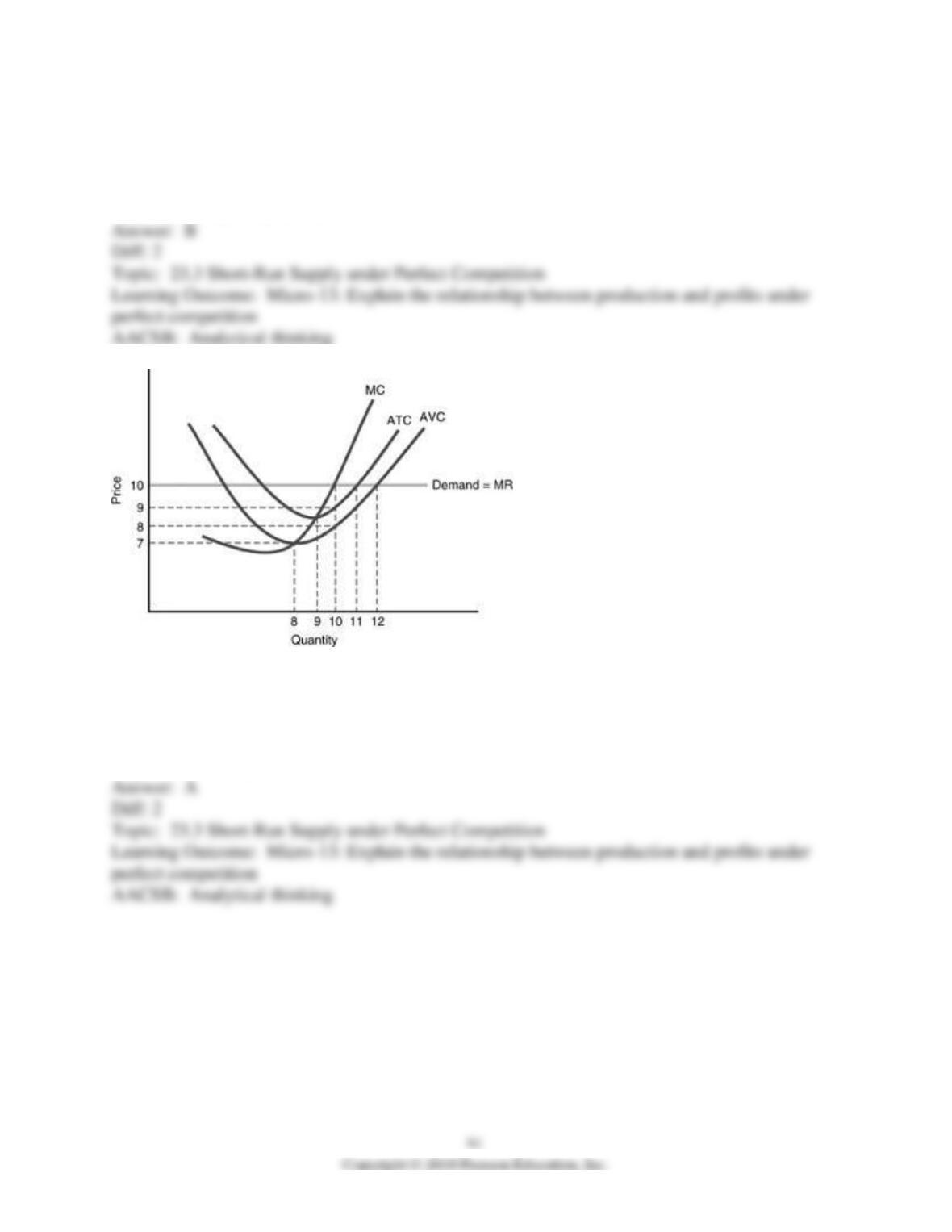
92) In the above figure, if the market price is $10, the firm
A) produces 10 units.
B) produces 12 units.
C) shuts down operations.
D) produces 11 units.
93) In the above figure, if the market price is less than $7, the firm
A) produces 10 units.
B) produces 8 units.
C) produces 0 units.
D) produces 11 units.
94) In the above figure, if the market price is $8, the firm
A) continues to produce but at an economic loss.
B) continues to produce but at an economic profit.
C) shuts down operations.
D) produces 10 units.
95) The short-run break-even price is
A) the price at which a firm’s total revenues exceed total costs.
B) the point at which the firm’s total costs are maximized.
C) the price at which a firm’s total revenues equal its total costs.
D) the point at which the firm’s implicit costs are maximized.
96) If a firm shuts down in the short run
A) it will lose its operating costs.
B) its losses will be equal to zero.
C) it will incur its fixed costs.
D) it will incur only its explicit costs.
97) Suppose the price of an item in a perfectly competitive market is $2. For a firm in this
market, MC = MR at an output of 100 units. The average total cost at this output level is $4 per
unit, and TVC is $80. We may conclude that
A) the firm should shut down because TC > TR.
B) the firm should continue to produce because P>AVC.
C) the firm should shut down because its TFC is $320 and its TC is $400.
D) the firm should shut down because other firms will enter the industry as the market is
perfectly competitive.
98) Suppose a perfectly competitive firm can produce 20,000 bushels of corn a year at an output
at which marginal cost equals marginal revenue. The market price of corn per bushel is $1.00.
The firm’s total costs per year are $50,000 and fixed costs per year are $25,000. In the short run,
this firm should
A) shut down.
B) continue producing until the price of corn increases.
C) produce 20,000 bushels of corn because, although they are losing money, they are losing less
than if they shut down.
D) produce 40,000 bushels to try to increase economic profit.
99) Suppose a perfectly competitive firm can produce 20,000 bushels of corn a year at an output
at which marginal cost equals marginal revenue. The market price of corn per bushel is $2.00.
The firm’s total costs per year are $50,000 and fixed costs per year are $25,000. In the short run,
this firm should
A) shut down.
B) continue producing until the price of corn increases.
C) produce 20,000 bushels of corn because, although they are losing money, they are losing less
than if they shut down.
D) produce 40,000 bushels to try to increase economic profit.
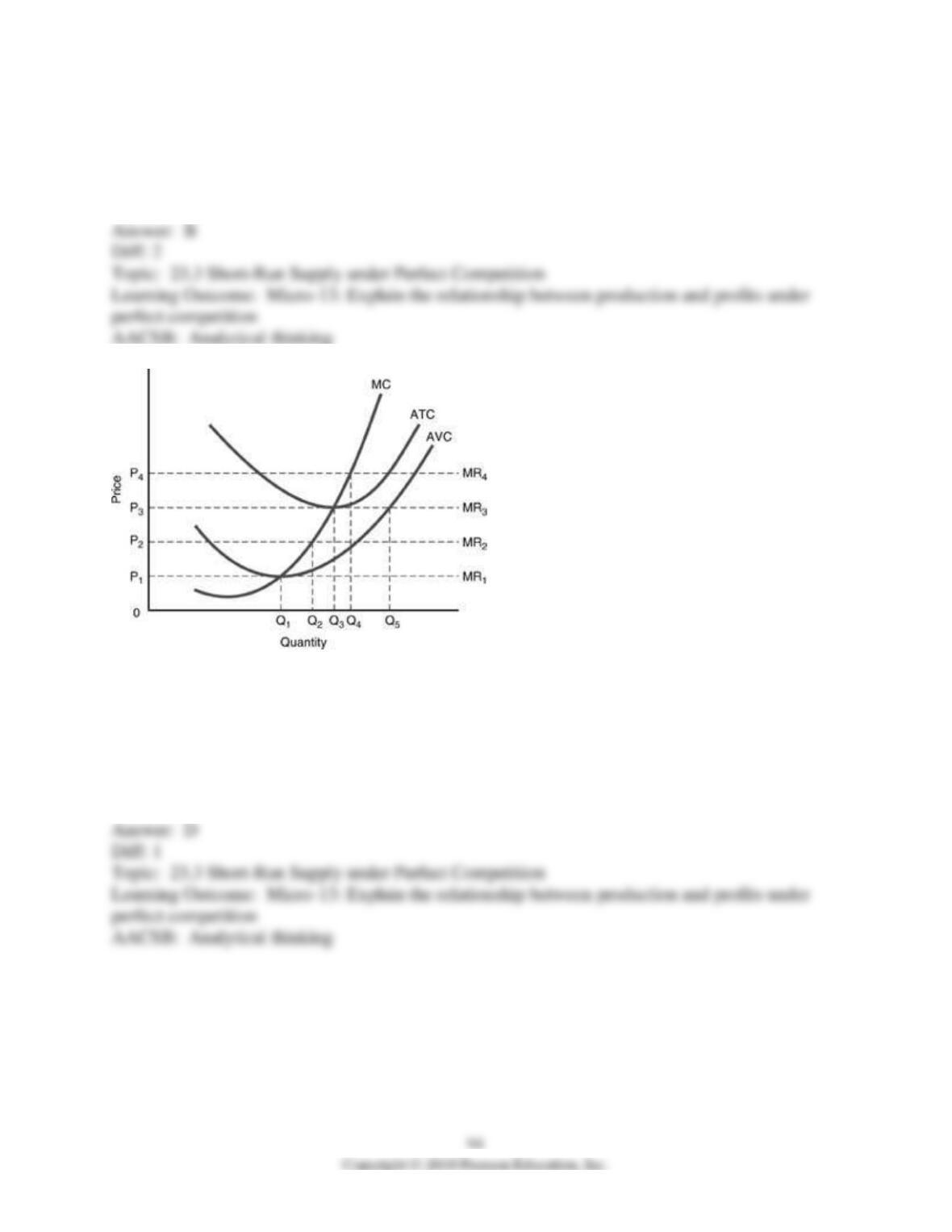
100) The break-even price for a perfectly competitive firm is the price that is equal to
A) AVC.
B) ATC.
C) MC.
D) MR
101) Using the above figure, the perfectly competitive firm in the diagram will earn an economic
profit if the market price is
A) P1.
B) P2.
C) P3.
D) P4.
102) Using the above figure, the perfectly competitive firm should shut down if the market price
is below
A) P1.
B) P2.
C) P3.
D) P4.
103) Using the above figure, the short-run break-even price for the perfectly competitive firm
will be
A) P1.
B) P2.
C) P3.
D) P4.
104) Which of the following could generate economic profits for perfectly competitive firms in
the short run, if they initially earn zero economic profits?
A) a fall in demand
B) a unit tax on output
C) an increase in total fixed costs
D) a decrease in input prices
105) A firm is currently producing an output at which price equals the minimum point on the
average variable cost curve. If wage rates increase, the firm will
A) increase its rate of output to make up for the higher variable costs.
B) shut down since it would no longer be covering its variable costs.
C) decrease its rate of output to offset the higher variable costs.
D) not make any changes since its current rate of output is still minimizing its losses.
106) The perfectly competitive seller’s short-run supply curve is
A) its entire marginal cost curve.
B) its marginal revenue curve.
C) the part of its marginal cost curve above the average variable cost curve.
D) the part of its marginal cost curve above the average total cost curve.
107) The rising portion of a perfectly competitive firm’s marginal cost curve, above the
intersection with AVC, is its
A) demand curve.
B) economic profit.
C) supply curve.
D) accounting profit.
108) In a perfectly competitive market, a firm’s short-run supply curve is
A) its total cost curve.
B) its marginal cost curve equal to or above the point of intersection with its average variable
cost curve.
C) its average variable cost curve below the point of intersection with its total cost curve.
D) its total cost curve between the shutdown point and the break-even point.
109) If price is below average variable costs at all rates of output, the quantity supplied by a
perfectly competitive firm will equal
A) zero.
B) the rate of output where price equals marginal cost.
C) the rate of output associated with the break-even point.
D) the rate of output where marginal revenue equals average fixed costs.
110) Assuming fixed factor prices, the short-run industry supply curve for a perfectly
competitive industry is equal to the sum of the
A) AVC curves above minimum AVC.
B) ATC curves above minimum ATC.
C) MC curves above minimum AVC.
D) MC curves above minimum ATC.
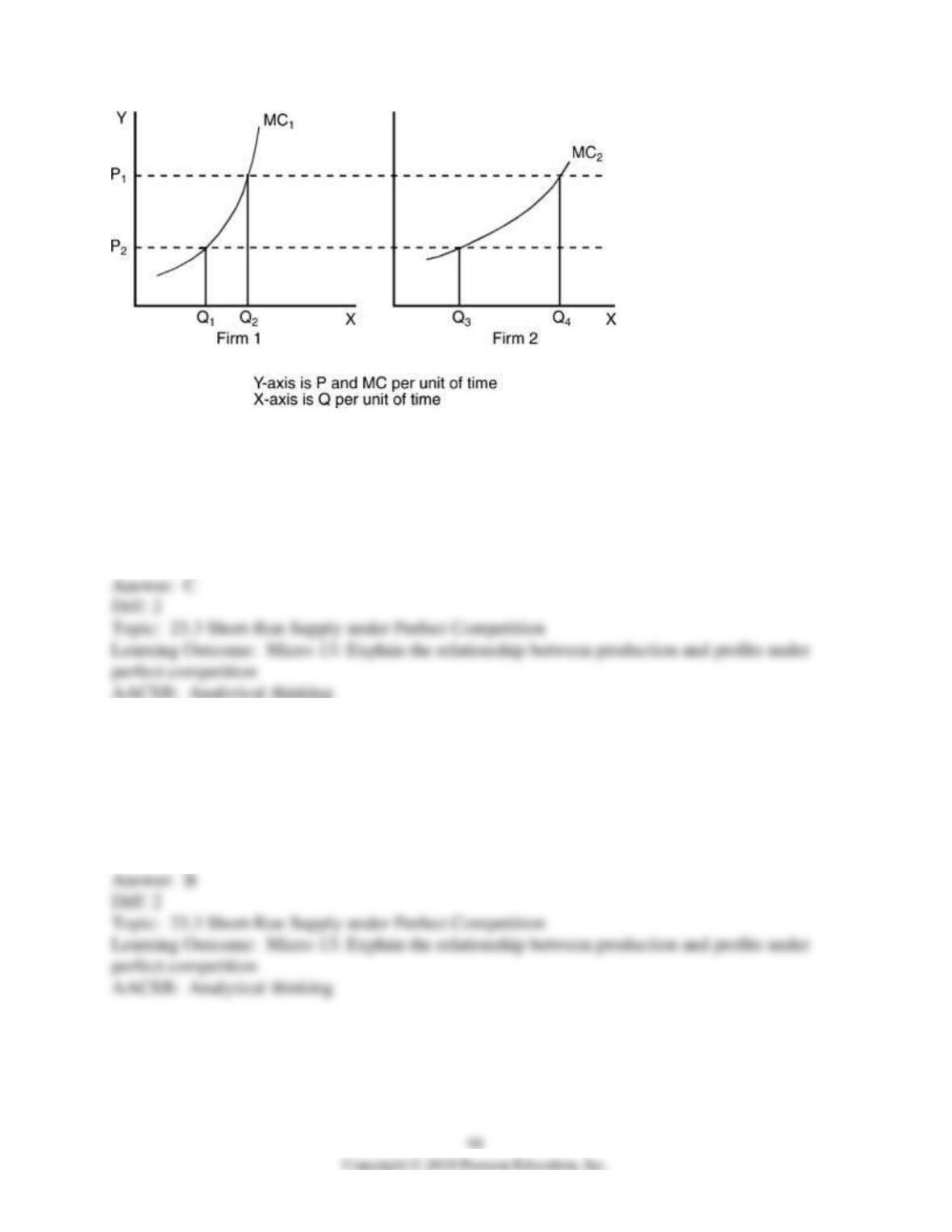
111) In the above figure, assuming Firm 1 and Firm 2 are the sole producers in the industry, the
industry quantity supplied at price P1 is equal to
A) Q1 + Q2.
B) Q1 + Q3.
C) Q2 + Q4.
D) Q4 – Q2.
112) In the above figure, assuming Firm 1 and Firm 2 are the sole producers in the industry, the
industry quantity supplied at price P2 is equal to
A) Q1 + Q2.
B) Q1 + Q3.
C) Q2 + Q4.
D) Q4 – Q2.
113) A perfectly competitive industry’s short-run supply curve is best described as
A) the upward sloping portion of the industry’s marginal cost curve.
B) horizontal.
C) perfectly inelastic.
D) the horizontal summation of the individual firms’ supply curves.
114) The short-run supply curve of a perfect competitor is
A) its average variable cost curve.
B) its marginal revenue curve.
C) its entire marginal cost curve.
D) its marginal cost curve equal to or above the minimum point on its average variable cost
curve.
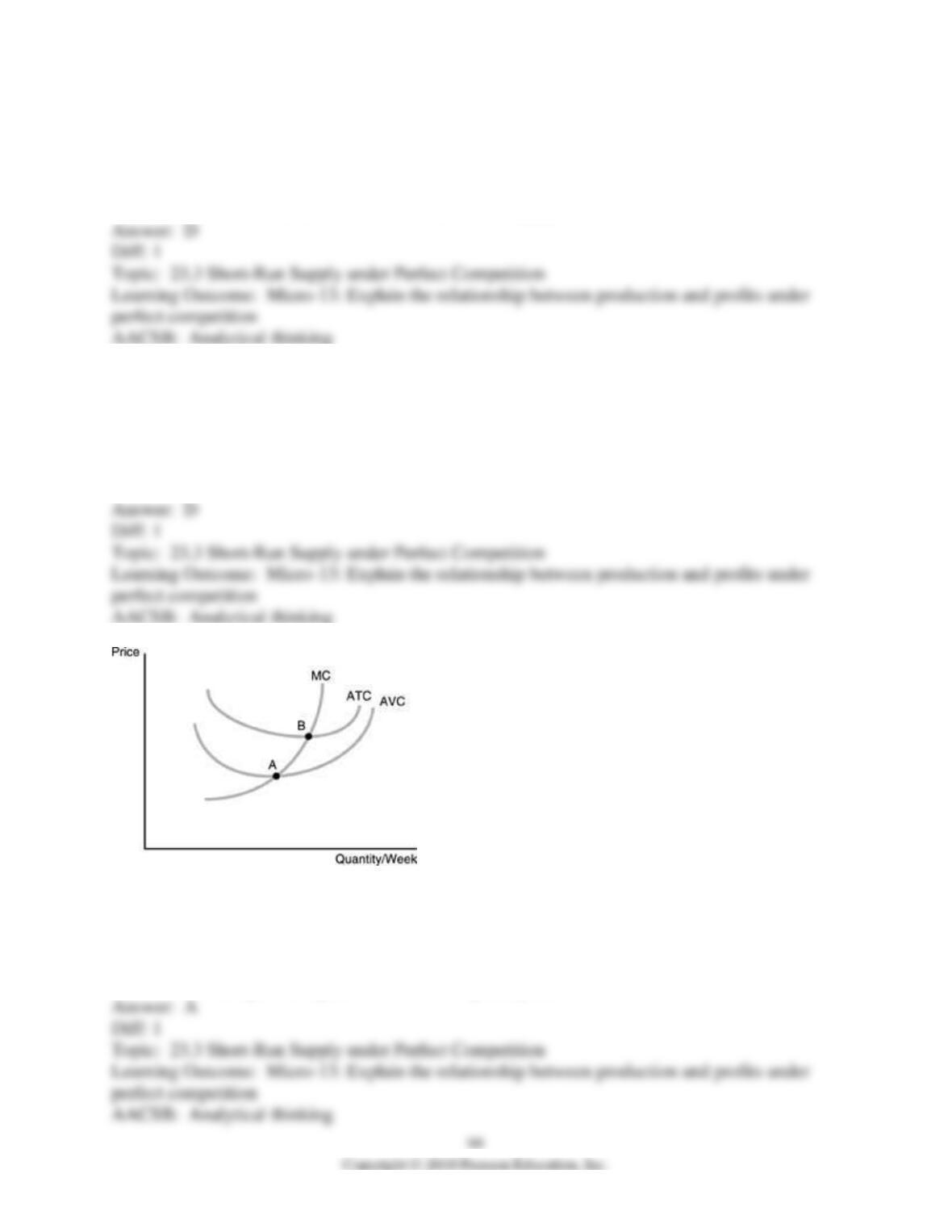
115) Refer to the above figure. The competitive firm’s short run supply curve
A) starts at A and goes along the MC curve as quantity increases.
B) starts at B and goes along the MC curve as quantity increases.
C) starts at A and goes along the AVC curve as quantity increases.
D) starts at B and goes along the ATC curve as quantity increases.
116) A perfectly competitive firm is producing zero units of output in the short run. We know
that price is
A) below the minimum point of its average fixed cost curve.
B) below the minimum point of its average variable cost curve.
C) below the minimum point of its average total cost curve.
D) between the minimum points of its average total cost curve.
117) The short-run industry supply curve is found by
A) taking the inverse of the industry demand curve.
B) horizontally summing the average total cost curve of all firms in the industry.
C) adding up the quantities supplied at each price by each firm in the industry.
D) adding up the quantities supplied at each price by each of the firms in the industry that are
making a profit.
118) The short-run industry supply curve slopes up because
A) the firms eventually experience diseconomies of scale.
B) the law of diminishing marginal product applies in the short run.
C) wages increase as the industry increases output.
D) the higher price is needed to get more firms to enter the industry.