Macroeconomics: Policy and Practice, 2e (Mishkin)
Chapter 22 Modern Business Cycle Theory
22.1 Real Business Cycle Model
1) The New Keynesian model, is Keynesian in that ________.
A) it assumes wages and prices are sticky
B) changes in the money supply are taken to be the single most important influence on business
movements
C) the velocity of money is a constant
D) expectations are assumed to be rational
2) The real business cycle model begins with the assumption that ________.
A) wages and prices are sticky
B) wages and prices are completely flexible
C) the velocity of money is a constant
D) nominal variables are superior to real variables in describing economic activity
3) Among the pioneers of real business cycle theory is ________.
A) Edward Prescott
B) Robert Lucas
C) Robert Solow
D) Paul Volcker
4) The complete wage and price flexibility of the real business cycle framework implies that
________.
A) the velocity of money is a constant
B) the velocity of money times the money supply is equal to the nominal value of transactions
over a given period of time
C) aggregate output always equals potential output
D) sustained economic contractions, like the Great Depression, cannot occur in real, historical
time
2
5) In real business cycle models, a change in willingness to work ________.
A) is associated with productivity shocks
B) causes a shift of the aggregate demand curve
C) would violate the market-clearing assumption
D) has no effect on potential output
6) In real business cycle models, shifts of the aggregate demand curve ________.
A) cause changes in inflation, but have no effect on output
B) cannot occur
C) result from changes in the willingness to work
D) result from Solow residuals
7) The primary source of shocks to potential output and long-run supply for real business cycle
theorists is ________.
A) changes in the money supply
B) a change in the price of complements
C) a change in any of the components of aggregate demand
D) shocks to productivity
8) Which of the following would be considered a negative real supply shock?
A) a relaxation of government environmental regulations
B) a permanent increase in the price of energy
C) a decrease in the money supply
D) a decrease in aggregate demand
9) Which of the following would be considered a negative real supply shock?
A) an increase in expected inflation
B) a disruption of financial markets
C) a decrease in government spending
10) In the real business cycle model, the short-run aggregate supply curve is always the same as
________.
A) long-run aggregate supply
B) the long-run aggregate demand schedule
C) the velocity of money
D) the real rate of interest
11) According to the real business cycle model, a rightward shift in the long-run aggregate
supply schedule would be caused by ________.
A) a negative supply shock
B) an increase in aggregate demand
C) a positive supply shock
D) a decrease in aggregate demand
12) Solow residuals are estimates of ________.
A) deadweight loss
B) the natural rate of unemployment
C) aggregate productivity
D) labor hoarding
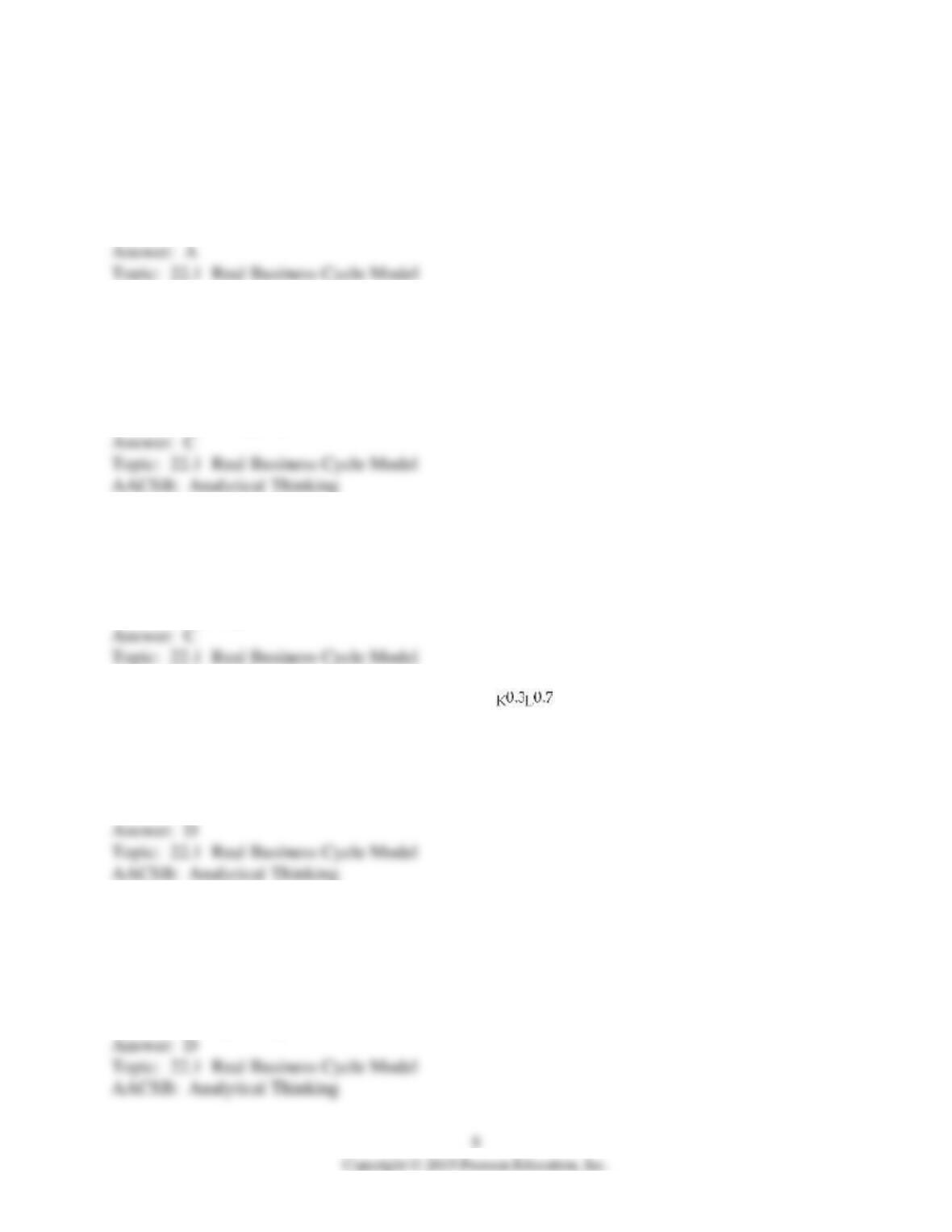
13) Given the aggregate production function Y = A , the Solow residual equals ________
when Y is 60, K = 5 and L = 5.
A) 2.4
B) 35
C) 25
D) 12
14) If output begins to grow substantially faster than capital and labor inputs, then the real
business cycle model predicts, ceteris paribus, ________.
A) an increase in inflation
B) a decrease in employment
C) a decrease in investment
D) a business cycle expansion
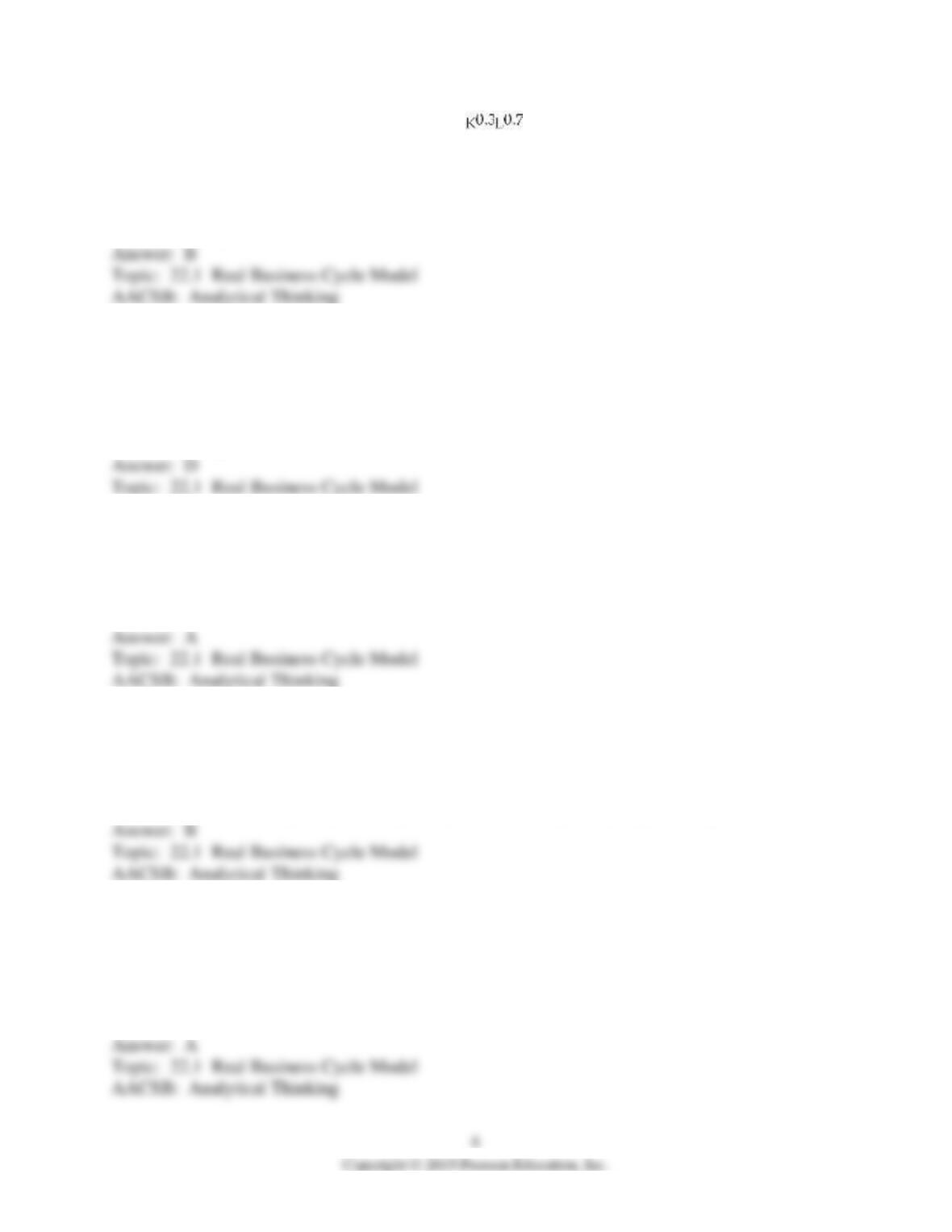
15) In the aggregate production function Y = A , real business cycle theory treats
________ as the key independent variable.
A) potential output
B) productivity
C) the capital stock
D) the labor input
16) Real business cycle theorists take the comovement of aggregate output and Solow residuals
as strong confirmation that economic fluctuations are caused by ________.
A) changes in aggregate demand
B) changes in the money supply
C) changes in the rate of inflation
D) productivity shocks
17) During business contractions, the growth rate of Solow residuals is ________.
A) near or below zero
B) well above zero
C) approaching infinity
D) impossible to calculate
18) In the real business cycle model, fluctuations in employment are explained by ________.
A) changes in the composition of household assets
B) intertemporal substitution as real wages and real interest rates changes
C) changes in the marginal propensity to consume
D) the impact of a change in price on quantity demand and quantity supplied in goods markets
19) According to real business cycle theory, a likely cause of an increase in employment is
________.
A) an increase in the real wage
B) an increase in aggregate demand
C) a decrease in the real wage
D) a decrease in the real interest rate
20) In the real business cycle model, unemployment is ________.
A) costless to individual workers
B) the result of higher productivity
C) voluntary
D) the result of higher wages
21) Critics of real business cycle analysis suggest that the persuasiveness of the model may be
limited by the existence of ________.
A) flexible wages and prices
B) rising wages
C) voluntary unemployment
D) labor hoarding
22) If workers sit idly by for a portion of their workday, but are still employed, firms may be
engaged in ________.
A) intertemporal substitution
B) voluntary unemployment
C) labor hoarding
D) real business
23) If workers sit idly by for a portion of their workday, but are still employed, ________.
A) the negative productivity shock has no effect on output
B) it is unlikely that a decrease in aggregate demand is the cause
C) aggregate data may create a false illusion of a negative productivity shock
D) a negative productivity shock is the most plausible explanation
24) Critics of real business cycle theory doubt the plausibility of ________.
A) intertemporal substitution
B) negative productivity shocks
C) adaptive expectations
D) a trade-off between work and leisure
25) The real business cycle model suggests that, with aggregate demand unchanged, increases in
output would be associated with ________.
A) an increase in inflation
B) a decline in inflation
C) and unchanged price level
D) procyclical inflation
26) According to real business cycle theory, an increase in financial frictions might lead to
________, if ________.
A) a decrease in output; the rise in the credit spread causes a leftward shift of aggregate demand
B) a decrease in inflation; the disruption of capital markets results in a leftward shift of long-run
aggregate supply
C) a decrease in output; the disruption of capital markets results in a leftward shift of long-run
aggregate supply
D) a decrease in output; a decline in expected output causes a leftward shift of aggregate demand
27) Use the concept of intertemporal substitution to explain how, in real business cycle models, a
change in potential output causes an immediate change in actual output.
28) How might a real business cycle theorist explain the “Volcker recession” of the early 1980s?
29) How might real business cycle theorists respond to evidence of procyclical inflation?
22.2 New Keynesian Model
1) The new Keynesian model has ________ in common with the real business cycle model.
A) wage and price stickiness
B) a theory of aggregate demand
C) procyclical inflation
D) a microeconomic foundation
2) In the new Keynesian model, sticky prices may be due to ________.
A) involuntary unemployment
B) negative productivity shocks
C) positive productivity shocks
D) staggered prices
3) In the new Keynesian model, expected inflation is a function of ________.
A) expected future output gaps and markup shocks
B) current and past inflation
C) unanticipated aggregate demand shocks
D) expected growth of the money supply
4) The standard IS curve is adjusted in new Keynesian theory to account for ________.
A) the forward-looking behavior of households and firms
B) the difference between real and nominal variables
C) changes in GDP, or Gross Domestic Product
D) the impact of a rising national debt
5) In the new Keynesian model, an increase in productivity will cause ________.
A) a leftward shift in short-run and long-run aggregate supply
B) a rightward shift in short-run and long-run aggregate supply
C) a leftward shift in short-run aggregate supply and rightward shift in long-run aggregate supply
D) a rightward shift in short-run aggregate supply and a leftward shift in long-run aggregate
supply
6) In the new Keynesian model, an ________ increase in productivity will impact ________.
A) unanticipated; both aggregate demand and aggregate supply
B) anticipated; both aggregate demand and aggregate supply
C) anticipated; aggregate demand, but not aggregate supply
D) unanticipated; aggregate demand, but not aggregate supply
7) Shocks to long-run aggregate supply can be a source of business fluctuations ________.
A) only in real business cycle models
B) only in new Keynesian models
C) in both real business cycle and new Keynesian models
D) only if the money supply rises
8) In the new Keynesian model, a positive, permanent supply shock will result in ________.
A) an increase in aggregate demand
B) a decrease in aggregate demand
C) no change in aggregate demand
D) a change in aggregate demand, only if the shock is anticipated
9) In the new Keynesian model, if an aggregate demand increase is unanticipated, then
________.
A) aggregate demand will not change
B) short-run aggregate supply will shift up immediately
C) short-run aggregate supply will shift down immediately
D) there is no immediate effect on the short-run supply curve
9
10) In the new Keynesian model, if an aggregate demand increase is anticipated, then ________.
A) aggregate demand will not change
B) short-run aggregate supply will shift up immediately
C) short-run aggregate supply will shift down immediately
D) there is no immediate effect on the short-run supply curve
11) In the new Keynesian model, if an aggregate demand increase is unanticipated, then
________.
A) aggregate demand will not change
B) short-run aggregate supply will shift up immediately
C) short-run aggregate supply will shift down immediately
D) there is no immediate effect on expectations about future inflation
12) In the new Keynesian model, the effects on output of an anticipated aggregate demand shock
are ________.
A) less than if that event was unanticipated
B) greater than if that event was unanticipated
C) the same as would develop if that event was unanticipated
D) independent of whether or not that event is anticipated or unanticipated
13) In the new Keynesian model, the immediate effect on inflation of an anticipated aggregate
demand shock is ________.
A) less than if that event was unanticipated
B) greater than if that event was unanticipated
C) the same as would develop if that event was unanticipated
D) independent of whether or not that event is anticipated or unanticipated
14) In the new Keynesian model, the ultimate effect on inflation of an anticipated aggregate
demand shock is ________.
A) less than if that event was unanticipated
B) greater than if that event was unanticipated
C) the same as would develop if that event had never occurred
D) independent of whether or not that event is anticipated or unanticipated
15) In the new Keynesian model, the ultimate effect on output of an anticipated aggregate
demand shock is ________.
A) less than if that event was unanticipated
B) greater than if that event was unanticipated
C) the same as would develop if that event had never occurred
D) dependent on whether or not that event is temporary or permanent
16) Research supporting the new Keynesian model finds that prices are ________.
A) slow to adjust to aggregate demand shocks
B) changed very frequently
C) changed only infrequently
D) not as flexible as wages
17) Suppose a tax cut that had been anticipated by households and businesses doesn’t happen.
Describe a new Keynesian analysis of the consequences of this “event.”
18) In the long run, does it matter whether a policy action was anticipated or not?
22.3 A Comparison of Business Cycle Models
1) Expectations are adaptive in ________.
A) traditional Keynesian models
B) the Lucas Model
C) new Keynesian theory
D) the real business cycle model
2) Expectations are taken to be rational in ________.
A) traditional Keynesian and new Keynesian theory
B) new Keynesian and real business cycle theory
C) real business cycle and traditional Keynesian theory
D) traditional Keynesian, new Keynesian and real business cycle theory
3) The three business cycle models differ mostly in their treatment of ________.
A) aggregate demand
B) short-run aggregate supply
C) long-run aggregate supply
D) productivity shocks
4) ________ highlights the importance of fiscal policy as a determinant of good macroeconomic
performance.
A) The real business cycle model
B) The traditional Keynesian model
C) The new Keynesian model
D) Rational expectations
5) Long-run aggregate supply shocks are a source of business cycle fluctuations in ________.
A) traditional Keynesian and new Keynesian theory
B) new Keynesian and real business cycle theory
C) real business cycle and traditional Keynesian theory
D) traditional Keynesian, new Keynesian and real business cycle theory
6) Long-run aggregate supply shocks are not a source of business cycle fluctuations in the
________, because ________.
A) traditional Keynesian model; long-run supply shocks are incompatible with adaptive
expectations
B) traditional Keynesian model; demand fluctuations are considered of dominant importance
C) real business cycle model; shocks cannot persist in the long run, when prices and wages are
flexible
D) new Keynesian model; such shocks are anticipated by forward-looking consumers and firms
7) A belief that demand shocks are an important source of business cycle fluctuations implies a
preference of ________.
A) the new Keynesian model over the traditional Keynesian model
B) the real business cycle model over the traditional Keynesian model
C) the real business cycle model over the new Keynesian model
D) the new Keynesian model over the real business cycle model
8) Prices are regarded as sticky in ________.
A) new Keynesian and traditional Keynesian theory
B) real business cycle and new Keynesian theory
C) real business cycle and traditional Keynesian theory
D) traditional Keynesian, new Keynesian and real business cycle theory
9) Price flexibility is a key feature of ________.
A) traditional Keynesian theory
B) new Keynesian theory
C) real business cycle theory
D) traditional Keynesian, new Keynesian and real business cycle theory
10) Discretionary economic policy is not beneficial in the ________.
A) traditional Keynesian theory
B) new Keynesian theory
C) Luka Brazzi model
D) real business cycle theory
11) Credibility is important to successful anti-inflationary policy in ________.
A) new Keynesian theory
B) traditional Keynesian theory
C) real business cycle theory
D) post classical theory
12) Credibility is not important in ________.
A) new Keynesian and traditional Keynesian theory
B) real business cycle and traditional Keynesian theory
C) real business cycle and new Keynesian theory
D) traditional Keynesian, new Keynesian and real business cycle theory
13) The level of income is unchanged in response to unanticipated anti-inflation policy in
________.
A) real business cycle theory
B) traditional Keynesian theory
C) new Keynesian theory
D) post classical theory
14) The level of income is unchanged in response to anticipated anti-inflation policy in
________.
A) real business cycle theory
B) traditional Keynesian theory
C) new Keynesian theory
D) post classical theory
15) In macroeconomic modelling, as price flexibility increases ________.
A) the short-run aggregate supply schedule will get flatter
B) the short-run aggregate supply schedule will get steeper
C) the short-run aggregate supply schedule will shift to the right
D) the short-run aggregate supply schedule will shift to the left
16) Expansionary policy only leads to inflation, but does not raise output in ________.
A) traditional Keynesian theory
B) new Keynesian theory
C) real business cycle theory
D) traditional Keynesian, new Keynesian and real business cycle theory
17) The management of expectations has increased in importance in policymaking in recent
decades with the rise of ________.
A) traditional Keynesian theory
B) institutionalist theory
C) torsion theory
D) new Keynesian theory
18) No distinction is made between the effects of anticipated and unanticipated policy in
________.
A) traditional Keynesian theory
B) new Keynesian theory
C) real business cycle theory
D) traditional Keynesian and real business cycle theory
19) Reductions in inflation have no cost in terms of lower output in ________.
A) traditional Keynesian theory
B) new Keynesian theory
C) real business cycle theory
D) traditional and new Keynesian theory
20) Anti-inflationary policy is less costly when that policy is anticipated in ________.
A) traditional Keynesian theory
B) new Keynesian theory
C) real business cycle theory
D) institutionalist theory
21) The possibility that unanticipated policy changes are an important source of output
fluctuations is most consistent with ________.
A) traditional Keynesian theory
B) new Keynesian theory
C) real business cycle theory
D) institutionalist theory
22) Suppose the U.S. government announces that it will bring the federal budget deficit to zero,
over the next ten years, with no change in tax rates. Describe the effects of such a policy
according to the three business cycle models, assuming that the policy is fully credible.
23) How do the new Keynesian and real business cycle models differ on the ability of
inflationary expectations to affect output?
24) As the U.S. economy recovers from the recession of 2007-2009, stubbornly high
unemployment is a concern. For each of the three business cycle models, identify the appropriate
policy regime.
25) What insights into the macroeconomic consequences of financial frictions arise from the new
22.4 Web Appendix: The New Classical Model
1) In the new classical model, all wages and prices ________.
A) are completely flexible with respect to expected changes in the price level
B) are fixed with respect to expected changes in the price level
C) are flexible with respect to the value of the dollar
D) are fixed with respect to the money supply
2) In the new classical model, workers and firms try to keep their real wages and relative prices
from falling when ________.
A) income falls
B) they expect inflation to rise
C) they expect inflation to fall
D) they expect aggregate demand to fall
17
3) The policy ineffectiveness proposition of the new classical model suggests that ________.
A) unanticipated policy has no effect on the business cycle
B) anticipated policy can have an effect on the business cycle
C) anticipated policy has no effect on the business cycle
D) legislative policy initiatives have little effect if the executive branch of government is in the
hands of another political party
4) Which of the following demonstrates that policymakers cannot know the outcome of their
decisions without knowing the public’s expectations of them?
A) traditional Keynesian theory
B) Post Keynesian theory
C) real business cycle theory
D) new classical theory
5) One of the primary objections to the new classical model is that ________.
A) firms could easily get information about price movements and so would not be fooled for
very long
B) price is negatively related to quantity demanded, but positively related to quantity supplied
C) business cycles are relatively brief in duration
D) it failed to incorporate rational expectations into its presentation