81) In the above table, when output is 8 units, average variable costs are
A) $4.75.
B) $3.50.
C) $1.25.
D) $4.50.
82) In the above table, when output is 8 units, average total costs are
A) $4.75.
B) $3.50.
C) $38.
D) $28.
83) In the above table, the marginal cost of the ninth unit is
A) $4.00.
B) $5.00.
C) $6.00.
D) $7.00.
84) In the above table, the marginal cost of the fourth unit is
A) $1.00.
B) $2.00.
C) $6.00.
D) $24.00.
85) In the above table, the marginal cost of the seventh unit is
A) $4.00.
B) $5.00.
C) $3.00.
D) $33.00.
86) Marginal cost is equal to average variable cost
A) when average variable cost is at its minimum value.
B) when marginal cost is at its minimum value.
C) when average variable cost is getting smaller.
D) when average variable cost is getting larger.
87) The ratio of total costs to the quantity produced is referred to as
A) average fixed costs.
B) average variable costs.
C) marginal costs.
D) average total costs.
88) As a firm continues to produce additional output, which of the following will continue to
decline as output expands?
A) average total costs
B) marginal costs
C) average fixed costs
D) opportunity costs
89) The addition to total costs associated with the production of one more unit of output is
referred to as
A) average cost.
B) marginal cost.
C) opportunity cost.
D) overhead cost.
90) The marginal cost curve always intersects the average total cost curve at the point at which
the average total cost curve
A) is zero.
B) is at its minimum.
C) is at its maximum.
D) has a vertical slope.
91) Which of the following is NOT correct?
A) MC = change in TC/change in Q
B) ATC = TC/Q
C) AVC = TVC/Q
D) ATC + AVC = AFC
92) Total fixed cost is
A) the cost of buying and installing new machinery.
B) the cost that does not change as output changes.
C) the expenditure on imported raw materials.
D) the wages paid to consultants.
93) Which of the following would be an example of a fixed cost?
A) the electric and gas bills
B) wages paid to temporary workers
C) property insurance premiums
D) expenditures on imported raw materials
94) The average fixed cost curve
A) is parallel to the x-axis.
B) is the distance between the TC and TVC curves.
C) slopes downward as output increases.
D) increases as the cost of inputs rise.
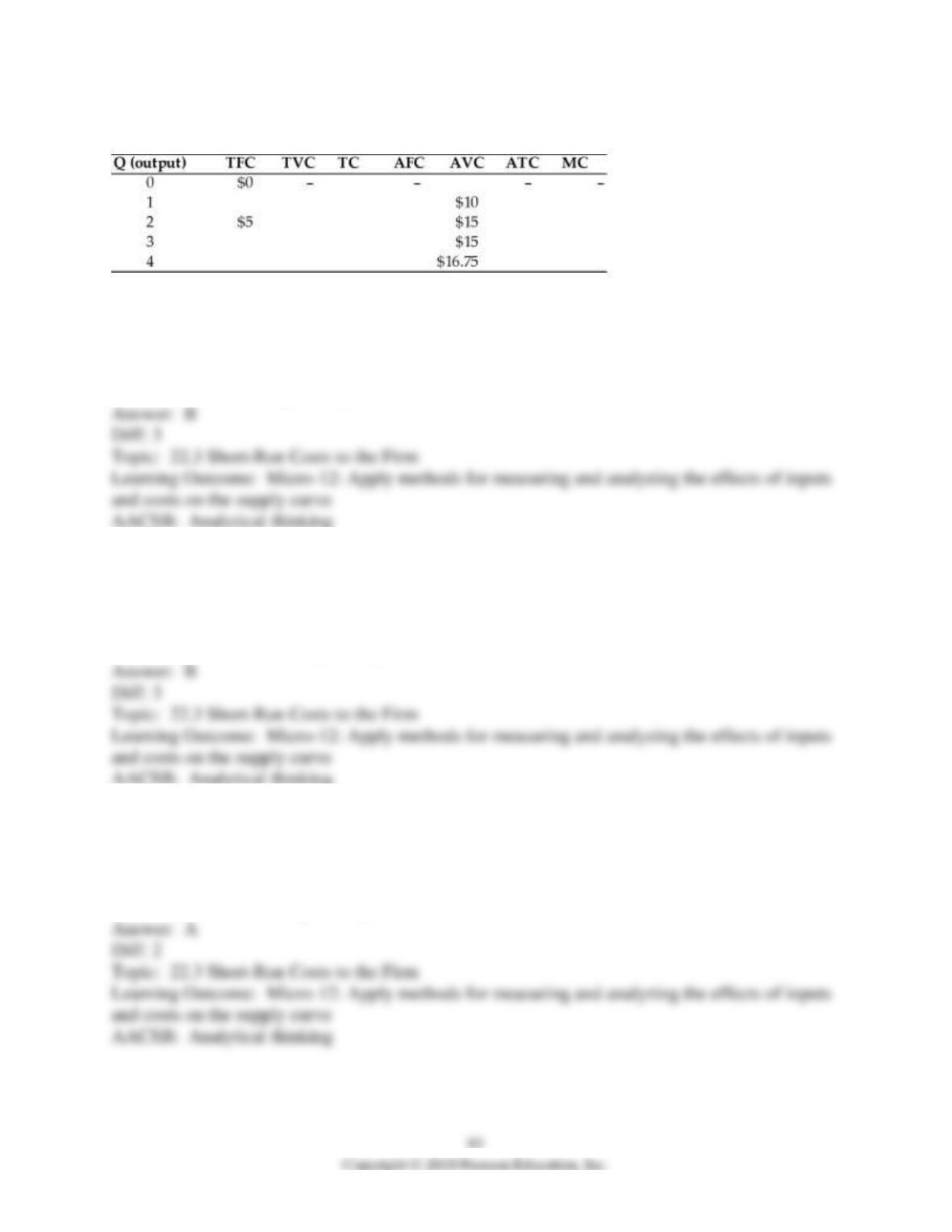
95) Using the above table, the AFC, the AVC, and the ATC when output is 1 unit are
A) $10, $10, and $20, respectively.
B) $5, $10, and $15, respectively.
C) $0, $10, and $10, respectively.
D) $5, $10, and $5, respectively.
96) Using the above table, the TC, the AFC, and the TVC when output is 2 units are
A) $20, $2.50, and $15, respectively.
B) $35, $2.50, and $30, respectively.
C) $30, $2.50, and $40, respectively.
D) $35, $2.50, and $20, respectively.
97) Using the above table, the TVC, the TC, and MC when output is 3 units are
A) $45, $50, and $15, respectively.
B) $15, $20, and $15, respectively.
C) $45, $18, and $15, respectively.
D) $15, $45, and $15, respectively.
98) Using the above table, the TVC, the TC, and the MC when output is 4 units are
A) $67, $72, and $22, respectively.
B) $16.75, $21.75, and $22, respectively.
C) $16.75, $21.75, and $30, respectively.
D) $67, $62, and $22, respectively.
99) The distance between the TC and the TVC curve
A) is constant.
B) decreases as output increases.
C) increases as output increases.
D) is the MC curve.
100) MC = AVC and MC = ATC at points at which
A) the AVC and ATC curves are at their respective maximums.
B) the AVC and ATC curves are at their respective minimums.
C) the distance between the ATC and AVC curves is at its minimum.
D) the distance between the ATC and AVC curves is at its maximum.
101) At an output at which MC is greater than ATC
A) the ATC curve is downward sloping.
B) the ATC curve is upward sloping.
C) the AFC curve is upward sloping.
D) the AVC curve is downward sloping.
102) At an output at which ATC is greater than MC
A) the ATC curve is downward sloping.
B) the ATC curve is upward sloping.
C) the AFC curve is upward sloping.
D) the AVC curve is upward sloping.
103) A firm has average fixed costs of $0.20 and average variable costs of $2.50 at an output of
500 units. The firm’s total costs are therefore
A) $1,250.
B) $1,350.
C) $1,150.
D) $1,500.
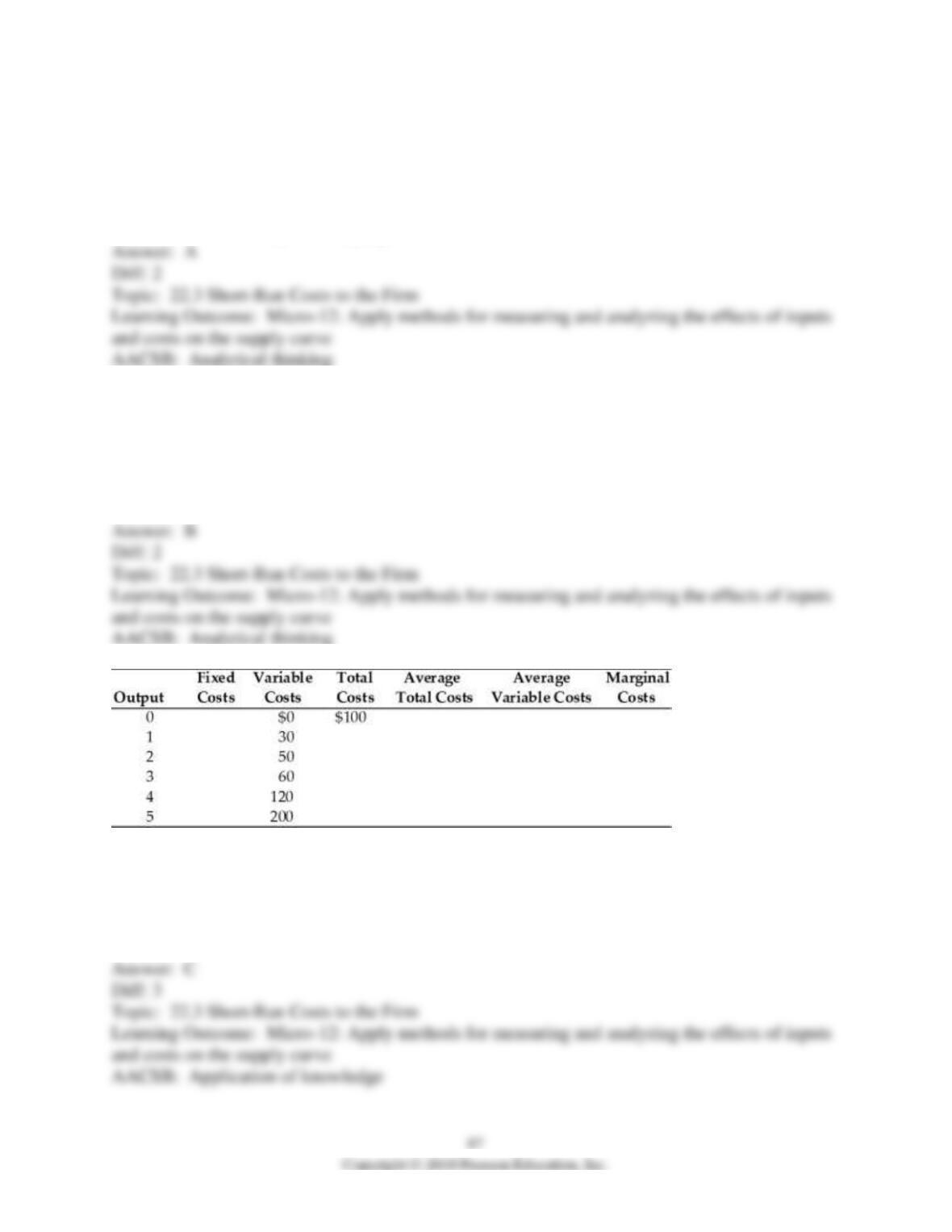
104) In the above table, what are the total fixed costs for an output of 4?
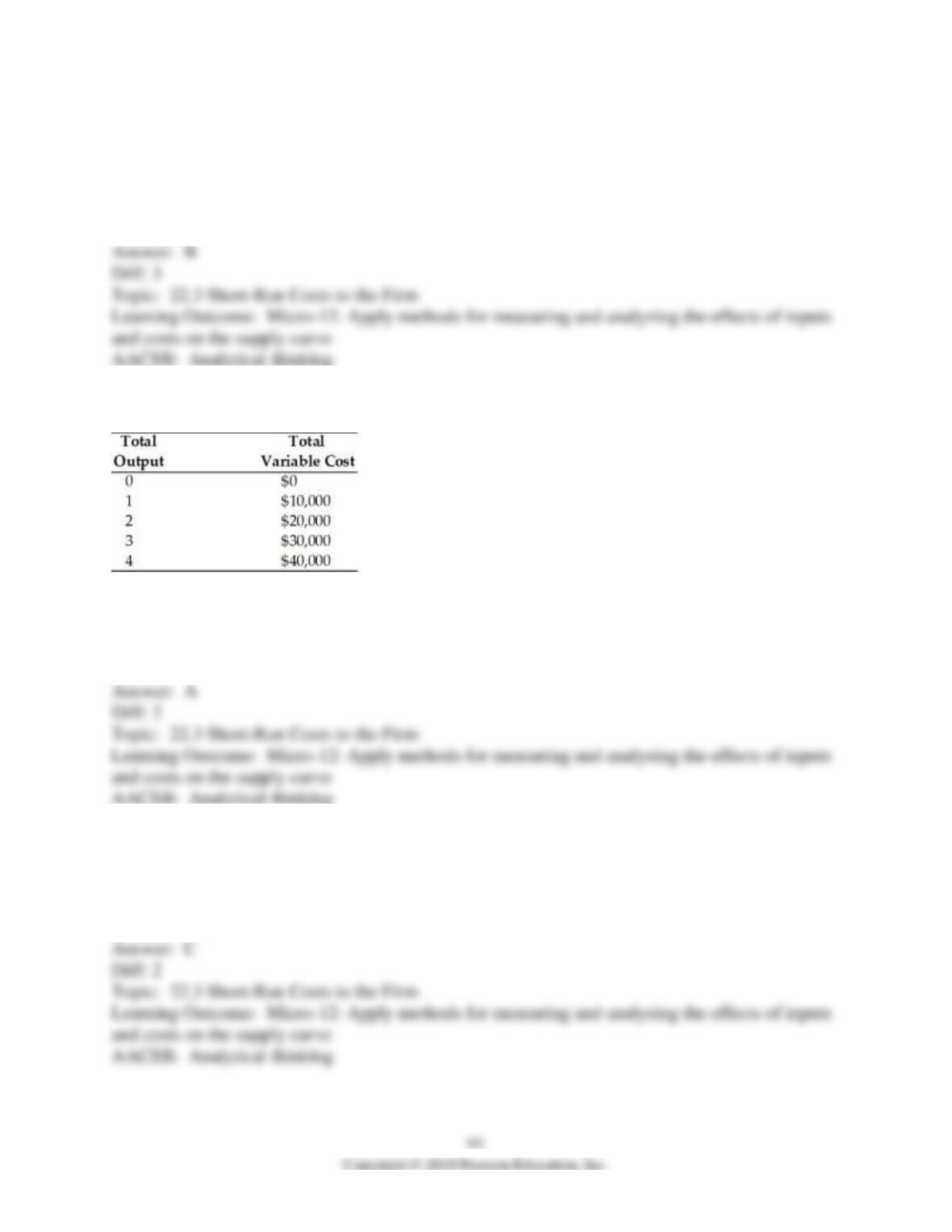
A) $0
B) $120
C) $100
D) $220
105) In the above table, what is the marginal cost to produce the 5th unit of output?
A) $80
B) $60
C) $55
D) $20
106) In the above table, what is the marginal cost to produce the 4th unit of output?
A) $30
B) $60
C) $55
D) $20
107) In the above table, what is the marginal cost to produce the 2nd unit of output?
A) $30
B) $60
C) $55
D) $20
108) In the above table, what is the average variable cost to produce 4 units of output?
A) $30
B) $60
C) $55
D) $20
109) In the above table, what is the average variable cost to produce 3 units of output?
A) $30
B) $60
C) $10
D) $20
110) In the above table, what is the average variable cost to produce 2 units of output?
A) $25
B) $60
C) $55
D) $20
111) In the above table, what is the average total cost to produce 4 units of output?
A) $30
B) $60
C) $55
D) $20
112) In the above table, what is the average total cost to produce 5 units of output?
A) $80
B) $55
C) $40
D) $60
113) In the above table, what is the average total cost to produce 3 units of output?
A) $33.33
B) $53.33
C) $55
D) $20
114) Which of the following statements regarding the relationship between average and marginal
costs is INCORRECT?
A) There is always a definite relationship between average and marginal cost.
B) When marginal costs are less than average costs, the latter must fall.
C) When marginal costs are greater than average costs, the latter must rise.
D) There is no way for average variable costs to fall when marginal costs are falling.
115) Assume that in the short run a firm is producing 100 units of output, has average total costs
of $100, and average variable costs of $50. The firm’s total fixed costs are
A) $50.
B) $5,000.
C) $150.
D) $15,000.
116) Assume that in the short run a firm is producing 100 units of output, has average total costs
of $100, and average fixed costs of $20. The firm’s total variable cost at this output level is
A) $120.
B) $80.
C) $8,000.
D) $12,000.
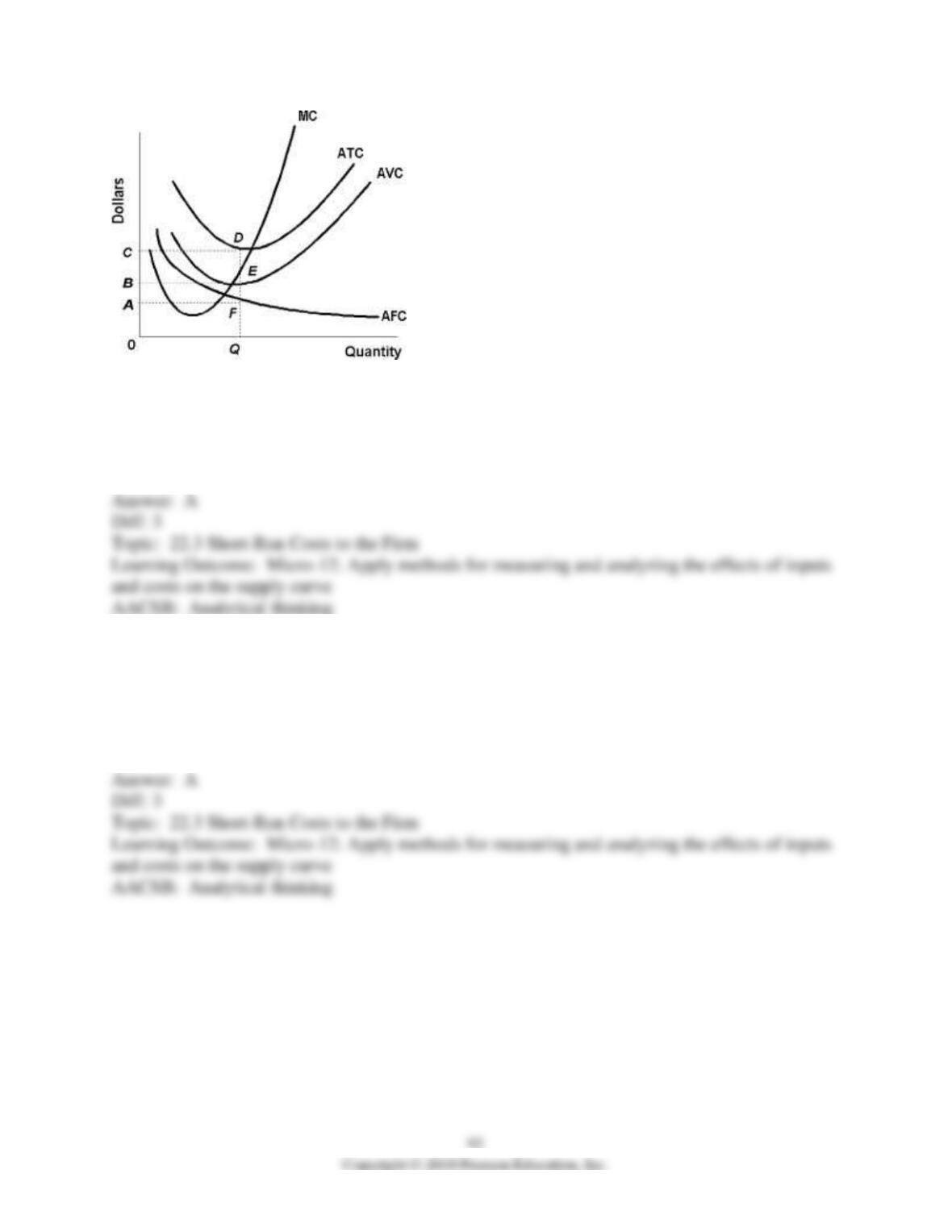
117) Use the above figure. At an output equal to “Q” the total cost for the firm will be the area
A) OQDC.
B) OQFA.
C) OQBC.
D) OQEB.
118) Use the above figure. At an output equal to “Q” the average fixed cost for the firm will be
the line segment
A) DE.
B) AB.
C) BE.
D) CD.
119) Use the above figure. At an output equal to “Q” the total variable cost for the firm will be
the area
A) OQAB.
B) OQEB.
C) OQFA.
D) OQDC.
120) In the table below, what are the marginal costs of the fourth unit of output?
A) $10,000
B) $20,000
C) $30,000
D) $40,000
121) Which of the following is TRUE?
A) The MC curve intersects AFC at its minimum point.
B) If MC is below AVC, AVC must be increasing.
C) If MC is above ATC, ATC must be increasing.
D) none of the above
122) If average total cost is decreasing as more and more units are produced, then marginal cost
must be
A) rising.
B) constant.
C) below average total cost.
D) negative.
123) Marginal cost begins to rise when
A) diminishing marginal product begins.
B) diminishing marginal product ends.
C) average total cost falls.
D) fixed cost falls.
124) At the output rate at which diminishing marginal product begins, a firm will experience
A) constant average total costs.
B) increasing average fixed costs.
C) increasing marginal costs.
D) decreasing average variable costs.
125) Which of the following statements is correct?
A) Average variable costs always exceed average total costs.
B) Average fixed costs are constant.
C) Average variable cost reaches its minimum when average product equals its maximum.
D) Average fixed costs are always less than average variable costs.
126) If the marginal product of an input is falling, then
A) average fixed cost is constant.
B) marginal cost is falling.
C) average total cost is constant.
D) marginal cost is rising.
127) When marginal product is rising
A) total product is falling.
B) marginal cost is falling.
C) marginal cost is rising.
D) average fixed cost is rising.
128) The shape of the short-run average total cost curve is a result of
A) economies of scale.
B) diseconomies of scale.
C) the law of diminishing marginal product.
D) falling profits.
129) As a firm’s production increases in the short run, the average total cost curve eventually
slopes upward because
A) marginal physical product eventually declines as output increases.
B) marginal cost eventually declines as output increases.
C) average fixed cost declines with increases in output.
D) average physical product rises with increases in output.
130) The law of diminishing marginal product is NOT responsible for the shape of
A) the total cost curve.
B) the average variable cost curve.
C) total fixed cost curve.
D) marginal cost curve.
131) When the marginal physical product is rising
A) total cost is falling.
B) average total cost is increasing.
C) marginal cost is falling.
D) marginal cost is rising.
132) When the marginal physical product is falling
A) marginal cost is rising.
B) average fixed costs are rising.
C) total costs are falling.
D) average variable costs are falling.
133) When the average physical product is rising
A) total cost is falling.
B) average total cost is increasing.
C) average variable cost is falling.
D) marginal cost is always rising.
134) When the average physical product is falling
A) average variable costs are rising.
B) average fixed costs are rising.
C) total costs are falling.
D) average variable costs are falling.
135) Marginal costs will begin to rise at the point where
A) fixed costs increase.
B) variable costs increase.
C) average variable costs increase.
D) diminishing marginal product begins.
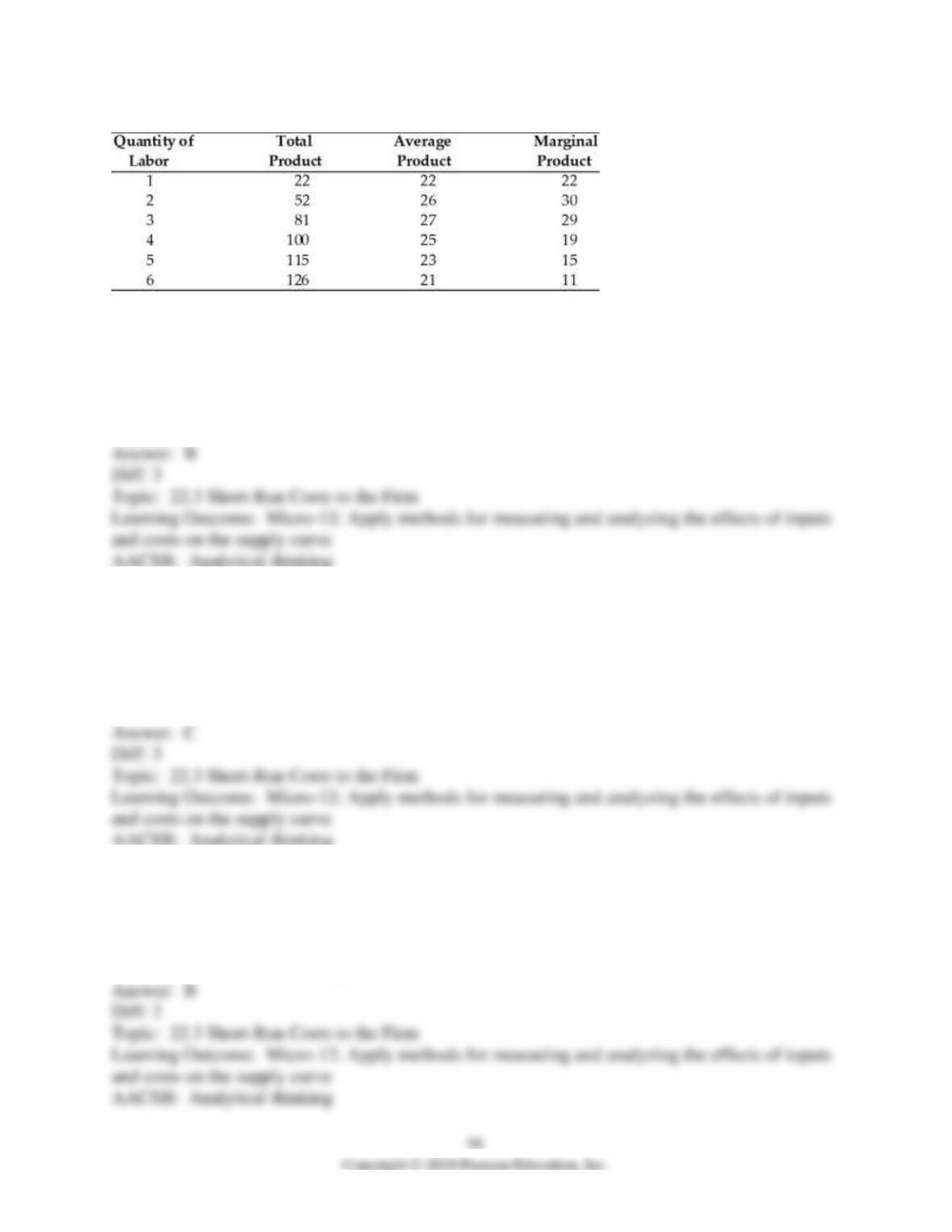
136) Refer to the above table. At what quantity of labor does the marginal cost curve start to
increase?
A) after 1 unit
B) after 2 units
C) after 3 units
D) after 6 units
137) Refer to the above table. At what quantity of labor does the average variable cost curve start
to increase?
A) after 1 unit
B) after 2 units
C) after 3 units
D) after 6 units
138) Marginal physical product of labor equals
A) the wage.
B) the wage divided by marginal cost.
C) marginal cost divided by the wage.
D) marginal cost times the wage.
139) Short-run cost relationships for a firm are
A) determined by the law of diminishing marginal product.
B) determined by the specific long-run relationships that exist.
C) due to the level of wages relative to other input prices.
D) due to the normal contractual relations in a market.
140) If the marginal product curve is intersecting the average product curve, we know that
A) the average variable cost curve is intersecting the average total cost curve.
B) the marginal cost curve is intersecting the average fixed cost curve.
C) the average total cost curve lies above the marginal cost curve.
D) the marginal cost curve is intersecting the average total cost curve.
141) When marginal costs are rising
A) marginal physical product is also rising.
B) marginal physical product is falling.
C) average physical product is rising.
D) average physical product is falling.
142) When average variable costs are rising
A) marginal physical product is also rising.
B) marginal costs is falling.
C) average physical product is rising.
D) average physical product is falling.
143) What happens to the marginal cost curve when the marginal physical product of labor is
rising?
A) It becomes upward sloping.
B) It becomes vertical.
C) It becomes downward sloping.
D) It becomes horizontal.
144) The typical cost curves are U-shaped due to the
A) law of diminishing marginal utility.
B) law of supply.
C) law of demand.
D) law of diminishing marginal product.
145) If the price of labor is constant and a firm experiences diminishing marginal product, then
its
A) marginal costs increase.
B) marginal costs decrease.
C) fixed costs increase.
D) total costs decrease.