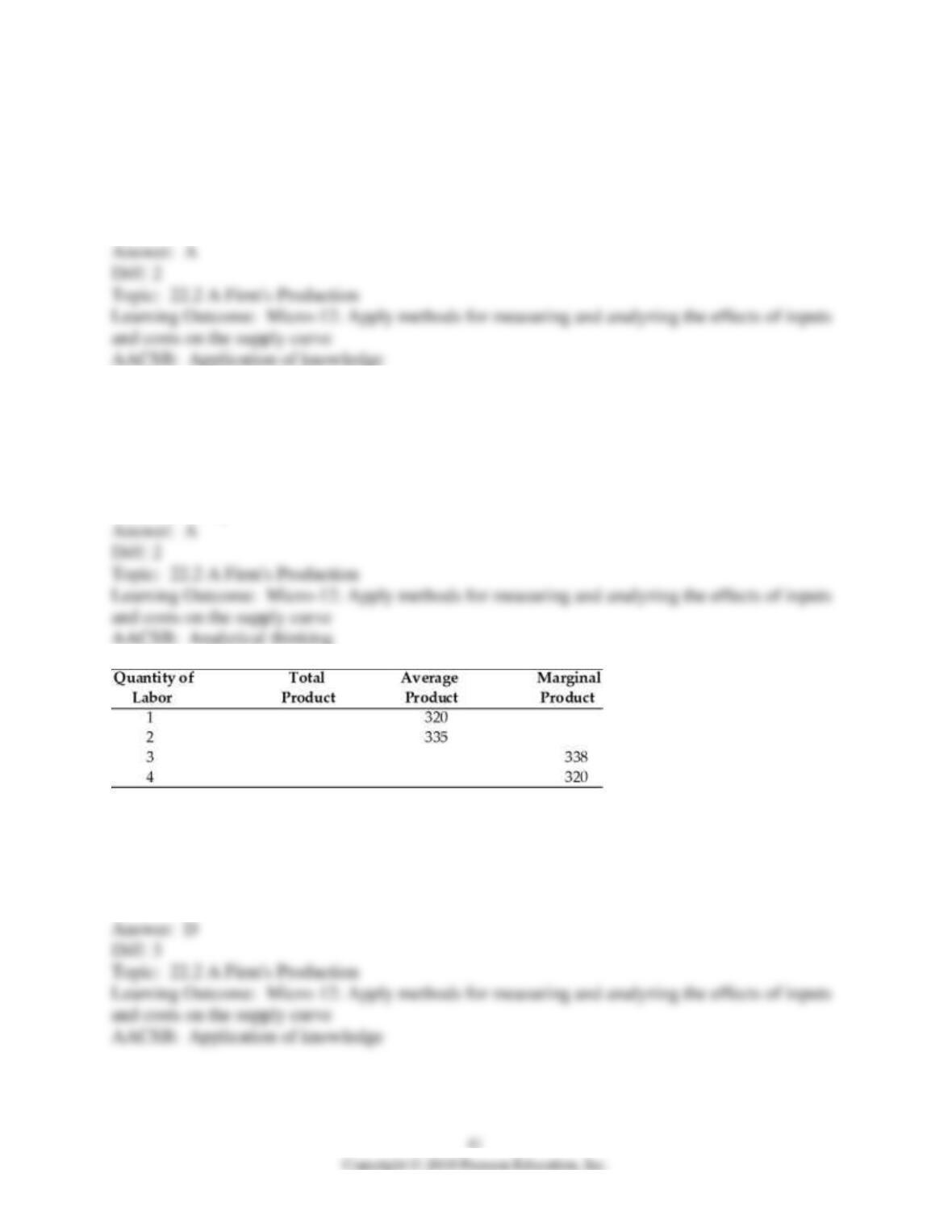
84) In the above table, the average product for 5 workers and the marginal product of the 5th
worker is
A) 3.6; 2.
B) 0.72; 1.
C) 2; 0.6.
D) 16; 2.
85) The production function illustrates the amount of total product that can be produced with a
given set of
A) inputs.
B) outputs.
C) marginal product.
D) marginal input.
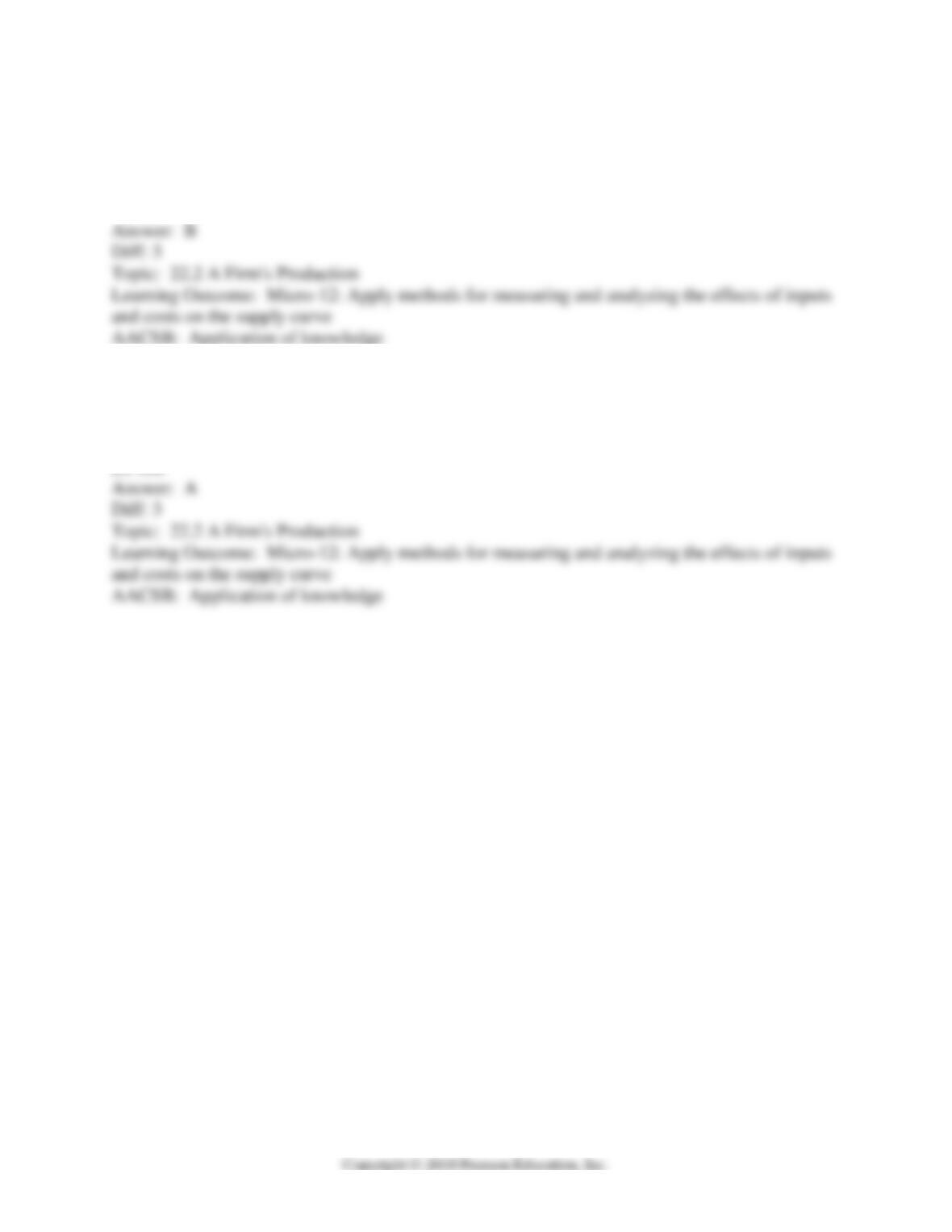
86) Refer to the above table. What does total product equal when 2 units of labor are used?
A) 320
B) 335
C) 350
D) 670
42
87) Refer to the above table. What does total product equal when 3 units of labor are used?
A) 336
B) 1008
C) 338
D) 3
88) Refer to the above table. What does total product equal when 4 units of labor are used?
A) 1328
B) 332
C) 320
D) 960
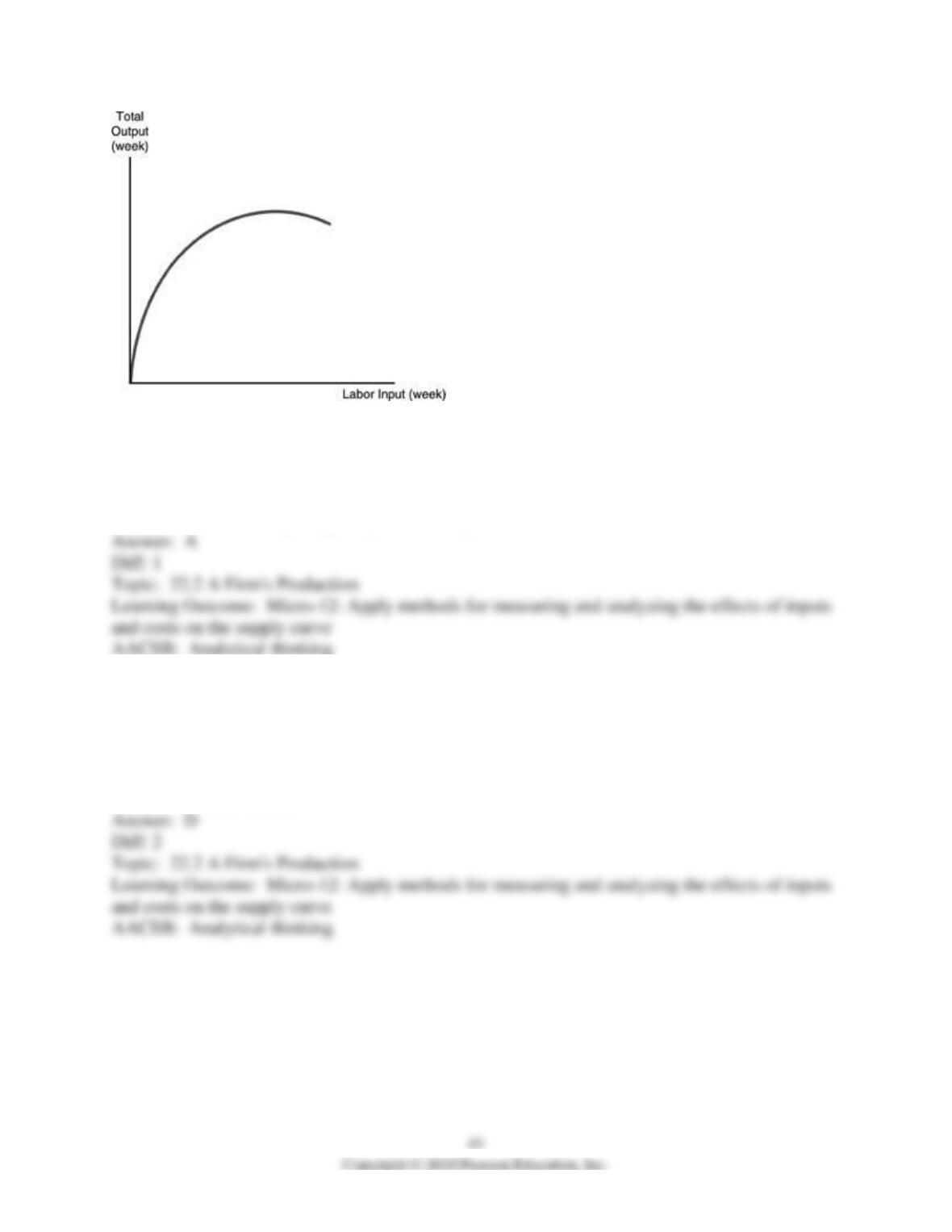
89) Refer to the above figure. The curve reflects
A) the law of diminishing marginal product in labor.
B) the law of increasing marginal product in labor.
C) the law of diminishing marginal product in capital.
D) the law of increasing marginal product in capital.
90) Phil found that as he continued to crowd laborers into his hot dog stand, the extra output he
was receiving from each additional laborer was beginning to fall off. This is an example of the
A) law of increasing opportunities.
B) law of demand.
C) law of diminishing marginal utility.
D) law of diminishing product.
91) The marginal productivity of labor will eventually decrease as more workers are employed
because
A) average product is increasing.
B) total product is decreasing.
C) the amount of capital will also be increasing.
D) on the average each worker will have fewer inputs to work with.
92) If we add successive laborers to work a given amount of land on a wheat farm, eventually
A) average total cost will fall to zero.
B) the increases in wheat harvested will rise at a constant rate.
C) the increases in wheat harvested will get smaller and smaller.
D) the increases in wheat harvested will get larger and larger.
93) After some point successive equal increases in a variable factor of production, when added to
a fixed amount of inputs, will result in smaller increases in output. This is known as
A) the long run.
B) the law of diminishing marginal product.
C) marginal physical product.
D) short run average cost.
94) The marginal product of labor may increase rapidly initially as more
A) workers are able to specialize.
B) total product is decreasing.
C) the amount of other inputs is held constant.
D) workers will get crowded in a fixed factory.
95) As successive equal increases in a variable factor of production are added to fixed factors of
production, there will be a point beyond which the extra product that can be attributed to each
additional unit of the variable factor of production will decline. This is known as the law of
A) diminishing total product.
B) diminishing average product.
C) diminishing marginal product.
D) decreasing product.
96) The law of diminishing marginal product indicates that
A) average product will eventually decrease.
B) marginal product will eventually decrease.
C) total product will eventually decrease.
D) resources are inefficient.
97) The observation that beyond some point, successive increases in a variable factor of
production added to a fixed factor of production lead to smaller and smaller increases in output is
A) the law of marginal utility.
B) the law of averages.
C) the law of diminishing marginal product.
D) the law of opportunity costs.
98) The law of diminishing marginal product states that
A) output will continue to increase indefinitely if more variable factors of production are added
to an existing stock of fixed factors.
B) successive equal-sized increases in labor, when added to fixed factors of production, will
result in smaller increases of output.
C) a doubling all inputs will double output.
D) variable costs tend to decrease with output.
99) The law of diminishing marginal product is a statement
A) that concerns changes in variable input and changes in output.
B) that concerns the long run.
C) that concerns changes in profits.
D) that relates to plant size.
100) The point of saturation occurs when a firm
A) has total returns equal to zero.
B) first encounters negative marginal product.
C) first experiences positive marginal product.
D) maximizes its total returns.
101) What happens at a firm’s point of saturation?
A) For the first time, hiring an additional worker decreases total product.
B) Workers cannot take on any additional tasks without working overtime hours.
C) The market for a firm’s output has been saturated and sales fall to zero.
D) The firm’s total costs exceed its revenues.
102) Refer to the above table. At what quantity of labor does the law of diminishing marginal
product set in?
A) after 1 unit
B) after 2 units
C) after 3 units
D) after 6 units
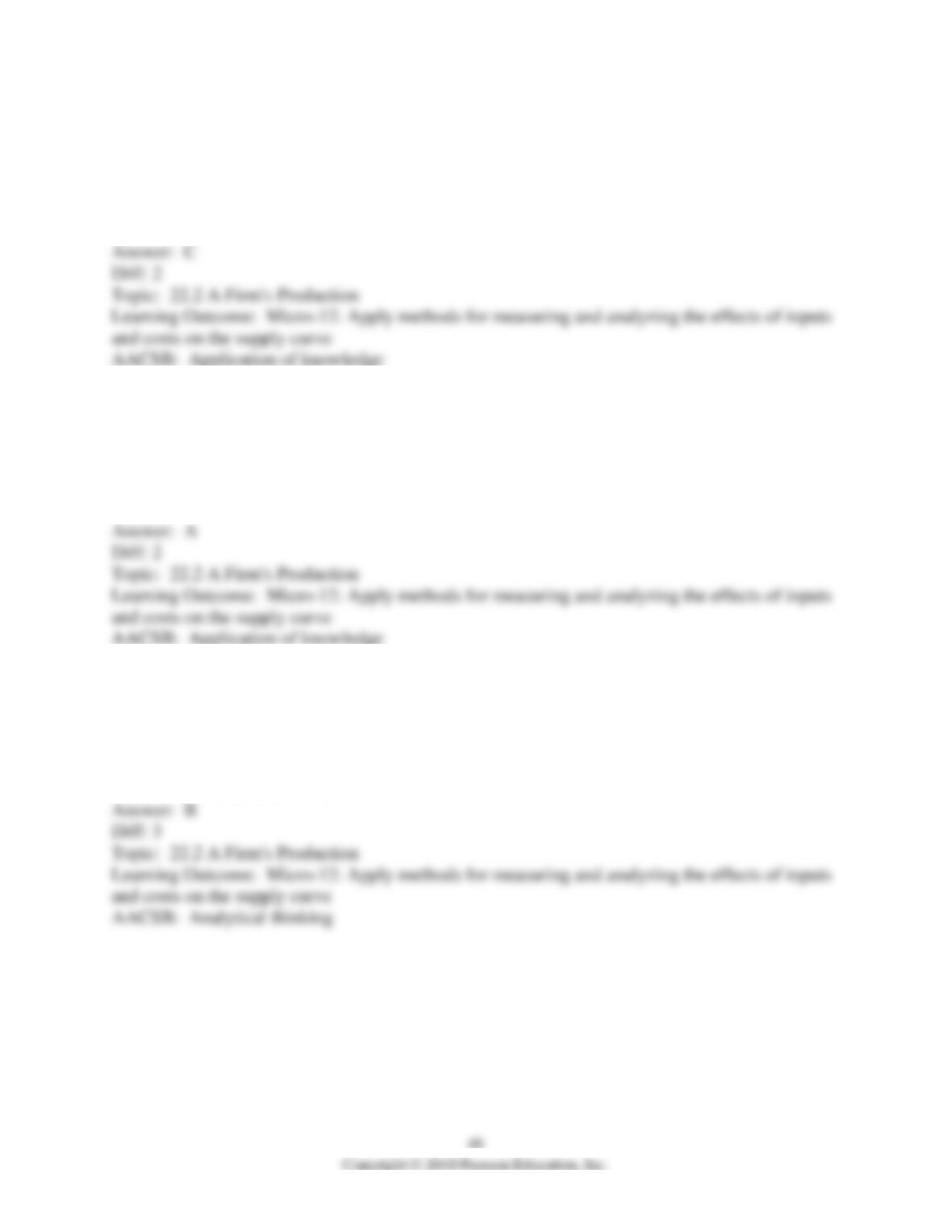
103) Refer to the above table. At what quantity of labor is the average product of labor
maximized?
A) 1 unit
B) 2 units
C) 3 units
D) 6 units
104) Refer to the above table. At what quantity of labor does it become obvious that the law of
diminishing marginal product has set in?
A) worker number 3
B) worker number 4
C) worker number 21
D) worker number 5
105) As long as marginal product of labor exceeds the average product of labor, then average
product of labor
A) must fall.
B) must rise.
C) will stay unchanged.
D) will be at its maximum value.
106) If marginal product is zero, we know that
A) total product is also zero.
B) average product is also zero.
C) total output is maximized.
D) average product is constant.
107) Total product will start to decrease
A) at the quantity where the law of diminishing returns starts.
B) when average physical product decreases.
C) when marginal physical product increases.
D) when marginal physical product becomes negative.
108) Suppose the total output curve increases at an increasing rate for workers 1-50, increases at
a decreasing rate from workers 51-101, and decreases beyond 101 workers. We would know that
A) marginal product is increasing from workers 1-50 and then becomes negative after worker 51.
B) marginal product is increasing from workers 1-50, decreasing after 51 workers, and becomes
negative after the 101st worker.
C) marginal product is decreasing from workers 1-101, becoming negative at the 102nd worker.
D) marginal product is increasing from workers 1-50, constant from workers 51 to 101, and is
decreasing after that.
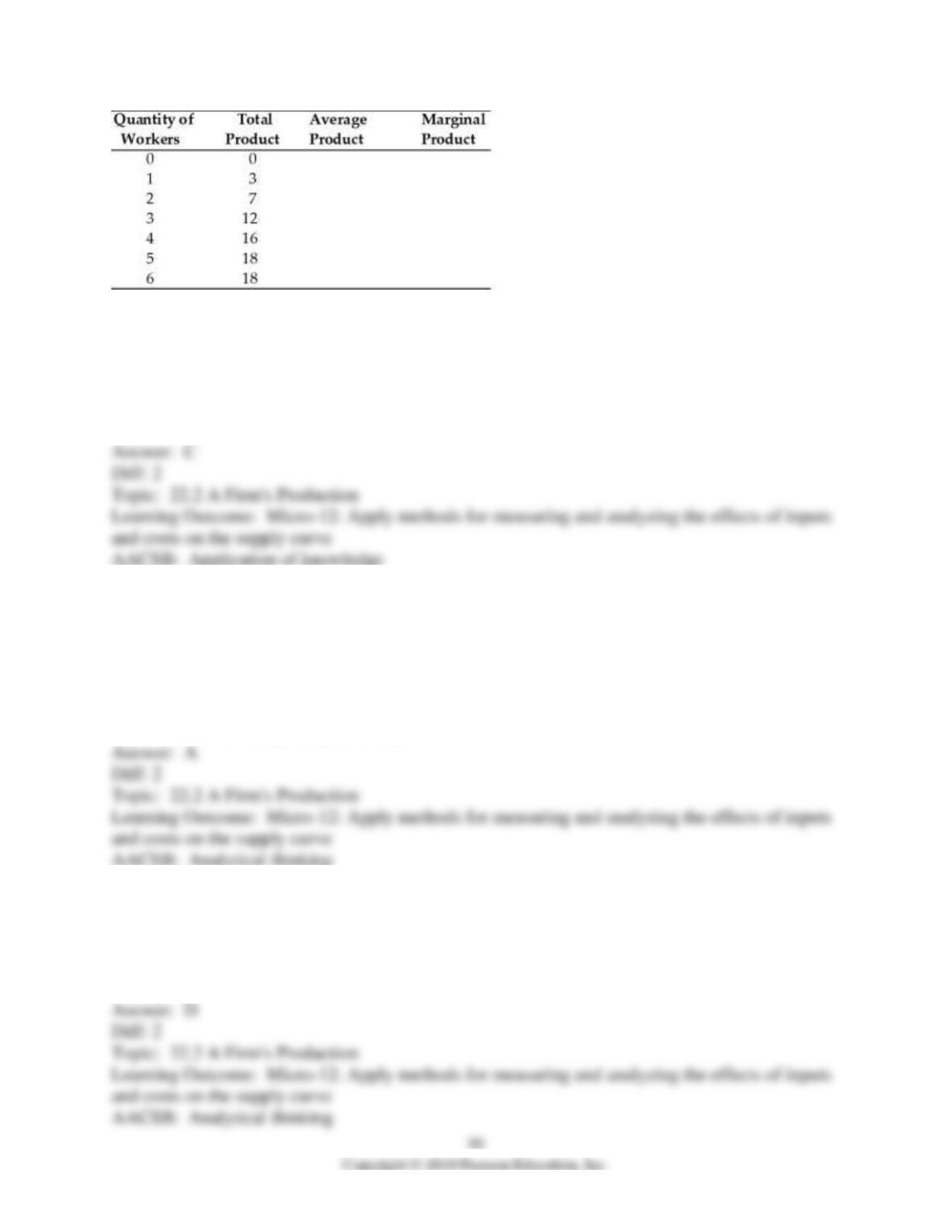
109) In the above table, the law of diminishing marginal product sets in after the ________
worker.
A) first
B) sixth
C) third
D) fourth
110) The observation that after some point, successive equal size increases in a variable factor of
production, such as labor, added to fixed factors of production, will result in smaller increases in
output is the
A) law of diminishing marginal product.
B) streamlining production function.
C) consumer equilibrium.
D) theory of increasing marginal utility.
111) When total product is decreasing, marginal product is
A) positive and increasing.
B) positive and decreasing.
C) constant.
D) negative.
112) The law of diminishing marginal product shows the relationship
A) between accounting and economic profits.
B) between short-run and long-run outputs of a firm.
C) between inputs and outputs for a firm in the short run.
D) between inputs and outputs for a firm in the long run.
113) Suppose the manager of a restaurant notices that when she has too many waiters on the
floor for a shift that the waiters get in each other’s way and fewer dinners are served. This is an
example of
A) diminishing marginal product.
B) diminishing marginal utility.
C) diminishing marginal workforce.
D) diminishing marginal inputs.
114) Describe the concept of the production function. What happens to the production function
when a firm becomes less efficient, so that it now requires more labor to produce the same
amount of output as before?
115) Explain how you can calculate average physical product and marginal physical product
from information on total physical product and variable input.
116) What is a production function?
117) Graphically, what happens to the production function if a firm uses automation to raise the
amount of output per worker? Explain.
118) What is the law of diminishing marginal product?
119) Graphically, what does the marginal product curve for a labor input look like? Explain in
words.
120) What is the law of diminishing marginal product? Is it a realistic concept for describing the
real world? Explain.
121) “Diminishing marginal product is a basic law because new workers are always less
qualified than the existing workers.” Do you agree or disagree? Explain.
22.3 Short-Run Costs to the Firm
1) The firm’s short-run costs contain
A) only variable costs.
B) only fixed costs.
C) both variable and fixed costs.
D) only opportunity costs.
2) Which of the following is correct?
A) TC = TFC + TVC
B) TC = TFC – TVC
C) TC = TFC * TVC
D) TC = TFC / TVC
3) Suppose that a firm is currently producing 500 units of output. At this level of output, AVC is
$1 per unit, and TFC is $500. What is the firm’s TC?
A) $1,500
B) $1,000
C) $500
D) $501
4) Suppose that a firm is currently producing 500 units of output. At this level of output, TVC =
$10,000 and TFC = $25,000. What is the firms ATC?
A) $20
B) $50
C) $70
D) $100
5) Suppose that when the level of output for the firm increases from 50 to 60 units, its variable
costs increase from $500 to $700. What is the firm’s marginal cost?
A) $5
B) $10
C) $20
D) $115
6) Which one of the following statements is FALSE?
A) TC = TFC + TVC
B) ATC = AFC + AVC
C) AFC = TFC divided by Q
D) MC = TC divided by Q
7) Assume it takes 10 units of labor to produce 4 units of output. When the price of labor is $6
per unit and fixed costs equal $60, what is the total cost of those 4 units of output?
A) $60
B) $70
C) $120
D) $84
8) Short-run total cost is defined as
A) the sum of marginal cost and total variable cost.
B) price of labor per unit multiplied by the number of labor units.
C) total fixed cost plus total variable cost.
D) total capital cost only.
9) In economics, a fixed cost is a cost that
A) is present only in the short run.
B) goes up as the level of output goes up.
C) goes down as the level of output goes up.
D) does not vary with the level of output.
10) Which of the following would NOT be considered a fixed cost of production?
A) wages paid to labor
B) the opportunity cost of capital
C) interest payments on a loan
D) insurance payments on plant and equipment
11) All of the following are most likely to be fixed costs EXCEPT the cost relating to
A) insurance.
B) taxes.
C) rent.
D) packaging.
12) With a given plant size, an increase in output will NOT result in an increase in
A) total cost.
B) average fixed cost.
C) total fixed cost.
D) average variable cost.
13) When output is 100 units, the firm’s total fixed cost is $50. What will this firm’s total fixed
cost be if output doubles to 200 units?
A) $1,000
B) $50
C) $100
D) Can’t tell from the information provided.
14) Which of the following statements about a firm’s short-run variable costs is correct?
A) They increase as the level of output decreases.
B) They typically include the cost of workers’ wages.
C) They include the costs of plant and equipment.
D) They are always a greater expense than are fixed costs.
15) As a firm increases the level of output that it produces, short-run average fixed cost
A) rises and then falls.
B) remains constant since fixed costs are constant.
C) decreases.
D) decreases up to a particular level of output and then increases.
16) Average fixed costs will
A) rise as output rises.
B) fall then rise as output rises.
C) rise then fall as output rises.
D) fall as output rises.
17) When a company produces 5,000 units, total costs equal $150,000 and total variable costs
equal $75,000. At this level of output, what is that company average fixed cost?
A) $75,000
B) $30
C) $225,000
D) $15
18) In the short run, average total cost is
A) higher than average variable cost.
B) equal to average variable cost.
C) less than average variable cost.
D) sometimes higher and sometimes lower than average variable cost.
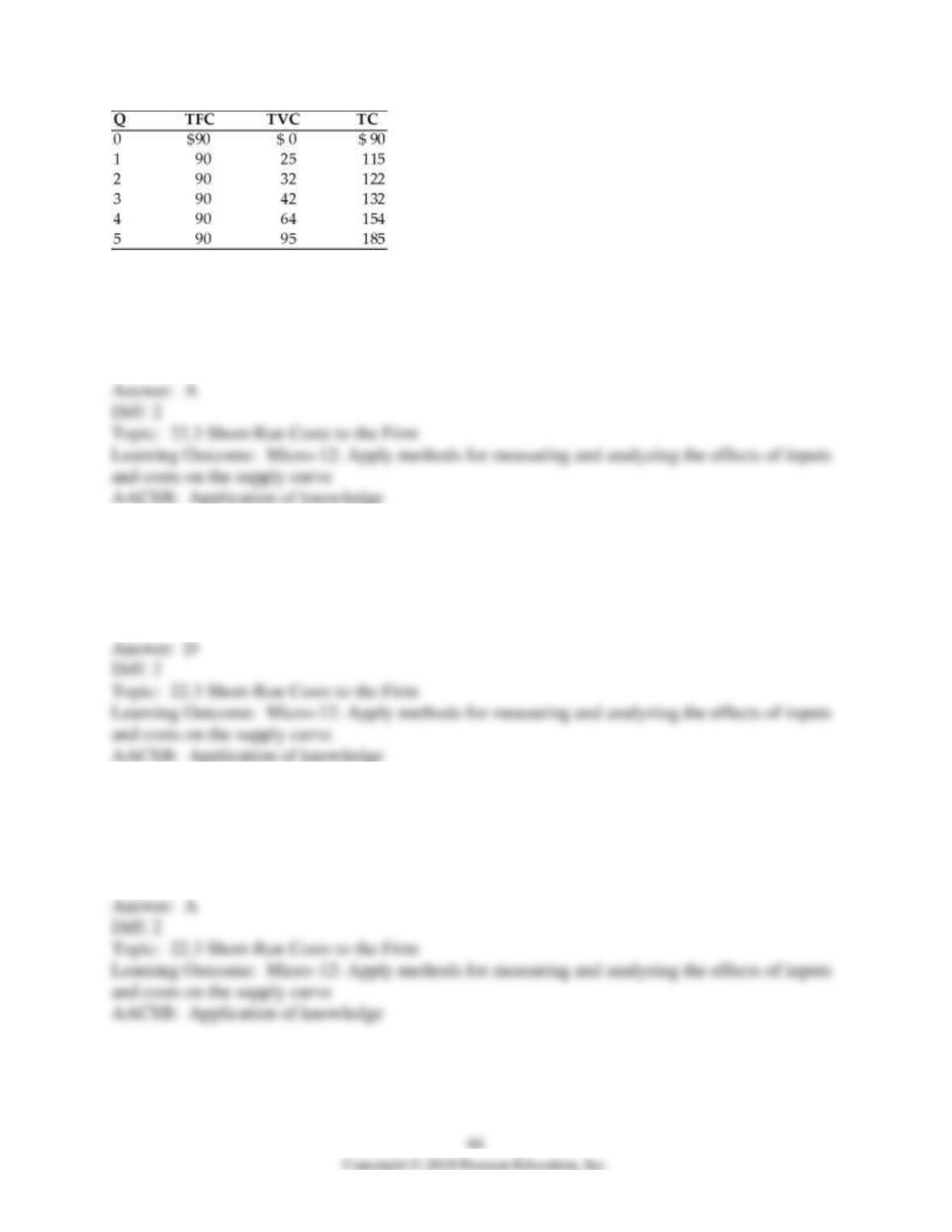
19) Refer to the above table. At an output of 4 units, average variable costs are
A) $16.
B) $22.
C) $38.50.
D) $44.
20) Refer to the above table. At an output of 3 units, average variable costs are
A) $42.
B) $30.
C) $44.
D) $14.
21) Refer to the above table. At an output of 2 units, average total costs are
A) $61.
B) $122.
C) $16.
D) $45.