Moderate
DISC: Markets, market failure, a – DISC: Markets, market failure, and externalities
United States – BPROG: Analytic
Markets, market failure, and ext – Markets, market failure, and externalities
The Economy on a Roller Coaster
132. In the 1960s, U.S. economy experienced
a.
a substantial decline in real GDP but limited inflation.
b.
a substantial decline in real GDP coupled with significant inflation.
c.
substantial real GDP growth coupled with significant inflation.
d.
substantial real GDP growth with limited inflation.
Easy
DISC: Measuring the Economy
United States – BPROG: Analytic
Measuring the Economy
The Economy on a Roller Coaster
133. In the past 100 years the U.S. economy has primarily experienced
a.
deflation.
b.
unemployment.
c.
inflation.
d.
depression.
c
Easy
DISC: Measuring the Economy
United States – BPROG: Analytic
Measuring the Economy
The Economy on a Roller Coaster
Figure 5-1
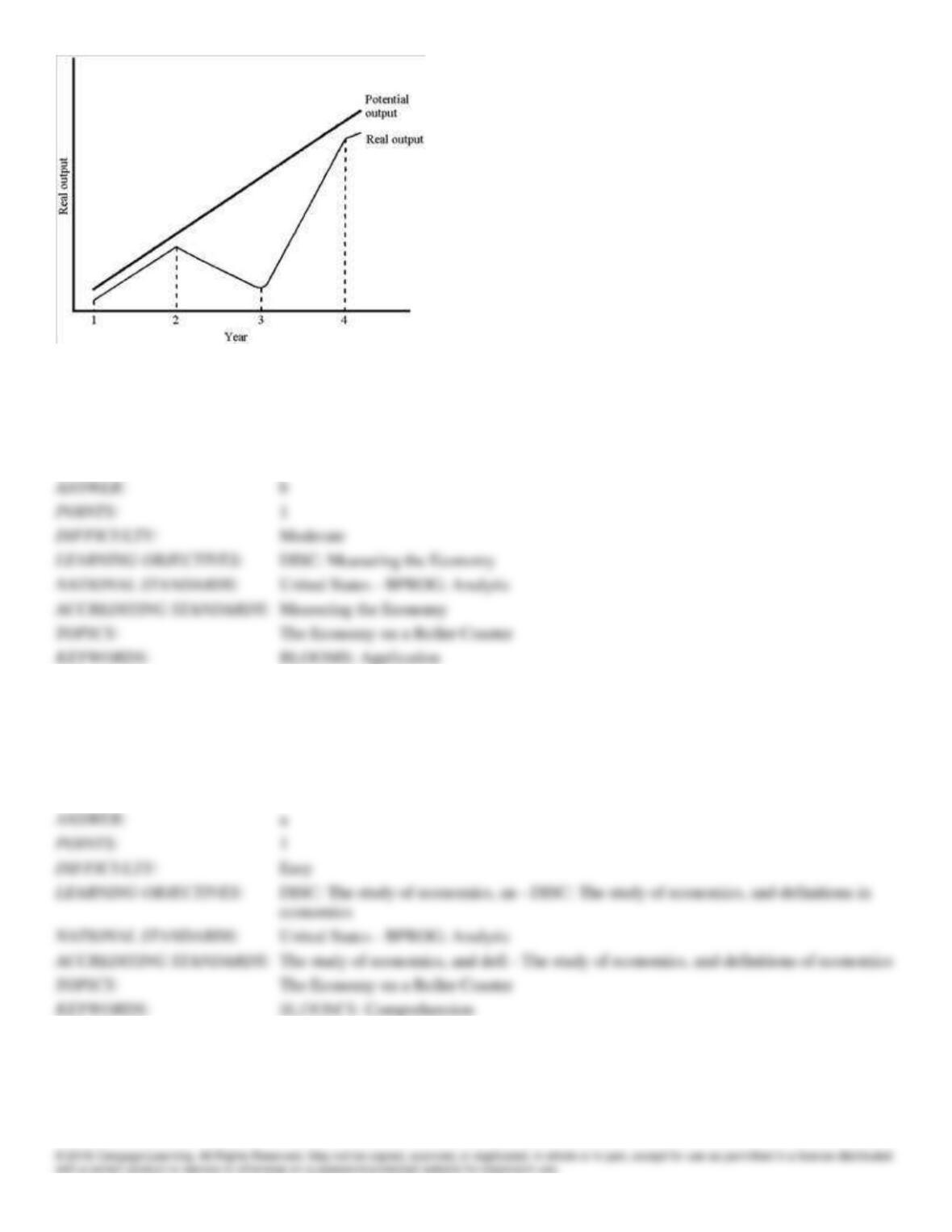
134. Figure 5-1 plots potential and real output for a hypothetical economy. Based on this graph, the recession occurred
a.
between years 1 and 2.
b.
between years 2 and 3.
c.
between years 3 and 4.
d.
after year 4.
Moderate
DISC: Measuring the Economy
United States – BPROG: Analytic
Measuring the Economy
The Economy on a Roller Coaster
BLOOMS: Application
135. A period in which the price level is rising is experiencing
a.
inflation.
b.
reflation.
c.
deflation.
d.
deconstruction.
a
Easy
United States – BPROG: Analytic
The study of economics, and defi – The study of economics, and definitions of economics
The Economy on a Roller Coaster
136. In the United States during the period from 1870 to 1940, the price level was most likely to
a.
fluctuate.
b.
increase.
c.
decrease.
d.
trend generally upward.
a
Easy
DISC: Measuring the Economy
United States – BPROG: Analytic
Measuring the Economy
The Economy on a Roller Coaster
137. In the period of U.S. economic history known as the Great Depression, the rate of inflation was generally
a.
trending upward.
b.
positive.
c.
uncertain.
d.
negative.
Easy
DISC: Measuring the Economy
United States – BPROG: Analytic
Measuring the Economy
The Economy on a Roller Coaster
138. Before the Great Depression of the 1930s, most economists believed that
a.
only active government policy could prevent recessions or inflation.
b.
a capitalist economy had a natural tendency to cure recessions or inflation.
c.
a capitalist economy had a natural tendency to inflation.
d.
recessions and depressions were inevitable until the economy broke down completely.
Moderate
DISC: Measuring the Economy
United States – BPROG: Analytic
Measuring the Economy
The Economy on a Roller Coaster
139. John Maynard Keynes wrote The General Theory of Employment, Interest, and Money (1936) to
a.
improve the gold supply balances of the British government.
b.
prove that the punitive nature of the Treaty of Versailles would ultimately lead to recession in Europe.
c.
prove that active government policy would produce unemployment and high rates of inflation.
d.
demonstrate that pessimistic consumers and businesspersons could reduce their spending and condemn the
economy to long-run stagnation.
United States – BPROG: Reflective Thinking – BPROG: Analysis
The study of economics, and defi – The study of economics, and definitions of economics
The Economy on a Roller Coaster
140. During the Great Depression of the 1930s, unemployment peaked at _____%.
a.
5 percent
b.
10 percent
c.
20 percent
d.
25 percent
e.
30 percent
DISC: Measuring the Economy
United States – BPROG: Analytic
Measuring the Economy
The Economy on a Roller Coaster
141. In The General Theory of Employment, Interest, and Money, Keynes rejected the idea that
a.
a capitalist economy always gravitates toward high levels of employment.
b.
budget deficits necessarily cause recessions and inflation.
c.
the ultimate breakdown of the capitalist system is inevitable.
d.
international trade always helps to achieve economic stability.
DISC: Aggregate demand and aggre – DISC: Aggregate demand and aggregate supply
United States – BPROG: Analytic
Aggregate demand and aggregate s – Aggregate demand and aggregate supply
The Economy on a Roller Coaster
142. According to Keynes, a pessimistic outlook causes consumers and businesspersons to ____, and a recession could
occur.
a.
increase planned investment
b.
decrease planned spending
c.
increase exports
d.
decrease imports
e.
decrease saving
DISC: Aggregate demand and aggre – DISC: Aggregate demand and aggregate supply
United States – BPROG: Analytic
Aggregate demand and aggregate s – Aggregate demand and aggregate supply
The Economy on a Roller Coaster
143. The Great Depression of the 1930s led to a revolution in macroeconomic thinking, following the work of
a.
Arthur Laffer.
b.
Milton Friedman.
c.
Adam Smith.
d.
John Maynard Keynes.
e.
David Ricardo.
DISC: Aggregate demand and aggre – DISC: Aggregate demand and aggregate supply
United States – BPROG: Analytic
Aggregate demand and aggregate s – Aggregate demand and aggregate supply
The Economy on a Roller Coaster
144. The most severe depression in the United States was the 30 percent decrease in real GDP that occurred between
a.
1899 and 1913.
b.
1929 and 1933.
c.
1959 and 1963.
d.
1979 and 1983.
DISC: Measuring the Economy
United States – BPROG: Analytic
Measuring the Economy
The Economy on a Roller Coaster
145. Keynes’ great book offered the promise of ending depressions through
a.
investors reacting to lower interest rates.
b.
consumers taking over the ownership of factories.
c.
government nationalizing key industries.
d.
government influencing aggregate demand.
DISC: Aggregate demand and aggre – DISC: Aggregate demand and aggregate supply
United States – BPROG: Analytic
Aggregate demand and aggregate s – Aggregate demand and aggregate supply
The Economy on a Roller Coaster
146. Technically speaking, in what year did the “Great Recession” end?
a.
1933
b.
1935
c.
2007
d.
2009
e.
It had not ended as of 2011.
United States – BPROG: Analytic
The study of economics, and defi – The study of economics, and definitions of economics
The Economy on a Roller Coaster
147. The Great Depression ended in the United States when
a.
the New Deal reforms were initiated by President Roosevelt.
b.
deficit spending ended in 1937.
c.
the United States returned to the gold standard in 1940.
d.
the United States began to mobilize for war in the early 1940s.
e.
the German economy suffered hyperinflation in the 1920s.
DISC: Measuring the Economy
United States – BPROG: Analytic
Measuring the Economy
The Economy on a Roller Coaster
148. Which of the following would be counted in the U.S. GDP for 2015?
a.
a Ford Fiesta made in Mexico
b.
the $5,000 an investor used to purchase stock in Home Depot
c.
Ford buying tires from Goodyear for new Ford Mustangs
d.
none of the above
DISC: Measuring the Economy
United States – BPROG: Analytic
Measuring the Economy
What Gets Counted in GDP
149. What was suggested by Keynes to move the economy out of a depressed state?
a.
The invisible hand
b.
The price mechanism
c.
Monetary and fiscal policy
d.
Zero government intervention
DISC: Monetary and fiscal policy
United States – BPROG: Analytic
Monetary and fiscal policy
The Economy on a Roller Coaster
150. The human consequences of the Great Depression included
a.
homeless families.
b.
closed factories.
c.
bankrupt farmers.
d.
soup lines.
e.
all of the above conditions.
DISC: Measuring the Economy
United States – BPROG: Analytic
Measuring the Economy
The Economy on a Roller Coaster
151. The price controls on consumer goods during World War II led to
a.
permanent surpluses.
b.
stable long-term prices.
c.
a burst of inflation when they were ended.
d.
increased production of consumer goods to satisfy demand.
DISC: Supply and demand
United States – BPROG: Analytic
Supply and demand
The Economy on a Roller Coaster
152. The 1960s are remembered by most economists as a period of
a.
very high rates of inflation.
b.
very high rates of unemployment.
c.
price controls and low inflation.
d.
noninflationary growth.
e.
all of the above.
DISC: Measuring the Economy
United States – BPROG: Analytic
Measuring the Economy
The Economy on a Roller Coaster
153. The successes of the 1960s were ascribed to the effects of
a.
classical policies from the 1800s.
b.
classical policies from the 1930s.
c.
classical policies from the 1950s.
d.
Keynesian policies from the 1930s.
e.
Keynesian policies from the 1950s.
United States – BPROG: Analytic
The study of economics, and defi – The study of economics, and definitions of economics
The Economy on a Roller Coaster
154. Usually, increased government spending for war increases inflationary pressures. The principal reason that inflation
occurred during the Vietnam War and not during World War II was the existence, during World War II, of
a.
full employment.
b.
government ownership of factories.
c.
full production.
d.
wage and price controls.
e.
high levels of patriotism.
DISC: Measuring the Economy
United States – BPROG: Analytic
Measuring the Economy
The Economy on a Roller Coaster
155. In contrast to the typical Republican Party laissez-faire policies, President Richard Nixon in 1971 introduced
a.
mandatory drug testing of cabinet officers.
b.
monetary targets for the Federal Reserve Board.
c.
wage and price controls.
d.
mandatory gold purchases by the U.S. Treasury.
c
Moderate
DISC: Monetary and fiscal policy
United States – BPROG: Analytic
Monetary and fiscal policy
The Economy on a Roller Coaster
156. The international organization most responsible for rising prices during the 1970s was
a.
the WTO.
b.
OPEC.
c.
the CIA.
d.
the World Bank.
e.
the Trilateral Commission.
Easy
DISC: Measuring the Economy
United States – BPROG: Analytic
Measuring the Economy
The Economy on a Roller Coaster
157. The recession of 1973-1975 was unusual in that both inflation and unemployment increased at the same time. This
suggests that the primary cause of the recession was an
a.
inward shift of the aggregate demand curve.
b.
outward shift of the aggregate supply curve.
c.
inward shift of the aggregate supply curve.
d.
outward shift of the aggregate demand curve.
c
Moderate
DISC: Aggregate demand and aggre – DISC: Aggregate demand and aggregate supply
United States – BPROG: Analytic
Aggregate demand and aggregate s – Aggregate demand and aggregate supply
The Economy on a Roller Coaster
158. The movements of real GDP and inflation during the 1973-1975 recession can be best explained by a:
a.
rightward shift of the aggregate demand curve.
b.
leftward shift of the aggregate demand curve.
c.
rightward shift of the aggregate supply curve.
d.
leftward shift of the aggregate supply curve.
Moderate
DISC: Aggregate demand and aggre – DISC: Aggregate demand and aggregate supply
United States – BPROG: Analytic
Aggregate demand and aggregate s – Aggregate demand and aggregate supply
The Economy on a Roller Coaster
159. The period of 1973 to 1980 can best be described as a time of
a.
deflation.
b.
reflation.
c.
unflation.
d.
stagflation.
e.
disflation.
Easy
DISC: Measuring the Economy
United States – BPROG: Analytic
The Economy on a Roller Coaster
160. The term “stagflation” was invented in the 1970s to describe an economy experiencing both
a.
deflation and economic stagnation.
b.
inflation and economic stagnation.
c.
high inflation and high employment.
d.
high inflation and high levels of economic growth.
Moderate
United States – BPROG: Analytic
The study of economics, and defi – The study of economics, and definitions of economics
The Economy on a Roller Coaster
161. The stagflation in the United States during the 1974-1975 period can be attributed to
a.
increases in real GDP due to high levels of defense spending.
b.
tight monetary and fiscal policies of the Nixon-Ford administrations.
c.
rapid increases in petroleum prices, poor harvests, and the removal of wage and price controls.
d.
budget deficits by the federal government and increasing trade deficits by the United States.
c
Moderate
DISC: Measuring the Economy
United States – BPROG: Analytic
Measuring the Economy
The Economy on a Roller Coaster
162. Stagflation can be defined as a combination of ____.
a.
economic migration and inflation
b.
economic aggregation and deflation
c.
economic stagnation and inflation
d.
economic aggregation and inflation
c
Moderate
United States – BPROG: Analytic
The study of economics, and defi – The study of economics, and definitions of economics
The Economy on a Roller Coaster
163. The significantly high rates of inflation in the 1970s occurred, in part,
a.
because of increased petroleum prices.
b.
due to high unemployment.
c.
despite falling gasoline prices.
d.
due to restrictive monetary policies.
a
Easy
DISC: Aggregate demand and aggre – DISC: Aggregate demand and aggregate supply
United States – BPROG: Analytic
Aggregate demand and aggregate s – Aggregate demand and aggregate supply
The Economy on a Roller Coaster
164. The Iranian Revolution in 1979 led to another interruption of oil supplies to the United States. This caused the
reoccurrence of
a.
deflation.
b.
full-employment.
c.
trade surpluses.
d.
stagflation.
Easy
DISC: Aggregate demand and aggre – DISC: Aggregate demand and aggregate supply
United States – BPROG: Analytic
Aggregate demand and aggregate s – Aggregate demand and aggregate supply
The Economy on a Roller Coaster
165. The worst post-World War II recession in the United States occurred in
a.
1964.
b.
1973.
c.
1981.
d.
2007.
Easy
DISC: Measuring the Economy
United States – BPROG: Analytic
Measuring the Economy
The Economy on a Roller Coaster
166. In 1981, the Reagan administration employed a policy that included tax ____ while at the same time the Federal
Reserve’s strategy was to combat ____.
a.
cuts; unemployment
b.
cuts; inflation
c.
hikes; unemployment
d.
hikes; inflation
Easy
DISC: The role of government
United States – BPROG: Analytic
The role of government
The Economy on a Roller Coaster
167. The period from 1983 to 1990 was characterized by
a.
decreasing budget deficits and increasing trade surpluses.
b.
persistently high inflation.
c.
below average rates of real GDP growth.
d.
consistent growth of real GDP and decreasing rates of inflation.
Moderate
DISC: Measuring the Economy
United States – BPROG: Analytic
Measuring the Economy
The Economy on a Roller Coaster
168. The supply-side policies of the Reagan and Bush administrations led to high levels of
a.
budget surpluses.
b.
unemployment.
c.
inflation.
d.
budget deficits.
Moderate
DISC: Measuring the Economy
United States – BPROG: Analytic
Measuring the Economy
The Economy on a Roller Coaster
169. The election campaign of George Bush to succeed Ronald Reagan as president was
a.
hindered due to high levels of unemployment in 1988.
b.
hindered by the increasing inflationary problems of the late 1980s.
c.
helped by the budget surpluses generated in the last years of the Reagan administration.
d.
helped by the continuing low levels of unemployment and inflation in 1988.
Difficult
DISC: Measuring the Economy
United States – BPROG: Analytic
Measuring the Economy
The Economy on a Roller Coaster
170. The main reason that President Clinton was forced to revise his campaign promise to cut taxes was that, in 1993, he
faced a large
a.
balance of payments surplus.
b.
balance of payments deficit.
c.
federal budget deficit.
d.
federal budget surplus.
c
Moderate
DISC: Measuring the Economy
United States – BPROG: Analytic
Measuring the Economy
The Economy on a Roller Coaster
171. The macroeconomic conditions during the mid-1990s confounded many economists because of the simultaneous
occurrence of
a.
low unemployment and decreasing inflation rates.
b.
low unemployment and increasing budget deficits.
c.
low unemployment and increasing interest rates.
d.
high unemployment and increasing inflation rates.
DISC: Measuring the Economy
United States – BPROG: Analytic
Measuring the Economy
The Economy on a Roller Coaster
172. The first year of the Bush administration in 2001 could be represented as a(n)
a.
increase in the aggregate demand curve.
b.
decrease in the aggregate demand curve.
c.
increase in the aggregate supply curve.
d.
decrease in the aggregate supply curve.
DISC: Aggregate demand and aggre – DISC: Aggregate demand and aggregate supply
United States – BPROG: Analytic
Aggregate demand and aggregate s – Aggregate demand and aggregate supply
The Economy on a Roller Coaster
173. The tax cut of 2001 turned out to be well-timed because it caused a
a.
rightward shift of the aggregate demand curve.
b.
rightward shift of the aggregate supply curve.
c.
leftward shift of the aggregate demand curve.
d.
leftward shift of the aggregate supply curve.
DISC: Aggregate demand and aggre – DISC: Aggregate demand and aggregate supply
United States – BPROG: Analytic
Aggregate demand and aggregate s – Aggregate demand and aggregate supply
The Economy on a Roller Coaster
174. The name given to government programs implemented to prevent or shorten recessions and counteract inflation is
a.
supply-side economics.
b.
contractionary policy.
c.
monetary policy.
d.
stabilization policy.
United States – BPROG: Analytic
The study of economics, and defi – The study of economics, and definitions of economics
The Problem Of Macroeconomic Stabilization: A Sneak Preview
175. Government policy to reduce unemployment and increase national output can be illustrated by an
a.
outward shift of the aggregate demand curve caused by an increase in government spending.
b.
outward shift of the aggregate supply curve caused by a reduction in government spending.
c.
inward shift of the aggregate demand curve caused by an increase in government spending.
d.
inward shift of the aggregate supply curve caused by a reduction in government spending.
DISC: Aggregate demand and aggre – DISC: Aggregate demand and aggregate supply
United States – BPROG: Analytic
Aggregate demand and aggregate s – Aggregate demand and aggregate supply
The Problem Of Macroeconomic Stabilization: A Sneak Preview
176. The primary benefit to the macroeconomy of increasing government spending is a(n)
a.
decrease in the price level.
b.
decrease in real GDP.
c.
increase in the price level.
d.
decrease in the unemployment rate.
DISC: The role of government
United States – BPROG: Analytic
The role of government
The Problem Of Macroeconomic Stabilization: A Sneak Preview
177. If the government uses stabilization policies to reduce inflation, the economy may have to suffer
a.
higher rates of real GDP growth.
b.
higher rates of unemployment.