c.
lower rates of unemployment.
d.
higher rates of price level growth.
DISC: Monetary and fiscal policy
United States – BPROG: Analytic
Monetary and fiscal policy
The Problem Of Macroeconomic Stabilization: A Sneak Preview
178. Combating recession may require the government to
a.
decrease aggregate supply.
b.
increase aggregate demand.
c.
decrease aggregate demand.
d.
decrease government spending.
DISC: Aggregate demand and aggre – DISC: Aggregate demand and aggregate supply
United States – BPROG: Analytic
Aggregate demand and aggregate s – Aggregate demand and aggregate supply
The Problem Of Macroeconomic Stabilization: A Sneak Preview
179. In response to significant economic problems, the Obama administration recommended
a.
more tax cuts.
b.
increased government spending.
c.
substantial aid to state and local governments.
d.
all of the above
DISC: Measuring the Economy
United States – BPROG: Analytic
Measuring the Economy
The Problem Of Macroeconomic Stabilization: A Sneak Preview
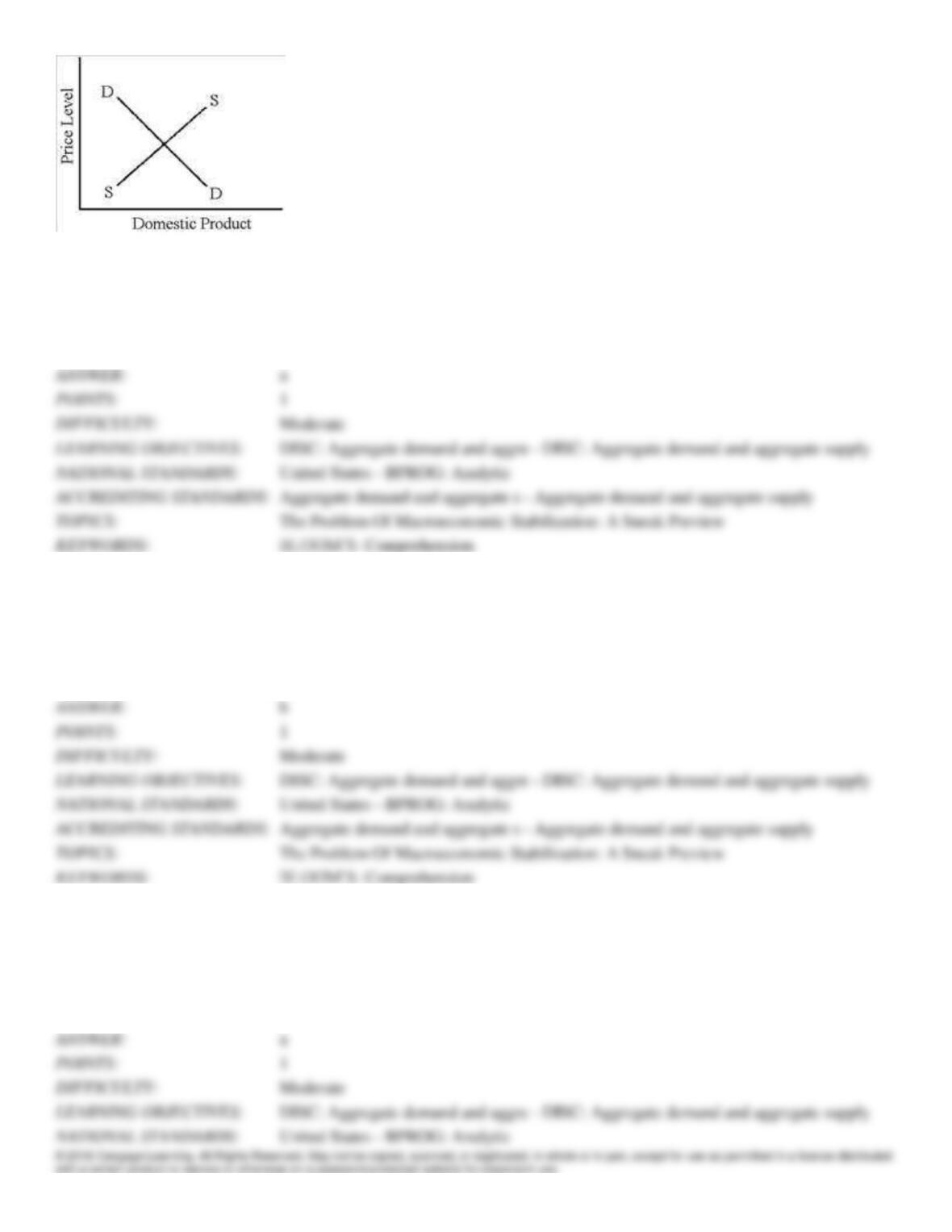
180. In Figure 5-2, if the aggregate demand curve shifts outward over time, the economy will
a.
experience inflation.
b.
see a sustained decrease in the price level.
c.
experience a significant decrease in unemployment.
d.
experience economic recession.
DISC: Aggregate demand and aggre – DISC: Aggregate demand and aggregate supply
United States – BPROG: Analytic
Aggregate demand and aggregate s – Aggregate demand and aggregate supply
The Problem Of Macroeconomic Stabilization: A Sneak Preview
181. In Figure 5-2, an increase in government spending would cause
a.
an outward shift in the aggregate supply curve and an increase in the price level.
b.
an outward shift in the aggregate demand curve and an increase in the price level.
c.
an inward shift of the aggregate demand curve and an increase in the price level.
d.
an inward shift of the aggregate demand curve and a decrease in the price level.
DISC: Aggregate demand and aggre – DISC: Aggregate demand and aggregate supply
United States – BPROG: Analytic
Aggregate demand and aggregate s – Aggregate demand and aggregate supply
The Problem Of Macroeconomic Stabilization: A Sneak Preview
182. In Figure 5-2, if the aggregate demand curve moves to the right less rapidly than the aggregate supply curve, then
a.
the price level should decline over time.
b.
the price level should remain stable.
c.
the price level will tend to increase.
d.
the level of real GDP should decrease.
DISC: Aggregate demand and aggre – DISC: Aggregate demand and aggregate supply
United States – BPROG: Analytic
Aggregate demand and aggregate s – Aggregate demand and aggregate supply
The Problem Of Macroeconomic Stabilization: A Sneak Preview
183. The economy in the period 1950 to 1998 behaved differently than the economy in the 1870 to 1940 time period.
Economists explain this difference
a.
in part because of the use of stabilization policy.
b.
because of increases in U.S. population due to the “baby boom.”
c.
in part because of the globalization of the economy.
d.
in part because of the use of competition policy.
DISC: Measuring the Economy
United States – BPROG: Analytic
Measuring the Economy
The Problem Of Macroeconomic Stabilization: A Sneak Preview
184. To fight inflation, the government may
a.
decrease aggregate demand, which will also lead to lower unemployment rates.
b.
increase aggregate demand, which will also lead to lower unemployment rates.
c.
increase aggregate demand, which will also lead to higher unemployment rates.
d.
decrease aggregate demand, which will also lead to higher unemployment rates.
DISC: Aggregate demand and aggre – DISC: Aggregate demand and aggregate supply
United States – BPROG: Reflective Thinking – BPROG: Analysis
Aggregate demand and aggregate s – Aggregate demand and aggregate supply
The Problem Of Macroeconomic Stabilization: A Sneak Preview
185. To fight recession, the government may
a.
decrease aggregate demand, which will also lead to lower unemployment rates.
b.
increase aggregate demand, which will also lead to higher price levels.
c.
increase aggregate demand, which will also lead to lower price levels.
d.
decrease aggregate demand, which will also lead to higher unemployment rates.
DISC: Aggregate demand and aggre – DISC: Aggregate demand and aggregate supply
United States – BPROG: Analytic
Aggregate demand and aggregate s – Aggregate demand and aggregate supply
The Problem Of Macroeconomic Stabilization: A Sneak Preview
186. Stabilization policy is the name given to government economic policies designed to
a.
stabilize the price level.
b.
shorten and/or prevent recessions.
c.
diminish unemployment.
d.
All of the above are correct.
d
1
DISC: Monetary and fiscal policy
United States – BPROG: Analytic
Monetary and fiscal policy
The Problem Of Macroeconomic Stabilization: A Sneak Preview
187. In contrast to the post-World War II period, before 1940 the government
a.
actively intervened in the economy for stabilization purposes.
b.
used aggregate demand management to avoid recessions.
c.
rarely intervened in the economy to influence inflation or unemployment rates.
d.
used government ownership to guarantee full employment.
1
DISC: The role of government
United States – BPROG: Analytic
The role of government
The Problem Of Macroeconomic Stabilization: A Sneak Preview
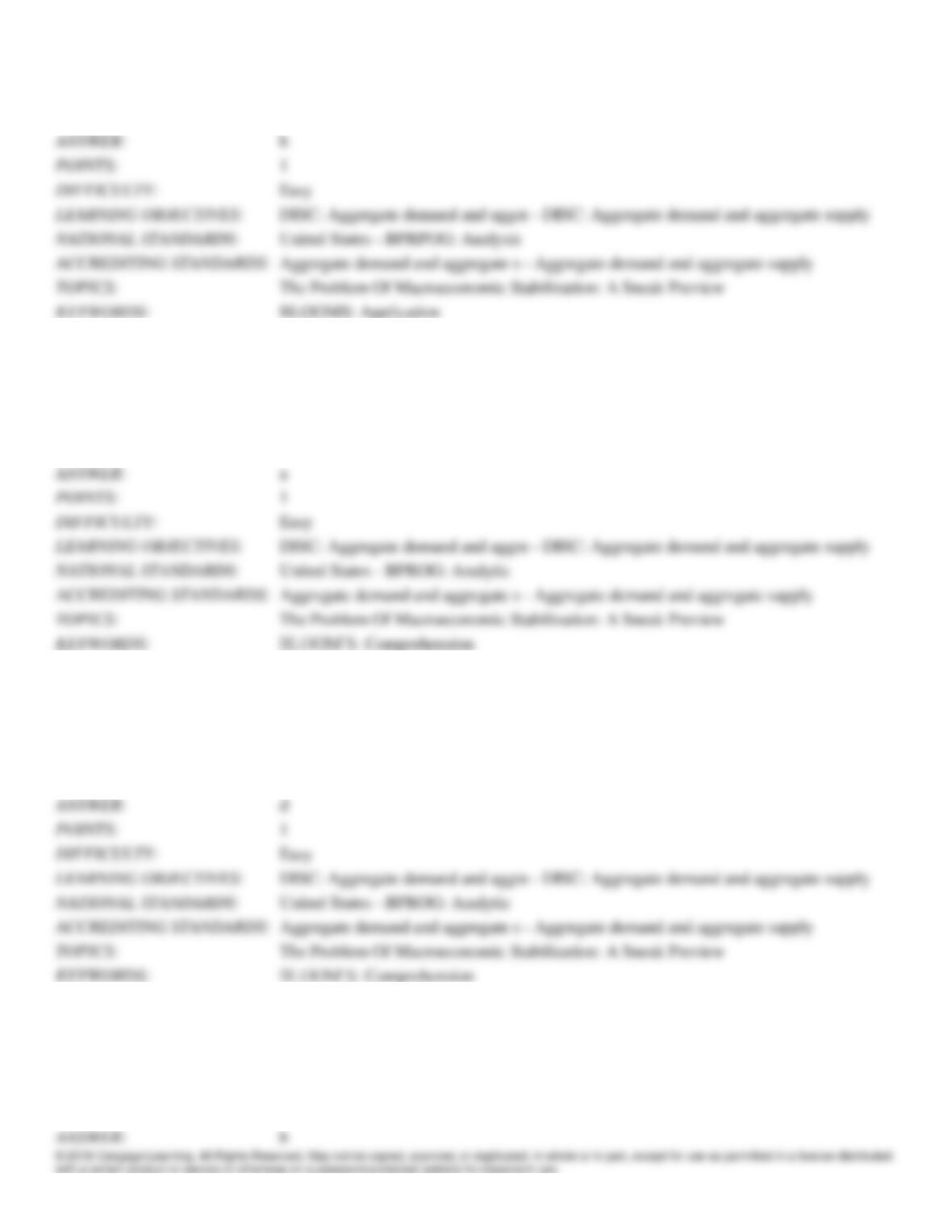
188. Which graph in Figure 5-3 best represents the aggregate demand-induced Great Depression of the 1930s?
a.
1
b.
2
c.
3
d.
4
b
1
189. Which graph in Figure 5-3 best represents the supply-side shock of the 1970s oil crisis?
a.
1
b.
2
c.
3
d.
4
1
190. Which graph in Figure 5-3 best represents the favorable macroeconomy of the late 1990s?
a.
1
b.
2
c.
3
d.
4
d
1
191. Which graph in Figure 5-3 best represents the economic conditions of the American economy in 2001?
a.
1
b.
2
c.
3
d.
4
b
Moderate
DISC: Aggregate demand and aggre – DISC: Aggregate demand and aggregate supply
United States – BPRPOG: Analysis
Aggregate demand and aggregate s – Aggregate demand and aggregate supply
The Problem Of Macroeconomic Stabilization: A Sneak Preview
BLOOMS: Application
192. An increase in aggregate demand is most likely to result in
a.
inflation.
b.
recession.
c.
economic stagnation.
d.
a decrease in real GDP.
a
Moderate
DISC: Aggregate demand and aggre – DISC: Aggregate demand and aggregate supply
United States – BPRPOG: Analysis
Aggregate demand and aggregate s – Aggregate demand and aggregate supply
The Problem Of Macroeconomic Stabilization: A Sneak Preview
BLOOMS: Application
193. A rightward shift in the aggregate demand curve is most likely to result in
a.
inflation.
b.
recession.
c.
economic growth.
d.
an increase in real GDP.
a
Moderate
DISC: Aggregate demand and aggre – DISC: Aggregate demand and aggregate supply
United States – BPRPOG: Analysis
Aggregate demand and aggregate s – Aggregate demand and aggregate supply
The Problem Of Macroeconomic Stabilization: A Sneak Preview
BLOOMS: Application
194. Recessions
a.
almost never occur in the American economy.
b.
follow a regular and predictable cycle.
c.
are common features of the American economy.
d.
have been abolished by wise macroeconomic policy.
c
Easy
DISC: Measuring the Economy
United States – BPROG: Analytic
Measuring the Economy
The Problem Of Macroeconomic Stabilization: A Sneak Preview
195. From the end of World War II until the present, the price level has
a.
slowly fallen over time.
b.
fluctuated around a downward trend.
c.
remained stable throughout the period.
d.
fluctuated around an upward trend.
DISC: Markets, market failure, a – DISC: Markets, market failure, and externalities
United States – BPROG: Analytic
Markets, market failure, and ext – Markets, market failure, and externalities
The Problem Of Macroeconomic Stabilization: A Sneak Preview
196. Business cycles in the United States after World War II have been
a.
more severe than before the war.
b.
less severe than before the war.
c.
the same as the pre-war cycles.
d.
easier to predict than the pre-war cycles.
DISC: Measuring the Economy
United States – BPROG: Analytic
Measuring the Economy
The Problem Of Macroeconomic Stabilization: A Sneak Preview
197. You can generally distinguish an aggregate supply-caused recession from an aggregate demand-caused recession
because
a.
real GDP will rise in an aggregate supply recession.
b.
the price level will fall in an aggregate supply recession.
c.
the price level will fall in an aggregate demand recession.
d.
real GDP will rise in an aggregate demand recession.
DISC: Aggregate demand and aggre – DISC: Aggregate demand and aggregate supply
United States – BPRPOG: Analysis
Aggregate demand and aggregate s – Aggregate demand and aggregate supply
The Problem Of Macroeconomic Stabilization: A Sneak Preview
198. What makes the macroeconomic performance of the 1993 to 1998 period so unusual is the
a.
simultaneous occurrence of unemployment and inflation increases.
b.
simultaneous occurrence of real GDP decreases and inflation rate increases.
c.
occurrence of real GDP decreases while the unemployment rate increases.
d.
simultaneous occurrence of reduced unemployment rates and falling inflation rates.
DISC: Measuring the Economy
United States – BPROG: Analytic
Measuring the Economy
The Problem Of Macroeconomic Stabilization: A Sneak Preview
199. According to the text, the government can use aggregate demand management policies to reduce unemployment
rates. A byproduct of this policy will be
a.
an increase in the price level.
b.
a decrease in real GDP.
c.
a decrease in the price level.
d.
an increase in the budget surplus.
DISC: Aggregate demand and aggre – DISC: Aggregate demand and aggregate supply
United States – BPROG: Analytic
Aggregate demand and aggregate s – Aggregate demand and aggregate supply
The Problem Of Macroeconomic Stabilization: A Sneak Preview
200. If the aggregate demand curve shifts to the left and the aggregate supply curve shifts to the right, the result will be a
a.
decrease in the level of output.
b.
decrease in the price level.
c.
higher price level.
d.
higher unemployment rate.
DISC: Aggregate demand and aggre – DISC: Aggregate demand and aggregate supply
United States – BPROG: Analytic
Aggregate demand and aggregate s – Aggregate demand and aggregate supply
The Problem Of Macroeconomic Stabilization: A Sneak Preview
201. Technological change, such as the information technology revolution of the 1990s can shift the aggregate supply
curve outward. If, at the same time, the government is decreasing spending, the most likely outcome of these two factors
is a(n)
a.
increase in the price level.
b.
decrease in the price level.
c.
increase in real GDP.
d.
decrease in real GDP.
Difficult
DISC: Aggregate demand and aggre – DISC: Aggregate demand and aggregate supply
United States – BPRPOG: Analysis
Aggregate demand and aggregate s – Aggregate demand and aggregate supply
The Problem Of Macroeconomic Stabilization: A Sneak Preview
202. Since the end of World War II, the economy of the United States has been more influenced by stabilization policy.
One of the undesirable side effects of this has been that the economy now has a greater tendency to suffer from
a.
more severe recessions and depressions.
b.
higher levels of unemployment and lower rates of employment growth.
c.
lower rates of growth in real and nominal GDP.
d.
more persistent periods of inflation.
Moderate
DISC: Monetary and fiscal policy
United States – BPROG: Reflective Thinking – BPROG: Analysis
Monetary and fiscal policy
The Problem Of Macroeconomic Stabilization: A Sneak Preview
BLOOMS: Application
203. GDP does not measure the economic well-being of a nation because:
a.
some things which contribute to well-being have no price tag
b.
GDP places no value on leisure
c.
ecological costs are not netted out of GDP
d.
All of the above are correct.
Moderate
DISC: Measuring the Economy
United States – BPROG: Analytic
Gross Domestic Product
204. Corrected for inflation, the real GDP was only about _____ times greater in 2014 than in 1959.
a.
3.1
b.
5.3
c.
6.7
d.
11.2
Moderate
DISC: Measuring the Economy
United States – BPROG: Analytic
Measuring the Economy
The Economy on a Rollercoaster
Essay
205. Define the following terms and explain their importance to the study of macroeconomics:
a.
aggregation
b.
recession
c.
gross domestic product
d.
final goods and services
e.
stabilization policy
intermediate goods and services.
Easy
United States – BPROG: Analytic
The study of economics, and defi – The study of economics, and definitions of economics
Drawing a Line between Macroeconomics and Microeconomics
206. Discuss some of the fundamental differences between microeconomics and macroeconomics.
decisions interact, and their influence on the allocation of a nation’s resources and the
207. What is an aggregate? How is it used in macroeconomics? Give two examples of specific aggregates that are used in
the study of macroeconomics.
208. What are the two basic principles of aggregation?
209. What is Gross Domestic Product? What is included in this statistic? What is excluded? Give two examples of goods
or services that are included in GDP and two examples of goods or services that are excluded.
United States – BPROG: Analytic
The study of economics, and defi – The study of economics, and definitions of economics
Gross Domestic Product
210. Which of the following items are included in GDP? For those items not included, explain why they are not included
in GDP.
a.
Jane buys newly issued shares of stock in Macro.com, Inc.
b.
Ross buys a new pair of jeans at a local department store.
c.
Joey has his mustache trimmed at his hair salon.
d.
Rachel buys an antique chest at a resale shop.
e.
Monica makes her own pasta sauce in her apartment.
f.
Phoebe grows her own herbs on her apartment balcony.
g.
Michael travels to Austria and buys wine and cheese.
a.
This is not included in GDP. No good or service has been produced.
b.
c.
d.
Not included. Produced in a previous year.
f.
Not included. “Household production.”
g.
Not included. The goods were produced in a foreign country.
United States – BPROG: Analytic
The study of economics, and defi – The study of economics, and definitions of economics
Gross Domestic Product
211. Define and distinguish between real and nominal GDP. Explain why the distinction is important to economists.
212. What are intermediate goods? Why do economists exclude the value of intermediate goods while calculating national
income?
213. Compare and contrast the U.S. economic record prior to 1940 and after 1950. How do the two time periods differ?
What best explains the differences according to a macroeconomist?
214. Why do price levels increase when government adopts fiscal or monetary policy to correct the economy when it
faces a recession and high unemployment?
215. Describe some of the steps used to combat inflation. What are their side-effects?
216. Contrast the economic performance of the American economy of 2001 with the economic performance of the 1996 to
2001 period. Use the appropriate aggregate demand and aggregate supply curves to distinguish the differing economic
condition of the two periods.