146) If the price of labor is constant and a firm experiences diminishing marginal product, then
its
A) marginal costs decrease.
B) fixed costs increase.
C) average variable cost increases.
D) total costs decrease.
147) What is the difference between average variable costs and average total costs?
148) What are the relationships between the marginal cost curve and the average cost curves?
Explain in words.
149) “All average costs have a U-shaped curve.” Do you agree or disagree? Explain why?
150) What is the relationship between the marginal cost curve and marginal product? Explain.
151) What is the most important determinant of the firm’s short-run cost curves?
152) What is the relationship between marginal cost and marginal physical product?
22.4 Long-Run Cost Curves
1) In economics, the planning horizon is defined as
A) one year for every firm.
B) the longest time period over which the firm can make decisions.
C) the period of time for which technology is fixed.
D) the long run, during which all inputs are variable.
2) The minimum possible short-run average costs are equal to long-run average costs when
A) the plant is producing at its short-run minimum point.
B) short-run and long-run costs are declining.
C) the long-run curve is at a minimum point.
D) production is at any point on the LAC curve.
3) The long-run average cost curve
A) is always a downward sloping straight line.
B) is a curve which is tangent to each member of a set of short-run average cost curves.
C) is identical to the marginal cost curve.
D) should always be horizontal.
4) A firm’s long-run average cost curve is
A) the locus of points representing the minimum unit cost of producing any given rate of output
when all inputs may be adjusted.
B) the locus of points made up of the minimum point on each short-run average total cost curve
when only one input may be adjusted.
C) the envelope of the firm’s variable cost curves.
D) identical to the lowest short-run average cost curve the firm has.
5) The long run is
A) over one year.
B) over five years.
C) when all factors of production are fixed.
D) the time period in which all factors of production can be varied.
6) Which of the following is TRUE for a firm in the long run?
A) Variable costs will initially increase and then decrease.
B) The law of diminishing marginal product holds.
C) All costs are variable costs.
D) Variable costs will equal marginal cost at all output levels.
7) The planning horizon is the
A) long run.
B) short run.
C) point where production begins.
D) point where diminishing marginal product starts.
8) Which of the following statements is TRUE about the planning horizon?
A) All inputs are fixed.
B) All inputs are variable.
C) There are fixed and variable inputs.
D) Costs do not exist.
9) Every point on the long-run average cost curve is
A) also a minimum point on a short-run average cost curve.
B) on a short-run average total cost curve.
C) on a short-run average variable cost curve.
D) on a short-run marginal cost curve.
10) The locus of points representing the minimum unit cost of producing any given rate of output
is the
A) short-run average total cost curve.
B) long-run marginal cost curve.
C) short-run total cost curve.
D) long-run average cost curve.
11) The long run for a business is a period of time
A) longer than a year.
B) when most inputs are variable.
C) when all inputs can change.
D) when labor is the only input used by the business.
12) The long run is defined as a time period during which full adjustment can be made to any
change in the economic environment. Thus in the long run, all factors of production are variable.
Long-run curves are sometimes called planning curves, and the long run is sometimes called the
A) foreseeable future.
B) minimum efficient time period.
C) non-adjustment period.
D) planning horizon.
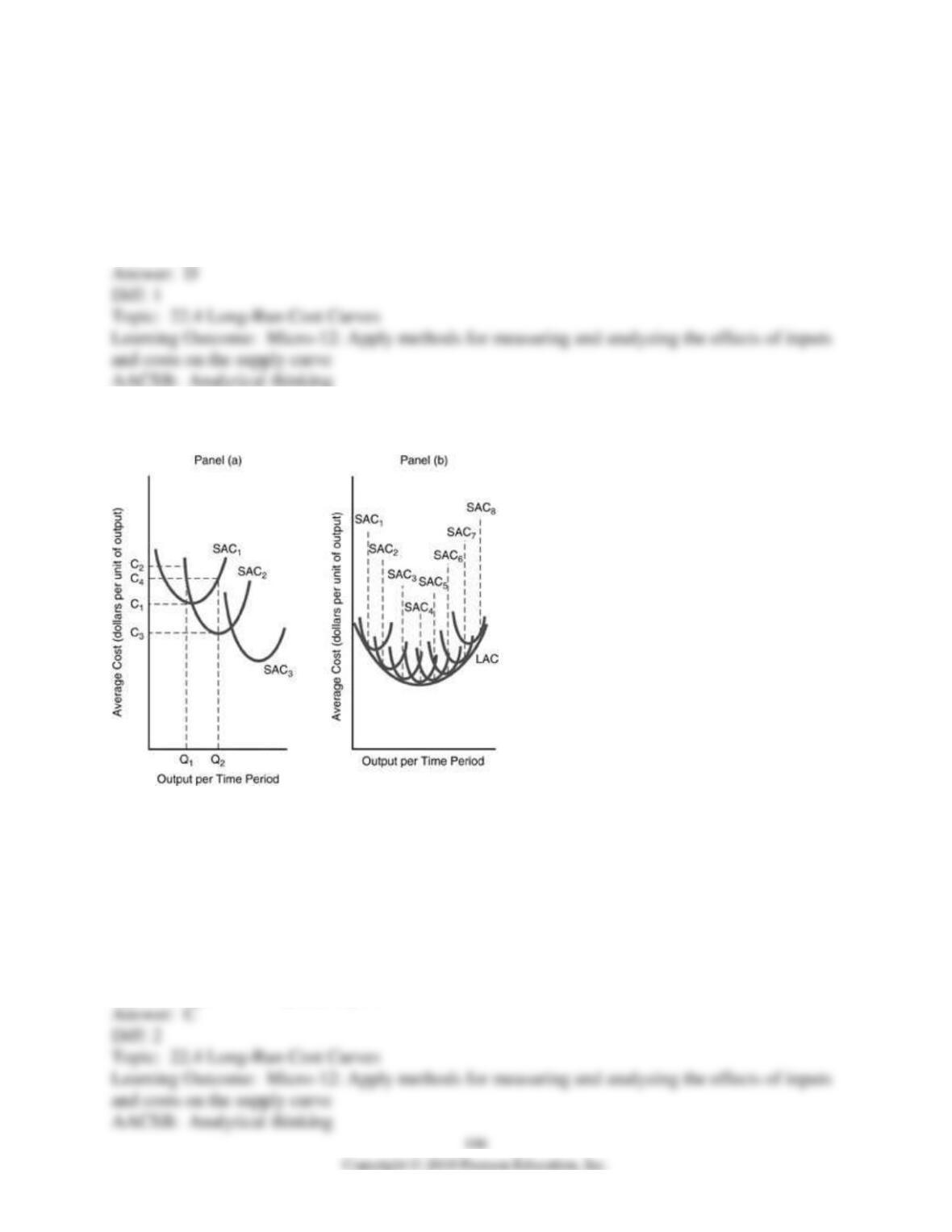
13) Which of the following statements with respect to the figure below is INCORRECT?
A) All the possible short-run average cost curves that correspond to the different plant sizes are
shown as SAC1 – SAC8.
B) If the anticipated permanent rate of output per unit time period is Q1 in panel (a), the optimal
plant would correspond to SAC1.
C) If the permanent rate of output increases to Q2 in panel (a), it will be more profitable to have
a plant size corresponding to SAC3.
D) The long-run average cost curve LAC in panel (b) is sometimes called the planning curve
representing the locus (path) of points.
14) The planning curve is the
A) long-run average cost curve.
B) production function.
C) short-run marginal cost curve.
D) short-run average cost curve.
15) Which of the following is NOT one of the reasons a firm might be expected to experience
economies of scale?
A) specialization
B) the dimensional factor
C) improved productive equipment
D) depreciation
16) Due to extremely large fixed costs, an electricity generating plant probably experiences
which of the following returns to size?
A) diseconomies of scale
B) diminishing marginal product
C) constant returns to scale
D) economies of scale
17) If a firm gets so large that management of employees and other resources becomes a costly
problem, it will be experiencing
A) diseconomies of scale.
B) diminishing marginal product.
C) constant returns to scale.
D) economies of scale.
18) Suppose a firm doubles its output in the long run. At the same time the unit cost of
production remains unchanged. We can conclude that the firm is
A) exploiting the economies of scale available to it.
B) facing constant returns to scale.
C) facing diseconomies of scale.
D) not using the available technology efficiently.
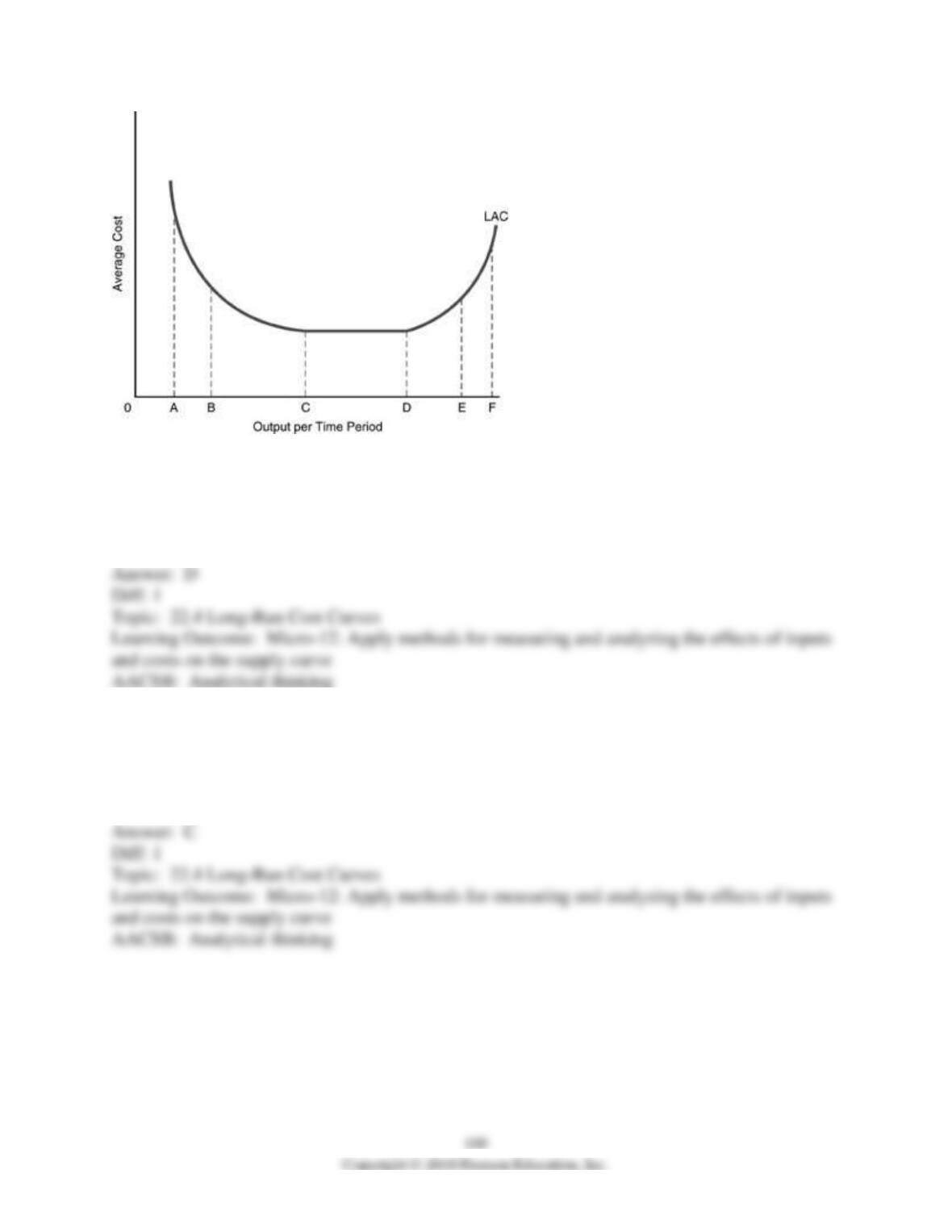
19) In the above figure, the long-run cost curve between points A and B illustrates
A) diseconomies of scale.
B) diminishing marginal product.
C) constant returns to scale.
D) economies of scale.
20) In the above figure, the long-run cost curve between points C and D illustrates
A) diseconomies of scale.
B) diminishing marginal product.
C) constant returns to scale.
D) economies of scale.
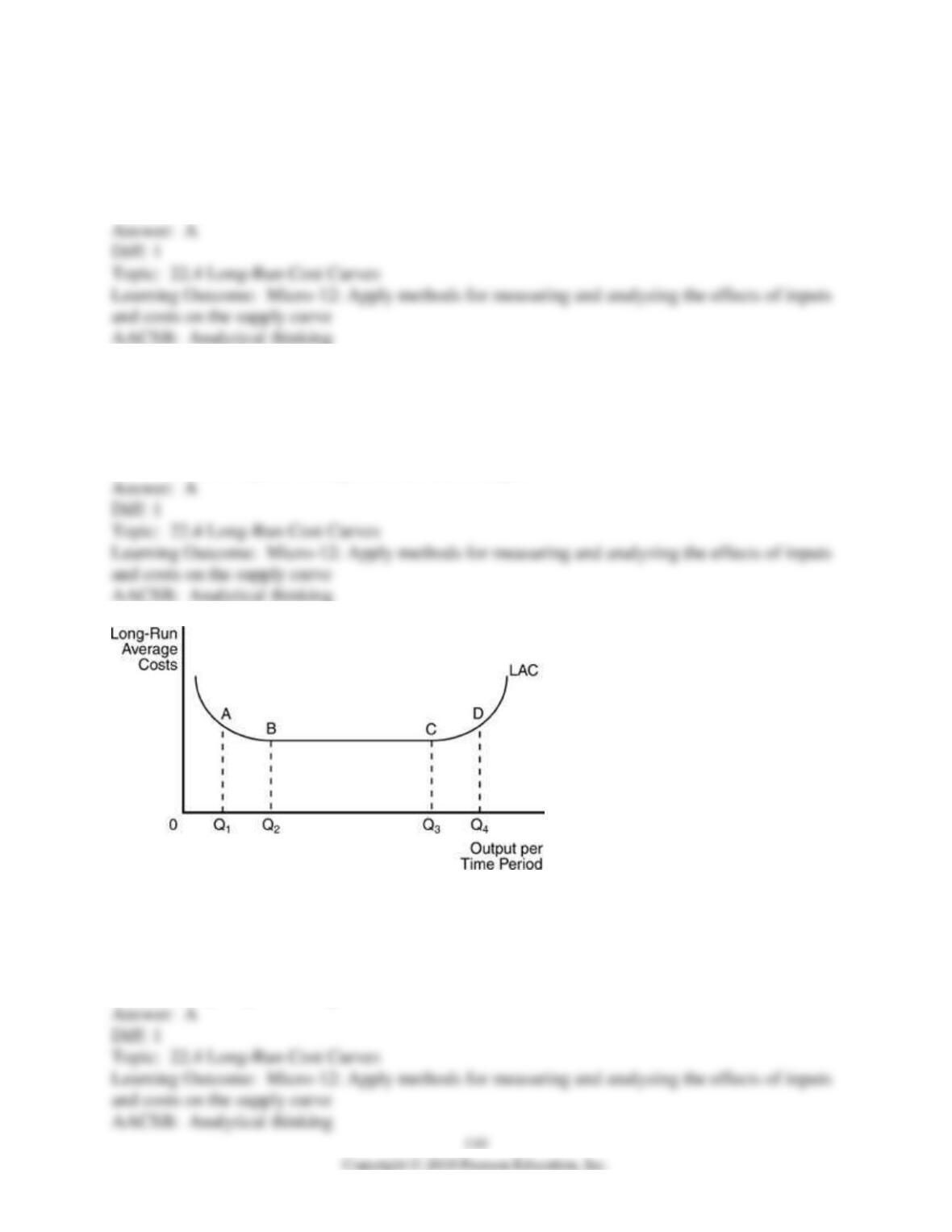
21) In the above figure, the long-run cost curve between points E and F illustrates
A) diseconomies of scale.
B) diminishing marginal product.
C) constant returns to scale.
D) economies of scale.
22) Economies of scale occur when there are
A) decreases in long-run average costs resulting from increases in output.
B) no changes in long-run average costs when output increases.
C) increases in long-run average costs when output increases.
D) decreases in output resulting from decreases in input.
23) In the above figure, for any output level less than Q2, this firm experiences
A) economies of scale.
B) diseconomies of scale.
C) constant economies of scale.
D) decreasing long run average costs.
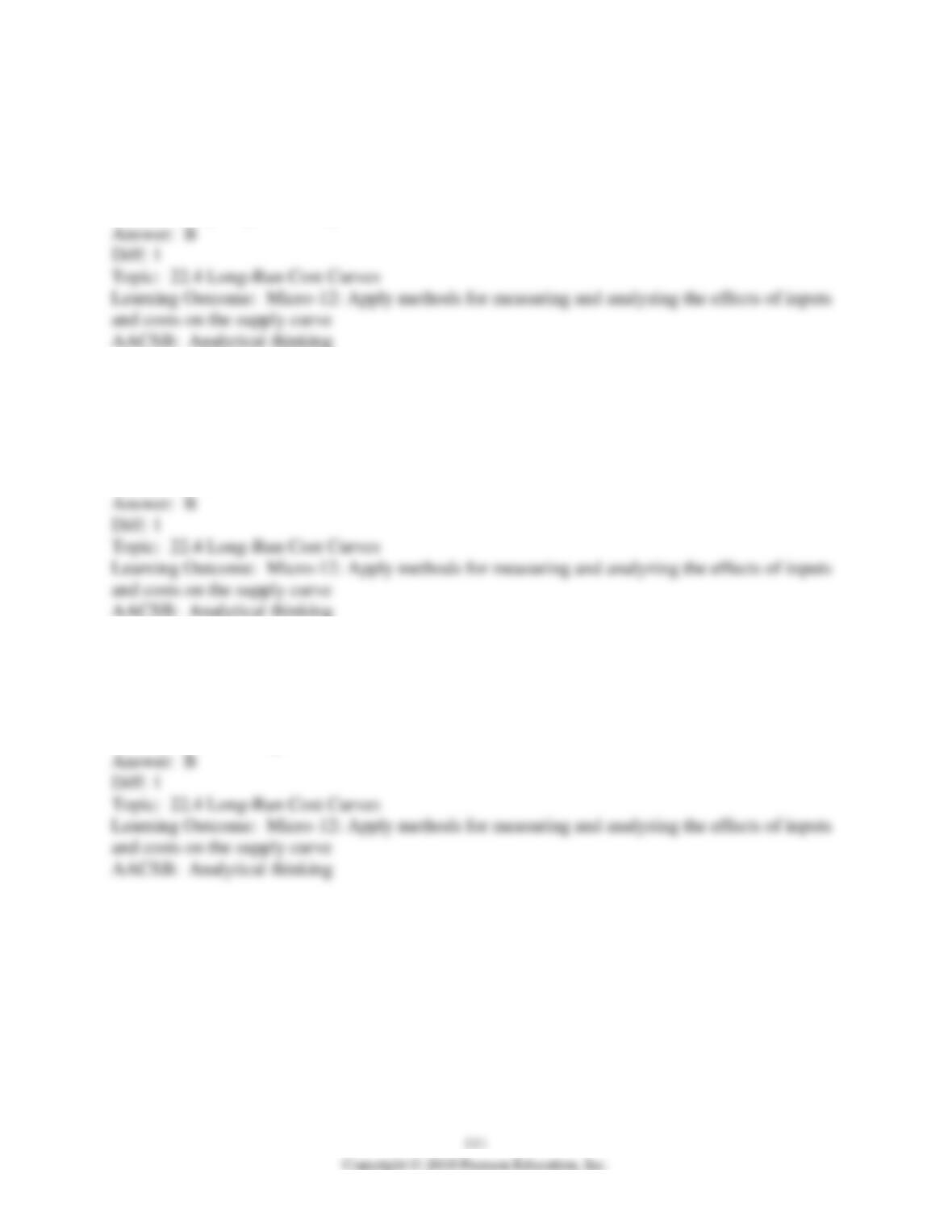
24) In the above figure, for any output level larger than Q3, this firm experiences
A) economies of scale.
B) diseconomies of scale.
C) constant economies of scale.
D) decreasing long run average costs.
25) In the above figure, the firm experiences constant returns to scale between output levels of
A) zero and Q1.
B) Q2 and Q3.
C) Q3 and Q4.
D) any level greater than Q4.
26) Economies of scale exist where the long-run average cost curve is
A) horizontal.
B) downward sloping.
C) upward sloping.
D) tangent to the marginal cost curve.
27) The typical shape of the long-run average cost curve is like
A) the letter “C.”
B) the letter “U.”
C) an inverse of the letter “V.”
D) a circle.
28) Diseconomies of scale occur
A) only in the short run.
B) only in the long run.
C) because of fixed costs.
D) none of the above.
29) A horizontal long-run average cost curve indicates
A) constant returns to scale.
B) diseconomies of scale.
C) constant marginal physical product.
D) economies of scale.
30) When increasing its output results in falling costs, a firm that can adjust all inputs is
experiencing
A) diseconomies of scale.
B) economies of scale.
C) loss.
D) capital gains.
31) Which of the following is NOT a reason a firm might experience economies of scale?
A) specialization
B) dimensional factors
C) increasing long-run average costs
D) more productive equipment
32) Which of the following physical relationships might generate economies of scale?
A) Proportionally larger pipes can transport more than a proportional increase in oil.
B) Larger equipment tends to weigh more and use more fuel on a per-unit-of-output basis.
C) Each lift truck requires one lift truck driver.
D) A doubling of all inputs leads to a doubling of output.
33) If a firm is experiencing diseconomies of scale, then
A) proportional increases in all inputs result in proportional increases in output.
B) the long-run average cost curve is rising as output expands.
C) the long-run average cost curve is decreasing as output expands.
D) the firm should expand the size of its operation.
34) The law of diminishing marginal product is responsible for
A) economies of scale.
B) constant returns to scale.
C) diseconomies of scale.
D) none of the long-run relationships.
35) The law of diminishing marginal product
A) holds in the short run and the long run because as you increase the amount of variable inputs
eventually the increases in output will decrease.
B) does not hold in the short run because of fixed costs.
C) does not hold in the long run because there are no fixed inputs in the long run.
D) holds in the short and long run because of economies to scale.