Economics Today, 19e (Miller)
Chapter 22 The Firm: Cost and Output Determination
22.1 Short Run Versus Long Run
1) Economists generally define the short run as being
A) that period of time in which at least one of the firm’s inputs, usually plant size, is fixed.
B) that period of time in which all inputs are variable.
C) any period of time less than one year.
D) any period of time less than six months.
2) Which of the following is TRUE about the long run?
A) All resources are variable.
B) All resources are fixed.
C) At least one resource is fixed.
D) none of the above
3) Which of the following is a short-run decision for a firm?
A) downsizing the firm’s manufacturing plant
B) expanding the firm’s distribution network of long-haul freight trucks and smaller delivery
trucks
C) firing workers
D) investing in a new addition to the firm’s manufacturing plant
4) The focus of firm decisions in the short run is primarily on
A) variable inputs.
B) capital investment.
C) plant size.
D) economies of scale.
5) McDonald’s is a fast-food restaurant chain. Which of the following would be a long-run
decision for McDonald’s?
A) open a new restaurant in a city
B) hire one more worker in a restaurant location
C) supply more hamburgers in one restaurant
D) replace the manager of a restaurant
6) Which of the following would NOT be a short-run decision for the firm?
A) Recall workers who were previously laid-off.
B) Have labor work two hours overtime each day in order to expand output
C) Build another wing on the plant in order to add a new assembly line.
D) Place an order with a supplier for additional raw materials.
7) A basic distinction between the long run and the short run is that
A) if a firm produces no output in the long run, it still incurs a cost.
B) the opportunity costs of production are lower in the short run than in the long run.
C) in the long run, some inputs are fixed, while in the short run, all inputs are variable.
D) in the short run, complete adjustment of all inputs is impossible, while in the long run all
inputs can be adjusted.
8) During the short run, a firm cannot
A) increase its use of labor.
B) change its plant size.
C) purchase more raw materials.
D) change its variable costs.
9) For a hotdog vendor, the hotdog stand represents his
A) fixed input.
B) variable input.
C) diseconomies of scale.
D) none of the above.
10) For a hotdog vendor, the hotdog buns represents his
A) fixed input.
B) variable input.
C) sunk cost.
D) none of the above.
11) The time period during which a firm’s capital is fixed but its labor is variable is called
A) the planning horizon.
B) the short run.
C) the long run.
D) the very long run.
12) The long run is defined as the time period in which
A) the firm can vary only one input.
B) the firm can make positive economic profits.
C) all factors of production can be altered.
D) the firm can alter its rate of production.
13) A fixed resource is one that
A) is physically tied to a specific location.
B) costs more than the average daily revenue of the firm.
C) cannot be varied in the short run.
D) can be disposed of only if the firm goes out of business.
14) Which of the following would be a fixed input to an automobile firm?
A) steel
B) a plant in California
C) car batteries
D) engineers
15) Which of the following would be a fixed input for an amusement park?
A) ticket booth workers
B) unpopped popcorn
C) concession workers
D) a roller coaster
16) Mr.Hershey’ company produces chocolate bars. Which is NOT a variable input for this firm?
A) sugar
B) assembly line workers
C) the big chocolate-stirring machines
D) packaging materials
17) In economics, how long is the long run?
A) more than one year
B) 24 months or longer
C) 5 years or more
D) whatever time it takes a firm to vary all inputs
18) The short run is
A) a year or less.
B) up to three years.
C) the period of time in which the firm can vary its rate of output.
D) the period of time in which the firm cannot change its use of at least one input.
19) The time period during at least one input cannot be changed is the
A) production time.
B) calendar year.
C) long run.
D) short run.
20) The time period during which all factors of production can be varied is the
A) production time.
B) calendar year.
C) long run.
D) short run.
21) Ajax Corporation has recently finished building a new factory. They moved into the factory a
month ago and found that it is the perfect size given the amount they want to produce. Ajax is
now operating in the
A) production time.
B) corporation time.
C) long run.
D) short run.
22) If the firm can vary all factors of production, it is operating
A) at a profit.
B) at a zero economic profit.
C) in the short run.
D) in the long run.
23) The difference between the short run and the long run is
A) economic profits are negative in the short run and positive in the long run.
B) economic and accounting profits are not equal in the short run but are equal in the long run.
C) that in the short run at least one factor of production cannot be varied while in the long run all
factors of production can be varied.
D) the short run is a period less than a year while the long run is a period greater than a year.
24) Which of the following statements is NOT true about the short run and the long run?
A) The short run for a firm is today while the long run is next week.
B) These terms apply to the planning decisions of firms.
C) The firm is always operating in the short run.
D) In the short run, the firm can change the amount of variable inputs.
25) For a wheat farmer in the middle of harvesting system, a fixed input would be
A) workers hired.
B) combines rented.
C) the land that had been planted.
D) trucks rented to haul the wheat.
26) The best way to think of the short run and the long run is as
A) specific periods of time, although the time periods may differ across industries.
B) planning terms that apply to managers.
C) concepts that apply to all people who work for a firm.
D) a concept that only accountants are concerned with.
27) For a firm, we define the short run as a period of time during which
A) at least one input cannot be changed.
B) all inputs can be changed.
C) only the plant size can be changed.
D) all inputs cannot be changed.
28) The short run is
A) a period of time during which at least one input cannot be changed.
B) a period of time during which no inputs can be changed.
C) a period of time during which all inputs can be changed.
D) a period of time shorter than one year.
29) In economics, the short run means a time period
A) during which new firms are prohibited from entering the industry.
B) during which firms are not allowed to change the amount of imported resources they use.
C) that is between one and five years.
D) during which the firm is unable to change its plant size.
30) When El Torito Restaurant is deciding how many waiters to hire for a holiday weekend, it is
making a ________ decision.
A) plant-size
B) long-run
C) short-run
D) fixed-input
31) When El Torito Restaurant is deciding to open a new restaurant location in another town, it is
making a ________ decision.
A) labor
B) long-run
C) short-run
D) fixed-input
32) In the long run, a firm can change
A) nothing.
B) only one input, such as plant size.
C) all inputs.
D) None of the above are correct.
33) The amount of calendar time associated with the long run
A) is less than five years.
B) is greater than one year.
C) is between one and five years.
D) varies by industry.
34) If Dell, a computer company, is determining whether to build a new plant in Texas or in New
Mexico, it is making a(n) ________ decision.
A) immediate-run
B) long-run
C) short-run
D) variable-input
35) The time frame in which all factors of production can vary is
A) the short run.
B) the intermediate run.
C) the long run.
D) indeterminate.
36) If a firm can vary all of its factors of production, it is operating in
A) the long run.
B) the immediate run.
C) equilibrium.
D) the short run.
37) Which of the following is a long-run adjustment?
A) A restaurant hires a new chef.
B) A company relocate to a new headquarter in another city.
C) A bank hires a new CEO.
D) A company hires ten new management trainees.
38) If a farmer buys one-hundred more acres for her flower farm, she is making a
A) long-run decision.
B) short-run decision.
C) immediate-run decision.
D) variable-input decision.
39) What is the difference between the short run and the long run? What is the appropriate time
dimension of the long run?
40) “In the short run, a firm cannot change any of its inputs.” Do you agree or disagree? Explain.
41) “In economics, the short run commonly refers to a period within one year and the long run is
a period longer than one year.” Do you agree or disagree? Explain your answer.
22.2 A Firm’s Production
1) Production functions indicate the relationship between
A) factor costs and output prices.
B) factor inputs and the quantity of output.
C) the value of inputs and average costs.
D) factor inputs and factor prices.
2) Suppose that one worker can produce 15 cookies, two workers can produce 40 cookies
together, and three workers can produce 75 cookies together. What is the marginal product of the
2nd worker?
A) 20 cookies
B) 25 cookies
C) 35 cookies
D) 40 cookies
3) Suppose that one worker can produce 15 cookies, two workers can produce 35 cookies
together, and three workers can produce 50 cookies together. What is the marginal product of the
3rd worker?
A) 20 cookies
B) 15 cookies
C) 50 cookies
D) 35 cookies
4) Suppose that one worker can produce 15 cookies, two workers can produce 35 cookies
together, and three workers can produce 60 cookies together. What is the average product of the
first two workers?
A) 15 cookies
B) 20 cookies
C) 17.5 cookies
D) 35 cookies
5) Suppose that one worker can produce 15 cookies, two workers can produce 35 cookies
together, and three workers can produce 60 cookies together. What is the average product of the
first three workers?
A) 25 cookies
B) 30 cookies
C) 17.5 cookies
D) 20 cookies
6) When a firm uses technological improvements to increase output from the same amount of
inputs, the result is
A) a new production function.
B) losses.
C) guaranteed profits.
D) diseconomies of scale.
7) The concept of the production function implies that a firm using resources inefficiently will
A) obtain less output than the theoretical production function shows.
B) obtain more output than the theoretical production function shows.
C) obtain exactly the amount that the theoretical production function shows.
D) not be subject to diminishing marginal product.
8) Changes in production functions are associated with changes in
A) the level of output.
B) demand.
C) the levels of costs.
D) technology.
9) Which of the following statements is FALSE?
A) Included in the firm’s short-run production function are both fixed and variable inputs.
B) An efficient firm can obtain more output than the production function shows.
C) The production function shows the technical relationship between a firm’s inputs and outputs.
D) The production function presents the technically efficient methods of combining inputs to
produce output.
10) Will’s Franks originally sold hotdogs and soft drinks from a cart located in front of City Hall.
Then Will purchased another hotdog cart and hired someone to sell hotdogs and soft drinks near
the high school. Both locations have been successful. When Will’s Franks expanded to two
locations, which of the following did NOT occur?
A) Will’s production function changed.
B) Production increased.
C) The company increased the inputs it employs.
D) The firm employed additional capital.
11) Which of the following changes a firm’s production function?
A) hiring additional workers
B) acquiring additional physical capital
C) adding a second production facility exactly like its first production site
D) adopting new technology
12) A negative value for the marginal physical product would indicate that
A) the company has not yet reached the point of saturation.
B) total output increased by a significant amount.
C) total output decreased when the extra unit of the variable input was added.
D) total output increased, but the increase was very small.
13) If the marginal product curve is increasing from workers 1-89 and then decreases steadily,
crossing the horizontal axis at 190 workers, we know that
A) the total output curve increases from workers 1-89, decreases from workers 90-189, and
becomes 0 at the 190th worker.
B) the total output curve is increasing at an increasing rate from workers 1-89, then increases at a
decreasing rate until the 190th worker, after which it decreases.
C) the total output curve is increasing throughout, although at an increasing rate for the first 190
workers and at a decreasing rate after the 190th worker.
D) diminishing marginal product sets in with the 190th worker.
14) If marginal product is negative, then
A) total product is rising.
B) total product is falling.
C) marginal cost is falling.
D) average profit is rising.
15) Marginal physical product of the first worker is 100, 120 for the second, 80 for the third, 30
for the fourth, 5 for the fifth, 3 for the sixth, 2 for the seventh, 1 for the eighth, and 0 for the
ninth. What is total product for the fifth worker and the ninth worker respectively?
A) 335; 341
B) 335; 0
C) 5; 0
D) 0; 5
16) When total product is rising
A) fixed cost must be rising.
B) marginal product must be positive.
C) variable cost must be declining.
D) marginal product must be negative.
17) If in the short run total product is decreasing as more workers are hired, then the marginal
physical product is
A) increasing.
B) zero.
C) negative.
D) positive.
18) The production function
A) shows the maximum level of output for a given set of inputs.
B) is an economic relationship between revenue and cost.
C) shows the relationship between input prices and amount of input used.
D) always shows increasing marginal product of labor.
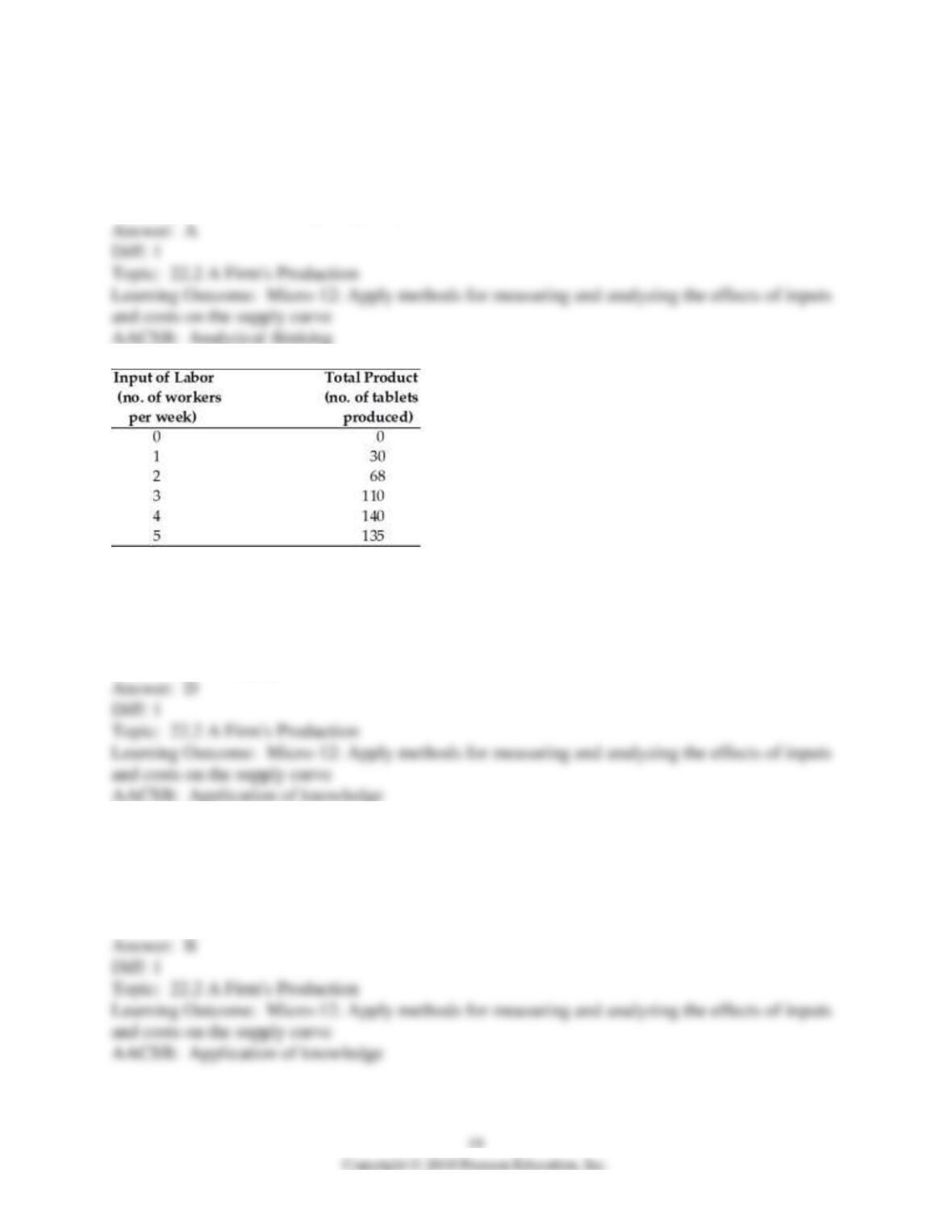
19) In the above table, average product is 30 tablets when
A) 4 workers are employed.
B) 3 workers are employed.
C) 2 workers are employed.
D) 1 worker is employed.
20) In the above table, when the firm employs 4 workers, the marginal product will be
A) 140 tablets.
B) 30 tablets.
C) 35 tablets.
D) 208 tablets.
21) In the above table, when the firm employs 3 workers, the marginal product will be
A) 42 tablets.
B) 30 tablets.
C) 36.67 tablets.
D) 208 tablets.
22) In the above table, how many workers are employed when marginal product reaches its
maximum?
A) 1
B) 2
C) 3
D) 4
23) In the above table, diminishing marginal product occurs after employing the
A) first worker.
B) second worker.
C) third worker.
D) fourth worker.