24) In the above table, marginal product becomes negative after employing the
A) second worker.
B) third worker.
C) fourth worker.
D) fifth worker.
25) In the above table, the marginal product of the second worker is
A) 68.
B) 98.
C) 38.
D) It cannot be determined.
26) In the above table, the average product of the fifth worker is
A) 35.
B) 135.
C) -5.
D) 27.
27) In the above table, which two workers have the same marginal product?
A) 1 and 2
B) 2 and 4
C) 1 and 3
D) 1 and 4
28) The marginal product of labor is calculated assuming other factor inputs
A) increase more than proportionately.
B) increase less than proportionately.
C) remain constant.
D) decrease.
29) In the short run, the additional output that results from hiring an additional unit of a variable
input is the
A) marginal product.
B) average product.
C) average variable cost.
D) marginal cost.
30) Average product is calculated by dividing total product by the
A) amount of variable and fixed inputs employed.
B) quantity of the variable input.
C) quantity of the fixed input.
D) production function.
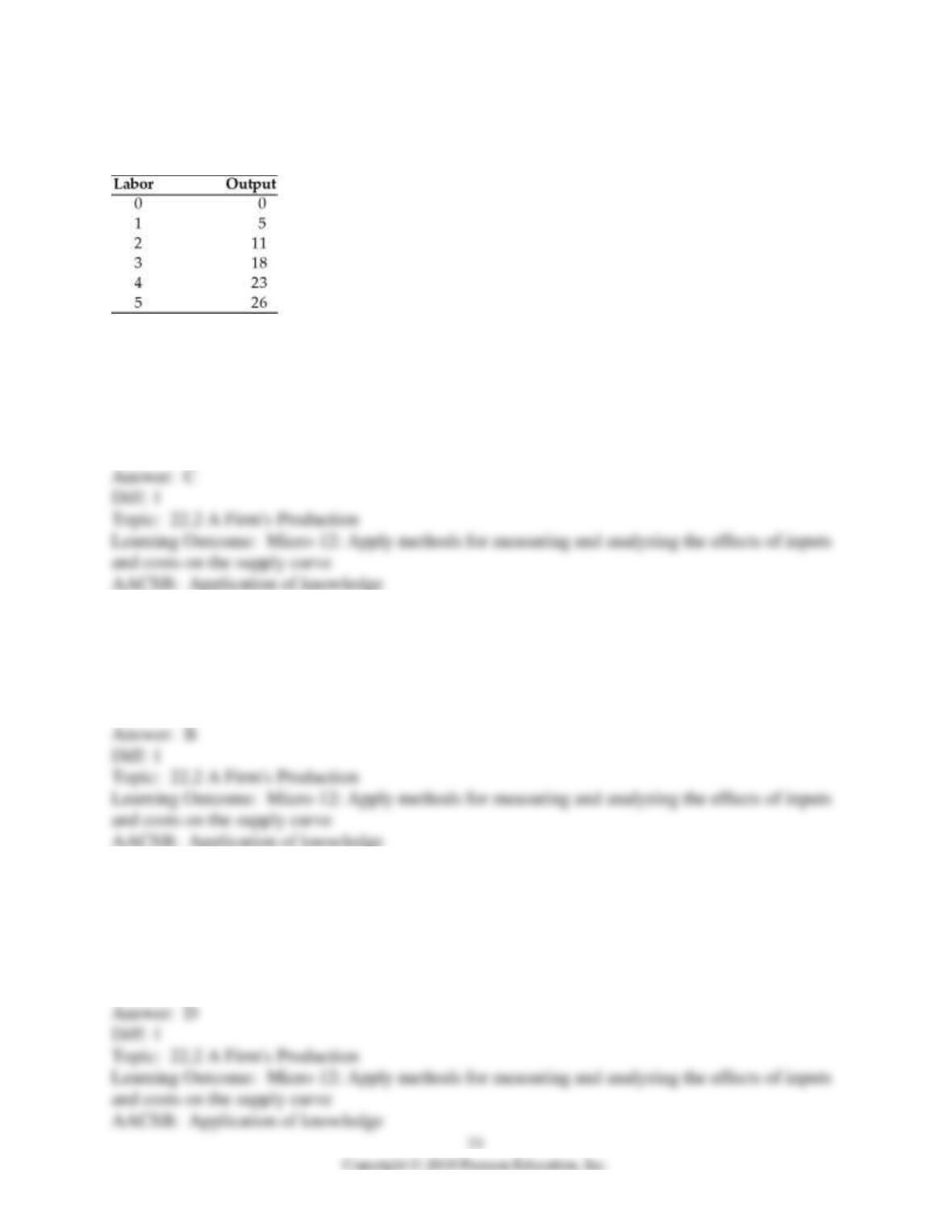
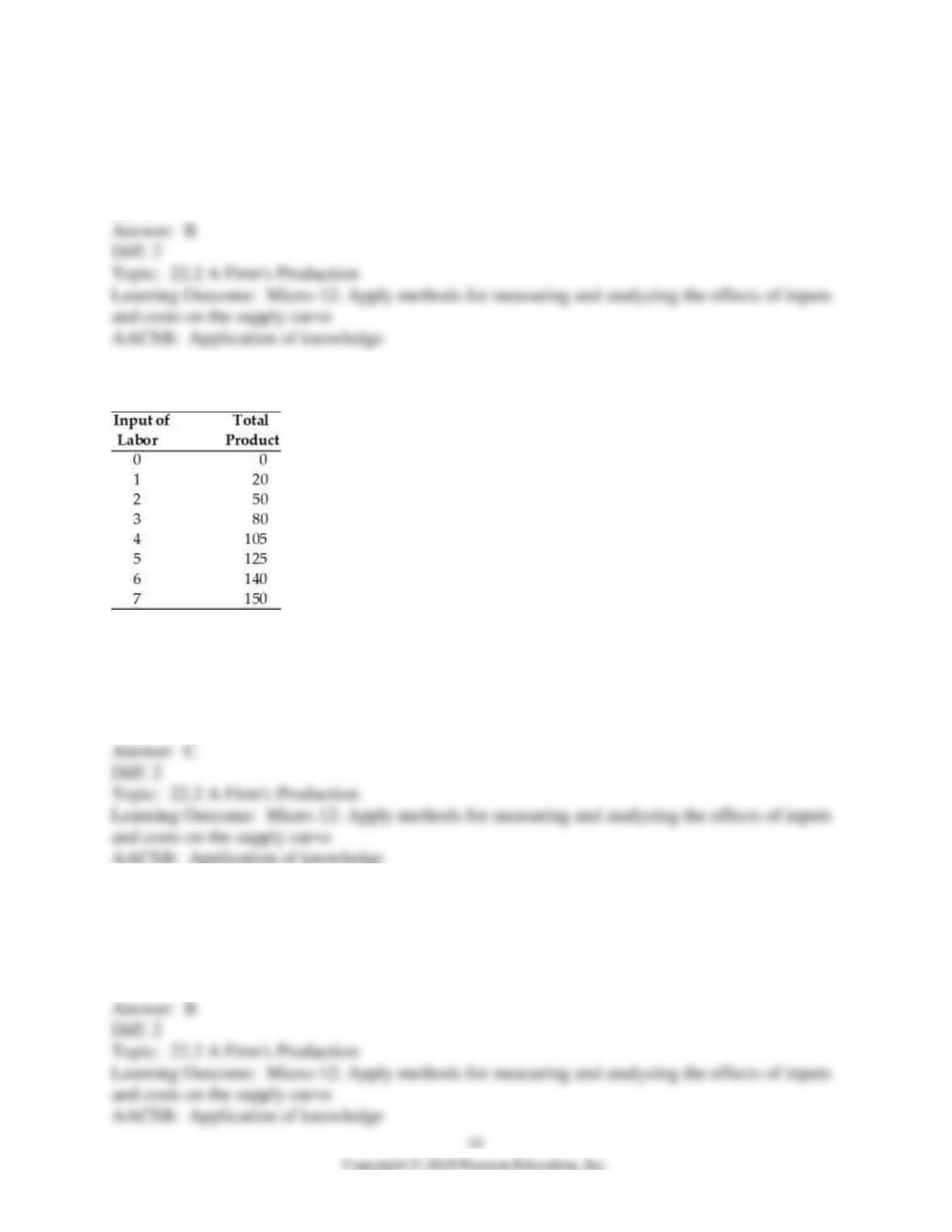
A firm has the following production relationship between labor and output, for a fixed
capital stock.
31) According to the above table, at what usage of labor does diminishing marginal product
begin?
A) 1
B) 2
C) 4
D) 5
32) According to the above table, what is the marginal product of the 4th unit of labor?
A) 3
B) 5
C) 6
D) 7
33) According to the above table, what is the average product of labor when three laborers are
employed?
A) 3
B) 4
C) 5
D) 6
34) According to the above table, what is the marginal product of the 5th unit of labor?
A) 3
B) 4
C) 5.2
D) 5
35) According to the above table, what is the average product of labor when five laborers are
employed?
A) 3
B) 5.2
C) 5.75
D) 6
36) Production
A) is a process by which resources are produced.
B) is a process by which resources are transferred into goods and services.
C) only applies to manufacturing of goods.
D) is carried on by corporations, but not by sole proprietorships.
37) Any activity that results in the conversion of resources into products that can be used in
consumption is
A) planning.
B) investment.
C) production.
D) discounting.
38) The relationship Q = f(K, L) is an example of a
A) cost function.
B) production function.
C) demand equation.
D) profit equation.
39) Which of the following activities is NOT included in the production process?
A) determining the value of the goods
B) making the goods
C) packaging the goods
D) transporting the goods
40) The production function
A) gives the maximum amount of output for a given level of inputs.
B) gives the implicit costs for all inputs.
C) gives the amount of time necessary to reach the long run.
D) allows us to compute the difference between accounting and economic profits.
41) Which of the following statements is NOT true about the production function?
A) It gives the maximum output that can be obtained for a given level of inputs.
B) A new production function does not have to be developed when there is technical progress
since technology is included in the function.
C) The production function depends upon the level of technology available to the firm.
D) It specifies the cost of inputs necessary to produce a certain level of outputs.
42) The relationship between inputs and outputs is known as
A) business.
B) manufacturing.
C) a production function.
D) marginal product.
43) A production function is a(n)
A) cost relationship.
B) economic relationship.
C) accounting relationship.
D) technological relationship.
44) The production function does NOT provide information about
A) the technology used in the production process.
B) the types of inputs used in the production process.
C) the relationship between changes in quantity of inputs and changes in the quantity of output.
D) the profits of producing a good.
45) Another term for the total quantity of output is
A) average product.
B) marginal product.
C) total product.
D) average variable product.
46) Total product divided by the variable input is
A) average total cost.
B) marginal cost.
C) average product.
D) marginal product.
47) Marginal product and average product are measured in
A) dollars.
B) profit terms.
C) units of production.
D) the same units as marginal cost and average total cost.
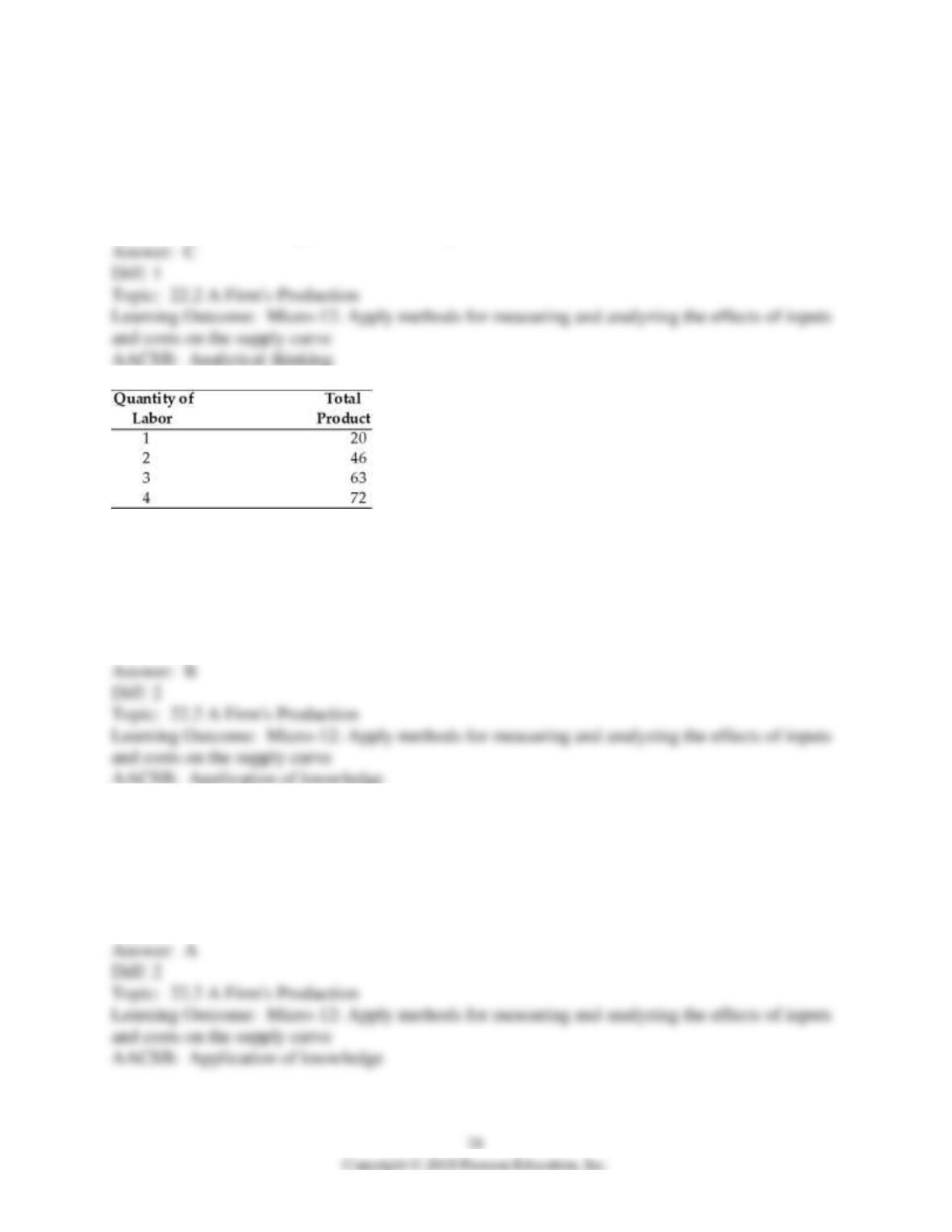
48) Refer to the above table. When the quantity of labor equals 2, what does the average product
equal?
A) 46
B) 23
C) 26
D) 92
49) Refer to the above table. When the quantity of labor equals 3, what does the average product
equal?
A) 21
B) 17
C) 63
D) 189
50) Refer to the above table. When the quantity of labor equals 4, what does the average product
equal?
A) 9
B) 18
C) 72
D) 216
51) Refer to the above table. What does the marginal product equal when the quantity of labor
goes from 1 to 2?
A) 46
B) 23
C) 26
D) 92
52) Refer to the above table. What does the marginal product equal when the quantity of labor
goes from 2 to 3?
A) 21
B) 17
C) 63
D) 189
53) Refer to the above table. What does the marginal product equal when the quantity of labor
goes from 3 to 4?
A) 9
B) 18
C) 72
D) 216
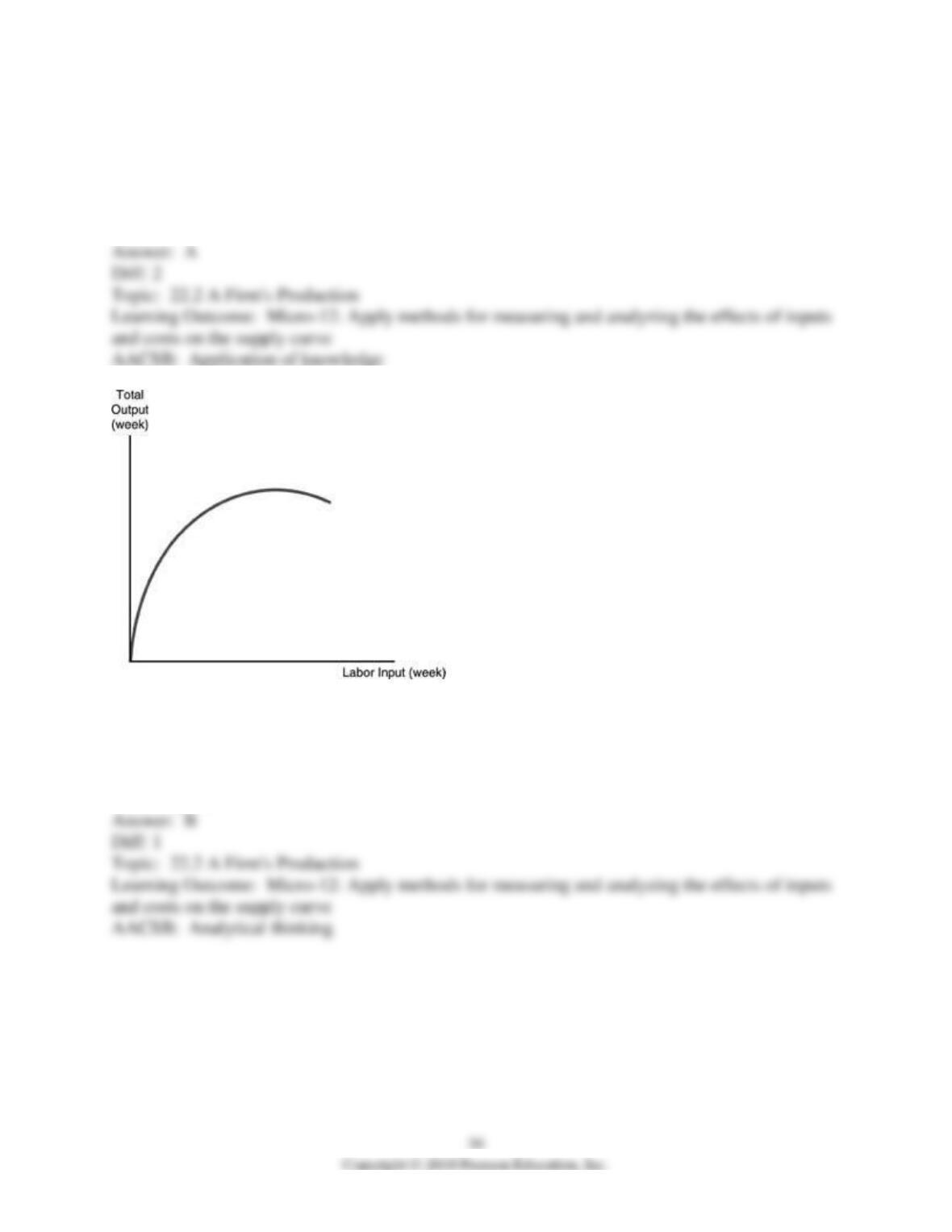
54) Refer to the above figure. The curve represents a
A) marginal product curve.
B) total product curve.
C) total cost curve.
D) average total cost curve.
55) As the amount of a variable input increases, while all other inputs are held constant, total
product will
A) always increase.
B) always decrease.
C) initially decrease and then increase.
D) initially increase and then decrease.
56) If the average product of 20 workers is 100 bushels of wheat and the average product of 21
workers of wheat is 99 bushels of wheat, then the marginal product of the 21st worker was
A) -1 bushel of wheat.
B) 5 bushels of wheat.
C) 79 bushels of wheat.
D) 99 bushels of wheat.
57) Marginal product is
A) the change in total output from using an additional unit of one variable input, holding other
inputs constant.
B) the change in total output from using an additional unit of all variable inputs.
C) the total output divided by the number of units of the variable input.
D) the change in total output divided by the number of units of the variable input, holding
constant all other inputs.
58) The change in total product occurring when a variable input is increased and all other inputs
are held constant is
A) average total cost.
B) marginal cost.
C) average product.
D) marginal product.
59) The physical output that is due to the addition of one more unit of a variable factor of
production is
A) average total cost.
B) marginal cost.
C) average product.
D) marginal product.
60) As the quantity of labor increases while the amount of other inputs are held constant,
marginal product of labor will
A) increase continuously.
B) decrease continuously.
C) initially decrease and then increase.
D) initially increase and then decrease.
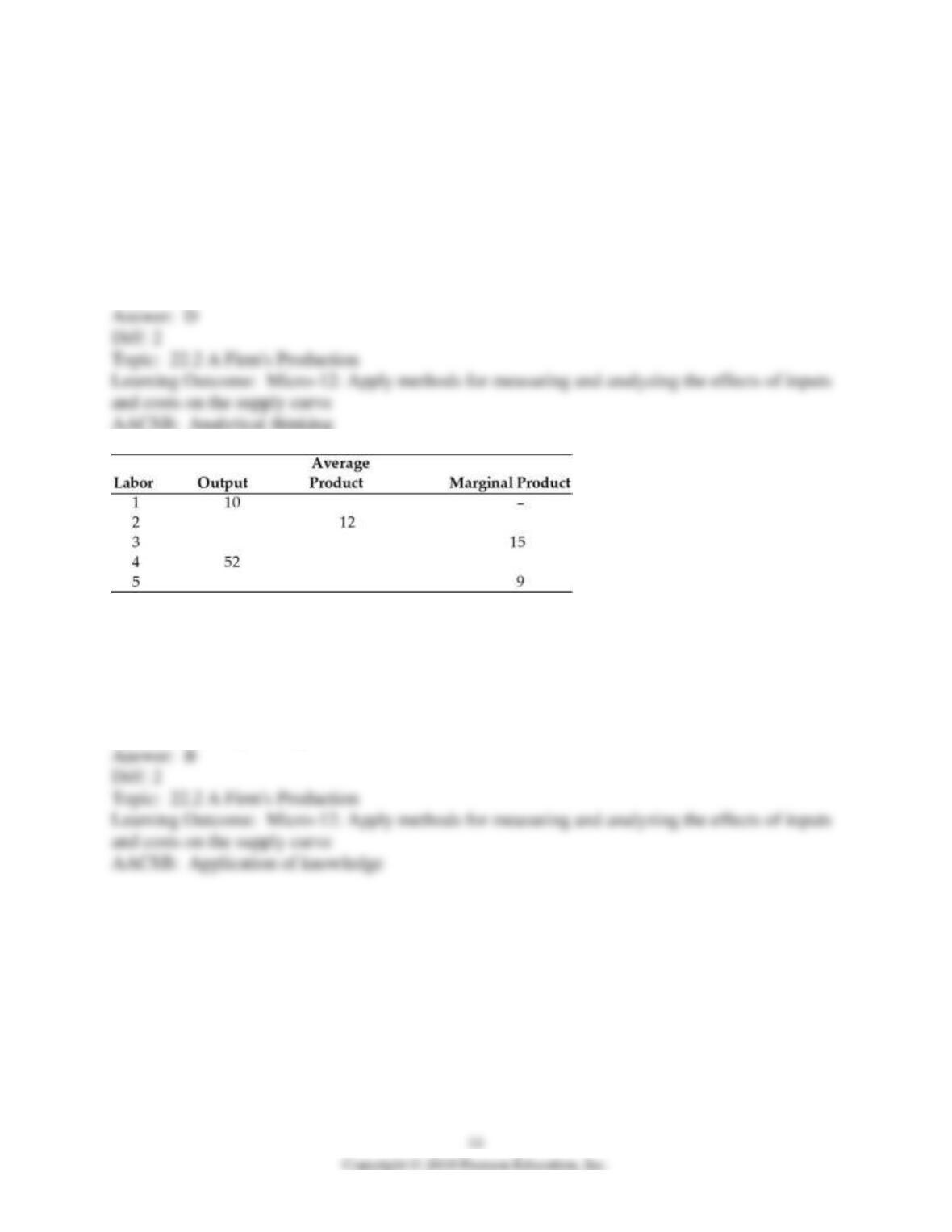
61) Recently Apple Computer developed Apple’s new iTunes Music Store, which offers more
than 200,000 songs from five major record labels, for use with Apple’s iPod and iMac. More than
a million songs were downloaded the first week alone! In economic terms, CEO Tim Cook
helped convert capital and labor inputs into products consumers use. Any activity that results in
the conversion of resources into products that can be used in consumption is
A) not profitable.
B) a start up venture.
C) demand.
D) production.
62) Using the above table, the total product and average product when 3 workers are employed
are
A) 36 and 12, respectively.
B) 39 and 13, respectively.
C) 37 and 27, respectively.
D) 40 and 10, respectively.
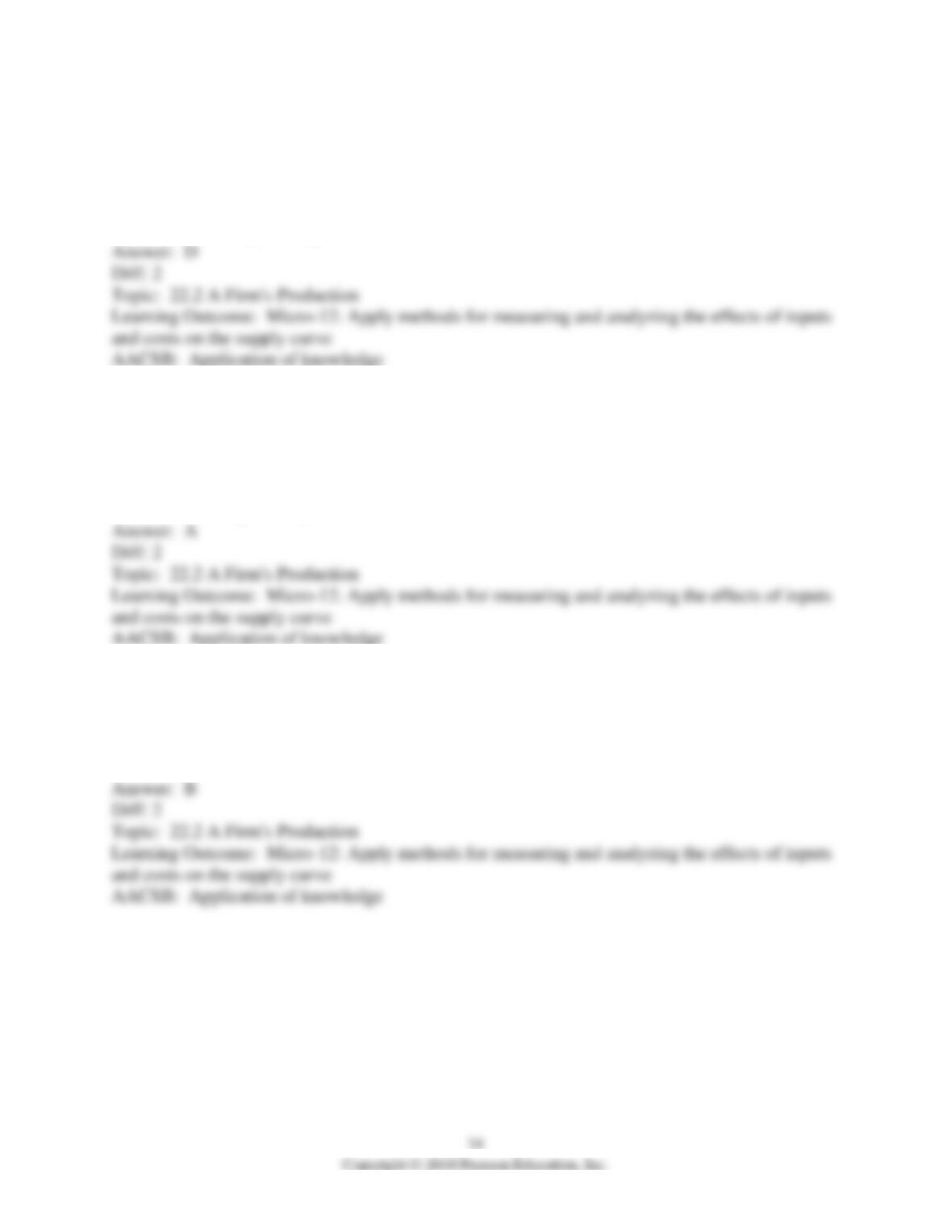
63) Using the above table, the total product and average product when 5 workers are employed
are
A) 61 and 21, respectively.
B) 62 and 13, respectively.
C) 62 and 15, respectively.
D) 61 and 12.2, respectively.
64) Using the above table, the average product and marginal product when 4 workers are
employed are
A) 13 and 13, respectively.
B) 13 and 14, respectively.
C) 13 and 9, respectively.
D) 14 and 13, respectively.
65) Using the above table, the marginal product of the 2nd worker is
A) 12.
B) 14.
C) 15.
D) 13.
66) Using the above table, the marginal product of the 4th worker is
A) 12.
B) 13.
C) 14.
D) 15.
Use the information from the below table to answer following question(s).
67) In the above table, the average product for 5 units of labor is
A) 20.0.
B) 22.5.
C) 25.0.
D) 15.0.
68) In the above table, the average product for 3 units of labor is
A) 30.0.
B) 26.7.
C) 26.3.
D) 25.0.
69) In the above table, the marginal product of the fourth worker is
A) 30.
B) 25.
C) 20.
D) 15.
70) In the above table, the marginal product of the sixth worker is
A) 10.
B) 25.
C) 20.
D) 15.
71) When total product is increasing at an increasing rate, marginal product is
A) positive and increasing.
B) positive and decreasing.
C) constant.
D) negative.
72) When total product is increasing at a decreasing rate, marginal product is
A) positive and increasing.
B) positive and decreasing.
C) constant.
D) negative.
73) If four workers were hired and we discovered that we could produce 88 units of production,
what is the average physical product of labor?
A) 44
B) 352
C) 11
D) 22
74) At Phil’s Pretzel Stand, we found the following:
4 laborers produced 66 pretzels
5 laborers produced 76 pretzels
6 laborers produced 85 pretzels
7 laborers produced 88 pretzels
What was the marginal product of the sixth laborer?
A) 10 pretzels
B) 9 pretzels
C) 6 pretzels
D) 3 pretzels
75) At Phil’s Pretzel Stand, we found the following:
4 laborers produced 66 pretzels
5 laborers produced 76 pretzels
6 laborers produced 85 pretzels
7 laborers produced 88 pretzels
What was the marginal physical product of the seventh laborer?
A) 10 pretzels
B) 9 pretzels
C) 3 pretzels
D) none of the above due to insufficient information
76) The change in output caused by a one-unit change in labor is referred to as the
A) compounded physical product of labor.
B) average product of labor.
C) marginal product of labor.
D) total product of labor.
77) Which of the following statement is correct?
A) When Marginal Product is greater than Average Product, Average Product is increasing.
B) When Marginal Product is greater than Average Product, Average Product is decreasing.
C) When Marginal Product is greater than Average Product, Average Product is equal to Total
Product.
D) When Marginal Product is greater than Average Product, Total Product is increasing at a
decreasing rate.
78) The average product of labor is equal to
A) total product divided by quantity of labor.
B) change in total product divided by quantity of labor.
C) total product divided by change in quantity of labor.
D) change in total product divided by change in quantity of labor.
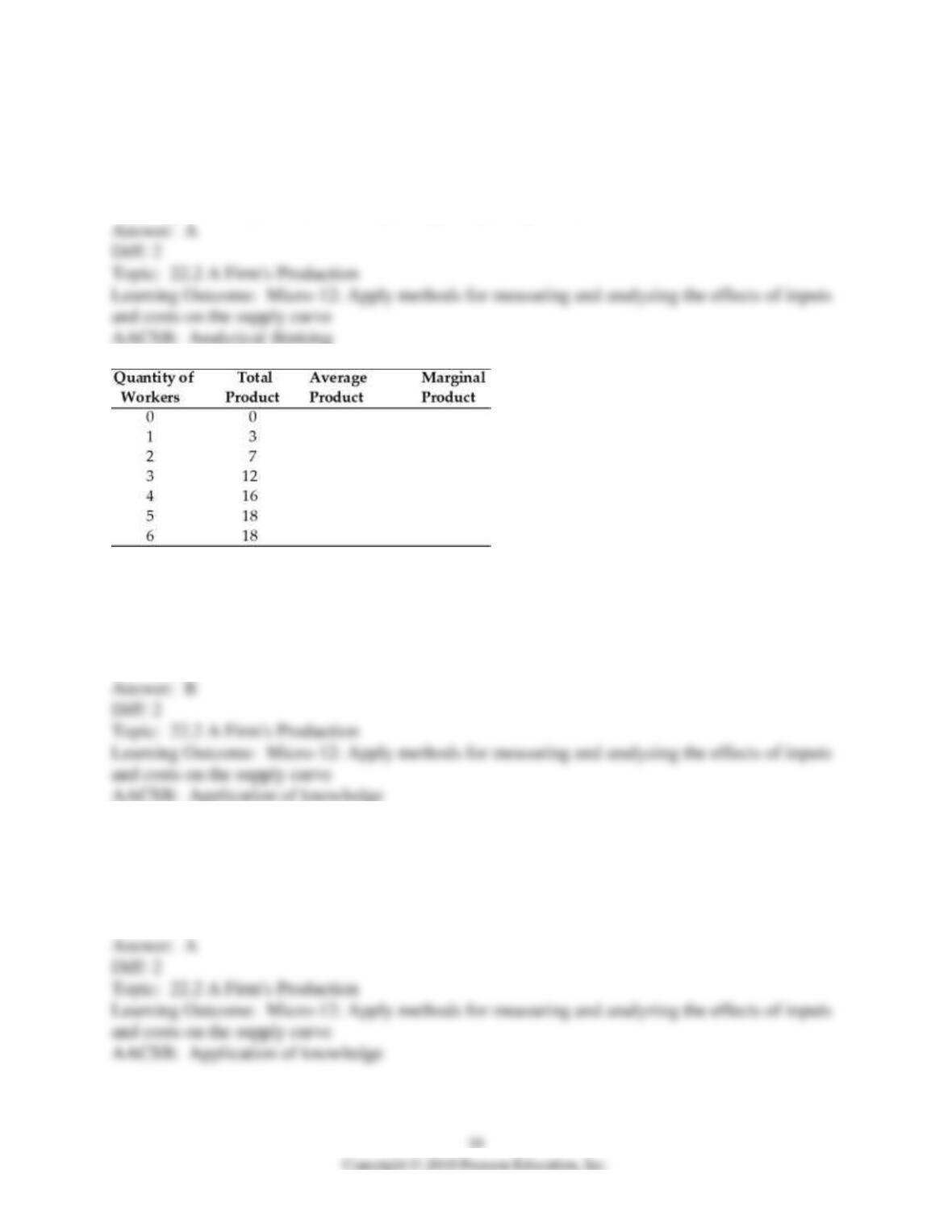
79) In the above table, the average product of the 3rd worker is
A) 5.
B) 4.
C) 3.
D) 12.
80) In the above table, the marginal product of the 3rd worker is
A) 5.
B) 4.
C) 3.
D) 12.
81) In the above table, the average product of the 6th worker is
A) 5.
B) 4.
C) 3.
D) 0.
82) In the above table, the marginal physical product of the 6th worker is
A) 5.
B) 4.
C) 3.
D) 0.
83) In the above table, the average physical product of 2 workers and the marginal product of the
2nd worker is
A) 2; 2.
B) 4; 1.
C) 3.5; 3.5.
D) 3.5; 4.