New gym
New library
New computer lab
New library
New computer lab
New gym
New computer lab
New gym
New library
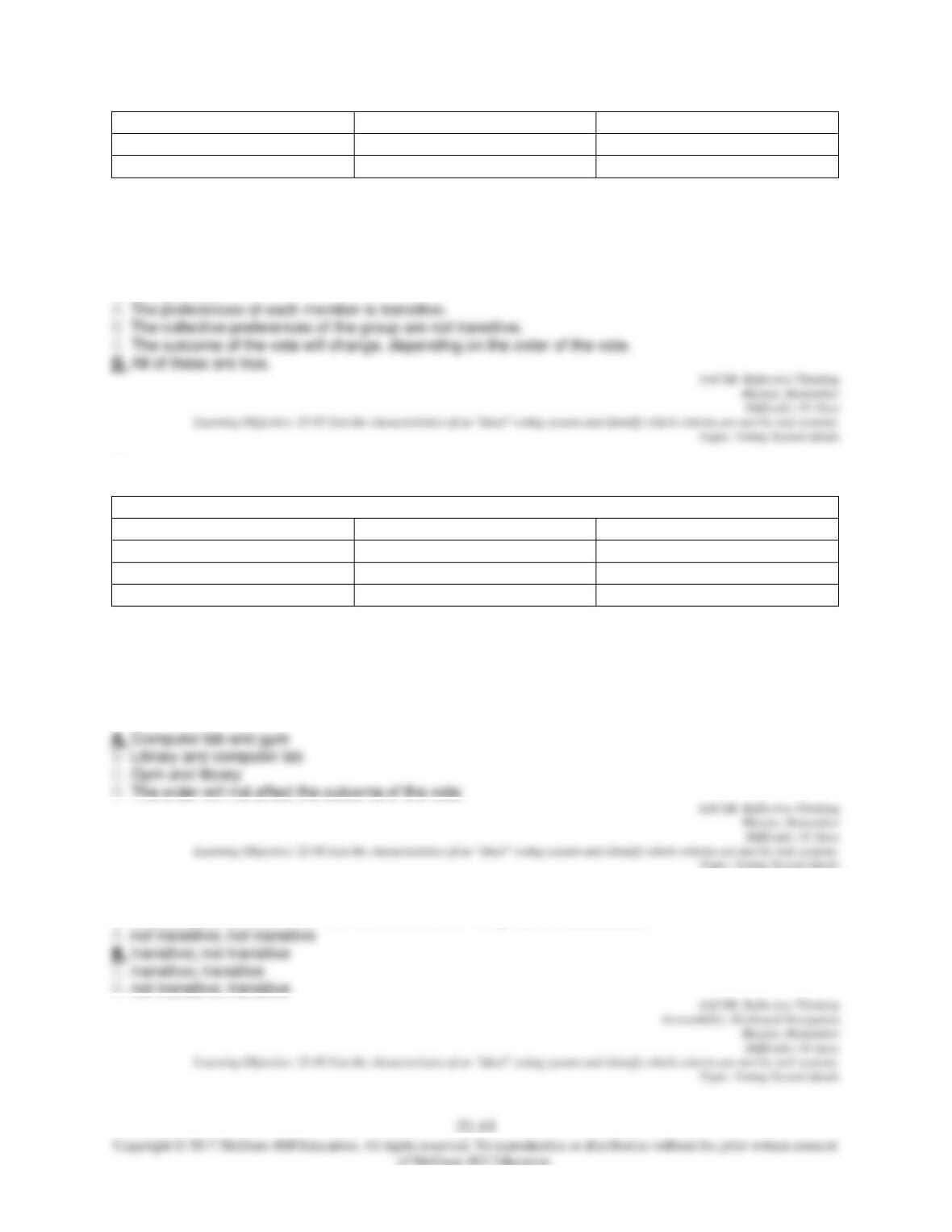
If a pair-wise majority vote was held and the voters’ preferences are shown in the table, which of the
following is true?
52.
School Board Voters’ Ordered Preferences
David
Ernie
Fiona
New gym
New library
New computer lab
New library
New computer lab
New gym
New computer lab
New gym
New library
If a pair-wise majority vote was held to determine which school project gets funded and the voters’
preferences are shown in the table, in order for the library to win overall, which items must be voted on
first?
53. The Condorcet paradox is a situation in which the preferences of each individual member of a group
are ___________, and the collective preferences of the group are _________.
54. The Condorcet paradox can arise with:
55. Pair-wise majority voting ______________ the criteria of an ideal voting system.
56. Pair-wise majority voting fails to meet which of the following criteria?
57. When voting systems fall short of the ideal by violating the principle of transitivity, the ____________
is sometimes crucial in shaping the final outcomes.
58. Arrow’s impossibility theorem tells us:
59. Which theorem tells us that no voting system is perfect?
60. Research demonstrates that elections can be swayed by factors other than the rational policy
considerations of well-informed voters, such as:
61. When a voter chooses to remain ignorant when the opportunity costs of gathering information
outweigh the benefits, it is called:
62. If we think of good governance as a public good created by well-informed voters, we can predict that it
will be:
63. Research has shown that the chances of one vote making a difference in an election is:
64. Research has shown that voters are more likely to turn out in elections with ________ electorates and
when the election is likely to be ____________.
65. Despite the fact that most votes have virtually no impact on the outcome of a vote, and knowing
people incur opportunity costs to vote, we recognize that people vote for all of the following reasons
except they:
66. Mail-in ballots are designed to:
67. An unintentional consequence of using mail-in ballots in a small community is:
68. By using mail-in ballots, voter participation may fall. This can be explained as the decreased:
69. The problem caused when people are often reluctant to voluntarily pay for goods and services that
provide benefits for everyone, even for those who don’t pay is called the:
70. The consequence for society of the free-rider problem is:
71. Political advocacy:
72. If the free-rider problem affects political advocacy, the result may be that the:
73. We refer to situations in which individuals need to act collectively to reach solutions that will make
everyone better off as:
22–20
74. When a group of people stand to gain from an action that is not rational for any of the members to
undertake individually, it is referred to as a:
75. A collective-action problem is a situation in which:
76. The time and money it takes to organize a group or a campaign and to get the attention of lots of busy
people is the:
77. When organizing a collective action, it is generally true that the larger the group the:
78. The likelihood of successful collective action:
79. If two groups disagree about a policy, a smaller group that experiences higher benefits per person
can be:
80. At its extreme, the use of the powers of government by public officials to achieve personal gains is:
81. Rent-seeking behavior creates:
82. Lobbying can shape regulations through:
83. Steel producers lobbying to keep imports out is an example of:
84. Why doesn’t the process of electing officials prevent rent-seeking and corruption?
85. Bureaucratic capture is:
86. What situation arises when government positions are filled with people who have close ties to the
group they are supposed to regulate?
87. Bureaucratic capture occurs when:
88. The amount of corruption that occurs in a government is hard to measure because:
89. The intent of the liberum veto was ___________, and the outcome was _____________.
90. If the liberum veto is used in a policy-making setting, it means:
91. Political structure, or the process by which laws become enacted:
92. __________ countries have explicit requirements about the number of parties that can participate in
an election.
93. First-past-the-post voting structures tend to lead to a:
94. When smaller political groups wish to have influence in a government with pluralistic voting, they will:
95. Many countries use a proportional-representation system, which means that:
96. Compared to proportional-representation systems, two-party systems are thought to lead to:
97. Compared to two-party systems, proportional-representation systems are thought to:
98. Compared to proportional-representation systems, two-party systems are thought to:
99. Term limits on political offices have all of the following properties except:
100. An example of term limits in the United States would be that U.S. presidents cannot hold more than:
101. A political structure’s enfranchisement refers to:
102. In the past, voting systems in most countries required that you be:
22–26
103. Historically, controlling who was able to vote was an important tool:
104. Poll taxes are:
Chapter 22 Test Bank Summary
Category
# of Ques
tions
AACSB: Reflective Thinking
104
Accessibility: Keyboard Navigation
87
Blooms: Remember
66
Blooms: Understand
38
Difficulty: 01 Easy
66
Difficulty: 02 Medium
38
Learning Objective: 22-01 Explain the predictions and assumptions of the median-
voter theorem.
9
Learning Objective: 22-
02 List the characteristics of an “ideal” voting system and identify which criteria are met
by real systems.
50
Learning Objective: 22-
03 Discuss problems with the idea of the “rational voter” and define the idea of rational
ignorance.
9
Learning Objective: 22-
04 Explain the persistence of policies that provide concentrated benefits to a few while i
mposing diffuse costs on the majority.
11

22–27
Learning Objective: 22-05 Explain why corruption and rent-
seeking can persist in a democratic system.
9
Learning Objective: 22-
06 List three major features of political structure and identify how they can affect policy
choices.
16
Topic: Collective Action
11
Topic: Corruption and Rent Seeking
9
Topic: Median-Voter Theorem
9
Topic: Political Structure
16
Topic: Rational Ignorance
9
Topic: Voting System Ideals
50