
Chapter 22
Natural Resources, the Environment, and Climate Change
Multiple Choice
1. The wood in a forest would be considered a
A) limited natural resource.
B) renewable natural resource.
C) sequestered natural resource.
D) sustainable natural resource.
2. Natural gas would be considered a
A) limited natural resource.
B) renewable natural resource.
C) sequestered natural resource.
D) sustainable natural resource.
3. Crude oil would be considered a
A) limited natural resource.
B) renewable natural resource.
C) sequestered natural resource.
D) sustainable natural resource.
4. The fish in the ocean would be considered a
A) limited natural resource.
B) renewable natural resource.
C) sequestered natural resource.
D) sustainable natural resource.
5. Iron ore would be considered a
A) limited natural resource.
B) renewable natural resource.
C) sequestered natural resource.
D) sustainable natural resource.

6. The optimal resource use for a limited natural resource very much depends on the
A) discount rate you apply to the use to future limited natural resources.
B) place from where it is harvested.
C) incomes of those who will benefit from its use.
D) relative cost of extracting that resource relative to a substitute.
7. The optimal resource use for a limited natural resource is
A) more front loaded with a higher discount rate.
B) more back loaded with a higher discount rate.
C) unrelated to the discount rate.
D) more likely to be u-shaped with a higher interest rate.
8. The optimal resource use for a limited natural resource is
A) more front loaded with a higher discount rate.
B) more back loaded with a higher discount rate.
C) unrelated to the discount rate.
D) more likely to be u-shaped with a higher interest rate.
9. Suppose an ardent environmentalist sought to preserve limited natural resources for future
generations, she would, more than likely be arguing that oil and gas companies use an
inappropriately
A) high discount rate when considering optimal resource use.
B) low discount rate when considering optimal resource use.
C) decreasing discount rate when considering optimal resource use.
D) flat discount rate when considering optimal resource use.
10. The act of weighing the long run use of limited natural resources is called
A) stewardship.
B) gamesmanship.
C) brinksmanship.
D) fostering.
11. Sustainability requires that
A) renewable natural resources be used only at a rate at which they can be replaced.
B) limited natural resources be used as sparingly as possible.
C) gamesmanship.
D) Both gamesmanship and renewable natural resources be used only at a rate at which they
can be replaced.
12. A person using a high discount rate is going to consider the concept of sustainability
A) as wise.
B) as unwisely focusing on the present.
C) as overly weighting the future.
D) just a fancy term oil and gas companies use to argue for increased rights to drill.
13. A person using a discount rate or 0% is going to consider the concept of sustainability
A) as wise.
B) as unwisely focusing on the present.
C) as overly weighting the future.
D) just a fancy term oil and gas companies use to argue for increased rights to drill.
14. The concept of “clean enough” to an economist means the
A) perfect state of cleanliness.
B) state of cleanliness where the average cost of cleaning more equals the average benefit of
cleaning more.
C) state of cleanliness where the marginal cost of cleaning equals the marginal benefit of
cleaning.
D) state of cleanliness where the total cost of cleaning equals the total benefit of cleaning.
15. Economists assume that early in the process of cleaning a dirty environment there are
relatively
A) high benefit-low cost things than can and should be done first.
B) high benefit-high cost things than can and should be done first.
C) low benefit-low cost things than can and should be done first.
D) low benefit-high cost things than can and should be done first.
16. Economists assume that late in the process of cleaning a dirty environment there are
relatively
A) high benefit-low cost things than could and should be saved for last.
B) high benefit-high cost things than could and should be saved for last.
C) low benefit-low cost things than could and should be saved for last.
D) low benefit-high cost things than could and should be saved for last.
17. Pollution is an example of a
A) negative externality.
B) positive externality.
C) neutral externality.
D) golden externality.
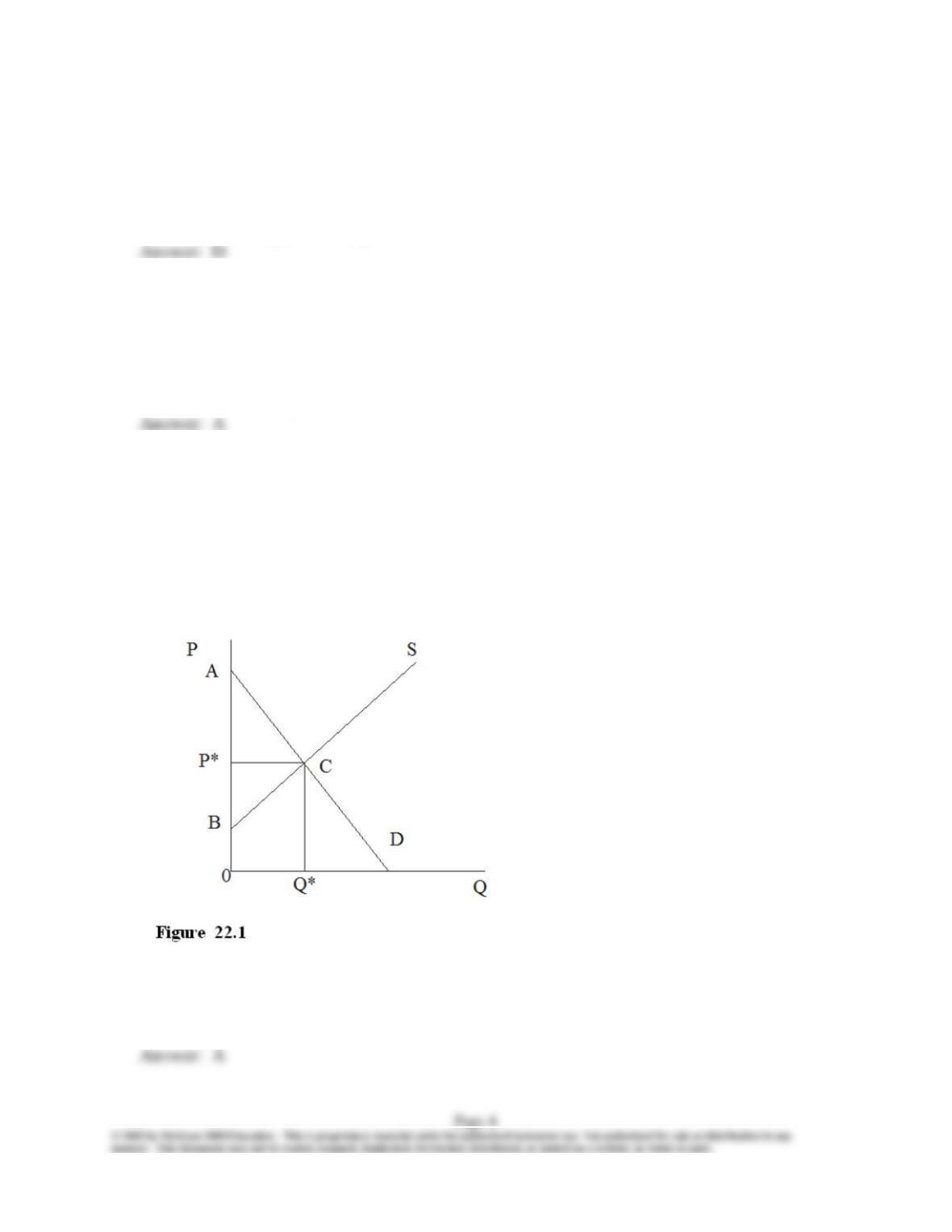
18. In Figure 22.1 for a good with no externality, which area represents the total value to the
consumer?
A) 0ACQ*
B) BP*C
C) 0BCQ*
D) 0P*CQ*
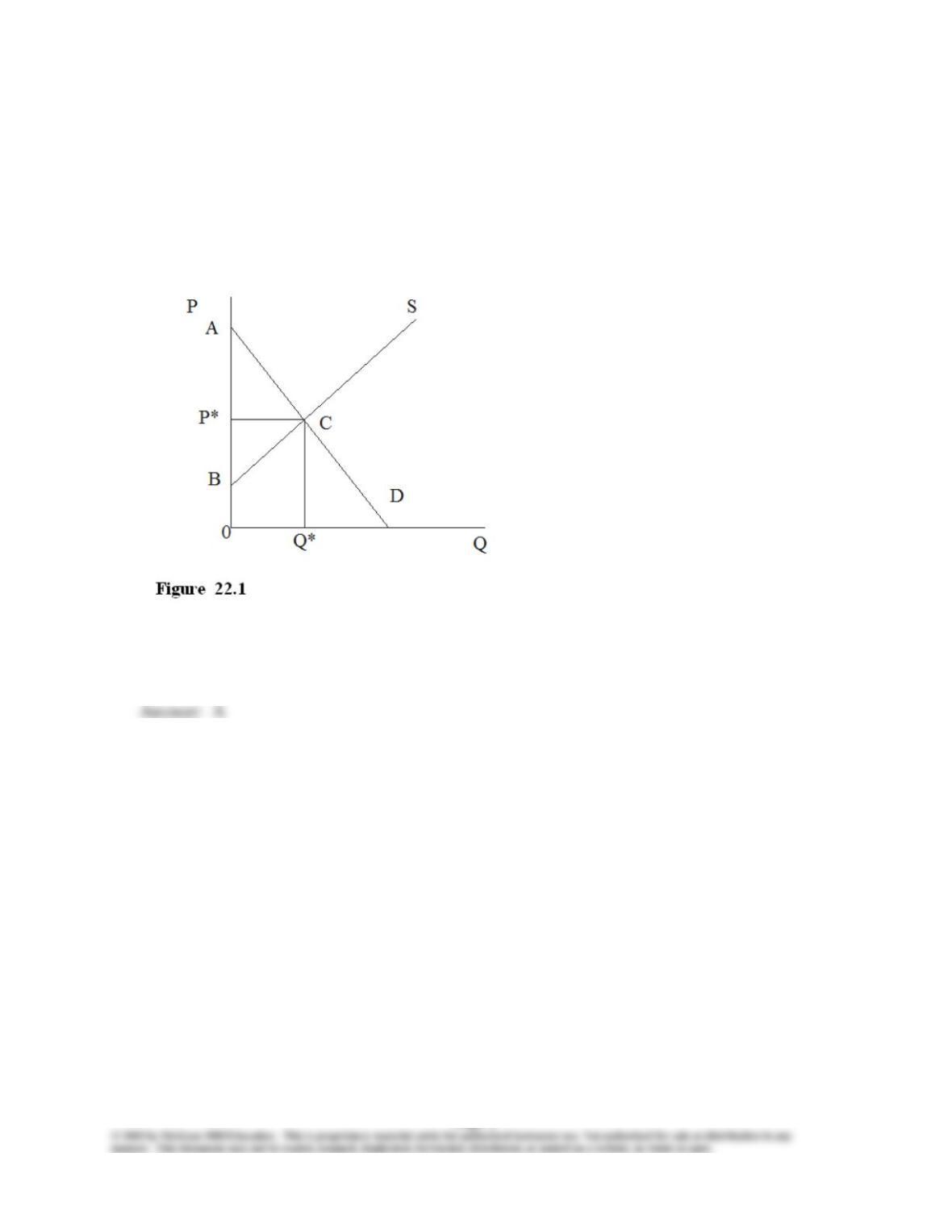
19. In Figure 22.1 for a good with no externality, which area represents consumer surplus to the
consumer?
A) AP*C
B) 0ACQ*
C) 0BCQ*
D) 0P*CQ*
20. In Figure 22.1 for a good with no externality, which area represents the total variable cost to
the producer?
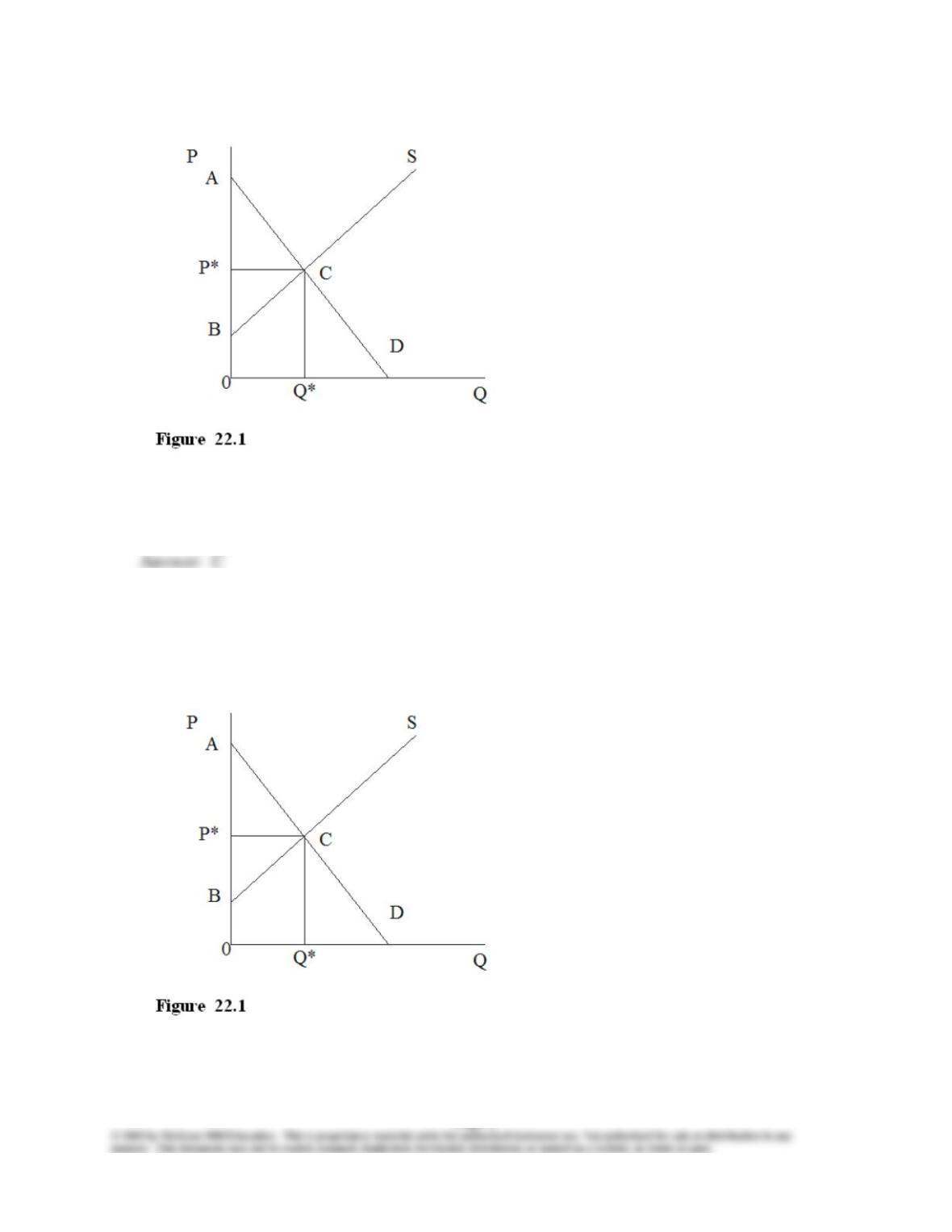
A) OACQ*
B) BP*C
C) 0BCQ*
D) 0P*CQ*
21. In Figure 22.1 for a good with no externality, which area represents the total revenue to the
producer?
A) AP*C
B) BP*C
C) 0BCQ*
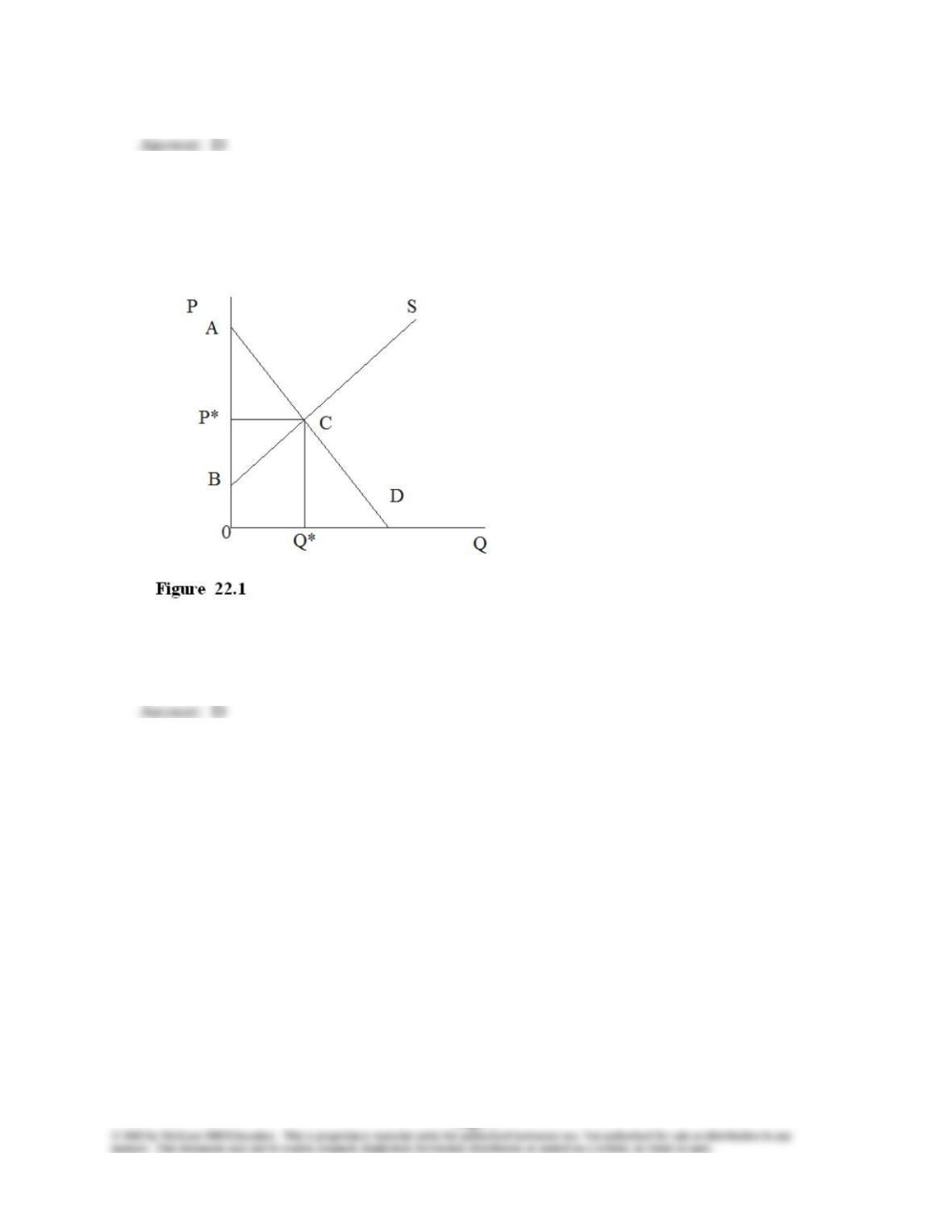
D) 0P*CQ*
22. In Figure 22.1 for a good with no externality, which area represents the total revenue to the
producer?
A) 0ACQ*
B) BP*C
C) 0BCQ*
D) 0P*CQ*
23. In Figure 22.1 for a good with no externality, which area represents the producer surplus?
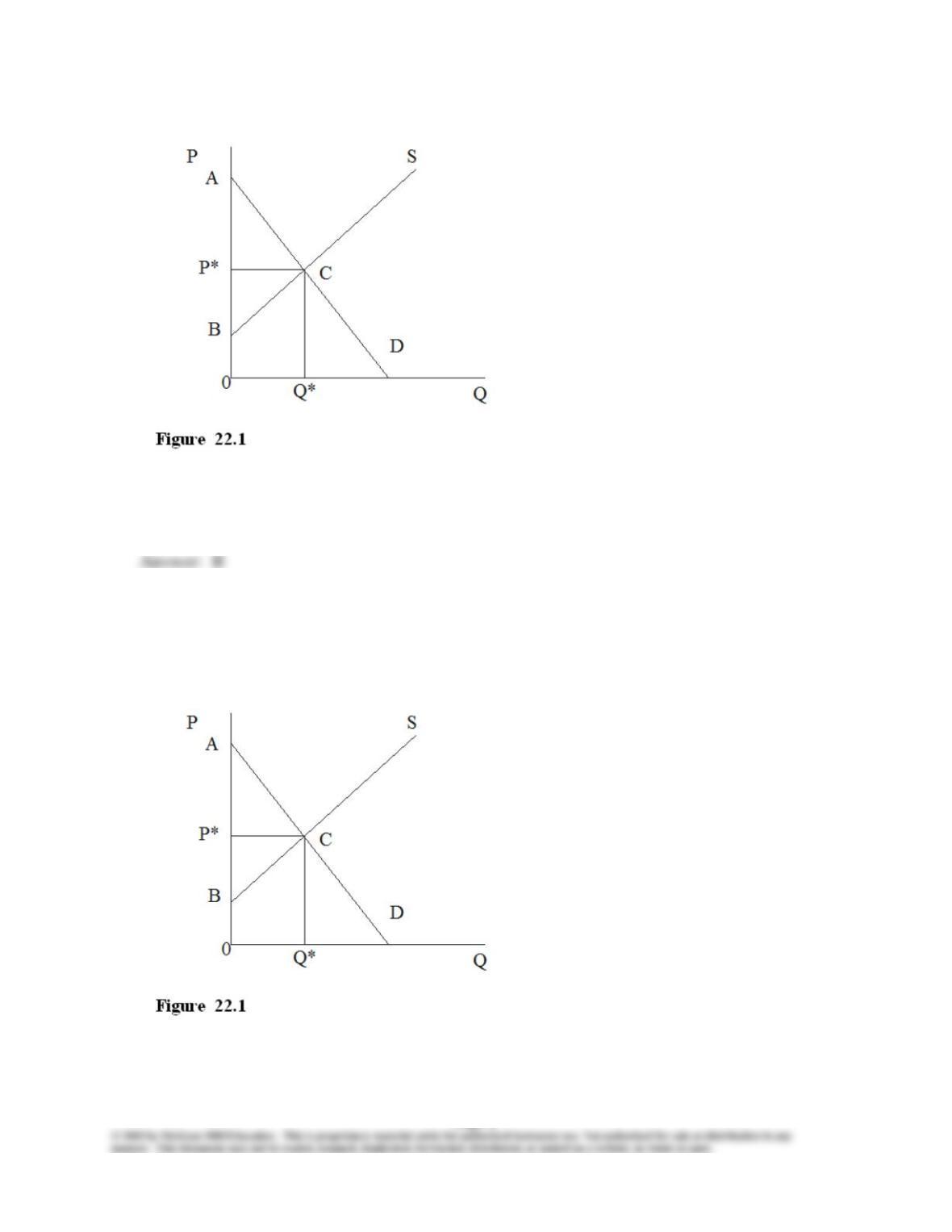
A) ABC
B) BP*C
C) 0BCQ*
D) 0P*CQ*
24. In Figure 22.1 for a good with no externality, which area represents the net benefit to society
of this market?
A) 0ACQ*
B) ABC
C) BP*C

D) 0P*CQ*
25. Economists refer to the problem that exists when public property is treated poorly because it
is in no one’s private interest to protect it as the
A) tragedy of capitalism.
B) tragedy of the commons.
C) Achilles’ heal of socialism.
D) mistake of zoning.
26. Which of the following would economists label as an example of the “tragedy of the
commons?”
A) The use of pesticides on private farm land.
B) The use of growth hormone on cattle.
C) The over-fishing of the oceans.
D) The neighbor who does not mow his yard.
27. Which of the following would economists label as an example of the “tragedy of the
commons?”
A) The over grazing of private land by ranchers.
B) The over grazing of public land by ranchers.
C) The disregard for health warnings on home use pesticide sprays.
D) The loss of value that a homeowner incurs when they fail to maintain their lawn.
28. A key element in an economist’s analysis of whether a company is making rational decisions
with regard to their exploitation of a natural resource is the notion of
A) sentimental value.
B) present value.
C) ignored value.
D) created value.
29. Using present value analysis, an economist will argue that we do not have to worry about
loggers harvesting young trees on private land.
A) Because it is more profitable for them to let the young trees grow.
B) Because it is not profitable for them to engage in any logging.
C) Because logging companies do not attempt to maximize profit.

D) Because young tree have no market value.
30. If logging companies are allowed to harvest on public lands, economists use present value
analysis to suggest that logging companies will
A) harvest all they can as quickly as the can.
B) leave the young trees for later.
C) harvest only the prettiest trees.
D) leave only the taller trees.
31. External costs are modeled by creating a new social cost curve that is
A) lower than the original supply curve.
B) higher than the original supply curve.
C) lower than the original demand curve.
D) higher than the original demand curve.
32. After accounting for externalities with a social cost curve, the new equilibrium would be
such that equilibrium price is
A) lower than before and equilibrium quantity is higher than before.
B) higher than before and equilibrium quantity is higher than before.
C) lower than before and equilibrium quantity is lower than before.
D) higher than before and equilibrium quantity is lower than before.
33. Nobel laureate economist Ronald Coase suggests that pollution problems could be solved if
A) people used a community spirit rather than a self-interested motive when making
decisions.
B) community property were owned by self-interested parties.
C) community property were made the norm.
D) people simply thought about the costs of their actions.
34. The economic explanation that is given by Nobel laureate economist Ronald Coase for why
community property is polluted more often that private property is that
A) damaging community property indirectly affects individuals’ wealth whereas damaging
private property directly affects their wealth.

B) damaging private property indirectly affects individuals’ wealth whereas damaging
community property directly affects their wealth.
C) people are not made aware of their actions toward community property.
D) people ignore what is not right in front of them.
35. According to Nobel laureate economist Ronald Coase, if a person lives near a neighborhood
park and a storm uproots several trees around the neighborhood, people will naturally
A) work to repair their own private damage first.
B) pay for someone to work on their own private property and pitch in to help on the park.
C) work on the public park first.
D) ignore the entire problem.
36. The Environmental Protection Agency was created in
A) the 1930’s.
B) the 1960’s.
C) the 1980’s.
D) the 1990’s.
37. The Clean Air Act and the Clean Water Act were originally passed in
A) the 1930’s.
B) the 1960’s.
C) the 1970’s.
D) the 1990’s.
38. By most standards of clean air and water published from government sources, the
environment is ______ than it was in 1975.
A) much cleaner (more than 25% by most measures)
B) much dirtier (more than 25% by most measures)
C) somewhat dirtier (1-5% by most measures)
D) somewhat clearer (1-5% by most measures)
39. Lead in the air is _____ than its 1975 level.
A) 97% less
B) 3% less
C) 3% more
D) 97% more
40. Sulfur dioxide in the air is _____ than its 1975 level.
A) 40% less
B) 4% less
C) 4% more
D) 40% more
41. Carbon monoxide in the air is _____ than its 1975 level.
A) 25% less
B) 3% less
C) 3% more
D) 25% more
42. The Clean Water Act has
A) succeeded in getting every body of water in the U.S. to acceptably clean levels.
B) succeeded in getting no body of water in the U.S. to acceptably clean levels.
C) succeeded in getting many bodies of water in the US to acceptably clean levels.
D) made things worse because more bodies of water are unsafe now than before the law was
passed.
43. The Endangered Species Act was originally passed in
A) the 1930’s.
B) the 1970’s.
C) the 1980’s.
D) the 1990’s.
44. The Endangered Species Act has
A) succeeded in that there are no endangered species to be concerned about in the US.
B) succeeded marginally in that 11 of the more than 800 endangered species now have stable
populations.
C) failed in that no species of plant or animal is better off now than when the law was

passed.
D) made things worse because it allows more species to become extinct.
45. The Clean Air Act of 1992 focused on
A) greenhouse gases.
B) acid rain.
C) the ozone layer.
D) smog.
46. Economists see the greenhouse effect as
A) having both negative and positive economic impacts.
B) having only positive economic consequences.
C) having only negative economic consequences.
D) having no economic consequences.
47. The average temperature is supposed to rise
A) 1 degree F in the next 100 years.
B) 3-5 degrees F in the next 100 years.
C) 15 degrees F in the next 100 years.
D) 3-5 degrees in the next 10 years.
48. The average global temperature rose
A) 1 degree F in the last 100 years.
B) 3-5 degrees F in the last 100 years.
C) 15 degrees F in the last 100 years.
D) 3-5 degrees in the last 10 years.
49. A tax on a polluting activity could internalize the externality if it were set equal to the
A) average cost of the pollution.
B) marginal cost of the pollution.

C) total cost of the pollution.
D) moral cost of the pollution
50. A tax on a good whose production causes pollution will
A) raise the equilibrium price and lower the equilibrium quantity.
B) lower the equilibrium price and lower the equilibrium quantity.
C) raise the equilibrium price and raise the equilibrium quantity.
D) lower the equilibrium price and raise the equilibrium quantity.
51. Setting taxes equal to marginal external costs are modeled by creating a new social cost
curve that is
A) lower than the original supply curve.
B) higher than the original supply curve.
C) lower than the original demand curve.
D) higher than the original demand curve.
52. Tradable emission permits
A) allow polluters to keep polluting while paying no price.
B) prevent industries from polluting regardless of how beneficial their goods are to society.
C) encourage polluting companies to look at the value of reducing pollution just as they look
at they value of increased production.
D) do nothing to increase efficiency.
53. The price of tradable emission permits for sulfur dioxide
A) has steadily increased since 1992.
B) has steadily decreased since 1992.
C) remained almost totally unchanged since 1992.
D) was set at a specific price in 1992 and cannot change without a new law.
54. Economists generally believe that
A) free market activity cannot coexist with a clean environment.
B) regulation is the only effective way to reduce pollution.
C) private incentives can be used to motivate individuals to act “green”.

D) Both free market activity cannot coexist with a clean environment and regulation is the
only effective way to reduce pollution.
55. Which issue type of environmental problem is least easily solved?
A) One that is entirely confined to a single property owned by an individual.
B) One that is entirely confined to a single community.
C) One that is entirely confined to a single country.
D) One that is global.
56. Global environmental problems are less easily solved than those confined to a single country
because
A) a single country has no incentive to solve global problems.
B) there is no worldwide interest in solving global problems.
C) there is no effective enforcement mechanism available for solving global problems.
D) all of the options are correct.
57. Which of the following environmental problems is among the most easily solved?
A) waste water treatment
B) a nation’s air pollution issues
C) a nation’s coastal water pollution issues
D) the world’s global warming issues
58. Which of the following environmental problems is among the least easily solved?
A) waste water treatment
B) a nation’s air pollution issues
C) a nation’s coastal water pollution issues
D) the world’s global warming issues
59. If it costs ConEd approximately $20 per additional ton of air pollution abated, but it costs
PG&E only $10 per additional ton of air pollution abated, a marketable pollution permit
trading for $14 per ton could
A) save PG&E $4 per ton and earn ConEd $6 per ton.
B) earn PG&E $4 per ton and save ConEd $6 per ton.
C) save PG&E $6 per ton and earn ConEd $4 per ton.

D) earn PG&E $6 per ton and save ConEd $4 per ton.
60. If it costs ConEd approximately $20 per additional ton of air pollution abated, but it costs
PG&E only $10 per additional ton of air pollution abated and a marketable pollution permit
trades for $14 per ton,
A) PG&E could gain by selling and ConEd could gain by buying.
B) PG&E could gain by buying and ConEd could gain by selling.
C) both PG&E and ConEd could gain by buying.
D) both PG&E and ConEd could gain by selling.
61. A system of tradable air pollution permits has the advantage of
A) reducing the total amount of air pollution.
B) eliminating all environmental liability for participating polluters.
C) rewarding efficient abatement effort at the expense of inefficient abatement efforts.
D) ensuring that the goal amount of abatement occurs at the lowest social cost.
62. If it costs ConEd approximately $26 per additional ton of air pollution abated, but it costs
PG&E only $18 per additional ton of air pollution abated, the two companies could both
benefit from trading a marketable pollution permit at any price between
A) $0 per ton and $18 per ton.
B) $0 per ton and $26 per ton.
C) $18 per ton and $26 per ton.
D) $26 per ton and $36 per ton.
63. If it costs ConEd approximately $20 per additional ton of air pollution abated, but it costs
PG&E only $10 per additional ton of air pollution abated and a marketable pollution permit
trades for $14 per ton,
A) PG&E could gain by buying and ConEd could gain by selling.
B) society would gain if PG&E would sell and ConEd would buy.
C) both PG&E and ConEd could gain by buying.
D) both PG&E and ConEd could gain by selling.
64. The Kyoto Protocols were initially
A) approved by the U.S. Senate and signed by President Clinton
B) approved by the U.S. Senate but never signed by President Clinton

C) signed by President Clinton but never approved by the U.S. Senate
D) approved by President Bush
65. Compared to the situation existing when the Kyoto Protocols were created,
A) India actually produces less greenhouse gasses (GHG)
B) the U.S. Senate finally approved the treaty under pressure from President Bush
C) the U.S. is producing less greenhouse gasses (GHG) than it had promised
D) China produces two and one-half times more greenhouse gasses (GHG)
66. Compared to the situation existing when the Kyoto Protocols were created,
A) India produces twice as much greenhouse gasses (GHG)
B) the U.S. Senate finally approved the treaty under pressure from President Bush
C) the U.S. is producing less greenhouse gasses (GHG) than it had promised
D) China actually produces less greenhouse gasses (GHG)
67. The Obama Administration is likely to
A) continue the Bush Administration’s policies toward greenhouse gas (GHG) regulation
B) alter the U.S. government’s position toward greenhouse gas (GHG) regulation
C) withdraw the U.S. from the Kyoto Protocol negotiations
D) resist pressure from the American people for approval of the Kyoto Protocols
68. Elimination of the current 25% overproduction of greenhouse gasses (GHG) by the U.S.
A) can be achieved by encouraging American drivers to be more considerate of poorer
nations
B) might require a $2.00 per gallon increase in the price of gasoline in the U.S.
C) is likely to be achieved almost painlessly as the Baby Boomers retire
D) can be achieved by repealing the current federal excise tax on gasoline
69. The Obama Administration’s proposed environmental policy of “Cap and Trade” will
A) freely issue unlimited rights to pollute, while taxing polluters for every ton of emissions
B) tax polluters for every ton of emissions, to subsidize their adoption of “green”
technologies
C) limit the total amount of pollution allowed, while prohibiting exchange of rights to

pollute
D) limit the total amount of pollution allowed, while permitting exchange of rights to pollute