Economics Today, 19e (Miller)
Chapter 21 Rents, Profits, and the Financial Environment of Business
21.1 Economic Rent
1) Pure economic rent is
A) a payment to a resource owner over and above what is necessary to keep the resource in its
current use.
B) a payment to a resource owner just sufficient to keep its supply constant.
C) the inverse of economic profit.
D) the competitive rental rate on capital.
2) A payment for the use of any resource over and above its opportunity cost is called
A) accounting profit.
B) economic profit.
C) normal cost.
D) economic rent.
3) Economic rent is defined as
A) any payment that has a contract period.
B) a payment to an owner of a factor that is in perfectly elastic supply.
C) a payment to an owner of a factor greater than the opportunity cost of utilizing the factor.
D) the opportunity cost or return to a productive factor such as capital.
4) Economic rent is a concept that can be applied
A) only to land, as that is the only resource that is in limited supply.
B) only to land and natural talent.
C) to any factor of production that is fixed in supply.
D) to any resource or factor of production that has a supply curve with a positive (upward) slope.
5) Economic rent is broadly defined as
A) a payment received by a landowner.
B) a payment for the use of any resource that has a fixed supply.
C) the return to owners of farmland.
D) the dividend return on a share of stock.
6) Economic rent applies to
A) land only and nothing else.
B) real property only.
C) all resources.
D) any resource in fixed supply.
7) Economic rent is any payment
A) received by the owner of a resource in perfectly elastic supply.
B) received by the owner of a resource with a supply curve that is not horizontal.
C) in excess of the resource’s opportunity cost.
D) below that of a normal profit or return.
8) Pure economic rent is a payment to a resource that
A) has a high opportunity cost.
B) has a perfectly inelastic supply.
C) has a negative opportunity cost.
D) has a perfectly elastic demand.
9) David Ricardo’s assumption for economic rents for land was based on
A) the supply of land being a fixed quantity.
B) a shortage of land.
C) a surplus of land.
D) total government control of land.
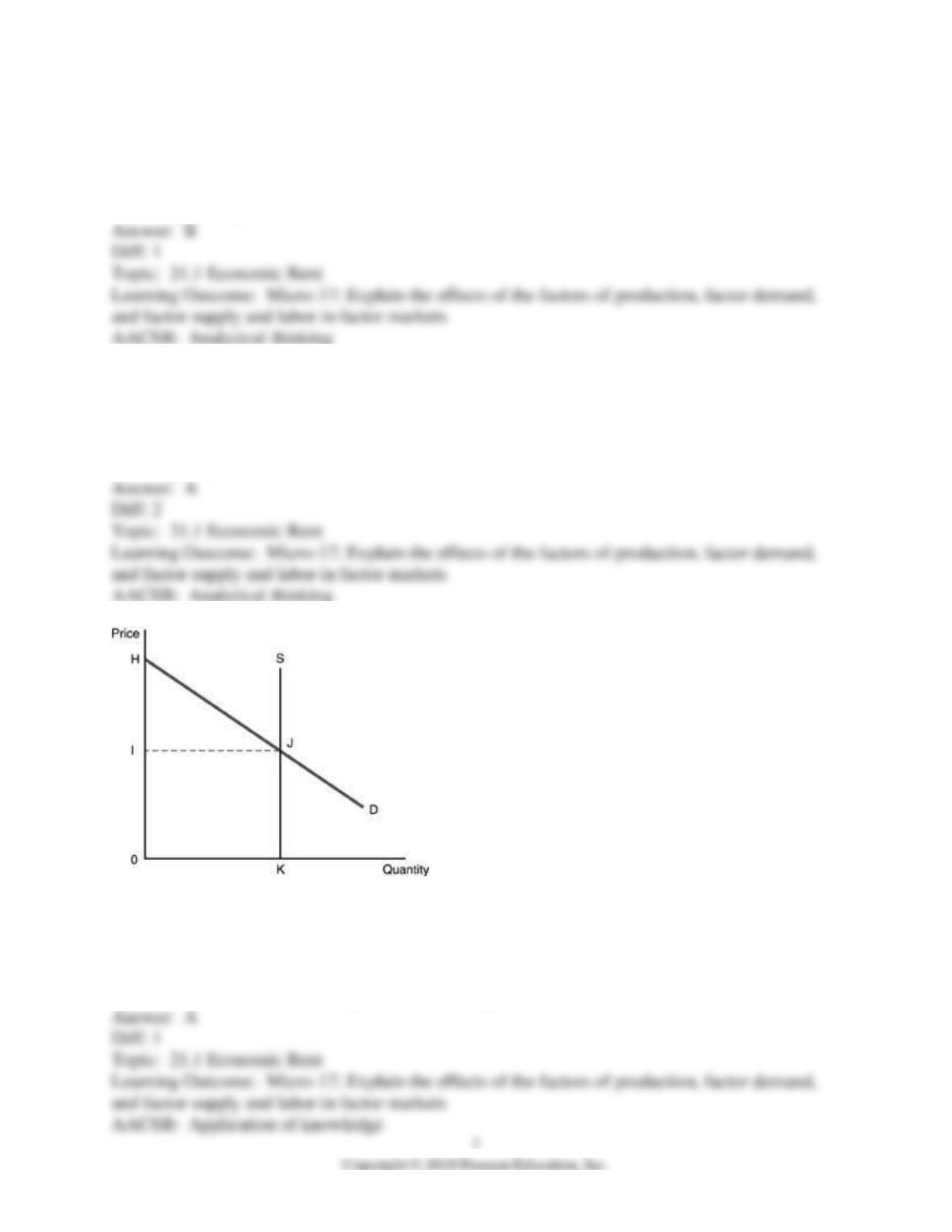
10) Refer to the above figure. What can we say about economic rent?
A) Economic rent equals the area IJK0.
B) Economic rent equals the area HJI.
C) Economic rent equals the area HJK0.
D) There is no economic rent represented in the figure.
11) In analyzing land rent, David Ricardo constructed a model based on
A) perfectly elastic demand for land.
B) a perfectly elastic supply of land.
C) land being available in infinite quantities.
D) the supply of land being perfectly inelastic.
12) A key assumption of David Ricardo’s economic rent concept was that
A) all land is equally productive.
B) land is too differentiated to be able to measure.
C) only land in large cities matters.
D) land is always cheap and needs development.
13) The concept of economic rent is associated with the economist
A) Adam Smith.
B) Karl Marx.
C) David Ricardo.
D) John Maynard Keynes.
14) According to David Ricardo’s explanation of land rent, what happens when the demand for
land increases?
A) The supply curve shifts to the right just enough to keep the price per acre constant.
B) Revenues to owners of land increase but economic rent declines.
C) The amount of economic rent stays constant, constrained by a perfectly inelastic supply curve.
D) Both revenues to owners of land and economic rent increase.
15) For an individual who has special talent as a singer, a large proportion of her salary can be
considered
A) a fixed cost.
B) economic rent.
C) a payment below opportunity cost.
D) opportunity cost.
16) For an actor whose natural talent is almost impossible to duplicate
A) all of his earnings consist of economic rents.
B) none of his earnings consist of economic rents since rent applies only to land.
C) part of his earnings consists of economic rents.
D) all of his earnings consist of interest payments.
17) A portion of a worker’s earnings is economic rent if the worker
A) has skills that make him more productive than an unskilled worker.
B) would accept a small reduction in pay without quitting.
C) was the last person hired at the going wage rate.
D) has been on the job for at least a year.
18) A dedicated professor loves being in the classroom and would teach for $70,000 per year, but
he is actually paid $80,000 per year. This individual
A) receives economic rent of $150,000.
B) has an opportunity cost of $80,000.
C) has an opportunity cost of $70,000.
D) receives economic rent of $10,000.
19) World-class models receive significant economic rents because
A) their talents and abilities are in fixed supply.
B) there is a shortage of world-class models.
C) there is a surplus of world-class models.
D) there is no equilibrium quantity of world-class models.
20) A singer would willingly perform in a concert for $10,000. If she is paid $25,000 for the
concert, she is
A) receiving $25,000 to cover her opportunity cost.
B) not being paid her full opportunity cost.
C) receiving $15,000 of economic rent.
D) certainly being paid more than warranted by the level of demand.
21) Supermodel Linda Evangelista has been quoted as saying, “[I] don’t wake up for less than
$10,000 a day.” If Ms. Evangelista is paid $15,000 for her next daylong photo shoot, then
A) she is being paid $15,000 to cover her opportunity cost.
B) the first $10,000 she receives is economic rent to labor and the next $5,000 is more economic
rent.
C) the entire $15,000 would be considered economic rent to labor.
D) she is receiving economic rent to labor equal to $5,000.
22) If land is reallocated or switched from agricultural use to recreational use, then it is likely
that
A) food is not as important as recreation.
B) the demand for food is less today than in previous decades.
C) land earns a higher rent in recreational use than in agricultural use.
D) the demand curve for land in the agricultural industry is shifting to the right.
23) Suppose that Rihanna sells 1,000 tickets to a concerts at $480 each. If the equilibrium price
is $600 per ticket for a fixed supply of 1,000 tickets, what is the value of the additional economic
rent that Rihanna could earn if she charged the market clearing price?
A) $1,080,000
B) $120,000
C) $600,000
D) $480,000
24) If a factor of production with a fixed supply is earning $100 in its current use and its next
best use would yield earnings of $90, the factor is earning a pure economic rent equal to
A) $0.
B) $10.
C) $90.
D) $190.
25) If Lady Gaga insists that tickets to her concert be sold for $100 each rather than the $500
each that could be charged as reflected by demand for those tickets, then the result will be
A) to create an excess supply of tickets.
B) to eliminate $150 worth of economic rent per ticket.
C) that part of the economic rent will be dissipated by scalpers, radio station owners, etc.
D) that the demand for tickets will decrease.
26) Economic rent directs resources to
A) the people who can use them most efficiently.
B) people only.
C) large corporations.
D) labor-intensive industries only.
27) The Hawaiian island of Lana’i is privately owned by Castle & Cooke and for generations
most of its land was used to grow pineapples. Now, many of the pineapple fields have been
replaced by tourist accommodations, including a pair of world-class hotels and a top rated golf
course. What would an economist say about this change in land-use patterns?
A) While growing pineapples used the island’s land more efficiently, tourism provides utility to
the largest number of people.
B) Economic rent has allocated the island’s resources to their highest valued use: tourism.
C) Agriculture is still the land’s highest-valued and most efficient use, but tourism earns more
profits for Castle & Cooke.
D) To find the land’s economic rent, add the price per acre that land on Lana’i would be worth if
used to grow pineapples to the value per acre when used for a golf course.
28) Economic rent is
A) the return to owners of farmland.
B) the return to landlords.
C) a payment for the use of any resource above its opportunity cost.
D) a payment for land, an apartment, or a house that one does not own.
29) The payment for the use of a resource in an amount higher than the resource’s opportunity
cost is
A) a proprietorship.
B) an irrational economic concept.
C) economic rent.
D) reinvestment.
30) The payment for a factor of production that is completely inelastic in supply is
A) opportunity cost.
B) economic rent.
C) discounting.
D) limited liability.
31) Pure economic rent involves situations where
A) the supply curve is perfectly inelastic.
B) the supply curve is perfectly elastic.
C) the uses to which a resource can be used can be varied but the quality of the resource cannot
be varied.
D) the quality of a resource can be varied but the price cannot be varied.
32) When the supply curve of a resource is vertical, then the return to the resource owner is
A) zero.
B) partly economic rent and partly opportunity costs.
C) partly economic rent and partly profits.
D) pure economic rent.
33) The first economist to analyze economic rent was
A) Henry George.
B) David Ricardo.
C) Karl Marx.
D) John Stuart Mill.
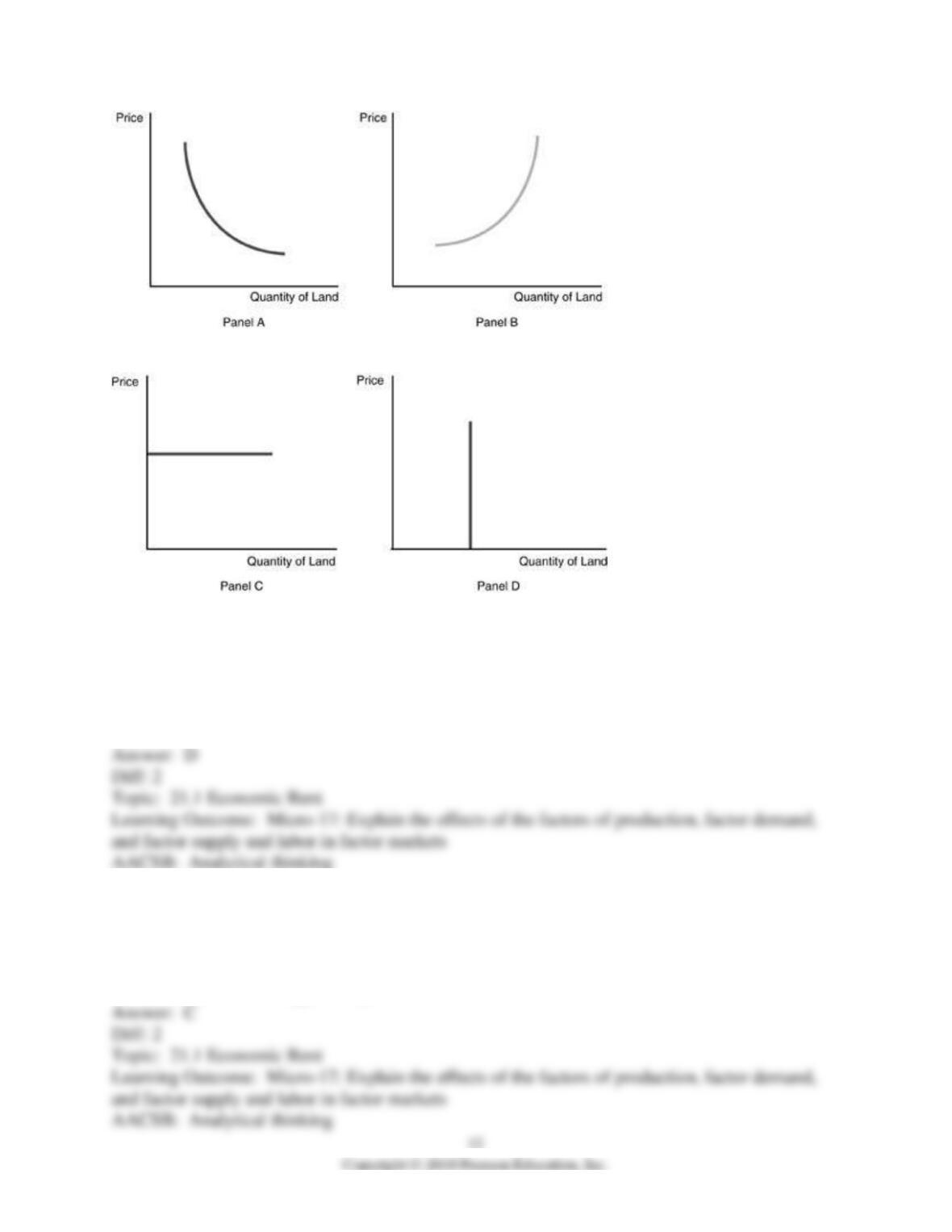
34) Refer to the above figure. Which panel is consistent with Ricardo’s view on the supply of
land?
A) Panel A
B) Panel B
C) Panel C
D) Panel D
35) If all the return to a resource is economic rent, we know that
A) the price of the resource is below its opportunity cost.
B) the price of the resource equals its opportunity cost.
C) the price of the resource is above its opportunity cost.
D) the resource has no opportunity cost.
36) Suppose the supply of land is perfectly inelastic and landowners are receiving payments
equal to $25,000 an acre. If the government taxed the landowners’ income with a tax rate of 80
percent, how much tax would the government collect?
A) zero, because the owner would do something else with the tax rather than pay such a high tax
B) less than $20,000 because the owners would change their behavior so as to pay less tax
C) more than $20,000 because the combined effects of all the owners trying to change their
behavior actually would generate higher returns
D) $20,000 because the use of the land doesn’t depend on the price the landowners receive for
the land
37) The concept of economic rent can be applied to
A) land only.
B) land and natural resources only.
C) land, natural resources, and paintings by dead masters only.
D) any resource that cannot be replicated exactly.
38) Rents
A) have no useful economic purpose.
B) have an allocative function since they help decide to which use a resource will be put.
C) have a distributional function since they affect incomes, but have no allocative function since
the resource is in fixed supply.
D) have an economic purpose only if they are taxed and provide revenue to the government.
39) Economic rents are useful because
A) they increase the income of the owner.
B) they make it easy to calculate opportunity cost.
C) resources will go to their most efficient use.
D) they increase tax revenue.
40) For superstar athletes
A) their entire earnings are economic rent.
B) part of their earnings are economic rent.
C) none of their earnings are economic rent since rent doesn’t apply to labor.
D) none of their earnings are economic rent since they will do some other work once they are too
old to be an athlete.
41) In which field would economic rents likely be greatest for the best in their field?
A) farming
B) teaching
C) hockey
D) car repairing
42) Superstars in sports or entertainment presumably would be willing to continue working in
their specific areas for lower income than they are currently earning. This implies that
A) the large salaries serve no allocative function and only serve to make the superstars richer.
B) superstars are exploiting their fans by receiving such a large salary.
C) superstars do not respond to monetary incentives.
D) the high salaries are used to allocate their time but fail to bring in new sources of supply
(other superstars) that are exactly like themselves.
43) A popular entertainer gives a concert in a 50,000 seat stadium. To give her fans a break, she
charges only $50 a seat instead of the customary $75 a seat. At $75 a ticket, there would have
been 50,000 tickets sold, and at $50, there are 80,000 people who want tickets. As a consequence
of the generosity of the entertainer
A) her fans are made better off.
B) a more fair system of pricing the tickets has been found.
C) another type of system will have to be found to allocate the tickets, making some of her fans
better off and others worse off.
D) her fans are made worse off since there is an excess demand of 30,000 tickets.
44) Economic rent serves
A) a descriptive function by making some wealthier than others, but serves no allocative
function.
B) an allocative function by guiding available supplies to the most efficient use.
C) only to make the rich richer and the poor poorer.
D) no useful function in a modern economy.
45) When economic rent exists
A) the price is equal to the opportunity cost of the resources.
B) price is the same as the discount rate.
C) resources are allocated inefficiently.
D) resources are allocated efficiently.
46) Jorge is debating whether to concentrate on playing professional football or professional
baseball. He is offered $6 million a year to play baseball and $8 million a year to play football. If
he chooses to play football
A) the economic rent in his salary is $8 million.
B) the economic rent in his salary is $6 million.
C) the economic rent in his salary is $2 million.
D) the economic rent in his salary is $14 million.
47) The opportunity cost of owner-provided labor is the
A) wage rate paid to the owner.
B) explicit part of the wage rate paid to the owner.
C) salary the owner could have made if she worked at her best alternative job.
D) profit after all of the bills have been paid.
48) Bonnie is debating whether to take a job as a professional therapist or a florist. She will earn
$40,000 a year as a therapist or $30,000 a year as a florist. If she chooses to be a therapist, the
opportunity cost is
A) $40,000.
B) $30,000.
C) $10,000.
D) unable to determine.
49) Angie is debating whether to take a job as a professional therapist or a florist. She will earn
$40,000 a year as a therapist or $25,000 a year as a florist. If she chooses to be a therapist, the
economic rent is
A) $40,000.
B) $25,000.
C) $15,000.
D) unable to determine.
50) A portion of a worker’s earnings is rent if
A) the worker was the last person hired at the going wage rate.
B) the supply curve of labor is horizontal.
C) the worker would accept a small wage cut without quitting or working for someone else.
D) the worker has industry-specific skills.
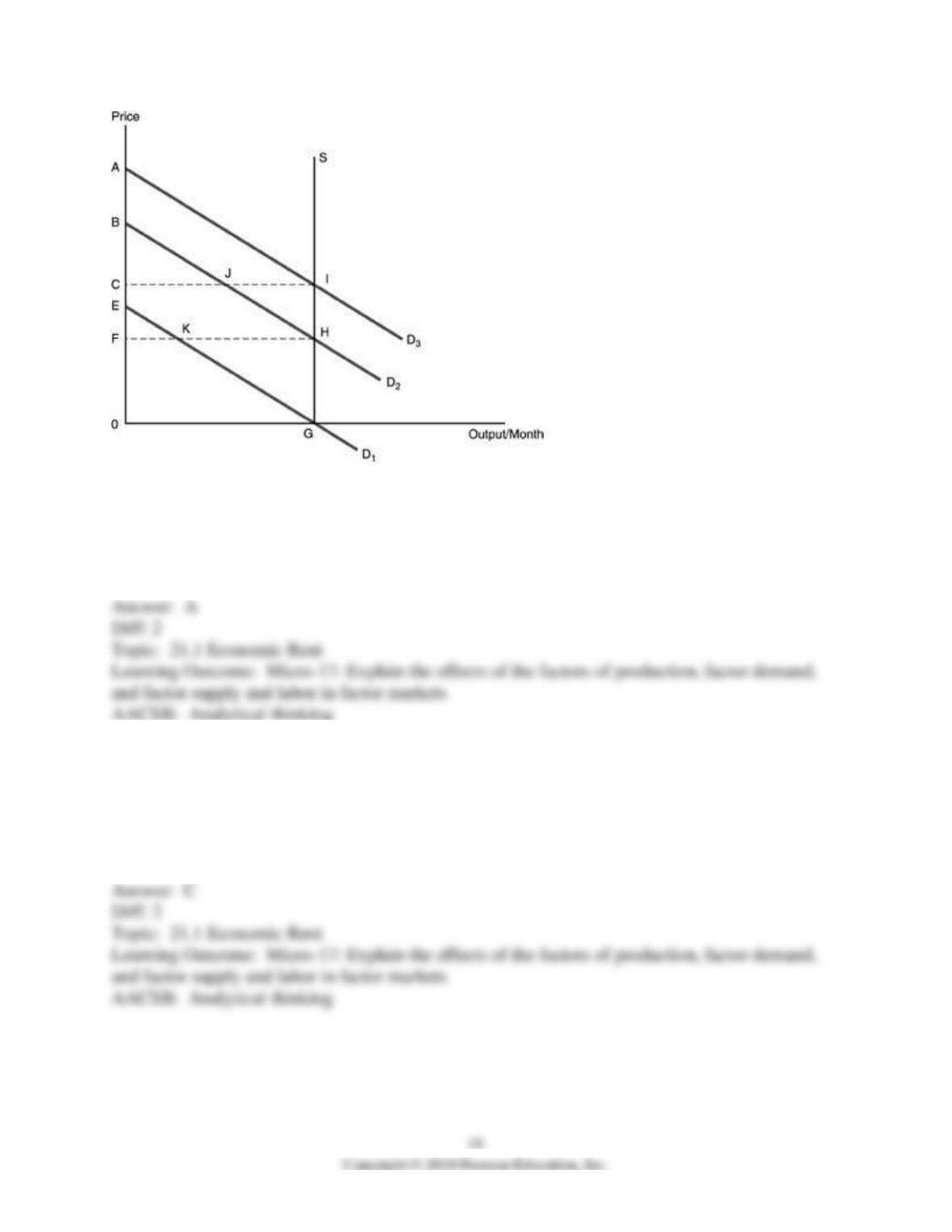
51) Refer to the above figure. If demand curve D1 is the relevant demand curve, rent is
A) zero.
B) OG.
C) area FHGO.
D) area KHG.
52) Refer to the above figure. Suppose demand is D2 and then increases to D3. Economic rent
after the change is
A) zero.
B) area CIHF.
C) area CIGO.
D) area BJC.
53) Refer to the above figure. Suppose demand is D2 and then increases to D3. The change in
economic rent is
A) zero.
B) area CIHF.
C) area CIGO.
D) area BJC.
54) Refer to the above figure. At demand curve D2, price equals ________ and economic rent
equals ________.
A) OF; KHG
B) OF; FHGO
C) OE; EKGO
D) OE; KHG
55) A payment to an owner of a resource in excess of its opportunity cost is know as
A) real wages.
B) economic rent.
C) financial interest.
D) accounting profits.
56) The concept of economic rent is associated with the British economist David Ricardo (1772-
1823). Ricardo analyzed economic rent for land. Which of the following is FALSE with respect
to determining land rent?
A) The supply curve for land is vertical (perfectly inelastic).
B) Rent is payment for a resource above its opportunity cost.
C) Payment for a resource below its opportunity cost is rent.
D) Ricardo assumed the quantity of land in a country is fixed.
57) A payment for a resource above the opportunity cost of the resource is
A) economic rent.
B) social rent.
C) nominal rent.
D) real rent.
58) When a resource has a perfectly inelastic supply curve
A) the amount of economic rent for this resource is determined by its supply.
B) the amount of economic rent for this resource is determined by demand for the resource.
C) the amount of economic rent for this resource is determined by the government.
D) there is no economic rent being earned by this resource.