c.
countries are free to pursue their own macroeconomic policies without maintaining exchange rates.
d.
countries cannot act independently and must thus coordinate their macroeconomic policies.
e.
the global interest rate tends to decline to the lowest possible level.
63. How many dollars do you need to buy a Swedish Kronor (SEK) when the exchange rate is $1 = 6.429 SEK?
a.
$0.016
b.
$1.056
c.
$0.649
d.
$0.156
e.
$1.56
d
Moderate
MACR.BOYE.16.108 – ch. 21, 6
Fixed or Floating Exchange Rates
Application
64. How many U.S. dollars does a U.S. importer need to pay for 100,000 yen worth of stereo equipment when the price of
1 yen is $0.008?
a.
$125 million
b.
$1.25 million
c.
$80,000
d.
$1,250
e.
$800
Moderate
MACR.BOYE.16.108 – ch. 21, 6
Prices and Exchange Rates
Application
65. When a U.S. importer needs $22,000 to settle an invoice for 25,520 Swiss francs, the exchange rate must be:
a.
1 Swiss franc = $1.16.
b.
1 Swiss franc = $0.16.
c.
1 Swiss franc = $0.84.
d.
$1 = 1.16 Swiss franc.
e.
$1 = 1.84 Swiss franc.
Moderate
MACR.BOYE.16.107 – ch. 21, 5
United States – International Trade and Finance
Fixed or Floating Exchange Rates
Knowledge
66. A decrease in the price of a currency in terms of another under a flexible exchange rate regime is called:
a.
capital flight.
b.
depreciation.
c.
revaluation.
d.
devaluation.
e.
currency adjustment.
b
Easy
MACR.BOYE.16.108 – ch. 21, 6
Prices and Exchange Rates
Knowledge
67. When the exchange rate moves from $1 = CAD1.5 to $1 = CAD1.66, it implies:
a.
the U.S. dollar has depreciated in relation to the Canadian dollar.
b.
U.S. imports of Canadian goods will rise.
c.
the dollar price of the Canadian dollar has risen.
d.
the Canadian dollar has appreciated in relation to the U.S. dollar.
e.
Canadian imports of U.S. goods will rise.
b
Challenging
MACR.BOYE.16.108 – ch. 21, 6
United States – Reflective Thinking
Prices and Exchange Rates
Analysis
68. When the U.S. dollar depreciates against other currencies:
a.
foreign goods become less expensive to U.S. buyers.
b.
U.S. goods become more expensive to foreign buyers.
c.
foreign currencies depreciate against the U.S. dollar.
d.
the volume of U.S. imports decline.
e.
the volume of U.S. exports decline.
d
Moderate
MACR.BOYE.16.108 – ch. 21, 6
d
Challenging
MACR.BOYE.16.108 – ch. 21, 6
United States – Reflective Thinking
Prices and Exchange Rates
Application
69. When the U.S. dollar depreciates in relation to the Swiss franc:
a.
a U.S. importer will need more dollars to pay for an invoice denominated in Swiss francs.
b.
a Swiss exporter will receive more Swiss francs for an invoice denominated in the exporter’s currency.
c.
Swiss imports of U.S. goods will fall.
d.
the Swiss franc is now worth less in terms of the U.S. dollar.
e.
a U.S. exporter will receive fewer dollars for an invoice denominated in Swiss francs.
Challenging
MACR.BOYE.16.108 – ch. 21, 6
United States – Reflective Thinking
Prices and Exchange Rates
Comprehension
70. Suppose a U.S. importer agrees to pay a Japanese firm 55,000 yen for a shipment of goods. If the agreement is made
when the exchange rate is $1 = ¥100, what is the change in the dollar value of the goods if the exchange rate changes to
$1 = ¥110, on the payment-due date?
a.
-$50
b.
$550,000
c.
-$550,000
d.
$50
e.
-$55,000
Challenging
MACR.BOYE.16.108 – ch. 21, 6
United States – Reflective Thinking
Prices and Exchange Rates
Application
71. Assume an Australian importer expects to pay 16,000 Australian dollars (AUD) for $8,000 worth of U.S. goods, but
on the shipment date 30 days later, the same volume of U.S. goods costs the Australian importer only 10,000 Australian
dollars. This means that between the contract date and the payment date, the exchange rate has changed:
a.
from $1 = 1.25 AUD to $1 = 2.0 AUD.
b.
from $1 = 2.0 AUD to $1 = 1.25 AUD.
c.
from $1 = 0.8 AUD to $1 = 0.5 AUD.
d.
from $1 = 0.5 AUD to $1 = 0.8 AUD.
e.
from $1 = 0.5 AUD to $1 = 2.0 AUD.
b
Challenging
MACR.BOYE.16.108 – ch. 21, 6
Prices and Exchange Rates
Prices and Exchange Rates
Comprehension
72. Suppose a U.S. importer purchases “Mexican Oaxaca” cheese for $500. If the present exchange rate is Mexican peso
(MXP) 10 per U.S. dollar, and the MXP appreciates 10 percent against the U.S. dollar between the date of purchase and
the date of payment, then the peso value of the invoice when payment is due is:
a.
MXP 500.
b.
MXP 550.
c.
MXP 4,500.
d.
MXP 5,500.
e.
MXP 4,450.
MACR.BOYE.16.108 – ch. 21, 6
Prices and Exchange Rates
73. An appreciation of the Norwegian kroner in relation to the U.S. dollar is most likely to cause:
a.
an increase in the U.S. demand for Norwegian goods.
b.
an increase in the Norwegian demand for U.S. goods.
c.
an increase in the supply of U.S. goods to Norway.
d.
a decrease in the supply of Norwegian goods to the United States.
e.
no change in the demand or supply of goods for either country.
MACR.BOYE.16.108 – ch. 21, 6
Prices and Exchange Rates
74. Which of the following holds true, if goods sell for the same price worldwide when converted to a common currency?
a.
A high rate of inflation exists
b.
A fixed exchange-rate system exists
c.
Purchasing power parity exists
d.
The foreign exchange market is in equilibrium
e.
Arbitrage opportunities exist
MACR.BOYE.16.108 – ch. 21, 6
United States – International Trade and Finance
Prices and Exchange Rates
75. Purchasing power parity exists when domestic currency:
a.
maintains a fixed exchange rate with foreign currency.
b.
is not convertible into foreign currency.
c.
buys more goods at home than abroad.
d.
buys as many goods at home as it does abroad.
e.
appreciates in value against foreign currency.
76. Deviations from purchasing power parity will be increasingly higher as international trade tariffs become more
restrictive. The main reason for this phenomenon is that:
a.
arbitrage activities become less profitable.
b.
governments prefer purchasing power parity not to hold.
c.
the interest rate parity fails to hold.
d.
goods become more differentiated across countries.
e.
individuals develop hatred toward closed economies.
MACR.BOYE.16.108 – ch. 21, 6
Prices and Exchange Rates
77. Assume that a Chrysler automobile sells for $15,000 in the United States and that the exchange rate is $1 = €1.3. For
purchasing power parity to hold, the same car should sell in Germany for:
a.
€15,000.
b.
€11,538.
c.
€19,500.
d.
€1,538.
e.
€15,500.
MACR.BOYE.16.108 – ch. 21, 6
United States – Reflective Thinking
Prices and Exchange Rates
78. If a bushel of corn sells for $2 in the United States and for 4,000 COP (Colombian peso) in Colombia, and if 1 dollar
is worth 2,200 COP, then:
a.
the corn is 400 COP more expensive in Colombia.
b.
the corn is 400 COP cheaper in Colombia.
MACR.BOYE.16.108 – ch. 21, 6
United States – International Trade and Finance
Prices and Exchange Rates
c.
the price of a bushel of corn equals $2 in both the United States and Colombia.
d.
the price of corn is 4,000 COP lower in Colombia than in the United States.
e.
the price of corn is $0.20 lower in the United States than in Colombia.
79. Suppose purchasing power parity exists in the car stereo market in the United States and Australia. If a car stereo costs
$230 in the United States and the exchange rate is $1 = $AUD1.67, the same car stereo may be purchased in Australia for
approximately:
a.
$AUD 138.
b.
$AUD 230.
c.
$AUD 2,300.
d.
$AUD 384.
e.
$AUD 108.
Moderate
MACR.BOYE.16.108 – ch. 21, 6
United States – International Trade and Finance
Prices and Exchange Rates
80. Suppose a U.S. investor buys a Canadian government bond with a face value of Canadian dollar (CAD) 100 and an
annual yield of 8.8 percent. Which of the following statements is true?
a.
At maturity, the dollar return from the Canadian bond will be $108.8, regardless of what happens to the
exchange rate.
b.
The Canadian bond will yield the same dollar return from the time of purchase to the time of maturity.
c.
An American will make a profit on the Canadian bond only when the CAD-denominated return is higher on
the Canadian bond than the dollar-denominated return on a comparable U.S. bond.
d.
The dollar return on the Canadian bond depends on the dollar price of the Canadian dollar at the time of
maturity.
e.
The decision to buy the Canadian bond should be based solely on the CAD interest return and not on changes
in the exchange rate.
MACR.BOYE.16.109 – ch. 21, 7
United States – International Trade and Finance
United States – Reflective Thinking
Interest Rates and Exchange Rates
Comprehension
81. Suppose a U.S. firm buys a one-year U.K. bond for 6,000 British pounds when 1 British pound is worth $1.50 on the
foreign exchange market. What is the firm’s approximate rate of return on the bond if the interest rate on the bond is
Challenging
MACR.BOYE.16.108 – ch. 21, 6
United States – International Trade and Finance
United States – Reflective Thinking
Prices and Exchange Rates
Application
15 percent and the exchange rate is 1 British pound is worth $1.93 at maturity?
a.
11 percent
b.
15 percent
c.
25 percent
d.
33 percent
e.
48 percent
82. Assume a U.S. firm invests $1,500 to buy a one-year U.K. bond. What is the dollar value of the proceeds if the dollar
return on the U.K. bond is 20 percent at maturity?
a.
$1,800
b.
$1,500
c.
$1,200
d.
$1,000
e.
$500
Moderate
MACR.BOYE.16.110 – ch. 21, 8
Interest Rates and Exchange Rates
Application
83. Assume a U.S. investor buys a Mexican bond with a face value of MXP 1,000 and a 20 percent annual interest yield
while the exchange rate is MXP 10 per dollar. What is the dollar return from the bond if the exchange rate at the end of
the year is MXP 11 per dollar?
a.
9.1%
b.
10.0%
c.
18.2%
d.
20.0%
e.
32.0%
Challenging
MACR.BOYE.16.110 – ch. 21, 8
United States – International Trade and Finance
Interest Rates and Exchange Rates
Application
84. An Australian investor buys a U.S. Treasury bond that has a price of $10,000, pays 5 percent interest, and matures in a
year. Between the purchase date and the maturity date, the exchange rate changes from $1 = AUD 5.0 to $1= AUD 5.2.
What will be the Australian investor’s rate of return from the U.S. bond?
Challenging
MACR.BOYE.16.110 – ch. 21, 8
Interest Rates and Exchange Rates
Application
a.
4 percent
b.
7 percent
c.
9.2 percent
d.
12 percent
e.
25 percent
85. Suppose a U.S. citizen invests $1,000 to purchase a one-year Japanese bond that has an interest yield of 10 percent. If
the dollar appreciates 20 percent against the Japanese yen by the maturity date, the dollar value of the proceeds is _____.
a.
$900
b.
$1,100
c.
$1,300
d.
$1,500
e.
$1,200
Challenging
MACR.BOYE.16.110 – ch. 21, 8
Interest Rates and Exchange Rates
Application
86. Suppose a Japanese investor purchases a dollar deposit that yields 5 percent interest at the end of a year. What will be
the approximate return in terms of yen at maturity if the exchange rate moves from $1 = ¥100 to $1 = ¥105 during the
year?
a.
1 percent
b.
5 percent
c.
10 percent
d.
20 percent
e.
0 percent
Challenging
MACR.BOYE.16.110 – ch. 21, 8
United States – Reflective Thinking
Interest Rates and Exchange Rates
Application
87. If you receive a dollar return of 6 percent on a one-year Korean bond that yields 10 percent annually, this means that
between the purchase date and the time of maturity:
a.
the Korean won (KRW) has depreciated 4 percent against the U.S. dollar.
Challenging
MACR.BOYE.16.110 – ch. 21, 8
United States – Reflective Thinking
Interest Rates and Exchange Rates
Application
b.
the dollar price of the Korean won (KRW) has risen by 10 percent.
c.
the percentage change in the dollar per Korean won exchange rate is 6 percent.
d.
the dollar proceeds from the Korean bond are 4 percent higher than the initial dollar investment.
e.
the dollar has depreciated 16 percent against the Korean won.
88. What is the interest rate on a 12-month U.K. certificate of deposit if the dollar return on the certificate is 4 percent and
the dollar has appreciated 9 percent against the British pound?
a.
15 percent
b.
13 percent
c.
9 percent
d.
5 percent
e.
4 percent
MACR.BOYE.16.110 – ch. 21, 8
United States – International Trade and Finance
Interest Rates and Exchange Rates
89. Given a one-year Canadian bond with a yield of 8 percent, what will be the U.S. investor’s rate of return at maturity if
the Canadian dollar appreciates 10 percent against the U.S. dollar?
a.
2 percent
b.
8 percent
c.
10 percent
d.
18 percent
e.
25 percent
MACR.BOYE.16.110 – ch. 21, 8
United States – Reflective Thinking
Interest Rates and Exchange Rates
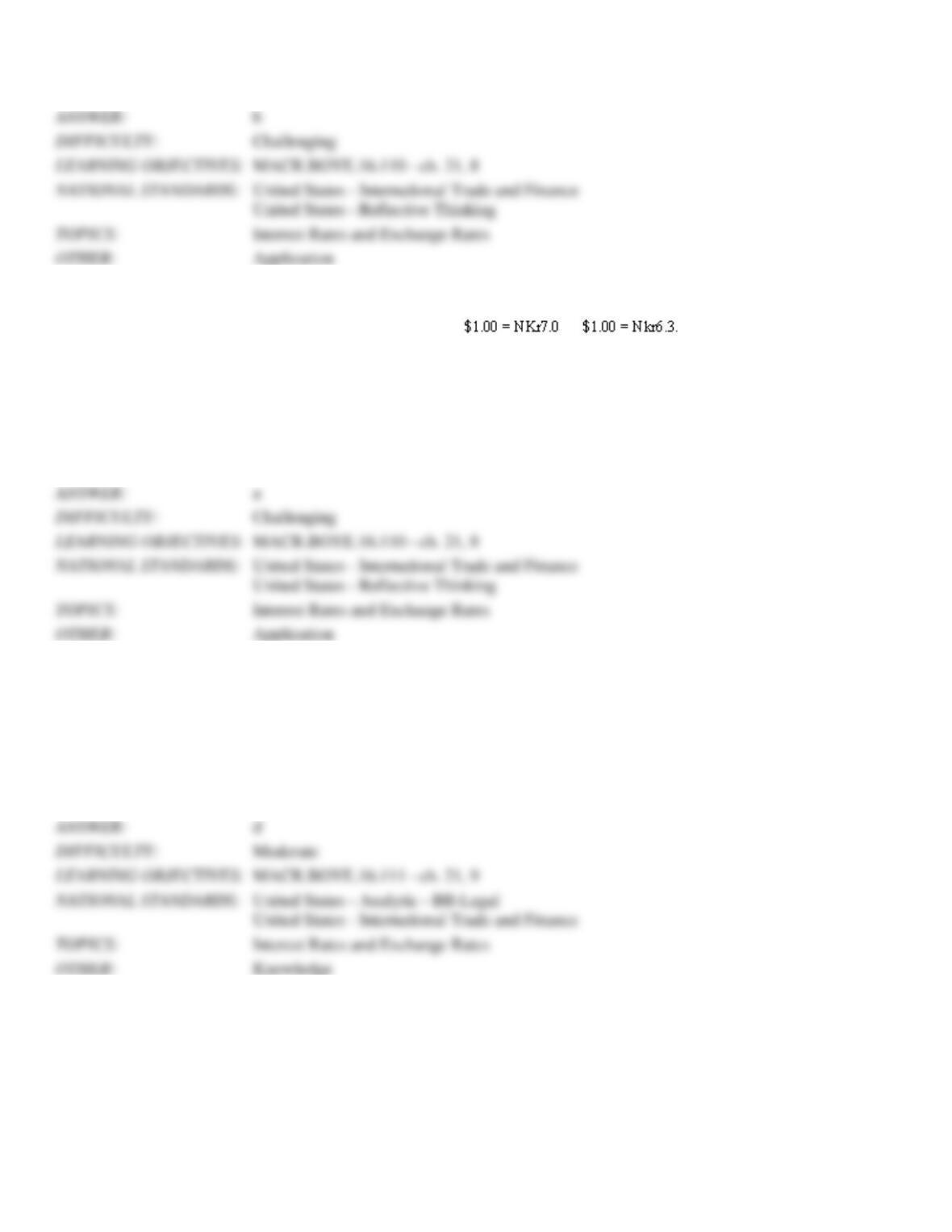
90. Assume that a one-year Malaysian bond yields 10 percent interest and that the dollar return on maturity is 5 percent. If
the exchange rate at maturity is $1 = MYR 4.00 (Malaysian ringgit), what was the exchange rate at the time the bond was
purchased?
a.
$1 = MYR 4.2
b.
$1 = MYR 3.8
c.
$1 = MYR 3.6
MACR.BOYE.16.110 – ch. 21, 8
Interest Rates and Exchange Rates
d.
MYR 1 = $0.26
e.
MYR 1 = $0.4
91. Suppose a U.S. citizen purchases a one-year Norwegian bond that yields 10 percent interest. Between the purchase
date and the maturity date, the exchange rate changes from to How much was initially
invested in the bond if the dollar value of the proceeds at maturity is $3,500? (roundoff up to the nearest whole number)
a.
$2,916
b.
$3,150
c.
$3,500
d.
$3,850
e.
$4,200
Challenging
MACR.BOYE.16.110 – ch. 21, 8
Interest Rates and Exchange Rates
92. Interest rate parity can be summarized by which of the following equilibrium conditions?
a.
The foreign interest rate must equal the domestic interest rate plus the expected inflation.
b.
The foreign interest rate must equal the domestic interest rate.
c.
The foreign interest rate must equal the expected change in the exchange rate.
d.
The domestic interest rate must equal the foreign interest rate plus the expected change in exchange rate.
e.
The domestic interest rate must equal the foreign interest rate minus any expected inflation.
d
Moderate
MACR.BOYE.16.111 – ch. 21, 9
United States – International Trade and Finance
Interest Rates and Exchange Rates
Knowledge
93. If a dollar invested in the United States yields the same return as a dollar’s worth of yen invested in Japan, then it
implies that:
a.
purchasing power parity exists.
b.
the exchange market is in equilibrium.
c.
the dollar/yen exchange rate is fixed.
d.
interest rate parity exists.
e.
both the currencies are pegged to a fixed amount of gold.
b
Challenging
MACR.BOYE.16.110 – ch. 21, 8
United States – Reflective Thinking
Interest Rates and Exchange Rates
Application
94. Suppose a Canadian investor buys a one-year U.S. government bond that pays 7 percent interest. If the U.S. dollar
appreciates 4 percent against the Canadian dollar during the year, what must be the yield on a comparable Canadian
government bond for interest rate parity to hold?
a.
3 percent
b.
4 percent
c.
7 percent
d.
10 percent
e.
11 percent
Moderate
MACR.BOYE.16.111 – ch. 21, 9
United States – Reflective Thinking
Interest Rates and Exchange Rates
Application
95. Suppose you are a U.S. exporter expecting to receive a payment of NZD1,000 (New Zealand dollars) in 12 months.
The annual interest rate on NZD deposits is 5 percent, and the annual interest rate on dollar deposits is 9 percent. If the
present exchange rate is $0.50 per NZD and interest rate parity holds, how many dollars do you expect to receive at the
maturity date of the export contract?
a.
$2,000
b.
$1,923
c.
$1,000
d.
$580
e.
$520
Challenging
MACR.BOYE.16.111 – ch. 21, 9
United States – Reflective Thinking
Interest Rates and Exchange Rates
Application
96. In the foreign exchange market where French francs are traded for Japanese yen, a decrease in the interest rate in
France is most likely to cause:
a.
a decrease in the yen price of the French franc.
b.
an increase in the interest rate in Japan.
c.
an increase in the yen price of the French franc.
d.
an increase in the demand for French francs.
d
Easy
MACR.BOYE.16.111 – ch. 21, 9
United States – International Trade and Finance
Interest Rates and Exchange Rates
Knowledge