1. If $1 was equivalent to 120 Japanese yen in 2008 and 125 Japanese yen in 2010, it implies in 2010, there was:
a.
a depreciation of the dollar against the yen.
b.
a depreciation of the yen against the dollar.
c.
an appreciation of the yen against the dollar.
d.
no change in the value of yen, but the dollar had weakened.
e.
no change in the value of dollar, but the yen had strengthened.
2. Consider a country Atlantica, using dollars ($) as its currency. If this country sets a price for gold, and then issues
currency such that the amount in circulation is equivalent to the value of gold held in reserve, it is said to be following:
a.
a gold exchange standard.
b.
a gold standard.
c.
a reserve currency standard.
d.
a crawling peg standard.
e.
a currency board standard.
MACR.BOYE.16.103 – ch. 21, 1
Past and Current Exchange-Rate Adjustments
3. A country on a gold standard was able to maintain people’s confidence in the value of its currency by:
a.
printing more and more paper money.
b.
restricting international exchange of goods and services.
c.
ensuring the convertibility of paper money into gold.
d.
maintaining a fixed stock of foreign currencies.
e.
ensuring balance of payment surplus.
MACR.BOYE.16.103 – ch. 21, 1
United States – International Trade and Finance
Past and Current Exchange-Rate Adjustments
4. If the price of an ounce of gold is 200 ZARs in South Africa and $75 in Canada, what will be the South African Rand
(ZAR) per Canadian dollar (C$) exchange rate?
a.
C$1 = 4.25 ZAR
b.
C$1 = 1.75 ZAR
MACR.BOYE.16.103 – ch. 21, 1
c.
C$1 = 2 ZAR
d.
C$1 = 2.67 ZAR
e.
C$1 = 4 ZAR
5. A commodity money standard exists when exchange rates are:
a.
artificially pegged to the price of oil.
b.
fixed in terms of gold, thus creating flexible exchange rates between countries.
c.
fixed in terms of gold, thus creating fixed exchange rates between countries.
d.
allowed to fluctuate based on the values of different currencies.
e.
fixed, based on the values of different currencies, in terms of some commodity.
MACR.BOYE.16.103 – ch. 21, 1
Past and Current Exchange-Rate Adjustments
6. Economists typically date the beginning of the gold standard to the period:
a.
before 1500.
b.
before 1776.
c.
between 1880 and 1914.
d.
between the two world wars.
e.
between 1970 and 2000.
MACR.BOYE.16.103 – ch. 21, 1
Past and Current Exchange-Rate Adjustments
7. Suppose the price of an ounce of silver is 100 nuevos soles in Peru and $400 in the United States. This implies:
a.
the Peruvian nuevo sol is worth four times the value of a U.S. dollar.
b.
the Peruvian nuevo sol is worth one-fourth the value of a U.S. dollar.
c.
Peru’s economy must be four times larger than the U.S. economy.
d.
the U.S. economy must be four times larger than that of Peru.
e.
the U.S. dollar is worth four times the value of a Peruvian nuevo sol.
MACR.BOYE.16.103 – ch. 21, 1
United States – Reflective Thinking
Past and Current Exchange-Rate Adjustments
8. The gold standard fixes the:
a.
future price of gold in terms of silver.
b.
price of gold in terms of international currencies.
c.
future price of silver in terms of gold.
d.
money supply in terms of paper currency.
e.
past exchange rate and the future exchange rate.
MACR.BOYE.16.103 – ch. 21, 1
United States – International Trade and Finance
Past and Current Exchange-Rate Adjustments
9. The gold standard ended with the:
a.
rise of Napoleon to power.
b.
American Declaration of Independence.
c.
outbreak of World War I.
d.
first Arab oil embargo.
e.
presidency of Richard Nixon.
MACR.BOYE.16.103 – ch. 21, 1
Past and Current Exchange-Rate Adjustments
10. Which of the following can be categorized as a commodity money standard?
a.
The pegged exchange rate standard
b.
The free float standard
c.
The managed float standard
d.
The reserve currency standard
e.
The gold standard
MACR.BOYE.16.103 – ch. 21, 1
MACR.BOYE.16.103 – ch. 21, 1
Past and Current Exchange-Rate Adjustments
11. The exchange-rate arrangement that emerged from the Bretton Woods conference is often referred to as the:
a.
dollar exchange standard.
b.
euro exchange standard.
c.
gold exchange standard.
d.
silver exchange standard.
e.
flexible exchange rate standard.
MACR.BOYE.16.103 – ch. 21, 1
United States – International Trade and Finance
Past and Current Exchange-Rate Adjustments
12. A reserve currency is a currency that is:
a.
used exclusively to settle domestic debts.
b.
specifically designed for use by commercial banks to settle accounts.
c.
held only by bureaucrats.
d.
used to settle international debts by private corporations.
e.
held by governments to facilitate foreign exchange market interventions.
MACR.BOYE.16.103 – ch. 21, 1
United States – International Trade and Finance
Past and Current Exchange-Rate Adjustments
13. The focal point of the Bretton Woods system was the:
a.
Great Britain pound.
b.
institution of special drawing rights.
c.
U.S. dollar.
d.
gold reserve.
e.
management of commodity money.
MACR.BOYE.16.103 – ch. 21, 1
Past and Current Exchange-Rate Adjustments
14. In effect, during the period immediately following World War II, the world was on a(n):
Past and Current Exchange-Rate Adjustments
a.
gold standard.
b.
flexible-exchange-rate standard.
c.
U.S. dollar standard.
d.
exchange-rate standard dictated by Germany
e.
pegged-exchange rate standard.
15. Which of the following was the reserve currency under the gold exchange standard?
a.
U.S. dollar
b.
Euro
c.
Great Britain pound
d.
Australian dollar
e.
Deutsche mark
Easy
MACR.BOYE.16.103 – ch. 21, 1
Past and Current Exchange-Rate Adjustments
Knowledge
16. Under the Bretton Woods system, international debts were settled in:
a.
gold.
b.
U.S. dollars.
c.
British pounds.
d.
silver.
e.
German marks.
b
Easy
MACR.BOYE.16.103 – ch. 21, 1
United States – International Trade and Finance
Past and Current Exchange-Rate Adjustments
Knowledge
17. The Bretton Woods System of exchange rates was established:
a.
to solidify support for the then-existing gold standard.
b.
to peg the worldwide price of silver to the price of gold.
c.
in Europe before World War II to establish a flexible exchange rate regime.
d.
in the United States in 1944 to develop a gold exchange standard.
Easy
MACR.BOYE.16.103 – ch. 21, 1
United States – International Trade and Finance
Past and Current Exchange-Rate Adjustments
Knowledge
e.
by a mechanism that made gold the reserve currency of the system.
18. Which of the following statements concerning the International Monetary Fund is true?
a.
The IMF was created to help finance economic development in poor countries.
b.
One of the principal aims of the IMF is to discourage international trade and encourage countries to become
self-sufficient.
c.
The IMF lends money to countries experiencing large balance-of-payments surpluses.
d.
When the IMF lends currencies, it always insists on the borrowing country taking action to reduce its balance-
of-payments surplus.
e.
The IMF obtains funds from annual membership fees charged to member countries.
Easy
MACR.BOYE.16.103 – ch. 21, 1
United States – Analytic – BB-Legal
Past and Current Exchange-Rate Adjustments
Knowledge
19. The U.S. provides about _____ percent of the annual membership fees of IMF member countries.
a.
5.6
b.
10.2
c.
15.3
d.
17.3
e.
22.4
d
Moderate
MACR.BOYE.16.103 – ch. 21, 1
Past and Current Exchange-Rate Adjustments
Knowledge
20. The World Bank obtains the funds it lends by:
a.
selling bonds on the international bond market.
b.
selling bonds to countries it has loaned funds to.
c.
collecting each country’s annual membership fee or quota.
d.
levying a small tax on every foreign exchange conversion worldwide.
e.
depending on voluntary subsidies from member nations.
Easy
d
Moderate
MACR.BOYE.16.103 – ch. 21, 1
United States – Analytic – BB-Legal
Past and Current Exchange-Rate Adjustments
Knowledge
21. The annual membership fees of the 185 member countries of the IMF are called:
a.
annuities.
b.
quotas.
c.
vetos.
d.
conditionalities.
e.
petrodollars.
b
Easy
MACR.BOYE.16.103 – ch. 21, 1
Past and Current Exchange-Rate Adjustments
Knowledge
22. Foreign exchange market intervention is most effective when:
a.
each country’s political leaders agree to cooperate fully with the process.
b.
leading economists in each country concur that intervention is needed.
c.
permanent differences between the free market exchange rate and the fixed exchange rate are expected.
d.
temporary differences between the free market exchange rate and the fixed exchange rate are expected.
e.
all the countries restrict the international movement of goods and services.
d
Easy
MACR.BOYE.16.103 – ch. 21, 1
United States – International Trade and Finance
Past and Current Exchange-Rate Adjustments
Knowledge
23. Suppose the official gold value of the Brazilian real changes from 457 reals per ounce to 528 reals per ounce. We can
then say that:
a.
the Brazilian real has been devalued.
b.
the Brazilian economy is expected to experience rapid inflation.
c.
gold has been devalued.
d.
the Brazilian real has appreciated in value.
e.
gold is now cheaper to purchase in Brazil than it was before.
MACR.BOYE.16.103 – ch. 21, 1
Past and Current Exchange-Rate Adjustments
MACR.BOYE.16.103 – ch. 21, 1
Past and Current Exchange-Rate Adjustments
Knowledge
24. Suppose the official gold value of the Brazilian real changes from 527 reals per ounce to 508 reals per ounce. We can
then say that:
a.
the Brazilian real has depreciated in value as a consequence of free market fluctuations.
b.
the Brazilian real has appreciated in value.
c.
gold is now more expensive to purchase in Brazil than it was before.
d.
the Brazilian real has been devalued.
e.
the Brazilian economy is expected to experience rapid inflation.
MACR.BOYE.16.103 – ch. 21, 1
Past and Current Exchange-Rate Adjustments
25. The exchange rate that is established in the absence of foreign exchange market intervention by the government is
known as a(n):
a.
historical anachronism.
b.
fixed exchange rate.
c.
“dirty float” exchange rate.
d.
unmanaged exchange rate.
e.
free market equilibrium exchange rate.
MACR.BOYE.16.103 – ch. 21, 1
Past and Current Exchange-Rate Adjustments
26. The Bretton Woods system required countries to actively buy and sell dollars to maintain fixed exchange rates when:
a.
a country experienced a severe bout of inflation.
b.
the free market equilibrium exchange rate differed from the fixed rate.
c.
a country experienced serious unemployment.
d.
the threat of recession began to spread from one country to another.
e.
worldwide trade began to deteriorate.
MACR.BOYE.16.103 – ch. 21, 1
United States – International Trade and Finance
Past and Current Exchange-Rate Adjustments
27. Which of the following had resulted from the Smithsonian agreement of 1971?
a.
Devaluation of the U.S. dollar
b.
Dissolution of a fixed exchange rate regime
c.
Appreciation of the U.S. dollar
d.
Establishment of an equilibrium exchange rate
e.
Laissez-faire in the foreign exchange market
28. The primary function of the World Bank is to:
a.
lend money to the World Trade Organization.
b.
provide loans to countries experiencing huge budget deficit.
c.
finance economic development in poor countries.
d.
assist countries experiencing balance of payments deficits.
e.
finance the fiscal stabilization program of the U.S. government.
MACR.BOYE.16.103 – ch. 21, 1
United States – Analytic – BB-Legal
Global Business Insight – The IMF and the World Bank
29. The IMF mostly receives its funds from:
a.
the subscription fees paid by the member nations.
b.
selling of bonds.
c.
the loans given by the World Bank.
d.
the central banks of the major industrialized nations.
e.
the gold reserves available with the Fed.
MACR.BOYE.16.103 – ch. 21, 1
United States – Analytic – BB-Legal
United States – International Trade and Finance
Global Business Insight – The IMF and the World Bank
30. What is a currency board?
a.
A fixed exchange rate that, by law, exchanges domestic currency for a specified foreign currency at a fixed
exchange rate.
b.
A floating exchange rate.
c.
A managed floating exchange-rate policy that the government adjusts periodically according to some
economic indicator.
MACR.BOYE.16.103 – ch. 21, 1
United States – Analytic – BB-Legal
United States – International Trade and Finance
Past and Current Exchange-Rate Adjustments
d.
A laissez-faire exchange-rate policy.
e.
An interventionist exchange-rate policy.
31. Assume that a country’s government influences the exchange rate through active central bank intervention, with no
pre-announced path. This policy is known as a(n):
a.
floating exchange-rate policy.
b.
managed floating exchange-rate policy.
c.
fixed exchange-rate policy.
d.
crawling-peg exchange-rate policy.
e.
interventionist exchange-rate policy.
MACR.BOYE.16.104 – ch. 21, 2
Past and Current Exchange-Rate Adjustments
32. When the exchange rate fluctuates around a fixed central target, allowing for a moderate amount of fluctuation, while
tying the currency to the target central rate, the exchange rate is under:
a.
a horizontal band.
b.
a crawling peg.
c.
a managed float.
d.
an independent float.
e.
a currency board.
MACR.BOYE.16.104 – ch. 21, 2
Past and Current Exchange-Rate Adjustments
33. Under the _____ arrangement, the exchange rate is adjusted periodically by small amounts at a fixed, pre-announced
rate or in response to certain indicators.
a.
currency board
b.
crawling peg
c.
reserve currency
d.
conventional fixed peg
e.
independent float
MACR.BOYE.16.104 – ch. 21, 2
United States – International Trade and Finance
Past and Current Exchange-Rate Adjustments
34. Which of the following exchange rate systems have a legislative commitment to exchange domestic currency for a
specified foreign currency at a fixed exchange rate?
a.
Gold standard
b.
Gold exchange standard
c.
Crawling band
d.
Horizontal band
e.
Currency board
MACR.BOYE.16.104 – ch. 21, 2
United States – International Trade and Finance
Past and Current Exchange-Rate Adjustments
35. Equilibrium in the foreign exchange market occurs:
a.
at the point where the foreign exchange demand and supply curves intersect.
b.
at the point where the foreign exchange demand and supply curves reach maximum separation.
c.
when two nations’ economic leaders agree on the appropriate exchange rate.
d.
when two nations’ diplomatic leaders agree on an exchange rate that meets both countries’ needs.
e.
only by chance, if at all, because they change very frequently.
MACR.BOYE.16.105 – ch. 21, 3
Fixed or Floating Exchange Rates
36. An upward-sloping supply curve of Korean won in terms of Canadian dollars indicates that:
a.
the higher the dollar price of Korean won, the more won will be demanded.
b.
the higher the dollar price of Korean won, the fewer won will be supplied.
c.
the lower the dollar price of Korean won, the more won will be demanded.
d.
the lower the dollar price of Korean won, the fewer won will be supplied.
e.
the Korean economy is stronger than the Canadian economy.
MACR.BOYE.16.104 – ch. 21, 2
United States – International Trade and Finance
Past and Current Exchange-Rate Adjustments
37. Assume that you have just returned to the United States from a summer vacation in Russia, where you exchanged
American dollars for Russian rubles. Your economic actions can be said to have:
a.
increased the supply of American dollars in Russia.
b.
decreased the supply of Russian rubles in America.
c.
decreased the supply of American dollars in Russia.
d.
increased the demand for American dollars in America.
e.
increased the supply of Russian rubles in Russia.
MACR.BOYE.16.105 – ch. 21, 3
Fixed or Floating Exchange Rates
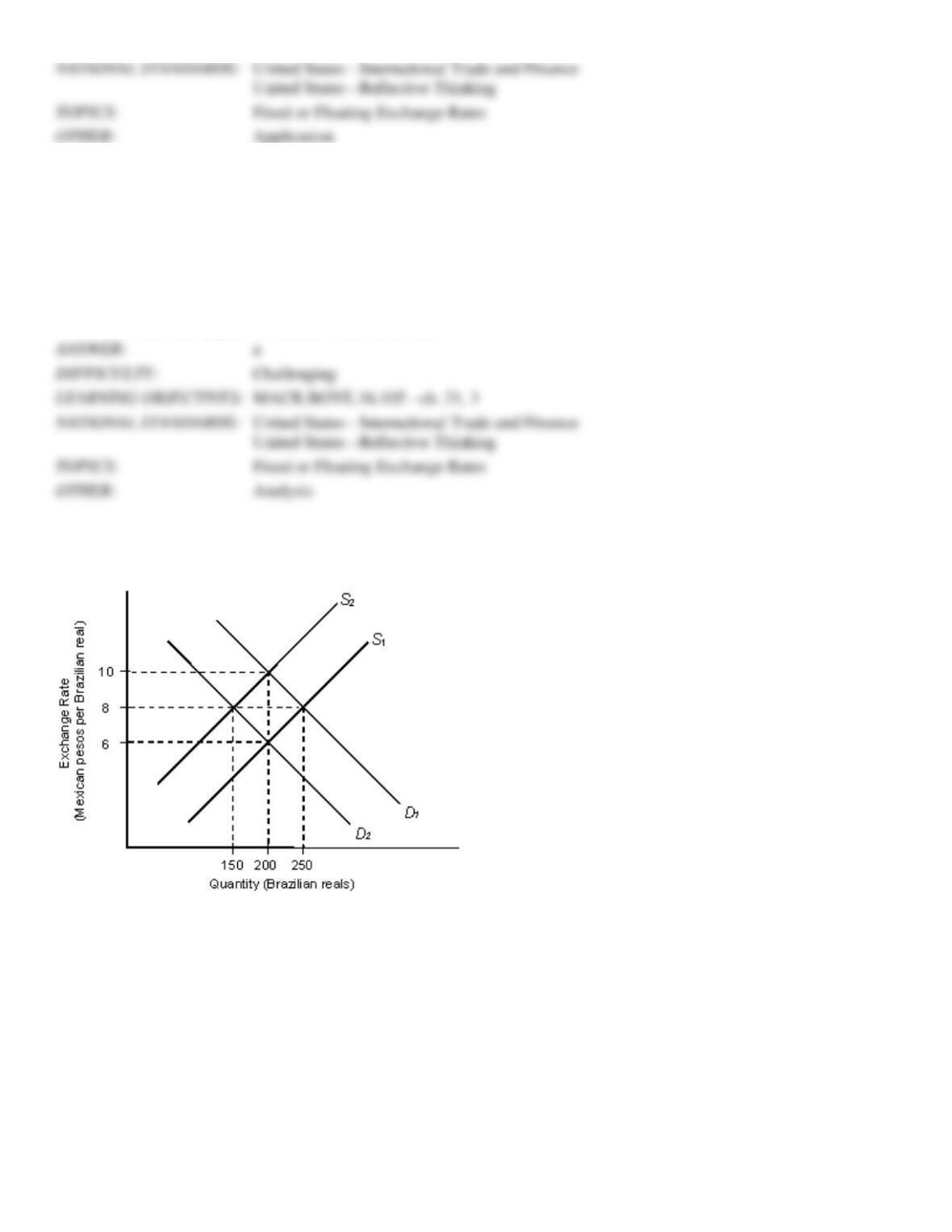
The figure given below depicts the demand and supply of Brazilian reals in the foreign exchange market. Assume that the
market operates under a flexible exchange rate regime.
Figure 21.1
In the figure:
D1 and D2: Demand for Brazilian reals
S1 and S2: Supply of Brazilian reals
38. Refer to Figure 21.1. Determine the equilibrium exchange rate and equilibrium quantity of Brazilian reals, if D1 and
S1 are the relevant demand and supply curves for Brazilian reals in this market.
a.
10 pesos per real and a quantity of 150 reals
b.
6 pesos per real and a quantity of 250 reals
c.
8 pesos per real and a quantity of 150 reals
d.
8 pesos per real and a quantity of 250 reals
e.
6 pesos per real and a quantity of 200 reals
39. Refer to Figure 21.1. Assume that the initial equilibrium exchange rate is 8 Mexican pesos per Brazilian real and 150
brazilian reals are traded in the market. Suppose, there is an increase in the Brazilian demand for Mexican exports. Other
things remaining equal, which of the following can be concluded?
a.
The demand curve for Brazilian reals will shift to the the right.
b.
The supply curve of Brazilian reals will shift to the the right.
c.
The Mexican pesos will depreciate in value.
d.
The Brazilian reals will appreciate in value.
e.
Around 100 Brazilian reals will be traded in the forex market.
MACR.BOYE.16.105 – ch. 21, 3
United States – Reflective Thinking
Fixed or Floating Exchange Rates
40. Refer to Figure 21.1. Suppose the initial equilibrium exchange rate is 10 pesos per real. A decrease in the Mexican
demand for Brazilian coffee, other things equal, is most likely to result in a new equilibrium exchange rate of:
a.
6 pesos per real and an equilibrium quantity of 200 Brazilian reals.
b.
6 pesos per real and an equilibrium quantity of 250 Brazilian reals.
c.
8 pesos per real and an equilibrium quantity of 150 Brazilian reals.
d.
8 pesos per real and an equilibrium quantity of 100 Brazilian reals.
e.
10 pesos per real and an equilibrium quantity of 200 Brazilian reals.
MACR.BOYE.16.105 – ch. 21, 3
United States – Reflective Thinking
Fixed or Floating Exchange Rates
41. Refer to Figure 21.1. Assume that the initial equilibrium exchange rate is 6 pesos per real. Other things remaining
equal, an increase in the number of Brazilian tourists to Mexico is most likely to:
a.
keep the equilibrium exchange rate constant.
b.
shift the demand curve for pesos to the right.
c.
shift the supply curve of pesos to the left.
d.
shift the demand curve for pesos to the left.
e.
shift the supply curve of pesos to the right.
MACR.BOYE.16.105 – ch. 21, 3
United States – Reflective Thinking
Fixed or Floating Exchange Rates
42. Refer to Figure 21.1. If the initial equilibrium exchange rate is 6 pesos per real, then other things equal, a decrease in
the number of Brazilian tourists to Mexico would:
a.
increase the demand for Brazilian reals from D2 to D1 and increase the exchange rate to 8 pesos per real.
b.
decrease the supply of Brazilian reals from S1 to S2 and increase the exchange rate to 8 pesos per real.
c.
decrease the supply of Brazilian reals from S1 to S2 and increase the exchange rate to 10 pesos per real.
d.
decrease the demand for Brazilian reals from D1 to D2 and increase the exchange rate to 8 pesos per real.
e.
decrease the supply of Brazilian reals from S1 to S2 and increase the demand for Brazilian reals from D2 to D1,
thereby changing the exchanging rate to 10 pesos per real.
MACR.BOYE.16.105 – ch. 21, 3
Fixed or Floating Exchange Rates
43. Refer to Figure 21.1. The supply curves shown for Brazilian reals are based on:
a.
the supply of Brazilian goods in the international market.
b.
the Brazilian demand for Mexican products.
c.
the supply of Mexican pesos in the market.
d.
the Brazilian demand for Brazilian products.
e.
the Mexican demand for Brazilian products.
MACR.BOYE.16.105 – ch. 21, 3
United States – Reflective Thinking
44. Refer to Figure 21.1. The demand curves shown for Brazilian reals are based on:
a.
the supply of Brazilian reals in the market.
b.
the demand for Mexican pesos.
c.
Brazilian demand for Brazilian products.
d.
Brazilian demand for Mexican products.
e.
Mexican demand for Brazilian products.
MACR.BOYE.16.105 – ch. 21, 3
MACR.BOYE.16.105 – ch. 21, 3
Fixed or Floating Exchange Rates
45. Suppose you observe that with a given supply curve, the Peruvian demand for Argentinean pesos steadily decreases.
This will most likely mean:
a.
the supply of Peruvian nuevos soles has increased on the foreign exchange market.
b.
the Argentinean peso will appreciate in value relative to the Peruvian nuevo sol.
c.
the Argentinean peso will depreciate in value relative to the Peruvian nuevo sol.
d.
the Peruvian demand for Argentinean goods has increased.
e.
the supply of Argentinean pesos has increased on the foreign exchange market.
MACR.BOYE.16.105 – ch. 21, 3
Fixed or Floating Exchange Rates
46. The supply of Thai baht in the foreign exchange market originates with:
a.
tourists who go on vacation to Thailand.
b.
the export of Thailand oranges and other goods.
c.
Thai residents who wish to purchase goods from other countries.
d.
the Thai royal family.
e.
Thai central bank intervention to stop the peseta from depreciating.
MACR.BOYE.16.105 – ch. 21, 3
United States – Reflective Thinking
Fixed or Floating Exchange Rates
47. In 1991, the French mineral water Perrier was temporarily taken off the market in the United States because of
suspected impurities. Other things equal, this action brought about:
a.
an increase in the demand for Perrier.
b.
a decrease in the price of Perrier in terms of French francs.
c.
a depreciation of the French franc relative to the U.S. dollar.
d.
an appreciation of the French franc relative to the U.S. dollar.
e.
an increased supply of dollars in the foreign exchange market.
MACR.BOYE.16.105 – ch. 21, 3
48. Carlos Silva, a Colombian singer, goes on tour to the United States for one month, following high American demand
for his live shows. Assuming that all the show’s expenses are paid by the U.S. promoters, other things equal, the U.S. tour
will bring about:
a.
a decreased supply of Colombian pesos in the foreign exchange market.
b.
an increased supply of American dollars in the foreign exchange market.
c.
an increased supply of Colombian pesos in the foreign exchange market.
d.
a decreased demand for Colombian pesos in the foreign exchange market.
e.
an increased demand for American dollars in the foreign exchange market.
MACR.BOYE.16.105 – ch. 21, 3
Fixed or Floating Exchange Rates
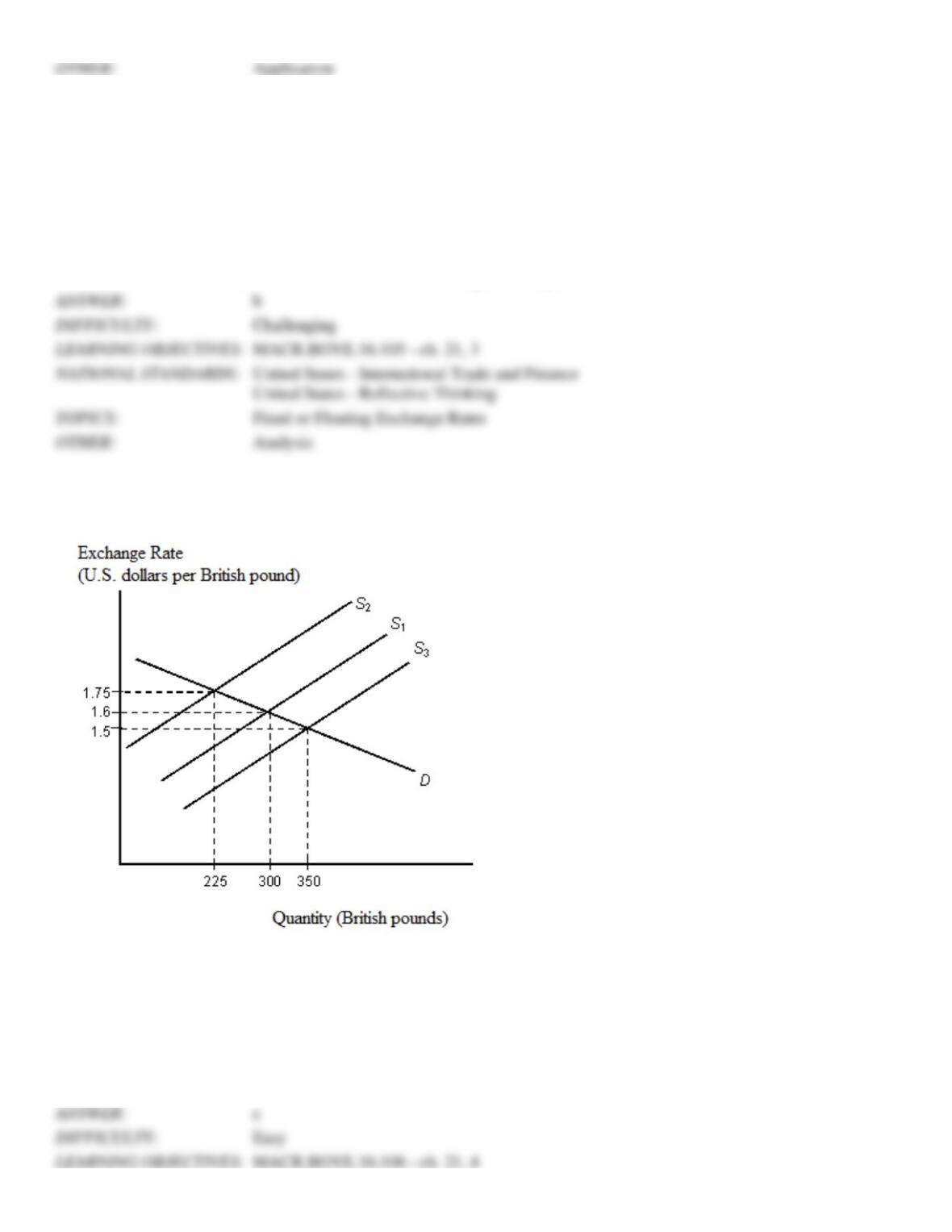
The figure given below depicts the foreign exchange market for British pounds traded for U.S. dollars.
Figure 21.2
49. Refer to Figure 21.2. At the initial equilibrium point, with demand curve D and supply curve S1:
a.
the price of dollar per British pound is $1.50 and the quantity of British pounds being traded is 225.
b.
the price of dollar per British pound is $1.60 and the quantity of British pounds being traded is 225.
c.
the price of dollar per British pound is $1.60 and the quantity of British pounds being traded is 300.
d.
the price of dollar per British pound is $1.75 and the quantity of British pounds being traded is 350.
e.
the price of dollar per British pound is $1.75 and the quantity of British pounds being traded is 300.
MACR.BOYE.16.106 – ch. 21, 4
50. Refer to Figure 21.2. Suppose S1 is the initial supply curve and the British demand for U.S. manufactured computers
decreases. Then, with flexible exchange rates:
a.
the price per British pound decreases by $0.10 and the quantity of British pounds increases by 50.
b.
the price per British pound decreases by $0.10 and the quantity of British pounds decreases by 50.
c.
the price per British pound increases by $0.15 and the quantity of British pounds decreases by 50.
d.
the price per British pound increases by $0.15 and the quantity of British pounds decreases by 75.
e.
the price per British pound and the quantity of British pounds remain unchanged.
MACR.BOYE.16.106 – ch. 21, 4
Fixed or Floating Exchange Rates
51. Refer to Figure 21.2. An increase in the equilibrium quantity of British pounds from 300 to 350 would most likely
mean that:
a.
the demand for British pounds has decreased.
b.
the supply of British pounds has decreased.
c.
increased demand for dollars has caused the dollar to depreciate and the pound to appreciate.
d.
increased demand for dollars has caused the dollar to appreciate and the pound to depreciate.
e.
the equilibrium exchange rate is $1.60 per British pound.
MACR.BOYE.16.106 – ch. 21, 4
Fixed or Floating Exchange Rates
52. Refer to Figure 21.2. Suppose that the British central bank wishes to maintain a fixed exchange rate of £1 = $1.60. If
supply decreases from S1 to S2, the bank must:
a.
buy 25 pounds to shift the supply curve from S2 to S1.
b.
buy 50 pounds to shift the supply curve from S2 to S1.
c.
sell 75 pounds to shift the supply curve from S2 to S1.
d.
buy 75 pounds to shift the supply curve from S2 to S1.
e.
sell 10 pounds to shift the supply curve from S2 to S1.
53. Refer to Figure 21.2. Suppose the British central bank is committed to maintaining an exchange rate of £1 = $1.50, but
there is a permanent shift in supply from S1 to S3. According to the Bretton Woods agreement:
a.
the pound should be devalued.
b.
the dollar should be devalued.
c.
the British central bank should buy pounds in exchange for dollars.
d.
the British central bank should encourage speculation.
e.
the Fed should intervene to maintain the exchange rate of £1 = $1.
MACR.BOYE.16.106 – ch. 21, 4
Fixed or Floating Exchange Rates
54. Suppose a permanent increase in demand for the Argentinean peso causes a chronic shortage of this currency in the
foreign exchange market. The Argentinean government should then:
a.
request other countries to revalue their currency.
b.
devalue the peso.
c.
allow the peso to appreciate.
d.
restricts exports.
e.
restrict imports.
MACR.BOYE.16.106 – ch. 21, 4
Fixed or Floating Exchange Rates
55. A permanent shift in the foreign exchange market supply and demand curves such that the fixed exchange rate is no
longer an equilibrium rate is referred to as:
a.
permanent devaluation.
b.
speculative disequilibrium.
c.
permanent revaluation.
d.
speculative equilibrium.
e.
fundamental disequilibrium.
MACR.BOYE.16.106 – ch. 21, 4
56. Currency speculators are traders who seek to profit from a(n):
a.
shift in global demand and supply patterns.
b.
increase in the price of oil.
c.
sudden shift in interest rates.
d.
exchange rate change by selling the currency expected to appreciate and buying the currency expected to
depreciate.
e.
exchange rate change by selling the currency expected to depreciate and buying the currency expected to
appreciate.
Easy
United States – Analytic – BB-Legal
United States – International Trade and Finance
Fixed or Floating Exchange Rates
Knowledge
57. Suppose a hefty rise in the demand for Mexican pesos create a chronic shortage of this currency in the foreign
exchange market. Which of the following steps should be adopted by the Mexican government to eliminate this shortage?
a.
The government should impose a ban on Mexican exports.
b.
The government should devalue the peso.
c.
The government should print more pesos to increase its supply.
d.
The government should allow the peso to appreciate.
e.
The government should allow the peso to depreciate.
Challenging
MACR.BOYE.16.106 – ch. 21, 4
United States – International Trade and Finance
United States – Reflective Thinking
Fixed or Floating Exchange Rates
Analysis
58. If prices rise within a country, then, other things equal, the value of a unit of domestic currency will:
a.
rise in both the domestic and the foreign exchange markets.
b.
fall in both the domestic and the foreign exchange markets.
c.
rise in the domestic market and fall in the foreign exchange market.
d.
fall in the domestic market and rise in the foreign exchange market.
e.
fluctuate unpredictably in both domestic and foreign exchange markets.
b
MACR.BOYE.16.107 – ch. 21, 5
United States – International Trade and Finance
Fixed or Floating Exchange Rates
59. Under the flexible exchange rate system, when a country tries to stimulate economic growth and improve its
employment rates, it is likely to cause:
a.
the domestic inflation rate to rise and the domestic currency to depreciate.
b.
the domestic inflation rate to rise and the domestic currency to appreciate.
c.
the domestic inflation rate and the value of the domestic currency to remain constant.
d.
the domestic inflation rate to fall and the domestic currency to appreciate.
e.
the domestic inflation rate to fall and the domestic currency to depreciate.
60. Fixed exchange rates require the economic policies of countries linked by the exchange rate to be:
a.
completely independent.
b.
complementary to each other.
c.
determined by the World Bank.
d.
similar in nature.
e.
determined by the International Monetary Fund.
MACR.BOYE.16.107 – ch. 21, 5
Fixed or Floating Exchange Rates
61. Under a fixed exchange-rate system, in order to maintain the exchange rate:
a.
governments must adopt a laissez-faire economic policy.
b.
all trading partners must enjoy the same level of economic growth.
c.
currencies must be inconvertible.
d.
the imports of one country must equal the exports of its trading partner.
e.
governments must intervene in the foreign exchange market.
MACR.BOYE.16.107 – ch. 21, 5
United States – International Trade and Finance
Fixed or Floating Exchange Rates
62. One of the advantages of floating exchange rates is that:
a.
consumers always know how much imported goods cost.
b.
businesses always know, in advance, what future exchange rates will be.
MACR.BOYE.16.107 – ch. 21, 5
United States – Reflective Thinking