78. Suppose a consumer spends her income on two goods: music CDs and DVDs. The price of a CD is $8, and the price
of a DVD is $20. If we graph the budget constraint by measuring the quantity of CDs purchased on the vertical axis and
the quantity of DVDs on the horizontal axis, what is the slope of the budget constraint?
a.
-5.0
b.
-2.5
c.
-0.4
d.
The slope of the budget constraint cannot be determined without knowing the income the consumer has
available to spend on the two goods.
79. Suppose a consumer is currently spending all of her available income on two goods: music CDs and DVDs. If the
price of a CD is $9, the price of a DVD is $18, and she is currently consuming 10 CDs and 5 DVDs, what is the
consumer’s income?
a.
$90
b.
$180
c.
$270
d.
$360
80. A consumer is currently spending all of her available income on two goods: music CDs and DVDs. At her current
consumption bundle, she is spending twice as much on CDs as she is on DVDs. If the consumer has $120 of income and
is consuming 10 CDs and 2 DVDs, what is the price of a CD?
a.
$4
b.
$8
c.
$12
d.
$20
81. A consumer is currently spending all of her available income on two goods: music CDs and DVDs. At her current
consumption bundle, she is spending twice as much on CDs as she is on DVDs. If the consumer has $120 of income and
is consuming 10 CDs and 2 DVDs, what is the price of a DVD?
a.
$4
b.
$8
c.
$12
d.
$20
82. A family on a trip budgets $800 for meals and gasoline. If the price of a meal for the family is $50, how many meals
can the family buy if they do not buy any gasoline?
a.
8
b.
16
c.
24
d.
32
83. A family on a trip budgets $1,000 for meals and gasoline. If the price of a meal for the family is $50 and if gasoline
costs $3.50 per gallon, then how many meals can the family buy if they buy 100 gallons of gasoline?
a.
13
b.
16
c.
19
d.
21
84. A family on a trip budgets $800 for meals and hotel accommodations. Suppose the price of a meal is $40. In addition,
suppose the family could afford a total of 8 nights in a hotel if they don’t buy any meals. How many meals could the
family afford if they gave up two nights in the hotel?
a.
1
b.
2
c.
5
d.
8
85. If the price of bread is zero and the price of cheese is positive, then the budget constraint between bread (on the
horizontal axis) and cheese (on the vertical axis) would
a.
be vertical.
b.
coincide with the vertical axis.
c.
coincide with the horizontal axis.
d.
be horizontal.
86. An increase in a consumer’s income
a.
increases the slope of the consumer’s budget constraint.
b.
has no effect on the slope of the consumer’s budget constraint.
c.
decreases the slope of the consumer’s budget constraint.
d.
has no effect on the consumer’s budget constraint.
87. A decrease in a consumer’s income
a.
increases the slope of the consumer’s budget constraint.
b.
has no effect on the consumer’s budget constraint.
c.
decreases the slope of the consumer’s budget constraint.
d.
has no effect on the slope of the consumer’s budget constraint.
88. Gerald spends his weekly income on gin and cocktail olives. The price of gin has risen from $7 to $9 per bottle, the
price of cocktail olives has fallen from $6 to $5 per jar, and Gerald’s income has stayed fixed at $46 per week. Since the
price changes, Gerald has been buying 4 bottles of gin and 2 jars of cocktail olives per week. At the original prices, 4
bottles of gin and 2 jars of cocktail olives would have
a.
exactly exhausted his income.
b.
cost more than his income.
c.
cost less than his income.
d.
could have maximized his satisfaction given his budget constraint.
89. Mark spends his weekly income on gin and cocktail olives. The price of gin has risen from $7 to $9 per bottle, the
price of cocktail olives has fallen from $6 to $5 per jar, and Mark’s income has stayed fixed at $46 per week. If you
measure gin on the vertical axis and cocktail olives on the horizontal axis, then the budget constraint
a.
is steeper after the price changes.
b.
is flatter after the price changes.
c.
is the same after the price changes.
d.
shifts in a parallel fashion to the old budget constraint after the price changes.
90. Suppose the only two goods that Charlie consumes are wine and cheese. When wine sells for $10 a bottle and cheese
sell for $10 a pound, he buys 6 bottles of wine and 4 pounds of cheese — spending his entire income of $100. One day the
price of wine falls to $5 a bottle and the price of cheese increases to $20 a pound, while his income does not change. The
bundle of wine and cheese that he purchased at the old prices now costs
a.
the same amount at the new prices.
b.
less than Charlie’s income at the new prices.
c.
more than Charlie’s income at the new prices.
d.
We do not have enough information to answer the question.
91. Suppose the only two goods that Lorenzo consumes are wine and cheese. When wine sells for $10 a bottle and cheese
sell for $10 a pound, he buys 6 bottles of wine and 4 pounds of cheese — spending his entire income of $100. One day the
price of wine falls to $5 a bottle, and the price of cheese increases to $20 a pound, while his income does not change. If
you illustrate wine on the vertical axis and cheese on the horizontal axis, then
a.
the slope of Lorenzo’s budget has not changed.
b.
the slope of Lorenzo’s budget constraint is flatter at the new prices.
c.
the slope of Lorenzo’s budget constraint is steeper at the new prices.
d.
Lorenzo’s budget constraint has shifted in a parallel fashion to the budget constraint with the old prices.
92. If the relative price of a concert ticket is three times the price of a meal at a good restaurant, then the opportunity cost
of a concert ticket can be measured by the
a.
slope of the budget constraint.
b.
slope of an indifference curve.
c.
marginal rate of substitution.
d.
income effect.
93. Grace consumes two goods: iced tea and spaghetti. The price of iced tea is $2 per bottle. Her income is $500 per
month. Grace spends all her income each month. She purchases 50 bottles of iced tea and 100 servings of spaghetti. What
is the price of a serving of spaghetti?
a.
$10
b.
$5
c.
$4
d.
$2
94. Bill consumes two goods: iced tea and spaghetti. The price of iced tea is $2 per bottle, and the price of spaghetti is $8
per serving. His income is $1,000 per month. He spends all of his income each month. He purchases 200 bottles of iced
tea. How many servings of spaghetti does he purchase?
a.
125
b.
75
c.
50
d.
10
95. Suppose a consumer consumes two goods, X and Y. The slope of the budget constraint equals the
a.
marginal rate of substitution.
b.
rate at which the consumer will give up X to gain Y while maintaining the same level of utility.
c.
relative price of the two goods.
d.
All of the above are correct.
96. Suppose a consumer consumes two goods, X and Y. The relative price of the two goods equals the
a.
marginal rate of substitution.
b.
rate at which the consumer will give up X to gain Y while maintaining the same level of utility.
c.
slope of the budget constraint.
d.
All of the above are correct.
97. Andi uses all of her income to purchase books and games. At any two points A and B on Andi’s budget constraint,
a.
Andi is spending all of her income on books and games.
b.
Andi is spending one half of her income on books and the other half of her income on games.
c.
the price of books relative to the price of games is different.
d.
All of the above are correct.
98. Fiona uses all of her income to purchase popcorn and butter. At any two points A and B on Fiona’s budget constraint,
a.
Fiona is equally happy.
b.
Fiona is spending more money on popcorn than she is spending on butter.
c.
Fiona’s income is different.
d.
the price of popcorn relative to the price of butter is the same.
99. On a graph we draw a consumer’s budget constraint, measuring the number of apples on the horizontal axis and the
number of light bulbs on the vertical axis. If the slope of the budget constraint is –2, then
a.
an apple costs twice as much as a light bulb.
b.
the opportunity cost of a light bulb is 2 apples.
c.
the opportunity cost of an apple is one-half of a light bulb.
d.
All of the above are correct.
100. On a graph we draw a consumer’s budget constraint, measuring the number of pineapples on the horizontal axis and
the number of pencils on the vertical axis. If the slope of the budget constraint is –6, then
a.
a pineapple costs six times as much as a pencil.
b.
the opportunity cost of a pineapple is 6 pencils.
c.
the opportunity cost of a pencil is one-sixth of a pineapple.
d.
All of the above are correct.
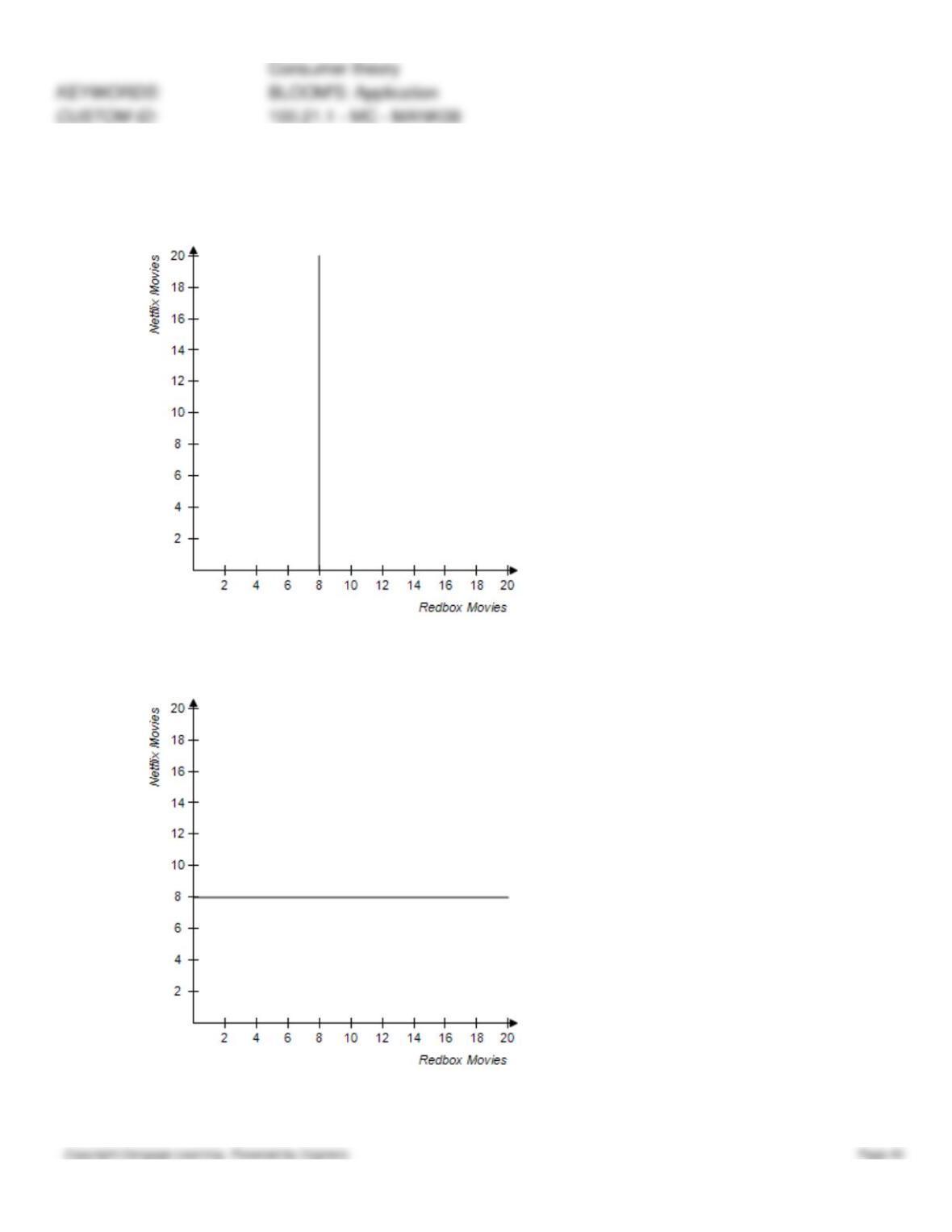
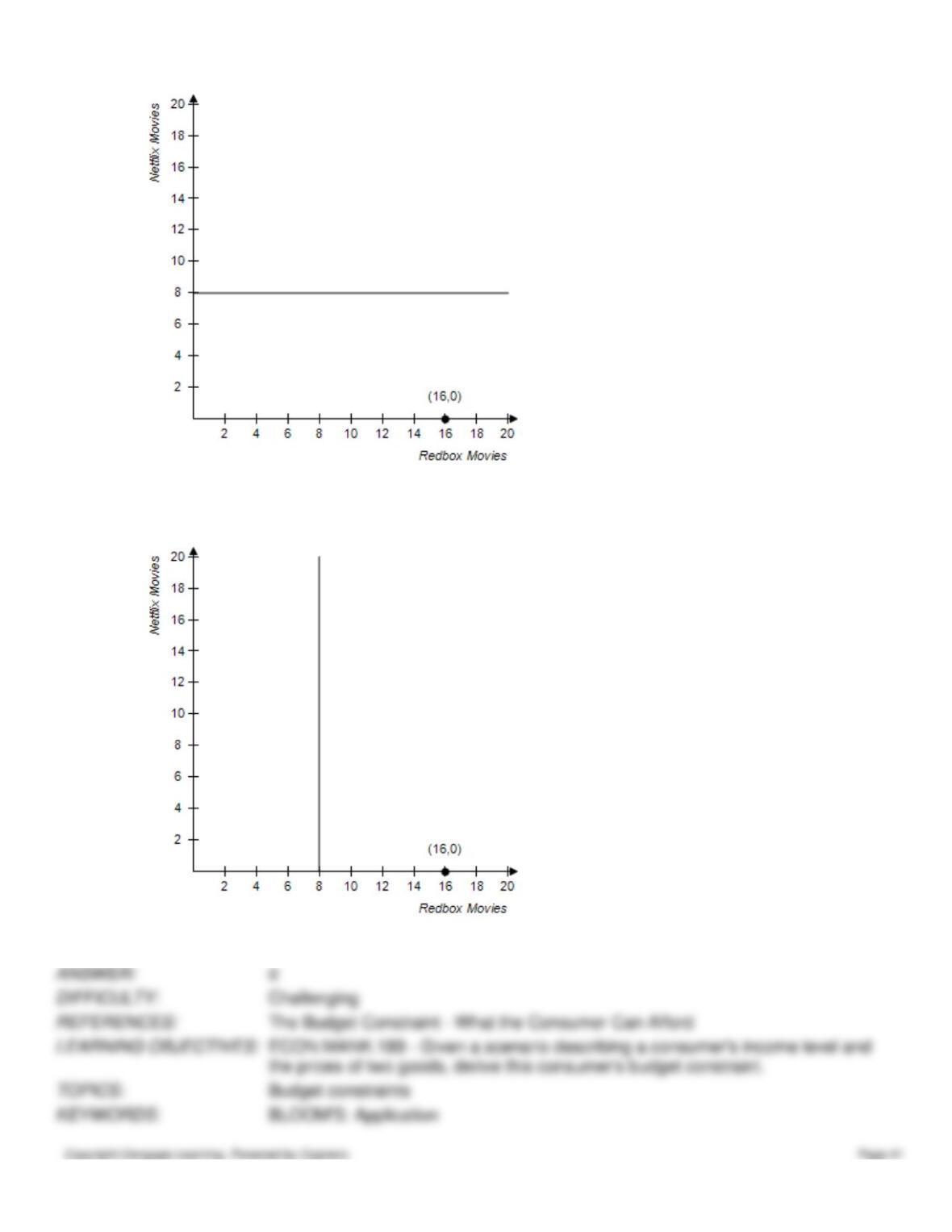
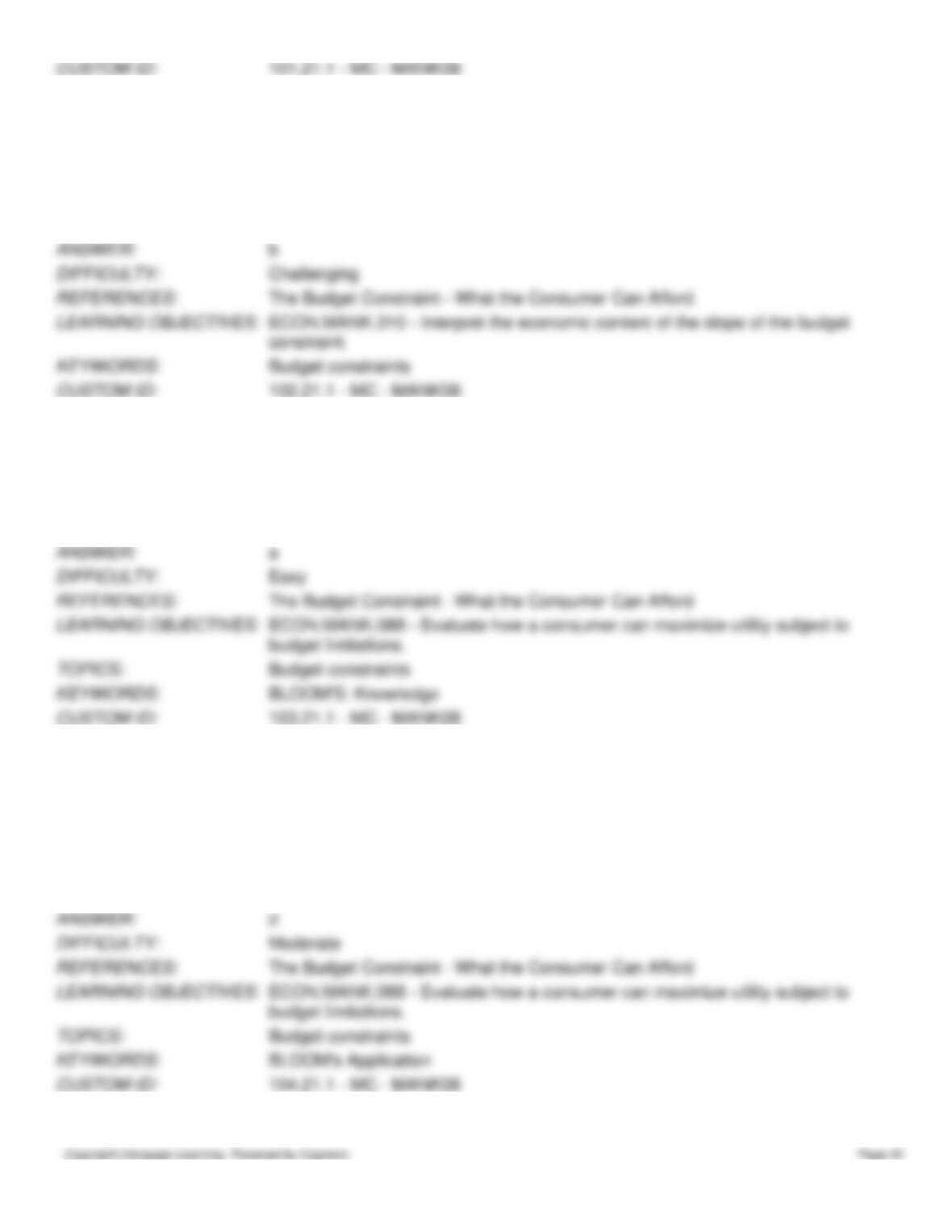
101. Suppose an individual is choosing between Netflix and Redbox movies. He has $16 a month to spend on movies.
The price of a Redbox movie is $1 while Netflix offers unlimited movies for a monthly fee of $8. Which of the following
represents this individual’s budget line?
a.
b.
c.
d.
102. Suppose good X is on the horizontal axis, good Y is on the vertical axis, and the slope of an individual’s budget line
is –2. Which of the following is true?
a.
Good Y is twice as expensive as good X.
b.
The consumer gives up two units of good Y for each unit of good X she purchases.
c.
The opportunity cost of good X is one half of a unit of good Y.
d.
All of the above are correct.
103. Which of the following statements is necessarily true regarding a point along a budget line?
a.
It implies an individual has spent her entire income.
b.
It implies an individual is as happy as possible given her income.
c.
It implies an individual no longer faces tradeoffs between both goods.
d.
It implies an individual would be better off consuming a different bundle of goods.
104. Suppose Raul has budgeted $100 of his monthly income towards two good: t-shirts and jeans. If the price of a pair of
jeans is $20 and last month he spent his $100 on a bundle containing 2 pairs of jeans and 12 t-shirts, which of the
following is another point on Raul’s budget line?
a.
3 pairs of jeans and 16 t-shirts
b.
1 pair of jeans and 15 t-shirts
c.
3 pairs of jeans and 6 t-shirts
d.
0 pairs of jeans and 20 t-shirts