35) A decrease in the price of a good causes
A) the utility of the good to decrease.
B) the marginal utility of the good to decrease.
C) purchasing power of a person’s income to increase.
D) the nominal wealth of a person to increase.
36) For most goods, the real-income effect of a price change is
A) small because the good accounts for a small part of the consumer’s budget.
B) small because the decision to buy a good depends only on the income of a consumer.
C) large because the price of the good is in terms of the currency and the income of the person is
also in terms of the currency.
D) zero because the real-income effect only applies to durable goods.
37) If your money income stays the same but the price of one good that you are buying goes up,
your effective purchasing power
A) rises.
B) does not change.
C) cannot be determined.
D) falls.
38) Your annual review is given to you at your place of employment, and you get a raise of 3
percent for the next year. On the subway home though, you read an article stating the price of
homes in the area you are looking to buy will increase by 6 percent during the coming year. You
determine from the article that if you buy in your favorite neighborhood
A) your purchasing power declines.
B) consumer optimum is reached.
C) your real income actually increases.
D) quantity demanded will increase.
39) When the price of DVDs falls relative to movie and restaurant prices, and consumers buy
more of the DVDs, economists call this
A) indifference.
B) satisfaction.
C) marginalization.
D) substitution.
40) Which of the following statements is FALSE regarding consumer choice?
A) Each change in price has a substitution effect and a real income effect.
B) When price falls, the consumer chooses in favor of the cheaper good.
C) Diminishing marginal utility is one reason for a downward sloping demand curve.
D) Purchasing power has an inverse relationship with the rise in income.
41) If a college student stays home and watches a Netflix movie for $2 rather than going out to a
$15 movie, this is an example of the
A) utility effect.
B) value effect.
C) substitution effect.
D) income effect.
42) When consumers shift away from relatively higher price goods and services in favor of those
that are less expensive, this is known as the
A) principle of utility.
B) principle of substitution.
C) principle of supply.
D) principle of increasing opportunity costs.
43) If you regularly spend $100 a month on gasoline and the price of gasoline doubles, your
purchasing power has
A) increased.
B) remained constant.
C) became stable.
D) decreased.
44) With a given level of money income, when the price of a product that a consumer buys
declines, the purchasing power of your money income
A) decreases.
B) increases.
C) is unchanged.
D) can increase or decreases depending on the goods being consumed.
45) When the price of a good that a person is consuming falls, other things being constant, there
is
A) a decline in real income.
B) a decline in purchasing power.
C) a real income effect.
D) no change in purchasing power.
46) If the price of tea rises relative to all other prices, consumers are likely to
A) buy more tea.
B) buy less tea and more coffee.
C) buy less coffee and less tea.
D) buy less coffee.
47) If the price of a slice of pizza falls from $2 to $1.5, a pizza-loving consumer will
A) see her purchasing power fall.
B) see her purchasing power rise.
C) substitute more Chinese food for pizza.
D) spend more on soft drinks and less on pizza.
48) If the price of a slice of pizza falls, Tom can
A) buy more pizza with his paycheck.
B) buy more soft drinks with his paycheck.
C) no longer afford pizza on his paycheck.
D) Either A or B is possible.
49) The idea that people will substitute cheaper commodities for more expensive commodities is
called
A) the marginal effect.
B) the real-income effect.
C) the substitution effect.
D) the utility effect.
50) When an individual’s purchasing power changes due to a change in the price of a good or
service, this is referred to as
A) marginal effect.
B) real-income effect.
C) substitution effect.
D) utility effect.
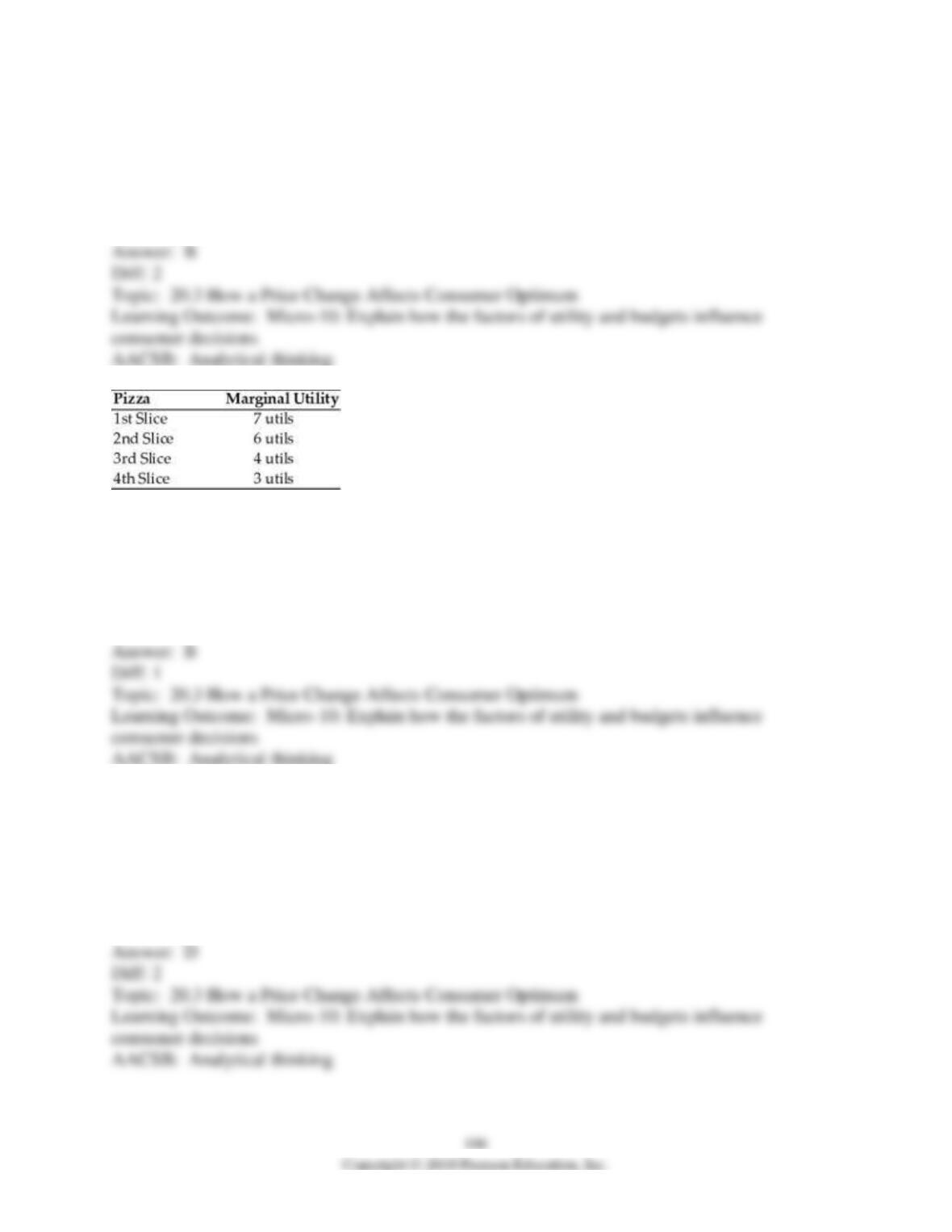
51) Suppose the price of pizza is $2 and the consumer optimum is reached when MU/P = 3.
Tom’s preferences for pizza are shown in the above table. How many slices will Tom buy?
A) 1 slice
B) 2 slices
C) 3 slices
D) 4 slices
52) Suppose the price of pizza falls to $1 per slice. Assuming that Tom’s preferences continue to
be those shown in the above table, and assuming that MU/P = 3 is still the point at which his
consumer optimum is reached, how many slices will Tom now buy?
A) 1 slice
B) 2 slices
C) 3 slices
D) 4 slices
53) Suppose Lois usually buys two cups of coffee for two dollars each and one scone for two
dollars each. If the price of scones falls to one dollar each and she now buys two cups of coffee
and two scones, this illustrates the
A) substitution effect.
B) marginal rate of substitution.
C) total utility effect.
D) real-income effect.
54) The negative relationship between the quantity demanded of a commodity and its price can
be explained by the principle of
A) increasing total utility.
B) contingent valuation.
C) indifference analysis.
D) diminishing marginal utility.
55) According to the substitution effect, if the price of a product goes down
A) the consumer will buy more of the good at the lower price than at a higher price, creating a
downward sloping demand curve.
B) the consumer will buy more of the good at a lower price than at a higher price, creating a
horizontal demand curve.
C) the consumer will not change the level of purchases of the good when the price changes,
making the demand curve a vertical line.
D) the real income of the consumer will increase, causing the consumer to want to buy more of
the good, creating a downward sloping demand curve.
56) The inverse relationship between quantity demanded and price of a good or service can be
explained, in part, by
A) a shift in the demand curve.
B) diminishing marginal utility only.
C) diminishing marginal utility and the rule of equal marginal utilities per dollar.
D) the real income effect.
57) Which of the following is FALSE?
A) A consumer is maximizing total utility when he or she gets the same amount of marginal
utility from the last dollar spent on each good purchased.
B) As additional units of a good or service are consumed, marginal utility diminishes.
C) Utility is want-satisfying power.
D) Assuming that the law of diminishing marginal utility holds, the demand curve must be
upward sloping.
58) Given the utility-optimizing rule and the presence of diminishing marginal utility for a good
A) the demand curve for the good will be vertical.
B) there will not be a well-defined demand curve.
C) there will not be a substitution effect.
D) the demand curve for the good will be negatively sloped.
59) The law of demand is derived under the assumption of
A) constant prices.
B) constant real incomes.
C) constant consumer tastes and preferences.
D) constant marginal utility.
60) The total utility of water is
A) lower than the total and marginal utility of diamonds.
B) lower than the total utility of diamonds, but the marginal utility is higher.
C) higher than the total utility of diamonds, but the marginal utility of diamonds is higher.
D) the same as the total utility of diamonds, but the marginal utilities are the same.
61) The diamond-water paradox illustrates the idea that ________ determines what consumers
are willing to pay for a particular good.
A) total utility
B) the real-income effect
C) marginal utility
D) the substitution effect
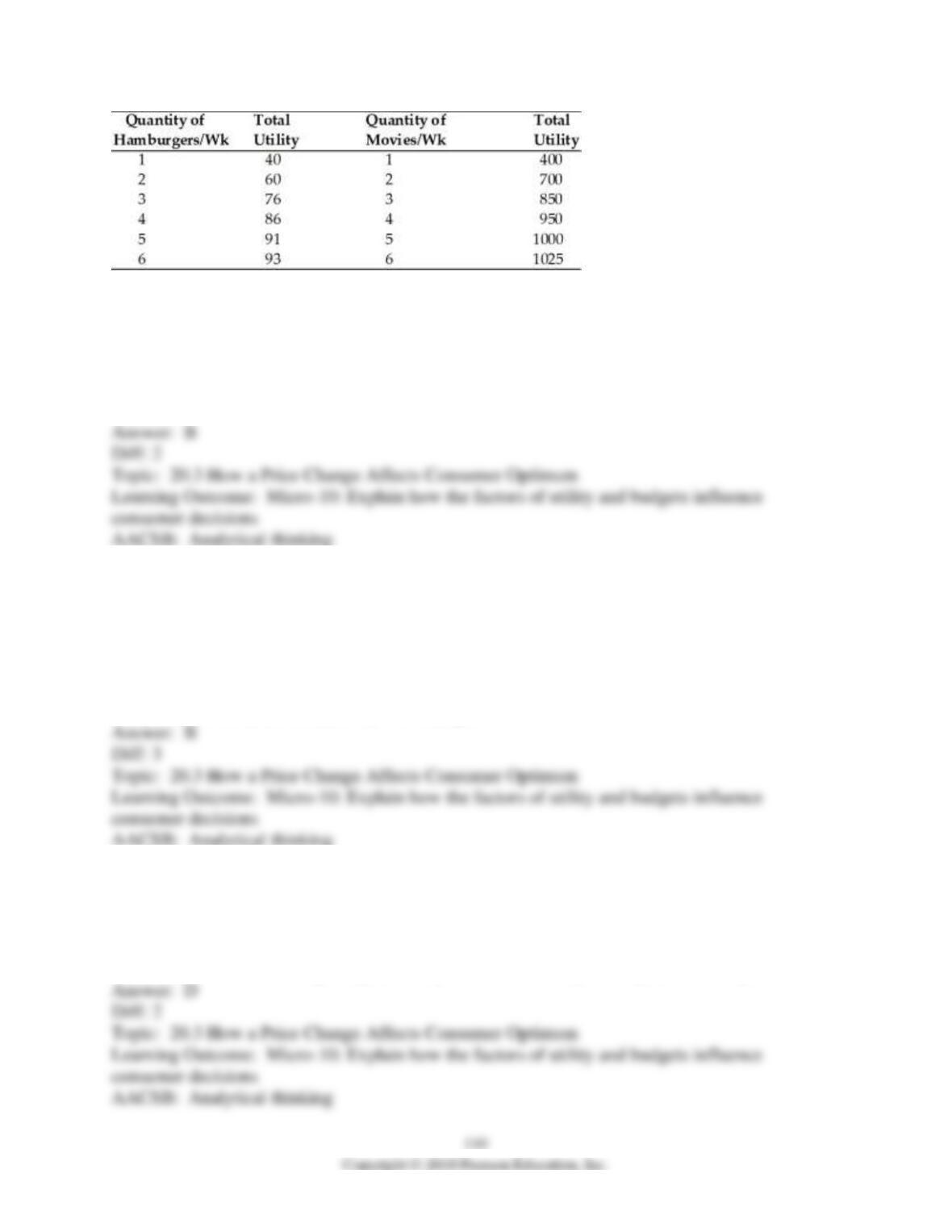
62) Refer to the above table. Suppose the price of a movie is $5 and the income of the consumer
is $29. What are the quantities demanded of hamburger at prices of $2 and $1 respectively?
A) 0; 1
B) 2; 4
C) 1; 2
D) 3; 5
63) Refer to the above table. The price of a hamburger is $2, the price of a movie is $10, and the
consumer has $44. What is the change in quantity demanded of hamburgers if the price of a
hamburger decreases to $1?
A) Quantity demanded increases by 1 hamburger.
B) Quantity demanded increases by 2 hamburgers.
C) Quantity demanded increases by 3 hamburgers.
D) Quantity demanded increases by 4 hamburgers.
64) An individual’s demand curve slopes down because
A) marginal utility falls as price falls.
B) the value of the marginal utility falls as the price falls.
C) of the rule that the marginal utility of the last unit must equal the price.
D) of the law of diminishing marginal utility and the rule of equal marginal utilities per dollar.
65) A consumer was at an optimum. She then discovers that the marginal utility per dollar spent
on food is more than the marginal utility per dollar spent on movies. She knows then that
A) the price of movies must have decreased.
B) the price of food must have increased.
C) the price of movies must have increased or the price of food must have decreased.
D) the price of movies must have decreased or the price of food must have increased.
66) To derive the law of demand, we assume that
A) prices are constant.
B) real prices are constant.
C) marginal utility is constant.
D) tastes are constant.
67) The diamond-water paradox is an example that shows that
A) necessities like water should have a higher price.
B) marginal utility rather than total utility determines what people are willing to pay for a good.
C) there are exceptions to the law of diminishing marginal utility.
D) marginal utility can initially increase and then decrease.
68) Why are diamonds more expensive than water?
A) because the last glass of water has higher marginal utility than the last diamond
B) because the last diamond has higher marginal utility than the last glass of water
C) because you get more total utility from diamonds
D) because water is a necessity
69) The diamond-water paradox was solved by knowing that
A) the total utility of water is greater than the total utility of diamonds.
B) the marginal utility of water is greater than the marginal utility of diamonds.
C) the price of water and diamonds is determined by total utility received, not marginal utility.
D) the price of water and diamonds is determined by marginal utility, not total utility.
70) The reason that diamonds cost more than water is
A) the marginal utility of each diamond a consumer purchases is quite high due to the small
amount of diamonds that most consumers purchase.
B) most consumers consume little water.
C) diamonds are more beautiful than water.
D) water is a necessity.
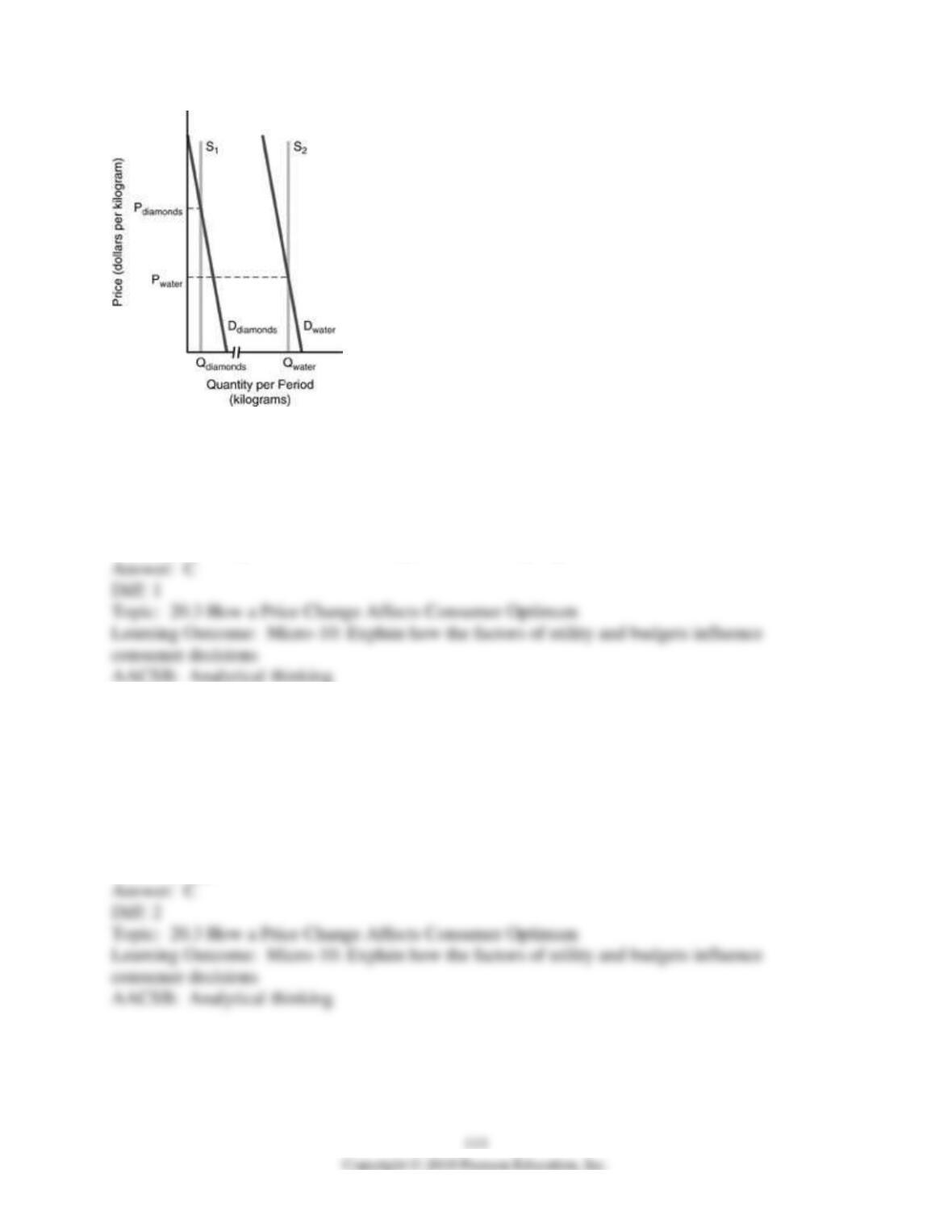
71) Refer to the above figure. All of the following are true concerning the diamond-water
paradox EXCEPT
A) the demand for water exceeds the demand for diamonds.
B) the price of diamonds exceeds the price of water.
C) since the price of diamonds is high, demand is great.
D) marginal utility of diamond consumption is relatively high.
72) Which of the following statements is FALSE, with respect to what economist Adam Smith
called the diamond-water paradox?
A) The total utility of water greatly exceeds the total utility derived from diamonds.
B) Total utility does not determine what people are willing to pay for a unit of a particular
commodity; marginal utility does.
C) The demand for water is much smaller than the demand for diamonds.
D) There are relatively few diamonds, so the marginal utility of the last diamond consumed is
relatively high.
73) Given the price of a good or service, what determines how much a person is willing to pay
for that good or service?
A) marginal utility
B) total utility
C) the substitution effect
D) average utility
74) The average demand curve slopes downward due to all of the following EXCEPT
A) the law of increasing relative costs.
B) the laws of diminishing marginal utility.
C) the real-income effect.
D) the principle of substitution.
75) If you could pay for a product according to the marginal utility that you gain from additional
consumption, then as you consume more of a product the price you pay would
A) remain the same.
B) increase.
C) be deferred.
D) decline.
76) Suppose a consumer is at an optimum, consuming 6 hamburgers a week at a price of $1.50
each and 10 donuts a week at 50 cents a donut. If the price of a hamburger increases to $2.00,
what will the consumer do to arrive at a new equilibrium? Why?
77) Discuss the substitution and real-income effects of a price decrease.
78) Why does a price increase of a product result in a decrease in the quantity demanded of that
product, according to utility analysis?
79) Why is water much cheaper than diamonds even though water is essential to human lives
while diamonds are NOT?
80) Explain how utility analysis can be used to derive a downward sloping demand curve.
81) Use the law of diminishing marginal utility to explain the diamond-water paradox.
20.4 Behavioral Economics and Consumer Choice Theory
1) Observations of violations of consumer optimum predicted by consumer choice theory could
provide support for
I. utility analysis
II. bounded rationality
III. behavioral economics
A) I only.
B) III only.
C) both I and II.
D) both II and III.
2) Behavioral economists focus on the assumption that
A) consumers have limitations that prevent them from examining all possible choices when they
make decisions.
B) consumer behavior cannot be predicted by economics.
C) consumers are irrational and so they do not seek to maximize utility.
D) consumer choice is perfectly predictable by basic economic theory.
3) The fact that the price of diamonds is higher than the price of water
A) cannot be explained by behavioral economics or consumer choice theory.
B) is an outcome of irrational behavior in consumer choice theory.
C) can be explained only by behavioral economics but not by consumer choice theory.
D) can be explained as the outcome of a consumer optimum in consumer choice theory.
4) Because the behavioral economics approach suggests many alternative behaviors that people
might exhibit if they fail to behave as if they are rational, this approach
A) often fails to provide clearly testable behavioral predictions.
B) reproduces the same predictions as utility analysis.
C) has an over reliance on the rationality assumption.
D) ignores the possibility of bounded rationality.
5) Observations of real-world situations that appear to violate a consumer optimum could be
offered as evidence favoring
A) utility analysis.
B) bounded rationality.
C) diminishing marginal utility.
D) zero marginal utility at a utility-maximizing point.
6) One piece of evidence that possibly supports the bounded-rationality assumption of behavioral
economics is that experiments appear to have shown that
A) people make different decisions in calm situations than in situations in which emotions come
into play.
B) people make the same decisions in calm situations than in situations in which emotions come
into play.
C) total utility is maximized when marginal utility is equal to zero.
D) total utility is declining when marginal utility is negative.
7) Behavioral economics suggests that people face human limitations that prevent them from
examining every possible choice available to them, with the implication that
A) the consumer optimum implied by utility theory is an inappropriate approach to deriving
demand curves.
B) the consumer optimum implied by utility theory is an appropriate approach to deriving
demand curves.
C) marginal utility is always equal to zero.
D) marginal utility is always negative.
20.5 Appendix F: On Being Indifferent
1) An indifference curve provides the set of consumption alternatives that
A) yield the same total amount of satisfaction.
B) maximize the utility of the consumer.
C) can be purchased for the same amount of money.
D) yield the same marginal utility for the last unit consumed of each good.
2) An indifference curve shows
A) the combinations of goods that a consumer does not like very much.
B) the combinations of goods that generate the same ratio of marginal utilities.
C) the set of consumption alternatives that yield the same amount of total utility.
D) the set of consumption alternatives that yield the same amount of marginal utility.
3) A curve where every combination of the two goods being considered yields the same level of
satisfaction is known as
A) a marginal utility curve.
B) a total utility curve.
C) an indifference curve.
D) a budget constraint.
4) Along an indifference curve
A) every combination of goods the consumer can purchase with their income is given.
B) the prices of goods will change.
C) utility increases as you move to the right.
D) every combination of the goods give the same level of satisfaction.
5) Along an indifference curve,
A) the marginal utility of all items is equal.
B) the total satisfaction is the same.
C) the prices of all goods are equal.
D) the marginal utility/price ratios of all items are equal.