Economics Today, 19e (Miller)
Chapter 20 Consumer Choice
20.1 Utility Theory
1) In economics, another term for satisfaction is
A) scarcity.
B) need.
C) utility.
D) return.
2) The amount of pleasure or satisfaction derived from consumption of a good is called
A) need.
B) utility.
C) consumer surplus.
D) demand.
3) Suppose that Dillon derives 40 utils of total utility from eating 5 hotdogs and 42 utils of total
utility from eating 6 hotdogs. What is Dillon’s marginal utility from eating the 6th hotdog?
A) 2
B) 6
C) 7
D) 6.67
4) Utility analysis helps economists understand
A) how people make decisions about what they buy and how much.
B) how to eliminate opportunity costs.
C) how to eliminate scarcity.
D) none of the above.
5) Which of the following is NOT true of utility?
A) It represents the want-satisfying power of a good.
B) It is measured using a representative unit called a util.
C) The utility that a good provides depends on a consumer’s preferences.
D) Utility can be measured objectively.
6) The utility that people experience from the consumption of a good depends on
A) their income level.
B) their tastes and preferences.
C) total sales of the good.
D) how much shopping time they spent obtaining the good.
7) Economists use what term to describe the want-satisfying power of a good?
A) demand
B) utility
C) marginal propensity to consume
D) income elasticity
8) In economics, utility is defined as
A) the want-satisfying power of a good or service.
B) the usefulness of a good or service.
C) the utilitarian value of a good or service.
D) the objective measure of the desirability of a good or service.
9) In economic utility analysis, consumer tastes and preferences are assumed
A) to be determined by income.
B) to be influenced by the prices of goods.
C) given and stable for an individual.
D) given but rapidly changeable.
10) A representative unit that measures the want-satisfying power of a good is
A) a margin.
B) purchasing power.
C) income.
D) a util.
11) Which English philosopher set out to develop an arithmetic formula for measuring happiness
and along the way invented the util?
A) John Maynard Keynes
B) Milton Friedman
C) Jeremy Bentham
D) Adam Smith
12) Marginal utility is measured as
A) utility per unit of production.
B) additional output divided by additional utility.
C) output of a good or service divided by price.
D) additional utility from each additional good consumed.
13) Marginal utility is
A) the utility received from consuming one unit of a good.
B) the change in total utility due to a one-unit change in the quantity of a good consumed.
C) the total utility received from consuming a certain quantity of a good divided by the quantity.
D) the utility received by the last consumer of a good.
14) Marginal utility equals the change in total utility divided by
A) the number of units consumed.
B) the price of the product.
C) the change in the number of units consumed.
D) the consumer’s subjective level of preference.
15) The term marginal means
A) total.
B) average.
C) subjective.
D) additional.
16) When economists refer to people making decisions at the margin, they mean that we
compare ________ benefits with ________ costs.
A) total; total
B) total; incremental
C) additional; additional
D) additional; marginal
17) The concept of marginality is important in economics because
A) individuals make decisions at the margin.
B) marginal decisions indicate a lack of importance.
C) individuals make decisions based on tastes only.
D) large expenditures are the only factor influencing consumption.
18) Marginal utility can be thought of as
A) the incremental change in a person’s total satisfaction level from the consumption of a good.
B) the total change in satisfaction from buying a good.
C) the additional cost of that next good purchased.
D) the opportunity cost of buying the next good.
19) If total utility is decreasing, then marginal utility is
A) negative.
B) positive.
C) zero.
D) increasing.
20) If total utility is increasing, then marginal utility is
A) negative.
B) positive.
C) zero.
D) decreasing.
21) If total utility is unchanged, then marginal utility is
A) negative.
B) positive.
C) zero.
D) increasing.
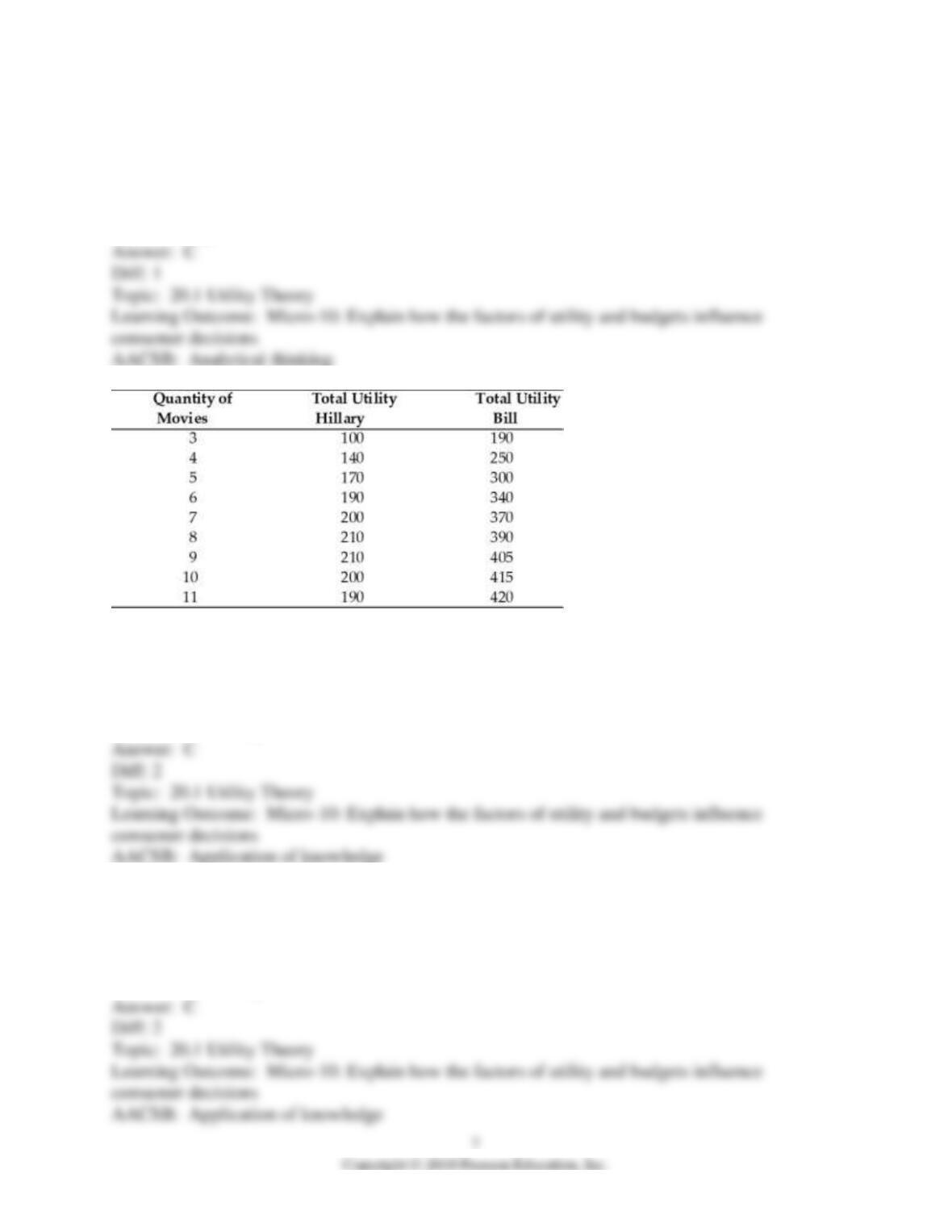
22) According to the above table, Hillary’s marginal utility from watching the 5th movie is
A) 170 units of utility.
B) 50 units of utility.
C) 30 units of utility.
D) 20 units of utility.
23) According to the above table, Bill’s marginal utility from watching the 9th movie is
A) 405 units of utility.
B) 0 units of utility.
C) 15 units of utility.
D) 10 units of utility.
24) According to the above table, Hillary’s marginal utility from watching the 4th movie is
A) 140 units of utility.
B) 40 units of utility.
C) 60 units of utility.
D) 30 units of utility.
25) Refer to the above table. What is the marginal utility for the 10th unit for Hillary and for
Bill?
A) Hillary: -10; Bill: 10
B) Hillary: 10; Bill 10
C) Hillary: 220; Bill 450
D) Hillary: 0; Bill: 0
26) The total utility from consuming 8 units of a good is 155. The marginal utility of the 8th unit
is 7 and the marginal utility of the 7th unit is 11. The total utility from consuming 6 units of the
good is
A) 173.
B) 144.
C) 137.
D) 130.
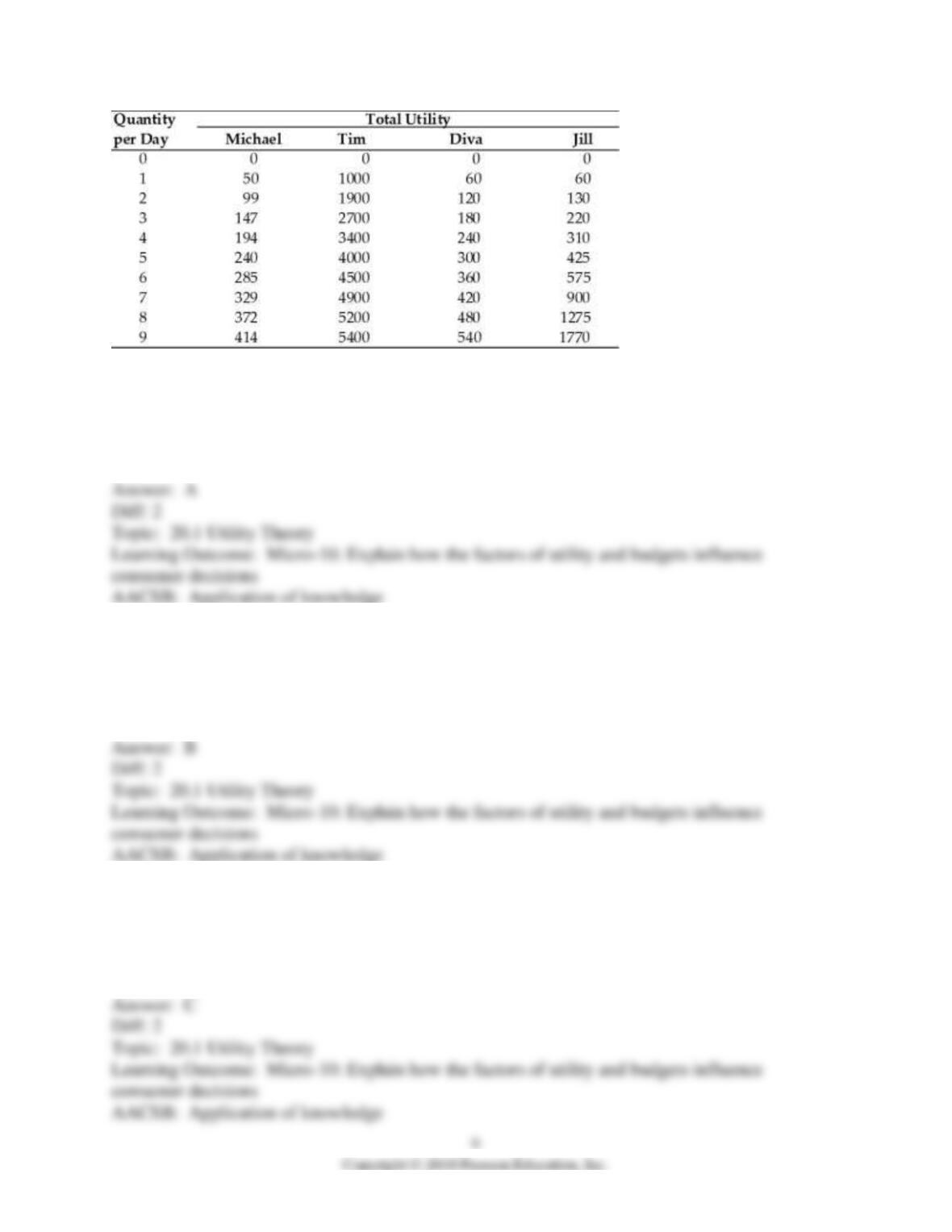
27) According to the above table, what is Jill’s marginal utility of the 4th unit?
A) 90
B) 220
C) 310
D) 115
28) According to the above table, what is Michael’s marginal utility of the 8th unit?
A) 372
B) 43
C) 42
D) 44
29) According to the above table, what is Tim’s marginal utility of the 5th unit?
A) 60
B) 4500
C) 600
D) 500
30) According to the above table, what is Diva’s marginal utility of the 7th unit?
A) 420
B) 400
C) 120
D) 60
31) When the total utility from consuming one good is maximized, marginal utility is
A) maximized.
B) minimized.
C) zero.
D) positive.
32) If two units of a good provide 8 utils and the marginal utility of the third unit of the good is 2
utils, what is the total utility from consuming three units of the good?
A) 2 utils
B) 8 utils
C) 10 utils
D) 6 utils
33) Marginal utility is defined as
A) the increase in utility divided by the total number of units consumed.
B) the total utility divided by the total number of units consumed.
C) the change in total utility divided by the change in number of units consumed.
D) the number of units consumed divided by the total utility.
34) Consumers are most satisfied when
A) all of their income has been saved.
B) the total level of utility is as high as possible.
C) goods are bought “on sale.”
D) they save more than they spend.
35) Utility refers to
A) the usefulness of a good or service.
B) the value of a good or service.
C) the want-satisfying power of a good or service.
D) the degree to which a good or service is needed.
36) The want-satisfying power of a good or service is known as
A) purchasing power.
B) utility.
C) consumer optimum.
D) principle of substitution.
37) A good synonym for “utility” is
A) marginal.
B) need.
C) necessity.
D) satisfaction.
38) The concept of utility is
A) subjective so that there can be no true measurement of someone’s utility.
B) subjective so measurement of someone’s utility must be done scientifically.
C) objective so that devices can be developed that would measure a person’s utility.
D) objective so that psychologists can measure utility and compare one person’s utility with that
of another person.
39) Economists infer that a consumer receives more utility from one good than another by
A) giving consumers surveys about the utility they receive from the goods.
B) observing the consumer’s behavior.
C) the logic of the models used.
D) means of introspection and speculation.
40) Utility analysis is the analysis of
A) how consumers decide how to earn more money.
B) the formation of tastes and preferences.
C) the psychology of decision making.
D) consumer decision making based on utility maximization.
41) The analysis of consumer decision making based on utility maximization is known as
A) specialization analysis.
B) consumption analysis.
C) utility analysis.
D) market analysis.
42) At a ball game we can observe people eating hot dogs, french fries, and hamburgers. If all
are priced the same and we observe Michelle eating a hot dog and David eating a hamburger, we
can conclude that
A) Robert will be eating french fries.
B) Michelle likes hot dogs better than David does and David likes hamburgers better than
Michelle does.
C) Michelle derives the same amount of utility from eating a hot dog as David derives from
eating a hamburger.
D) at this time Michelle derives more utility from eating a hot dog than from eating either a
hamburger or french fries, while David derives more utility from eating a hamburger than from
eating either a hot dog or french fries.
43) Juan and Lauren have decided to stop studying economics and get a bite to eat. Juan wants to
go for a pizza and Lauren wants a hot dog They decide to go for pizza. What can we conclude
from this?
A) Juan always gets more utility from pizza than Lauren does.
B) Lauren gets less utility from pizza than she could from a hot dog.
C) Lauren will get negative utility from the pizza.
D) Utility analysis does not work here since Lauren did not eat a hot dog.
44) A representative unit by which utility is measured is
A) a util.
B) utility.
C) marginal utility.
D) ordinal utility.
45) In cardinal utility analysis
A) numbers can be assigned to utility.
B) it is recognized that numbers can not be assigned to utility.
C) the concept of marginal utility exists while in ordinal utility analysis marginal utility does not
exist.
D) marginal utility always increases as more of a good is consumed.
46) Marginal utility is
A) the utility received by the last consumer of a good.
B) the total utility received from consuming a given quantity of a good divided by the number of
units consumed.
C) the change in total utility from consuming an additional unit of a good.
D) the utility received from consuming the first unit of a good.
47) The change in the total utility as a result of increasing consumption by one unit is known as
A) marginal utility.
B) average utility.
C) proportional utility.
D) utils.
48) The rate of change in total utility equals
A) marginal utility.
B) the change in marginal utility associated with eating all the quantities a person can handle.
C) the change in marginal utility divided by the change in quantity.
D) the rate of change in marginal utility divided by the price.
49) Josh has just eaten another cookie and his total utility increased. This means that Josh’s
marginal utility for this additional cookie is
A) positive.
B) negative.
C) zero.
D) not determinable without more information.
50) Jose has just eaten another hot dog and his total utility decreased. This means that Jose’s
marginal utility for this additional hot dog is
A) positive.
B) negative.
C) zero.
D) not determinable without more information.
51) Kelly has decided that she would enjoy eating another cupcake. Which of the following
statements is consistent with Kelly’s decision?
A) Kelly’s marginal utility has decreased with a corresponding decrease in total utility.
B) Kelly’s marginal and total utility remain unchanged.
C) Kelly’s marginal utility has decreased but it is unclear what has happened to total utility.
D) Kelly’s total utility has increased but it is unclear what has happened to her marginal utility.
52) A student athlete loves cookies. He receives 200 utils for the first cookie, an additional 160
for the second, an additional 120 for the third, another 80 for the fourth, and another 40 for the
fifth. The marginal utility of the fourth cookie is ________ and the total utility of consuming
four cookies is ________.
A) 40; 80
B) 80; 600
C) 80; 560
D) 40; 40
53) Sam loves cookies. She receives 200 utils for one cookie, 360 for two cookies, 490 for the
third, 560 for four cookies, and 600 for five cookies. The marginal utility of the third cookie is
A) 130.
B) 490.
C) 70.
D) cannot be determined.
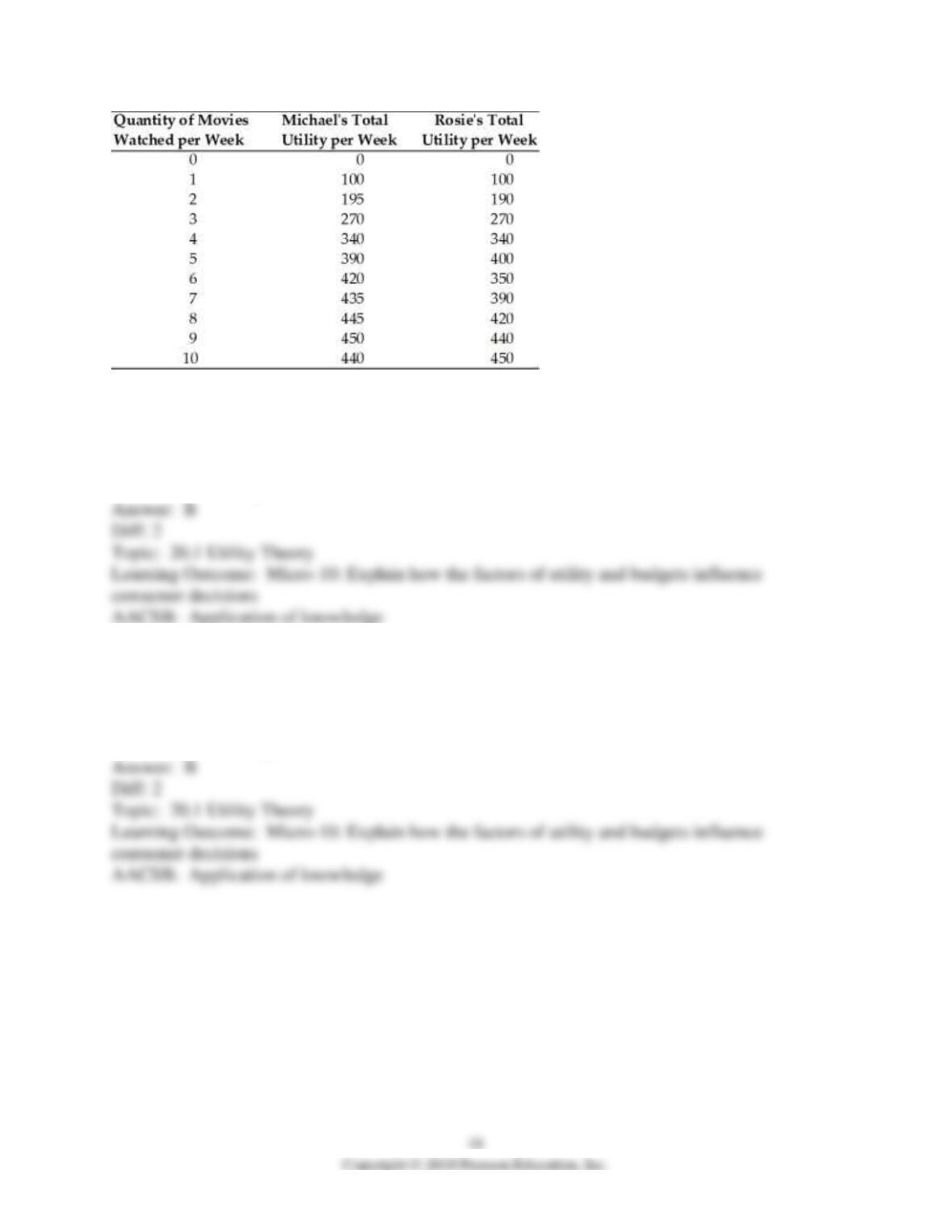
54) Refer to the above table. The marginal utility of the 6th movie for Michael is
A) 25 units of utility.
B) 30 units of utility.
C) 35 units of utility.
D) 40 units of utility.
55) Refer to the above table. The marginal utility of the 5th movie for Michael is
A) 40 units of utility.
B) 50 units of utility.
C) 60 units of utility.
D) 390 units of utility.
56) Refer to the above table. The marginal utility of the 7th movie for Michael is
A) 15 units of utility.
B) 20 units of utility.
C) 35 units of utility.
D) 435 units of utility.
57) Refer to the above table. The marginal utility of the 2nd movie for Rosie is
A) 95 units of utility.
B) 90 units of utility.
C) 80 units of utility.
D) 190 units of utility.
58) Refer to the above table. The marginal utility of the 5th movie for Rosie is
A) 400 units of utility.
B) 50 units of utility.
C) 60 units of utility.
D) 70 units of utility.
59) Refer to the above table. The marginal utility of the 8th movie for Rosie is
A) 30 units of utility.
B) 20 units of utility.
C) 420 units of utility.
D) 5 units of utility.
60) Refer to the above table. What is the marginal utility for the 10th unit for Michael and for
Rosie?
A) Michael: 50; Rosie: 50
B) Michael: 15; Rosie: 20
C) Michael: 10; Rosie: 10
D) Michael: -10; Rosie: 10
61) Refer to the above table. What is the marginal utility for the 3rd unit for Michael and for
Rosie?
A) Michael: -10; Rosie: 20
B) Michael: 75; Rosie: 75
C) Michael: 75; Rosie: 80
D) Michael: 270; Rosie: 270
62) Refer to the above table. In examining the utility schedules for Michael and Rosie, we can
conclude that
A) they like movies the same.
B) they like the third movie the same.
C) Michelle likes movies more than Robert does.
D) they both received the same satisfaction from watching the fourth movie.