121) As an individual consumes more of a particular good, the total level of utility derived from
that consumption usually
A) increases at a constant rate.
B) increases at an increasing rate.
C) increases at a decreasing rate.
D) decreases at an increasing rate.
122) Which economic principle accounts for the fact that all-you-can-eat buffet restaurants can
be profitable?
A) the law of demand
B) the principle of diminishing marginal utility
C) the principle of comparative advantage
D) the law of supply
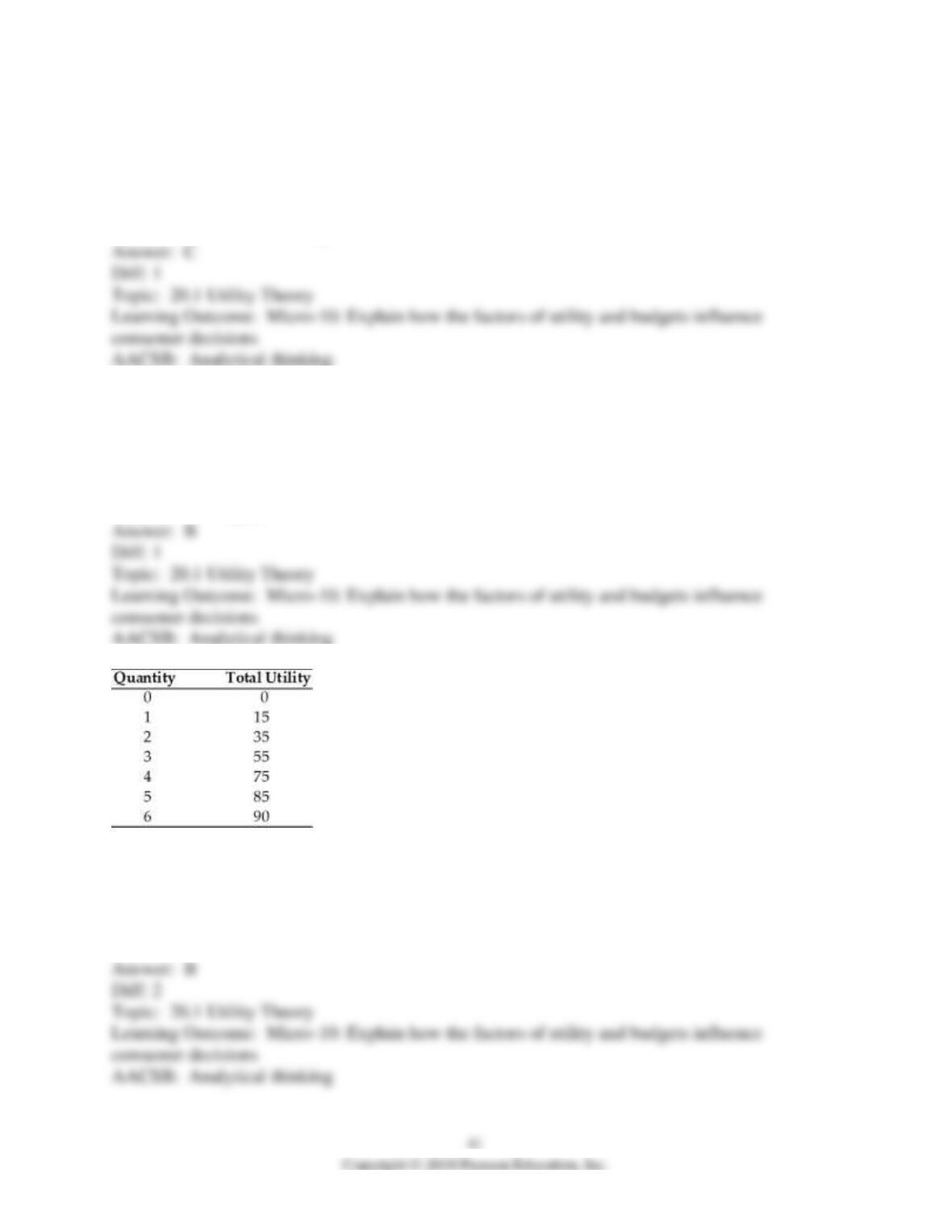
123) Refer to the above table. At what quantity does diminishing marginal utility set in?
A) 1st
B) After 4
C) After 5
D) After 6
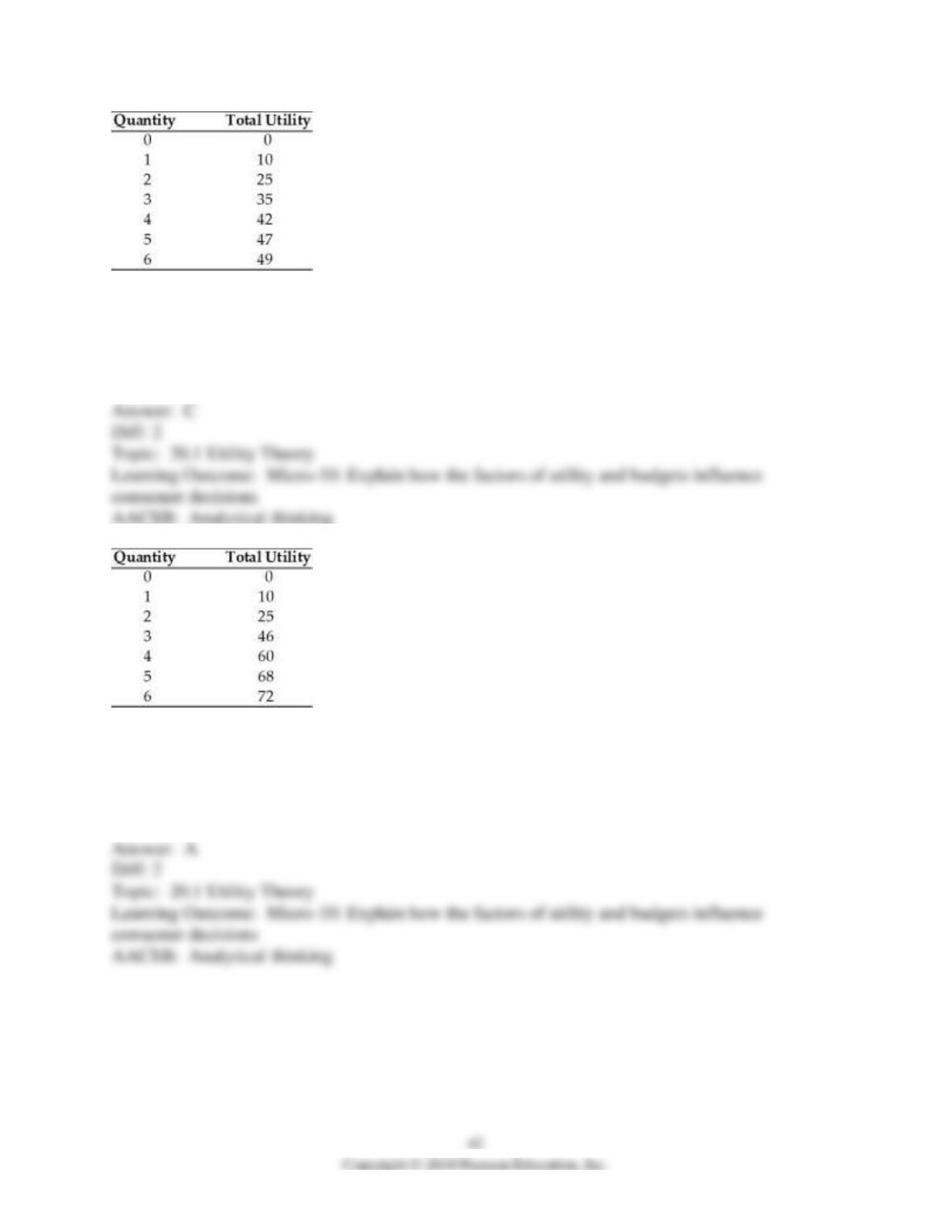
124) Refer to the above table. At what quantity does diminishing marginal utility set in?
A) after 0
B) after 1
C) after 2
D) after 10
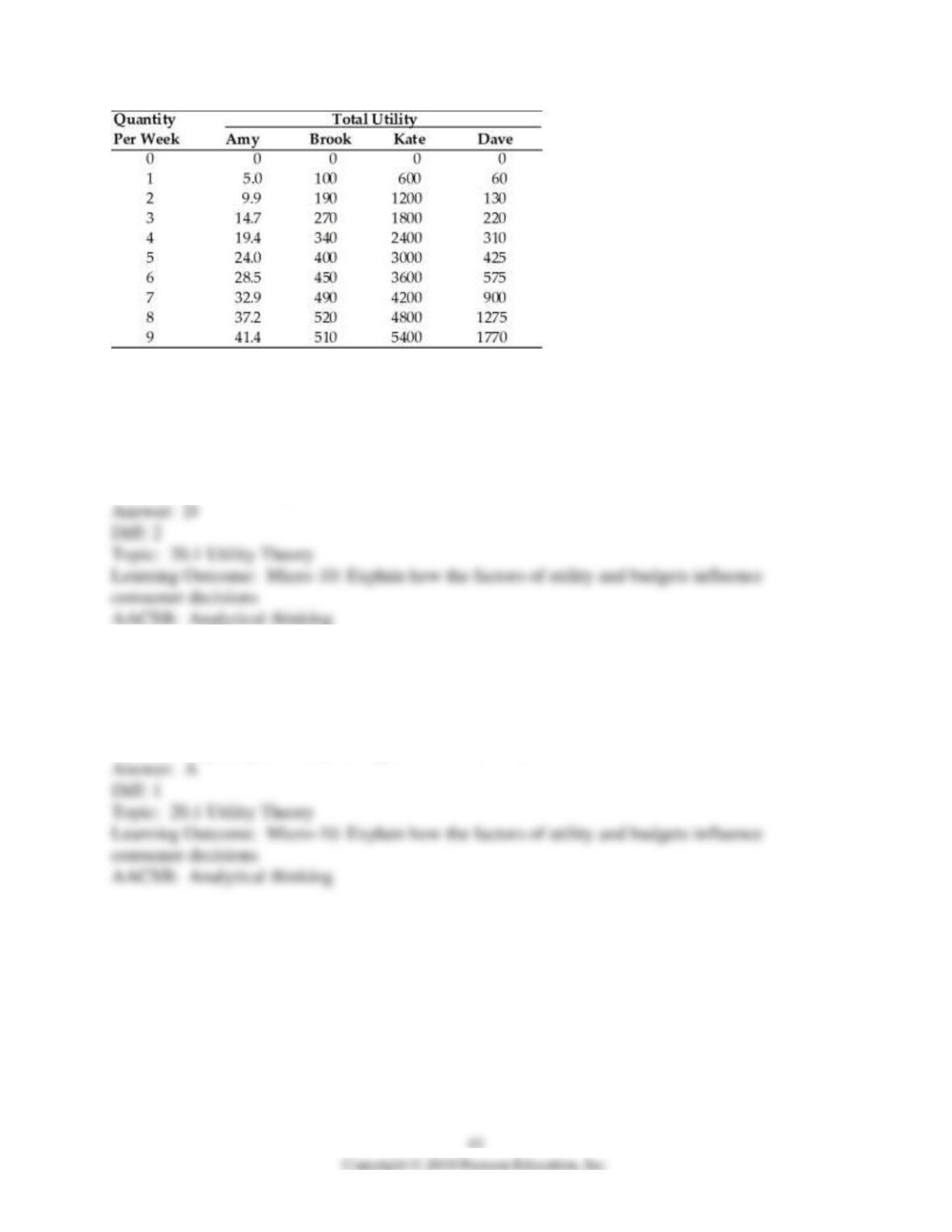
125) Refer to the above table. At what quantity does diminishing marginal utility set in?
A) after 3
B) after 2
C) after 10
D) after 15
126) Refer to the above table. Which of the four people have utility schedules characterized by
the law of diminishing marginal utility?
A) Amy, Brooke, and Kate only
B) Dave only
C) Dave and Kate only
D) Amy and Brook only
127) Refer to the above table. Amy’s utility schedule shows
A) diminishing marginal utility throughout her entire schedule.
B) initially increasing marginal utility and then decreasing marginal utility.
C) initially decreasing marginal utility and then increasing marginal utility.
D) increasing marginal utility throughout her entire schedule.
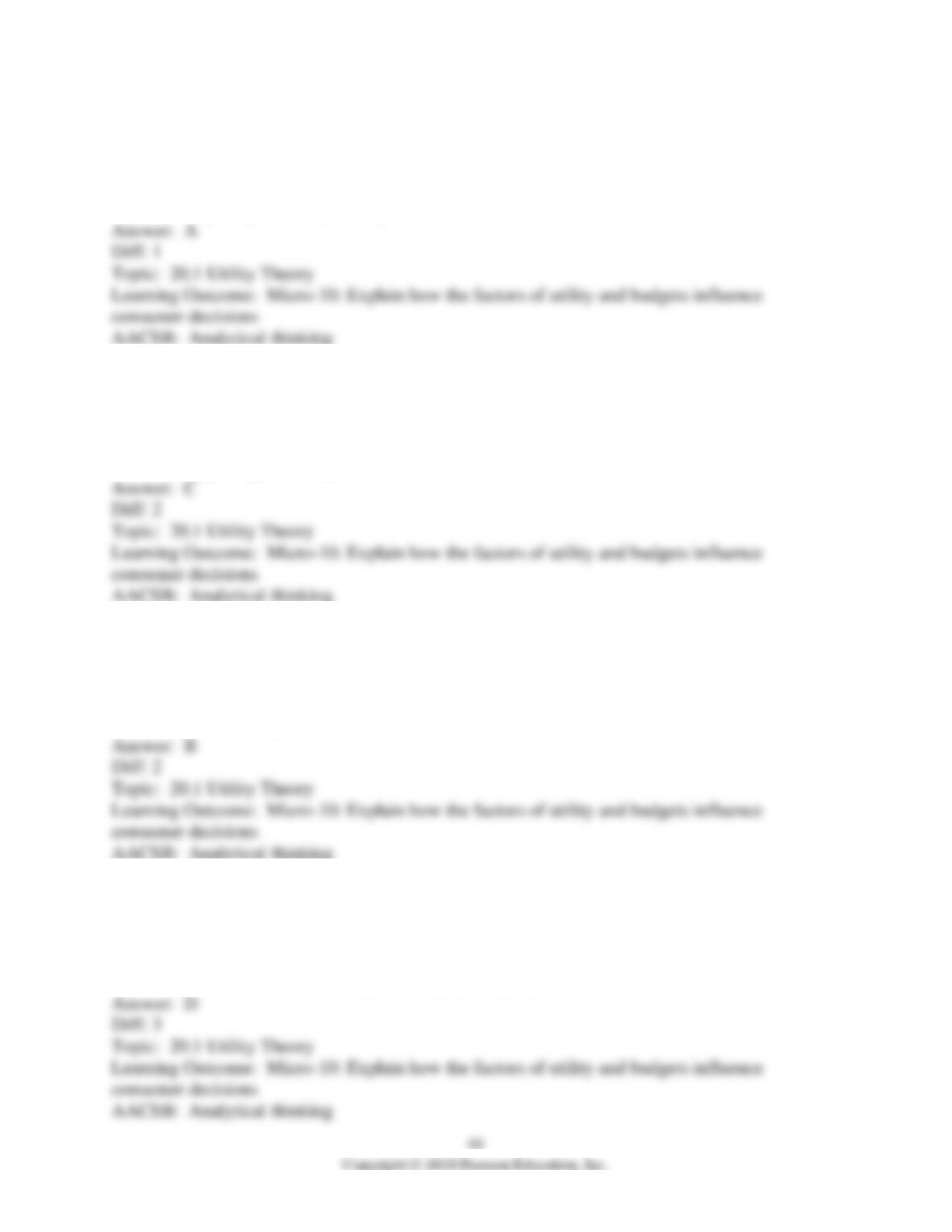
128) Refer to the above table. Brook’s utility schedule shows
A) diminishing marginal utility throughout her entire schedule.
B) initially increasing marginal utility and then decreasing marginal utility.
C) initially decreasing marginal utility and then increasing marginal utility.
D) increasing marginal utility throughout her entire schedule.
129) Refer to the above table. Kate’s utility schedule is characterized by
A) diminishing marginal utility.
B) increasing marginal utility.
C) constant marginal utility.
D) decreasing marginal utility.
130) Refer to the above table. Dave’s utility schedule is characterized by
A) diminishing marginal utility.
B) increasing marginal utility.
C) constant marginal utility.
D) constant total utility.
131) Refer to the above table. The one who likes the good the most is
A) Dave.
B) Kate.
C) Brook.
D) uncertain since we cannot compare utility across people.
132) As you consume more of a particular commodity, your total level of utility derived from
that consumption will
A) increase at an increasing rate.
B) increase at a decreasing rate.
C) increase at a constant rate.
D) remain constant.
133) Which of the following is NOT consistent with the law of diminishing marginal utility?
A) Newspaper vending machines are not as secure as soft drink machines.
B) A student selects to eat at an all-you-can-eat restaurant rather than at a restaurant that charges
for refills.
C) A student’s enjoyment of a movie increases the more she watches it.
D) A symphony has free throat lozenges in their lobby.
134) Increases in total utility from the consumption of a good decrease as more is consumed.
This statement is
A) the law of diminishing marginal utility.
B) the law of average utility.
C) the consumer optimum.
D) not consistent with the assumption of rational behavior.
135) Maria buys a cup of coffee every day after her economics class. The first cup of coffee
always tastes wonderful. The second does not taste quite as good as the first. The third does not
taste quite as good as the second. Maria is experiencing
A) irrational behavior.
B) the law of diminishing marginal utility.
C) the income effect.
D) the substitution effect.
136) On a hot summer day, a construction worker enters a McDonald’s fast-food restaurant. He
orders the first Big Mac. He consumes it within 3 minutes. He then orders a second Big Mac and
consumes it in 10 minutes. He eats only half of the third one in 18 minutes and throws away the
rest. The store manager offers him the fourth for free. The construction worker says: “No
thanks.” Why?
A) For the construction worker, total utility increased at an increasing rate.
B) Marginal utility increased at an increasing rate.
C) Marginal utility declined as he consumed additional Big Macs.
D) The law of diminishing marginal utility does not apply to consumption of Big Macs.
137) A student enters a McDonald’s fast-food restaurant. He orders the first Big Mac. He
consumes it within 3 minutes. He then orders a second Big Mac and consumes it in 10 minutes.
He eats only half of the third one in 18 minutes and throws away the rest. The store manager
offers him the fourth for free. The student says: “No thanks.” For the student described above,
we can say that
A) diminishing marginal utility set in only after he had consumed the second Big Mac.
B) diminishing marginal utility began as soon as he had eaten the first Big Mac.
C) diminishing marginal utility did not occur, he simply wanted to quit eating.
D) the law of diminishing marginal utility only applies to durable goods.
138) Carol is very hungry. She has just sat down to eat. Her first bite gives her a certain level of
utility. Her second bite increases her utility by more than the first bite. Her third bite increases
her utility by more than the second bite. Carol has 40 bites left before she finishes. Which of the
following statements is TRUE about Carol?
A) Carol is being inconsistent with the law of diminishing marginal utility.
B) Carol’s total utility decreases with each bite.
C) Carol’s marginal utility will be negative when she takes her last bite.
D) Carol will eventually experience diminishing marginal utility by the time she finishes eating,
if her marginal utility begins to decline.
139) Brad ate four bags of chips at the baseball game. The first bag tasted best, but he found that
as he ate more chips the amount of extra satisfaction he was receiving was beginning to fall. This
would demonstrate
A) the law of total utility maximization.
B) the law of zero utility.
C) the law of diminishing marginal utility.
D) the law of diminishing costs.
140) The reason that all-you-can-eat restaurants can make a profit is due to
A) the law of demand.
B) the law of increasing relative costs.
C) the law of diminishing marginal utility.
D) the law of diminishing marginal returns.
141) If a restaurant guest said, “Every bite, including the last bite, tasted as good as the first,”
then the marginal utility for her
A) is decreasing.
B) is increasing.
C) is constant.
D) is positive.
142) Diminishing marginal utility means that as more of a good is consumed
A) the rate at which total utility increases starts to diminish.
B) the rate at which total utility increases stays the same.
C) the rate at which total utility increases starts to increase.
D) there is no impact on the rate of change of total utility.
143) Which of the following statements is TRUE with respect to total utility and marginal
utility?
A) Marginal utility always rises as total utility increases.
B) Marginal utility can decline as total utility rises.
C) Total utility is not related to marginal utility.
D) Total utility can decline while marginal utility rises.
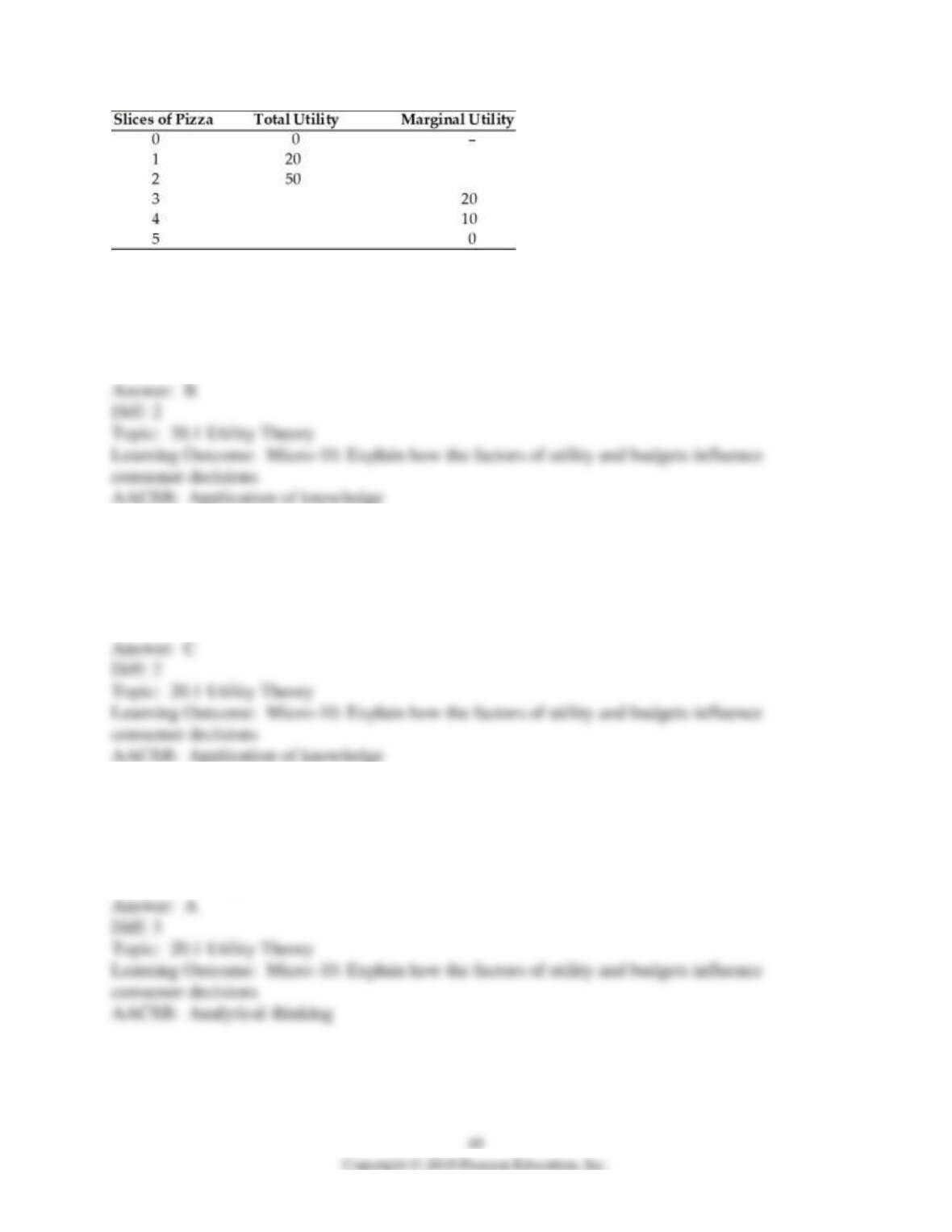
144) In the above table, the total utility of three slices of pizza is
A) 20.
B) 70.
C) 50.
D) 80.
145) In the above table, the marginal utility of fifth slice of pizza is
A) -10.
B) 10.
C) 0.
D) 20.
146) In the above table, marginal utility begins to diminish after consumption of the
A) second slice of pizza.
B) third slice of pizza.
C) fourth slice of pizza.
D) fifth slice of pizza.
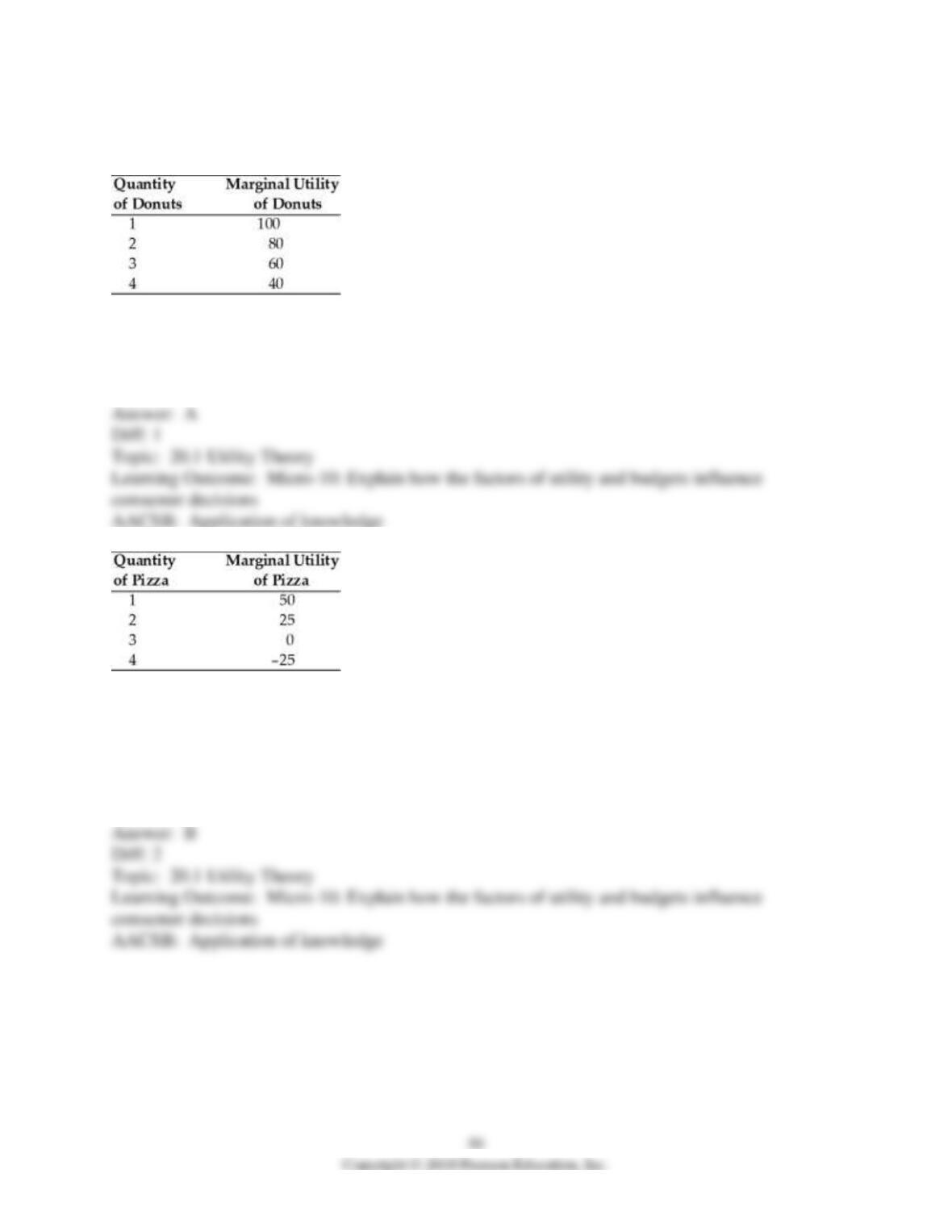
147) After consuming what quantity of donuts does the consumer in the table below experience
diminishing marginal utility?
A) 1
B) 2
C) 3
D) 4
148) Using the above table, what is the maximum number of slices of pizza a rational consumer
would buy?
A) 4
B) 3
C) 2
D) 1
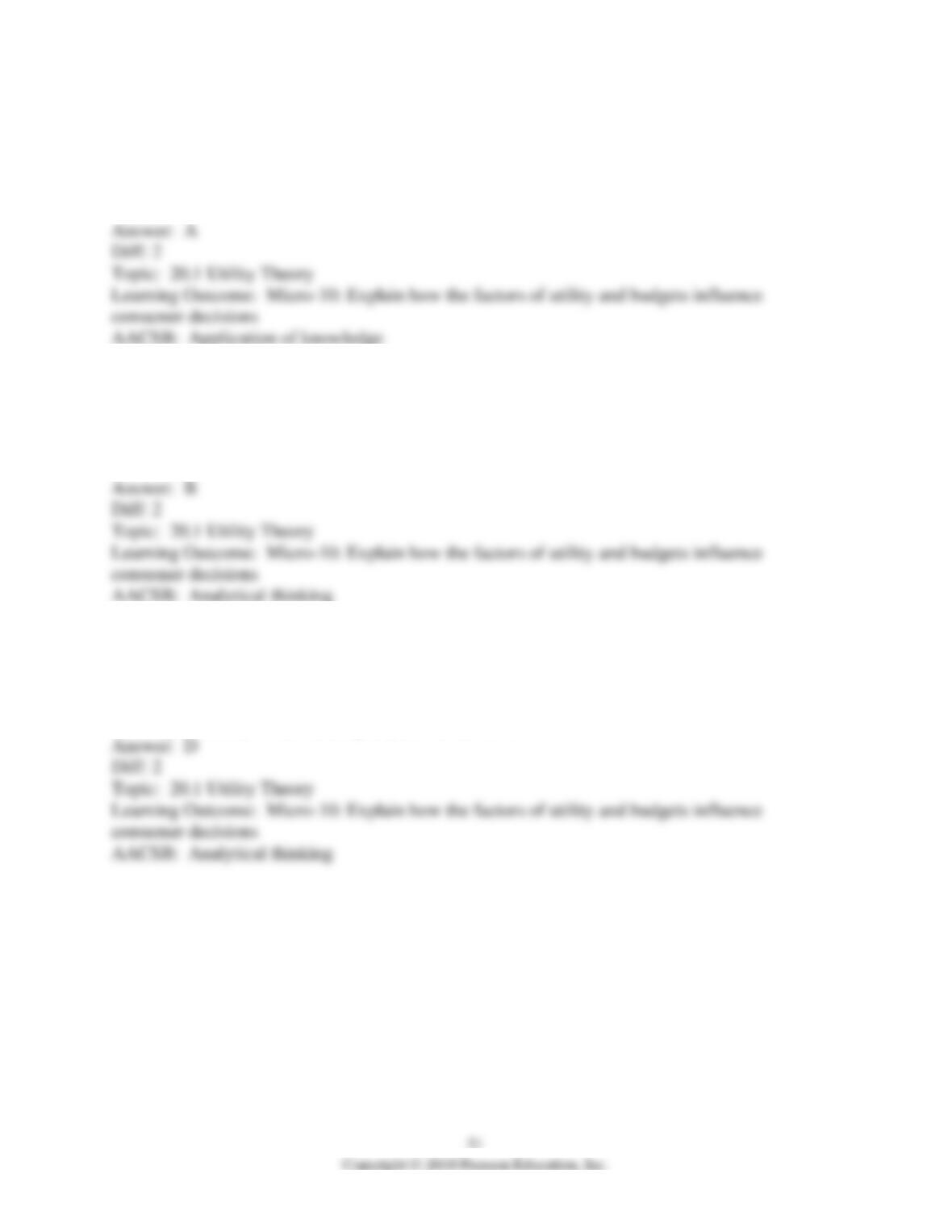
149) Using the above table, what is the total utility of the third piece of pizza?
A) 75 utils
B) 0 utils
C) 25 utils
D) -25 utils
150) Using the above table, what is the total utility of the first piece of pizza?
A) 0 utils
B) 50 utils
C) 75 utils
D) 100 utils
151) When you tell your mother, “I’ll never be tired of your cooking,” you are saying the
A) total utility of her cooking to you is constant.
B) total utility of her cooking to you is equal to 1.
C) marginal utility of her cooking to you is 0.
D) marginal utility of her cooking to you will never be 0.
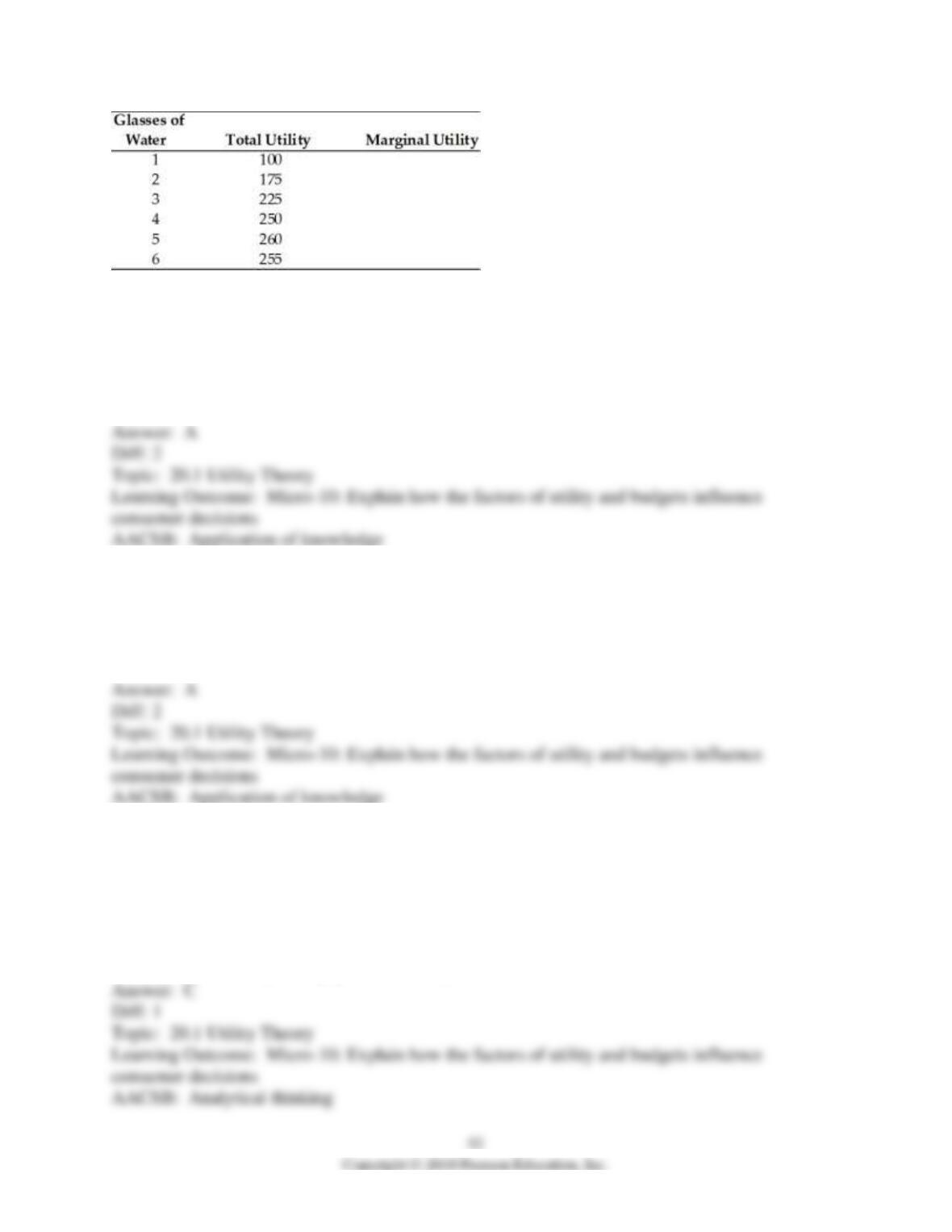
152) Using the above table, diminishing marginal utility begins after the ________ glass of water
is consumed.
A) 1st
B) 2nd
C) 6th
D) 5th
153) Using the above table, the marginal utility for the sixth glass of water is
A) -5 utils.
B) 255 utils.
C) 5 utils.
D) 260 utils.
154) Newspaper vending machines are often built so that customers can pay to lift a door and
take a paper off a pile of daily newspapers. Newspaper distributors are NOT concerned about
customers taking the whole stack of papers because
A) the total utility of a daily newspaper is zero.
B) the marginal utility of any one daily newspaper is zero.
C) the marginal utility of a second daily newspaper is zero.
D) the price of a daily newspaper is relatively low.
155) What is utility and what are its characteristics?
156) What is marginal utility? Why is the term “marginal” important in utility analysis?
157) What is utility analysis? What is the goal of this analysis?
158) What do we know about total utility when marginal utility is zero?
159) Suppose that Jacob is going to a buffet restaurant that allows him to eat as many chicken
wings as he wants at a fixed price. How would you predict the number of chicken wings that
Jacob will eat using utility theory?
160) What is the relationship between marginal utility and total utility? What happens to total
utility as marginal utility declines?
161) “As an individual consumes more units of a good, her total utility falls because of the law of
diminishing marginal utility.” Do you agree or disagree? Explain.
162) Why does total utility rise at a decreasing rate as an individual’s consumption of an item
increases?
163) What is the principle of diminishing marginal utility?
164) Restaurants that allow customers to eat as much as they want for a fixed price must make
money or they would not remain in business. How can they earn profits when people can always
eat more so that the restaurant’s costs keep getting higher? What practice that regular restaurants
use will not be used by all-you-can-eat places?
165) Jill likes lobsters but she does NOT eat lobsters in every meal. How can utility theory
explain this?
20.2 Optimizing Consumption Choices
1) In order to maximize utility, a consumer should allocate money income so that
A) the marginal utility of the last unit of each product consumed is greater than the total utility of
each product consumed.
B) the total utility derived from each product consumed is the same.
C) the marginal utility obtained from the last dollar spent on each product is the same.
D) the elasticity of demand on all products purchased is the same.
2) Suppose Isaac’s marginal utility from attending his 10th San Antonio Spurs game was 50 and
the marginal utility from attending his 1st Rihanna concert was 200. Assume that the price of a
Spurs ticket is $30 and the price of a Rihanna ticket is $100. Which of the following would be
TRUE?
A) Isaac would attend more Rihanna concerts and less Spurs games.
B) Isaac would attend more Spurs games and less Rihanna concerts.
C) Isaac would not alter his behavior.
D) Isaac would attend less of both Spurs games and Rihanna concerts.
3) If a consumer concludes that the marginal utility of the last dollar spent on vegetables exceeds
the marginal utility of the last dollar spent on junk food, he will respond by
A) consuming relatively more junk food and fewer vegetables.
B) consuming relatively more vegetables and less junk food.
C) consuming equal amounts of vegetables and junk food.
D) halting consumption of junk food altogether.
4) For good A and good B, the consumer maximizes personal satisfaction when
A) MUA/PA = PB/MUB.
B) PA/MUA = PB/MUB.
C) MUA/PA = MUB/PB.
D) MUA/MUB = PA/PB.
Carl’s Marginal Utility for consuming beer and pizza with $8.00 in income
5) In the above table, Carl experiences diminishing marginal utility after consuming how many
hotdogs?
A) 1
B) 2
C) 3
D) 4
6) In the above table, Carl experiences diminishing marginal utility after consuming how many
beers?
A) 1
B) 2
C) 3
D) 4
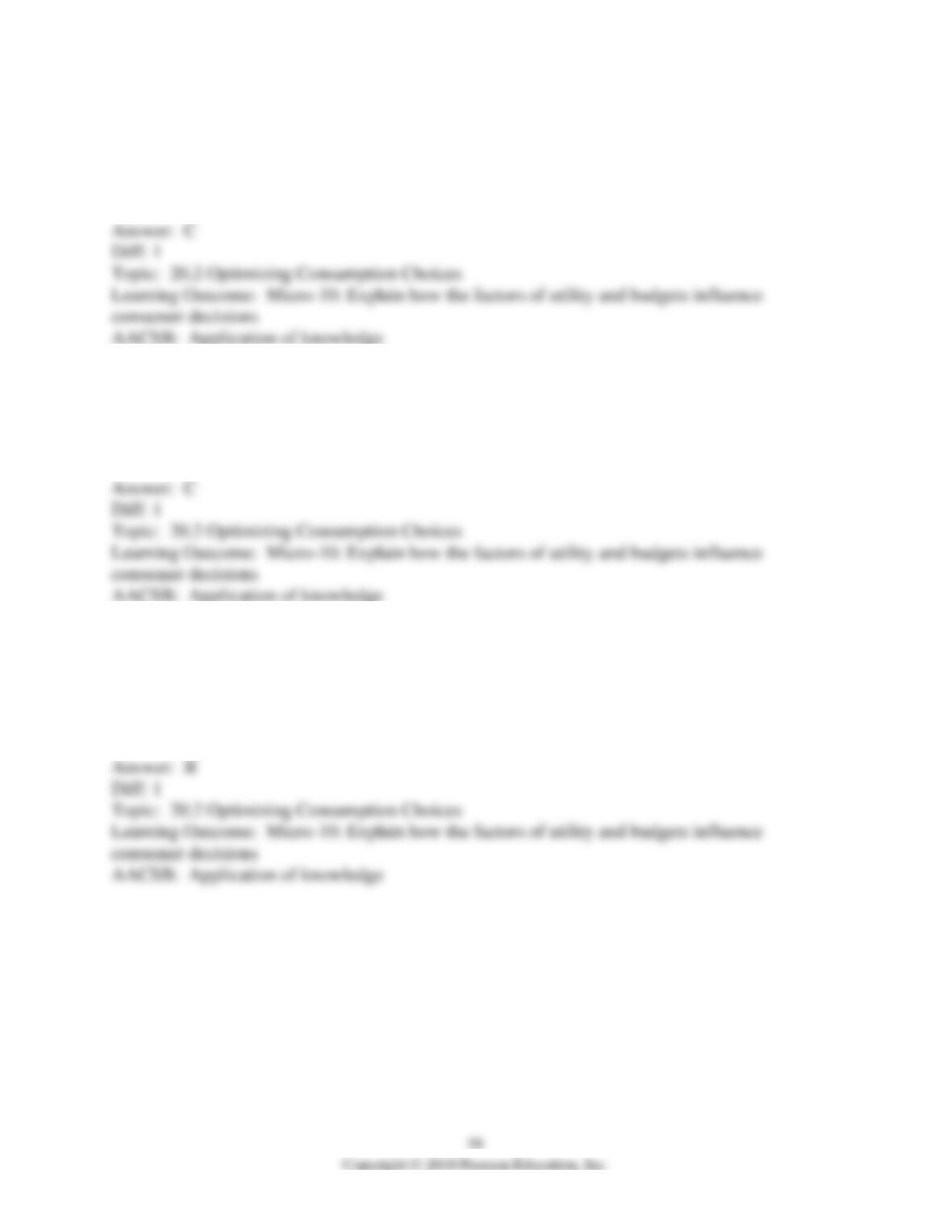
7) In the above table, how much total utility does Carl get from consuming 4 beers?
A) 10 utils
B) 45 utils
C) 125 utils
D) 115 utils
8) According to the above table, how much total utility does Carl get from 3 hotdogs?
A) 30 utils
B) 85 utils
C) 115 utils
D) 130 utils
9) In the above table, how many hotdogs and beers will Carl consume if the price of one hotdog
is $2.00 and the price of a beer is $2.00?
A) 1 hotdog and 3 beers
B) 2 hotdogs and 2 beers
C) 2 hotdogs and 3 beers
D) 3 hotdogs and 1 beer
10) Referring to the above table, suppose Carl’s ratios of marginal utility of beer to the price of
beer and the marginal utility of hotdogs to the price of hotdogs are equal. If the price of beer
increases
A) Carl will probably consume more beer and fewer hotdogs.
B) Carl will probably consume less beer and fewer hotdogs.
C) Carl will probably consume less beer and more hotdogs.
D) Carl will still consume the same amount of beer and hotdogs.
11) Assume that Juan concludes that he should eat less and play video games more. In this
situation, it must be TRUE that the marginal utility of the last dollar spent on food is
A) more than the marginal utility of the last dollar spent on video games.
B) less than the marginal utility of the last dollar spent on video games.
C) equal to the marginal utility of the last dollar spent on video games.
D) negative and less than the marginal utility of the last dollar spent on video games.
12) For any two goods, A and B, if MUA divided by PA equals 2.5 and MUB divided by PB
equals 4.0, then with given income and prices the consumer should
A) buy more of good A and less of good B.
B) buy more of good B and less of good A.
C) buy all of good B and no A.
D) stop because an equilibrium is achieved.
13) Mr. Smith is consuming beer and wine. At his current level of consumption, the marginal
utility per dollar is 30 units for beer and 20 units for wine. Mr. Smith should
A) consume twice as much beer as wine.
B) consume twice as much wine as beer.
C) increase his consumption of beer relative to wine.
D) increase his consumption of wine relative to beer.
14) Despite the fact that water is necessary to sustain life, it is less expensive than milk.
Economic theory suggests that this is so because
A) there is a conspiracy among milk producers to hold prices artificially high.
B) although the total utility of water consumption is high, its marginal utility per dollar spent is
low when compared to milk.
C) consumers are irrational.
D) sellers of water hold the price of water artificially low because of its importance.
15) The consumer optimum for consuming two goods is achieved when
A) the total utility from each good is equal.
B) the price of each good is equal.
C) the price multiplied by the marginal utility is equal for the two goods.
D) the marginal utility per last dollar spent is equal for the two goods.