d.
has already been won.
DISC: The role of government
United States – BPROG: Analytic
The role of government
The Facts: Poverty
74. Under a relative concept of poverty, poverty
a.
doesn’t really exist.
b.
is higher in rich countries than in poor countries.
c.
can never be wholly eliminated by public policy.
d.
declines as technology advances.
DISC: The role of government
United States – BPROG: Analytic
The role of government
The Facts: Poverty
75. Official data may overstate the extent of poverty because
a.
poverty is a relative as opposed to an absolute concept.
b.
it does not add “in-kind” transfers to the incomes of the poor.
c.
it overstates the taxes paid by the poor.
d.
it overestimates the amount the poor earn in the “underground economy.”
DISC: The role of government
United States – BPROG: Analytic
The role of government
The Facts: Poverty
76. The two ways to define poverty are which of the following?
a.
relatively and absolutely
b.
absolutely and definitely
c.
definitely and conceptually
d.
definitely and receptively
DISC: The role of government
United States – BPROG: Analytic
The role of government
The Facts: Poverty
77. The basic problem with the government setting an absolute poverty line is that it is
a.
completely objective.
b.
somewhat arbitrary.
c.
unconstitutional.
d.
based on average income.
Moderate
DISC: The role of government
United States – BPROG: Analytic
The role of government
The Facts: Poverty
78. In 2012, approximately what income level was the cut-off point for defining a family as “rich”?
a.
$72,000
b.
$104,000
c.
$143,000
d.
$195,000
Easy
DISC: The role of government
United States – BPROG: Analytic
The role of government
The Facts: Inequality
79. Under a system of free, competitive markets,
a.
a society can usually achieve efficiency only at the expense of equality.
b.
poverty cannot exist in the long run.
c.
employers do not practice statistical discrimination.
d.
income is distributed equally across the population.
a
Moderate
DISC: Markets, market failure, a – DISC: Markets, market failure, and externalities
United States – BPROG: Analytic
Markets, market failure, and ext – Markets, market failure, and externalities
The Facts: Inequality
80. In 2012, what percentage of total income in the U.S. was earned by the poorest fifth of all U.S. households?
a.
1.5%
b.
1.8%
c.
2.0%
d.
3.2%
d
1
Easy
DISC: The role of government
United States – BPROG: Analytic
The role of government
The Facts: Inequality
81. If incomes were equally distributed in the United States, each fifth of the population would receive ____ percent of the
income.
a.
5
b.
10
c.
15
d.
20
d
1
Easy
DISC: The role of government
United States – BPROG: Analytic
The role of government
The Facts: Inequality
82. If income is distributed equally in a society, the poorest fifth of the population receives
a.
5 percent of the total income.
b.
one–fifth as much as the richest fifth of the population.
c.
20 percent of society’s total income.
d.
50 percent of society’s total income.
c
1
Easy
DISC: The role of government
United States – BPROG: Analytic
The role of government
The Facts: Inequality
Table 21-1
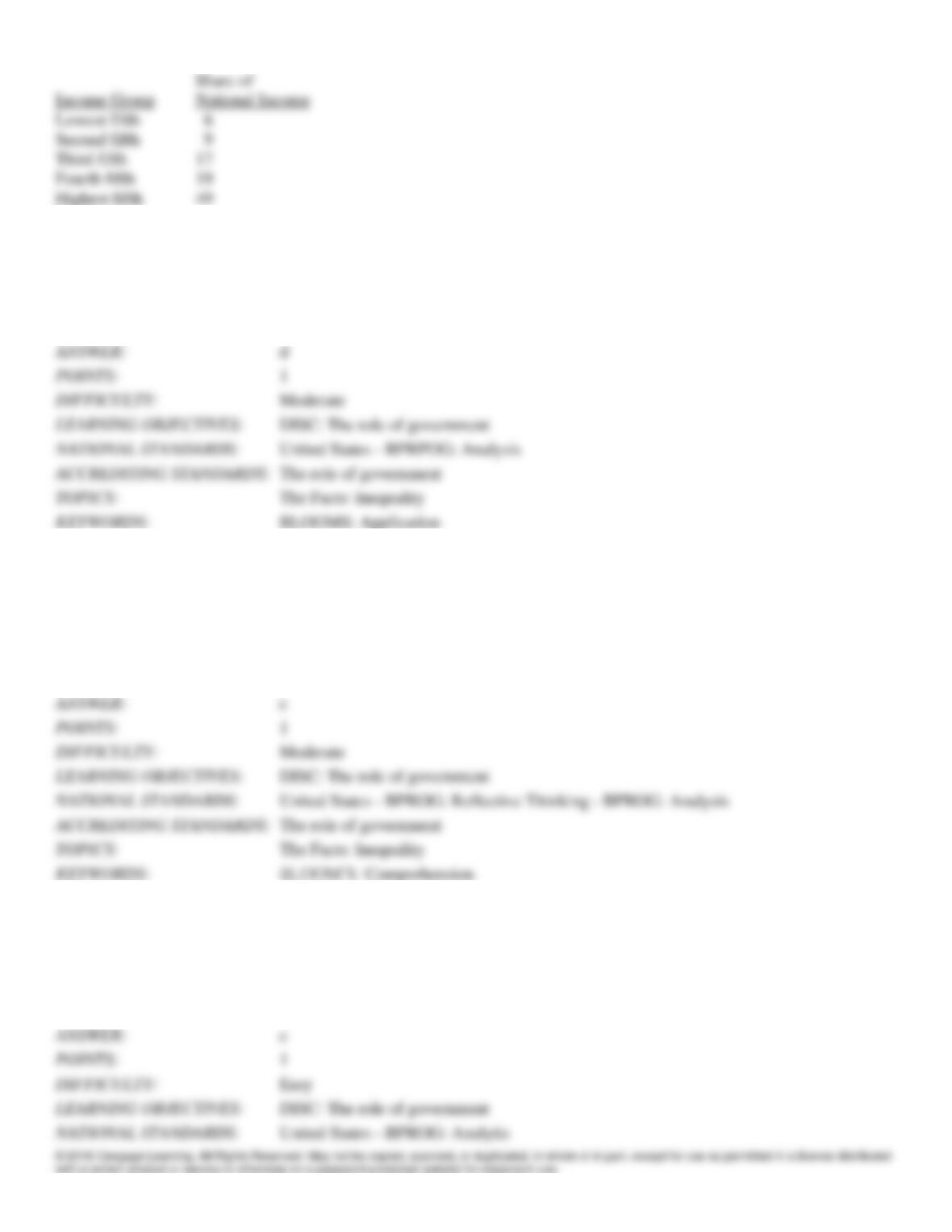
Share of
Income Group
National Income
Lowest fifth
Second fifth
Third fifth
17
Fourth fifth
19
Highest fifth
49
83. Consider the economy described by the income distribution in Table 21–1. From this table, we can conclude that the
a.
poorest quarter of the population earns 15 percent of the income.
b.
“middle” fifth of the population earns 32 percent of the income.
c.
poorest quarter of the population earns 19 percent of the income.
d.
richest fifth of the population earns 49 percent of the income.
DISC: The role of government
United States – BPRPOG: Analysis
The role of government
The Facts: Inequality
BLOOMS: Application
84. Consider the economy described by the income distribution in Table 21–1. From this table, we can conclude that the
poorest 60 percent of the population earns
a.
15 percent of the income.
b.
17 percent of the income.
c.
32 percent of the income.
d.
68 percent of the income.
DISC: The role of government
United States – BPROG: Reflective Thinking – BPROG: Analysis
The role of government
The Facts: Inequality
85. The distribution of income in the United States
a.
became slightly more equal during the 1980s.
b.
did not change significantly during the 1980s.
c.
has become more unequal since 1980.
d.
has become more equal since 1980.
DISC: The role of government
United States – BPROG: Analytic
The role of government
The Facts: Inequality
86. It has been found that
a.
less-developed countries have more equality of income distribution.
b.
more-developed countries have more equality of income distribution.
c.
only prior communist countries have more equality of income distribution.
d.
income distribution cannot be measured among countries with different political and economic systems.
Moderate
DISC: The role of government
United States – BPROG: Analytic
The role of government
The Facts: Inequality
87. The United States has greater inequality of income than
a.
Japan.
b.
Germany and Australia.
c.
most industrialized nations.
d.
all of the above.
Moderate
DISC: The role of government
United States – BPROG: Analytic
The role of government
The Facts: Inequality
88. Which of the following countries has the most equal income distribution?
a.
Sweden
b.
Japan
c.
United States
d.
Netherlands
a
Moderate
DISC: The role of government
United States – BPROG: Analytic
The role of government
The Facts: Inequality
89. Since 1970, the share of income going to the richest fifth of the population in the U.S. has
a.
diminished.
b.
grown.
c.
remained unchanged.
DISC: The role of government
United States – BPROG: Analytic
The role of government
The Facts: Inequality
90. Which of the following is a source of inequality in incomes?
a.
luck
b.
willingness to take risks
c.
differences in investment in human capital
d.
All of the above are correct.
Easy
DISC: The role of government
United States – BPROG: Analytic
The role of government
The Facts: Inequality
91. Which of the following is not a source of inequality in incomes?
a.
redistribution of income
b.
differences in intensity of work
c.
differences in ability
d.
risk taking
a
Easy
DISC: The role of government
United States – BPROG: Analytic
The role of government
The Facts: Inequality
92. Schooling and other types of training
a.
are regarded as investment in human capital.
b.
are an important cause of income differentials.
c.
involve workers’ sacrificing current income in order to enjoy higher future income.
d.
All of the above are correct.
Moderate
DISC: The role of government
United States – BPROG: Reflective Thinking – BPROG: Analysis
The role of government
The Facts: Inequality
93. Unequal incomes arise from
a.
discrimination.
b.
luck.
c.
different schooling.
d.
all of the above factors.
Easy
DISC: Labor markets
United States – BPROG: Analytic
Labor markets
The Facts: Inequality
94. Which of the following is a source of income inequality?
a.
differences in ability
b.
differences in work intensity
c.
risk taking
d.
all of the above
Easy
DISC: Labor markets
United States – BPROG: Analytic
Labor markets
The Facts: Inequality
95. The difference between the earnings of construction workers who work on bridges and skyscrapers and those who
work on highways is probably due to
a.
differences in education requirements.
b.
ability (mental) differences.
c.
a compensating differential.
d.
luck.
c
Moderate
DISC: Labor markets
United States – BPROG: Analytic
Labor markets
The Facts: Inequality
96. Which of the following best describes compensating wage differentials?
a.
Some jobs are more difficult than others, and the pay for them reflects this.
b.
Some jobs require more training than others, and the pay for them reflects this.
c.
Some jobs require more experience than others, and the pay for them reflects this.
d.
Some jobs require unique abilities, and the pay for them reflects this.
DISC: Labor markets
United States – BPRPOG: Analysis
Labor markets
The Facts: Inequality
97. The 1994 book by Murray and Herrnstein, The Bell Curve, was about
a.
government debt.
b.
the intelligence factor.
c.
capital growth.
d.
military readiness.
DISC: Labor markets
United States – BPROG: Analytic
Labor markets
The Facts: Inequality
98. From a purely economic point of view, discrimination exists when
a.
black teenagers earn more than white teenagers.
b.
all factors are earning average products.
c.
women earn less than men.
d.
equivalent factors earn different payments for equal contributions to output.
DISC: The role of government
United States – BPROG: Analytic
The role of government
The Facts: Discrimination
99. Which of the following situations is the most common? Men and women
a.
doing the same job and getting equal pay.
b.
doing the same job and getting unequal pay.
c.
doing very different kinds of work and consequently having different earnings.
d.
randomly distributed across occupations with average earnings about equal.
c
Moderate
DISC: Labor markets
United States – BPROG: Analytic
Labor markets
The Facts: Discrimination
100. The simplest economic definition of discrimination is
a.
prejudice.
b.
unequal pay for equal work.
c.
a dislike by one group of associating with another group.
d.
unequal pay for unequal work.
Easy
DISC: The role of government
United States – BPROG: Analytic
The role of government
The Facts: Discrimination
101. The existence of differences between the average earnings of men and women
a.
proves the existence of economic discrimination.
b.
may be partially due to factors other than economic discrimination.
c.
proves that men on average invest more in their human capital than women do.
d.
indicates that men are on average smarter than women.
Moderate
DISC: Labor markets
United States – BPROG: Analytic
Labor markets
The Facts: Discrimination
102. The factor accounting for most of the earnings difference between equally educated and experienced men and women
is that women
a.
receive less pay for equal work.
b.
are segregated into low-paying occupations.
c.
receive comparable pay only when they do work of comparable value to the employer.
d.
are prohibited by law from doing certain kinds of work.
DISC: Labor markets
United States – BPROG: Reflective Thinking – BPROG: Analysis
Labor markets
The Facts: Discrimination
103. Economists might be willing to accept a policy that adversely affected distribution of income if it
a.
lessened income disparities.
b.
diminished labor productivity by a large amount.
c.
increased productivity by a large amount.
d.
were favorable to the rich.
DISC: Labor markets
United States – BPROG: Analytic
Labor markets
104. One of the more powerful forces leading to an end in economic discrimination is
a.
pure competition.
b.
pure monopoly.
c.
government regulation.
d.
oligopolistic rivalry.
DISC: The role of government
United States – BPROG: Analytic
The role of government
The Facts: Discrimination
105. Susan argues that she is the victim of economic discrimination. The primary technical difficulty for an economist
investigating her claim will be
a.
defining economic discrimination.
b.
finding a worker with the same productivity as Susan for comparison purposes.
c.
defining statistical discrimination.
d.
measuring Susan’s human capital.
DISC: Labor markets
United States – BPROG: Analytic
Labor markets
The Facts: Discrimination
106. The extent of discrimination is
a.
measured by the differences in incomes.
b.
the reason for two-thirds of the income differential between black male workers and white male workers.
c.
difficult to quantify and controversial.
d.
easily measured for each category of workers.
DISC: Labor markets
United States – BPROG: Analytic
Labor markets
The Facts: Discrimination
107. The essence of the trade-off between equality and efficiency is that
a.
taxes and transfers reduce incentives to earn income, thus reducing GNP.
b.
people are ideologically opposed to socialistic income redistribution.
c.
redistribution violates the “work ethic.”
d.
people are prejudiced against blacks and women.
DISC: Efficiency and equity
United States – BPROG: Analytic
Efficiency and equity
The Trade-off Between Equality and Efficiency
Figure 21-1
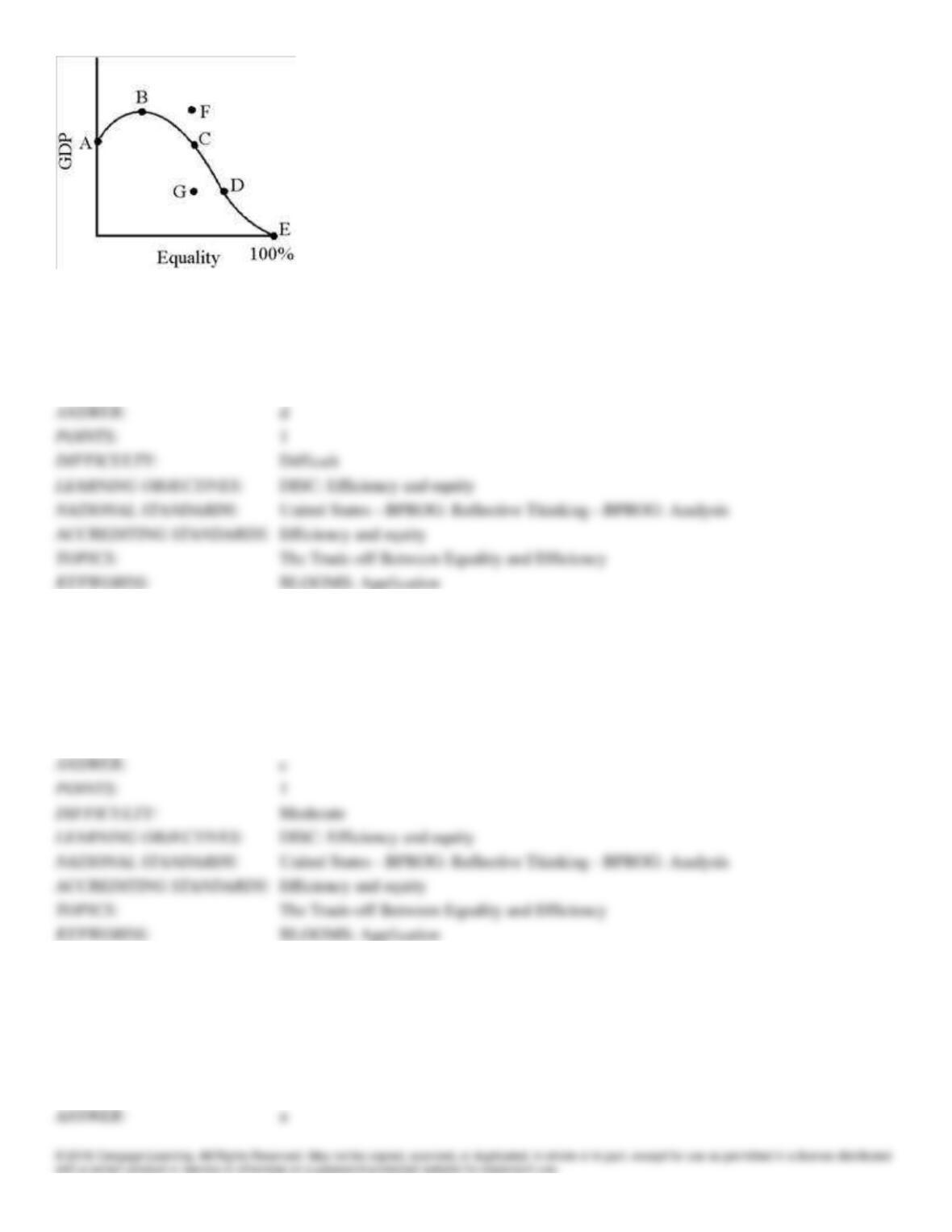
108. In Figure 21–1, the optimal amount of equality lies only between which points?
a.
A and B
b.
C and D
c.
D and E
d.
B and E
DISC: Efficiency and equity
United States – BPROG: Reflective Thinking – BPROG: Analysis
Efficiency and equity
The Trade-off Between Equality and Efficiency
BLOOMS: Application
109. In Figure 21–1, a reform in the distribution system that achieves the same distribution with less damage to work
incentives is represented by a move from which points?
a.
A to B
b.
C to G
c.
C to F
d.
B to C
DISC: Efficiency and equity
United States – BPROG: Reflective Thinking – BPROG: Analysis
Efficiency and equity
The Trade-off Between Equality and Efficiency
BLOOMS: Application
110. In Figure 21–1, if the existing antipoverty program were replaced by a negative income tax, most economists believe
that it would result in a move like which of the following?
a.
C to F
b.
A to B
c.
D to E
d.
G to D
Moderate
DISC: Efficiency and equity
United States – BPROG: Reflective Thinking – BPROG: Analysis
Efficiency and equity
The Trade-off Between Equality and Efficiency
BLOOMS: Application
111. Redistribution programs that reduce poverty and income inequality
a.
always increase GDP.
b.
always decrease GDP.
c.
usually increase GDP.
d.
usually decrease GDP.
Moderate
DISC: Efficiency and equity
United States – BPROG: Reflective Thinking – BPROG: Analysis
Efficiency and equity
The Trade-off Between Equality and Efficiency
112. Policies that redistribute income
a.
reduce the rewards of high-income earners.
b.
raise the rewards of low-income earners.
c.
reduce the incentive to earn high income.
d.
All of the above are correct.
Moderate
DISC: Efficiency and equity
United States – BPROG: Analytic
Efficiency and equity
The Trade-off Between Equality and Efficiency
113. An example of a policy to combat poverty is
a.
TANF.
b.
food stamps.
c.
Social Security.
d.
All of the above are correct.
Easy
DISC: The role of government
United States – BPROG: Analytic
The role of government
Policies to Combat Poverty
114. Under current federal antipoverty programs,
a.
economic equality is promoted at the least possible cost in economic efficiency.
b.
a family’s benefits do not depend on its earnings from work.
c.
a family’s total income (cash and in-kind benefits) may actually fall if its earnings from work rise.
d.
families with children are entitled to no more assistance than families without children.
DISC: The role of government
United States – BPROG: Analytic
The role of government
Policies to Combat Poverty
115. Aid to families with dependent children was
a.
a close-to-perfect welfare or public assistance program.
b.
criticized because it provided little incentive for recipients to get jobs.
c.
contributing to efficient production of goods.
d.
superior to a negative income tax for work incentives.
DISC: The role of government
United States – BPROG: Analytic
The role of government
Policies to Combat Poverty
116. The fundamental criticism from the efficiency perspective of AFDC and other antipoverty programs is that
a.
they do not help families with unemployed fathers.
b.
the benefits are too low.
c.
they offer disincentives to earning income.
d.
the tax on this income is too low.
DISC: The role of government
United States – BPROG: Analytic
The role of government
Policies to Combat Poverty
117. Economists generally agree that in reducing poverty, policies should be sought that do the
a.
greatest good for total production.
b.
least harm to work incentives.
c.
most good for the poor.
d.
least harm to equality of income.
Moderate
DISC: The role of government
United States – BPROG: Analytic
The role of government
Policies to Combat Poverty
118. A major problem with the negative income tax is that
a.
low tax rates imply low break-even incomes.
b.
low tax rates imply high break-even incomes.
c.
high tax rates imply low minimums.
d.
All of the above are correct.
Difficult
DISC: The role of government
United States – BPROG: Analytic
The role of government
Policies to Combat Poverty
119. If the United States is to reduce poverty by using a negative income tax, the guaranteed income should be
a.
two times the tax rate.
b.
close to the poverty line.
c.
close to the median income of all families.
d.
above the poverty line.
Moderate
DISC: The role of government
United States – BPROG: Analytic
The role of government
Policies to Combat Poverty
120. The welfare program economists believe to be most compatible with economic efficiency is
a.
a regressive tax system.
b.
AFDC.
c.
a negative income tax.
d.
Medicare/Medicaid.
c
Moderate
121. In the negative income tax plan, a guarantee of $5,000 and a tax rate of 50 percent imply a break-even income of
which of the following figures?
a.
$1,000
b.
$2,500
c.
$10,000
d.
$12,500
c
Difficult
122. In the negative income tax framework, a break-even point of $16,000 and a tax rate of 25 percent imply a guarantee
of which of the following figures?
a.
$4,000
b.
$8,000
c.
$12,000
d.
$16,000
a
Difficult
123. With a negative income tax providing a minimum of $20,000 and a tax rate of 25 percent, what amount of
supplement would the government pay to a household earning $10,000?
a.
$5,000
b.
$10,000
c.
$17,500
d.
$20,000
c
Moderate
DISC: The role of government
United States – BPROG: Analytic
The role of government
Policies to Combat Poverty
124. Economists favor a negative income tax because they believe
a.
that it will create more jobs for economists to monitor the program.
b.
the current welfare programs have excessively high work incentives, which result in less total work.
c.
it is more efficient than the existing welfare system because NIT provides better work incentives.
d.
All of the above are true.
c
Moderate
DISC: The role of government
United States – BPROG: Analytic
The role of government
Policies to Combat Poverty
125. The basic idea behind a negative income tax is to
a.
help local government agencies deliver more services to the poor.
b.
increase the in-kind income of the poor.
c.
help the poor get job skills.
d.
help the poor without destroying incentives to work.
Moderate
DISC: The role of government
United States – BPROG: Analytic
The role of government
Policies to Combat Poverty
126. The public assistance program that economists believe can promote economic equality at the least cost in economic
efficiency is
a.
Aid to Families with Dependent Children (AFDC).
b.
a negative income tax (NIT).
c.
food stamps.
d.
Medicaid.
Moderate