
CHAPTER 20: FINANCING WITH DERIVATIVES
1. are forms of options.
a. Warrants
b. Convertible securities
c. Leases
d. Warrants and convertible securities
2. A(n) is a call option issued by a company on its securities, usually common stock.
a. debenture
b. warrant
c. futures contract
d. extendible note
3. A is a fixed income security with a call option on common stock.
a. convertible security
b. warrant
c. futures contract
d. derivative security
4. Which of the following (if any) are factors affecting the value of a call option?
a. time remaining until expiration date
b. interest rates
c. expected stock price volatility
d. all of these factors affect the value of a call option
5. The is the price that the call option buyer pays the writer of the option if the buyer decides to exercise the
option.
a. option premium
b. option discount
c. conversion price
d. exercise price

Chapter 20: Financing with Derivatives
6. When a company issues convertible securities, its usual intention is:
a. future issuance of common stock
b. future reduction of outstanding common stock
c. future issuance of non-convertible debt and preferred stock
d. future issuance of preferred stock
7. A warrant has an exercise price of $15. The underlying common stock has a market price of $10. The formula
value of a warrant would be
a. $5
b. $0
c. –$5
d. cannot be determined from the information given
8. The conversion value (i.e., stock value) of a convertible bond is defined as the times the .
a. conversion ratio, conversion price
b. conversion premium, exercise price
c. conversion ratio, common stock market price
d. conversion ratio, exercise price
9. The difference between the market value of a convertible bond and the higher of its conversion or straight-bond
value is the
a. exercise premium
b. investment premium
c. conversion premium
d. liquidation premium
10. The conversion premium of a convertible bond tends to be when the conversion value is the straight-
bond value.
a. smallest, nearly equal to
b. largest, less than
c. largest, greater than
d. largest, nearly equal to

Chapter 20: Financing with Derivatives
11. All other things being equal, the the exercise price, given the stock price, the is the call option value.
a. higher, higher
b. higher, lower
c. lower, lower
d. lower, higher
12. The the time remaining before an option expires, the the option value.
a. longer, lower
b. shorter, higher
c. longer, higher
d. shorter, lower
13. The the expected stock price volatility, the the value of the call option.
a. greater, higher
b. lower, higher
c. greater, lower
d. lower, lower
14. The price at which convertible securities are exchangeable for common stock is the
a. conversion value
b. par value
c. put price
d. conversion price
15. The conversion ratio of a convertible security may change when
a. a cash dividend is paid
b. there is a change in the market value of the security
c. a stock dividend is paid
d. there is a rights offering
16. All of the following are reasons why companies issue convertible securities except:
a. cheaper total cost than nonconvertible securities
b. lower interest payments than nonconvertible securities
c. sell common stock at a price above current market price
d. deferred issuance of common stock

Chapter 20: Financing with Derivatives
17. The market value of a convertible debt issue is usually above the
a. conversion ratio
b. conversion value
c. straight-bond value
d. higher of either the conversion value or the straight-bond value
18. Conversion of a convertible security may be forced by the issuing company by
a. raising the interest rate
b. calling the securities for redemption
c. lowering the dividend on common stock
d. none of these are methods of forcing conversion
19. As a financing device, warrants have been used in connection with
a. bond swaps
b. equity offerings
c. debt restructurings and bond swaps
d. bond swaps, equity offerings, and debt restructurings
20. Which of the following is not a common feature of financing with warrants?
a. an exercise price that is below the market price of common stock at the time the warrant is issued
b. typical life of a warrant is between 5 and 10 years
c. warrant is usually detachable from a debenture or preferred stock
d. if a warrant is issued as part of a “unit,” it is usually detachable from a debenture or preferred stock
21. All of the following are reasons why firms issue warrants except:
a. lowers agency costs
b. increases leverage at time of issue
c. permits a company to sell common stock at a price above the price prevailing at the time of warrant issue
d. allows a firm to sell common stock in the future without incurring underwriting costs at the time of sale
22. Prior to a warrant’s expiration, its market price will be the formula value
a. equal to
b. less than
c. greater than
d. negative as compared to

Chapter 20: Financing with Derivatives
23. Craig Supermarkets, Inc. has convertible debentures ($1,000 par value) that are callable at 108 percent of par
value. The conversion price of the debenture is $40 per share, and the Craig common stock currently is selling
at $55 a share. The company
a. could not get the convertible holders to convert if it called the debt
b. has no intention of calling the convertibles
c. could force conversion by calling the issue
d. could realize a gain of $15 a share if it called the convertibles
24. A firm that issues warrants
a. can expect to receive additional funds if the formula value of the warrant is zero at the expiration date
b. has to pay the same per share dividend to the warrant holders as it pays to its stockholders
c. cannot issue convertible securities while the warrants are outstanding
d. can expect to receive additional funds if the formula value of the warrant is positive at the expiration date
25. Which of the following securities (if any) is not an example of an option?
a. warrant
b. convertible security
c. right
d. futures contract
26. A is a fixed-income security issued by a company with a call option on its common stock.
a. warrant
b. convertible debenture
c. lease
d. extendible note
27. A security whose payoffs (returns) depend on the value of another security is known as a(n) .
a. interest rate swap
b. master limited partnership
c. contingent claim
d. extendible note

Chapter 20: Financing with Derivatives
28. are examples of contingent claims.
a. Convertible bonds and warrants
b. Warrants and extendible notes
c. Options and extendible notes
d. Convertible bonds, options, and warrants
29. The preemptive right allows shareholders the
a. opportunity to maintain their original ownership percentage
b. right to purchase shares in the secondary markets
c. right to vote for members of the board of directors
d. all of these answers are correct
30. In general, the market price of a “right” is than the theoretical value and this difference in values as
the right’s expiration date approaches.
a. less, decreases
b. less, increases
c. greater, decreases
d. greater, increases
31. earnings per share are calculated based on the assumption that all dilutive securities are converted into
common shares.
a. Primary
b. Full primary
c. Fully diluted
d. First class
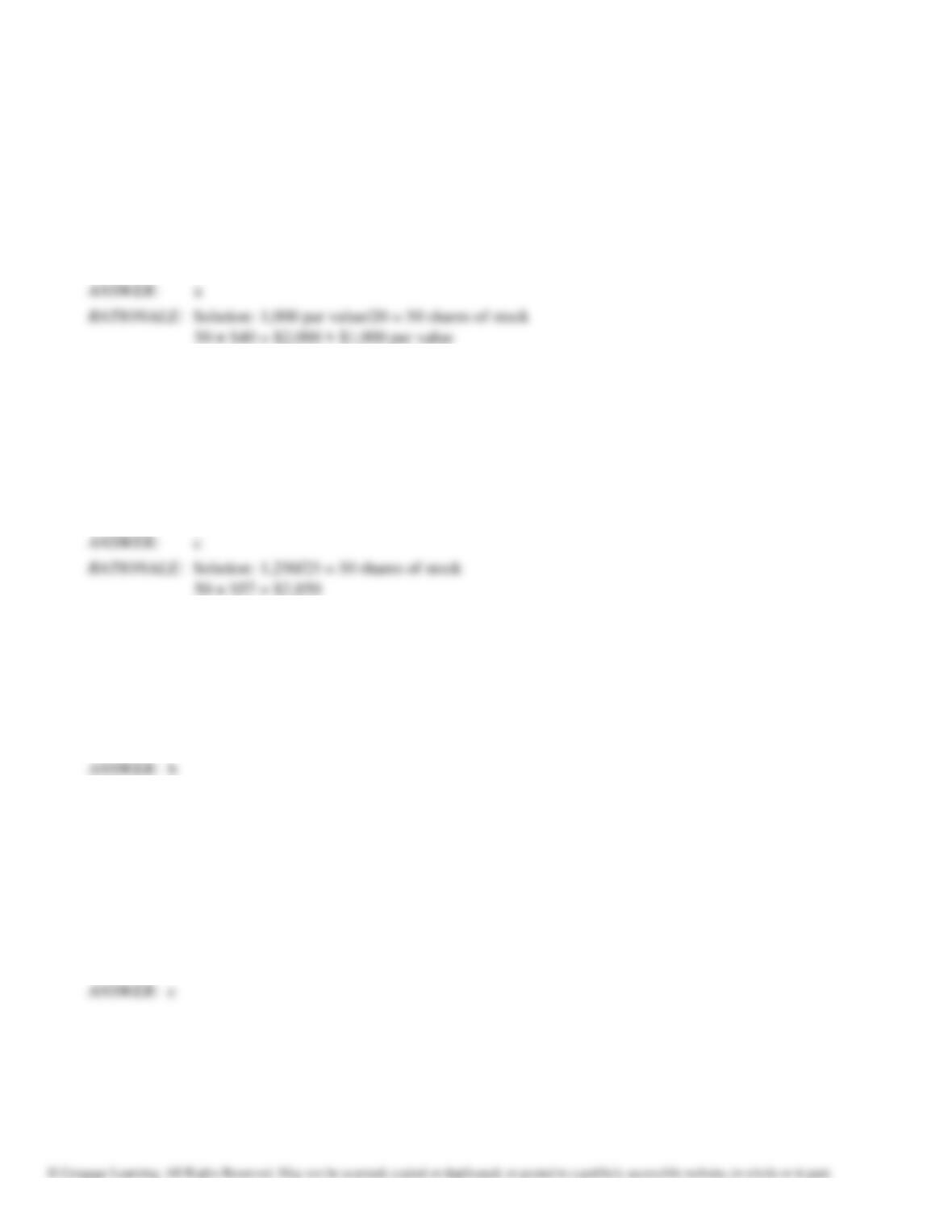
32. If the exercise price of an M-tel warrant is $48 and the stock splits 2 for 1, what will be the post-split exercise
price of the warrant? Assume the warrant was selling for $20 before the stock split.
a. $24
b. $20
c. $10
d. $48
33. The similarities between convertible securities and warrants include all of the following except:
a. both tend to reduce agency costs
b. the purpose of both is the deferred issuance of common stock
c. both give the company full control over when the common stock is issued
d. all of these answers are correct
Chapter 20: Financing with Derivatives
34. Bonds may have a which gives the holder of the bond the right to sell it back to the issuer under certain
conditions.
a. warrant
b. put option
c. rights offering
d. call option
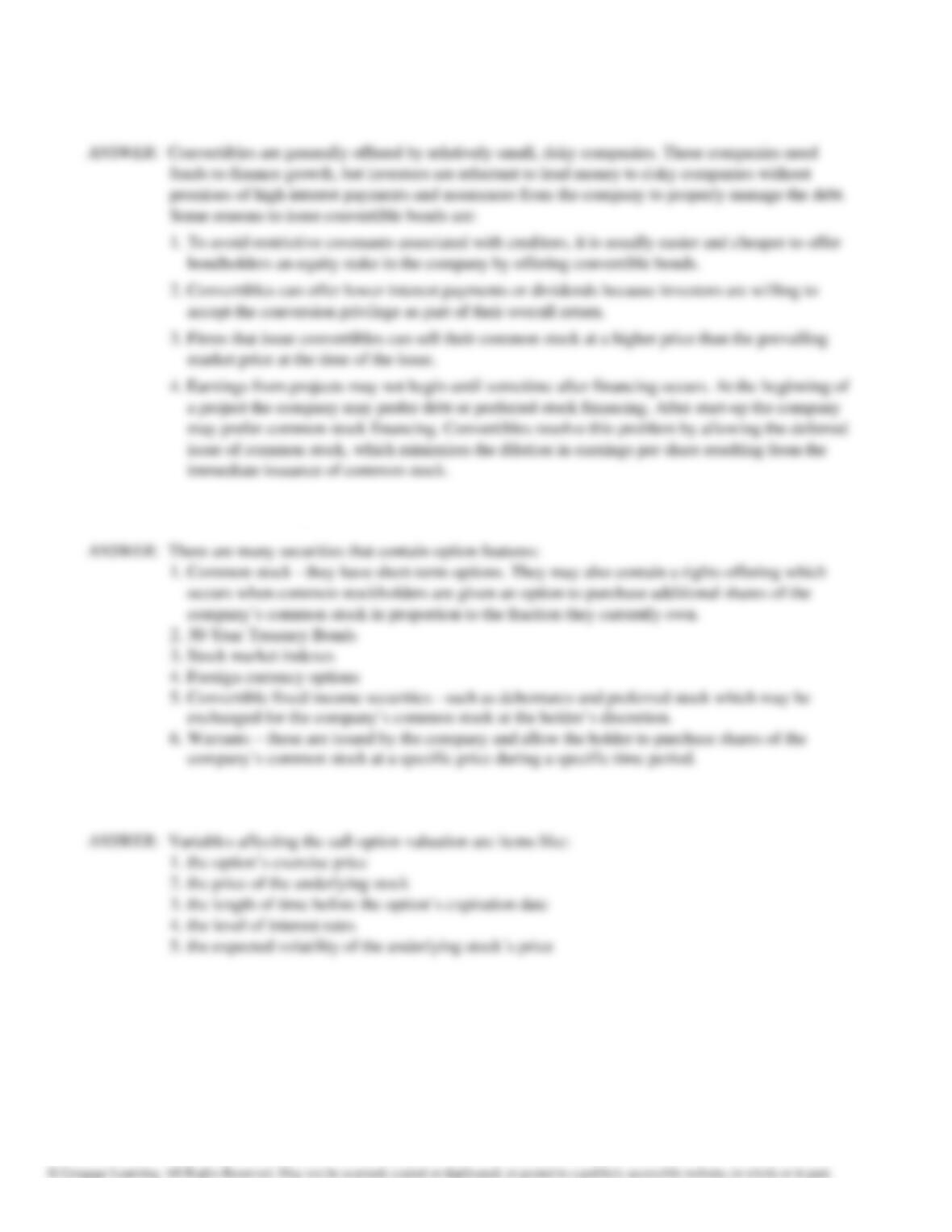
35. A type of financial derivative that would allow a firm to hedge against changes in interest rates over a 5-year
period is a ____.
a. interest rate futures contract
b. commodity soup
c. interest rate swap
d. interest rate put option
36. The most basic type of interest rate swap is the:
a. fixed for floating rate swap
b. exchange-rated swap
c. LIBOR for prime rate swap
d. Interest rate rights offering
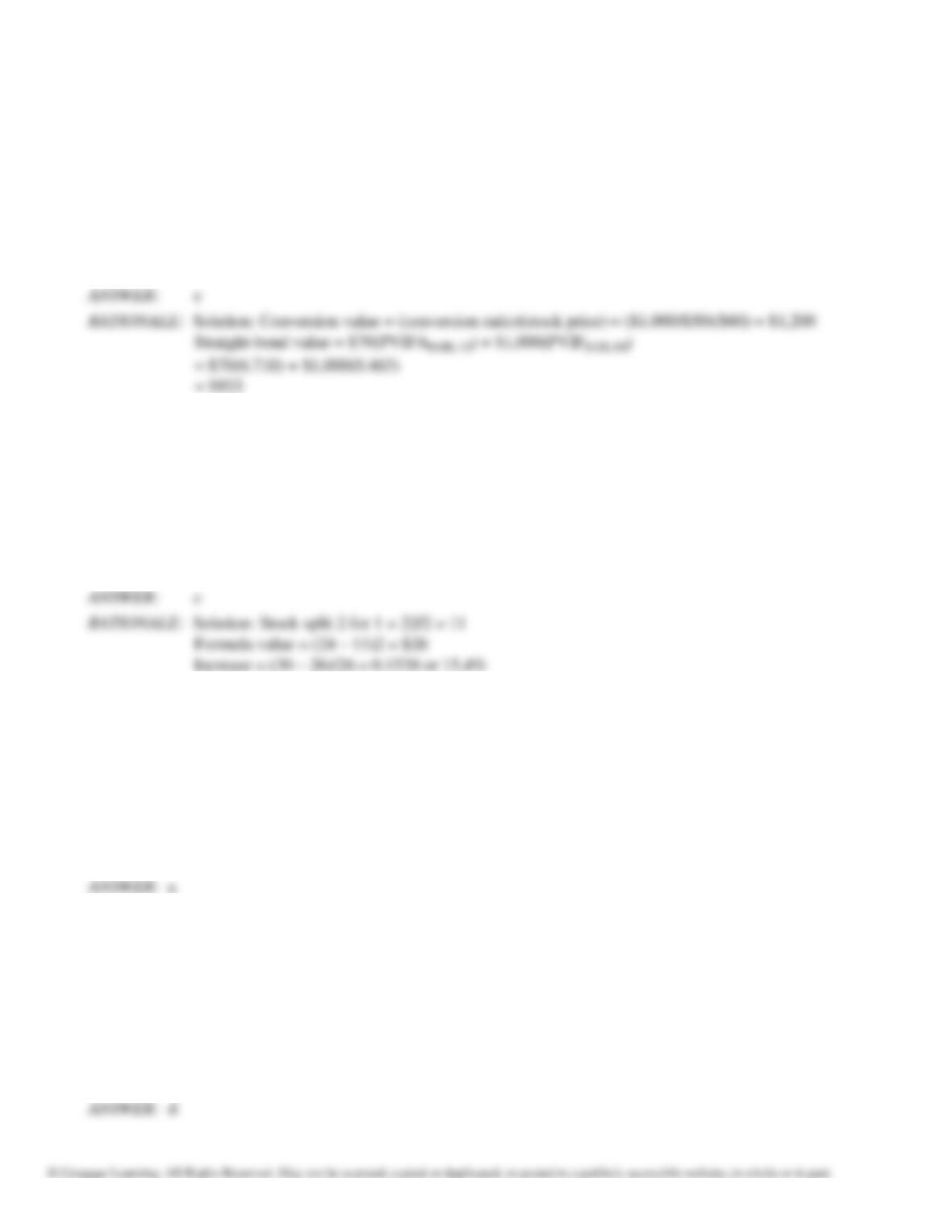
37. The conversion price of CRX’s convertible ($1,000 par) subordinated debentures is $40 and the present market
price of CRX common stock is $48. Determine the present conversion value of the convertible issue.
a. $1,000
b. $1,200
c. $833
d. $1,680
38. Rizzo Company has debentures ($1,000 par) outstanding that are convertible into the company’s common
stock at a price of $25. The convertibles have a coupon interest rate of 8% and mature in 12 years. In addition,
the convertible debenture is callable at 110% of the par value. Straight debt of equivalent risk is yielding 12%.
The company’s common stock is selling at $22 per share. The company has a marginal tax rate of 40%.
Determine the conversion value of the issue.
a. $1,000
b. $880
c. $1,136
d. $1,120
Chapter 20: Financing with Derivatives
39. Rizzo Company has debentures ($1,000 par) outstanding that are convertible into the company’s common
stock at a price of $25. The convertibles have a coupon interest rate of 8% and mature in 12 years. In addition,
the convertible debenture is callable at 110% of the par value. Straight debt of equivalent risk is yielding 12%.
The company’s common stock is selling at $22 per share. The company has a marginal tax rate of 40%.
Determine the straight-bond value of the issue.
a. $1,000
b. $496
c. $880
d. $753
40. The Marsh Company, whose present balance sheet is summarized below, is considering the issuance of $50
million of 8% subordinated debentures that are convertible into common stock at a price of $20.
Balance Sheet
(millions of dollars)
Current Assets
$150
Current Liabilities
$100
Fixed Assets, net
$350
Long-term Debt
$150
Total
$500
Common Equity
$250
Total
$500
Determine the amount of long-term debt (LTD) and common equity (CE) on the pro forma balance sheet,
assuming conversion of the entire issue (Answers are in $ million).
a. LTD $150, CE $250
b. LTD $150, CE $300
c. LTD $200, CE $300
d. LTD $200, CE $250
41. People Southwest Airlines (PSW) has warrants outstanding that have an exercise price of $10. Each warrant
entitles the holder to purchase one share of PSW common stock. Last week PSW common stock was selling
for $12 per share and, at the same time, the warrants traded at $5 each. Determine the formula value of PSW
warrants.
a. $0
b. $2
c. $5
d. $11
Chapter 20: Financing with Derivatives
42. PSW has warrants outstanding that have an exercise price of $10. Each warrant entitles the holder to purchase
one share of PSW common stock. Last week PSW common stock was selling for $12 per share and, at the
same time, the warrants traded at $5 each. Determine the warrant’s premium over the formula value.
a. $0
b. $2
c. $3
d. $5
43. The capital structure of Springmaid Company is as follows:
Long-term debt $ 400 million
Common stock, $1 par 50 million
Contributed capital in excess of par 250 million
Retained earnings 600 million
Total $1,300 million
The company has decided to raise additional capital by selling $100 million of 8% debentures with warrants
attached. Each $1,000 debenture will have 40 warrants attached, and each warrant will entitle the holder to
purchase one share of common stock at $20. Assume that no other changes in the capital structure occur
between now and the time the warrants are exercised. Determine the common stock at par account balance
after exercise of the warrants.
a. $50 million
b. $54 million
c. $56 million
d. $35 million
Chapter 20: Financing with Derivatives
44. The capital structure of Springmaid Company is as follows:
Long-term debt $ 400 million
Common stock, $1 par 50 million
Contributed capital in excess of par 250 million
Retained earnings 600 million
Total $1,300 million
The company has decided to raise additional capital by selling $100 million of 8% debentures with warrants
attached. Each $1,000 debenture will have 40 warrants attached, and each warrant will entitle the holder to
purchase one share of common stock at $20. Assume that no other changes in the capital structure occur
between now and the time the warrants are exercised. Determine the contributed capital in excess of par
account balance after exercise of the warrants.
a. $250 million
b. $330 million
c. $254 million
d. $326 million
45. The capital structure of Springmaid Company is as follows:
Long-term debt $ 400 million
Common stock, $1 par 50 million
Contributed capital in excess of par 250 million
Retained earnings 600 million
Total $1,300 million
The company has decided to raise additional capital by selling $100 million of 8% debentures with warrants
attached. Each $1,000 debenture will have 40 warrants attached, and each warrant will entitle the holder to
purchase one share of common stock at $20. Assume that no other changes in the capital structure occur
between now and the time the warrants are exercised. Determine how much total capital the company will raise
as a result of the issuance of debentures with warrants attached (after exercise of the warrants).
a. $100 million
b. $80 million
c. $180 million
d. $20 million
Chapter 20: Financing with Derivatives
46. Sharp Innovations has warrants outstanding and each entitles the holder to purchase 1 share of common stock
at an exercise price of $14 a share. If the current market price of the warrant is $9 and the common stock price
is $22, what is the premium over the formula value for the warrants?
a. $1
b. $5
c. $8
d. $2
47. Graybar recently sold a convertible bond with a $1,000 par value for a flotation cost of 2 percent (each bond
produced $980 for the firm). What is the conversion price if the conversion ratio is 22?
a. $44.55
b. $45.45
c. $50.00
d. $4.45
48. To raise capital funds, Twixt, Inc. issued $2 million worth of debentures with warrants attached. The warrants
had an exercise price of $15 and each warrant entitled the holder to two shares of common stock. If the current
market price per share of Twixt is $20, what is the formula value of a Twixt warrant?
a. $10
b. $5
c. $20
d. $0
49. JDH, Inc. presently has warrants outstanding that expire 5 years from today. Each warrant entitles the holder to
purchase 2 shares of the company’s common stock at an exercise price of $30 a share. The warrants currently
are trading at $4 each, and the JDH common stock currently is trading at $28 a share. Calculate the warrants’
formula value.
a. –$4.00
b. –$2.00
c. $0.00
d. $2.00
Chapter 20: Financing with Derivatives
50. The Bates Company has debentures ($1,000 par value) outstanding that are convertible into the company’s
common stock at a price of $50. The convertibles have a coupon interest rate of 9% and mature 20 years from
today. Straight debt of equivalent risk is yielding 12% today. The company’s common stock today is selling at
$60 a share. Calculate the conversion value of the issue.
a. $1,000
b. $1,200
c. $800
d. $300
51. Mills Trucking, Inc. has debentures ($1,000 par value) outstanding that are convertible into the company’s
common stock at a price of $25. The convertibles have a coupon interest rate of 8% and mature 20 years from
today. Straight debt of equivalent risk is yielding 10% today. The company’s common stock today is selling at
$23 a share. Calculate the straight-bond value of the issue.
a. about $830
b. about $1,000
c. about $950
d. about $1,500
52. The Ogden Company has warrants outstanding that entitle the holder to purchase 4 shares of the company’s
common stock at an exercise price of $20 per share. The market price of the warrants is $30 and the common
stock price is $25. Determine the premium over the formula value that the warrants are selling for.
a. $20
b. $25
c. $10
d. $30
Chapter 20: Financing with Derivatives
53. The Coatesville Company has decided to sell additional common stock through a rights offering. The company
has 12 million shares outstanding and plans to sell an additional 1.5 million shares through a rights offering.
Each shareholder will receive one right for each share currently held, and thus each right will entitle
shareholders to purchase 0.125 shares. The Coatesville common stock is currently selling at $50 per share, and
the subscription price of the rights will be $45 per share. Determine the theoretical value of the right for the
rights on case.
a. $0.556
b. $0.455
c. $0.50
d. $0.625
54. The Coatesville Company has decided to sell additional common stock through a rights offering. The company
has 12 million shares outstanding and plans to sell an additional 1.5 million shares through a rights offering.
Each shareholder will receive one right for each share currently held, and thus each right will entitle
shareholders to purchase 0.125 shares. The Coatesville common stock is currently selling at $50 per share, and
the subscription price of the rights will be $45 per share. Determine the theoretical value of the rights for the ex
rights case.
a. $0.455
b. $0.50
c. $0.625
d. $0.556
55. What is the value of a CKS Food’s option prior to expiration if the exercise price is $20 and the current stock
price is $20?
a. greater than $0
b. $0
c. less than $0
d. cannot be valued
56. A Sorsi bond has a par value of $1,000 but is currently selling for $920. If the bond has a conversion ratio of
23 what is the conversion price? Current stock price is $30.
a. $40.00
b. $43.48
c. $33.33
d. $30.67
Chapter 20: Financing with Derivatives
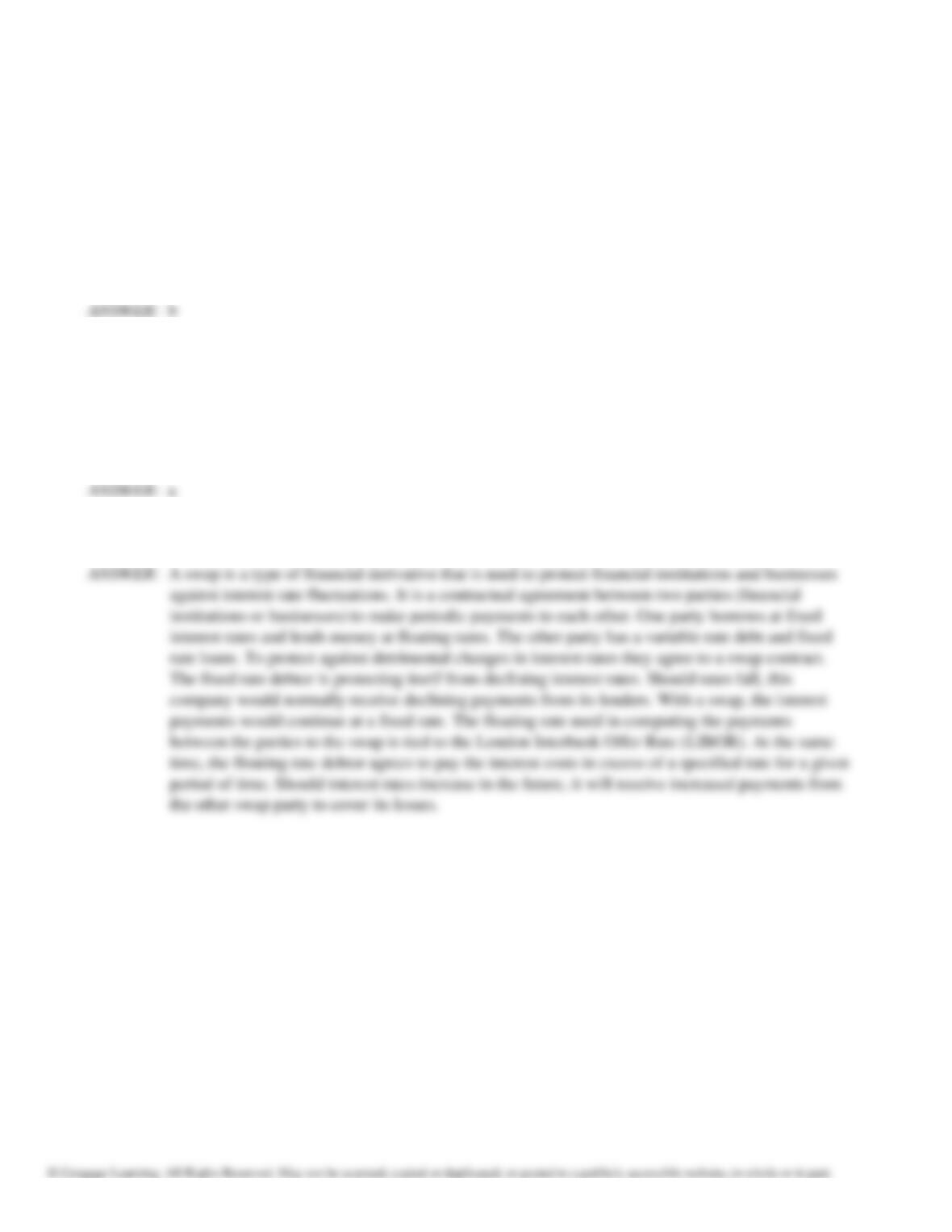
57. Lear Holdings plans to sell 60,000 units, each unit consisting of a $1,000 debenture and 15, 7-year warrants.
Each warrant allows the holder to purchase one common-share at $30. If the stock price goes to $38 and all
warrants were exercised, what is the total capital raised by Lear?
a. $94.2 million
b. $90.6 million
c. $87 million
d. $77 million
58. Jackson Electronics (40% marginal tax rate) is considering issuing convertible debentures. Its investment
banker tentatively has agreed to issue a 9.0 percent, 20-year convertible debenture ($1,000 par value). The
conversion price will be $50 a share. Jackson’s financial managers only want to issue the convertible if its
after-tax component cost of capital is less than or equal to 8.0 percent. Otherwise, they plan to issue non-
convertible debt. Jackson’s current common stock price is $43 a share. The company expects to call the
convertible issue 5 years from now when the common stock price is expected to be $60 a share. Under the
conditions given in this problem, what is the minimum price per debenture that Jackson can receive and keep
the after-tax cost of capital for the debentures at 8.0%?
a. about $1,033
b. about $946
c. about $897
d. $1,200
Chapter 20: Financing with Derivatives
59. A debenture of the Allegro Company (par value $1,000) is convertible into the company’s common stock at a
price of $50 per share. The convertible bond has a coupon interest rate of 7% and matures in 10 years. Straight
debt of equivalent risk and maturity is yielding 8%. The company’s common stock is currently selling for $60
per share. Determine the conversion value and straight-bond value of Allegro Company’s convertible bonds.
a. $1,200; $1,000
b. $1,000; $933
c. $1,200; $933
d. $1,000; $1,000
60. Mercury Inc. issued bonds with warrants attached that had an exercise price of $22. Each warrant allows the
holder to purchase two shares. Since the issuance, the stock split 2 for 1, the current stock price is $24 and the
warrant price is $30. How much is the warrant selling above its formula value?
a. 84.6%
b. 130.8%
c. 15.4%
d. 269%
61. Which of the following is/are a feature of convertible securities?
I. Conversion price
II. Conversion stock
a. Only statement I is correct
b. Only statement II is correct
c. Both statements I and II are correct
d. Neither statement I nor II is correct
62. Firms issue warrants for which of the following reasons?
I. Allows the company to sell stock at a price above what other company stock is selling for.
II. Allows the company to choose which investors are allowed to buy the company’s stock.
a. Only statement I is correct
b. Only statement II is correct
c. Both statements I and II are correct
d. Neither statement I nor II is correct

Chapter 20: Financing with Derivatives
63. In comparing warrants and rights, they:
a. are similar in that the company can discriminate as to who buys new company stock.
b. are similar in that they allow the purchase of existing stock only
c. are different in that both allow the firm to receive additional funds at the time they are exercised.
d. are different in that rights allow the holder of the right to vote in corporate elections based on the number of
shares the right can purchase.
64. The value of the right can be calculated under one of the following circumstances.
a. using the Gordon model
b. trading ex-rights
c. market order
d. based on a margin account
65. An option has a claim.
a. fixed
b. contingent
c. subordinated claim
d. superior claim
66. The conversion ratio of a convertible security is:
a. the number of shares that can be obtained
b. the value of the shares obtained
c. the price at which the security is exchangeable
d. the loss in the security’s value once it is exchanged.
67. Conversion of a convertible security can occur in two ways. Which of the following is/are correct?
I. It can be a voluntary conversion at specific times prior to the expiration date.
II. It can be a forced conversion at any time prior to the expiration date.
a. Only statement I is correct
b. Only statement II is correct
c. Both statements I and II are correct
d. Neither statement I nor II is correct
Chapter 20: Financing with Derivatives
68. Sam owns a $1,000 par value, convertible bond which can be converted now. The conversion ratio is 20 and
each share of stock is currently selling for $40 per share. What would be the conversion value of the bond, and
should Sam convert the bond or hold it to maturity?
a. The conversion value is $2,000 and Sam should convert.
b. The conversion value is $1,200 and Sam should convert.
c. The conversion value is $975 and Sam should hold the bond to maturity.
d. The conversion value is $800 and Sam should hold the bond to maturity.
69. Jana owns preferred stock from High Brow Cow Dairy Farms, makers of the finest dairy products. The stock
has a par value of $1,250 and a conversion ratio of 25. The stock is currently convertible. The firm’s common
stock is selling for $57 per share. If Jana converts the preferred stock, what would be the conversion value?
a. $1,250
b. $31,250
c. $2,850
d. $1,425
70. Conversion price is:
a. the number of common stock shares owned after the conversion.
b. the effective price of the common stock per share obtained by converting.
c. the market price of the common stock per share.
d. the difference between the market price of the common stock and the exercise price of the stock.
71. Conversion premium is the amount by which the market value of a convertible security is higher than:
I. the conversion value of the security
II. the combined interest or dividend payments of the security
a. Only statement I is correct
b. Only statement II is correct
c. Both statements I and II are correct
d. Neither statement I nor II is correct
Chapter 20: Financing with Derivatives
72. In general, when a convertible security is exchanged for common stock, the overall effect is which of the
following?
I. stock shares will decrease
II. earnings per share will decrease.
a. Only statement I is correct
b. Only statement II is correct
c. Both statements I and II are correct
d. Nether statement I nor II is correct
73. In calculating fully diluted earnings per share, earnings must be adjusted for:
a. interest saved.
b. the number of convertible securities in the marketplace.
c. the number of executive bonus packages that could impact the firm’s earnings.
d. the company’s credit rating.
74. What is an interest rate swap? Describe how they are used.
Chapter 20: Financing with Derivatives
75. Why would a company issue convertible securities instead of straight bonds?
76. List some securities that have option features.
77. What variables affect the call option valuation?
Chapter 20: Financing with Derivatives
78. Explain how conversion of a convertible security affects earnings and how does a firm handle this on its
financial statements?
79. What is the difference between a conversion price and a conversion ratio?
80. Which companies are the primary issuers of convertible securities and why do they do it?