63) The total utility of consuming 6 units of a good is 255. The marginal utility of the 6th unit is
45 and the marginal utility of the 5th unit is 65. The total utility of consuming 5 units of the good
is
A) 300.
B) 150.
C) 215.
D) 195.
64) When you buy something, you do so because of the satisfaction you expect to receive from
having and using that good. Another term that can be used for satisfaction is
A) need.
B) purchasing power.
C) utility.
D) price elasticity.
65) Economists once believed utility could be measured. This school of thought, known as
utilitarianism, was developed by the English philosopher
A) Jeremy Bentham.
B) Henri Leconte.
C) John Lennon.
D) Bernard Mandeville.
66) Kathy has eaten five cookies. The fifth cookie makes Kathy sick. This means that for Kathy
A) the fifth cookie has little utility.
B) the fifth cookie has negative utility.
C) the opportunity cost of cookies is high.
D) cookies must be inexpensive.
67) Marginal utility
A) at first rises and then declines as a person consumes more of a good or service.
B) can be thought of as being the equivalent to total utility.
C) equals the total satisfaction from consumption of goods and services.
D) is stable, but then as a person consumes more of a good or service, has a propensity to
increase.
68) The additional utility or satisfaction that one derives from consuming one more unit of any
good or service is referred to as
A) total utility.
B) diminishing utility.
C) average utility.
D) marginal utility.
69) The change in satisfaction derived when an individual consumes one more unit of a good or
service is called
A) total utility.
B) marginal utility.
C) average utility.
D) fixed utility.
70) Marginal utility is calculated as
A) total utility/number of units consumed.
B) change in total utility/number of units consumed.
C) change in total utility/change in number of units consumed.
D) total utility/change in number of units consumed.
71) In economics, the term “marginal” refers to
A) total.
B) a change in the total.
C) average change.
D) inverse.
72) In utility analysis, a consumer’s tastes and preferences are assumed to be
A) dependent on income and education.
B) predetermined and constant.
C) dependent on national origin.
D) non-existent
73) When total utility is at a maximum
A) marginal utility is at a minimum.
B) marginal utility is negative.
C) marginal utility is zero.
D) marginal utility is equal to total utility.
74) Total satisfaction is maximized when
A) marginal utility is positive.
B) marginal utility is negative.
C) marginal utility is zero.
D) marginal utility is equal to average utility.
75) As more of a product is consumed, total utility increases until
A) marginal utility increases at an increasing rate.
B) average utility increases at an increasing rate.
C) marginal utility is negative.
D) average utility decreases.
76) When marginal utility is negative, total utility
A) increases at a decreasing rate.
B) is zero.
C) is at its maximum.
D) decreases.
77) When marginal utility is positive, total utility is
A) increasing.
B) zero.
C) at its minimum.
D) decreasing.
78) When marginal utility is zero, total utility is
A) increasing.
B) at its maximum.
C) at its minimum.
D) decreasing.
79) The marginal utility derived from viewing the next movie download is the
A) average utility per minute of viewing.
B) additional utility from viewing the movie.
C) average utility per hour of viewing.
D) additional utility from viewing the first minute of the movie.
80) A rational person will NEVER consume a product when its
A) marginal utility is negative.
B) total utility is increasing at a decreasing rate.
C) marginal utility is decreasing.
D) total utility is decreasing at an increasing rate.
81) In economics, people make decisions regarding consumption based on comparing
A) additional units of satisfaction with additional costs.
B) average satisfaction with additional costs.
C) average satisfaction with average costs.
D) additional units of satisfaction with average costs.
82) If the commercial is TRUE that every additional bite of food tastes as good as the first, the
marginal utility from consuming more of the advertised product must be
A) increasing.
B) decreasing.
C) constant.
D) zero.
83) If you have been consuming large quantities of ice cream on a hot summer afternoon and you
decide to refrain from any additional consumption, it can be concluded that
A) total utility has reached a minimum and the marginal utility of an additional drink would be
large.
B) total utility has reached a maximum and the marginal utility of an additional drink would be
small.
C) total utility has reached a maximum and the marginal utility of an additional drink would be
zero.
D) total utility has reached a minimum and the marginal utility of an additional drink would be
negative.
84) If marginal utility is zero
A) a rational consumer will consume more units next time.
B) a rational consumer will consume fewer units next time.
C) a rational consumer will not consume additional units.
D) a rational consumer will consume more units if the price is zero.
85) One student loves donuts. He receives 100 units of utility for the first donut, an additional 80
for the second, an additional 60 for the third, another 50 for the fourth, and another 20 for the
fifth. The marginal utility of the fourth donut is ________ and the total utility from consuming
four donuts is ________.
A) 50; 40
B) 50; 290
C) 140; 290
D) 290; 100
86) If the total utility derived from consuming three oysters was 40 utils and the total utility
derived from consuming four oysters was 62 utils, what was the marginal utility derived from the
consumption of the fourth oyster?
A) 102 utils
B) 62 utils
C) 22 utils
D) It is impossible to determine.
87) Assuming that the marginal utility of the first four pieces of candy was 30, 28, 22, and 20
respectively, how much total utility was derived from eating the first three pieces of candy?
A) 58
B) 80
C) 22
D) 100
88) Utility analysis deals with
A) the formation of tastes and preferences.
B) the differences of tastes and preferences across individuals.
C) the consumption decisions of people based on utility maximization.
D) how consumers determine the utility they receive from consumption.
89) Utility theory assumes that a consumer tries to
A) maximize her average utility.
B) maximize her marginal utility.
C) maximize the difference between total and marginal utility.
D) maximize her total utility.
90) When marginal utility is positive but decreasing, total utility is
A) decreasing.
B) negative.
C) increasing.
D) zero.
91) When total utility is falling
A) marginal utility is at a maximum.
B) marginal utility is at zero.
C) marginal utility is negative.
D) marginal utility has decreased, but is now increasing.
92) If marginal utility is positive but diminishing, then
A) average utility must be negative.
B) total utility must also be diminishing.
C) total utility must be positive.
D) marginal utility must be more than total utility.
93) If marginal utility is zero, total utility is
A) falling.
B) zero.
C) at its maximum.
D) negative.
94) When we graph total utility, the total utility curve will
A) always be increasing.
B) always be decreasing.
C) be increasing as long as marginal utility is positive.
D) be horizontal if marginal utility is positive.
95) If marginal utility declines but remains positive, then
A) total utility continues to increase but at a decreasing rate.
B) total utility also declines.
C) total utility continues to be zero.
D) none of the above.
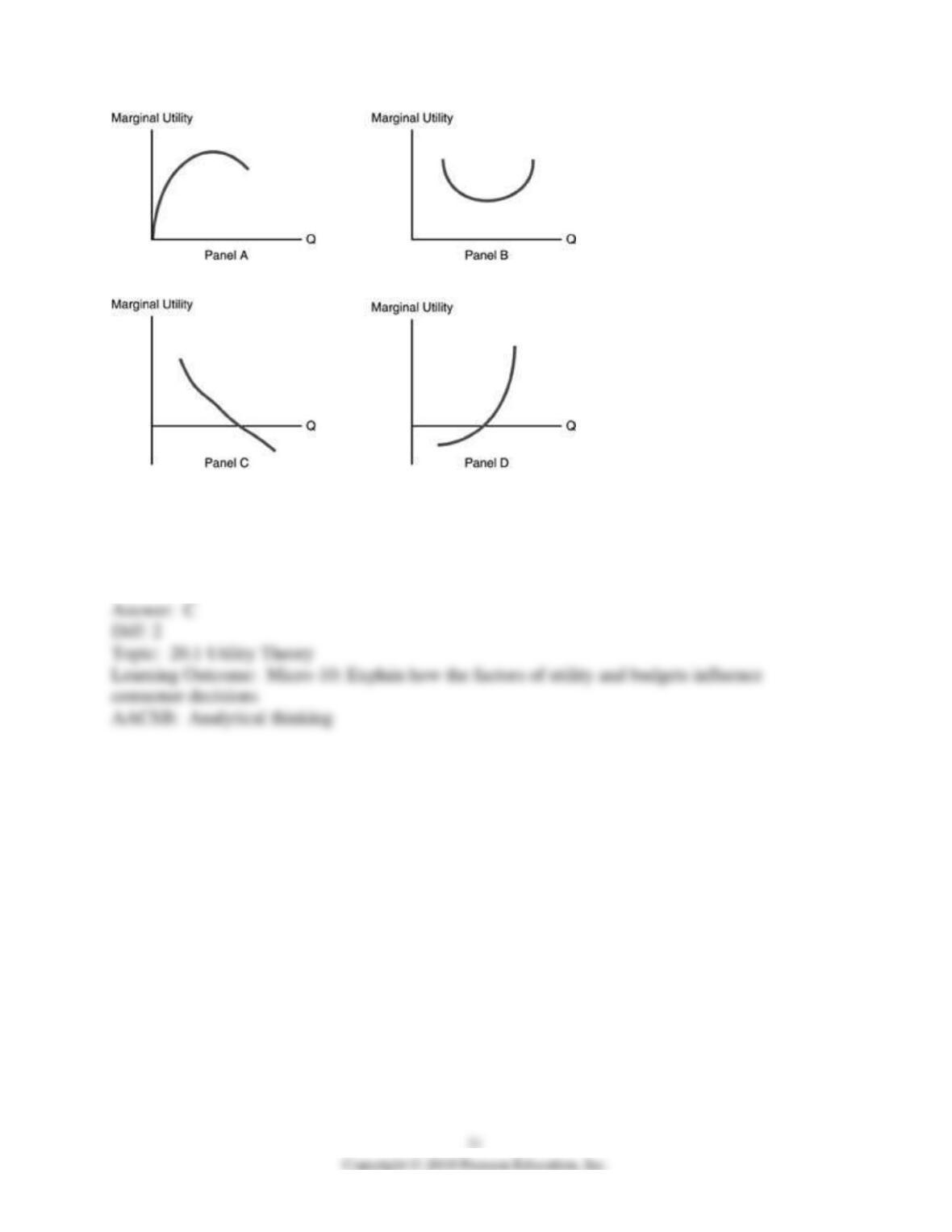
96) Refer to the above figures. Which panel best represents marginal utility?
A) Panel A
B) Panel B
C) Panel C
D) Panel D
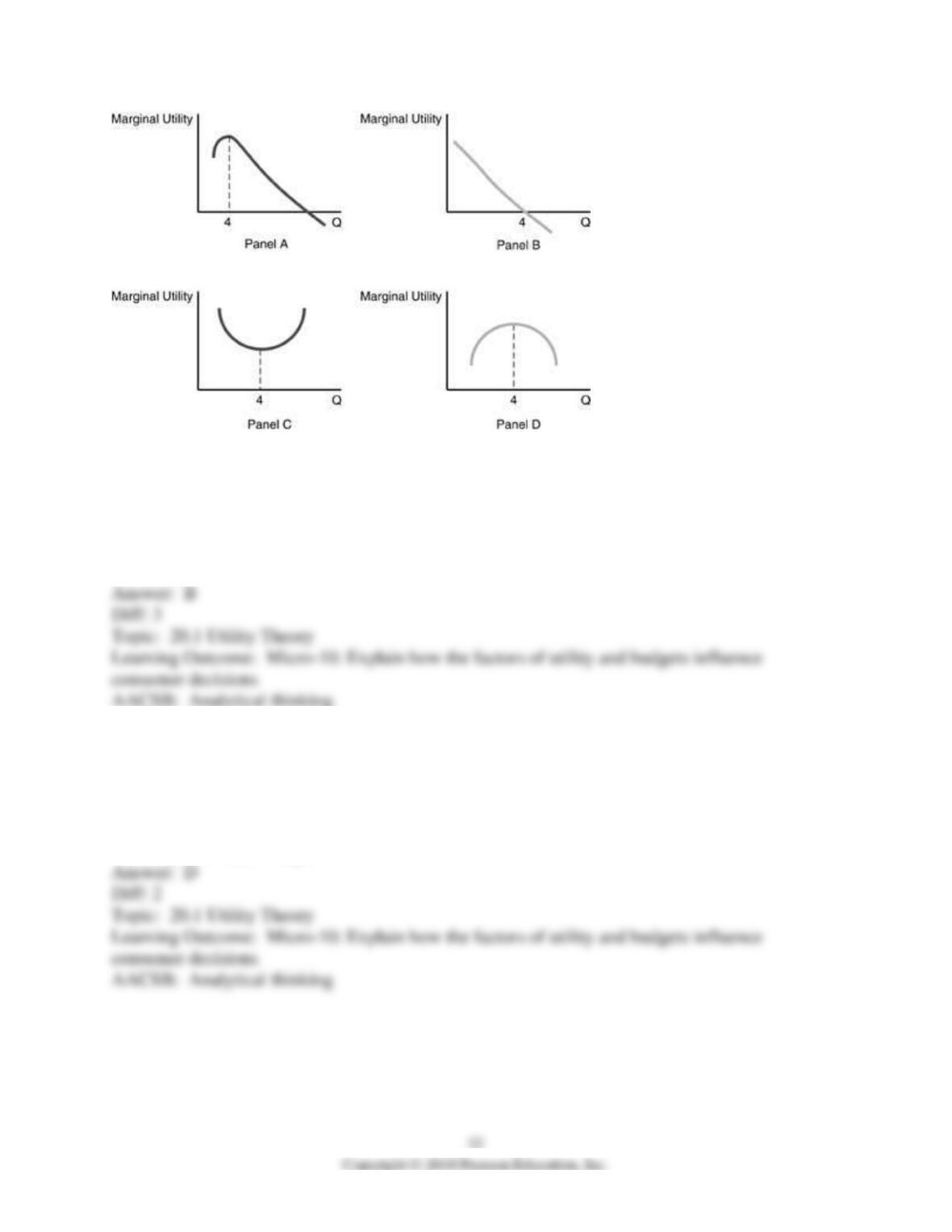
97) Refer to the above figures. Julie’s total utility for consuming donuts reaches a maximum at 4
cookies. Which panel best represents marginal utility?
A) Panel A
B) Panel B
C) Panel C
D) Panel D
98) Which of the following statements is NOT true about marginal utility when total utility is at
its maximum point?
A) Marginal utility is zero.
B) Marginal utility is decreasing.
C) A rational consumer will not consume additional units beyond this point.
D) Marginal utility is negative.
99) If marginal utility is zero
A) total utility increases at a decreasing rate.
B) total utility increases at an increasing rate.
C) total utility is at a maximum.
D) people will consume more of the good only if the price is zero.
100) If the price of a good is zero, a rational consumer will
A) buy all of the units available.
B) not consume the good at all since it must not be valuable if it has a zero price.
C) stop consuming the good when marginal utility is zero.
D) consume the good up to the point where total utility is just below zero.
101) In the above table, what is the marginal utility of the fourth hotdog consumed?
A) 10
B) 30
C) 120
D) 130
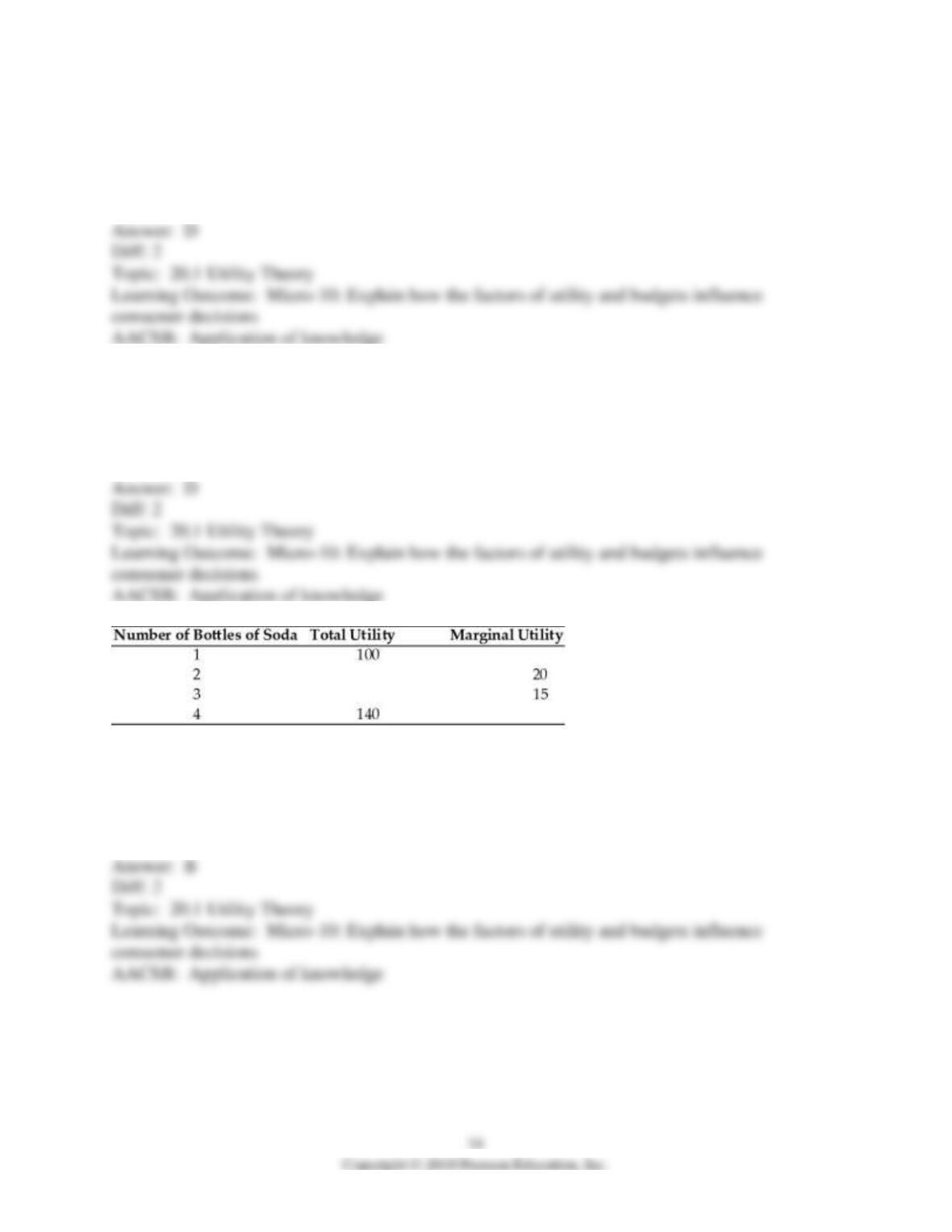
102) In the above table, what is the marginal utility of the second hotdog consumed?
A) 10
B) 90
C) 30
D) 40
103) In the above table, what is the marginal utility of the sixth hotdog consumed?
A) 7
B) 137
C) 120
D) -17
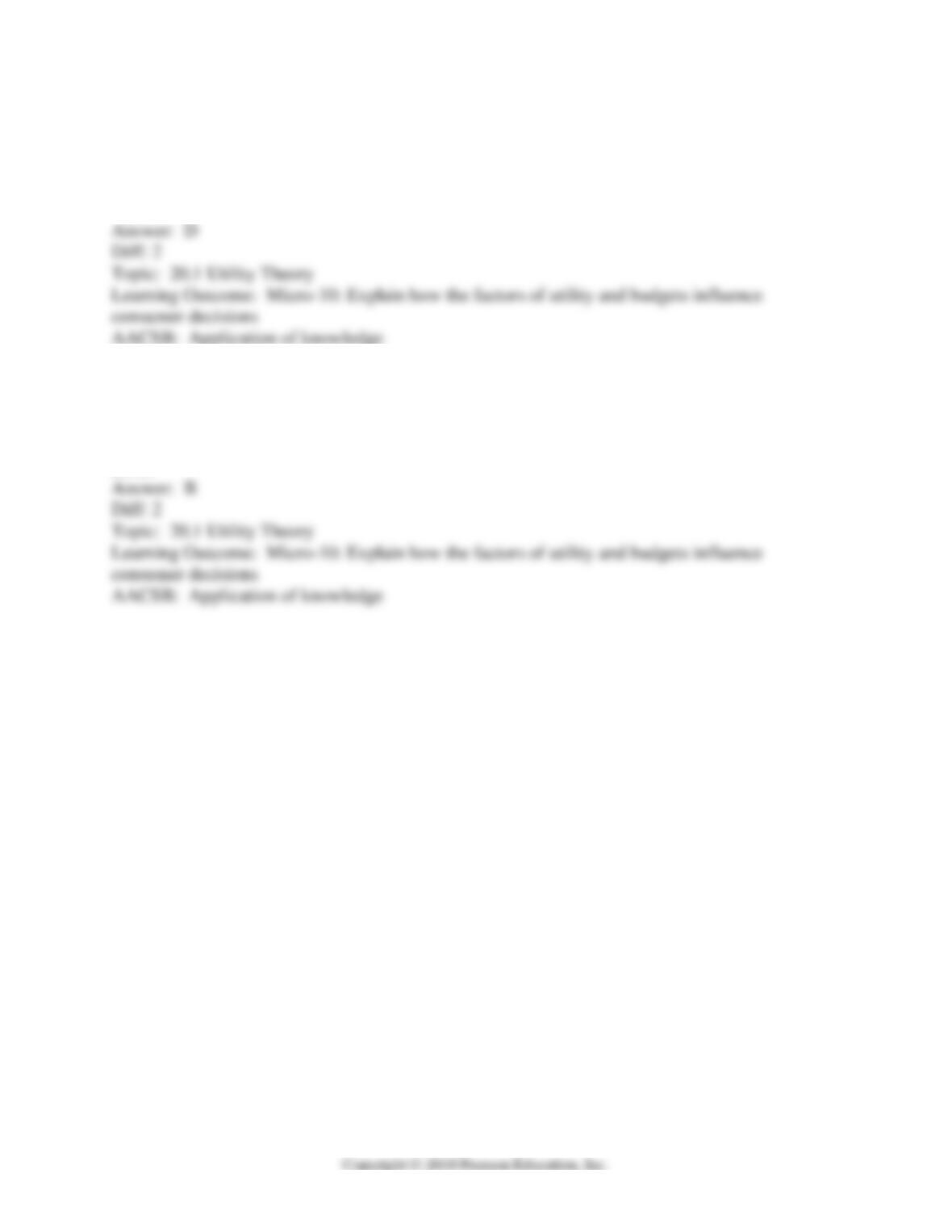
104) Using the above table, what is the total utility of consuming 2 bottles of soda?
A) 115
B) 120
C) 140
D) 240
35
105) Using the above table, what is the total utility of consuming 3 bottles of soda?
A) 115
B) 120
C) 240
D) 135
106) Using the above table, what is the marginal utility of the 4th soda?
A) 23.2
B) 5
C) 10
D) 15
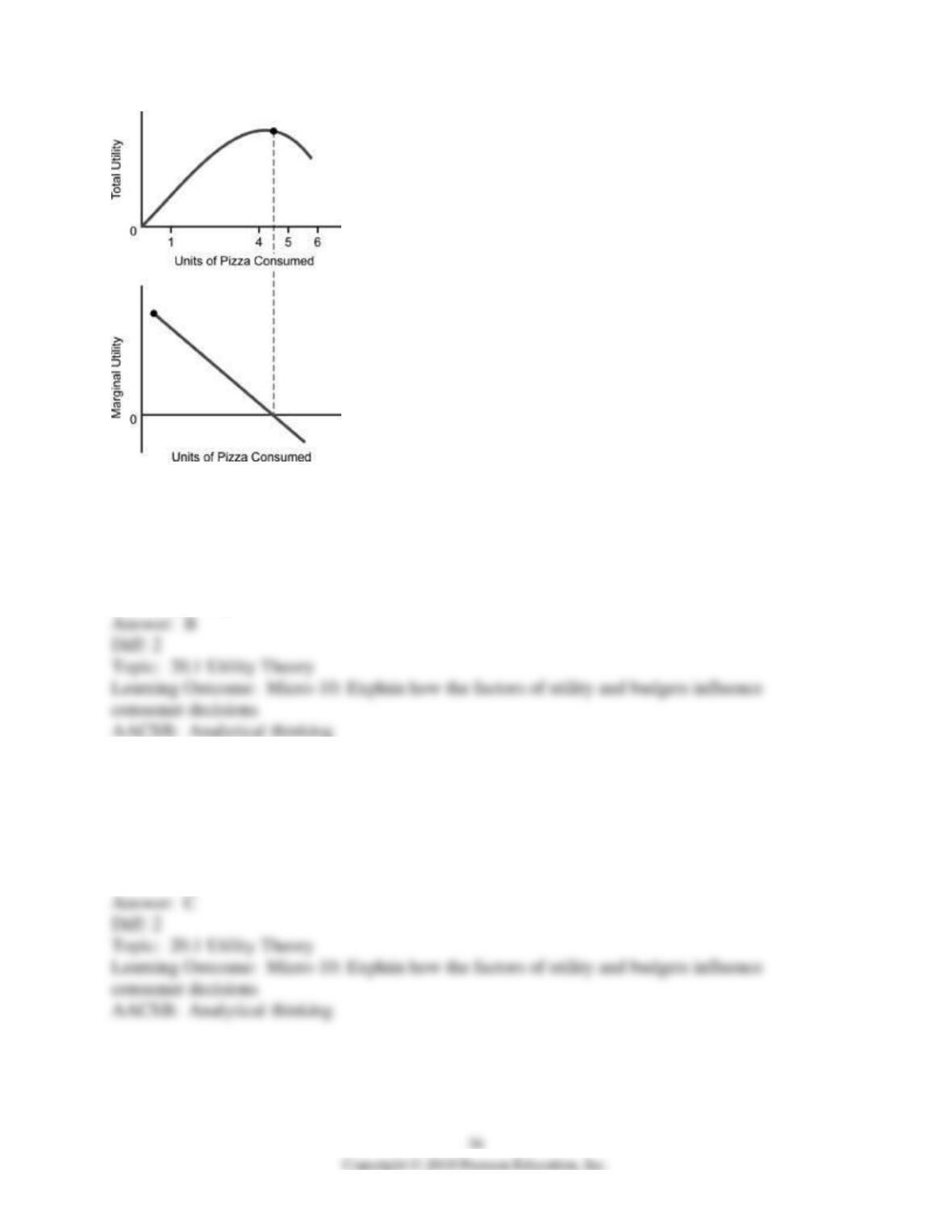
107) Given the above figure, when David eats a third piece of pizza his marginal utility is
________ and his total utility is ________.
A) falling; falling
B) falling; rising
C) rising; falling
D) rising; rising
108) Given the above figure and suppose that David is a rational consumer, then he will NOT eat
more than ________ piece(s) of pizza.
A) 1
B) 5
C) 4
D) 6
109) Given the above figure, marginal utility becomes negative when David consumes the
________ piece of pizza.
A) 1st
B) 3rd
C) 4th
D) 5th
110) When marginal utility is decreasing but still positive, then total utility is
A) increasing at a decreasing rate.
B) negative.
C) decreasing.
D) increasing at an increasing rate.
111) The statement that “as more of a good is consumed, its extra benefit declines” refers to
A) the law of demand.
B) the law of diminishing marginal product.
C) the law of diminishing marginal utility.
D) the law of comparative advantage.
112) If your guest is serious when he said that he just could not get enough of the lasagna you
cooked and that the more he ate the more he wanted, you would conclude that the marginal
utility of lasagna for him was
A) positive.
B) negative.
C) zero.
D) undefined.
113) If a person claims, “I wouldn’t eat anchovies if you paid me,” we can assume that his
marginal utility of anchovies is
A) positive.
B) positive, but decreasing.
C) zero.
D) negative.
114) If Mary complains that she doesn’t feel very well because she ate too many hotdogs, we
would conclude that the marginal utility of the last hotdog eaten was
A) positive.
B) zero.
C) very large.
D) negative.
115) According to the law of diminishing marginal utility, the marginal utility for a particular
product
A) remains constant, regardless of how much of the product is consumed.
B) remains constant as long as the product is still considered useful.
C) decreases as more of the product is consumed.
D) increases as more of the product is consumed.
116) Typically, an individual takes only one newspaper from the bin because
A) of the low marginal utility of additional newspapers.
B) total utility will rise with consumption of more than one newspaper.
C) marginal utility increases with the first consumption of newspapers.
D) there are limited amounts of newspapers in the bin.
117) According to the principle of diminishing marginal utility
A) total utility always falls with additional consumption.
B) total utility is usually negative.
C) the consumer will never tire of additional units of a good.
D) the rate at which utility increases diminishes as more of a good is consumed.
118) Regretting the last unit of consumption of beer implies that
A) the total utility from drinking beer is negative.
B) beer is an inferior good.
C) the marginal utility of the last unit of beer consumed is negative.
D) the demand curve for beer is horizontal.
119) A rational individual will never consume a unit of a good if its
A) marginal utility is diminishing.
B) marginal utility is greater than the price of the good.
C) marginal utility is increasing.
D) marginal utility is negative.
120) If marginal utility is negative
A) total utility increases at a decreasing rate.
B) the consumer will not consider extra units of the good even if its price is zero.
C) the consumer will want to consume the unit only if it is free.
D) the consumer likes the commodity, but not as much as he or she once did.