1. Which of the following statements is not correct?
a.
Libertarians are opposed to redistributing income.
b.
Critics of the welfare system argue that it breaks up families.
c.
One of the problems with measuring income inequality is valuing in-kind transfers.
d.
Utilitarians believe that the government should punish crimes but should not redistribute income.
2. Which of the following statements is not correct?
a.
Two key elements of welfare reform are work requirements and limiting the time that recipients can receive
benefits.
b.
The Earned Income Tax Credit (EITC) is very similar to a negative income tax.
c.
Minimum wage laws will likely increase unemployment.
d.
The elderly are more likely to be poor than single mothers.
3. Which of the following statements is correct?
a.
Followers of the liberalism political philosophy believe that society should maximize the total of individual
utilities.
b.
The poverty line is adjusted for regional differences in the costs of raising children.
c.
One advantage to the Earned Income Tax Credit (EITC) is that it benefits the working poor.
d.
Libertarians pursue policies to redistribute income from the rich to the poor.
4. The best government policy to reduce poverty is
a.
a minimum wage law because the resulting unemployment is small in comparison to the benefits to people it
helps.
b.
an expanded welfare program because people must have an additional “need” such as small children or a
disability.
c.
an in-kind transfer because it ensures that the poor receive what they need most such as food or shelter.
d.
not obvious. Government programs to reduce poverty have many advantages but also many disadvantages.
5. Which of the following programs would be opposed by philosopher John Rawls?
a.
a negative income tax
b.
the Supplemental Security Income (SSI) program
c.
a tax plan creating a perfectly egalitarian income distribution
d.
Rawls would oppose all of the programs.
6. When designing public policies, which income group would philosopher John Rawls argue needs the most attention?
a.
Individuals located in the bottom fifth of the income distribution.
b.
Individuals located at the average income level.
c.
Individuals located in the top fifth of the income distribution.
d.
Individuals located in the top five percent of the income distribution.
7. Which of the following programs to alleviate poverty would be most favored by philosopher Robert Nozick and why?
a.
A negative income tax because it would maximize the minimum income of members of society.
b.
An Earned Income Tax Credit (EITC) because a policy that rewards the working poor would be the most just.
c.
An in-kind transfer program because it would maximize the total utility of all members of society.
d.
None of the programs would be favored because each of them forcibly redistributes income that was fairly, if
not equally, earned.
8. Which of the following programs to alleviate poverty would be most favored by philosopher Robert Nozick?
a.
a negative income tax
b.
an Earned Income Tax Credit (EITC)
c.
an in-kind transfer program
d.
None of the programs would be favored by Nozick.
Scenario 20-3
Suppose that a society is made up of five families whose incomes are as follows:
$120,000; $90,000; $30,000; $30,000; and $18,000.
The federal government is considering two potential income tax plans:
Plan A is a negative income tax plan where the taxes owed equal 1/3 of income minus $20,000.
Plan B is a two-tiered plan where families earning less than $35,000 pay no income tax and families earning more than
$35,000 pay 10% of their income in taxes. The income tax revenue collected from those families earning over $35,000 is
then redistributed equally to those families earning less than $35,000.
9. Refer to Scenario 20–3. Assuming that utility is directly proportional to the cash value of after-tax income, which
government policy would an advocate of utilitarianism prefer?
a.
Plan A
b.
Plan B
c.
either Plan A or Plan B
d.
neither Plan A nor Plan B because any plan that forcibly redistributes income is against the philosophy
10. Refer to Scenario 20-3. Assuming that utility is directly proportional to the cash value of after-tax income, which
government policy would an advocate of liberalism prefer?
a.
Plan A
b.
Plan B
c.
either Plan A or Plan B
d.
neither Plan A nor Plan B because any plan that forcibly redistributes income is against the philosophy
11. Refer to Scenario 20-3. Assuming that utility is directly proportional to the cash value of after-tax income, which
government policy would an advocate of libertarianism prefer?
a.
Plan A
b.
Plan B
c.
either Plan A or Plan B
d.
neither Plan A nor Plan B because any plan that forcibly redistributes income is against the philosophy
12. Binding minimum-wage laws
a.
are costly for the government to impose.
b.
force a market imbalance between the supply and demand for labor.
c.
have the potential to provide benefits to all poor people, whereas a negative tax can only benefit some poor
people.
d.
do not affect segments of the population who are not poor.
Figure 20-5
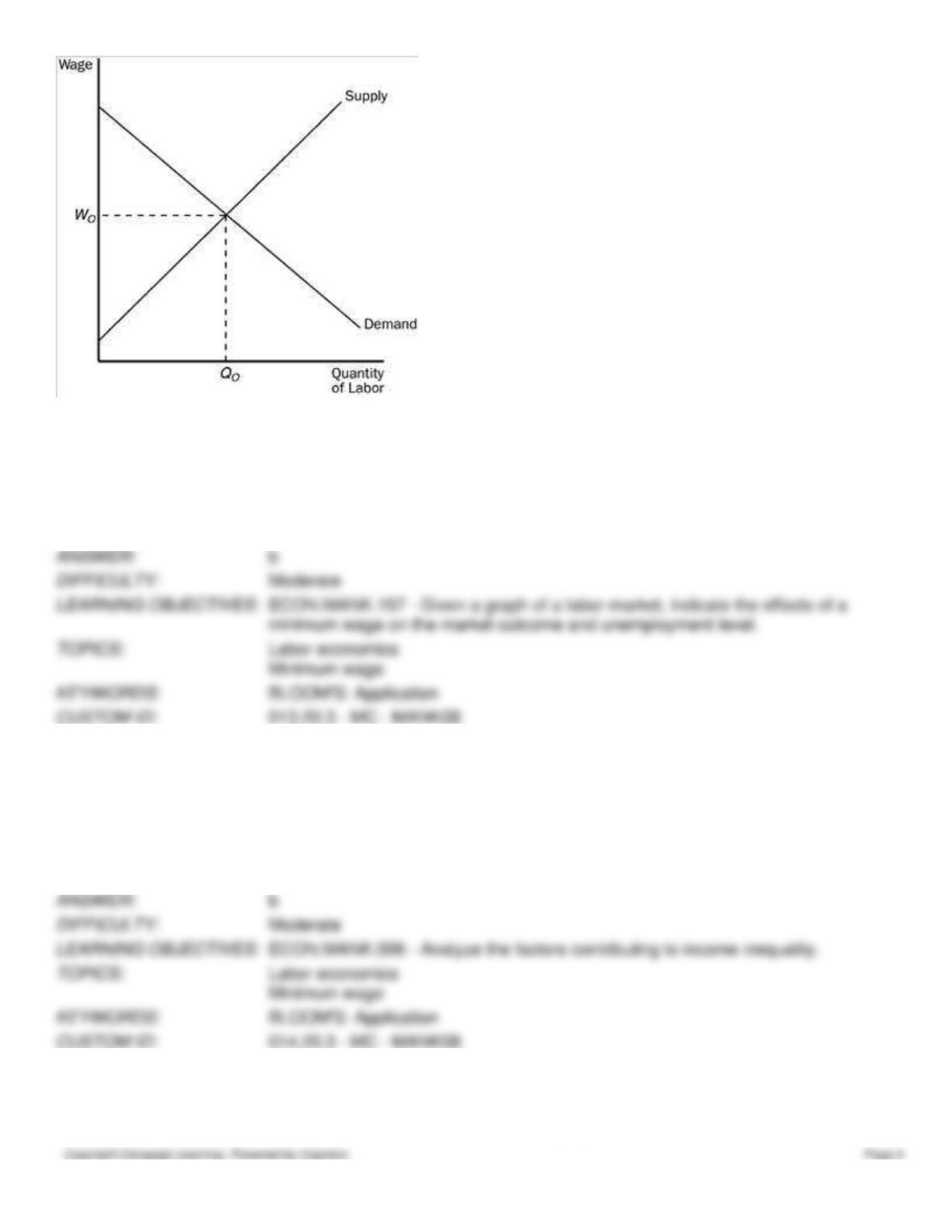
13. Refer to Figure 20-5. If the government imposes a minimum wage above Wo, it is likely to
a.
increase employment to a level above Qo.
b.
reduce employment to a level below Qo.
c.
provide more income to the working poor than they collectively received before the minimum wage was set.
d.
have no effect on employment.
14. Refer to Figure 20-5. An effective minimum wage would be set at a level
a.
above Wo, and employment would rise above Qo.
b.
above Wo, and employment would fall below Qo.
c.
below Wo, and employment would rise above Qo.
d.
below Wo, and employment would fall below Qo.
15. Minimum wage laws
a.
benefit all unskilled workers.
b.
create unemployment, but if demand is relatively elastic, the unemployment effects will be minor.
c.
may help the nonpoor, such as teenagers from wealthy families.
d.
reduce poverty by reducing unemployment.
16. A binding minimum wage
a.
affects employees but not employers.
b.
lowers the productivity of workers.
c.
raises the cost of labor to firms.
d.
All of the above are correct.
17. Critics of the minimum wage argue that
a.
labor demand is inelastic so firms can adjust production.
b.
too many older employees benefit at the expense of teenage workers.
c.
many minimum-wage earners are teenagers from middle-class families.
d.
All of the above are correct.
18. Economists who support minimum-wage legislation are likely to believe that the
a.
demand for unskilled labor is relatively inelastic.
b.
demand for unskilled labor is relatively elastic.
c.
supply of unskilled labor is relatively elastic.
d.
supply of unskilled labor is relatively inelastic.
19. Which of the following statements is correct?
a.
A disadvantage of a minimum-wage law is that it may benefit unskilled workers who are not low-income
workers.
b.
A disadvantage of a negative income tax program is that a poor person who chooses not to work many hours
would receive a cash benefit.
c.
A disadvantage of an Earned Income Tax Credit (EITC) is that a person who is unable to work due to a
disability does not benefit from the program.
d.
All of the above are correct.
20. Which of the following statements is correct?
a.
A minimum wage law will result in less additional unemployment if labor demand is elastic rather than
inelastic.
b.
An in-kind transfer allows a person to use the benefit to purchase whatever they think they need most.
c.
If a tax policy states that taxes owed equal 1/3 of income less $15,000, a person earning $25,000 per year
would owe $6,666.67 in taxes.
d.
Welfare reform enacted in 1996 limited the amount of time recipients could stay on welfare.
21. Which of the following statements is not correct?
a.
An advantage of an in-kind transfer is that it prevents an alcoholic from spending a cash benefit on alcohol.
b.
An advantage of the Supplemental Security Income (SSI) program is that it benefits the sick and disabled.
c.
An advantage of a negative income tax program is that the poor must work to be eligible.
d.
Minimum wage laws result in higher unemployment among those groups of workers affected by the minimum
wage.
22. Which of the following statements about the minimum wage is correct?
a.
An increase in the minimum wage enhances the well-being of all unskilled workers.
b.
An increase in the minimum wage has no effect on the well-being of middle-class families.
c.
Advocates of the minimum wage argue that the demand for labor is relatively inelastic.
d.
Critics of the minimum wage argue that it is an undesirable way of helping the poor because it is costly to the
government.
23. Many Democrats support raising the U.S. minimum wage. Critics of raising the minimum wage argue that minimum-
wage laws are
a.
too expensive for local governments to fund.
b.
too expensive for local governments to administer.
c.
imprecise in their ability to help the working poor.
d.
easy for businesses to pay.
24. Supporters of raising the minimum wage argue that minimum-wage laws are
a.
a tax-free way to help the working poor. Businesses bear the burden of paying higher wages, not the
government.
b.
better than the Earned Income Tax Credit (EITC) in targeting the working poor. The EITC may benefit
teenagers from middle-class families who work summer jobs at the minimum wage.
c.
better than in-kind transfers such as food stamps in providing food rather than unhealthy items such as drugs
or alcohol.
d.
a way to increase employment of those likely to earn the minimum wage.
25. Which of the following statements accurately characterizes the effects of minimum-wage laws?
a.
Some workers who might have been employed at a lower wage become unemployed.
b.
Those workers who remain employed benefit from a higher wage.
c.
The effects of minimum-wage laws depend strongly on the elasticity of demand.
d.
All of the above accurately characterize the effects of minimum-wage laws.
26. Which of the following statements is not correct?
a.
An advantage of the Earned Income Tax Credit (EITC) is that it targets the working poor better than the
minimum wage because it does not benefit teenagers from middle-class families who work summer jobs at the
minimum wage.
b.
A disadvantage of in-kind transfer programs such as food stamps is that they force recipients to purchase from
a restricted set of items which may not include things that the poor need the most such as diapers or cleaning
supplies.
c.
A disadvantage of minimum wage laws is that they are expensive for state and local governments to fund.
d.
Effective minimum wage laws create a surplus of labor.
27. A disadvantage associated with a minimum wage law to reduce poverty is that it
a.
encourages illegitimate births because single women with children receive higher payments.
b.
rewards laziness because it provides payments to those with low incomes regardless of their work effort.
c.
focuses on children and the disabled while neglecting the working poor.
d.
may benefit the teenage children of families who are not poor.
28. A disadvantage associated with in-kind transfers to reduce poverty is that they
a.
alter peoples’ incentives, whereas a negative income tax does not alter peoples’ incentives.
b.
do not allow poor families to make purchases based on their preferences.
c.
can only be distributed by the federal government.
d.
cannot restrict the group of recipients and some middle-class families may benefit from them.
29. Which of the following is not correct?
a.
Critics argue that minimum-wage laws hurt the very people they are intended to help.
b.
Minimum-wage laws may increase unemployment among the groups of workers affected by the minimum
wage.
c.
If the demand for unskilled labor is relatively inelastic, the higher wage will produce more unemployment than
if the demand for unskilled labor is relatively elastic.
d.
Minimum-wage laws may benefit teenagers from middle-class families, so the policy is not a precise way to
help the poor.
30. A common criticism of welfare programs is that they
a.
create self-reliant individuals.
b.
encourage strong family values.
c.
encourage illegitimate births.
d.
have increasing benefits over time, in real terms.
31. Since the early 1970s, welfare benefits have declined,
a.
which is largely due to the success of the negative income tax program.
b.
which is largely due to the success of private charities.
c.
yet the percentage of children living with only one parent has increased.
d.
and the percentage of children living with only one parent has decreased.
32. A common criticism of government programs that are designed to assist the poor is that
a.
those who receive assistance rarely meet the criterion for eligibility.
b.
the majority of those below the poverty line refuse to accept government assistance.
c.
they create incentives for people to become “needy.”
d.
they typically account for a majority of annual government expenditures.
33. Supplemental Security Income (SSI) is a type of
a.
in-kind transfer.
b.
minimum wage law.
c.
private charity.
d.
welfare payment.
34. Which of the following is an example of a welfare program?
a.
Temporary Assistance for Needy Families (TANF).
b.
Capital Gains Tax (CGT).
c.
Life Cycle Transfers (LCT).
d.
North American Free Trade Agreement (NAFTA).
35. In the Temporary Assistance for Needy Families program, most families
a.
must have both parents in the home to qualify.
b.
are female head-of-household families in which the father is absent.
c.
have adult children with disabilities living at home.
d.
are ineligible to receive assistance from other support programs.
36. Anti-poverty programs
a.
encourage saving among recipient groups.
b.
impose a very low marginal tax rate on income.
c.
are only made available to those with no other source of income.
d.
may discourage the poor from escaping poverty on their own.
37. Which of the following statements is not correct?
a.
Welfare programs may encourage illegitimate births.
b.
The decline in welfare benefits since the 1970s has been associated with a decline in the percentage of children
living with a single parent.
c.
Welfare programs may reduce incentives for people to work.
d.
A negative income tax program uses tax revenues collected from high-income families to provide cash
subsidies to low-income families.
38. For which of the following programs can a person qualify solely by having a low income?
a.
both Temporary Assistance for Needy Families (TANF) and Supplemental Security Income (SSI)
b.
Temporary Assistance for Needy Families (TANF) but not Supplemental Security Income (SSI)
c.
Supplemental Security Income (SSI) but not Temporary Assistance for Needy Families (TANF)
d.
neither Temporary Assistance for Needy Families (TANF) nor Supplemental Security Income (SSI)
39. The U.S. welfare system was revised by a 1996 law that
a.
consolidated all of the previous assistance programs into a single program.
b.
limited the amount of time that people could receive assistance.
c.
said it was no longer necessary for poor people to demonstrate an additional “need,” such as small children or
a disability, to qualify for assistance.
d.
turned all federally-run welfare programs over to the states.
40. Poor families are eligible for financial assistance, without having to demonstrate any additional “need,”
a.
under the current welfare system and under a negative income tax.
b.
under the current welfare system but not under a negative income tax.
c.
under a negative income tax but not under the current welfare system.
d.
under neither the current welfare system nor under a negative income tax.
41. Which of the following is not an example of a welfare program?
a.
Supplemental Security Income (SSI)
b.
Temporary Assistance for Needy Families (TANF)
c.
food stamps
d.
minimum wage laws