52. Suppose that the world price of kiwi fruit ($10 per box) is below the domestic price ($12 per box). A tariff of $1 per
box would:
a.
cause foreign producers to be better off, because the price they charge is now higher by $1 per box.
b.
cause domestic producers to be worse off by $5 per box.
c.
allow domestic consumers to enjoy kiwi fruit for $5 more per box than the free trade price, but still $2 less
than the domestic price.
d.
allow domestic consumers to enjoy kiwi fruit for $1 more per box than the free trade price, but still $1 less
than the domestic price.
e.
cause domestic producers to be worse off by $10 per box.
d
Moderate
MACR.BOYE.16.101 – ch. 20, 2
United States – International Trade and Finance
United States – Reflective Thinking
Tools of Commercial Policy
Application
53. Which of the following tools of commercial policy acts as a quantitative restriction on imports?
a.
Tariff
b.
Subsidy
c.
Health and Safety regulations
d.
Quota
e.
Government procurement
d
Easy
MACR.BOYE.16.101 – ch. 20, 2
United States – Analytic – BB-Legal
United States – International Trade and Finance
Tools of Commercial Policy
Knowledge
54. By restricting the amount of a good that may be imported, quotas:
a.
increase the price, thus causing domestic producers to sell less than they would with free trade.
b.
lower the price, thus allowing domestic producers to sell more than they would with free trade.
c.
increase the price and allow domestic producers to sell more at a higher price than they would with free trade.
d.
lower the price, thus causing domestic producers to realize lower total revenue from the quota item.
e.
simply replace foreign production with domestic production.
Easy
MACR.BOYE.16.101 – ch. 20, 2
United States – International Trade and Finance
Tools of Commercial Policy
Application
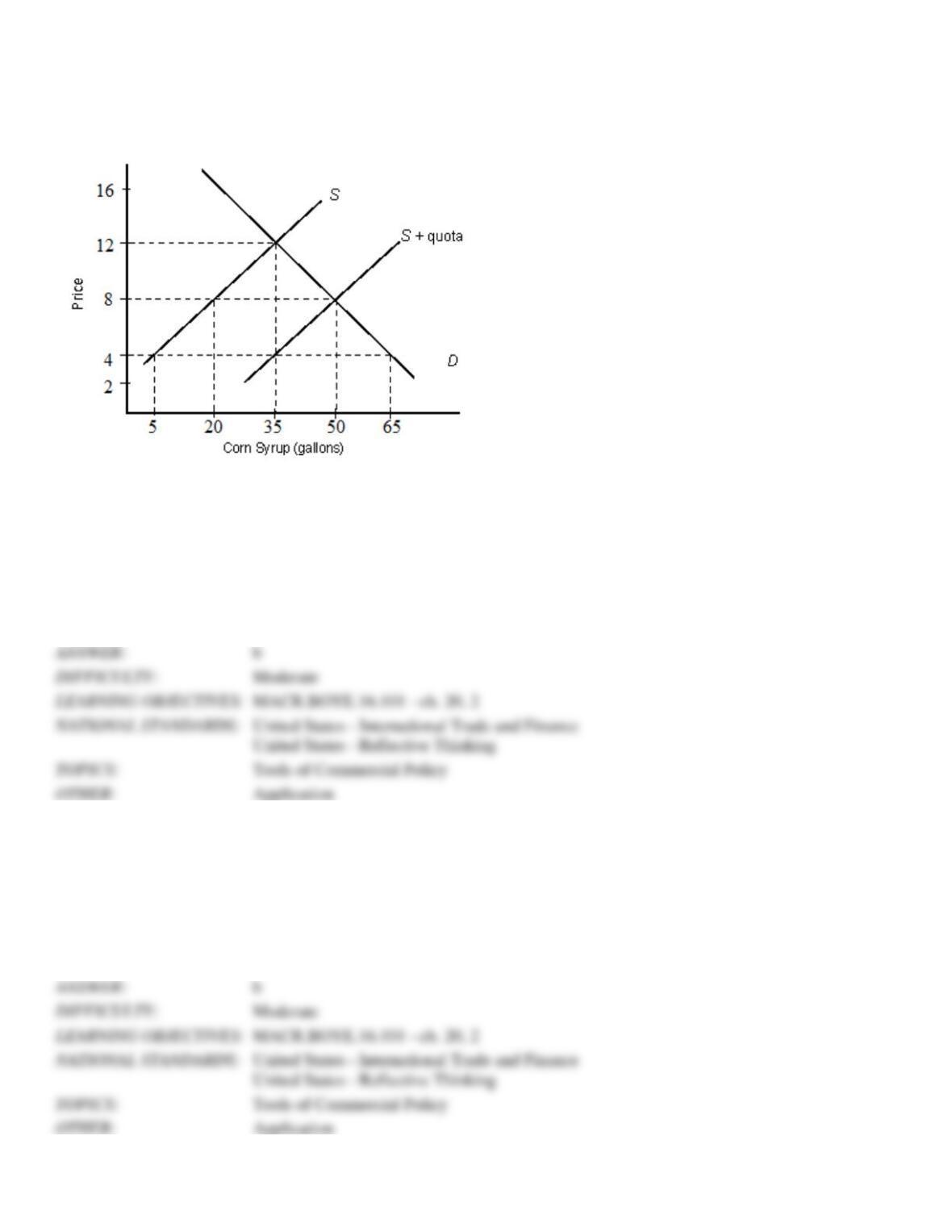
The figure below shows the demand (D) and supply (S) curves of corn syrups.
Figure 20.3
55. In Figure 20.3, what are the equilibrium price and quantity in the absence of trade?
a.
$8, 50 gallons
b.
$12, 35 gallons
c.
$8, 35 gallons
d.
$4, 20 gallons
e.
$16, 50 gallons
56. In Figure 20.3, suppose an import quota of 30 gallons of corn syrup is imposed. If the world price per gallon is $4:
a.
there will be an excess domestic demand of approximately 35 gallons.
b.
the domestic market will be in equilibrium.
c.
there will be an excess domestic demand for 10 gallons.
d.
there will be an excess supply of 20 gallons.
e.
there will be an excess domestic demand for 20 gallons.
MACR.BOYE.16.101 – ch. 20, 2
United States – Reflective Thinking
Tools of Commercial Policy
MACR.BOYE.16.101 – ch. 20, 2
United States – Reflective Thinking
Tools of Commercial Policy
57. In Figure 20.3, if the world price per gallon is $8, then without quotas:
a.
50 gallons of corn syrup will be imported.
b.
35 gallons of corn syrup will be imported.
c.
30 gallons of corn syrup will be imported.
d.
20 gallons of corn syrup will be imported.
e.
45 gallons of corn syrup will be imported.
58. In Figure 20.3, with an import quota of 30 gallons of corn syrup, what is the new equilibrium price?
a.
$4
b.
$6
c.
$8
d.
$10
e.
$12
Challenging
MACR.BOYE.16.101 – ch. 20, 2
United States – Reflective Thinking
Tools of Commercial Policy
Application
59. In Figure 20.3, with an import quota of 30 gallons of corn syrup, what is the new equilibrium quantity demanded?
a.
35 gallons
b.
50 gallons
c.
20 gallons
d.
65 gallons
e.
5 gallons
b
Challenging
MACR.BOYE.16.101 – ch. 20, 2
Tools of Commercial Policy
Application
60. The effect of an import quota on the domestic market is to shift the:
a.
demand curve to the right by the amount of the quota.
b.
demand curve to the left by the amount of the quota.
c.
supply curve to the right by the amount of the quota.
Moderate
MACR.BOYE.16.101 – ch. 20, 2
Tools of Commercial Policy
Application
d.
supply curve to the left by the amount of the quota.
e.
consumers’ marginal utility curves if they prefer foreign goods to domestic goods.
61. The basic difference between a tariff and quota is that:
a.
quota can be imposed both on imports and exports whereas a tariff can be imposed only on imports.
b.
quota yields revenue to the government whereas tariff does not yield any revenue.
c.
tariff reduces the import of the goods with greater certainty than quota as the amount of import restricted by
quota depends on the price elasticity of demand for importable.
d.
tariff is a quantitative restriction on imports whereas quota is an import duty.
e.
a tariff raises the price of the product only in the domestic market whereas with a quota, both domestic and
foreign producers receive a higher price.
MACR.BOYE.16.101 – ch. 20, 2
United States – Analytic – BB-Legal
United States – International Trade and Finance
Tools of Commercial Policy
62. Which of the following can be considered as a cultural barrier to trade?
a.
Prohibition on Zimbabwean aircrafts from flying over or landing in Canada.
b.
Restriction on the export of luxury goods to the Democratic Peoples Republic of Korea from Canada.
c.
An arms embargo imposed on China by the U.K. government
d.
Japanese law requiring a new retail firm to receive permission from other retailers in the area in order to open
a business.
e.
Restriction on the export of strategic goods to Ghana imposed by the government of U.K.
United States – International Trade and Finance
United States – Reflective Thinking
Tools of Commercial Policy
63. Subsidies are payments made by the government of a country to:
a.
foreign firms to encourage imports.
b.
foreign firms to encourage domestic exports.
c.
domestic firms to encourage exports.
d.
domestic firms to encourage imports.
e.
domestic firms to ensure domestic consumption of their goods.
MACR.BOYE.16.101 – ch. 20, 2
United States – International Trade and Finance
United States – Reflective Thinking
Tools of Commercial Policy
64. One of the negative impacts of export subsidy is that:
a.
the price of the domestic good increases in the world market.
b.
the domestic supply of the goods increases more than proportionately than increase in demand.
c.
the domestic cost of production of the exportable increase.
d.
it results in a general deflation and hence the domestic producers incur losses.
e.
the domestic consumers are harmed as the subsidies are financed by taxing them.
MACR.BOYE.16.101 – ch. 20, 2
United States – Analytic – BB-Legal
Tools of Commercial Policy
65. Suppose, in the United States, each farmer is given a federal agricultural subsidy worth $30,000. What will be the
effect of such subsidy?
a.
They discourage domestic agricultural production.
b.
They allow U.S. farmers to sell their products for lower prices in foreign markets.
c.
They give foreign producers an unfair cost advantage.
d.
They increase the amount of agricultural imports into the United States.
e.
The price of the primary products decline in the U.S. market.
MACR.BOYE.16.101 – ch. 20, 2
United States – International Trade and Finance
Tools of Commercial Policy
66. As a result of the government procurement policy in the U.S.:
a.
the domestic consumers are required to pay a higher price than the government for the domestically produced
goods.
b.
the government wields the sole authority of importing goods from abroad.
c.
the government wields the sole authority of exporting goods.
d.
the government is required to buy the domestic goods if the domestic price is less than the world price.
e.
the government is required to sponsor research and development for the domestic firms.
MACR.BOYE.16.101 – ch. 20, 2
MACR.BOYE.16.101 – ch. 20, 2
United States – Analytic – BB-Legal
United States – International Trade and Finance
Tools of Commercial Policy
67. After the U.S. government had approved the feeding of hormones to U.S. beef cattle, several western European
nations restricted the import of beef from the U.S. Which of the following tools of commercial policy had been put to use
in this situation?
a.
Tariff
b.
Quota
c.
Health and safety standards
d.
Subsidy
e.
Government procurement
Easy
MACR.BOYE.16.101 – ch. 20, 2
United States – Analytic – BB-Legal
United States – International Trade and Finance
Tools of Commercial Policy
Knowledge
68. Agreements to abolish most barriers to trade among nations are known as:
a.
free trade cartels.
b.
discriminatory trade agreements.
c.
neutral trade agreements.
d.
preferential trade agreements.
e.
retaliatory trade agreements.
Easy
MACR.BOYE.16.102 – ch. 20, 3
United States – Analytic – BB-Legal
Preferential Trade Agreements
Knowledge
69. A customs union is an organization of nations whose members:
a.
have impenetrable trade barriers among themselves but impose no trade barriers on nonmembers.
b.
have no trade barriers among themselves but impose common trade barriers on nonmembers.
c.
have no trade barriers among themselves but each member country chooses its own trade policies toward
nonmember countries.
d.
retaliate each other by raising reciprocal tariffs.
e.
neither have trade barriers among themselves nor impose any restriction on the nonmember countries.
Easy
MACR.BOYE.16.102 – ch. 20, 3
United States – International Trade and Finance
Knowledge
70. The European Economic Community was created in 1957 by:
a.
France, the United Kingdom, Italy, Belgium, the Netherlands, and Luxembourg.
b.
France, West Germany, Italy, Belgium, the Netherlands, and Luxemburg.
c.
France, West Germany, Italy, Belgium, the Netherlands, and the United Kingdom.
d.
France, West Germany, Italy, the United Kingdom, Belgium, the Netherlands, and Luxembourg.
e.
France, West Germany, Italy, Belgium, the United Kingdom, and Luxembourg.
MACR.BOYE.16.102 – ch. 20, 3
United States – International Trade and Finance
Preferential Trade Agreements
71. In 1992 the EEC was replaced by the EU with an agreement to:
a.
reduce trade barriers among the member countries.
b.
reduce trade barriers against nonmember countries.
c.
mutually restrict imports from nonmember countries.
d.
create a single market for goods and services in western Europe.
e.
enable the countries of Western Europe to emerge as major world powers.
MACR.BOYE.16.102 – ch. 20, 3
Preferential Trade Agreements
72. Trade diversion reduces worldwide efficiency, because:
a.
production is diverted to the country with the comparative advantage.
b.
production is diverted from the country with the comparative advantage.
c.
unnecessary trade restrictions are created in the economies.
d.
consumption is diverted to the country having inadequate demand.
e.
the cost of transshipment of the goods increases thus raising their prices in the world market.
MACR.BOYE.16.102 – ch. 20, 3
Preferential Trade Agreements
73. The trade-creation effect refers to:
a.
a reduction in economic efficiency as a result of a preferential trade agreement.
b.
a production shift to a higher-cost producer as a result of a preferential trade agreement.
c.
the outcome of a preferential trade agreement that allows a country to obtain goods at a lower cost than is
available at home.
d.
diversion of production from a country that has comparative advantage.
e.
a production shift to a country that does not have comparative advantage.
74. The most successful free trade agreements achieve all of the following goals, except:
a.
benefiting exporters by increasing exports to member countries.
b.
ensuring that production occurs on the basis of comparative advantage.
c.
benefiting consumers by making a wider variety of goods available at a lower price.
d.
stimulating trade creation to allow the benefits of trade to be realized.
e.
protecting domestic industries from foreign competition.
MACR.BOYE.16.102 – ch. 20, 3
Preferential Trade Agreements
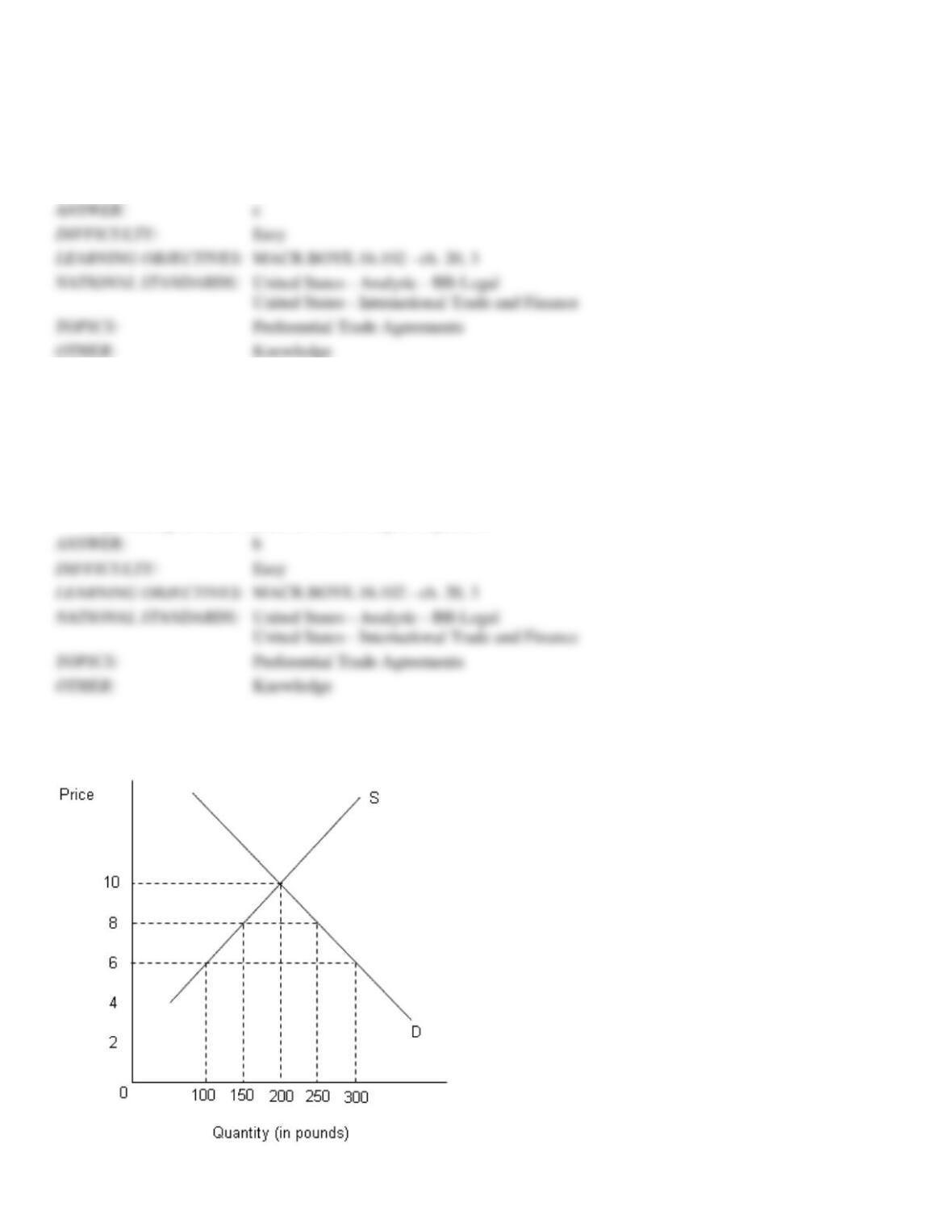
The figure below shows the demand (D) and supply (S) curves of cocoa in the U.S.
Figure 20.4
MACR.BOYE.16.102 – ch. 20, 3
United States – Analytic – BB-Legal
Preferential Trade Agreements
75. According to Figure 20.4, the no-trade equilibrium price and quantity of cocoa in the U.S. market are:
a.
$8 and 150 pounds.
b.
$10 and 250 pounds.
c.
$4 and 200 pounds.
d.
$10 and 200 pounds.
e.
$6 and 300 pounds.
76. Refer to Figure 20.4. If cocoa sells for $6 per pound in the world market, determine the volume of U.S. cocoa imports.
a.
250 pounds
b.
350 pounds
c.
300 pounds
d.
150 pounds
e.
200 pounds
MACR.BOYE.16.102 – ch. 20, 3
United States – Reflective Thinking
Preferential Trade Agreements
77. From Figure 20.4, determine the total volume of U.S. cocoa imports if its government imposes tariff at the rate of $2
per pound on cocoa.
a.
200 pounds
b.
250 pounds
c.
100 pounds
d.
300 pounds
e.
350 pounds
MACR.BOYE.16.102 – ch. 20, 3
United States – Reflective Thinking
Preferential Trade Agreements
78. Refer to Figure 20.4. Assume that Ghana is the only cocoa exporter supplying cocoa in the world market at $6 per
pound. If the U.S. enters into a free trade agreement (FTA) with Ghana, what would be its total cocoa imports?
a.
100 pounds
MACR.BOYE.16.102 – ch. 20, 3
Preferential Trade Agreements
b.
300 pounds
c.
200 pounds
d.
150 pounds
e.
250 pounds
79. In reality international trade is determined solely by comparative advantage and the free market forces of supply and
demand.
a.
True
b.
False
False
Easy
MACR.BOYE.16.100 – ch. 20, 1
United States – International Trade and Finance
Arguments for Protection
Knowledge
80. International trade on the basis of comparative advantage maximizes world output and allows consumers to access
better-quality products at lower prices than would be available in the domestic market alone.
a.
True
b.
False
True
Easy
MACR.BOYE.16.100 – ch. 20, 1
United States – International Trade and Finance
Arguments for Protection
Knowledge
81. When barriers to trade are imposed, we should expect some groups to be harmed at the expense of other groups.
a.
True
b.
False
True
Easy
MACR.BOYE.16.100 – ch. 20, 1
Arguments for Protection
Challenging
MACR.BOYE.16.102 – ch. 20, 3
Preferential Trade Agreements
Application
82. Protection from foreign competition benefits domestic producers in the protected industry at the expense of domestic
consumers.
a.
True
b.
False
83. The world output is higher if the countries follow restrictive trade policies rather than free trade.
a.
True
b.
False
False
Easy
MACR.BOYE.16.100 – ch. 20, 1
United States – International Trade and Finance
Arguments for Protection
Knowledge
84. When production does not proceed on the basis of comparative advantage, resources are expended on their most
efficient uses.
a.
True
b.
False
False
Easy
MACR.BOYE.16.100 – ch. 20, 1
Arguments for Protection
Knowledge
85. While it is possible to erect barriers to foreign competition and save domestic jobs, restricting international trade may
impose large costs on an economy.
a.
True
b.
False
True
Easy
MACR.BOYE.16.100 – ch. 20, 1
Preferential Trade Agreements
True
Moderate
MACR.BOYE.16.100 – ch. 20, 1
Arguments for Protection
Knowledge
86. Since individual consumers do not know how much of the price they pay for a commodity is due to protection,
consumers rarely lobby their political representatives to eliminate protection and reduce prices.
a.
True
b.
False
87. Domestic firms often claim that foreign firms have an unfair advantage because foreign workers are willing to work
for very low wages.
a.
True
b.
False
True
Easy
MACR.BOYE.16.100 – ch. 20, 1
United States – International Trade and Finance
Arguments for Protection
Knowledge
88. One danger associated with calls for fairness based on reciprocity is that, calls for fair trade may be invoked in cases
where, foreign restrictions on U.S. imports do not actually exist.
a.
True
b.
False
True
Moderate
MACR.BOYE.16.100 – ch. 20, 1
United States – International Trade and Finance
Arguments for Protection
Knowledge
89. Creating conditions for fair trade by limiting imports will make the domestic consumers better off, as they will be
required to pay low prices for the products.
a.
True
b.
False
False
Easy
MACR.BOYE.16.100 – ch. 20, 1
United States – International Trade and Finance
Knowledge
True
Moderate
MACR.BOYE.16.100 – ch. 20, 1
Preferential Trade Agreements
Knowledge
90. Tariffs are considered to be a popular tax in the first world countries, who justify them on the basis of the revenue they
generate for government spending.
a.
True
b.
False
91. Tariff accounts for 32% of the total government revenue in the U.K. and only 1.2% in India.
a.
True
b.
False
False
Moderate
United States – Reflective Thinking
Application
92. Industries that are truly critical to the national defense should be protected from foreign competition if that is the only
way to ensure their existence.
a.
True
b.
False
True
Easy
MACR.BOYE.16.100 – ch. 20, 1
Knowledge
93. The United States has no comparative advantage in shipping, so a domestic shipping industry has no reason to exist.
a.
True
b.
False
False
Moderate
Arguments for Protection
Application
94. Protection is rarely withdrawn from infant industries because such firms are necessary to ensure creation of domestic
False
Easy
MACR.BOYE.16.100 – ch. 20, 1
Knowledge
jobs.
a.
True
b.
False
95. Protecting infant industries from foreign competition may make sense, but only until the industry matures.
a.
True
b.
False
True
Easy
MACR.BOYE.16.100 – ch. 20, 1
Arguments for Protection
Knowledge
96. If an infant industry truly has a good chance to become competitive and produce profitably once it is well established,
it is not at all clear that government should even offer protection to reduce short-run losses.
a.
True
b.
False
True
Moderate
MACR.BOYE.16.100 – ch. 20, 1
United States – International Trade and Finance
Arguments for Protection
Knowledge
97. When dealing with strategic trade policy, one practical problem for government is the likelihood of retaliation by the
foreign government.
a.
True
b.
False
True
Easy
MACR.BOYE.16.100 – ch. 20, 1
United States – International Trade and Finance
Arguments for Protection
Knowledge
98. If the average costs of production decline with increases in output, then the larger a firm is, the lower its per unit costs
False
Easy
MACR.BOYE.16.100 – ch. 20, 1
United States – International Trade and Finance
Arguments for Protection
Knowledge
will be.
a.
True
b.
False
99. A monopoly exists when there is only one producer in an industry, and no close substitutes for the product exist.
a.
True
b.
False
True
Easy
MACR.BOYE.16.100 – ch. 20, 1
Arguments for Protection
Knowledge
100. Every country imposes tariffs on at least some imports.
a.
True
b.
False
True
Easy
United States – Analytic – BB-Legal
United States – International Trade and Finance
Knowledge
101. In order to protect key industries, some countries impose taxes on their exports instead of imports, mainly because it
is easier to collect taxes from the export industry.
a.
True
b.
False
False
Easy
MACR.BOYE.16.101 – ch. 20, 2
Knowledge
102. The total tariff revenue to the government of an imported good is found by adding the tariff to the quantity of the
good imported.
True
Easy
MACR.BOYE.16.100 – ch. 20, 1
Arguments for Protection
Knowledge
a.
True
b.
False
103. When the world price of the traded good is lower than the domestic no-trade equilibrium price, free trade causes
domestic production to fall and domestic consumption to rise.
a.
True
b.
False
True
Moderate
MACR.BOYE.16.101 – ch. 20, 2
Tools of Commercial Policy
Knowledge
104. Many economists believe that the collapse of world trade and the depression in the 1930s were linked by a decrease
in real income caused by producing on the basis of comparative advantage.
a.
True
b.
False
False
Easy
MACR.BOYE.16.101 – ch. 20, 2
United States – International Trade and Finance
Global Business Insight – Smoot-Hawley Tariff
Knowledge
105. A limit on the dollar worth of oranges imported into the United States is an example of a quantity quota.
a.
True
b.
False
False
Easy
MACR.BOYE.16.101 – ch. 20, 2
Tools of Commercial Policy
Application
106. In the United States, a “buy American” act was passed in 1933 to create larger markets for domestic goods.
a.
True
False
Easy
MACR.BOYE.16.101 – ch. 20, 2
United States – International Trade and Finance
Tools of Commercial Policy
Knowledge
b.
False
107. Government standards for products sold in the domestic market can have the effect of protecting domestic producers
from foreign competition.
a.
True
b.
False
Easy
MACR.BOYE.16.101 – ch. 20, 2
United States – International Trade and Finance
Tools of Commercial Policy
Knowledge
108. In a free trade area, member nations have no trade barriers among themselves but are free to set their own trade
policies toward nonmembers.
a.
True
b.
False
True
Easy
MACR.BOYE.16.102 – ch. 20, 3
United States – International Trade and Finance
Preferential Trade Agreements
Knowledge
109. Preferential trade agreements have a beneficial trade-diversion effect when they reduce prices for traded goods and
stimulate the volume of international trade.
a.
True
b.
False
False
Easy
MACR.BOYE.16.102 – ch. 20, 3
Preferential Trade Agreements
Knowledge
True
Easy
MACR.BOYE.16.101 – ch. 20, 2
Tools of Commercial Policy
Knowledge