16) The consumer optimum (for two goods, A and B) is reached when
A) TUA = TUB.
B) MUA = MUB.
C) TUA/PA = TUB/PB.
D) MUA/PA = MUB/PB.
17) The price of good X is $5 and the price of good Y is $15. If the marginal utility of good X is
20 then the marginal utility of good Y must be ________ to have an optimum combination of
goods purchased.
A) 4
B) 20
C) 60
D) 80
18) The marginal utility of good X is 6 and the marginal utility of good Y is 18. The price of
good X is $2. The price of good Y must be ________ if the consumer is optimizing her utility.
A) $5
B) $6
C) $18
D) $15
19) When the marginal utility per dollar of good A exceeds the marginal utility per dollar of
good B,
A) the consumer should consume more of good A.
B) the consumer is consuming too much of good A.
C) good B must have a negative marginal utility.
D) the consumer is in an optimal situation if the price of good A exceeds the price of good B.
20) Assume that the marginal utility from good A is 10 units and that the price of good A is $5
per unit. The marginal utility from good B is 15 units and its unit price is $7. In this situation, a
utility-maximizing consumer should
A) consume more of good A.
B) consume only good B.
C) consume more of good B.
D) consume neither good A nor good B.
21) Using the utility-optimizing model, which of the following would induce a consumer to
increase consumption of good A, a normal good?
A) an increase in the marginal utility of A
B) a decrease in the total utility of B
C) an increase in the marginal utility of good B
D) a decrease in income
22) In a restaurant we can observe people consuming coffee, tea, and juices. All are priced the
same. If Ann consumes coffee and Bob consumes a juice, we can conclude that
A) Carl, another restaurant guest, will be drinking tea.
B) Ann likes coffee more than Bob does, and Bob likes juices more than Ann does.
C) Ann derives more utility from coffee than from tea or juices, and Bob derives more utility
from juices than from tea or coffee.
D) the utility Ann receives from coffee consumption equals the utility that Bob receives from
consuming juices.
23) Consumers do NOT buy as many units of each good as they want because
A) of the law of diminishing marginal utility.
B) they have limited incomes.
C) they do not know what they want in all situations.
D) eventually marginal utility equals zero.
24) The consumer optimum is the set of goods and services, subject to the limited income of the
consumer, that
A) the consumer can afford to buy.
B) is characterized by zero marginal utility on each good and service.
C) maximizes the level of satisfaction for each consumer.
D) is characterized by increasing marginal utility.
25) A consumer with unlimited income will continue consuming goods until
A) the marginal utility of each is equal to zero.
B) the marginal utility of each is negative.
C) total utility rises.
D) marginal utility equals total utility.
26) The price of a hotdog is $1, the price of a movie ticket is $5, and the consumer has $13. A
consumer has purchased 3 hotdogs and two movie tickets, receiving 10 units of utility for the last
hotdog and 10 units of utility for the last movie. The set of goods
A) is an optimum since the entire income is spent and the marginal utility is the same for the last
unit of each good.
B) is an optimum because the consumer has maximized her utility given the limited income she
had.
C) is not an optimum because the marginal utility per dollar spent is greater for the hotdog than
for the movie.
D) is not an optimum because the marginal utility for the second hotdog was less than the
marginal utility for the first hotdog.
27) A consumer has spent all of his funds on hamburgers and movies. The price of a hamburger
is $1 and the price of a movie is $5. The marginal utility of the last hamburger is 5 and the
marginal utility of the last movie is 40. This consumer has
A) not maximized utility. To maximize utility, he should cut back on movies and buy more
hamburgers.
B) not maximized utility. To maximize utility, he should cut back on hamburgers and buy more
movies.
C) not maximized utility. To maximize utility, he should cut back consumption of each.
D) maximized utility.
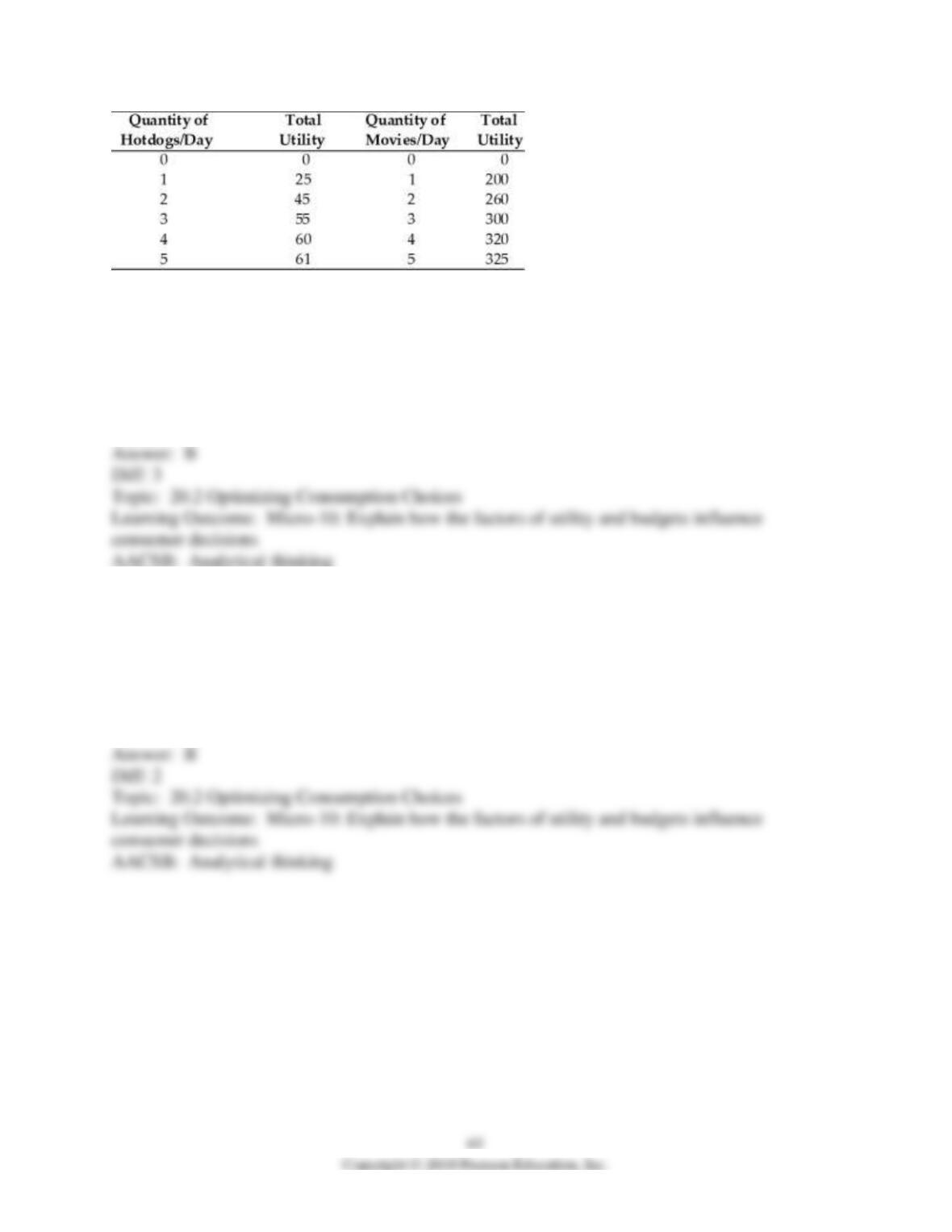
28) Refer to the above table. Assume the consumer spends his entire income. If the consumer’s
optimum at the current price of a movie is at 4 hotdogs and 4 movies, and the price of a hotdog is
$1, what is the consumer’s income?
A) $28
B) $20
C) $16
D) $40
29) Refer to the above table. Assume the consumer spends his entire income. The price of a
hotdog is $1, the price of a movie is $6, and the consumer has $15. What is the consumer’s
optimum?
A) 2 hotdogs and 2 movies
B) 3 hotdogs and 2 movies
C) 4 hotdogs and 4 movies
D) 0 hotdogs and 2.5 movies
30) When Sally increases the consumption of pizza and decrease the consumption of soda, her
marginal utility of
A) pizza falls and the marginal utility of soda will increase.
B) both pizza and soda will decrease.
C) pizza increases and the marginal utility of soda will fall.
D) both pizza and soda will increase.
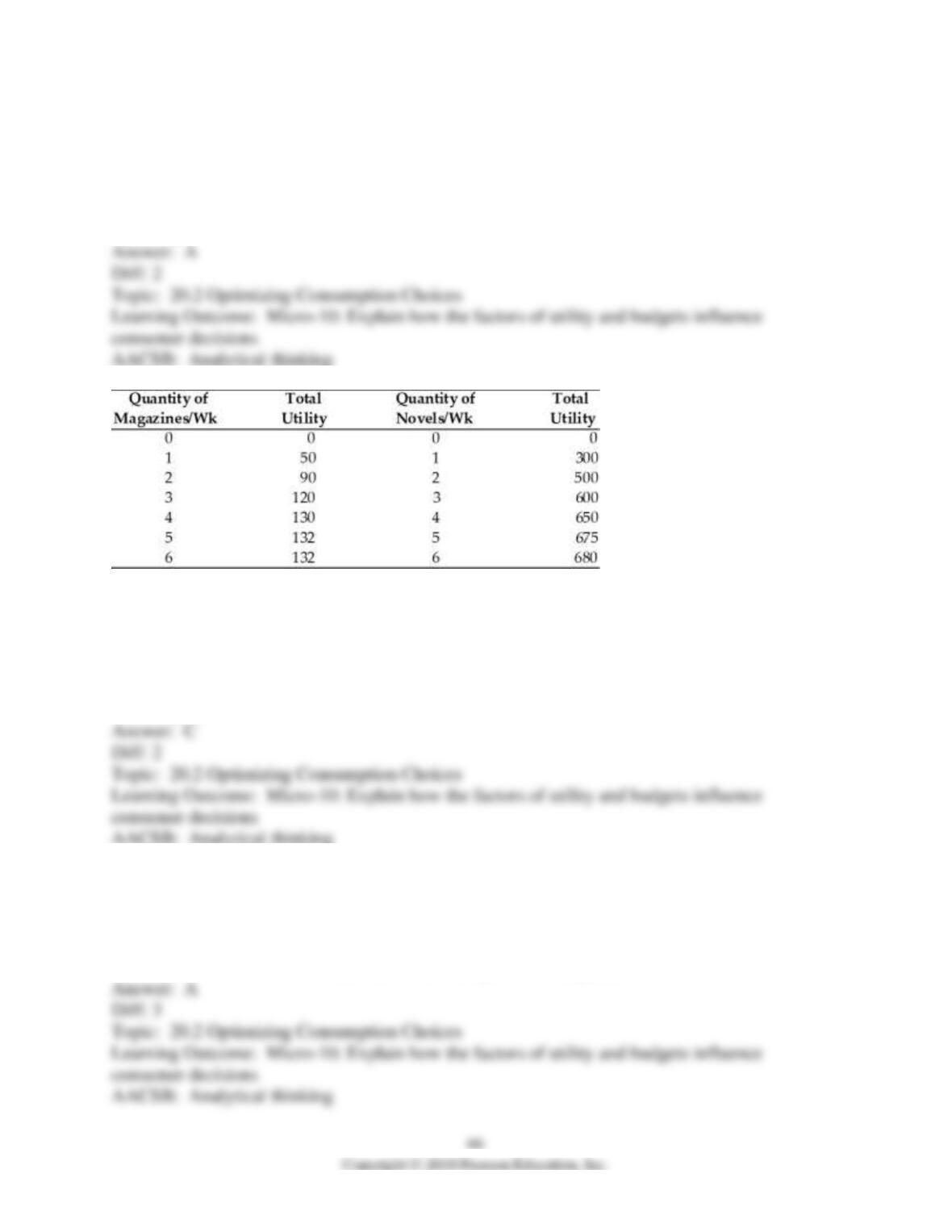
31) The price of a magazine is $2, the price of a novel is $5, and the consumer has $33.
According to the above table, the rational consumer will purchase
A) 1 magazine and 2 novels.
B) 2 magazines and 3 novels.
C) 4 magazines and 5 novels.
D) 5 magazines and 6 novels.
32) Refer to the above table. If a consumer’s optimum consists of 3 magazines and 6 novels, then
A) the price of a magazine is six times more than the price of a novel.
B) the price of a magazine is three times more than the price of a novel.
C) the price of a novel is more than five times more than the price of a magazine.
D) the price of a novel is six times more than the price of a magazine.
33) According to utility theory, consumer purchase decisions are made such that
A) the value of the ratio of marginal utility to price for the last units purchased and consumed is
equal.
B) the difference between the value of the marginal utility of the last unit purchased and the price
paid is maximized.
C) the total utility of the last unit purchased is equal to the price of that unit.
D) the total utility from consuming the good is less than the marginal utility of the last unit
consumed.
34) Consumers usually buy fewer units of a good than the quantity that would maximize total
utility from consuming the good because
A) they are not rational.
B) of the law of demand.
C) they have limited incomes.
D) marginal utility becomes zero after just a few units of the good.
35) The consumer optimum is defined as
A) the set of goods and services that maximizes marginal utility for each good.
B) the set of goods and services such that the marginal utility of each good equals zero.
C) the set of goods and services that maximizes the marginal utility of each good consumed.
D) the set of goods and services, subject to the limited income of the consumer, that maximizes
the total utility of the consumer.
36) The set of goods and services that maximizes the level of satisfaction for each consumer
subject to limited income is
A) the consumer optimum.
B) diminishing marginal utility.
C) increasing marginal utility.
D) substitution effect.
37) A consumer’s optimum is found when
A) the marginal utility of the last dollar spent equals zero for each good.
B) the marginal utility of each good is increasing and the total income is spent.
C) the total utility of each good is the same and the total income is spent.
D) the marginal utility of the last dollar spent on each good is the same and all income is spent.
38) A consumer’s optimum is found when
A) prices of goods go down.
B) the consumer is achieving the maximum level of utility given market prices and their limited
income.
C) the marginal utility of the last dollar spent equals 0 for every good.
D) the consumer saves part of their income.
39) A consumer has spent all of his income on pizza and movies. The price of a piece of pizza is
$1 and the price of a movie is $6. The marginal utility of the last piece of pizza is 5 and the
marginal utility of the last movie is 24. The consumer has
A) maximized utility.
B) not maximized utility. He should cut back on movies and buy more pizza.
C) not maximized utility. He should cut back on pizza and buy more movies.
D) not maximized utility. He should cut back consumption of each good.
40) The price of a piece of pizza is $1, and the price of a movie is $6. The consumer has
purchased 2 pieces of pizza and 2 movies, and her marginal utility from the second piece of pizza
is 20 and from the second movie is 120. The consumer has an income of $21. This combination
of goods
A) maximizes utility and is an optimum because the marginal utility of the last dollar spent on
each good is the same.
B) maximizes utility because the marginal utility of the last dollar spent on each good is the
same, but it is not an equilibrium because marginal utility is not zero.
C) is not an optimum because the consumer has not spent all of her money.
D) is not an optimum because the marginal utility of the last dollar spent on each good is not the
same.
41) The price of a piece of pizza is $1 and the price of a movie is $6 and the consumer has $14.
A consumer has purchased 2 pieces of pizza and 2 movies, receiving 20 units of utility for the
second piece of pizza and 100 units of utility for the second movie. When the consumer spends
all her income, the set of goods
A) is an optimum since the entire income is spent and the marginal utility per dollar spent is the
same for the last unit of each good.
B) is an optimum since the entire income is spent and total utility is maximized.
C) is not an optimum because the marginal utility per dollar spent is greater for pizza than for
movies and the consumer is not spending all of his income.
D) is not an optimum because the marginal utility for each good is not equal.
42) The price of a piece of pizza is $1 and the price of a movie is $4 and the consumer has $10.
A consumer has purchased 2 pieces of pizza and 2 movies, receiving 25 units of utility for the
second pizza and 100 units of utility for the second movie. The set of goods
A) is an optimum since the entire income is spent and the marginal utility per dollar spent is the
same for the last unit of each good.
B) is an optimum since the entire income is spent and total utility is minimized.
C) is not an optimum because the marginal utility per dollar spent is greater for pizza than for
movies.
D) is not an optimum because the consumer has not spent all of his money.
43) The price of one piece of pizza is $2 and the price of movies is $4. The consumer has $14 of
income. The consumer is purchasing 3 pieces of pizza and receiving 20 utils for the last piece.
He is also purchasing 2 movies and receiving 40 utils for the last movie. This set of goods
A) is an optimum since the entire income is spent and the marginal utility per dollar spent is the
same for the last unit of each good.
B) is an optimum since the entire income is spent and total utility is minimized.
C) is not an optimum because the marginal utility per dollar spent is greater for pizza than for
movies.
D) is not an optimum because the consumer has not spent all of his money.
44) The price of hamburgers is $2 and the price of brownies is $4. The consumer has $16 of
income. The consumer is purchasing 3 hamburgers and receiving 20 utils for the last hamburger.
He is also purchasing 2 brownies and receiving 40 utils for the last brownie. This set of goods
A) is an optimum since the entire income is spent and the marginal utility per dollar spent is the
same for the last unit of each good.
B) is an optimum since the entire income is spent and total utility is maximized.
C) is not an optimum because the marginal utility per dollar spent is greater for hamburgers than
for brownies.
D) is not an optimum because the consumer has not spent all of his money.
45) The price of hamburgers is $2 and the price of brownies is $4. The consumer has $14 of
income. The consumer is purchasing 3 hamburgers and receiving 30 utils for the last hamburger.
He is also purchasing 2 brownies and receiving 40 utils for the last brownie. This set of goods
A) is an optimum since the entire income is spent and the marginal utility per dollar spent is the
same for the last unit of each good.
B) is an optimum since the entire income is spent and total utility is maximized.
C) is not an optimum because the marginal utility per dollar spent is greater for hamburgers than
for brownies.
D) is not an optimum because the consumer has not spent all of his money.
46) John is going to spend all of his income. For the last unit of Good X consumed John gets 20
utils and for the last unit of Good Y consumed he gets 10 utils. The price of Good X is $4. The
price of Good Y is $1. If John wants to maximize his utility he should
A) continue to purchase the same amount of Good X and Good Y.
B) increase the consumption of Good X and decrease the consumption of Good Y.
C) decrease the consumption of Good X and increase the consumption of Good Y.
D) decrease the consumption of Good X and decrease the consumption of Good Y.
47) John is going to spend all of his income. For the last unit of Good X consumed John gets 20
utils and for the last unit of Good Y consumed he gets 10 utils. The price of Good X is $4. The
price of Good Y is $2. If John wants to maximize his utility he should
A) continue to purchase the same amount of Good X and Good Y.
B) increase the consumption of Good X and decrease the consumption of Good Y.
C) decrease the consumption of Good X and increase the consumption of Good Y.
D) decrease the consumption of Good X and decrease the consumption of Good Y.
48) John is going to spend all of his income. For the last unit of Good X consumed John gets 20
utils and for the last unit of Good Y consumed he gets 10 utils. The price of Good X is $1. The
price of Good Y is $10. If John wants to maximize his utility he should
A) continue to purchase the same amount of Good X and Good Y.
B) increase the consumption of Good X and decrease the consumption of Good Y.
C) decrease the consumption of Good X and increase the consumption of Good Y.
D) decrease the consumption of Good X and decrease the consumption of Good Y.
49) John is currently spending all of his income. For the last unit of Good X consumed John gets
20 utils and for the last unit of Good Y consumed he gets 10 utils. The price of Good X is $10.
The price of Good Y is $1. If John wants to maximize his utility he should
A) continue to purchase the same amount of Good X and Good Y.
B) increase the consumption of Good X and decrease the consumption of Good Y.
C) decrease the consumption of Good X and increase the consumption of Good Y.
D) decrease the consumption of Good X and decrease the consumption of Good Y.
50) John is currently spending all of his income. For the last unit of Good X consumed John gets
20 utils and for the last unit of Good Y consumed he gets 10 utils. The price of Good X is $2.
The price of Good Y is $5. If John wants to maximize his utility he should
A) continue to purchase the same amount of Good X and Good Y.
B) increase the consumption of Good X and decrease the consumption of Good Y.
C) decrease the consumption of Good X and increase the consumption of Good Y.
D) decrease the consumption of Good X and decrease the consumption of Good Y.
51) John is currently spending all of his income. For the last unit of Good X consumed John gets
20 utils and for the last unit of Good B consumed he gets 10 utils. The price of Good X is $10.
The price of Good Y is $5. If John wants to maximize his utility he should
A) continue to purchase the same amount of Good X and Good Y.
B) increase the consumption of Good X and decrease the consumption of Good Y.
C) decrease the consumption of Good X and increase the consumption of Good Y.
D) decrease the consumption of Good X and decrease the consumption of Good Y.
52) When Bo increases the consumption of Good X and decrease the consumption of Good Y,
her marginal utility of
A) X falls and the marginal utility of Y will increase.
B) both X and Y will decrease.
C) X increases and the marginal utility of Y will fall.
D) both X and Y will increase.
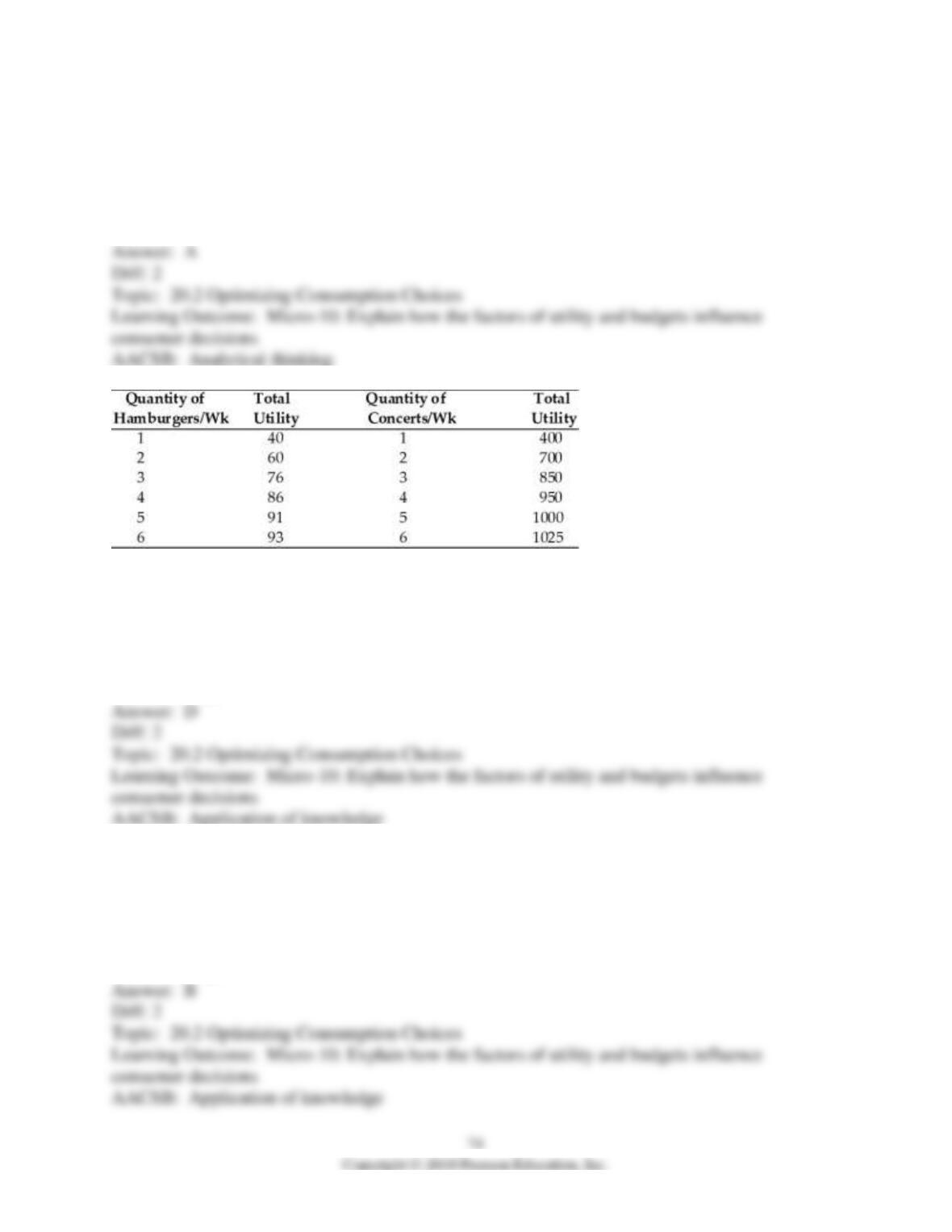
53) Refer to the above table. If the price of a hamburger is $2, the price of a concert ticket is $60,
and the consumer has $128, what is the consumer optimum?
A) 2 hamburgers and 2 concerts
B) 2 hamburgers and 3 concerts
C) 3 hamburgers and 2 concerts
D) 4 hamburgers and 2 concerts
54) Refer to the above table. If the price of a hamburger is $2, the price of a concert ticket is $60,
and the consumer has $190, what is the consumer optimum?
A) 4 hamburgers and 2 concerts
B) 5 hamburgers and 3 concerts
C) 6 hamburgers and 0 concerts
D) 0 hamburgers and 6 concerts
55) If the price of A is $3 and the price of B is $5, then, in a consumer optimum
A) the quantity purchased of B must be 60 percent of the quantity of A purchased.
B) the quantity purchased of B must be 67 percent of the quantity of A purchased.
C) the marginal utility of B must be 67 percent more than the marginal utility of A.
D) the marginal utility of A must equal 3 and the marginal utility of B must equal 5.
56) Refer to the above table If the price of a movie download is $2 and the price of an apple pie
is $5 and the consumer has $40, the rational consumer will purchase
A) 2 movies and 2 apple pies.
B) 2 movies and 3 apple pies.
C) 5 movies and 6 apple pies.
D) 6 movies and 6 apple pies.
57) Refer to the above table. If the price of a movie download is $2 and the price of an apple pie
is $5 and the consumer has $19, the rational consumer will purchase
A) 2 movies and 2 apple pies.
B) 2 movies and 3 apple pies.
C) 5 movies and 6 apple pies.
D) 6 movies and 6 apple pies.
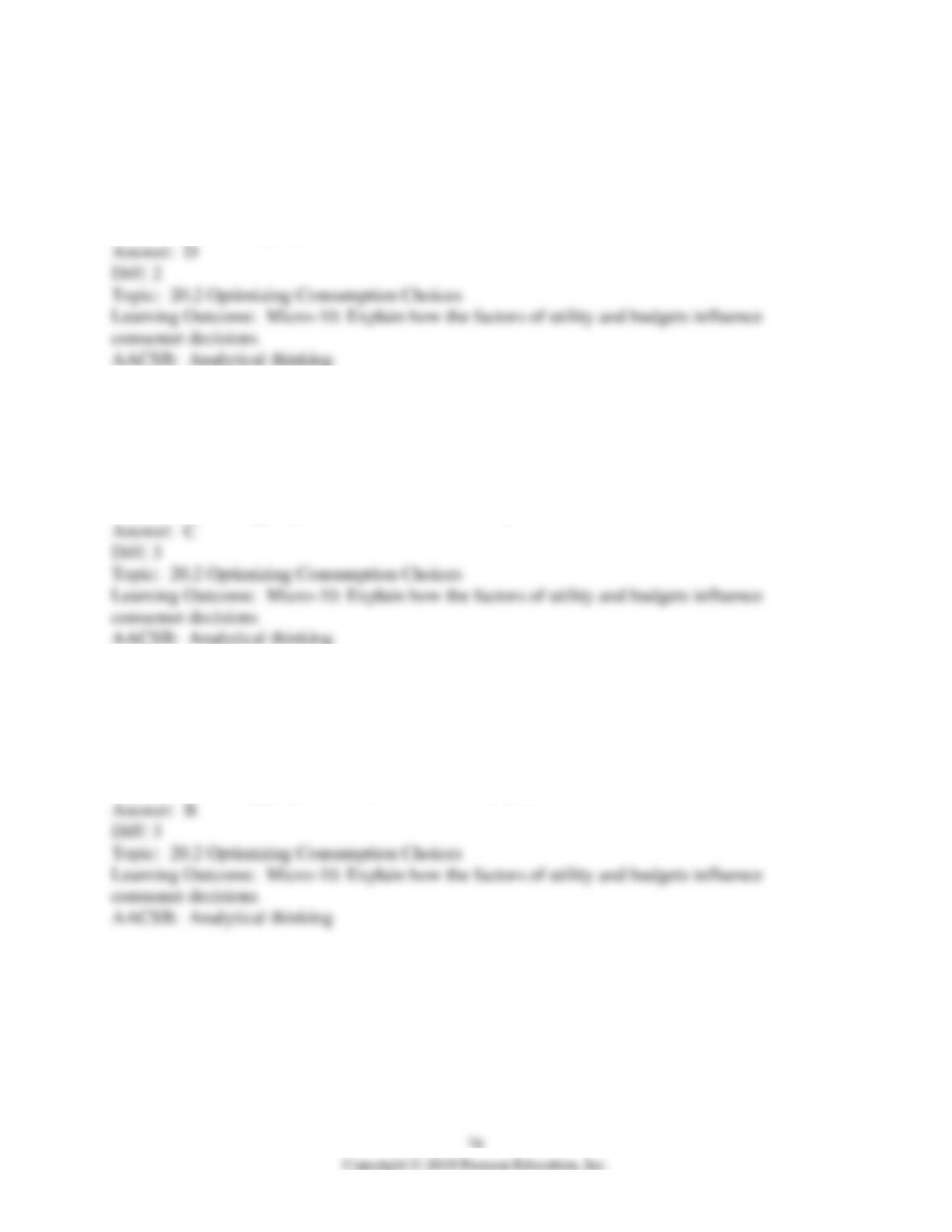
58) Refer to the above table. If the price of a movie download is $2 and the price of an apple pie
is $5 and the consumer has $33, the rational consumer will purchase
A) 2 movies and 2 apple pies.
B) 2 movies and 3 apple pies.
C) 5 movies and 6 apple pies.
D) 4 movies and 5 apple pies.
59) Refer to the above table. If the consumer’s equilibrium consists of 4 movies and 4 apple pies,
then we know that
A) the price of a movie download is 5 times more than the price of an apple pie.
B) the price of a movie download is 6 times more than the price of an apple pie.
C) the price of an apple pie is 5 times more than the price of a movie download.
D) the price of an apple pie is 3 times more than the price of a movie download.
60) Refer to the above table. If the consumer’s equilibrium consists of 3 movies and 6 apple pies,
then we know that
A) the price of a movie download is 4.5 times more than the price of an apple pie.
B) the price of a movie download is 6 times more than the price of an apple pie.
C) the price of an apple pie is 2 times more than the price of a movie download.
D) the price of an apple pie is 3 times more than the price of a movie download.
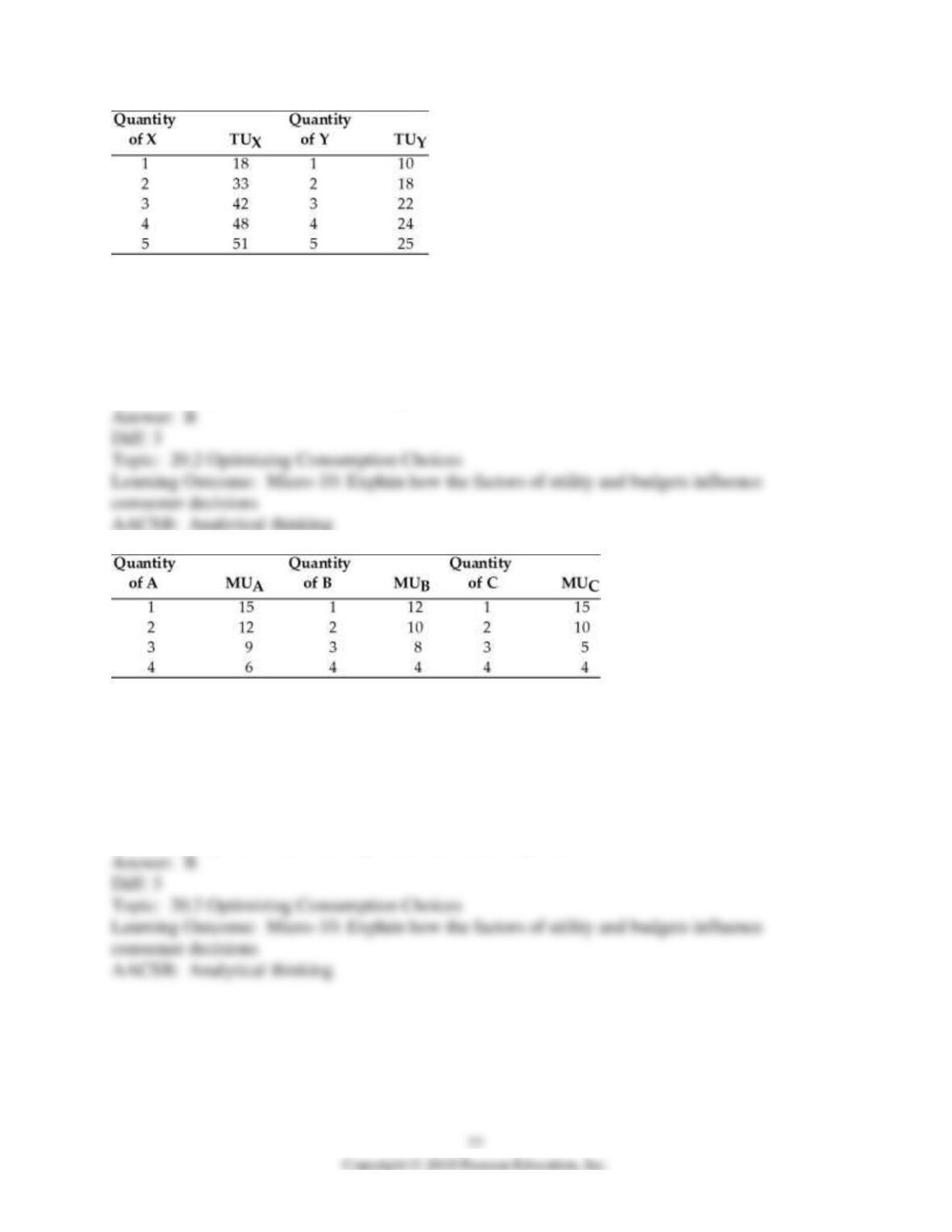
61) The price of product X is $3, the price of product Y is $2, and you have $18 to spend. What
combination of product X and product Y will give you the most satisfaction?
A) 5 units of product X; 1 unit of product Y
B) 4 units of product X and 3 units of product Y
C) 2 units of product X and 5 units of product Y
D) 3 units of product X and 5 units of product Y
62) Based on the information in the above table, the price of A is $3, the price of B is $2, and the
price of C is $5. If Lauren has $22 to spend, what combination of products A, B, and C should
she buy in order to maximize her satisfaction?
A) 3 units of product A; 3 units of product B; 1 unit of product C
B) 2 units of product A; 3 units of product B; 2 units of product C
C) 3 units of product A; 4 units of product B; 0 units of product C
D) 2 units of product A; 1 unit of product B; 4 units of product C
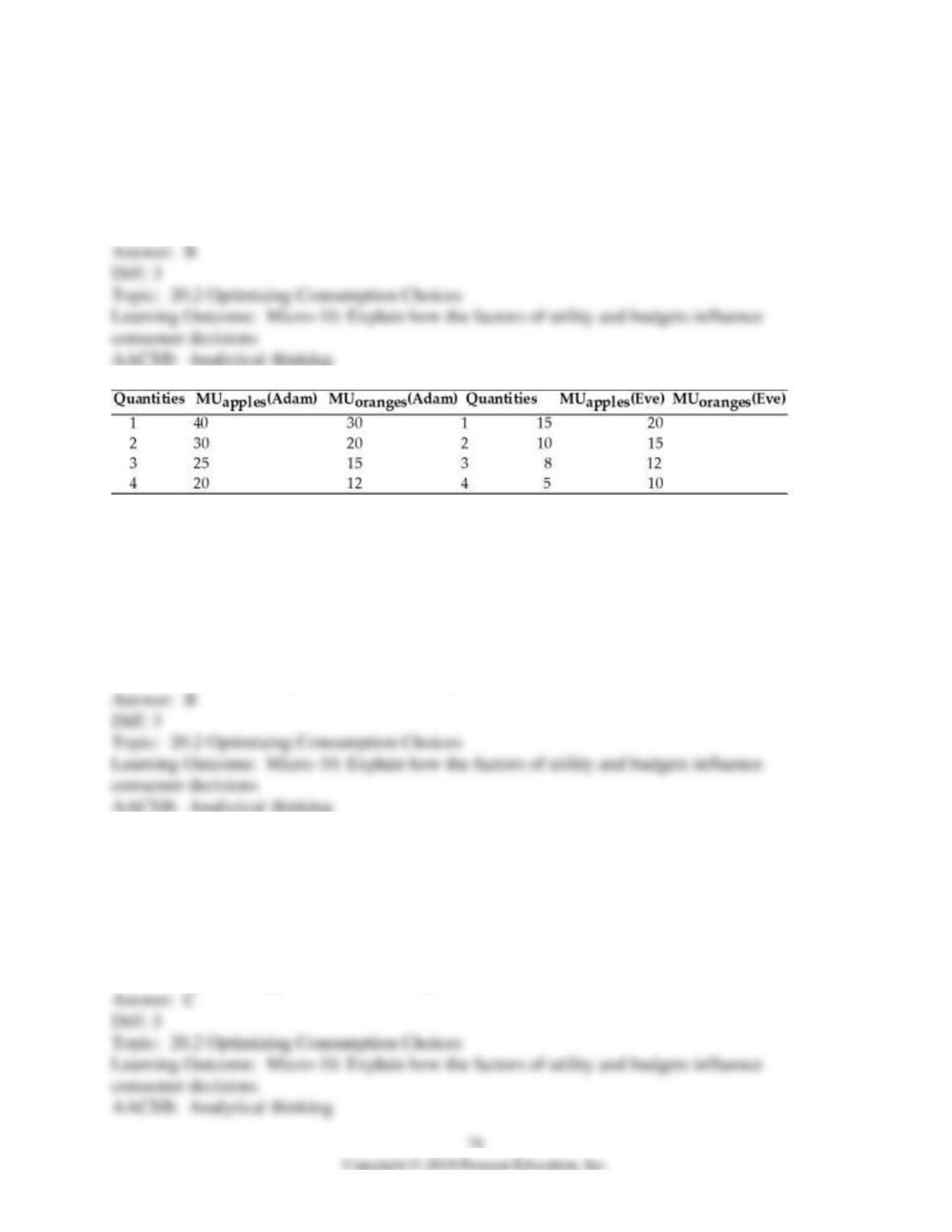
63) Based on the information in the above table, what is the total satisfaction Lauren can achieve
if she is a rational consumer?
A) 111 utils
B) 82 utils
C) 74 utils
D) 30 utils
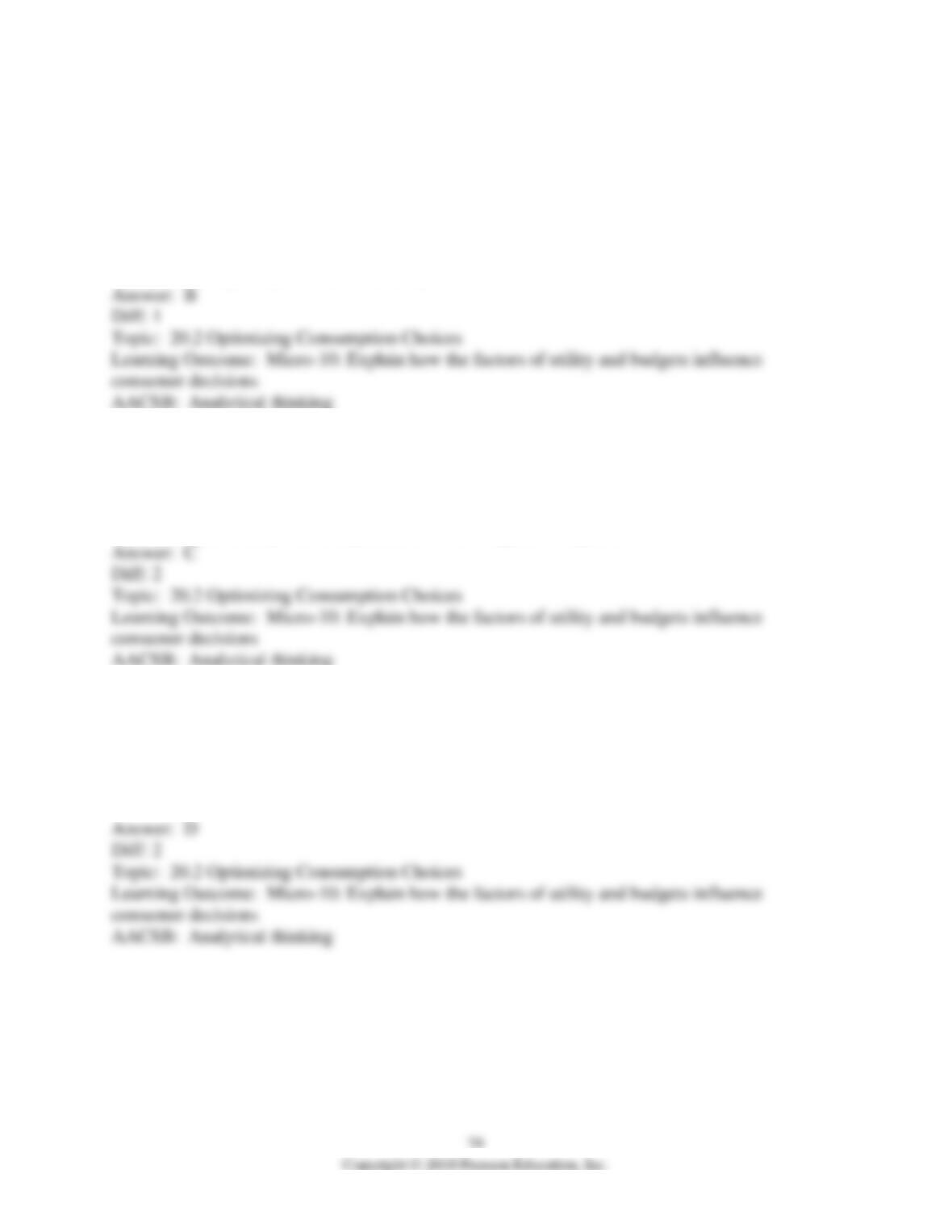
64) Adam has 3 apples and 3 oranges. Eve has 2 apples and 2 oranges. The marginal utilities for
Adam and Eve are summarized in the above table. Adam asks Eve to exchange one of her apples
for an orange.
A) Eve will be willing to make the exchange, because her total satisfaction will remain
unchanged.
B) Eve will be willing to make the exchange, because her total satisfaction will increase.
C) Eve will be unwilling to make the exchange, because she loses 5 utils of satisfaction.
D) Eve will be unwilling to make the exchange, because she loses 15 utils of satisfaction.
65) Use the above table. Adam has 3 apples and 3 oranges. Eve has 2 apples and 2 oranges. Eve
asks Adam to give her an apple in exchange for an orange. Should Eve go through with this
exchange?
A) Yes. This way she will have 3 apples, which will give her more total satisfaction.
B) Yes. She is indifferent between consuming apples and oranges.
C) No. She gives up more satisfaction than she gets.
D) No. Adam likes apples more than oranges.
66) Your allergies are bad this summer so your allergist writes you a prescription to relieve your
symptoms. When you get to the pharmacy, you notice the name brand allergy medicine is more
expensive than its generic equivalent. You purchase the generic equivalent and demonstrate all
of the following EXCEPT
A) the principle of substitution of one product for another.
B) the principle of diminishing marginal utility.
C) when price decreases, the quantity demanded increases.
D) a price change may affect consumer optimum.
67) A consumer is buying the optimal amount of goods when
A) the total utility from the purchases on all the goods purchased is the same.
B) the marginal utility from the purchases of all the goods purchased is the same.
C) the marginal utility per last dollar spent on all of the goods purchased is the same.
D) the marginal utility from the purchases of all the goods is equal to 1.
68) When a consumer is at the consumer optimum
A) MUa = MUb = MUc = . . . = MUn.
B) MUa/Pa = MUb/Pb = MUc/Pc = . . . = MUn/Pn = 1.
C) TUa = TUb = TUc = . . . = TUn.
D) MUa/Pa = MUb/Pb = MUc/Pc = . . . = MUn/Pn.
69) Which of the following best describes the consumer optimum?
A) MUa/Pa = TUb/Pb
B) MUa/TUa = Pa
C) MUa/Pa = MUb/Pb = . . . = MUz/Pz.
D) change in TU/change in P = MU
70) A consumer who has chosen the right mix of goods and services to maximize his or her
utility is said to have achieved
A) consumer equilibrium.
B) consumer benefit.
C) consumer surplus.
D) consumer optimum.
71) When DVDs and hamburgers were the same price, Mavis consumed 3 hamburgers and 5
DVDs, and Mavis received 10 utils from the last hamburger and 15 utils from the last DVD
consumed. What should be Mavis’ consumption strategy?
A) consume more DVDs and fewer burgers
B) consume more burgers and fewer DVDs
C) consume more of both items
D) consume less of both items