72) The idea that consumers continue to adjust their purchases until the marginal utility per last
dollar spent on all items is equal is called the
A) law of increasing costs.
B) law of diminishing marginal utility.
C) rule of 72.
D) consumer optimum.
73) Peter consumes bags of potato chips and cans of soft drink. The marginal utility of bags of
potato chips is 10 utils per bag and the marginal utility of cans of soft drink is 50 utils per can.
Potato chips cost $0.50 a bag, and a can of soft drink costs $1.00. What should Peter do?
A) Peter should eat more chips, because they cost less.
B) Peter should buy more chips and less soft drink.
C) Peter should buy more soft drink, because it costs less.
D) Peter should buy more soft drink and fewer potato chips.
74) According to the text, can we conclude that people will consume goods until the marginal
utility of each good is zero?
A) Yes, because at that point total utility is maximum.
B) Yes, because at that point marginal utility is minimum.
C) No, because consumption is determined by total utility.
D) No, because consumption is determined by the marginal utility/price ratio.
75) The price of a can of soft drink is $1.25 and the marginal utility of the second can consumed
is 10 utils. The marginal utility of the third hotdog is 4 utils. You should only consume the third
hotdog if the price of the hotdog is less than or equal to
A) $0.41.
B) $0.625.
C) $0.25.
D) $0.50.
76) If the last $5 spent on movies added 30 utils to your total satisfaction and the last $8 spent on
books add 56 utils
A) you can increase your satisfaction by buying more books and seeing fewer movies.
B) your total satisfaction is 86 utils.
C) you can increase your satisfaction by buying fewer books and seeing more movies.
D) you can increase your satisfaction by buying only books.
77) The state of consumer optimum is reached when the consumer’s
A) total utility/marginal utility ratio for all items is equal.
B) total utility/price ratio for all items is equal.
C) marginal utility for a product is zero.
D) marginal utility/price ratios for all items are equal.
78) You consider yourself to be a rational consumer. The marginal utility/price ratio of coffee is
12 utils per dollar. If the price of a donut is $0.75, you should only buy the donut if it gives you
at least
A) 16 utils of satisfaction.
B) 9 utils of satisfaction.
C) 12 utils of satisfaction.
D) The answer cannot be determined with this information.
79) When a consumer shifts her purchases from product X to product Y, the marginal utility of
A) X falls and the marginal utility of Y will increase.
B) both X and Y will decrease.
C) X increases and the marginal utility of Y will fall.
D) both X and Y will increase.
80) In order for a consumer to choose between two different goods, he has to take into
consideration the
A) marginal utility of production.
B) marginal utility divided by the price.
C) marginal utility plus the price.
D) total utility divided by price.
81) The consumer optimum is found by using
A) marginal utility.
B) total utility.
C) total utility minus marginal utility.
D) total utils.
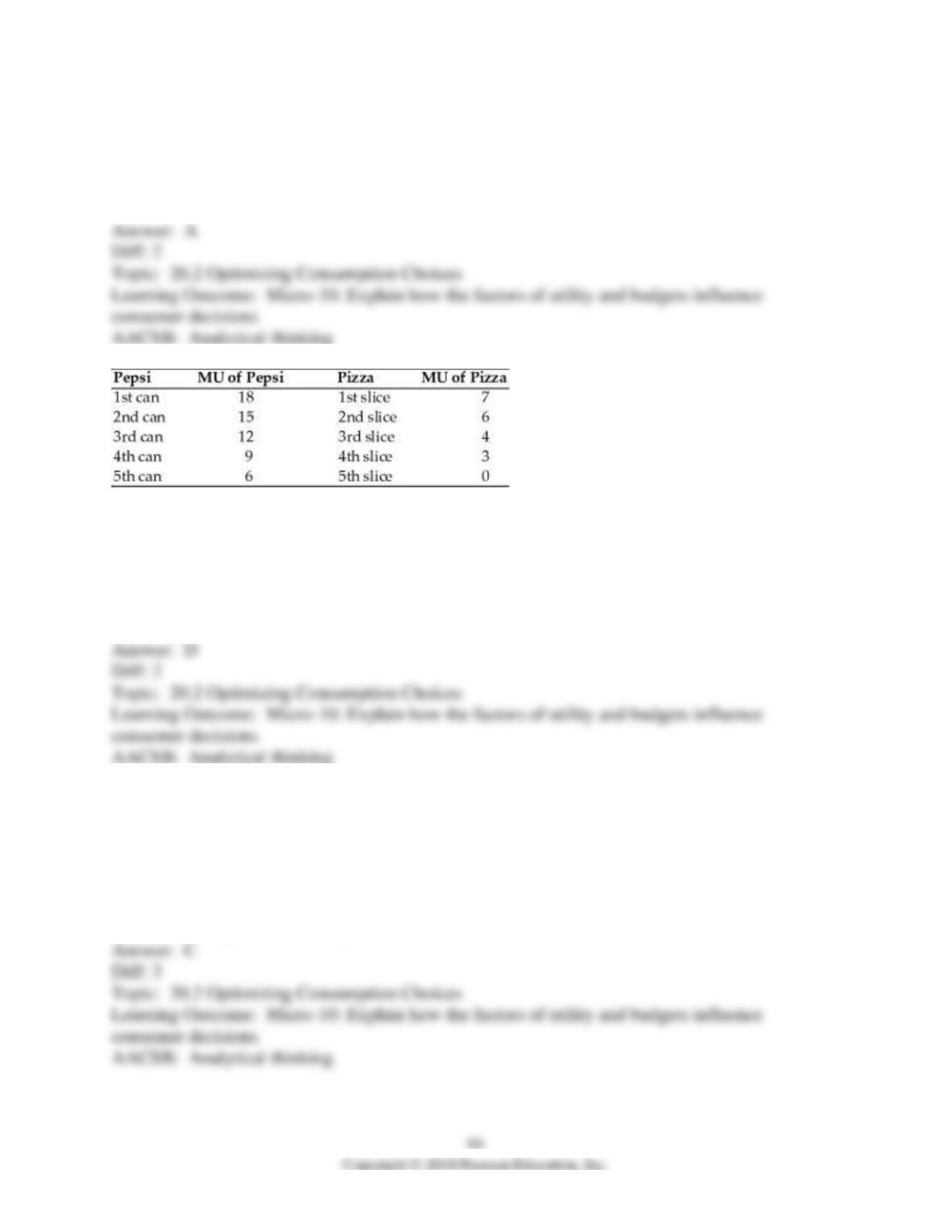
82) Using the above table, if the price of Pepsi is $3, how many cans of Pepsi would have to be
consumed in order to have a marginal utility to price ratio of 3?
A) one can
B) two cans
C) three cans
D) four cans
83) Assume that Katie has the preferences shown in the above table. Also assume that the price
of a can of Pepsi is $3.00 and that the price of a slice of pizza is $2.00. If she has $16 available to
spend, what combination of Pepsi and pizza will be her consumer optimum?
A) 1 can of Pepsi, 4 slices of pizza
B) 2 cans of Pepsi, 5 slices of pizza
C) 4 cans of Pepsi, 2 slices of pizza
D) 6 cans of Pepsi, 0 slices of pizza
84) Assume that Katie has the preferences shown in the above table. Also assume that the price
of a can of Pepsi is $3.00 and that the price of a slice of pizza is $1.00. If he has $16 available to
spend, what combination of Pepsi and pizza will be her consumer optimum?
A) 4 cans of Pepsi, 1 slice of pizza
B) 3 cans of Pepsi, 2 slices of pizza
C) 2 cans of Pepsi, 4 slices of pizza
D) 4 cans of Pepsi, 4 slices of pizza
85) The expression “getting the most bang for your buck” is an illustration of the
A) total utility/price ratio.
B) total utility/marginal utility ratio.
C) marginal utility/price ratio.
D) marginal utility/total utility ratio.
86) Suppose that a consumer is currently at an optimum when consuming goods A and B. Which
of the following must be TRUE?
A) The total utility from A is equal to the total utility from B.
B) The price of A is equal to the price of B.
C) The marginal utility of A is equal to the marginal utility of B.
D) The marginal utility to price ratio of A is equal to the marginal utility to price ratio of B.
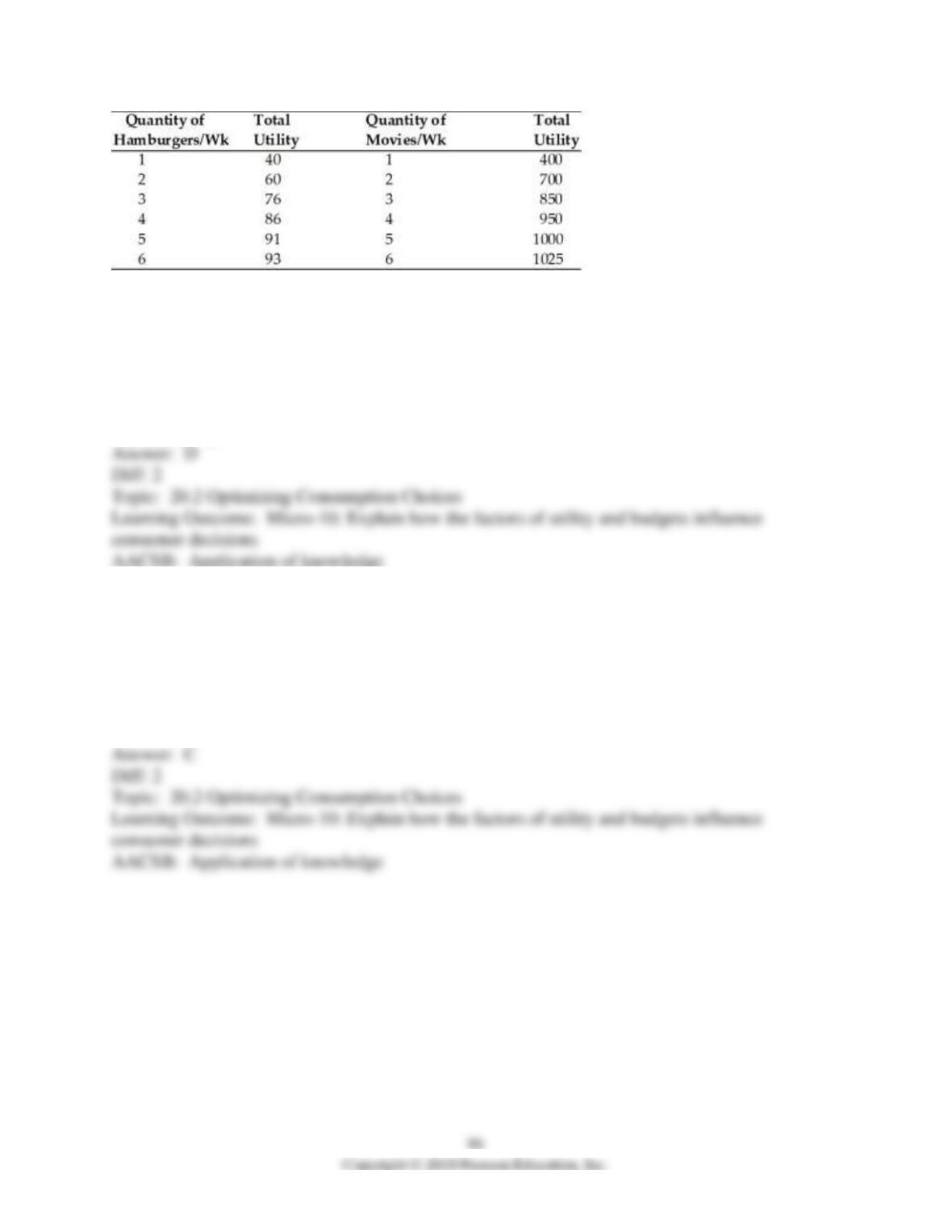
87) Refer to the above table. Suppose the price of a hamburger is $2, the price of a movie is $5,
and the income of the consumer is $29. How many hamburgers and movies will this consumer
buy to be at an optimum?
A) 1 hamburger and 5 movies
B) 6 hamburgers and 3 movies
C) 4 hamburgers and 4 movies
D) 2 hamburgers and 5 movies
88) Refer to the above table. Suppose the price of a hamburger is $2, the price of a movie is $5,
and the income of the consumer is $29. What will the consumer’s total utility equal at an
optimum?
A) 70
B) 1025
C) 1060
D) 1118
89) Refer to the above table. The price of a hamburger is $2, the price of a movie is $5, and the
consumer’s income is $29. What is the marginal utility per last dollar spent on movies equal to if
the consumer is at an optimum?
A) 50
B) 40
C) 20
D) 10
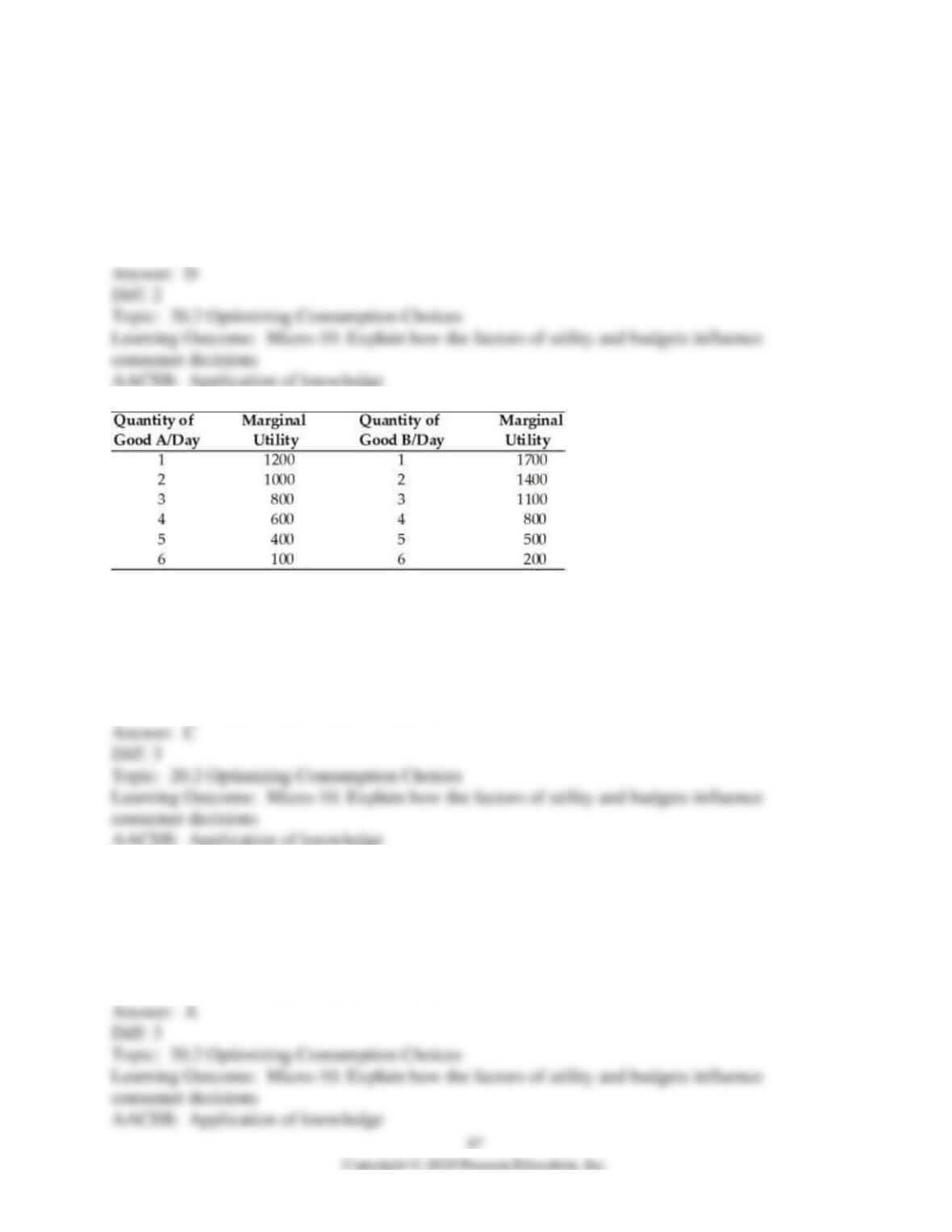
90) Refer to the above table. If the price of Good A is $2, the price of Good B is $1, and the
consumer has $9, the rational consumer will purchase
A) 6 units of Good A and 0 units of Good B.
B) 6 units of Good A and 3 units of Good B.
C) 2 units of Good A and 5 units of Good B.
D) 5 units of Good A and 6 units of Good B.
91) Refer to the above table. If the price of Good A is $2, the price of Good B is $2, and the
consumer has $14, the rational consumer will purchase
A) 3 units of Good A and 4 units of Good B.
B) 6 units of Good A and 6 units of Good B.
C) 6 units of Good A and 0 units of Good B.
D) 3 units of Good A and 3 units of Good B.
92) Refer to the above table. If the price of Good A is $1, the price of Good B is $2, and the
consumer has $13, the rational consumer will purchase
A) 3 units of Good A and 4 units of Good B.
B) 1 units of Good A and 1 units of Good B.
C) 6 units of Good A and 0 units of Good B.
D) 5 units of Good A and 4 units of Good B.
93) What is consumer optimum according to utility theory?
94) Explain how a consumer maximizes utility.
95) Suppose that an individual consumes only two goods. What will happen to the individual if
her last dollar spent on one good yields more marginal utility than that from another good?
96) Suppose a family purchases 10,000 gallons of water a year at 20 cents a gallon and one
diamond ring at a price of $1,000. Can we conclude that the diamond ring provides more utility
to the family than water? Explain.
20.3 How a Price Change Affects Consumer Optimum
1) Suppose a consumer is currently buying 5 goods so that utility is maximized. The price of one
of the goods falls while the prices of the other 4 goods do not change. The consumer should
A) buy less of all goods being consumed to get to the optimal position.
B) buy more of all of the goods but the one that experiences the decline in price, to get to the
optimal position.
C) buy more of all goods being consumed to get to the optimal position.
D) buy more of the good that has experienced the fall in price to get to the optimal position.
2) If Frank has been consuming 10 tacos per week at a consumer optimum, and the price of tacos
falls, how will Frank respond?
A) He will save more income.
B) He will buy more of everything.
C) He will buy more tacos.
D) He will buy more of everything except tacos.
3) To remain in consumer optimum
A) a price increase requires an increase in consumption.
B) a price decrease requires an increase in consumption.
C) a price decrease requires a decrease in consumption.
D) prices must remain static.
4) The change in people’s purchasing power that occurs when the price of a good they purchase
changes, assuming all else is held constant is known as
A) the substitution effect.
B) the real income effect.
C) the elasticity effect.
D) the multiplier effect.
5) Suppose that a consumer is at an optimum consuming A and B. If the price of A falls, then to
get to a new equilibrium the consumer must
A) purchase less A and more B.
B) purchase less B and less A.
C) purchase more A.
D) purchase more B.
6) Suppose a consumer is at an optimum. What happens when the price of one good she has been
consuming increases?
A) The value of the marginal utility of the last unit consumed decreases.
B) The value of the marginal utility of the last unit consumed increases.
C) The marginal utility per dollar spent on the last unit consumed of that good increases by the
same proportion as the price increases.
D) The marginal utility per dollar spent on the last unit consumed of that good is now smaller
than the marginal utility per dollar spent on other goods the person consumes.
7) A consumer is at an optimum when the price of one good she has been consuming decreases.
As a result
A) the value of the marginal utility of the last unit consumed has increased.
B) the value of the marginal utility of the last unit consumed has decreased.
C) the price of the other good must decrease too.
D) the marginal utility of the last dollar spent on this good is now greater than the marginal
utility of the last dollar spent on other goods.
8) A consumer has been buying 3 magazines and 1 book each month. The price of magazines
then decreases, which directly causes the marginal utility per dollar spent on
A) magazines to increase, thereby inducing the consumer to purchase fewer magazines and more
books.
B) magazines to increase, thereby inducing the consumer to purchase more magazines and fewer
books.
C) books to increase, thereby inducing the consumer to purchase fewer magazines and more
books.
D) books to decrease, thereby inducing the consumer to purchase fewer magazines and more
books.
9) The real-income effect shows that
A) a decrease in the price of a good increases the purchasing power of the consumer’s income.
B) if the consumer’s income rises, he or she buys more of inferior goods and less of normal
goods.
C) if a good is inferior, a decrease in the purchasing power of income results in less of the good
being consumed.
D) when the price of a good rises, consumers are able to buy more of other goods because of the
increase in the purchasing power of income.
10) The real-income and the substitution effects reinforce each other by
A) increasing the consumption of good B when the price of A falls.
B) increasing the consumption of both goods A and B when income increases.
C) decreasing the consumption of good A when the price of good B falls.
D) decreasing the consumption of good A when the price of good A increases.
11) The real-income effect is typically small because
A) the change in price of one particular item has little effect on total purchasing power.
B) income has no relation to consumption.
C) price changes tend to balance out over time.
D) real-incomes are always rising.
12) The real-income effect of a price change is most significant when
A) the substitution effect is insignificant.
B) the substitution effect is significant too.
C) the good under consideration constitutes a major portion of the consumer’s budget.
D) the marginal utility per dollar spent on the last unit is high.
13) The substitution effect shows that
A) if the price of a good increases, consumers buy more of that good and less of all others.
B) if the price of a good falls relative to all other goods, consumers buy less of that good and
more of all others.
C) if the price of a good falls, consumers buy less of all goods.
D) if the price of a good rises, consumers buy less of that good and more of others.
14) The substitution effect argues that a consumer
A) will always use the additional purchasing power from a price decrease to purchase more of
both goods.
B) will not purchase more of a good when its price falls.
C) will purchase more of a good that has become relatively cheaper, and less of a good that has
become relatively more expensive.
D) will purchase less of both goods if his or her real income increases.
15) When you purchase the lower-priced store brand bread instead of the more expensive name
brand, you are experiencing
A) the substitution effect.
B) the income effect.
C) a fall in total utility.
D) diminishing marginal product.
16) The fact that consumers will purchase more of a good that has become relatively cheaper
A) is called the nominal income effect.
B) is called the substitution effect.
C) leads to an upward sloping demand curve.
D) leads to negative marginal utility.
17) Other things being equal, when the money price of a good increases, its relative price
A) stays the same.
B) increases.
C) decreases.
D) falls to zero.
18) The price of a large pepperoni pizza used to be $12, but this week the price rose to $18. With
a budget of just $28, you can’t afford as many pizzas at the higher price. This change in
consumer behavior reflects the
A) real income effect.
B) substitution effect.
C) nominal income effect.
D) concept of diminishing marginal utility.
19) If a consumer is initially at an optimum, and then the price of X falls, then
A) MUX/PX > MUY/PY.
B) MUX/PX < MUY/PY.
C) MUX/PX = MUY/PY.
D) MUX/MUY < PY/PX.
20) If a consumer is initially at an optimum, and then the price of Y decreases, then
A) MUX/PX > MUY/PY.
B) MUX/PX < MUY/PY.
C) MUX/PX = MUY/PY.
D) MUX/MUY < PY/PX.
21) If a consumer is at an optimum, consuming X and Y, and the price of Y decreases, then to
get to a new equilibrium the consumer must
A) purchase less X.
B) purchase less Y.
C) purchase more X.
D) purchase more of both X and Y.
22) If a consumer is at an optimum, consuming X and Y, and the price of Y increases, then to get
to a new equilibrium the consumer must
A) purchase less X.
B) purchase less of both X and Y.
C) purchase more X.
D) purchase more of both X and Y.
23) A higher price for a good implies that
A) the marginal utility of the good has declined.
B) the total value of the good to the consumer has increased.
C) the sacrifice of utility of another good has increased.
D) the marginal utility of another good has decreased.
24) Initially, a consumer is at an optimum. Then the price of Y increases. Consequently
A) MUX/PX < MUY/PY.
B) MUX/PX > MUY/PY.
C) MUX/PX = MUY/PY.
D) MUX > MUY.
25) Initially, a consumer is at an optimum. Then the price of Y decreases. Consequently
A) MUX/PX < MUY/PY.
B) MUX/PX > MUY/PY.
C) MUX/PX = MUY/PY.
D) MUX > MUY.
26) A consumer has been buying 3 magazines and 2 books a month for many months. The price
of books then increases. To attain a new optimum, the consumer will
A) buy more magazines because they are now relatively more valuable than they were before,
while continuing to buy the same number of books.
B) buy more books because they are now relatively more valuable than they were before.
C) buy the same number of books and magazines as before because they provide different types
of utility.
D) buy fewer books than before because they are relatively more expensive than they were
before.
27) Dillon is undecided about whether to eat at a restaurant or to order pizza at home. He then
obtains a coupon for 10 percent off at the restaurant and decides to go there to eat. This is an
example of
A) someone using criteria other than price to make a consumption decision.
B) a lower price leading a consumer to substitute more of the less expensive good for the
relatively more expensive good.
C) a lower price leading a consumer to buy more of a good because of the income effect.
D) a consumer making a decision irrationally.
28) The substitution effect refers to
A) the law of diminishing marginal utility.
B) the want-satisfying power of a good or service.
C) substitution of less expensive commodities for more expensive commodities.
D) the change in purchasing power when the price of a good changes.
29) The tendency of people to substitute cheaper commodities for more expensive commodities
is the
A) law of diminishing marginal utility.
B) real-income effect.
C) substitution effect.
D) price income effect.
30) The real-income effect refers to
A) the law of diminishing marginal utility.
B) the want-satisfying power of a good or service.
C) substitution of less expensive commodities for more expensive commodities.
D) the change in purchasing power when the price of a good changes.
31) The change in people’s purchasing power that occurs when the price of one good that they
purchase changes is the
A) law of diminishing marginal utility.
B) real-income effect.
C) substitution effect.
D) price income effect.
32) The price of a good that Joe is currently consuming has increased.
A) Joe has experienced a decrease in purchasing power.
B) Joe will experience a shift in the demand curve of the good whose price has increased.
C) Joe will stop consuming this good.
D) Joe will experience increasing marginal utility.
33) When the price of a normal good decreases, people increase their consumption of the good.
The reason is
A) the law of diminishing marginal utility.
B) the substitution and income effects.
C) the substitution effect only.
D) the income effect only.
34) The real-income effect is likely to be greater when
A) the substitution effect is not very large.
B) the marginal utility of the last unit is high.
C) the marginal utility per dollar spent on the last unit is high.
D) the good is an expensive good.