1. Commercial policy is government policy that influences:
a.
the operation of commercial banks.
b.
domestic trade flows.
c.
domestic private corporations.
d.
international trade flows.
e.
the operation of capital markets.
2. If international trade is restricted by the government:
a.
domestic consumers are benefited.
b.
domestic producers are adversely affected.
c.
consumers in the importing country are required to pay higher prices for the goods.
d.
consumers can access to better quality product at lower prices.
e.
the resources are allocated to their highest paid uses.
MACR.BOYE.16.100 – ch. 20, 1
United States – International Trade and Finance
Arguments for Protection
3. When restrictions alter the pattern of international trade, the _____ benefit and the _____ suffer(s).
a.
domestic consumers; domestic producers
b.
domestic consumers; government
c.
domestic producers; domestic consumers
d.
foreign producers; domestic producers
e.
foreign producers; domestic consumers
MACR.BOYE.16.100 – ch. 20, 1
Arguments for Protection
4. Which of the following statements about international trade restrictions is true?
a.
They ensure that only efficient producers survive.
b.
They ensure that countries specialize only in those products that they can produce most efficiently.
c.
In the majority of cases, they harm domestic consumers.
MACR.BOYE.16.100 – ch. 20, 1
Arguments for Protection
d.
They typically benefit foreign producers at the expense of domestic consumers.
e.
They ensure that higher-quality goods are provided at lower prices.
5. Generally speaking, protection from foreign competition benefits:
a.
both domestic producers and foreign producers.
b.
both domestic consumers and foreign consumers
c.
domestic consumers and foreign consumers.
d.
neither domestic producers nor foreign producers.
e.
domestic producers at the expense of domestic consumers.
MACR.BOYE.16.100 – ch. 20, 1
United States – Analytic – BB-Legal
United States – International Trade and Finance
Arguments for Protection
6. It is often argued that if foreign goods are kept out of the domestic economy:
a.
jobs will be lost at home.
b.
jobs will be created abroad.
c.
foreign consumers will enjoy product surpluses.
d.
jobs will be created at home.
e.
foreign consumers will suffer product shortages.
MACR.BOYE.16.100 – ch. 20, 1
United States – Analytic – BB-Legal
United States – International Trade and Finance
Arguments for Protection
7. Which of the following statements is true of the impact of trade restrictions on domestic employment?
a.
Domestic firms will produce the goods that otherwise would have been produced abroad, thus employing
foreign workers instead of domestic workers.
b.
Beside the protected industry, other industries will also benefit in terms of employment.
c.
Domestic consumers will be required to pay lower prices for the output of the protected industry.
d.
Restrictions imposed on trade simply redistribute jobs by creating employment in the protected industry and
reducing employment elsewhere.
e.
If other countries retaliate by restricting the entry of the domestic exports, the output of domestic firms that
produce for export will rise.
MACR.BOYE.16.100 – ch. 20, 1
United States – Analytic – BB-Legal
United States – International Trade and Finance
Arguments for Protection
8. Typically, restrictions to “save domestic jobs” simply redistribute jobs by creating:
a.
employment in the protected industry and reducing employment elsewhere.
b.
employment in nonprotected industries and reducing employment in the protected industry.
c.
inflation in the overall economy.
d.
employment in the primary sector at the expense of the secondary sector.
e.
labor unions in the protected industries at the expense of employment in nonunionized industries
MACR.BOYE.16.100 – ch. 20, 1
Arguments for Protection
9. Employers and workers in the protected industry know that the consequences of protection are principally:
a.
lower prices for their output, lower profits for owners, and lower wages for workers.
b.
higher prices for their output, lower profits for owners, and lower wages for workers.
c.
higher prices for their output, lower profits for owners, and higher wages for workers.
d.
lower prices for their output, higher profits for owners, and higher wages for workers.
e.
higher prices for their output, higher profits for owners, and higher wages for workers.
MACR.BOYE.16.100 – ch. 20, 1
United States – Reflective Thinking
Arguments for Protection
10. Which of the following probably best explains why trade restrictions are imposed even if the costs to consumers are
greater than the benefits to protected industries?
a.
Indifference on the government’s part to the interests of domestic workers
b.
A desire to make other countries suffer
c.
Successful lobbying by consumers
d.
Successful lobbying by employers and workers
e.
The government’s preference to safeguard the interest of the producers at the expense of the consumers
MACR.BOYE.16.100 – ch. 20, 1
United States – International Trade and Finance
Arguments for Protection
11. According to empirical observations, the cost of restricting international trade in the U.S. is much greater than the
benefits generated from restriction. In the light of the above observation, which of the following statements is true?
a.
The benefits of protecting domestic jobs typically outweigh the costs.
b.
Consumers end up paying much more for the goods they buy in order to subsidize the relatively inefficient
domestic producer.
c.
U.S. GDP would be over $14 billion higher with import restrictions than without restrictions.
d.
Protection of the U.S. textile and sugar industries means that all consumers pay a lower price for clothing and
sugar.
e.
Protection of the domestic industries enable the producers to charge lower prices for their products.
Moderate
MACR.BOYE.16.100 – ch. 20, 1
United States – Analytic – BB-Legal
United States – International Trade and Finance
Arguments for Protection
Knowledge
12. Steel producers in the United States observe that foreign sales of U.S. steel has drastically declined due to stringent
trade policies adopted by the foreign governments and unfair treatment of U.S. steel exports in foreign countries. The
lobbying efforts of such loss making U.S. steel manufacturers induces the domestic government to restrict the entry of
imported steel and help stimulate the sales of domestically produced steel. Which of the following is most similar to the
example mentioned above?
a.
A tariff imposed by the government to stimulate domestic production of a high-technology good with positive
spillover effects
b.
A tariff imposed by the government on the import of cotton textiles because it is an infant industry in the
domestic country
c.
An import tariff applied against a foreign monopoly supplying the domestic market
d.
Taxes imposed by the government on an import competing industry that generates a negative production
externality
e.
Reciprocal tariffs introduced by the government of Mexico on tobacco imports from Brazil in retaliation to
unfair treatment of Mexican tobacco exports to the latter
Challenging
MACR.BOYE.16.100 – ch. 20, 1
United States – International Trade and Finance
United States – Reflective Thinking
Arguments for Protection
Analysis
13. The notion of reciprocity means that one nation will impose import restrictions on another in order to:
a.
stimulate an increase in trade restrictions in the latter.
b.
stimulate a decrease in trade restrictions in the latter.
c.
eliminate trade restrictions immediately in both countries.
United States – Analytic – BB-Legal
d.
improve the government revenue collections through tariffs in both countries.
e.
enforce standards of product quality in the latter.
14. People who call for creating a “level playing field” believe that:
a.
a country with relatively low wages is typically a country with an abundance of low-skilled labor.
b.
trading on the basis of comparative advantage benefits both domestic and foreign firms.
c.
creating a “level playing field” undermines the basis for specialization and economic efficiency.
d.
production in accordance with comparative advantage is unfair.
e.
free trade allocates the scarce resources in an efficient way.
MACR.BOYE.16.100 – ch. 20, 1
United States – International Trade and Finance
Arguments for Protection
15. Developing countries often justify imposition of tariffs because:
a.
it creates a burden on government budget.
b.
it is easy to collect direct taxes from people in the developing countries.
c.
a large number of people in the developing countries earn a taxable income.
d.
developing countries find income taxes difficult to levy and collect.
e.
the volume of imports of these countries is considerably low.
MACR.BOYE.16.100 – ch. 20, 1
United States – International Trade and Finance
Arguments for Protection
16. The infant industry argument is that:
a.
those industries that produce products for infants should be protected.
b.
protectionism will provide consumers with lower prices.
c.
protectionism should be used to create a level playing field for the domestic firms to compete with foreign
firms.
d.
protectionism promotes complete specialization in the country on the basis of comparative advantage.
e.
new industries should be protected from foreign competition until they have had adequate time to develop.
MACR.BOYE.16.100 – ch. 20, 1
United States – International Trade and Finance
Arguments for Protection
17. Nascent industries require adequate protection from foreign competition because:
a.
they experience economies of scale.
b.
they experience diseconomies of scale.
c.
the quality of the products of such industries are comparatively inferior than the products of their foreign
competitors.
d.
they do not have adequate resources to undertake research and development.
e.
their initial costs of production are considerably higher than the foreign firms.
MACR.BOYE.16.100 – ch. 20, 1
United States – Analytic – BB-Legal
Arguments for Protection
18. Protection of an infant industry should be withdrawn once that industry:
a.
charges the same price as foreign competitors.
b.
goes public on the stock exchange.
c.
raises a large amount of sales revenue.
d.
achieves sufficient size to compete with foreign firms.
e.
earns enough profit as a result of the subsidies to remain in business.
MACR.BOYE.16.100 – ch. 20, 1
United States – Analytic – BB-Legal
United States – International Trade and Finance
Arguments for Protection
19. In the light of the infant industry argument, identify the industry which is likely to have substantially high initial costs.
a.
Fashion designing
b.
Retail industry
c.
Iron and steel industry
d.
Dairy industry
e.
Software industry
MACR.BOYE.16.100 – ch. 20, 1
United States – Reflective Thinking
MACR.BOYE.16.100 – ch. 20, 1
United States – Analytic – BB-Legal
Arguments for Protection
20. Protection provided to the infant industries is rarely withdrawn because:
a.
the costs of withdrawing protection outweigh the benefits.
b.
the industries begin to experience diseconomies of scale.
c.
it leads to a loss of government revenue.
d.
the industries produce goods which are close substitutes of the imported goods.
e.
the larger and more successful the industry becomes, the more political power it wields.
MACR.BOYE.16.100 – ch. 20, 1
United States – International Trade and Finance
Arguments for Protection
21. Which of the following statements about an increasing-returns-to-scale industry is not true?
a.
It will tend to concentrate production in the hands of a very few large firms.
b.
Firms in the industry face higher costs per unit of production as their level of output increases.
c.
Opportunity costs may fall with the level of output.
d.
Proponents of strategic trade policy contend that tariffs can be used to stimulate production by a domestic
industry capable of achieving increasing returns to scale.
e.
The costs of producing a unit of output fall as more output is produced.
MACR.BOYE.16.100 – ch. 20, 1
United States – Analytic – BB-Legal
Arguments for Protection
22. If average costs of production decline with increases in output for a particular firm:
a.
many small firms will be more efficient than a single large firm.
b.
one large producer will be more efficient than many small producers.
c.
product diversification is necessary to spread the overhead.
d.
diseconomies of scale become significant as output increases.
e.
the variable cost of production must exceed the fixed costs.
MACR.BOYE.16.100 – ch. 20, 1
Arguments for Protection
23. Proponents of strategic trade policy contend that:
Arguments for Protection
a.
government should tax domestic firms to generate greater revenues.
b.
government should encourage imports to prevent monopoly in the domestic market.
c.
government should provide subsidies to domestic firms with decreasing costs.
d.
government should discourage domestic firms with decreasing costs from continuing production.
e.
government should tax domestic import competing firms.
24. According to strategic trade policy, international trade largely involves firms which:
a.
enjoy monopolistic power in the domestic market.
b.
has a high initial cost of production.
c.
pursues economies of scale.
d.
experiences diseconomies of scale.
e.
generates adequate employment in the domestic economy.
MACR.BOYE.16.100 – ch. 20, 1
Arguments for Protection
Knowledge
25. Suppose the production of helicopters is an industry characterized by increasing returns to scale and an Argentine
firm, Cicare, is the only player in this market. The firm caters to the global market and earns a profit of $10 million.
Flettner, a German firm has been considering entering this market for a while, but it is aware that its entry will cause each
firm to lose about $4 million. However, a government subsidy allows Flettner to enter the helicopter market and Cicare
incurs a loss of $4 million due to its entry. Eventually, Flettner evolves as the monopoly supplier of helicopters while
Cicare is forced to shut down. This conclusion rests on which of the following assumptions?
a.
The German government was experiencing a budget surplus.
b.
There was low demand for Cicare automobiles in the world market.
c.
The German government was able to forecast accurately the subsidy required to induce Flettner to produce
helicopters.
d.
The quality of Flettner’s helicopters were inferior compared to that of Cicare’s.
e.
Cicare diversified into the production of automobiles.
MACR.BOYE.16.100 – ch. 20, 1
Arguments for Protection
Analysis
Moderate
MACR.BOYE.16.100 – ch. 20, 1
United States – International Trade and Finance
Arguments for Protection
Knowledge
26. Suppose the production of helicopters is an industry characterized by increasing returns to scale and an Argentine
firm, Cicare, is the only player in this market. The firm caters to the global market and earns a profit of $10 million.
Flettner, a German firm has been considering entering this market for a while, but it is aware that its entry will cause each
firm to lose about $4 million. Although a government subsidy allows Flettner to enter the helicopter market, the company
is unable to reap profits in the long run. Which of the following could have led to this outcome?
a.
Flettner experienced high production costs due to inadequate supply of inputs.
b.
New firms had entered the helicopter industry.
c.
The German government ran a balance of payment deficit.
d.
The Argentine government retaliated by subsidizing Cicare.
e.
There was very low investment in research and development in this industry.
27. Which of the following is a tool of commercial policy?
a.
Corporate income tax
b.
Payroll tax
c.
Excise duty
d.
Tariff
e.
Octroi duty
d
MACR.BOYE.16.101 – ch. 20, 2
Tools of Commercial Policy
28. The abbreviation GATT stands for:
a.
General Analysis of Taxes and Transfers.
b.
General Agreement on Tariffs and Trade.
c.
Government Agency for Trade and Transportation.
d.
Government Agency for Treaties and Taxes.
e.
General Agreement on Terms of Trade.
MACR.BOYE.16.101 – ch. 20, 2
United States – International Trade and Finance
Tools of Commercial Policy
Knowledge
29. One of the primary objectives of the WTO is:
MACR.BOYE.16.100 – ch. 20, 1
United States – Reflective Thinking
Arguments for Protection
a.
to create trade restrictions across the countries.
b.
to reduce trade barriers created by the different countries.
c.
to enable certain countries to maintain their autarkic conditions.
d.
to enable the western countries to emerge as major players in the international trade.
e.
to redistribute wealth from the first world to the third world countries.
30. Which of the following is true of a tariff?
a.
It is a tax levied by the government on domestic production of goods and services.
b.
It is a quantitative restriction on imports imposed by the government.
c.
It is a monetary benefit received by exporters from the government.
d.
It is a monetary benefit received by importers from the government.
e.
It is a tax on import and export levied by the government.
MACR.BOYE.16.101 – ch. 20, 2
Tools of Commercial Policy
Knowledge
31. Which of the following tools of commercial policy yields a revenue to the government?
a.
Quota
b.
Tariff
c.
Export subsidy
d.
Government procurement policy
e.
Health and safety standards
b
Easy
MACR.BOYE.16.101 – ch. 20, 2
United States – International Trade and Finance
Tools of Commercial Policy
Knowledge
32. According to economists, which of the following acts was partially responsible for the Great Depression of the 1930s?
a.
The Robinson-Patman Act
b.
The National Recovery Act
c.
The Smoot-Hawley Tariff Act
d.
The Sarbanes-Oxley Act
b
Easy
MACR.BOYE.16.101 – ch. 20, 2
United States – International Trade and Finance
Tools of Commercial Policy
Knowledge
e.
The Sherman Antitrust Act
33. One important unintended consequence of the Smoot-Hawley Tariff Act was to:
a.
lessen the severity of the Great Depression by increasing exports.
b.
provide the federal government with an effective tool for exercising monetary policy.
c.
increase the efficiency of domestic automobile production.
d.
increase the severity of the Great Depression by causing other countries to retaliate, and thus leading to a
decline in exports.
e.
increase the U.S. government budget deficit by $15 million.
MACR.BOYE.16.101 – ch. 20, 2
United States – International Trade and Finance
Global Business Insight – Smoot-Hawley Tariff
The figure below shows the demand (D) and supply (S) curves of a good produced domestically in an economy as well as
traded in the international market.
Figure 20.1
In the figure,
P1: Price of the good in the international market.
P2: Price of the good in the domestic market after the imposition of tariff by the government.
MACR.BOYE.16.101 – ch. 20, 2
Global Business Insight – Smoot-Hawley Tariff
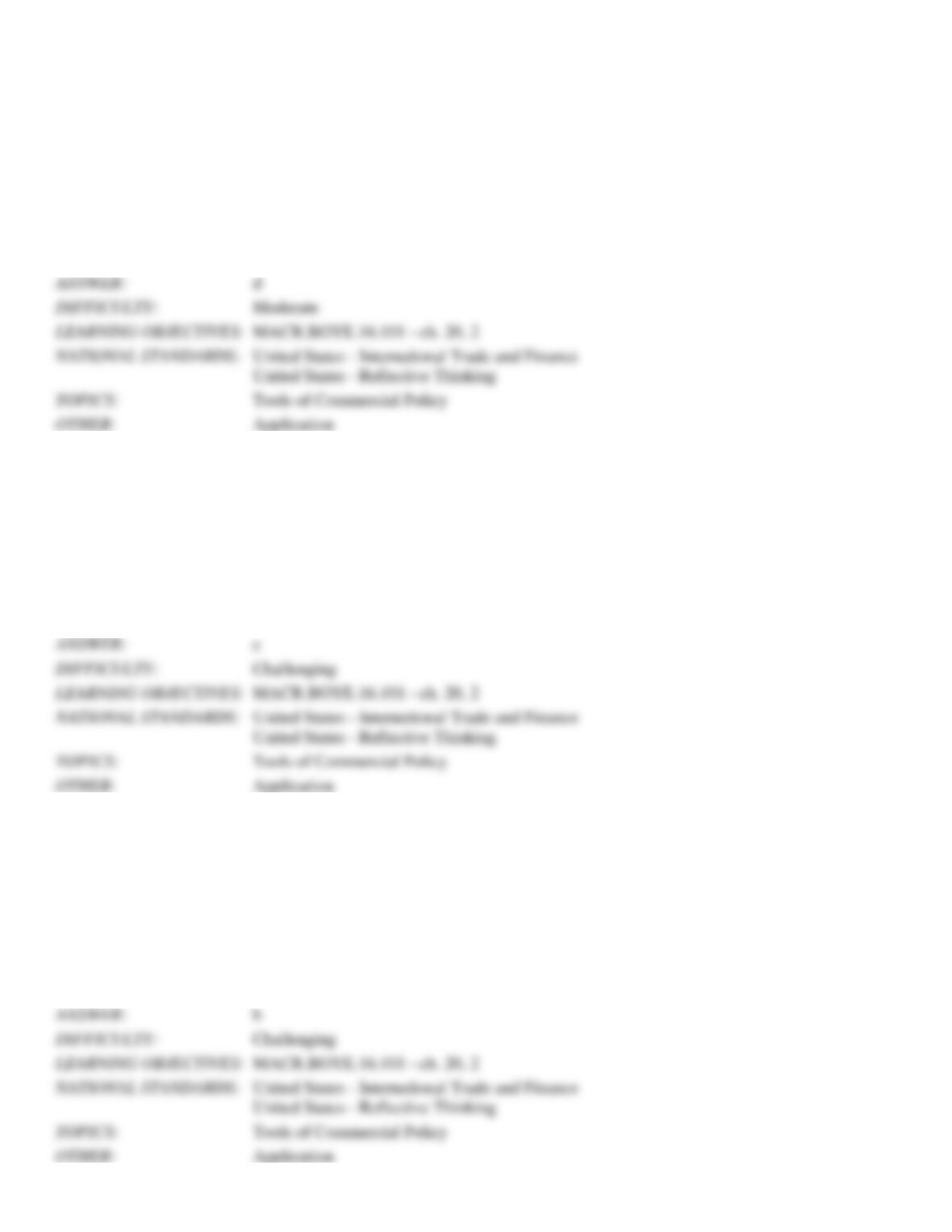
P3: No-trade price of the good in the domestic market.
34. According to Figure 20.1, the domestic equilibrium quantity of the good is:
a.
Q1.
b.
Q5.
c.
Q2.
d.
Q3.
e.
Q4.
35. According to Figure 20.1, if the international price of the good is P1, which of the following statements is true?
a.
The domestic market is in equilibrium.
b.
There is an excess supply in the domestic market by the amount Q4 – Q2.
c.
The country will export Q3 – Q1 units of the good.
d.
There is an excess demand of Q4 – Q2 units in the domestic market.
e.
The country needs to import Q5 – Q1 units of the good to satisfy domestic demand.
MACR.BOYE.16.101 – ch. 20, 2
Tools of Commercial Policy
36. Refer to Figure 20.1. If the government imposes a tariff such that the price of the good in the domestic market is P2
when the international price is P1:
a.
the import of the good by the domestic country increases by Q5 – Q4 units.
b.
the import of the good by the domestic country declines.
c.
the quantity of the good exported by the domestic country declines.
d.
the domestic country is in equilibrium.
e.
the quantity of the good exported by the domestic country increases.
MACR.BOYE.16.101 – ch. 20, 2
United States – Reflective Thinking
MACR.BOYE.16.101 – ch. 20, 2
Tools of Commercial Policy
37. Refer to Figure 20.1. If the government imposes a tariff such that the price of the good in the domestic market is P2
while the international price is P1, the dollar value of the tariff is equal to:
a.
P3 – P1.
b.
P2 – P3.
c.
P2 – P1.
d.
P1 – P2.
e.
P1 – P3.
38. According to Figure 20.1, the tariff revenue earned by the domestic government is equal to the:
a.
area ABEFH.
b.
area FEQ4Q2.
c.
area ABH.
d.
area HFP1P2.
e.
area BEFH
MACR.BOYE.16.101 – ch. 20, 2
United States – Reflective Thinking
Tools of Commercial Policy
39. Which of the following would result from a tariff?
a.
An increase in government budget deficit
b.
An increase in domestic production
c.
A greater volume of international trade
d.
Increased domestic consumption
e.
Decrease in prices of the imported goods
MACR.BOYE.16.101 – ch. 20, 2
United States – International Trade and Finance
40. If the world price of a good is lower than its domestic equilibrium price, the country will:
MACR.BOYE.16.101 – ch. 20, 2
Tools of Commercial Policy
a.
import a quantity of the good equal to the difference between the quantity demanded domestically and the
quantity supplied domestically.
b.
export a quantity of the good equal to the difference between the quantity demanded domestically and the
quantity supplied domestically.
c.
import a quantity of the good equal to the difference between the quantity demanded domestically and the
quantity supplied by foreign producers.
d.
export a quantity of the good equal to the difference between the quantity demanded by foreign consumers and
the quantity supplied domestically.
e.
import a quantity of the good equal to the difference between the quantity demanded by foreign consumers
and the quantity supplied by foreign producers.
41. Which of the following countries is forbidden to impose export tariff by its constitution?
a.
The United States
b.
Brazil
c.
United Kingdom
d.
Japan
e.
Mexico
Easy
MACR.BOYE.16.101 – ch. 20, 2
United States – Analytic – BB-Legal
United States – International Trade and Finance
Tools of Commercial Policy
Knowledge
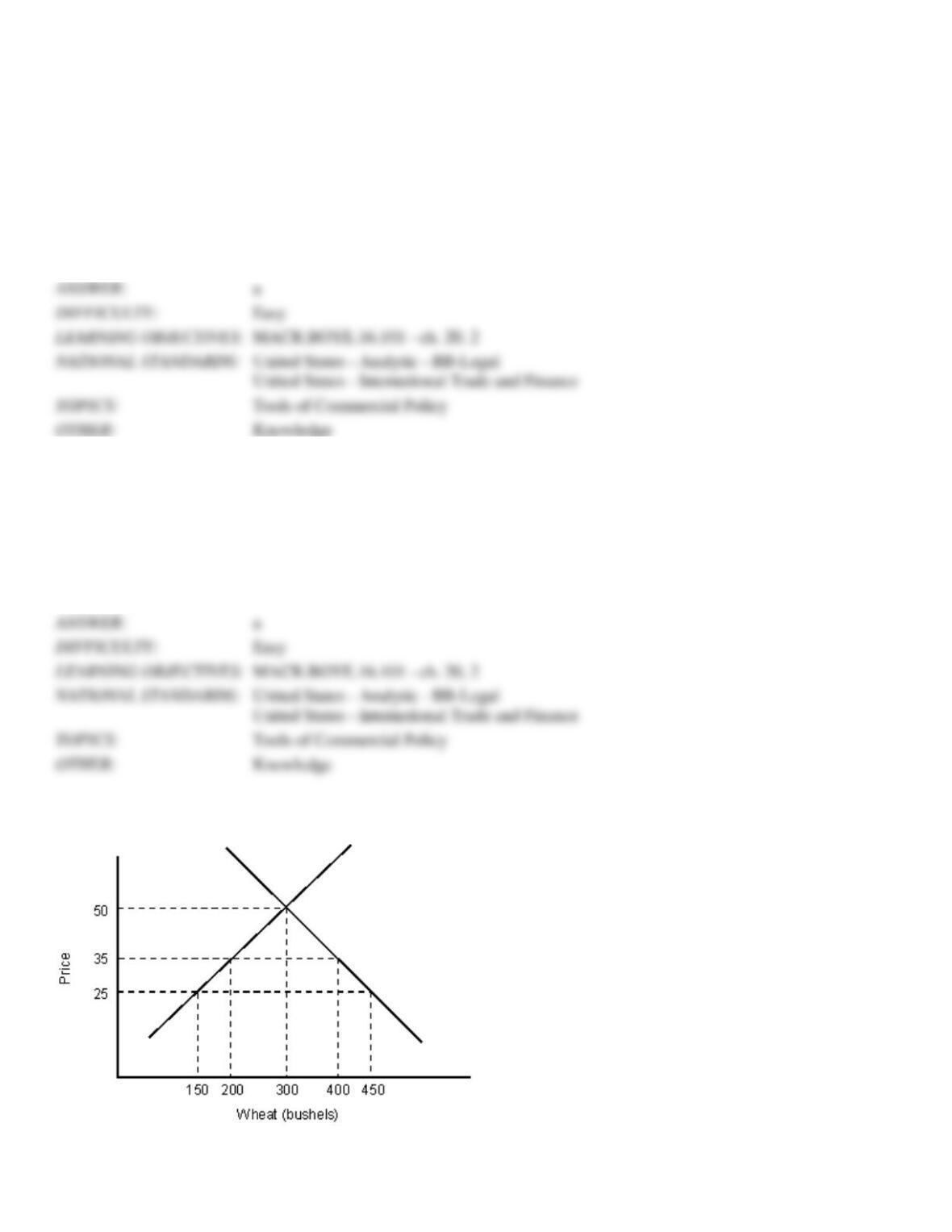
The figure given below depicts the negatively sloped demand and positively sloped supply curves of wheat in a country.
Figure 20.2
42. Refer to Figure 20.2. In the absence of international trade, what are the domestic equilibrium price and quantity?
Easy
MACR.BOYE.16.101 – ch. 20, 2
Tools of Commercial Policy
Knowledge
a.
$30 and 200 bushels
b.
$50 and 400 bushels
c.
$30 and 400 bushels
d.
$50 and 300 bushels
e.
$25 and 150 bushels
43. According to Figure 20.2, if the world price per bushel of wheat is $25, what is the domestic production?
a.
300 bushels
b.
450 bushels
c.
400 bushels
d.
150 bushels
e.
200 bushels
MACR.BOYE.16.101 – ch. 20, 2
Tools of Commercial Policy
44. According to Figure 20.2, if the world price per bushel of wheat is $25, how much is the domestic demand?
a.
400 bushels
b.
450 bushels
c.
200 bushels
d.
300 bushels
e.
150 bushels
MACR.BOYE.16.101 – ch. 20, 2
United States – Reflective Thinking
Tools of Commercial Policy
45. In Figure 20.2, if the world price per bushel of wheat is $25, how much wheat will be imported?
a.
450 bushels
b.
350 bushels
c.
200 bushels
d.
150 bushels
MACR.BOYE.16.101 – ch. 20, 2
United States – Reflective Thinking
Tools of Commercial Policy
e.
300 bushels
46. In Figure 20.2, if the world price per bushel of wheat is $25, and a tariff of $10 is imposed, what is the domestic
production?
a.
300 bushels
b.
450 bushels
c.
400 bushels
d.
150 bushels
e.
200 bushels
MACR.BOYE.16.101 – ch. 20, 2
United States – Reflective Thinking
Tools of Commercial Policy
47. In Figure 20.2, if the world price per bushel of wheat is $25 and a tariff of $10 is imposed by the domestic
government, what is the domestic demand?
a.
400 bushels
b.
450 bushels
c.
200 bushels
d.
300 bushels
e.
150 bushels
MACR.BOYE.16.101 – ch. 20, 2
Tools of Commercial Policy
48. In Figure 20.2, if the world price of wheat is $25 and a $10 tariff is imposed:
a.
imports will decrease from 300 to 200 bushels of wheat.
b.
imports will increase from 200 to 400 bushels of wheat.
c.
imports will remain unchanged.
d.
domestic production will decrease from 200 to 150 bushels of wheat.
e.
domestic production will remain unchanged.
MACR.BOYE.16.101 – ch. 20, 2
Tools of Commercial Policy
49. In Figure 20.2, if the world price of wheat is $35 and a $15 tariff is imposed:
a.
domestic consumption will decrease from 400 to 350 bushels of wheat.
b.
the government will collect $200 in revenue from the tariff.
c.
domestic consumption will increase from 150 to 200 bushels of wheat.
d.
imports will be eliminated.
e.
domestic consumption will increase from 150 to 300 bushels of wheat.
d
Challenging
MACR.BOYE.16.101 – ch. 20, 2
Tools of Commercial Policy
Application
50. According to Figure 20.2, if the world price of wheat is $25 and a tariff of $10 is imposed by the domestic
government, the total tariff revenue collected by the government is:
a.
$4,000.
b.
$0.
c.
$5,000.
d.
$2,000.
e.
$1,000.
d
Challenging
MACR.BOYE.16.101 – ch. 20, 2
Tools of Commercial Policy
Application
51. According to Figure 20.2, if the world price of wheat is $25 and a tariff of $25 is imposed by the domestic
government, the total tariff revenue collected by the government is:
a.
$2,000.
b.
$0.
c.
$200.
d.
$100.
e.
$4,000
b
Challenging
MACR.BOYE.16.101 – ch. 20, 2
MACR.BOYE.16.101 – ch. 20, 2
Tools of Commercial Policy
Application