4 Uncertainty, Information, and the Invisible Hand
1) As more information is gather, the marginal cost of additional information ________ and the
marginal benefit of additional information ________.
A) increases; increases
B) increases; decreases
C) decreases; increases
D) decreases; decreases
2) There is a growing market for buying and selling information about the online behavior of
consumers. Most people use one of only a small number of search engines (such as Google,
Bing, or Yahoo!) when surfing the net. It has been hard for new search engines to gain any
market share. The market for search is best considered as
A) perfectly competitive.
B) oligopoly.
C) monopolistically competitive.
D) monopoly.
3) Information can be thought of as a
A) non-economic piece of data.
B) violation of the invisible hand idea that the pursuit of self-interest promotes social interest.
C) good whose marginal benefit is infinite.
D) good whose marginal benefit decreases as more information is acquired.
4) Which of the following statements is CORRECT?
A) Because information is different from typical goods and services, it cannot be provided in a
market.
B) The marginal benefit from more information does not decrease.
C) Too little information is provided if the market for information is a monopoly.
D) Acquiring more information can never be inefficient.
5) There is a growing market for buying and selling information about the online behavior of
consumers. Most people use one of only a small number of search engines (such as Google,
Bing, or Yahoo!) when surfing the net. It has been hard for new search engines to gain any
market share. Based only on this information, the market for search is best considered as
A) perfectly competitive.
B) oligopoly.
C) monopolistically competitive.
D) monopoly.
5 News Based Questions
1) The International Maritime Bureau said the waters off Somalia are the world’s most
dangerous, accounting for nearly a third reported pirate attacks worldwide. Suppose all boats are
insured to $100,000 and pay a premium of $10,000 each. Suppose 10 out of 100 boats are
attacked by pirates and these 10 file claims with their insurance. If the insurance company’s only
costs are the claims it must pay, has the insurance company earned an economic profit?
A) Yes, they earned an economic profit of $90,000.
B) No, they broke even.
C) No, they sustained an economic loss of $90,000.
D) Yes, they earned an economic profit of $1,000,000.
2) The International Maritime Bureau said the waters off Somalia are the world’s most
dangerous, accounting for nearly a third reported pirate attacks worldwide. Suppose all boats are
insured to $100,000 and pay a premium of $10,000 each. Suppose 10 out of 100 boats are
attacked by pirates and these 10 file claims with their insurance. What is the value of the claims?
A) one trillion dollars
B) one billion dollars
C) one million dollars
D) one hundred thousand dollars
3) The International Maritime Bureau said the waters off Somalia are the world’s most
dangerous, accounting for nearly a third reported pirate attacks worldwide. Suppose all boats are
insured to $100,000 and pay a premium of $15,000 each. Suppose 10 out of 100 boats are
attacked by pirates and these 10 file claims with their insurance. Has the insurance company
earned an economic profit?
A) Yes, they earned an economic profit of $500,000.
B) Yes, they earned an economic profit of $50,000.
C) No, they sustained an economic loss of $85,000.
D) No, they broke even.
4) Mortgage insurance protects lenders when a borrower defaults by making up any shortfall
needed to repay the loan if the sale of the property doesn’t cover the debt. Federally regulated
lenders must have mortgage insurance on loans where the buyer’s down payment is less than 20
per cent of the price. In this example, what signal do potential homeowners give to indicate they
are low-risk?
A) indicating high income
B) buying an expensive home
C) having a large down payment
D) buying an inexpensive home
5) Mortgage insurance protects lenders when a borrower defaults by making up any shortfall
needed to repay the loan if the sale of the property doesn’t cover the debt. Federally regulated
lenders must have mortgage insurance on loans where the buyer’s down payment is less than 20
per cent of the price. This can partially prevent ________.
A) symmetric information problems
B) adverse selection problems
C) public information problems
D) the lemon problem
6) Mortgage insurance protects lenders when a borrower defaults by making up any shortfall
needed to repay the loan if the sale of the property doesn’t cover the debt. Federally regulated
lenders must have mortgage insurance on loans where the buyer’s down payment is less than 20
percent of the price. Why is this 20 percent threshold efficient for the insurance company?
A) Information about an individual’s mortgage repayment risk is valuable to the insurance
company, and the insurance company has found that all individuals fall into this 20 percent
threshold.
B) Information about an individual’s mortgage repayment risk is valuable to the insurance
company, but there diminishing marginal cost in obtaining very specific information.
C) Information about an individual’s mortgage repayment risk is valuable to the insurance
company, and the insurance company has found that this 20 percent threshold is perfectly
efficient.
D) Information about an individual’s mortgage repayment risk is valuable to the insurance
company, but there diminishing marginal benefit in obtaining very specific information.
7) Suppose Nara could invest her $1000 in a savings account or she could invest in the stock
market. After one year, the savings account has a guaranteed 5 percent interest rate and the stock
market has a 10 percent chance of tripling her money, and 90 percent chance of losing it all.
What is Nara’s expected wealth if she places her money in the savings account?
A) $1,050
B) $50
C) $300
D) $1,300
8) Suppose Nara could invest her $1000 in a savings account or she could invest in the stock
market. After one year, the savings account has a guaranteed 5 percent interest rate and the stock
market has a 10 percent chance of tripling her money, and 90 percent chance of losing it all.
What is the difference in Nara’s expected wealth between these two options?
A) $1050
B) $300
C) $750
D) $50
9) Suppose Nara could invest her $1000 in a savings account or she could invest in the stock
market. After one year, the savings account has a guaranteed 5 percent interest rate and the stock
market has a 10 percent chance of tripling her money, and 90 percent chance of losing it all.
What is Nara’s expected wealth if she places her money in the stock market?
A) $300
B) $1,300
C) $50
D) $1,050
10) Suppose Nara could invest her $1000 in a savings account or she could invest in the stock
market. After one year, the savings account has a guaranteed 5 percent interest rate and the stock
market has a 10 percent chance of tripling her money, and 90 percent chance of losing it all. To
give Nara the maximum expected wealth, what should she do?
A) She should invest all of her money in the stock market.
B) She should invest all of her money in the savings account.
C) She should invest half of her money in the savings account and half in the stock market.
D) She should only invest her money in the stock market if she is risk averse.
11) Katy has an ailing and wealthy, but miserly, parent. The parent has told Katy that if she takes
care of him until he dies, then she will get $100,000 in inheritance. Katy knows that there is only
a 50-50 chance that her father will leave her the full amount or nothing. To take care of her
father, she has to take a job that pays $30,000 where her current job pays her $70,000 per year. If
her father is expected to pass away in 1 year, what is Katy’s expected wealth if she takes care of
her father?
A) $130,000
B) $90,000
C) $80,000
D) $70,000
12) Katy has an ailing and wealthy, but miserly, parent. The parent has told Katy that if she takes
care of him until he dies, then she will get $100,000 in inheritance. Katy knows that there is only
a 50-50 chance that her father will leave her the full amount or nothing. To take care of her
father, she has to quit her job that pays $60,000 where per year. If her father is expected to pass
away in 1 year, what is Katy’s expected wealth if she takes care of her father?
A) $100,000
B) $50,000
C) $60,000
D) $110,000
13) In an ad for insurance, the text reads “Life’s an adventure, and there are plenty of perils
awaiting your jewelry: a lost or broken stone, theft, accidental loss, damage, mysterious
disappearance Have you thought about insurance?” What is the economic reasoning for an
individual to buy insurance?
A) Individuals who buy insurance are profit maximizers.
B) Individuals who buy insurance are rational.
C) Individuals who buy insurance are dishonest and can profit from dishonesty.
D) Individuals who buy insurance increase their expected utility by owning insurance.
14) In an ad for insurance, the text reads “Life’s an adventure, and there are plenty of perils
awaiting your jewelry: a lost or broken stone, theft, accidental loss, damage, mysterious
disappearance Have you thought about insurance?” How does the inclusion of accidental loss
and mysterious disappearance create moral hazard?
A) Individuals who purchase insurance are risk averse.
B) Those who seek this jewelry insurance know that tend to lose their jewelry often.
C) Once insured, some individuals wear their jewelry swimming, exercising, etc. where there is
an increased risk of loss.
D) Individuals who own jewelry know more about their risk than insurance company.
15) In an ad for insurance, the text reads “Life’s an adventure, and there are plenty of perils
awaiting your jewelry: a lost or broken stone, theft, accidental loss, damage, mysterious
disappearance Have you thought about insurance?” How does the inclusion of accidental loss
and mysterious disappearance create adverse selection?
A) Those who seek this jewelry insurance know that tend to lose their jewelry often.
B) Individuals who own jewelry know more about their risk than insurance company.
C) Once insured, some individuals wear their jewelry swimming, exercising, etc. where there is
an increased risk of loss.
D) Individuals who purchase insurance are risk averse.
16) Ebay is an online auction site where individual buyers and sellers receive feedback on their
how well they conducted their transaction. This feedback is public available. What is the purpose
of this feedback?
A) It is a signal that the buyer or seller is reliable.
B) To reduce credit risk of a faulty buyer
C) To reduce default risk of a faulty seller
D) It is a tool to prevent moral hazard.
17) Pirates have been intensely attacking ships off the shore of Somalia this year. Boat owners
have reportedly coughed up more than $30 million in ransom and insurance premiums have shot
up. Why would insurance premiums increase dramatically?
I. Because the probability of pirate attack has increased
II. Because consumers’ willingness to pay for insurance has increased because of these attacks
III. Because insurance claims have increased
A) I only
B) I and III only
C) III only
D) I, II, and III
18) Pirates have been intensely attacking ships off the shore of Somalia this year. Boat owners
have reportedly coughed up more than $30 million in ransom and insurance premiums have shot
up. The pirate activity and increase in premiums means that the expected wealth of boat owners
who sail near Somalia is ________.
A) decreasing
B) increasing
C) staying the same
D) decreasing only if they have insurance
19) Pirates have been intensely attacking ships off the shore of Somalia this year. Boat owners
have reportedly coughed up more than $30 million in ransom and insurance premiums have shot
up. The pirate activity means that the expected utility of wealth of risk averse boat owners who
do not have insurance and sail near Somalia is ________.
A) increasing
B) decreasing
C) staying the same
D) not able to be determined without knowing the extent of risk aversion
20) Pirates have been intensely attacking ships off the shore of Somalia this year. Boat owners
have reportedly coughed up more than $30 million in ransom and insurance premiums have shot
up. If there is a sudden and unexpected increase in risk, who gains?
A) insurance companies
B) the government of Somalia
C) boat owners who are insured with policies whose price cannot be changed
D) pirates
6 Essay Questions
1) What is expected utility?
2) What does it mean to be risk averse?
3) How can we measure the cost of risk?
4) When would a risk averse individual not insure a risky event?
5) What is private information and what problems does it create?
6) Explain the concept of moral hazard. Give an example.
7) “People buy insurance do protect themselves from moral hazard.” True or false? Explain.
8) Most college professors are granted tenure after six years of employment. Tenure implies a
lifetime appointment. What problem does this situation create, and how can colleges minimize
the problem?
9) Explain the concept of adverse selection. Give an example.
10) Consider a market for used cars. Suppose there are only two kinds of cars: lemons and good
cars. A lemon is worth $1,500 both to its current owner and to anyone who buys it. A good car is
worth $6,000 to its current and potential owners. Buyers can’t tell whether a car is a lemon until
after they have bought the car. What do economists call the problem that buyers of used cars
face? What kind of cars (lemons, good cars, or both) are traded? Explain and substantiate your
answer.
11) Consider a market for used cars. Suppose there are only two kind of cars: lemons and good
cars. A lemon is worth $1,500 both to its current owner and to anyone who buys it. A good car is
worth $6,000 to its current and potential owners. Buyers can’t tell whether a car is a lemon until
after they have bought the car. What do economists call the problem that buyers of used cars
face? What is the price of a used car? Explain and substantiate your answer.
12) How can a warranty at the seller’s expense signal that a product is high quality?
7 Numeric and Graphing Questions
1) Mike owns a car worth $20,000, and that is his only wealth. There is a 10 percent chance that
Mike will have an accident within a year. If he does have an accident, his car is worthless. What
is Mike’s expected wealth?
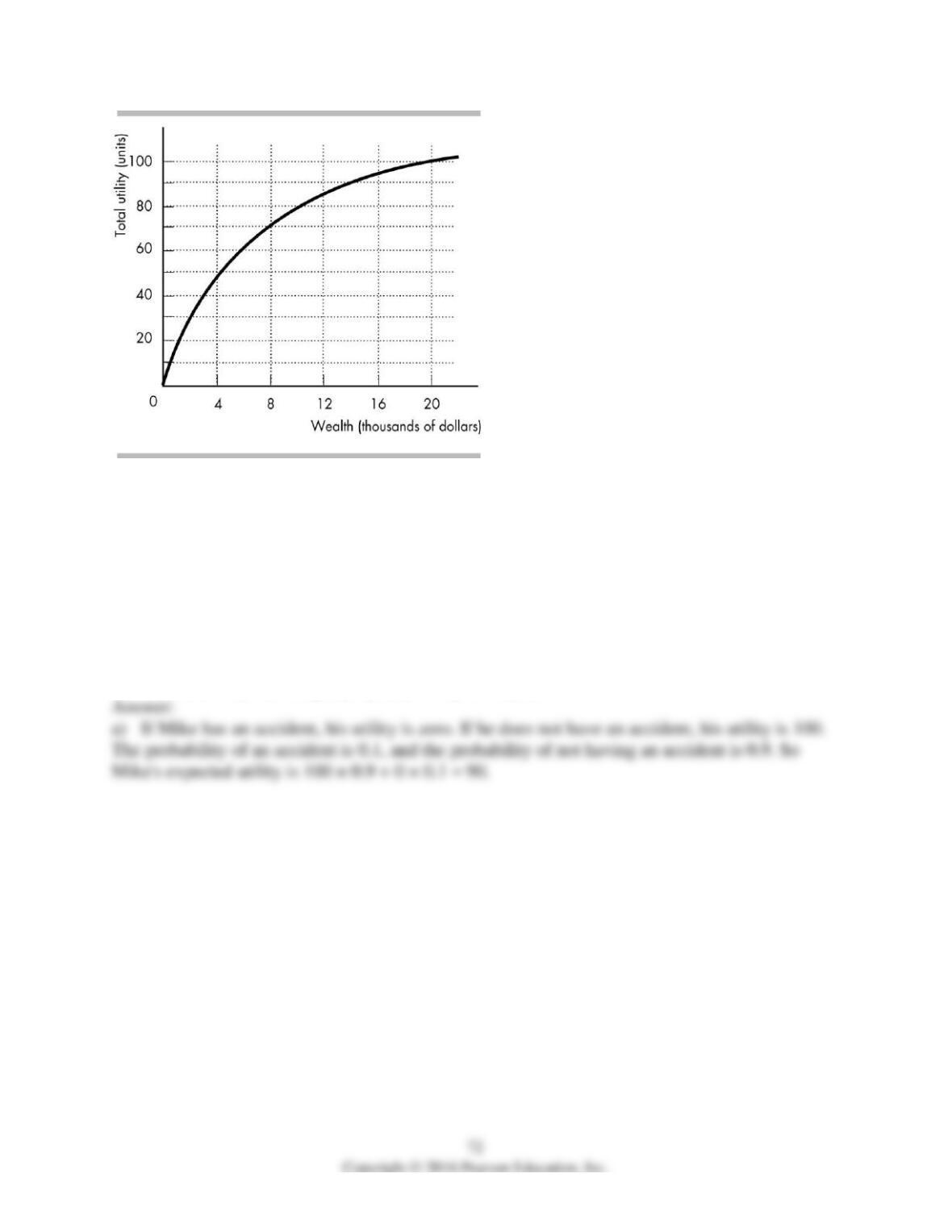
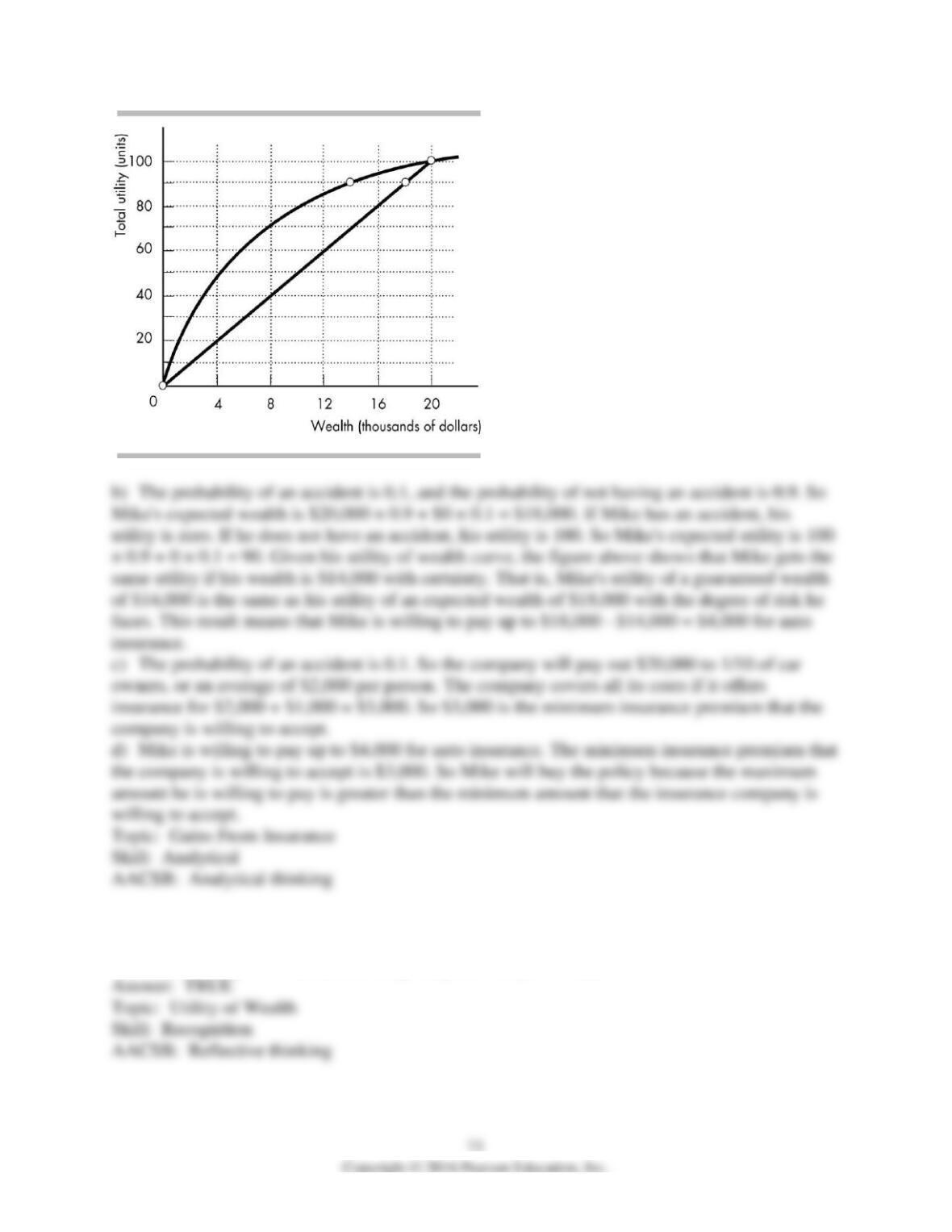
2) Mike has the utility of wealth curve shown in the figure above. He owns a car worth $20,000,
and that is his only wealth. There is a 10 percent chance that Mike will have an accident within a
year. If he does have an accident, his car is worthless.
a) What is Mike’s expected utility?
b) What is the maximum amount that Mike is willing to pay for auto insurance?
c) Suppose all car owners are like Mike insofar as they have a 10 percent chance of having an
accident. An insurance company agrees to pay each person who has an accident the full value of
his or her car. The company’s operating expenses are $1,000. What is the minimum insurance
premium that the company is willing to accept?
d) Will Mike buy the company’s policy? Why or why not?
8 True or False
1) A risk averse person has diminishing marginal utility of wealth.
2) Expected utility is the utility that arises from expected wealth.
3) The cost of risk is the same for everyone.
4) A risk averse person will always buy insurance against risk.
5) Moral hazard occurs when an agreement encourages undesirable behavior.
6) If reckless drivers are more likely than safe drivers to buy automobile insurance, then a moral
hazard problem has occurred.
7) Adverse selection occurs when a sales offer attracts the kinds of customers that the seller does
not want.
8) If insured drivers decide to drive more recklessly than uninsured drivers do, then an adverse
selection has occurred.
9 Extended Problems
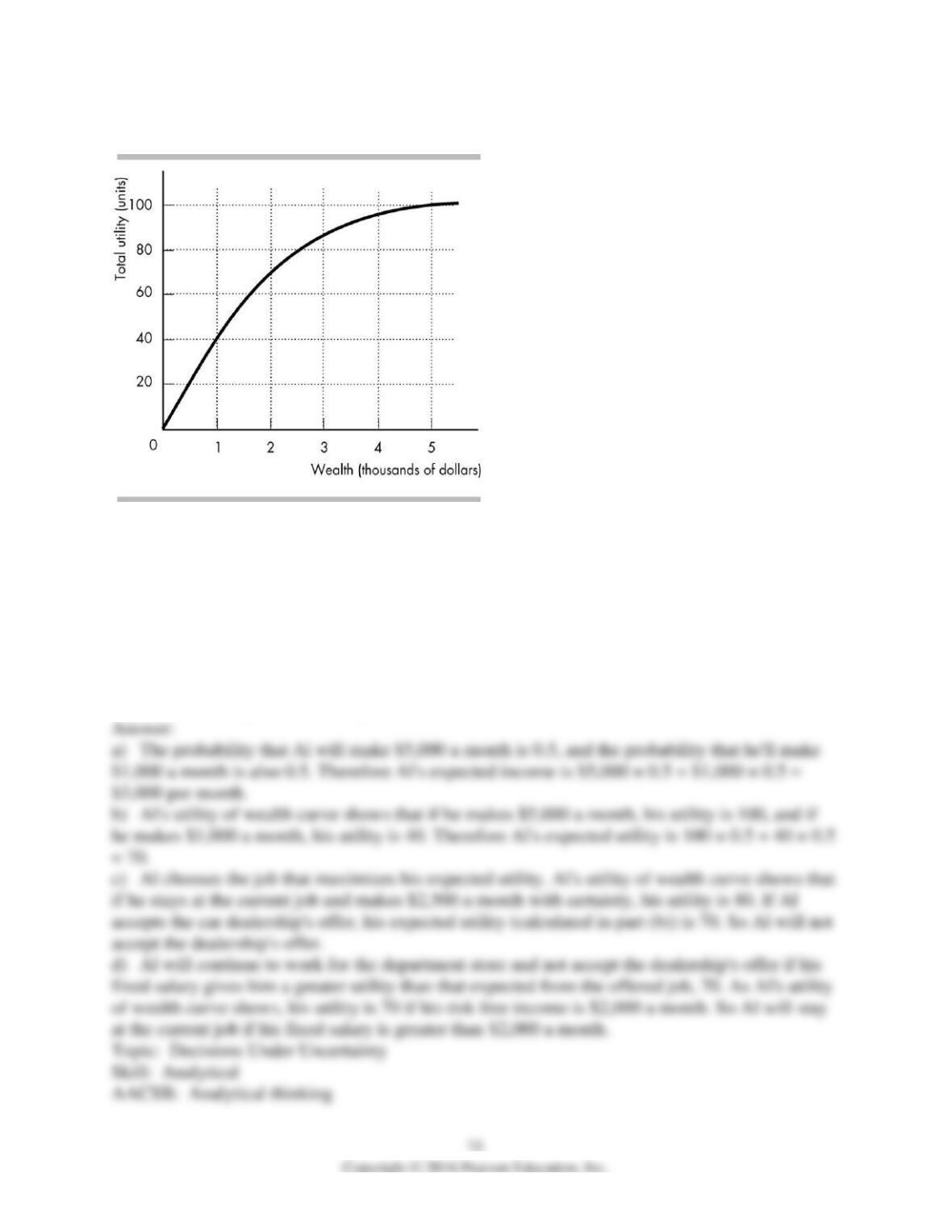
1) Al works as a sales clerk at a department store for a fixed salary of $2,500 per month. He is
offered a job as a salesperson at a car dealership in which there is a 50 percent chance that he
will make $5,000 a month and a 50 percent chance that he will make only $1,000 a month. The
figure above Al’s utility of wealth curve:
a) What is Al’s expected income from the offered job?
b) What is Al’s expected utility from the offered job?
c) Will Al accept the offer? Why or why not?
d) What is the minimum fixed salary for which Al will continue to work for the department
store and not accept the dealership’s offer?
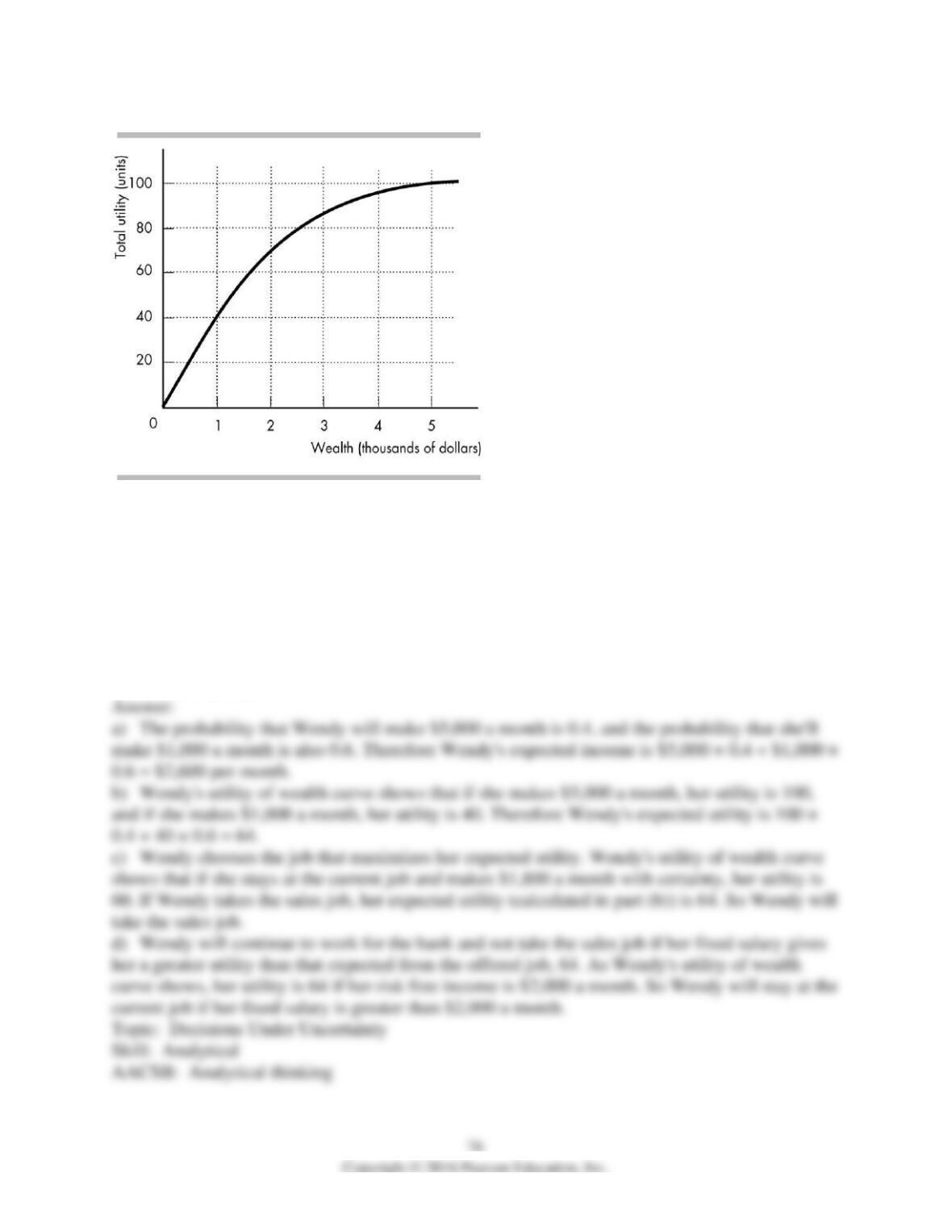
2) Wendy works as a teller at a bank for a fixed salary of $1,800 per month. She is offered a job
as a salesperson at which there is a 40 percent chance that she will make $5,000 a month and a
60 percent chance that she will make only $1,000 a month. The figure shows Wendy’s utility of
wealth curve:
a) What is Wendy’s expected income from the offered job?
b) What is Wendy’s expected utility from the offered job?
c) Will Wendy accept the offer? Why or why not?
d) What is the minimum fixed salary for which Wendy will continue to work for the bank and
not take the sales job?
77
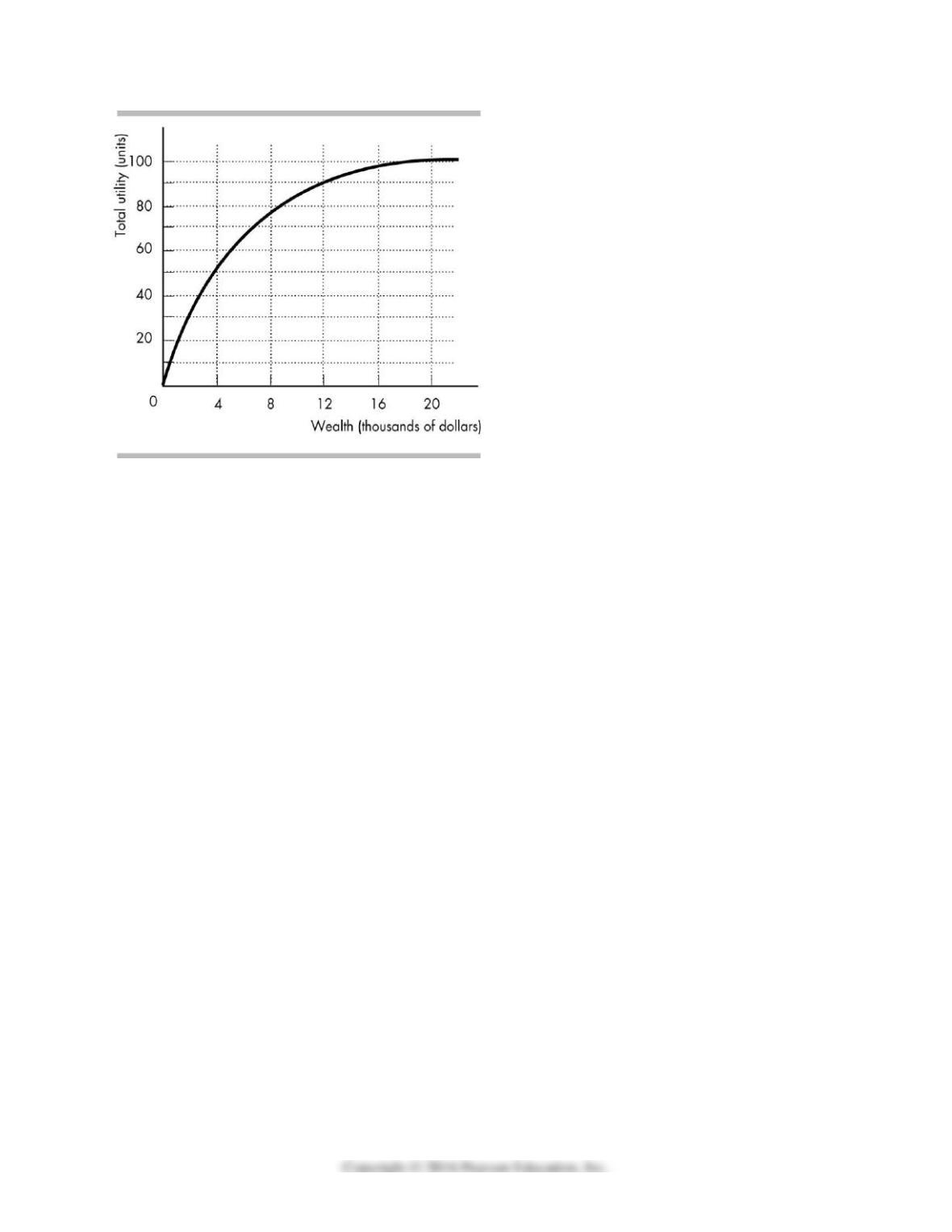
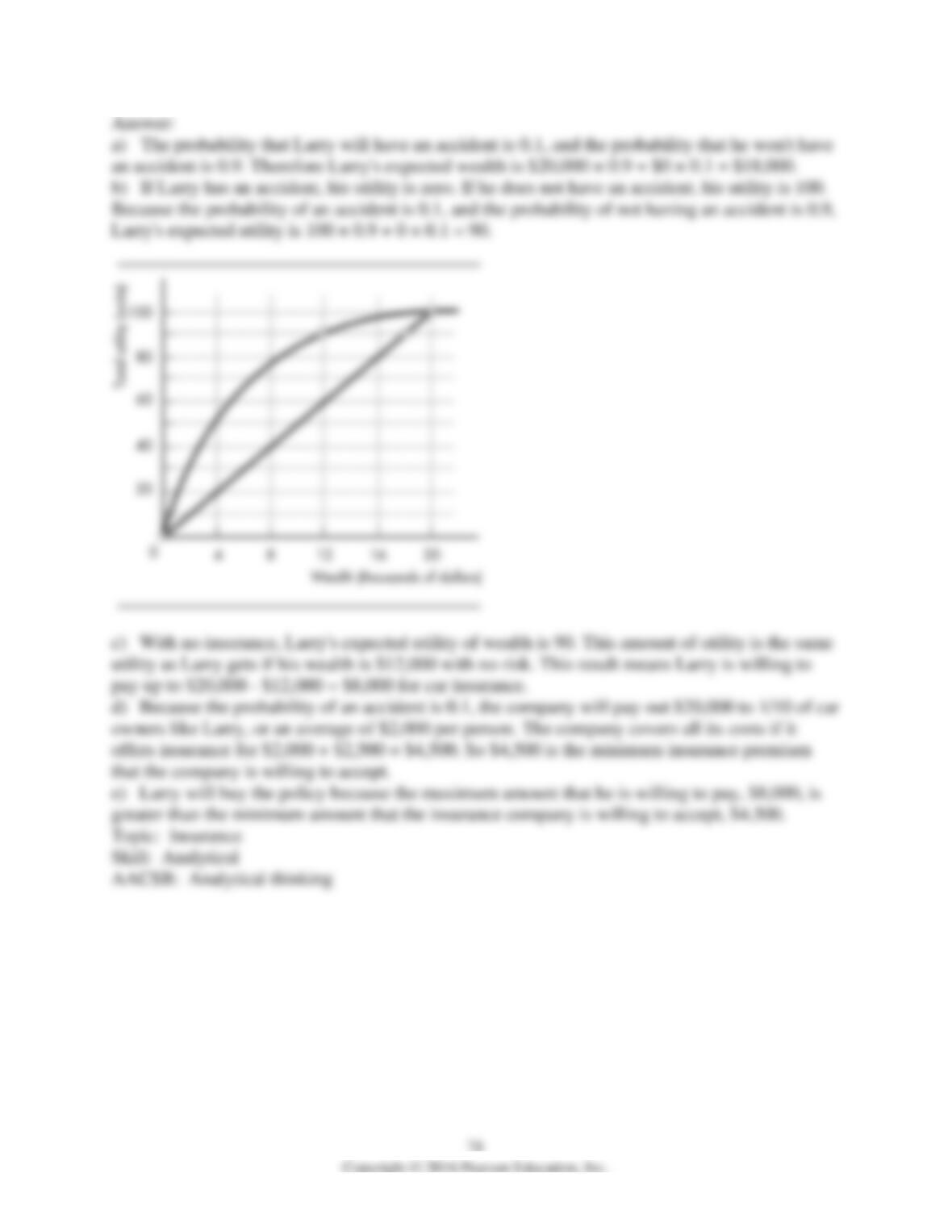
3) Larry owns a car worth $20,000, and that is his only wealth. There is a 10 percent chance that
Larry will have an accident within a year. If he does have an accident, his car is worthless.
Larry’s utility of wealth curve is shown in the figure above. An insurance company agrees to pay
a car owner like Larry the full value of his car in case of an accident if the car owner buys the
company’s insurance policy. The company’s operating expenses are $2,500 per policy.
a) What is Larry’s expected wealth?
b) What is Larry’s expected utility?
c) What is the maximum amount that Larry is willing to pay for car insurance?
d) What is the minimum premium that the insurance company is willing to accept?
e) Will Larry buy the insurance policy? Why or why not?
79
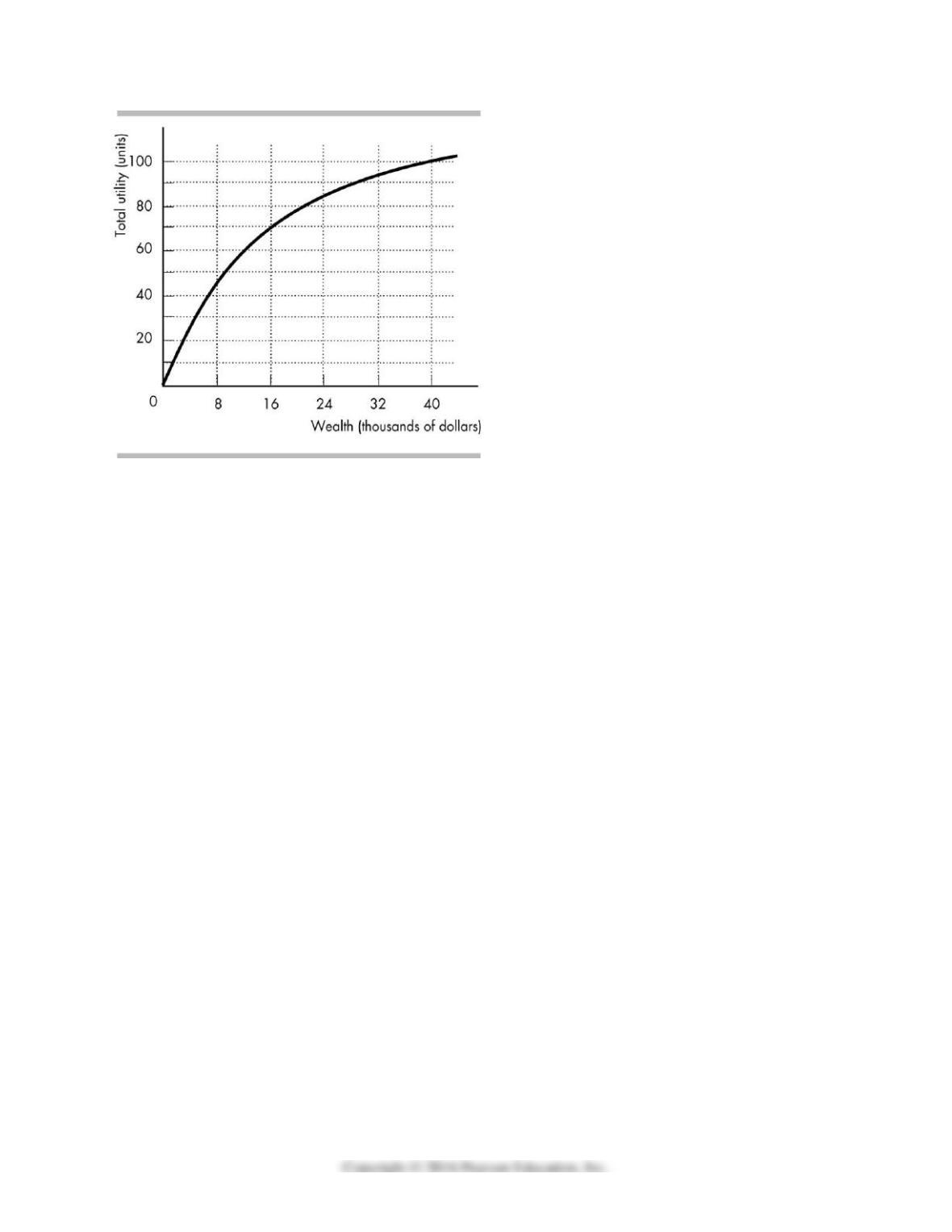
4) Roy owns a sports car worth $40,000, and that is his only wealth. Roy is a reckless driver, and
there is a 30 percent chance that he will have an accident within a year. If he does have an
accident, his car is worthless. Roy’s utility of wealth curve is shown in the figure below. An
insurance company agrees to pay a car owner like Roy the full value of his car in case of an
accident if the car owner buys the company’s insurance policy. The company’s operating
expenses are $2,000 per policy.
a) What is Roy’s expected wealth?
b) What is Roy’s expected utility?
c) What is the maximum amount that Roy is willing to pay for car insurance?
d) What is the minimum premium that the insurance company is willing to accept?
e) Will Roy buy the insurance policy? Why or why not?