34) John’s utility of wealth curve is shown in the above figure. He currently has total wealth of
$20,000. If there is a 50 percent chance that his $10,000 car will be stolen, what is the value of
insurance against the theft?
A) $0
B) $5,000
C) $7,000
D) $13,000
35) John’s utility of wealth curve is shown in the above figure. He currently has wealth of
$20,000. If there is a 10 percent chance that he could lose all his wealth, what is his expected
wealth?
A) $0
B) $2,000
C) $17,000
D) $18,000
36) John’s utility of wealth curve is shown in the above figure. He currently has wealth of
$20,000. If there is a 10 percent chance of losing all his wealth, what is the value of insurance
against this loss?
A) $0
B) $2,000
C) $3,000
D) $17,000
37) John’s utility of wealth curve is shown in the above figure. He currently has wealth of
$20,000 and there is a 10 percent chance of losing it all. John is
A) willing to pay any price for insurance.
B) willing to pay no more than $2,000 for insurance.
C) willing to pay no more than $3,000 for insurance.
D) willing to pay $5,000 for insurance.
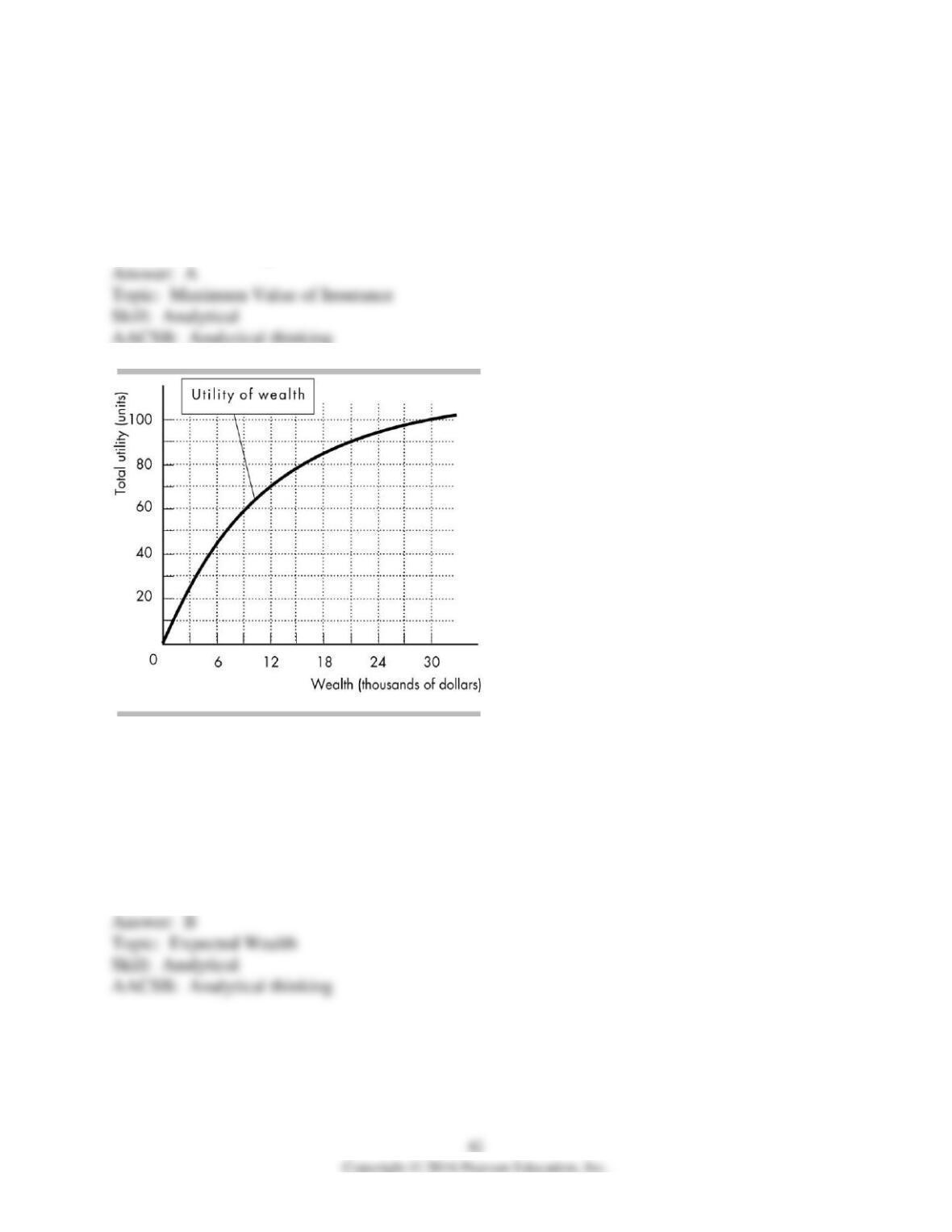
38) John’s utility of wealth curve is shown in the above figure. He currently has wealth of
$20,000, and there is a 25 percent chance that he could lose it all. If an insurance company offers
to insure against this loss for $6,000, John will
A) buy the policy.
B) not buy the policy.
C) be indifferent between being insured and uninsured.
D) There is not enough information to answer.
39) Andrew has the utility of wealth curve shown in the above figure. He owns an SUV worth
$30,000, and that is his only wealth. There is a 10 percent chance that he will have an accident
within a year. If he does have an accident, his SUV is worthless. What is Andrew’s expected
wealth?
A) $30,000
B) $27,000
C) $20,000
D) zero
40) Andrew has the utility of wealth curve shown in the above figure. He owns an SUV worth
$30,000, and that is his only wealth. There is a 10 percent chance that he will have an accident
within a year. If he does have an accident, his SUV is worthless. What is Andrew’s expected
utility?
A) 100
B) 90
C) 50
D) zero
41) Andrew has the utility of wealth curve shown in the above figure. He owns an SUV worth
$30,000, and that is his only wealth. There is a 10 percent chance that he will have an accident
within a year. If he does have an accident, his SUV is worthless. Andrew would have the same
expected utility as he currently has if his wealth was ________ and he faced no uncertainty.
A) $30,000
B) $27,000
C) $21,000
D) $18,000
42) Andrew has the utility of wealth curve shown in the above figure. He owns an SUV worth
$30,000, and that is his only wealth. There is a 10 percent chance that he will have an accident
within a year. If he does have an accident, his SUV is worthless. The value of insurance to
Andrew against an accident is
A) zero.
B) $3,000 per year.
C) $10,000 per year.
D) $6,000 per year.
43) Andrew has the utility of wealth curve shown in the above figure. He owns an SUV worth
$30,000 and that is his only wealth. There is a 10 percent chance that he will have an accident
within a year. If he does have an accident, his SUV is worthless. Suppose all SUV owners are
like Andrew. An insurance company agrees to pay each person who has an accident the full
value of his/her SUV. The company’s operating expenses are $1,500. What is the minimum
insurance premium that the company is willing to accept?
A) $1,500 per year
B) $4,500 per year
C) $3,000 per year
D) $6,000 per year
44) Andrew has the utility of wealth curve shown in the above figure. He owns an SUV worth
$30,000, and that is his only wealth. There is a 10 percent chance that he will have an accident
within a year. If he does have an accident, his SUV is worthless. Suppose all SUV owners are
like Andrew. An insurance company agrees to pay each person who has an accident the full
value of their SUV. The company’s operating expenses are $1,500. Andrew will ________ the
company’s policy because the minimum insurance premium that the company is willing to accept
is ________ the maximum premium that Andrew is willing to pay.
A) buy; by $1,500 lower than
B) buy; the same as
C) not buy; $500 higher than
D) not buy; $1,500 higher than
45) Ashton has the utility of wealth curve shown in the above figure. He owns a sports car worth
$30,000, and that is his only wealth. Ashton is a careless driver and there is a 30 percent chance
that he will have an accident within a year. If he does have an accident, his car is worthless.
What is Ashton’s expected wealth?
A) $30,000
B) $9,000
C) $21,000
D) zero
46) Ashton has the utility of wealth curve shown in the above figure. He owns a sports car worth
$30,000, and that is his only wealth. Ashton is a careless driver and there is a 30 percent chance
that he will have an accident within a year. If he does have an accident, his car is worthless.
What is Ashton’s expected utility?
A) 100
B) 30
C) 70
D) zero
47) Ashton has the utility of wealth curve shown in the above figure. He owns a sports car worth
$30,000, and that is his only wealth. Ashton is a careless driver and there is a 30 percent chance
that he will have an accident within a year. If he does have an accident, his car is worthless.
Ashton would have the same expected utility as he currently has if his wealth was ________ and
he faced no uncertainty.
A) $30,000
B) $21,000
C) $12,000
D) $9,000
48) Ashton has the utility of wealth curve shown in the above figure. He owns a sports car worth
$30,000, and that is his only wealth. Ashton is a careless driver and there is a 30 percent chance
that he will have an accident within a year. If he does have an accident, his car is worthless. The
maximum amount that Ashton is willing to pay for auto insurance is
A) $6,000 per year.
B) $3,000 per year.
C) $9,000 per year.
D) $10,000 per year.
49) Ashton has the utility of wealth curve shown in the above figure. Ashton owns a sports car
worth $30,000, and that is his only wealth. Ashton is a careless driver and there is a 30 percent
chance that he will have an accident within a year. If he does have an accident, his car is
worthless. Suppose all sports cars owners are like Ashton. An insurance company agrees to pay
each person who has an accident the full value of their car. The company’s operating expenses
are $1,000. What is the minimum insurance premium that the company is willing to accept?
A) $3,000 per year
B) $6,000 per year
C) $10,000 per year
D) $15,000 per year
50) Ashton has the utility of wealth curve shown in the above figure. He owns a sports car worth
$30,000, and that is his only wealth. Ashton is a careless driver and there is a 30 percent chance
that he will have an accident within a year. If he does have an accident, his car is worthless.
Suppose all sports cars owners are like Ashton. An insurance company agrees to pay each person
who has an accident the full value of their car. The company’s operating expenses are $1,000.
Ashton will ________ the company’s policy because the minimum premium for such insurance
that the company is willing to accept is ________ the maximum premium Ashton is willing to
pay.
A) buy; by $1,500 lower than
B) buy; the same as
C) not buy; $1,500 higher than
D) not buy; $1,000 higher than
51) Insurance companies
A) pool risk and thereby lower people’s utility.
B) can earn a profit only if people are risk neutral.
C) can increase risk averse people’s utility.
D) try to shift their customers’ utility of wealth curves downward.
52) When Sardar buys insurance, on net he
A) gains if the value of the insurance is greater than the price he pays the insurance company.
B) loses because the price must pay the insurance company lowers his expected utility.
C) gains because his actual wealth with the insurance is greater than his expected wealth without
the insurance.
D) loses if the price of the insurance equals his expected loss from a bad outcome.
3 Private Information
1) Private information is a situation in which
A) two parties to an exchange have information that is available to outsiders if they ask.
B) one party to an exchange has information that is not available to the other.
C) the marginal cost of a person’s obtaining additional information is zero.
D) the marginal cost of making information available to one more person is zero.
2) Of the following, the best example of private information is when
A) Michael knows the price of a gallon of milk at the minimart but Michelle doesn’t know.
B) you know some of your used car’s defects but a potential buyer cannot find out about them
until after buying.
C) you don’t know the quality of a used car and must hire a trained mechanic who tells you all its
defects.
D) you pay the owner of a used car a little extra and she lets you know all of the car’s defects.
3) Moral hazard results from ________ information and adverse selection results from ________
information.
A) private; private
B) private; public
C) public; private
D) public; public
4) Private information
A) creates moral hazard but eliminates adverse selection.
B) creates adverse selection but eliminates moral hazard.
C) creates both moral hazard and adverse selection.
D) eliminates both moral hazard and adverse selection.
5) Moral hazard and adverse selection are the result of
A) poorly functioning markets.
B) government intervention.
C) private information.
D) treachery.
6) Moral hazard occurs ________ an agreement is made and when monitoring the parties to the
agreement is ________.
A) before; easy
B) before; costly
C) after; easy
D) after; costly
7) Moral hazard exists chiefly because of
A) economies of scale.
B) diseconomies of scale.
C) private information.
D) public information.
8) Moral hazard is
A) the tendency for people to enter into agreements in which they can use their private
information to their own advantage and to the disadvantage of the less informed party.
B) when one of the parties to an agreement has an incentive after the agreement is made to act in
a manner that brings additional benefits to himself or herself at the expense of the other party.
C) a situation in which only bad quality items are bought and sold.
D) an action taken outside a market that conveys information that can be used by that market.
9) Moral hazard typically occurs because
A) people are dishonest.
B) agreements sometimes create incentives that are costly to monitor.
C) workers possess diminishing marginal productivity.
D) workers possess adverse selection.
10) Moral hazard occurs because people act
A) in the interest of others at all time.
B) in the best interest of society.
C) in their own self-interest.
D) like anarchists.
11) Which of the following is an example of moral hazard?
A) I hire you to work in my garden for a fixed fee, and you work hard all day.
B) I hire you to work at an hourly rate and you work as slowly as possible.
C) You apply for the job only because I pay a fixed wage per day, no matter how much or little
you do.
D) You agree to be paid by the weed to work in my garden, and then don’t work hard.
12) Because Don has health insurance, he is more likely to see the doctor when he has a cold.
This is an example of
A) adverse selection.
B) moral hazard.
C) both moral hazard and adverse selection.
D) private information.
13) If Sally drives less carefully after buying auto insurance, she illustrates
A) adverse selection.
B) negative selection.
C) moral hazard.
D) lemon hazard.
14) Adverse selection is created by
A) incentives to change behavior after two parties have reached an agreement.
B) risk.
C) lump-sum taxes.
D) private information.
15) Adverse selection can occur when
A) all parties have full information.
B) one party has information not available to the other party.
C) incentives result in one party not reaching an agreement with the other party.
D) nobody has any information.
16) The tendency for people to enter into agreements in which they can use their private
information to their own advantage and to the disadvantage of the less informed party is known
as
A) adverse selection
B) moral hazard.
C) the market for oranges.
D) a signal.
17) Adverse selection is the tendency for people who accept contracts to be those who
A) buy goods and then regret it later.
B) buy goods for more than their own reservation price.
C) plan to use private information to the disadvantage of the less well-informed party.
D) engage in a number of searches larger than that specified in the contract.
18) Travel insurance (which pays a traveler if the traveler needs to cancel his or her trip) has a
clause that states it will not pay if the trip is cancelled because of a pre-existing condition. If sick
people are more likely to purchase travel insurance, this clause is meant to
A) reduce moral hazard.
B) reduce adverse selection.
C) increase moral hazard.
D) increase adverse selection.
19) If a salesperson is paid by the volume of sales he or she makes, then the
A) moral hazard problem is diminished.
B) moral hazard problem is enhanced.
C) adverse selection problem is enhanced.
D) None of the above answers is correct.
20) Paying salespeople a fixed wage contract, one in which income does not depend on the
volume of sales, avoids
A) both adverse selection and moral hazard.
B) neither adverse selection nor moral hazard.
C) adverse selection but not moral hazard.
D) moral hazard but not adverse selection.
21) The use of incentive payments for salespeople combats
A) both adverse selection and moral hazard.
B) neither adverse selection nor moral hazard.
C) adverse selection but not moral hazard.
D) moral hazard but not adverse selection.
22) Even if your college degree is irrelevant to an employer’s needs, your high GPA might still
get you the job because
A) the firm is not a profit maximizer.
B) your GPA sends a signal about your quality as a worker.
C) the firm will most likely make an adverse selection.
D) the high GPA eliminates the possibility of moral hazard.
23) Signals are believable when the cost of sending a
A) false signal is known to be low.
B) false signal is known to be high.
C) true or false signal is known to be low.
D) true signal is known to be high.
24) A major function of incentive payments, guarantees, and signals is to enable markets to
overcome the problem of
A) irrational forecasting.
B) efficient forecasting.
C) private information.
D) public information.
25) Your grade point average acts as ________ to potential employers.
A) a signal
B) a reservation price
C) a guarantee
D) insurance
26) Without warranties, used car buyers can assume that all used cars are “lemons” because of
A) moral hazard.
B) moral dilemma.
C) adverse selection.
D) adverse reaction.
27) In the used car market without warranties, adverse selection results in
A) sellers of “lemons” claiming that their car is a lemon.
B) only lemons being available for sale.
C) the market price of used cars equal to that of good used cars.
D) all of the above.
28) Suppose that there are only two types of used cars, peaches and lemons. Peaches are worth
$10,000, and lemons are worth $4,000. If the market is such that only lemons are sold, then used
cars are
A) experience goods and the used car market has effective signals.
B) experience goods and the used car market lacks effective signals.
C) not experience goods and the used car market has effective signals.
D) not experience goods and the used car market lacks effective signals.
29) Suppose that there are only two types of used cars, peaches and lemons. Peaches are worth
$10,000 and lemons are worth $4,000. Without effective signals such as warranties, the owners
of peaches cannot sell their cars for $10,000 because the
A) owners of peaches cannot convince buyers that their cars are worth $10,000.
B) buyers cannot convince owners of peaches to sell their cars for $10,000.
C) owners of lemons cannot convince buyers that their cars are worth more than $4,000.
D) buyers cannot convince owners of lemons to sell their cars for $4,000.
30) Suppose that there are only two types of used cars, peaches and lemons and that used cars are
pure experience goods. Peaches are worth $10,000, and lemons are worth $6,000. Three fourths
of all used cars are peaches, and one fourth are lemons. In a market with no signals, for instance,
a market without warranties, the average value of cars actually sold will be
A) $6,000.
B) $7,000.
C) $9,000.
D) $10,000.
31) Suppose there are only two kind of cars in the market for used cars: lemons and good cars. A
lemon is worth $1,000 both to its current owner and to anyone who buys it. A good car is worth
$8,000 to its current and potential owners. Buyers can’t tell whether a car is a lemon until after
they have bought the car, and there is no warranty. What is the prevailing price of a used car?
A) $8,000
B) $1,000
C) $4,500
D) The prevailing price depends on how many lemons and how many good cars are traded.
32) The used car market without warranties suffers from
A) perfect competition.
B) oligopoly.
C) adverse selection and moral hazard.
D) excessive signaling.
33) One of the ways the market for used cars copes with the problems associated with private
information is through the offering of
A) leases.
B) warranties.
C) low interest rates.
D) low prices.
34) Used car buyers believe a car is good quality when the seller signals the car’s quality by
offering a warranty because
A) car sellers would never lie.
B) car buyers are gullible.
C) the signal cannot be false.
D) a false signal can be costly to the seller.
35) Used car buyers believe a car is good quality when the seller signals the car’s quality by
offering a warranty because
A) a warranty on a lemon is costly to the seller.
B) warranties are only offered on lemons.
C) the signal cannot be false.
D) a false signal has no effect on the seller.
36) In the used car market, adverse selection can be limited by
A) offering warranties.
B) establishing loan limits.
C) requiring high deductibles.
D) requiring low deductibles.
37) Warranties in the used car market ________ the problem of private information thereby
causing the price of good and bad used cars to ________.
A) reduce; be the same
B) reduce; differ
C) magnify; be the same
D) magnify; differ
38) If a lender checks credit reports on individuals before mailing out loan offers, it is most
likely trying to avoid
A) moral hazard.
B) moral dilemma.
C) adverse selection.
D) adverse reaction.
39) Questions about employment history on a loan application are used to prevent
A) moral hazard.
B) adverse selection.
C) market signaling.
D) risk aversion.
40) Dan, age 19, may have trouble buying insurance at a low price because
A) the insurance company has private information that he is a risky driver.
B) the insurance company has private information that his signals are valid.
C) insurance companies fear that he has private information that his deductible is too high.
D) insurance companies fear that he has private information that he is a risky driver.
41) In the market for automobile insurance, adverse selection implies that
A) those who are insured might take greater risks.
B) those who are uninsured might take greater risks.
C) insured and uninsured alike will take greater risks.
D) drivers with greater risks are more likely to buy insurance.
42) In the market for automobile insurance, adverse selection implies that
A) drivers with greater risks want to buy a policy without deductibles.
B) drivers with greater risks want to buy a policy with large deductibles.
C) uninsured drivers will drive recklessly.
D) insured drivers will drive recklessly.
43) In the health insurance market, adverse selection occurs when
A) chronically ill people buy health insurance.
B) insured people go to the doctor unnecessarily.
C) patients sue their doctor.
D) people with health insurance tend to behave more recklessly.
44) Life insurance companies often give applicants a physical examination to prevent
A) moral hazard.
B) adverse selection.
C) signaling.
D) warranties.
45) If a life insurance company offers coverage regardless of age, health status, or smoking
history, it is likely to suffer
A) moral hazard problems.
B) adverse selection problems.
C) lower costs.
D) low demand for its product.
46) Bill purchases property insurance for his office building, which includes coverage for fire
damage. The policy offers premium discounts for smoke detectors, fire alarms, fire extinguishers
and sprinkler systems. This is an incentive system to help avoid
A) adverse selection.
B) moral hazard.
C) optimal-stopping.
D) none of the above
47) In the market for automobile insurance, moral hazard implies that
A) those who are insured might take greater risks.
B) those who are uninsured might take greater risks.
C) insured and uninsured alike will take greater risks.
D) drivers with greater risks are more likely to buy insurance.
48) In the health insurance market, moral hazard occurs when
A) chronically ill people buy insurance.
B) insured people go to the doctor unnecessarily.
C) patients sue their doctor.
D) chronically ill people refuse appropriate medical treatment.
49) Insurance companies charge a lower premium to drivers who carry a higher deductible
because
A) insurance companies are not profit maximizers.
B) a driver’s riskiness decreases as the driver’s deductible increases.
C) a high deductible signals a high risk.
D) insurance companies prefer that drivers carry no deductible.
50) One way of reducing the moral hazard problem in the automobile insurance market is for
drivers to
A) carry high deductibles.
B) carry no deductibles.
C) all have good driving records.
D) never make any claims.
51) If Ben becomes less likely to buy smoke detectors after he has fire insurance, he is
illustrating
A) moral hazard.
B) adverse selection.
C) the lemon problem.
D) the free rider problem.
52) If buyers cannot assess the quality of used cars but there are warranties for cars,
A) too few lemons are sold.
B) too many good used cars are sold.
C) good used cars are sold at a higher price than lemons.
D) there is an adverse selection problem.
53) If you have private information that you are a safer driver than your record indicates, you are
likely to buy an insurance policy with
A) a higher than average deductible.
B) a positive but lower than average deductible.
C) an average deductible.
D) no deductible.
54) Travel insurance (which pays a traveler if the traveler needs to cancel his or her trip) has a
clause that states it will not pay if the trip is cancelled because of a pre-existing condition. If sick
people are more likely to purchase travel insurance, this clause is meant to
A) reduce moral hazard.
B) reduce adverse selection.
C) increase moral hazard.
D) increase adverse selection.