60) Jimmy’s utility of wealth schedule is given in the table above. Jimmy has a job with a one-
third chance of earning $200 and a two-thirds chance of earnings $400. Jimmy’s cost of risk is
A) $0.
B) $16.67.
C) $33.33.
D) Jimmy’s cost of risk cannot be determined without more information.
61) George is considering investing in a frozen yogurt store. If the store does well he will make
$20,0000, but if the store does poorly he will make only $10,000. There is a 50 percent chance of
each outcome. His utility of wealth schedule is in the above table. The expected utility of this
investment is
A) 115.
B) 140.
C) 165.
D) 180.
62) Based on the table and information in the previous question, which of the following is
TRUE?
A) George prefers to make $15,000 with certainty than make the investment.
B) George prefers making the investment than to make $15,000 with certainty.
C) George is indifferent between making $15,000 with certainty and making the investment.
D) As the investment has risk George should not make it under any circumstances.
Income
(dollars)
Total
utility
0
0
100
100
200
150
300
175
400
190
500
198
600
200
63) James has a utility of wealth schedule in the above table. He is offered a job selling video
games at Games Galore. James’ compensation depends on how much he sells. In a poor sales
period, a salesperson makes $100 per month. In a good sales period, a salesperson makes $600
per month. James is told by the manager that, in any given month, there is a 25 percent chance of
a poor sales period and a 75 percent chance of a good sales period. Suppose that one of James’
professors offers him the opportunity to be a research assistant for a fixed and guaranteed
amount each month. What amount must James’ professor pay in order to make James indifferent
between being a research assistant and working at Games Galore?
A) $300 per month
B) $350 per month
C) $475 per month
D) $600 per month
64) James has a utility of wealth schedule in the above table. He is offered a job selling video
games at Games Galore. James’ compensation depends on how much he sells. In a poor sales
period, a salesperson makes $100 per month. In a good sales period, a salesperson makes $600
per month. James is told by the manager that, in any given month, there is a 25 percent chance of
a poor sales period and a 75 percent chance of a good sales period. Suppose that one of James’
professors offers him the opportunity to be a research assistant for a fixed and guaranteed
amount each month. Comparing the two opportunities, working at Games Galore versus being a
research assistant, what is James’ cost of risk?
A) $125 per month
B) $175 per month
C) $375 per month
D) $500 per month
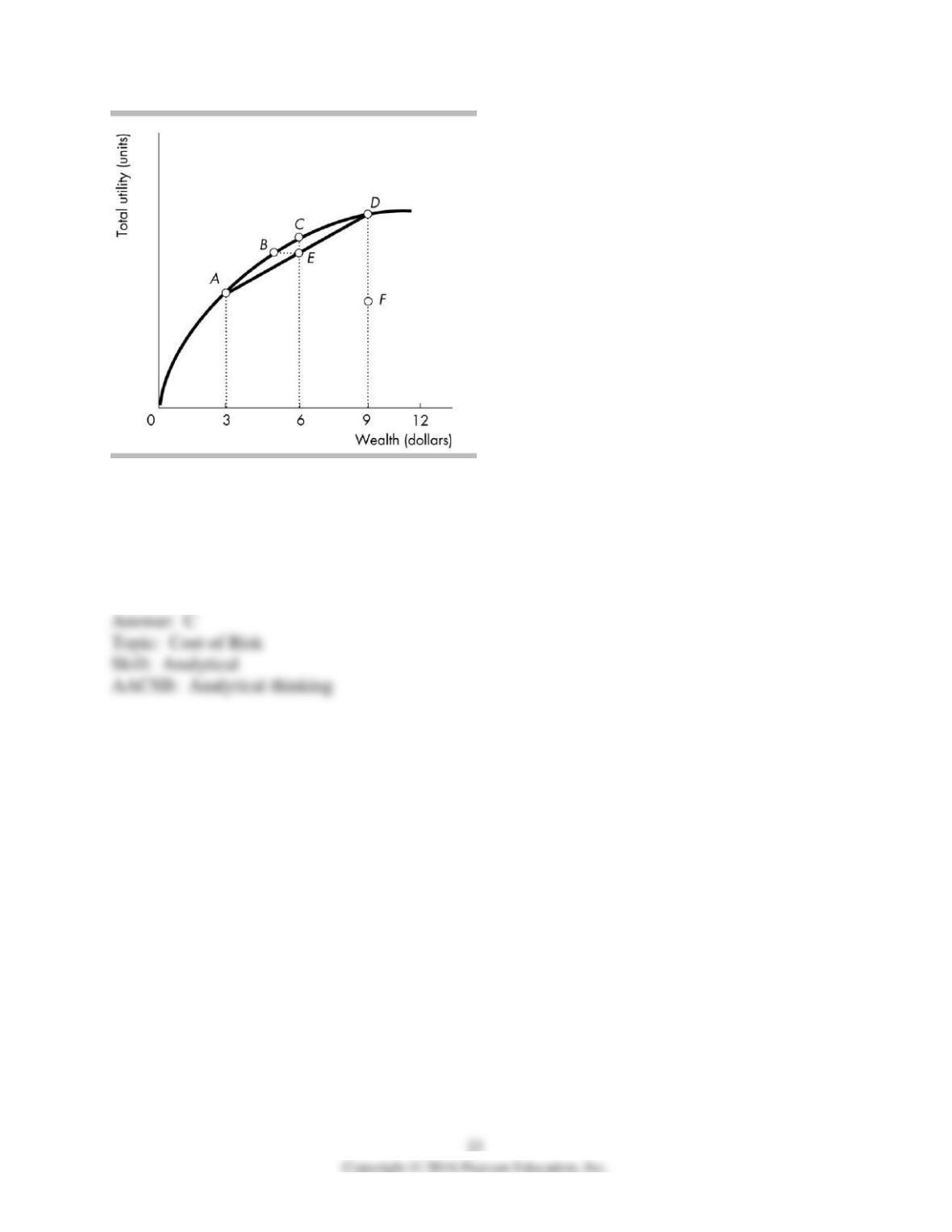
65) In the figure above, Lourdita faces a 0.5 probability of receiving $3,000 and a 0.5 probability
of receiving $9,000. Her cost of bearing this risk is the distance from
A) A to F.
B) A to D.
C) B to E.
D) C to E.
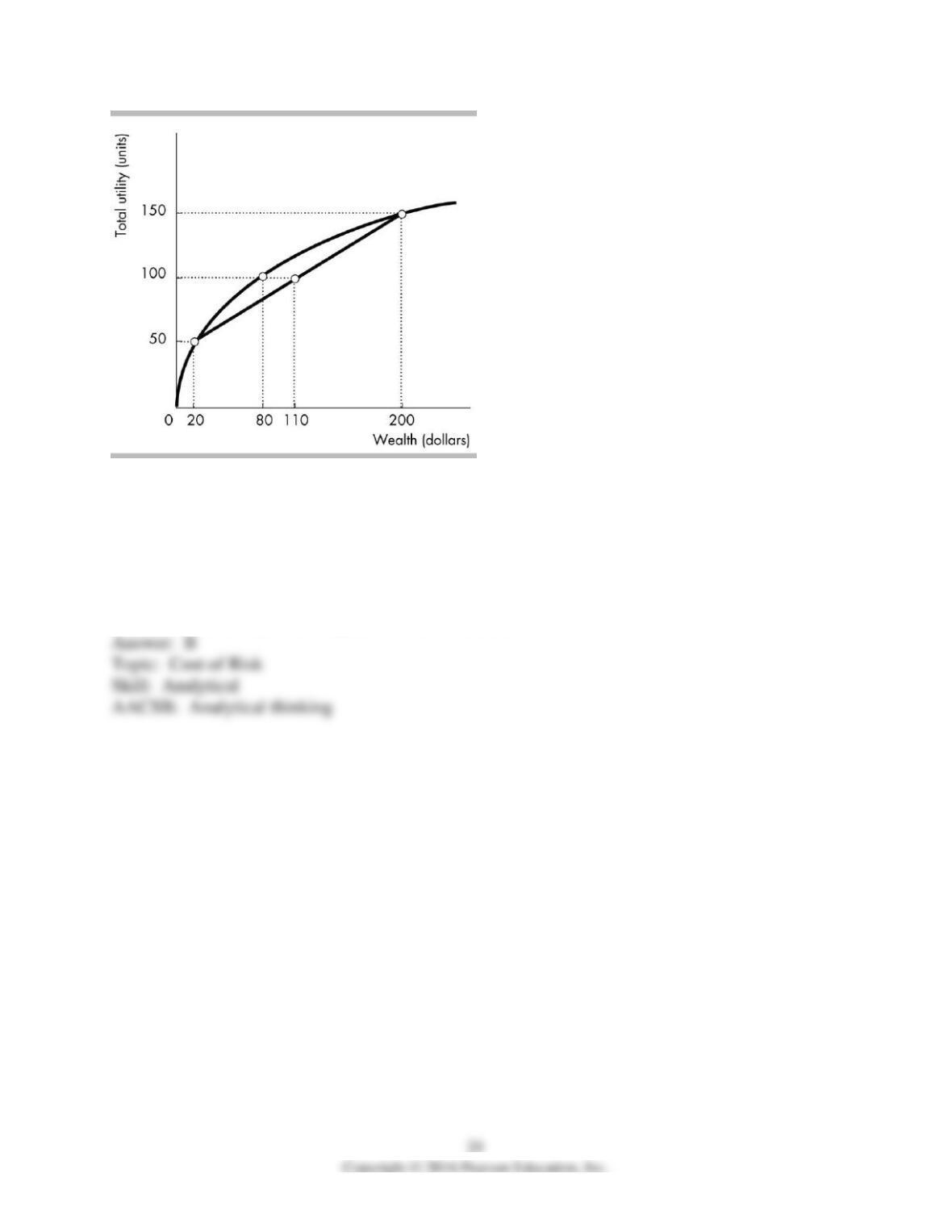
66) The above figure shows how an individual evaluates a bet in which he or she has a 0.5
probability of receiving $20 and a 0.5 probability of receiving $200. The individual would be
indifferent between
A) $110 with certainty or the expected value of the bet.
B) $80 with certainty or the expected value of the bet.
C) $200 with certainty or the expected value of the bet.
D) $20 with certainty or the expected value of the bet.
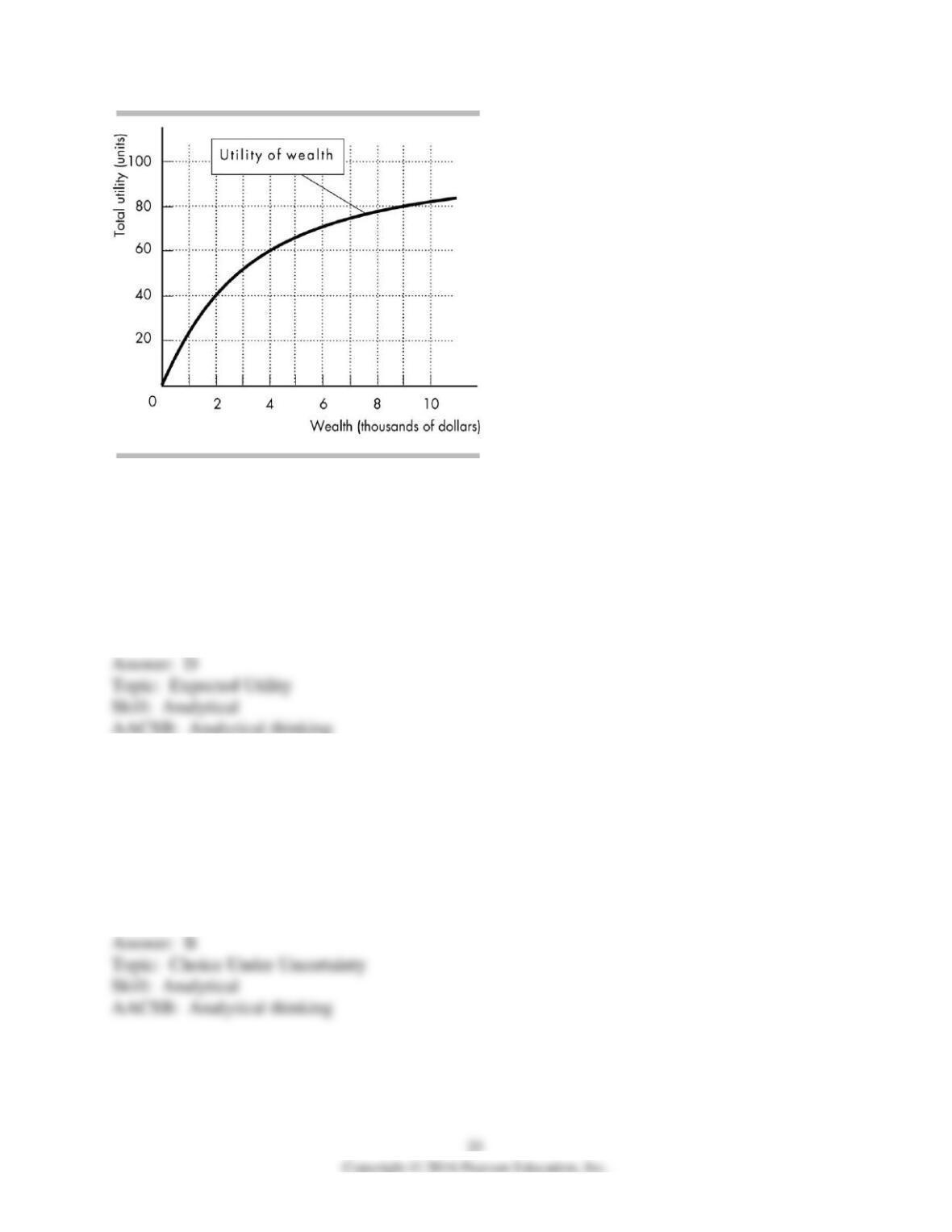
67) Adriana wants to try working as an independent contractor this summer. She has a 50 percent
chance that she will make $9,000 and 50 percent chance that she will make nothing. Her utility
of wealth curve is shown in the figure above. What’s Adriana’s expected utility from taking this
job?
A) 45
B) $4,500
C) $2,000
D) 40
68) Adriana wants to try working as an independent contractor this summer. She has a 50 percent
chance that she will make $9,000 and 50 percent chance that she will make nothing. Her utility
of wealth curve is shown in the figure above. What minimum fixed salary should another
employer offer Adriana to persuade her to work for his firm?
A) $1,001
B) $2,001
C) $3,001
D) $4,501
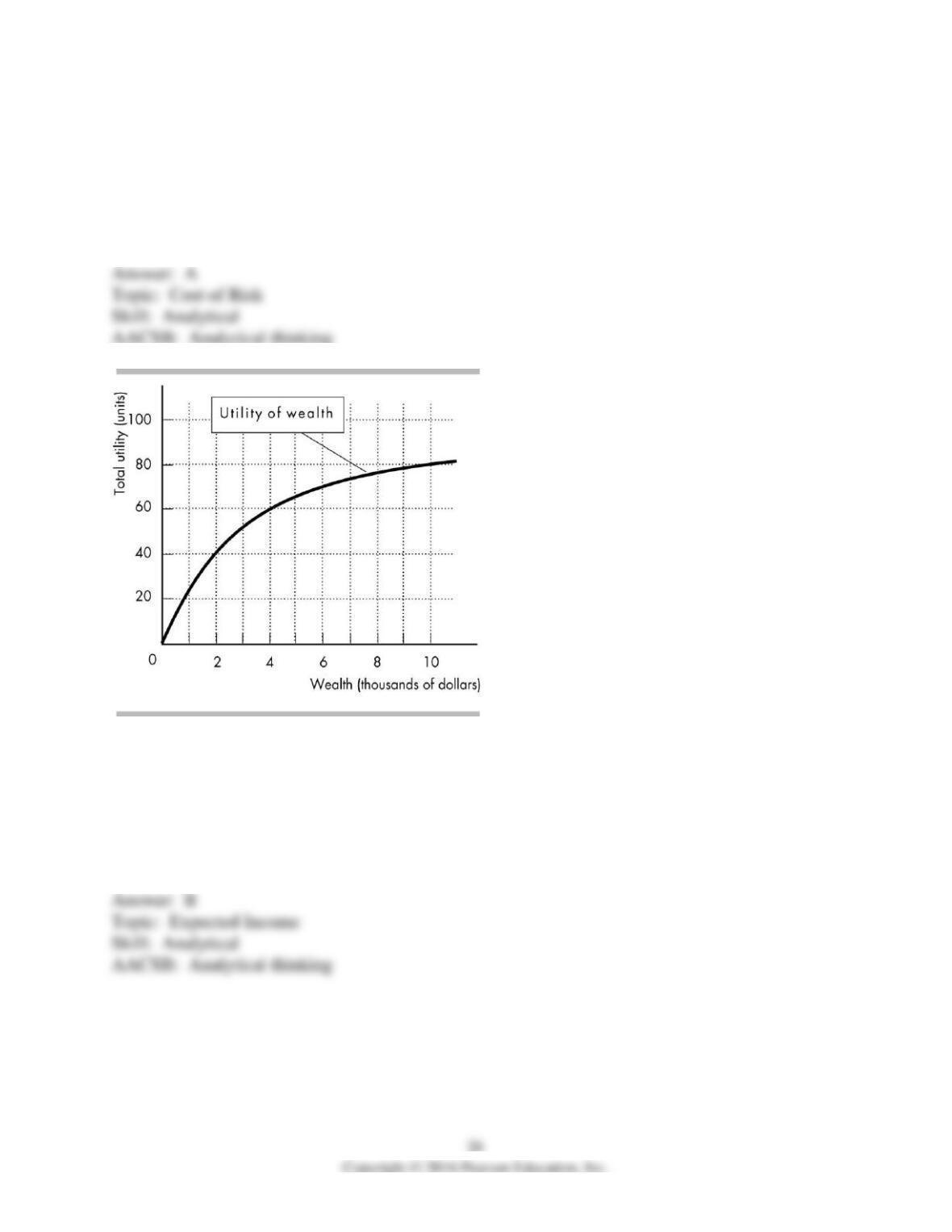
69) Adriana wants to try working as an independent contractor this summer. She has a 50 percent
chance that she will make $9,000 and 50 percent chance that she will make nothing. Her utility
of wealth curve is shown in the figure above. What’s Adriana’s cost of risk?
A) $2,500
B) $2,000
C) zero
D) $40
70) Bobby is offered a job as a salesperson in which there is a 50 percent chance that he will
make $2,000 and a 50 percent chance that he will make $10,000. Bobby’s utility of wealth curve
is shown in the figure above. What is Bobby’s expected income from taking this job?
A) $4,000
B) $6,000
C) $2,000
D) $10,000
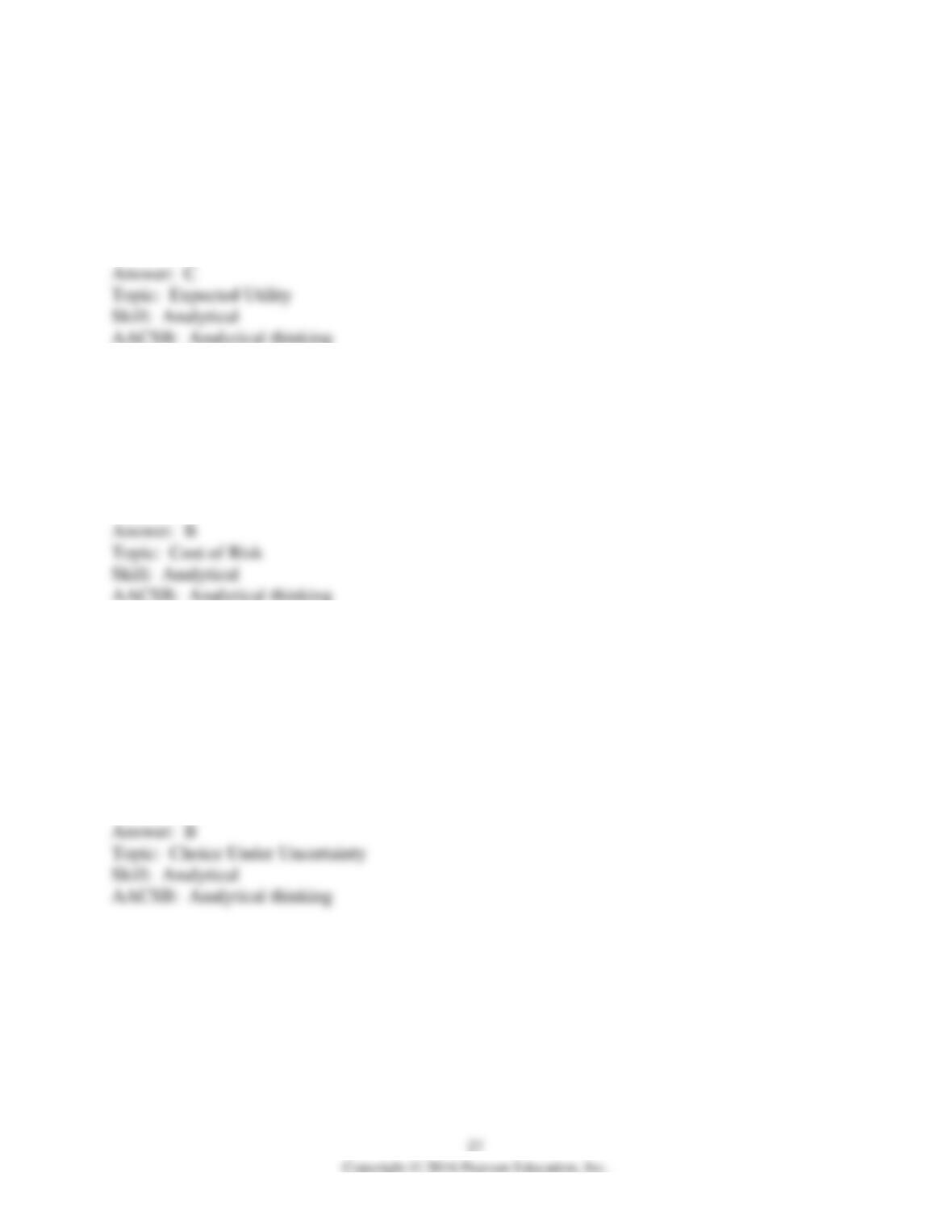
71) Bobby is offered a job as a salesperson in which there is a 50 percent chance that he will
make $2,000 and a 50 percent chance that he will make $10,000. Bobby’s utility of wealth curve
is shown in the figure above. What is Bobby’s expected utility from taking this job?
A) 40
B) 50
C) 60
D) 70
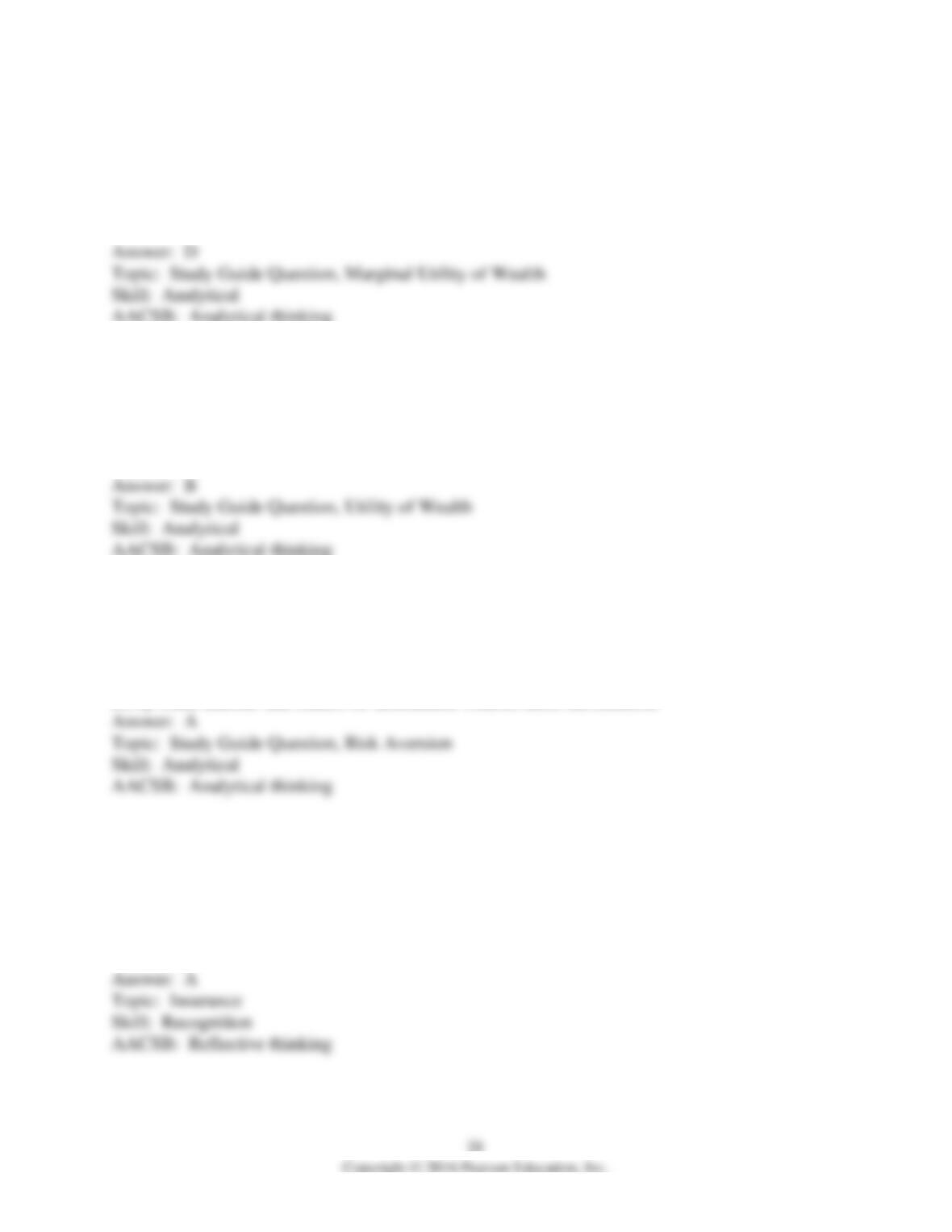
72) Bobby is offered a job as a salesperson in which there is a 50 percent chance that he will
make $2,000 and a 50 percent chance that he will make $10,000. Bobby’s utility of wealth curve
is shown in the figure above. What is Bobby’s cost of risk?
A) $1,000
B) $2,000
C) $3,000
D) $4,000
73) Bobby is offered two fulltime jobs. In the first job, as a salesperson, he has a 50 percent
chance to make $2,000 a month and a 50 percent chance to make $10,000 a month. The second
job, as a construction worker, pays $4,500 a month with certainty. Bobby’s utility of wealth
curve is shown in the figure above. Bobby will take the ________ job because his expected
________ from this job is greater.
A) first; utility
B) second; utility
C) second; income
D) first; income
74) Erika’s utility with $3,000 of wealth is 6,000 and her utility with $3,001 of wealth is 6,005.
Her marginal utility from gaining the additional $1 of wealth is ________.
A) 6,005
B) 3,001
C) 6,000
D) 5
75) If Al is risk averse, as his wealth increases, his total utility of wealth ________ and his
marginal utility of wealth ________.
A) increases; increases
B) increases; decreases
C) decreases; increases
D) decreases; decreases
76) Soran is risk averse. If her wealth rises by $100, her total utility increases by 300. If her
wealth increases, her total utility will decrease
A) by more than 300.
B) by less than 300.
C) by 300.
D) by some amount that cannot be determined without more information.
2 Buying and Selling Risk
1) Buying insurance is similar to
A) selling risk.
B) irrationally avoiding life’s risks.
C) being a free rider.
D) buying risk.
2) Insurance can be profitable when it
A) eliminates risks.
B) decreases risks.
C) pools risks.
D) changes the individual’s marginal utility of wealth.
3) Insurance works because
A) all policyholders pay in according to risks and all then receive a pay out in return.
B) all policyholders pay in according to risks and then receive a pay out only if they incur a loss.
C) all policyholders pay in according to risks and nobody receives any pay out.
D) only high risk policyholders pay in while everyone is entitled to a pay out.
4) You overhear the following in the hallway, “Everyone eventually dies, so how can a life
insurance company make a profit? Isn’t it a losing battle? You will always have to pay the death
benefit to your clients!” You know that life insurance companies can be profitable. This is
because
A) the premiums you pay on a life insurance policy are always more than any death benefit, so
the insurance company always comes out ahead.
B) older people with a greater probability of dying during the term of a policy are denied any
death benefits.
C) the insurance company collects more than enough in premiums today to cover expected
benefits payable today.
D) life insurance companies are notorious for cheating clients with “fine print” policy clauses.
5) Insurance is possible and can be profitable because of
A) private information.
B) adverse selection.
C) moral hazard.
D) consumers are risk aversion.
6) Jon is risk averse. When he buys insurance against all risks, then
A) he knows his wealth with certainty.
B) his utility exceeds his expected utility.
C) his wealth exceeds his expected wealth.
D) all of the above.
7) Ashwini is thinking of buying travel insurance (which pays her if she needs to cancel her trip)
for her trip to Cancun over spring break. There is a 5 percent chance that she will need to cancel
her trip. Without insurance she would lose the full $2,000 price of the trip; with insurance she
would get a full refund of $2,000. The premium for this insurance is $105. Which of the
following is CORRECT?
I. The expected value of Ashwini’s loss is $100.
II. If Ashwini is risk averse she is willing to buy the insurance only if its price is less than $100.
A) I only
B) II only
C) I and II
D) neither I nor II
8) Many residents of the city of Adelphia drive without automobile insurance. Assuming that
Adelphia is just like any other city and these are risk averse individuals, which of the following
is most likely TRUE?
A) Economic models do not work.
B) These people maximize wealth.
C) The price of automobile insurance exceeds their maximum value of insurance.
D) There are no automobile accidents or thefts in the city of Adelphia.
9) Dane has a car valued at $20,000 that gives him a utility of 80. There is a 5 percent chance
that he will have an accident that will make his car worthless, in which case his utility will be
zero. His utility from a wealth of $15,000 is 76. The maximum amount Dane will be willing to
pay for insurance is
A) $1,000.
B) $3,000.
C) $5,000.
D) $15,000.
10) Dan has a car valued at $10,000 that gives him a utility of 50 units. There is a 10 percent
chance that he will have an accident that will make his car worthless, in which case his utility
will be zero. His utility from a wealth of $7,000 is 45 units. The maximum amount Dan will be
willing to pay for car insurance is
A) $1,000.
B) $3,000.
C) $7,000.
D) zero.
Wealth
(dollars)
Total
utility
0
0
20,000
200
40,000
245
60,000
270
80,000
287
100,000
300
11) Beachcomber Beatrice spent her entire wealth of $100,000 to build a beach house on the
Gulf of Mexico. There is a 10 percent chance that the house will be totally destroyed by a
hurricane. Beatrice’s utility of wealth schedule is given in the table above. What is Beatrice’s
expected wealth?
A) $10,000
B) $50,000
C) $90,000
D) $100,000
12) Beachcomber Beatrice spent her entire wealth of $100,000 to build a beach house on the
Gulf of Mexico. There is a 10 percent chance that the house will be totally destroyed by a
hurricane. Beatrice’s utility of wealth schedule is given in the table above. What is Beatrice‘s
expected utility of wealth?
A) between 0 and 200
B) 245
C) 270
D) between 287 and 300
13) Beachcomber Beatrice spent her entire wealth of $100,000 to build a beach house on the
Gulf of Mexico. There is a 10 percent chance that the house will be totally destroyed by a
hurricane. Beatrice’s utility of wealth schedule is given in the table above. What is the minimum
amount that the insurance company would require Beatrice to pay for an insurance policy that
pays $100,000 if her beach house is destroyed by a hurricane? (Assume the insurance company
has no other costs.)
A) $10,000
B) $30,000
C) $40,000
D) $60,000
14) Beachcomber Beatrice spent her entire wealth of $100,000 to build a beach house on the
Gulf of Mexico. There is a 10 percent chance that the house will be destroyed by a hurricane.
Beatrice’s utility of wealth schedule is given in the table above. What is the maximum amount
that Beatrice would be willing to pay for an insurance policy that pays $100,000 if her beach
house is destroyed by a hurricane?
A) $10,000
B) $30,000
C) $40,000
D) $60,000
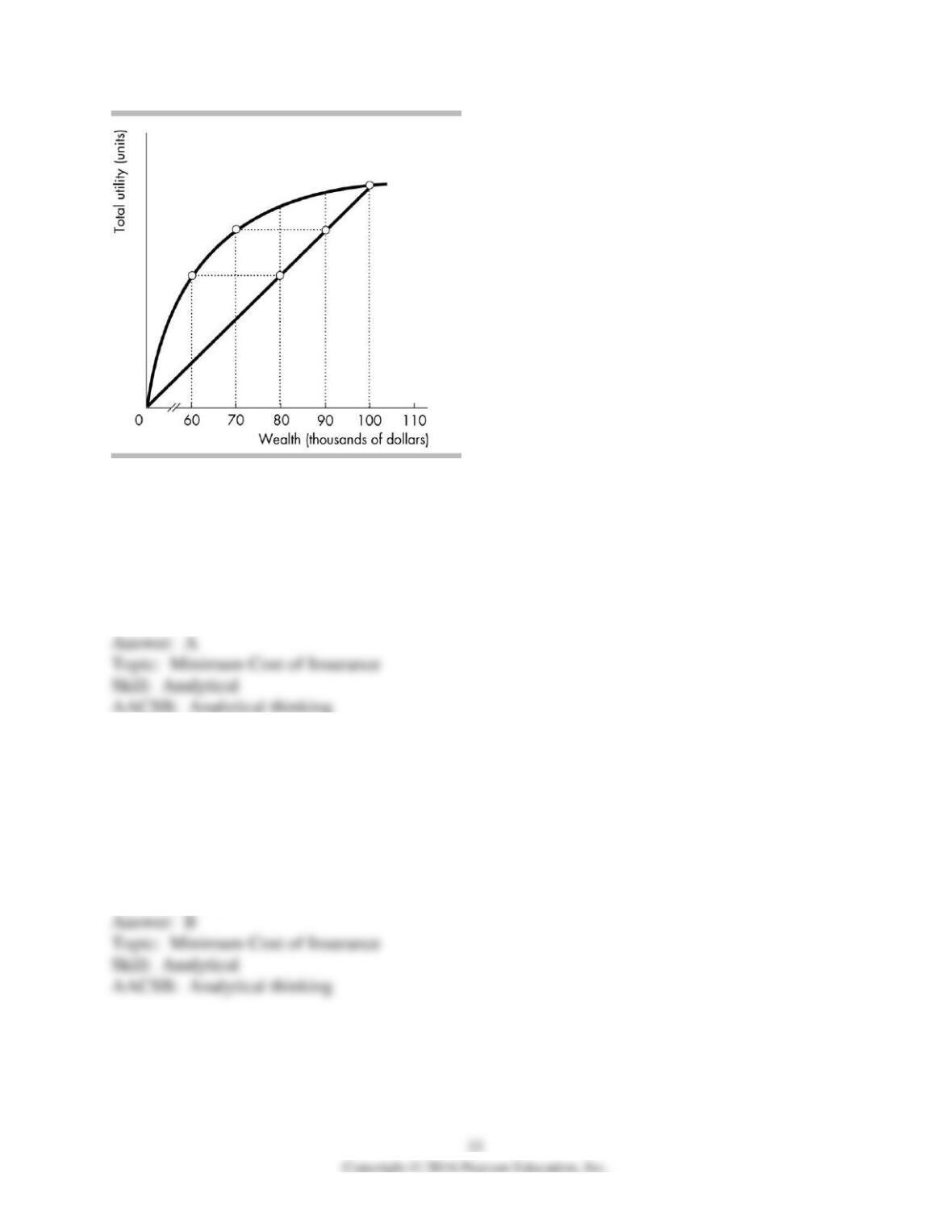
15) Van, whose utility of wealth curve is shown in the above figure, owns a home that is valued
at $100,000. There is a 10 percent chance that the house will be destroyed by hurricane. The
minimum cost of insurance in this case is
A) $10,000.
B) $20,000.
C) $30,000.
D) $40,000.
16) Van, whose utility of wealth curve is shown in the above figure, owns a home that is valued
at $100,000. Initially there is a 10 percent chance that the house will be destroyed by hurricane.
As the risk of destruction due to hurricane rises from 10 percent to 20 percent, the minimum cost
of insurance
A) stays the same.
B) increases by $10,000.
C) increases by $20,000.
D) increases by $30,000.
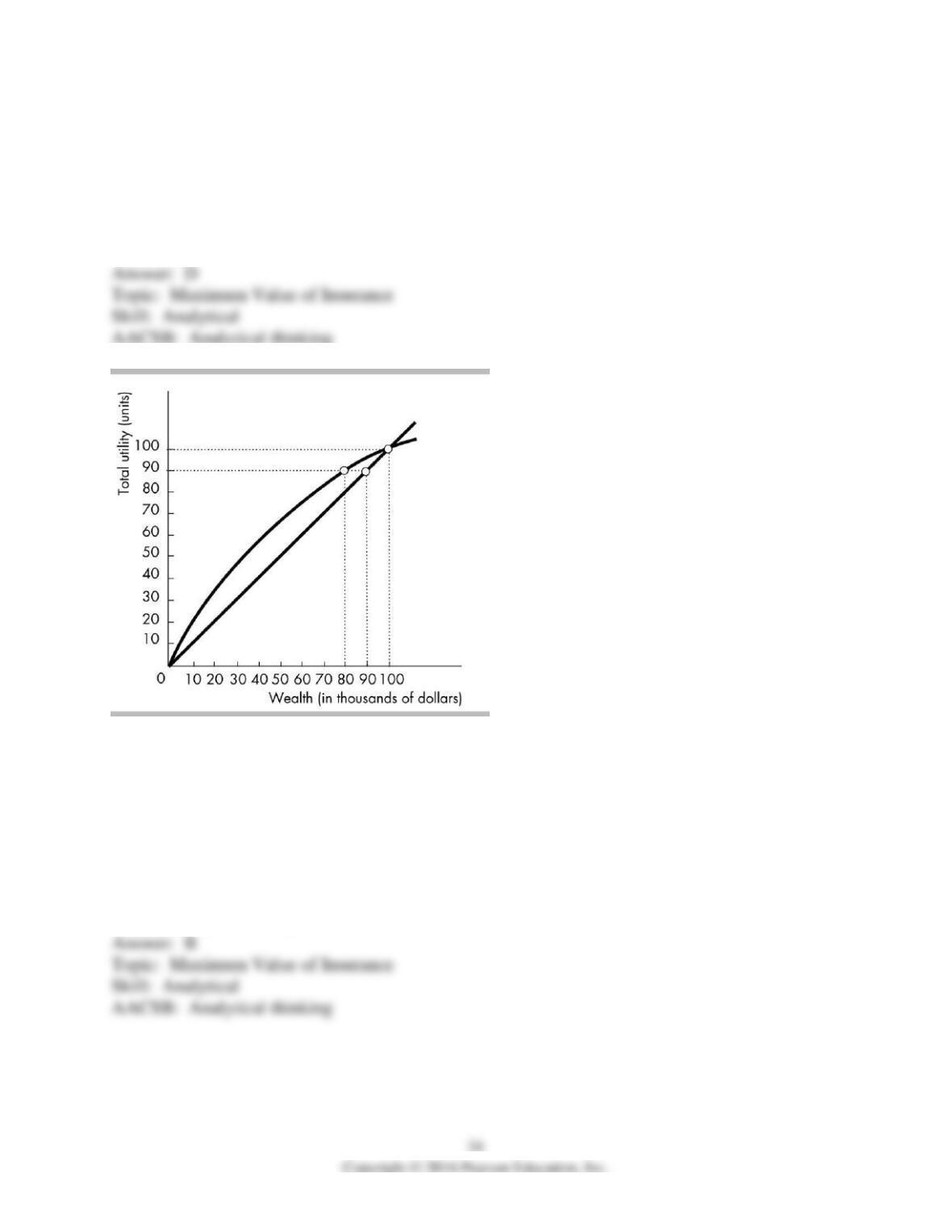
17) Van, whose utility of wealth curve is shown in the above figure, owns a home that is valued
at $100,000. There is a 10 percent chance that the house will be destroyed by hurricane. The
value of insurance to Van is
A) $10,000.
B) $15,000.
C) $20,000.
D) $30,000.
18) Bruce Copperwood’s utility of wealth curve is illustrated in the above figure. Bruce is
presently employed at a salary of $100,000. There is a 10 percent probability that Bruce will be
totally disabled, in which case he will have no wealth. The maximum amount that Bruce is
willing to pay for a disability insurance policy that would pay him $100,000 in the case of total
disability is
A) $10,000.
B) $20,000.
C) $80,000.
D) None of the above answers is correct.
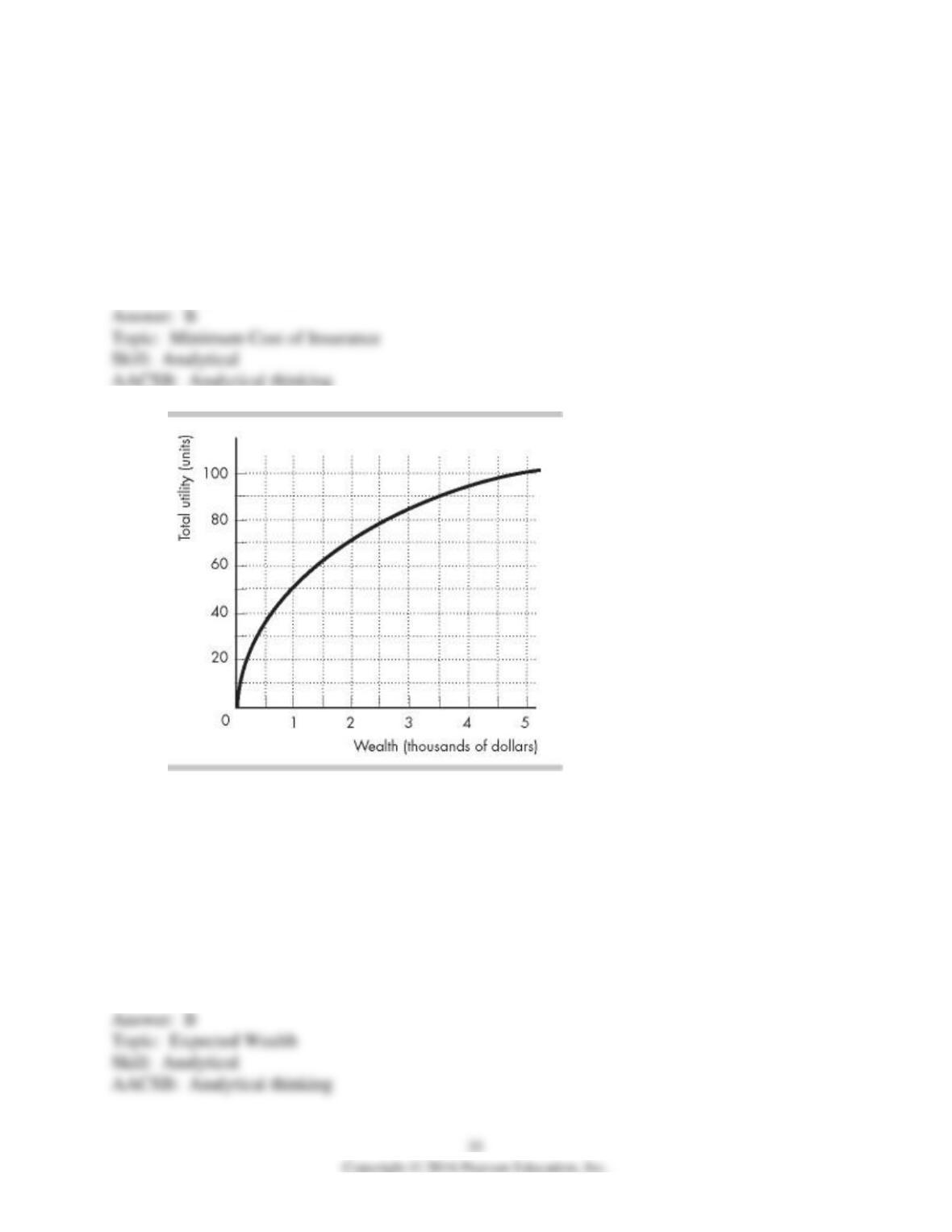
19) Bruce Copperwood’s utility of wealth curve is illustrated in the above figure. Bruce is
presently employed at a salary of $100,000. There is a 10 percent probability that Bruce will be
totally disabled, in which case he will have no wealth. An insurance company (with no operating
expenses) would be willing to offer Bruce a disability insurance policy paying $100,000 in the
case of total disability for a minimum premium of
A) $1,000.
B) $10,000.
C) $20,000.
D) None of the above answers is correct.
20) Steve owns a motorcycle valued at $5,000, and that is his only asset. There is a 5 percent
chance that Steve will have an accident within a year. If he does have an accident, his motorcycle
is worthless. Steve’s utility of wealth curve is shown in the figure above. An insurance company
agrees to pay Steve the full value of his motorcycle in case of an accident if he buys the
company’s insurance policy. The company’s operating expenses are $500 per policy. With no
insurance, Steve’s expected wealth is
A) $4,000.
B) $4,500.
C) $3,500.
D) $5,000.
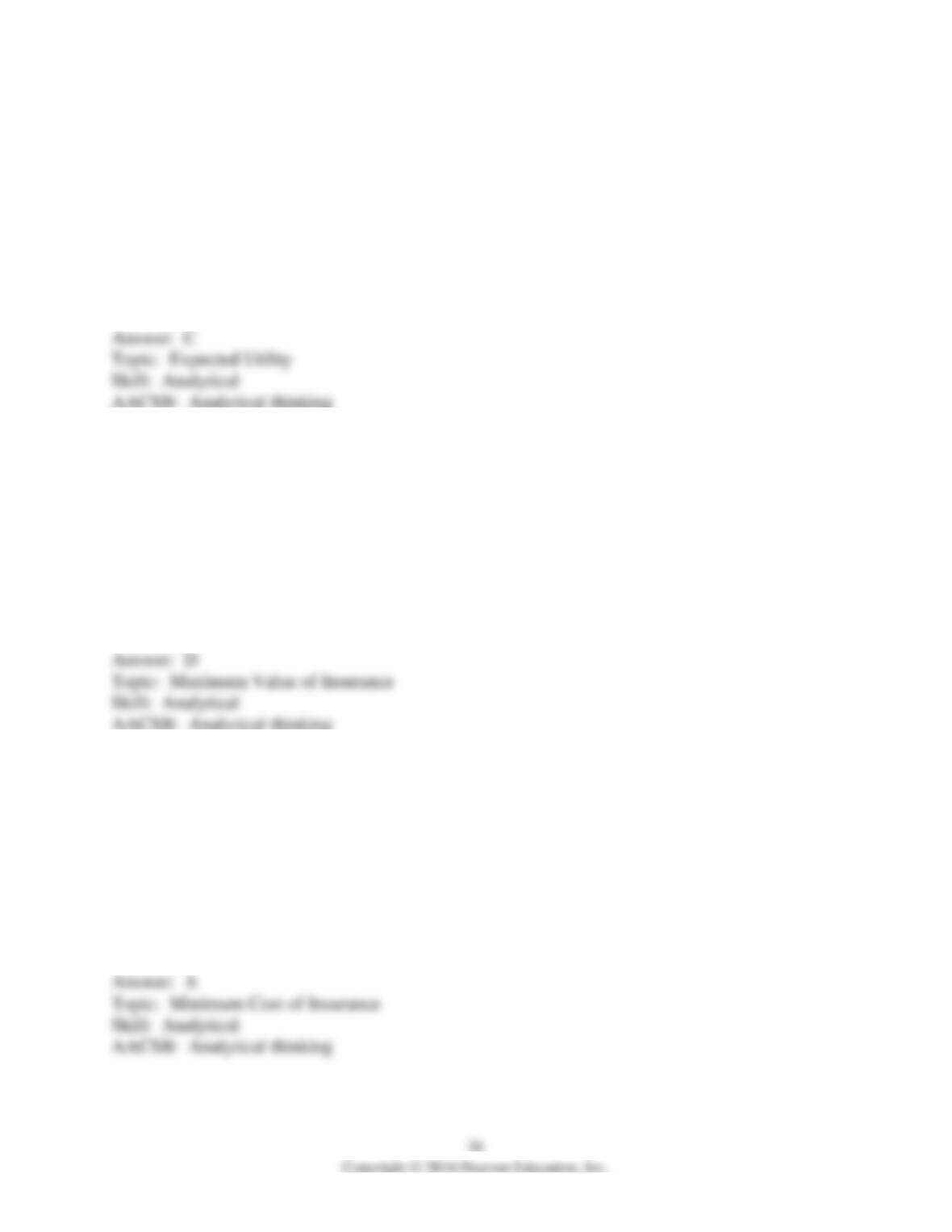
21) Steve owns a motorcycle valued at $5,000, and that is his only asset. There is a 5 percent
chance that Steve will have an accident within a year. If he does have an accident, his motorcycle
is worthless. Steve’s utility of wealth curve is shown in the figure above. An insurance company
agrees to pay Steve the full value of his motorcycle in case of an accident if he buys the
company’s insurance policy. The company’s operating expenses are $500 per policy. With no
insurance, Steve’s expected utility is
A) 97.
B) 84.
C) 90.
D) 100.
22) Steve owns a motorcycle valued at $5,000 and that is his only asset. There is a 5 percent
chance that Steve will have an accident within a year. If he does have an accident, his motorcycle
is worthless. Steve’s utility of wealth curve is shown in the figure above. An insurance company
agrees to pay Steve the full value of his motorcycle in case of an accident if he buys the
company’s insurance policy. The company’s operating expenses are $500 per policy. What is the
maximum insurance premium that Steve is willing to pay?
A) $2,000
B) $500
C) $1,000
D) $1,500
23) Steve owns a motorcycle valued at $5,000 and that is his only asset. There is a 5 percent
chance that Steve will have an accident within a year. If he does have an accident, his motorcycle
is worthless. Steve’s utility of wealth curve is shown in the figure above. An insurance company
agrees to pay Steve the full value of his motorcycle in case of an accident if he buys the
company’s insurance policy. The company’s operating expenses are $500 per policy. What is the
minimum premium that the insurance company will accept?
A) $1,000
B) $2,000
C) $500
D) $1,500
24) Steve owns a motorcycle valued at $5,000 and that is his only asset. There is a 5 percent
chance that Steve will have an accident within a year. If he does have an accident, his motorcycle
is worthless. Steve’s utility of wealth curve is shown in the figure above. An insurance company
agrees to pay Steve the full value of his motorcycle in case of an accident if he buys the
company’s insurance policy. The company’s operating expenses are $500 per policy. Both Steve
and the insurance company will gain if the insurance premium is
A) $900.
B) $1,200.
C) $1,600.
D) $700.
25) Steve owns a motorcycle valued at $5,000 and that is his only asset. There is a 5 percent
chance that Steve will have an accident within a year. If he does have an accident, his motorcycle
is worthless. Steve’s utility of wealth curve is shown in the figure above. An insurance company
agrees to pay Steve the full value of his motorcycle in case of an accident if he buys the
company’s insurance policy. The company’s operating expenses are $500 per policy. If Steve
buys the insurance for $1,000, his expected wealth will be ________, and his expected utility
will be ________ than with no insurance.
A) greater; greater
B) greater; less
C) less; greater
D) less; less
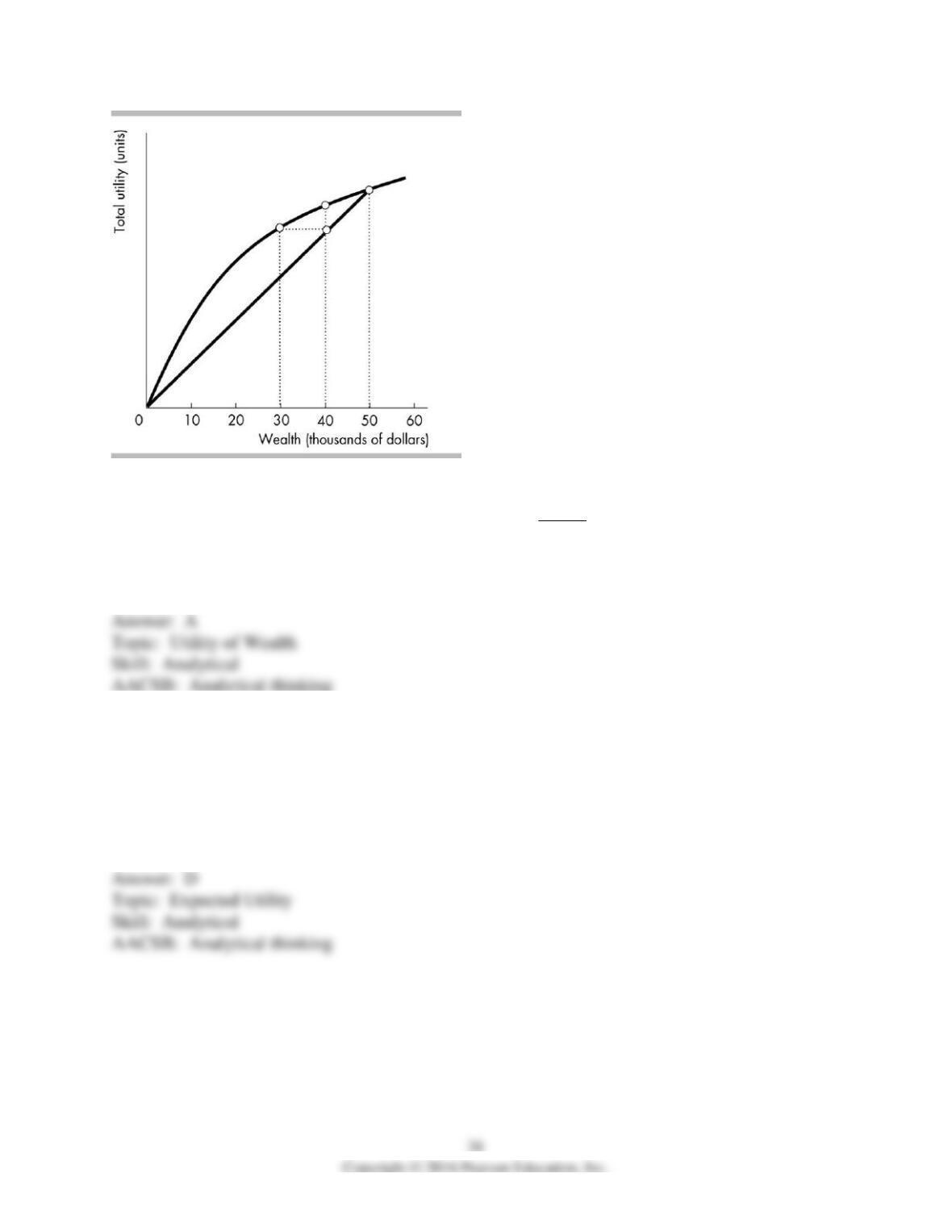
26) The above figure shows the utility of wealth curve for a homeowner whose only possession
is a $50,000 house. Which of the following statements is TRUE?
A) This person has diminishing marginal utility of wealth.
B) This person is not risk averse.
C) Risky situations cause this person no loss of utility.
D) None of the above are correct.
27) The above figure shows the utility of wealth curve for a homeowner whose only possession
is a $50,000 house. If there is a 20 percent chance that the home could be entirely destroyed,
what is the person’s expected wealth?
A) $10,000
B) $20,000
C) $30,000
D) $40,000
28) The above figure shows the utility of wealth curve for a homeowner whose only possession
is a $50,000 house. If there is a 20 percent chance that the home could be entirely destroyed,
what is the person’s cost of risk?
A) $10,000
B) $20,000
C) $30,000
D) $40,000
29) The above figure shows the utility of wealth curve for a homeowner whose only possession
is a $50,000 house. If there is a 20 percent chance that the home could be entirely destroyed, the
highest price for insurance this person would pay is
A) $0.
B) $5,000.
C) $10,000.
D) $20,000.
30) The above figure shows the utility of wealth curve for a homeowner whose only possession
is a $50,000 house. If there is a 20 percent chance that the home could be completely destroyed,
would this homeowner buy insurance?
A) No, because the homeowner is not risk averse.
B) Yes, at any price because the homeowner is risk averse.
C) Yes, but only if it costs less than $10,000.
D) Yes, but only if it costs less than $20,000.
31) The above figure shows the utility of wealth curve for a homeowner whose only possession
is a $50,000 house. If there is a 20 percent chance that the home could be entirely destroyed,
would this person buy a $20,000 insurance policy to replace the house if destroyed?
A) No, it is too expensive.
B) No, he is not risk averse.
C) Yes, the homeowner would pay even more.
D) Yes, this is the most the homeowner would pay.
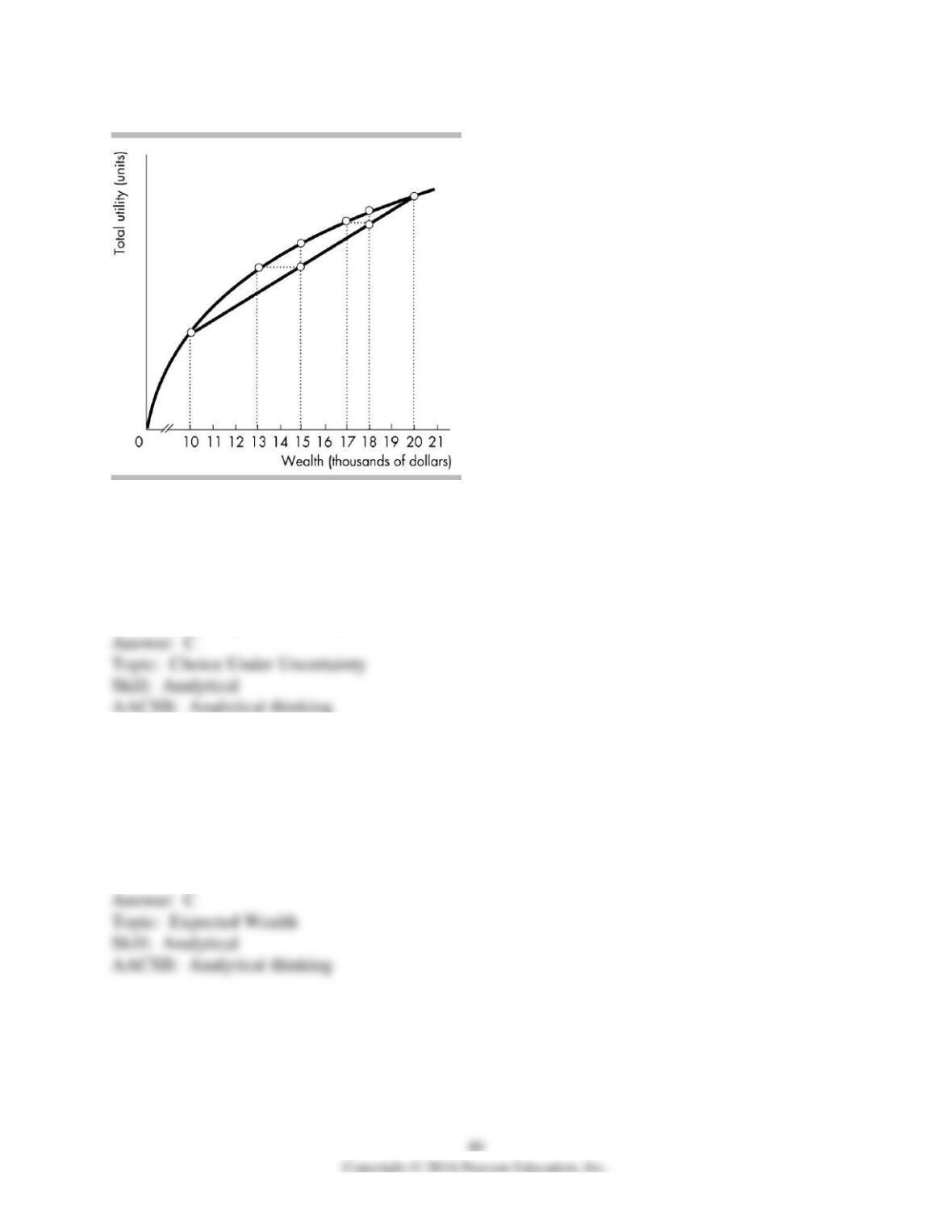
32) John’s utility of wealth curve is shown in the above figure. He currently has wealth of
$20,000. If the state lottery offers a 1 in 10,000 chance of winning $10,000, John will
A) pay whatever price it takes to play.
B) pay $1 to play this game.
C) pay less than $1 to play this game.
D) not be willing to play this game at any price.
33) John’s utility of wealth curve is shown in the above figure. He currently has total wealth of
$20,000. If there is a 50 percent chance that his $10,000 car will be stolen, then his expected
wealth equals
A) $0.
B) $10,000.
C) $15,000.
D) $20,000.